
Introduction
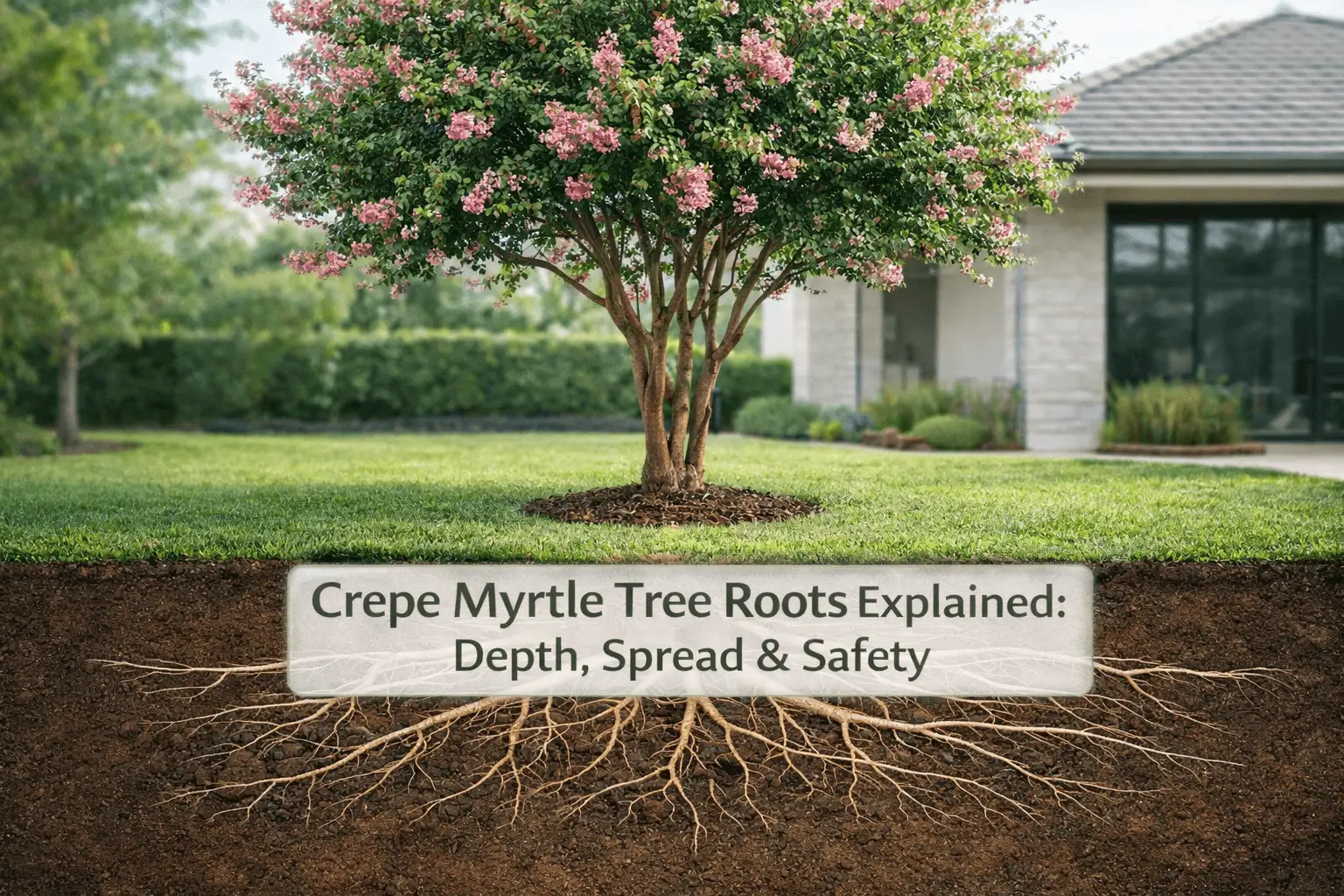
Crepe myrtle tree roots are a common concern for homeowners planning to plant this popular ornamental tree. Many worry about foundation damage, underground pipes, invasiveness, or planting too close to a house. Questions such as “do crepe myrtles have invasive roots” often arise before landscaping decisions are made. Understanding crepe myrtle roots and how the crepe myrtle root system actually behaves is essential for safe planting. This guide clearly explains root depth, spread, invasiveness, and potential risks, along with practical planting tips to prevent structural problems and ensure healthy growth.
Understanding the Crepe Myrtle Root System
What Type of Root System Do Crepe Myrtles Have?
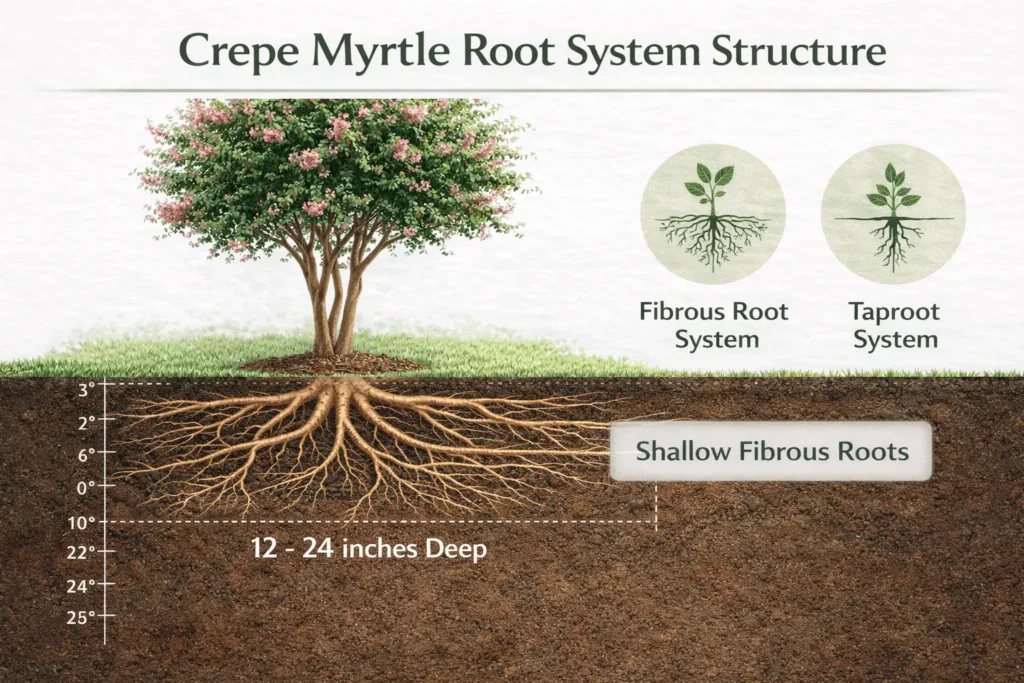
Crepe myrtles have a fibrous root system rather than a deep taproot system.
- Fibrous roots spread outward in multiple directions near the soil surface.
- Taproot systems grow one dominant vertical root deep into the ground.
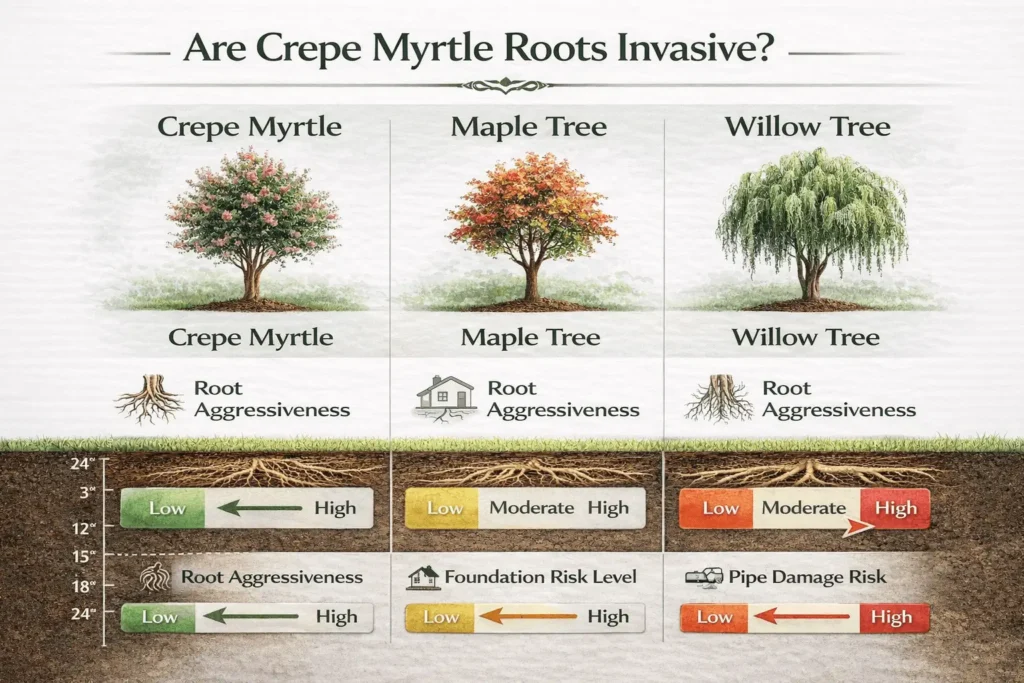
The crepe myrtle root system is shallow and spreading, designed for stability and surface nutrient absorption. Unlike aggressive trees such as silver maple or willow, the crepe myrtle roots system does not typically produce large, forceful roots capable of lifting heavy structures.
Crepe myrtles belong to the genus Lagerstroemia, a group of ornamental trees known for their adaptability and moderate root behavior, and you can explore more about their botanical characteristics in this detailed crepe myrtle plant overview.
This distinction is important. Aggressive tree roots expand rapidly and exert pressure on foundations and pipes. Crepe myrtle roots are comparatively moderate in growth and structure.
While crepe myrtles develop shallow, fibrous roots, other ornamental trees behave differently—for example, the teddy bear magnolia root system tends to grow more structured and compact, making it useful for comparison when planning landscape placement.
Crepe Myrtle Root System Diagram Explained
If you examine a crepe myrtle root system diagram, you would see:
- A network of thin, fibrous roots spreading horizontally
- Most roots concentrated in the top 12–24 inches of soil
- Lateral expansion extending beyond the canopy line
Roots spread outward more than they grow downward. A crepe myrtle root system diagram helps visualize that the majority of root mass remains shallow, making them less likely to interfere with deep foundations.
The horizontal spread supports nutrient uptake and moisture absorption while maintaining structural balance.
Comparing different plant root structures can help clarify growth patterns, especially when looking at systems like the firestick plant root system, where root spread and stability behave differently from traditional ornamental trees.
How Deep Do Crepe Myrtle Roots Go?
A common concern is: how deep do crepe myrtle roots go?
Crepe myrtle roots typically grow 12 to 24 inches deep in most soil conditions. In loose, well-draining soil, some roots may extend slightly deeper, but they do not develop deep penetrating taproots.
Instead of growing downward aggressively, they expand outward in shallow layers. This shallow spreading behavior reduces the risk of direct structural damage compared to trees with invasive root systems.
Are Crepe Myrtle Roots Invasive?
Are Crepe Myrtle Roots Invasive or Aggressive?
Are crepe myrtle roots invasive?
In most cases, no.
Crepe myrtles are not classified as trees with invasive root systems. When homeowners ask, “do crepe myrtles have invasive roots,” the answer depends on context. Compared to maple, willow, or poplar trees, crepe myrtle roots are far less aggressive.
They seek moisture like all trees but do not aggressively penetrate concrete or intact plumbing systems.
Crepe Myrtle Roots Near House — Is It Safe?
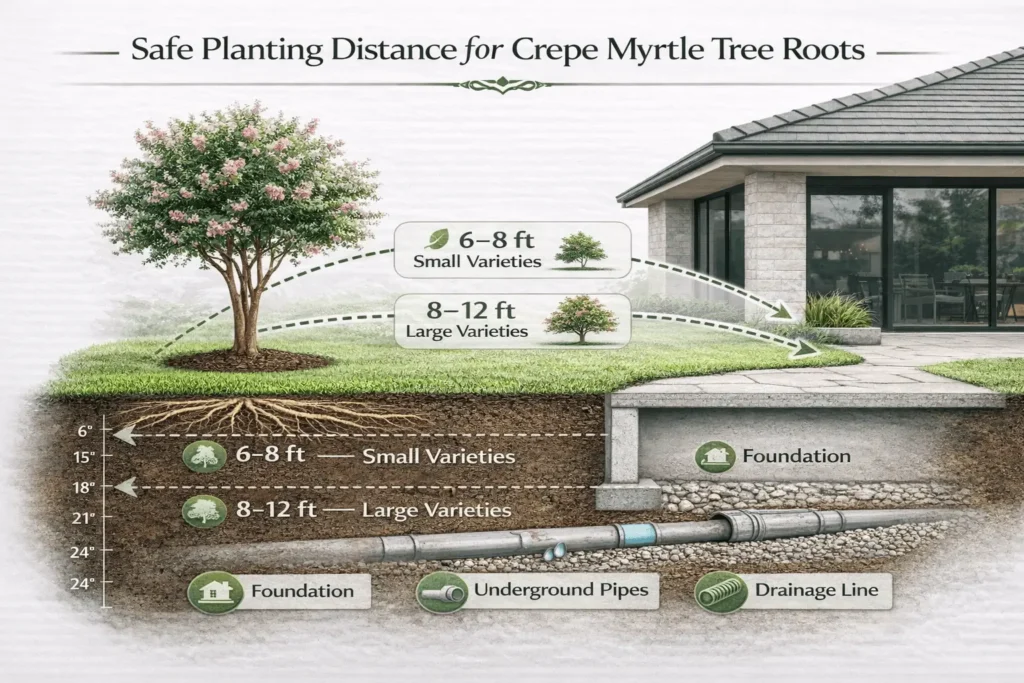
Planting crepe myrtle roots near house structures can be safe if proper spacing is maintained.
Recommended distance:
- Small varieties: 6–8 feet from foundation
- Larger varieties: 8–12 feet from foundation
Proper spacing reduces the chance of moisture imbalance or soil shifting. Crepe myrtle roots near house walls are generally not problematic when soil is stable and drainage is managed correctly.
Can Crepe Myrtle Roots Cause Damage?
Can Crepe Myrtle Roots Damage Foundation?
Can crepe myrtle roots damage foundation structures?
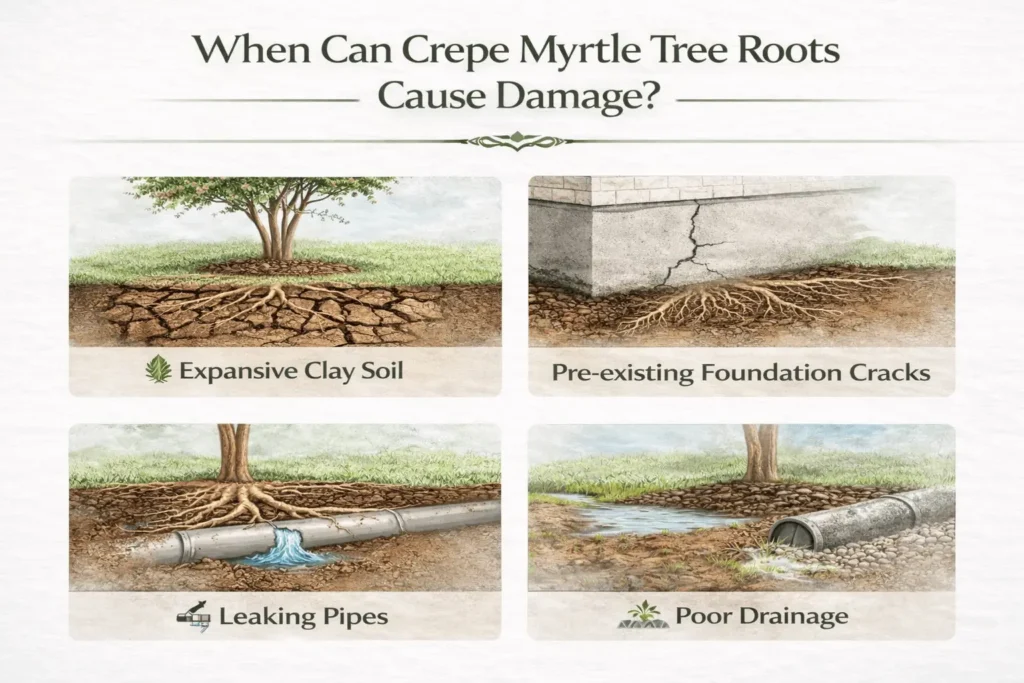
Under normal conditions, the risk is low. However, damage risk increases if:
- Soil is highly expansive clay
- Foundation already has cracks
- Tree is planted extremely close (within 3–4 feet)
In clay soil, root moisture absorption may contribute to soil shrinkage. This can indirectly affect foundations. The roots themselves do not typically crack solid concrete.
Can Crepe Myrtle Roots Damage Pipes?
Can crepe myrtle roots damage pipes?
Roots do not break intact pipes. However, they may grow toward leaking pipes because of moisture attraction.
Key distinction:
- Moisture-seeking roots grow toward water sources.
- Destructive roots physically break infrastructure.
Crepe myrtle roots fall into the moisture-seeking category. They exploit existing cracks but do not create them.
Removing or Managing Crepe Myrtle Tree Roots
Crepe Myrtle Tree Roots Removal — When Is It Necessary?
Removal becomes necessary when:
- Tree is diseased
- Roots interfere with construction
- Severe overcrowding occurs
Improper removal can damage nearby structures or encourage regrowth if root fragments remain.
How to Get Rid of Crepe Myrtle Tree Roots Safely
If wondering how to get rid of crepe myrtle tree roots safely:
- Cut the tree trunk close to ground level
- Apply stump treatment if preventing regrowth
- Dig around major lateral roots
- Remove root mass gradually
- Backfill with compacted soil
Professional removal is recommended for large specimens.
Digging Up Crepe Myrtle Roots — What to Expect
Digging up crepe myrtle roots requires moderate physical effort due to the fibrous spread.
Expect:
- Dense shallow roots
- Wide lateral extension
- Possible regrowth if roots remain
Digging up crepe myrtle roots completely may require stump grinding for full removal.
Seasonal and Growth Factors That Affect Root Behavior
Crepe Myrtle in Winter — Do Roots Keep Growing?
During crepe myrtle in winter, above-ground growth stops. Crepe myrtle winter dormancy reduces metabolic activity.
Roots may continue minimal growth in mild climates but largely remain inactive in cold soil. Root expansion significantly slows during dormancy.
How Shade and Growing Conditions Affect Roots
Can crepe myrtles grow in shade? They tolerate partial shade but perform best in full sun.
In shade:
- Root growth may slow
- Flowering reduces
- Nutrient competition increases
In full sun, root systems develop stronger lateral spread and support healthier canopy growth.
Root health is closely linked to moisture balance, and issues like underwatered orchid roots show how improper watering can directly affect root performance across different plant types.
Planting Tips to Avoid Root Problems
To minimize root concerns:
- Plant 6–12 feet from structures
- Prepare well-draining soil
- Avoid compacted clay
- Water consistently but avoid oversaturation
When planting a row of crepe myrtles, maintain adequate spacing to prevent root competition. Overcrowding leads to shallow nutrient competition rather than deep structural risk.
Conclusion — Should You Worry About Crepe Myrtle Tree Roots?
Crepe myrtle tree roots are shallow, fibrous, and generally non-invasive. Their root depth remains moderate, invasiveness is low compared to aggressive species, and damage potential is minimal when properly spaced.
With correct planting distance, soil preparation, and routine maintenance, crepe myrtles can be safely grown near homes. Homeowners should focus on spacing and soil management rather than fearing structural damage.
For a simplified overview and additional resources, you can explore this structured crepe myrtle root guide.
FAQs About Crepe Myrtle Tree Roots
How far do crepe myrtle tree roots spread?
They typically spread as wide as or slightly beyond the canopy, often 2–3 times the trunk diameter in radius.
Are crepe myrtle roots strong enough to crack concrete?
They rarely crack intact concrete. They may exploit existing cracks but are not forceful root systems.
What is the safest distance to plant crepe myrtle near a house?
6–12 feet depending on tree size.
Do crepe myrtles have invasive roots compared to maple trees?
No. Maple trees have far more aggressive root systems.
Can removing crepe myrtle roots cause regrowth?
Yes, if root fragments remain, regrowth is possible.
Does winter affect crepe myrtle root growth?
Yes. Growth slows significantly during dormancy in colder temperatures.

Written by the LeafyHeaven Editorial Team
LeafyHeaven shares practical gardening tips and simple plant care guides to help you grow, nurture, and enjoy your plants with ease. Our goal is to make gardening feel natural, approachable, and rewarding for everyone.