
Introduction to Deciduous vs Evergreen Trees
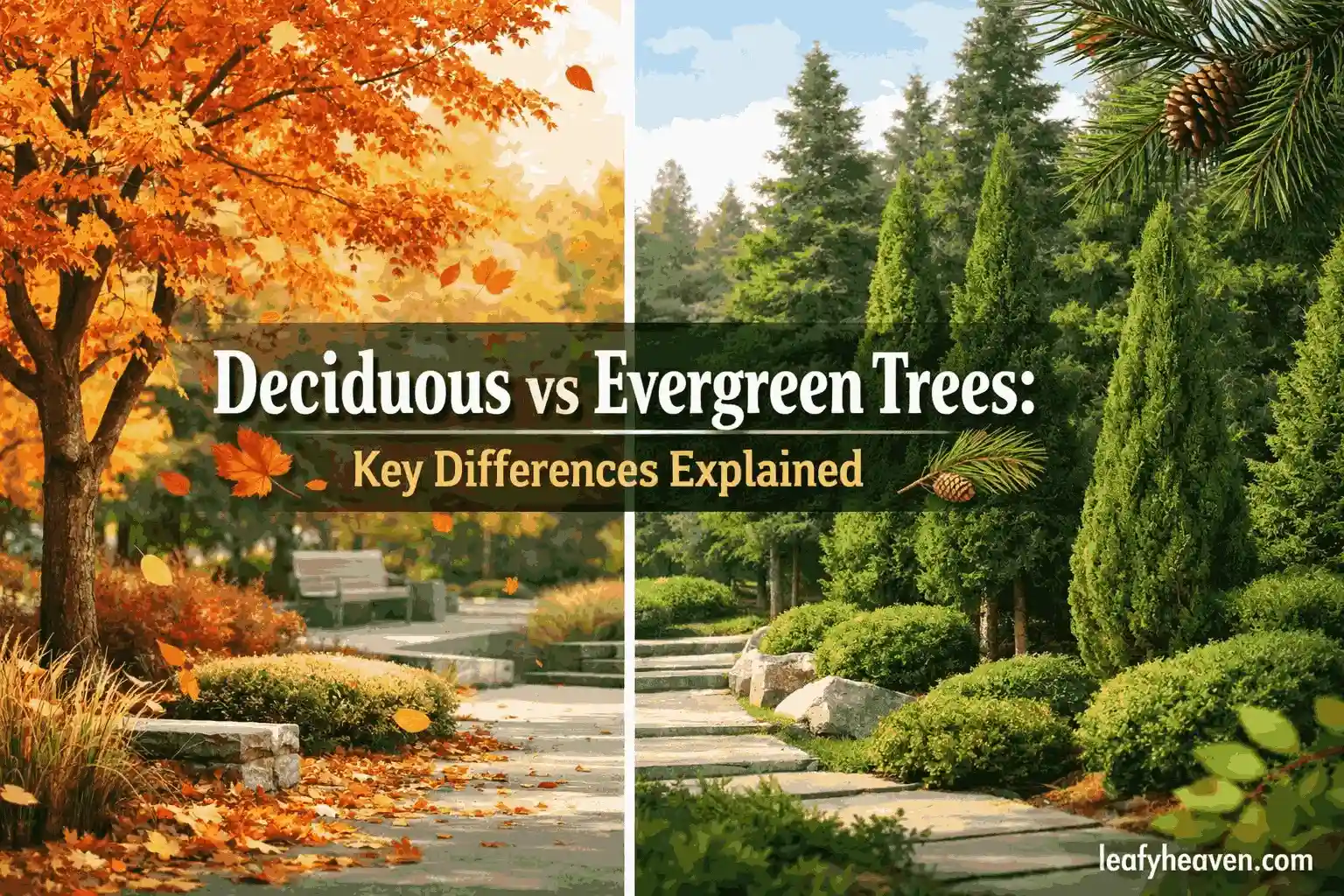
Deciduous vs evergreen trees refers to the two primary tree types based on how they manage their leaves throughout the year. In simple terms, deciduous trees shed their leaves during specific seasons, while evergreen trees retain foliage year-round. This distinction plays a major role in how trees function in different environments and how they are used in landscaping.
Understanding evergreen vs deciduous trees is essential for making informed decisions in gardening and landscape design. These tree types influence shade patterns, seasonal appearance, maintenance requirements, and overall garden structure. Choosing between tree types deciduous and tree types evergreen helps determine whether a space will have seasonal variation or consistent greenery.
In landscaping, the choice between these two tree categories affects sunlight exposure, privacy, and long-term maintenance. Deciduous trees are often selected for seasonal shade and visual change, while evergreen trees are preferred for year-round coverage and structure. This overview of tree types evergreen vs deciduous provides a clear foundation for selecting the right trees based on functional and aesthetic needs.
To better understand how different tree types grow, adapt, and perform in landscapes, exploring a complete gardening and plant care guide can provide essential insights.
What Is a Deciduous Tree?
Deciduous Tree Meaning & Definition
A deciduous tree is a type of tree that loses its leaves during a specific season each year. The definition of deciduous refers to plants that shed foliage as part of their natural life cycle, usually in response to temperature changes or dry conditions.
In simple terms, deciduous meaning is “trees that drop their leaves seasonally.” This process helps the tree conserve water and energy when environmental conditions are not favorable.
Seasonal leaf shedding is a key survival strategy. During autumn or dry periods, leaves fall to reduce water loss and protect the tree. When conditions improve, new leaves grow again, restarting the cycle.
Key Characteristics of Deciduous Trees
Deciduous trees have distinct biological and seasonal traits that separate them from evergreen types.
Main characteristics:
- Leaf drop in autumn: Known as the autumn trees effect, where leaves change color and fall
- Growth cycle: Active growth in spring and summer, followed by dormancy
- Winter dormancy: Trees conserve energy by slowing down metabolic processes
- Broadleaf structure: Most deciduous trees are broadleaf trees with wide, flat leaves
These features allow deciduous trees to adapt efficiently to seasonal climates and environmental changes.
Examples of Deciduous Trees
There are many well-known deciduous examples used in landscaping and natural ecosystems.
Common deciduous tree example:
- Maple
- Oak
- Birch
- Elm
Large deciduous trees:
- Oak trees
- Beech trees
Small deciduous trees:
- Japanese maple
- Dogwood
These deciduous plants are widely used for shade, seasonal color, and ornamental value in gardens and landscapes.
What Is an Evergreen Tree?
Evergreen Tree Meaning
Evergreen trees are trees that retain their leaves throughout the year instead of shedding them in a single season. Unlike deciduous trees, they maintain continuous foliage, which allows them to stay green in all seasons.
In simple terms, evergreen trees are non deciduous trees, meaning they do not follow a seasonal leaf-drop cycle. The difference between evergreen and non deciduous trees lies in leaf retention—evergreen trees replace leaves gradually, while deciduous trees shed them all at once during specific seasons.
Key Characteristics of Evergreen Trees
Evergreen trees have structural and functional traits that make them suitable for consistent landscape coverage.
Main characteristics:
- Year-round foliage: Leaves remain green and functional in all seasons
- Leaf types:
- Needle-like leaves (e.g., pine)
- Broadleaf evergreen types (e.g., magnolia)
- Low maintenance: Minimal leaf drop reduces cleanup requirements
- Consistent structure: Maintain shape and density year-round
These features make evergreen trees reliable for stable and predictable landscape design.
Examples of Evergreen Trees
There are many evergreen tree varieties used in both natural and designed environments.
Common evergreen tree varieties:
- Pine
- Cypress
- Spruce
- Magnolia
Ornamental and decorative types:
- Compact magnolia (evergreen ornamental tree)
- Lilly pilly (used in hedging and design)
These evergreen decorative trees are widely used as feature trees, privacy screens, and structural elements in landscaping due to their consistent appearance and adaptability.
For example, fast-growing evergreen species like the silver wattle tree are widely used for landscaping and environmental benefits.
Deciduous vs Evergreen Trees — Key Differences
Side-by-Side Comparison
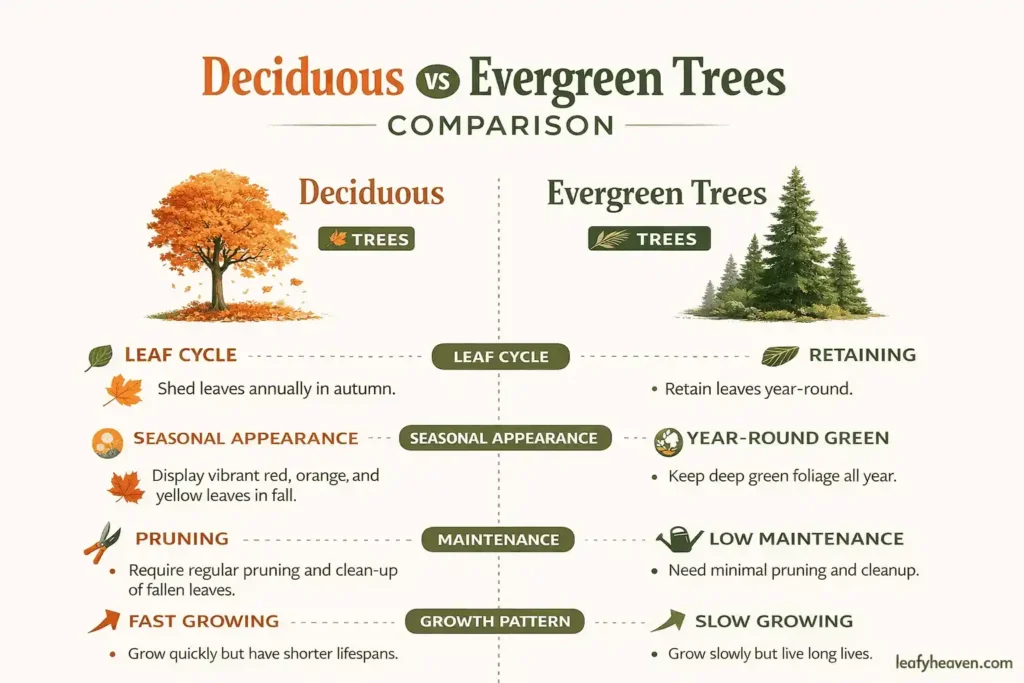
The core differences between deciduous and evergreen trees are based on leaf behavior, seasonal changes, and maintenance needs.
Comparison Table:
| Feature | Deciduous Trees | Evergreen Trees |
| Leaf Cycle | Shed leaves seasonally | Retain leaves year-round |
| Seasonal Appearance | Autumn trees with color change | Consistent green throughout the year |
| Growth Pattern | Active growth + dormancy cycle | Steady growth with no full dormancy |
| Maintenance | Higher due to leaf drop | Lower due to gradual leaf shedding |
Quick summary:
- Deciduous trees provide seasonal variation and adaptive shading
- Evergreen trees offer continuous coverage and stability
Climate Adaptation Differences
Deciduous and evergreen trees adapt differently based on environmental conditions.
Deciduous trees:
- Thrive in cold climates with distinct seasons
- Shed leaves to reduce water loss and survive winter
- Efficient in managing seasonal stress
Evergreen trees:
- Adapt well to warm or mild climates
- Retain leaves to support continuous photosynthesis
- Use water efficiently through specialized leaf structures
Key point:
- Deciduous trees are optimized for seasonal survival
- Evergreen trees are optimized for year-round efficiency
Visual & Landscaping Impact
The visual effect and landscaping role of each tree type differ significantly.
Deciduous trees:
- Known as colourful trees due to seasonal leaf changes
- Create dynamic landscapes with changing visuals
- Often used as feature trees for aesthetic impact
Evergreen trees:
- Provide consistent greenery in all seasons
- Maintain structure and uniform appearance
- Commonly used as shade trees and privacy screens
Quick comparison:
- Visual appeal → Deciduous (seasonal color)
- Structural consistency → Evergreen (year-round greenery)
Deciduous vs Evergreen Trees in Australia
Deciduous Trees in Australia
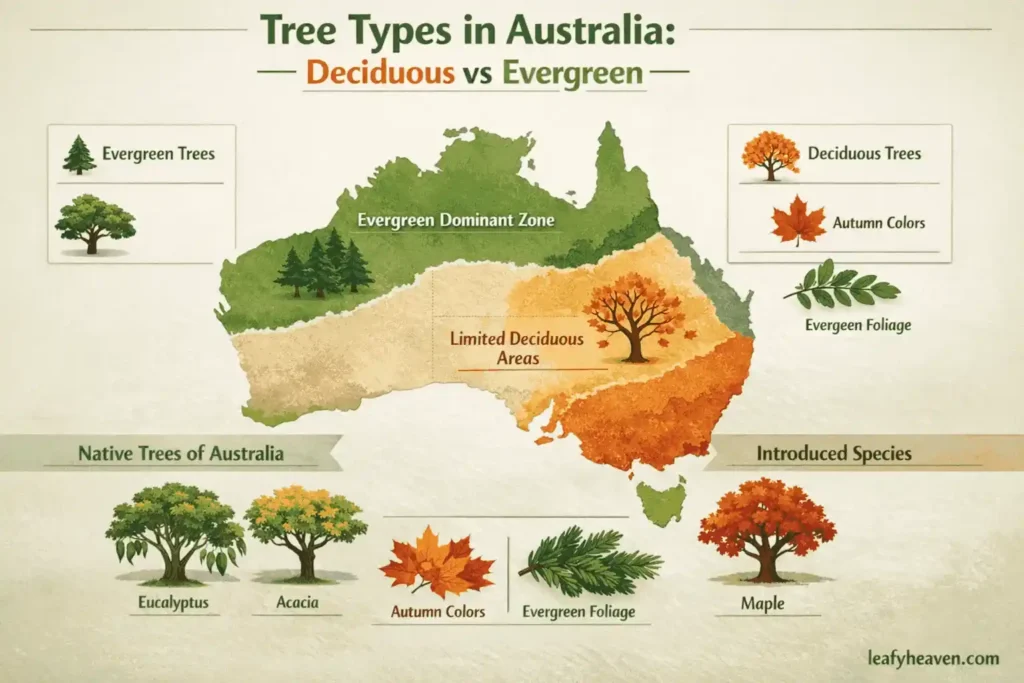
Deciduous trees Australia include both introduced and a small number of native species adapted to local conditions. Unlike colder regions, Australia has limited native deciduous trees, but they still play an important role in seasonal landscapes.
Key points:
- Australian deciduous trees are often introduced species such as maple and elm
- Some native species show semi-deciduous behavior depending on climate
- Popular for seasonal color trees, especially in cooler regions
Autumn trees Australia:
- Deciduous trees create vibrant autumn foliage in southern areas
- Widely used in parks, streetscapes, and ornamental gardens
These trees are ideal for adding seasonal variation and visual interest in Australian landscapes.
Evergreen Trees in Australia
Evergreen trees Australia dominate most natural ecosystems due to the country’s climate. Many Australian evergreen trees are native and well adapted to drought, heat, and variable rainfall.
Key points:
- Large number of native evergreen trees Australia such as eucalyptus and acacia
- Maintain foliage year-round for consistent greenery
- Highly suitable for long-term landscaping and low maintenance
Role in landscaping:
- Provide year-round shade and privacy
- Commonly used in hedges, windbreaks, and structural planting
- Essential for maintaining green landscapes in dry climates
Evergreen trees are the backbone of year-round landscaping in Australia.
Native vs Non-Native Tree Types
Understanding the difference between native and introduced species is important for sustainable planting.
Native trees Australia:
- Naturally adapted to local soil and climate
- Require less water and maintenance
- Support local ecosystems and biodiversity
Introduced species:
- Often include popular deciduous varieties
- Provide seasonal color and diversity
- May require more care and water
Key comparison:
- Trees native to Australia → resilient, low maintenance, eco-friendly
- Introduced trees → aesthetic value and seasonal variation
A balanced native Australian trees list combined with selected non-native species can create functional and visually appealing landscapes.
Fast Growing Deciduous vs Evergreen Trees
Fast Growing Deciduous Trees
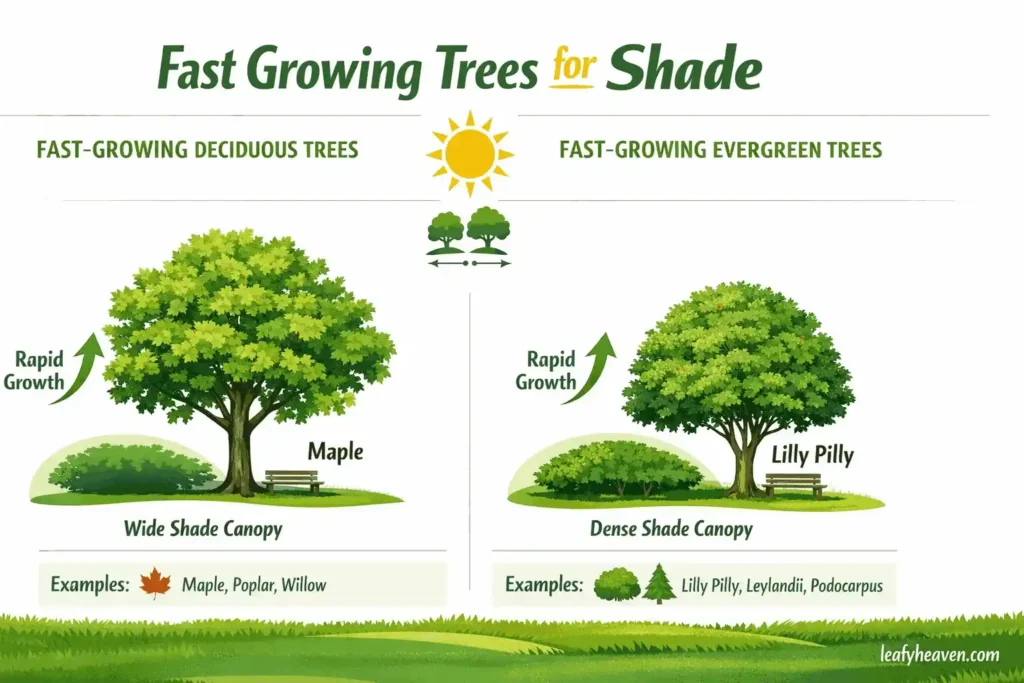
Fast growing deciduous trees Australia are widely used when quick shade and seasonal variation are needed. These trees grow rapidly during the active season and provide effective cooling in warmer months.
Key features:
- Rapid growth rate in suitable climates
- Provide seasonal shade during summer
- Allow sunlight penetration in winter after leaf drop
Common examples:
- Poplar
- Silver maple
- Jacaranda (semi-deciduous in some regions)
These trees are ideal for landscapes where fast shade development and seasonal light balance are important.
Fast Growing Evergreen Trees
Fast growing evergreen trees Australia are suitable for year-round coverage, especially in areas requiring consistent shade or privacy.
Key features:
- Maintain foliage throughout the year
- Provide continuous shade and screening
- Adapt well to Australian climates
Common examples:
- Lilly pilly
- Eucalyptus (selected species)
- Pine varieties
These trees are effective for creating instant privacy barriers and long-term structure in landscaping.
Best Trees for Quick Shade
Choosing trees that grow fast for shade depends on environmental conditions and intended use.
Shade-loving trees:
- Perform well in partial shade conditions
- Suitable for layered or dense gardens
- Typically slower initial growth compared to full sun species
Full sun trees:
- Grow faster in direct sunlight
- Provide stronger and wider canopy coverage
- Ideal for open landscapes
Quick decision guide:
- Need seasonal shade → Fast growing deciduous trees
- Need year-round shade → Fast growing evergreen trees
- Limited sunlight area → Shade tolerant trees
- Open sunny space → Full sun fast-growing trees
Selecting the right type ensures efficient shade coverage and optimal growth performance.
Best Tree Type for Your Garden or Landscape
Small Garden & Backyard Trees
Choosing the right small trees Australia is essential for compact spaces and residential landscapes. Both deciduous and evergreen options can work effectively depending on space and purpose.
Small deciduous vs small evergreen trees:
- Small deciduous trees:
- Provide seasonal shade and light control
- Add visual interest with changing foliage
- Suitable for decorative backyard planting
- Small evergreen trees:
- Maintain greenery year-round
- Require less cleanup and maintenance
- Ideal for privacy in small spaces
Best use cases:
- Small garden trees Australia for tight layouts
- Trees for backyard use where space is limited
- Balanced planting for shade and aesthetics
Shade Trees & Functional Uses
Selecting the right shade trees depends on light conditions and functional needs.
Shade tolerant trees Australia:
- Grow well in partial or filtered sunlight
- Suitable for layered gardens or under larger trees
Trees that grow in the shade fast:
- Adapt to low-light environments
- Provide moderate canopy coverage over time
Functional uses:
- Cooling outdoor spaces
- Reducing heat around buildings
- Improving comfort in garden areas
Ornamental & Feature Trees
Ornamental trees are selected for visual impact, color, and design value in landscaping.
Decorative trees and colourful trees:
- Enhance garden aesthetics
- Provide seasonal or year-round visual appeal
- Used as focal points in landscape design
Flowering trees:
- Purple flowering tree varieties for vibrant color
- Small white flower trees for subtle and elegant appearance
These trees are ideal as feature trees, adding structure, contrast, and beauty to both small and large landscapes.
Understanding how different trees grow below the surface, such as in the crepe myrtle root system guide, can also help you choose the right tree for your space.
Pros and Cons of Deciduous vs Evergreen Trees
Advantages of Deciduous Trees
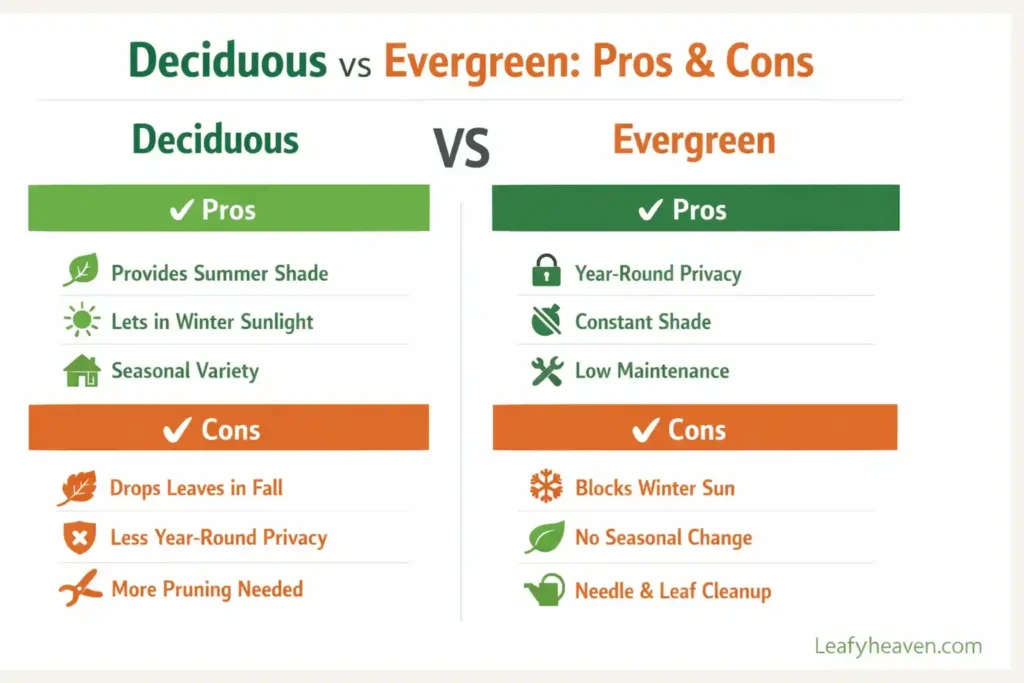
Deciduous trees offer functional and visual benefits, especially in climates with seasonal variation.
Key advantages:
- Seasonal beauty: Provide vibrant color changes, especially during autumn
- Better sunlight in winter: Leaf drop allows more sunlight to reach the ground and buildings
- Adapt well to changing climates
- Support biodiversity with seasonal cycles
These benefits make deciduous trees suitable for landscapes where light control and visual variation are important.
Advantages of Evergreen Trees
Evergreen trees provide consistency and long-term structural value in gardens and landscapes.
Key advantages:
- Privacy and screening: Dense foliage creates effective natural barriers
- Low maintenance greenery: Minimal leaf drop reduces cleanup effort
- Maintain structure and color throughout the year
- Provide continuous shade and wind protection
These features make evergreen trees ideal for year-round coverage and stability.
Disadvantages of Each Type
Both tree types have limitations that should be considered before planting.
Deciduous tree disadvantages:
- Leaf drop cleanup: Fallen leaves require regular maintenance
- Temporary loss of shade during leafless periods
Evergreen tree disadvantages:
- Less seasonal variation: Limited color change compared to deciduous trees
- Can block sunlight year-round, which may not be desirable in all cases
Understanding these trade-offs helps in selecting the most suitable tree type based on maintenance preferences and landscape goals.
How to Choose Between Deciduous and Evergreen Trees
Selecting between deciduous and evergreen trees depends on practical factors such as climate, available space, and intended use. Evaluating these elements helps identify the best trees for long-term performance and landscape value.
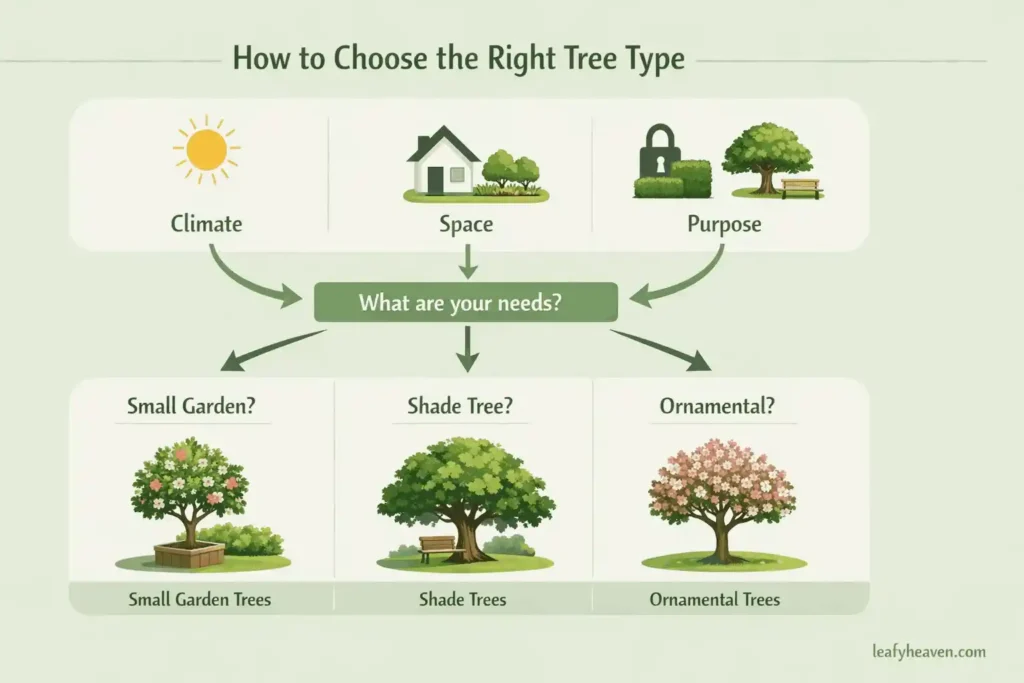
Based on Climate (Australia-Specific)
- Cooler regions (southern Australia):
Deciduous trees perform well due to clear seasonal cycles and are suitable for autumn color and seasonal shade - Warm or dry regions:
Evergreen trees are more reliable, as they retain foliage and tolerate heat and lower rainfall - Variable climates:
A mix of both types can create balanced and adaptable landscaping trees
Based on Garden Size (Small vs Large Trees)
- Small gardens:
- Choose compact or slow-growing species
- Use small deciduous or evergreen trees for controlled growth
- Ideal for backyard and urban planting
- Large spaces:
- Both large deciduous and evergreen trees can be used
- Provide broader canopy coverage and structural impact
Selecting the right size ensures proper spacing, growth management, and long-term sustainability.
Based on Purpose (Shade, Privacy, Decoration)
- Shade:
- Deciduous trees for seasonal shade and winter sunlight
- Evergreen trees for constant shade
- Privacy:
- Evergreen trees are the preferred choice for dense screening
- Decoration:
- Deciduous trees for colorful seasonal display
- Evergreen trees for consistent visual structure
For residential design, combining both types often creates the most effective results, especially when choosing great trees for front yard landscaping that balance shade, aesthetics, and functionality.
Conclusion
Deciduous vs evergreen trees highlights the fundamental difference between trees that shed leaves seasonally and those that retain foliage year-round. Each type offers distinct advantages in terms of shade, appearance, and maintenance. Deciduous trees provide seasonal beauty, flexible sunlight control, and dynamic landscape changes, while evergreen trees deliver consistent greenery, privacy, and structural stability.
There is no single option that is universally better. The right choice depends on your specific needs, climate conditions, and available space.
Final recommendation based on use-case:
- Shade control + seasonal sunlight: Deciduous trees
- Privacy + year-round coverage: Evergreen trees
- Low maintenance landscapes: Evergreen trees
- Visual interest + color variation: Deciduous trees
Selecting the appropriate tree type ensures better performance, improved landscape design, and long-term functionality.
FAQs
What is the main difference between deciduous and evergreen trees?
The main difference is leaf behavior. Deciduous trees shed their leaves seasonally, usually in autumn, while evergreen trees retain their leaves throughout the year.
What are examples of deciduous trees?
Common deciduous examples include maple, oak, birch, elm, and Japanese maple. These trees are known for seasonal leaf drop and color changes.
Are evergreen trees better for low maintenance gardens?
Yes, evergreen trees are generally better for low maintenance gardens because they do not shed all their leaves at once, reducing cleanup and upkeep.
Which trees grow faster: deciduous or evergreen?
In many cases, deciduous trees grow faster, especially those used for quick shade. However, some evergreen species can also grow rapidly depending on the variety and conditions.
Are there native deciduous trees in Australia?
Yes, but they are limited. Most trees native to Australia are evergreen, though a few native species show deciduous or semi-deciduous behavior.
What trees are not deciduous?
Trees that are not deciduous are called evergreen trees. These trees retain their leaves year-round and do not follow a seasonal leaf-drop cycle.
Can deciduous and evergreen trees be planted together?
Yes, they can be planted together. Combining both types creates a balanced landscape with seasonal variation from deciduous trees and consistent structure from evergreen trees.

Written by the LeafyHeaven Editorial Team
LeafyHeaven shares practical gardening tips and simple plant care guides to help you grow, nurture, and enjoy your plants with ease. Our goal is to make gardening feel natural, approachable, and rewarding for everyone.