
Introduction
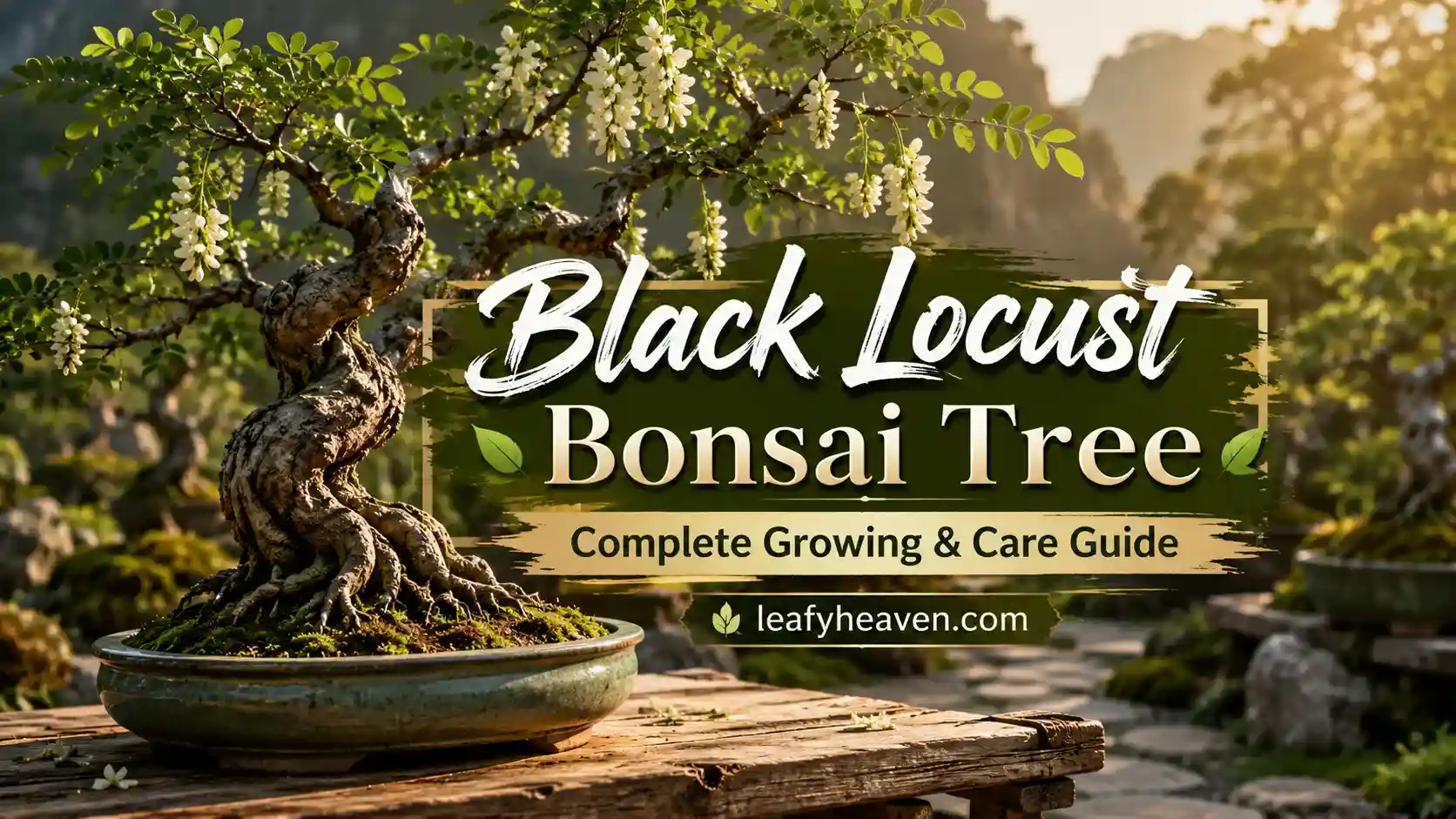
Black locust bonsai is a rugged and fast-growing outdoor bonsai tree developed from Robinia pseudoacacia, a hardy hardwood species native to North America. Bonsai growers value the black locust bonsai tree for its textured bark, compound foliage, rapid trunk thickening, and strong adaptability to outdoor conditions. Its naturally weathered appearance gives mature specimens a powerful and aged bonsai character even at a relatively young age.
A full-size black locust tree can grow very tall with an aggressive root system and dense hardwood structure, but in bonsai form, the tree becomes compact, highly controlled, and easier to style. Proper pruning, root management, and branch training transform this large deciduous species into an attractive locust bonsai suitable for patios, gardens, and outdoor bonsai collections.
Many growers choose locust tree bonsai because it responds well to pruning and develops rugged bark faster than many slower-growing species. Robinia pseudoacacia bonsai also tolerates seasonal weather changes, making it an excellent outdoor bonsai tree in temperate climates. With proper black locust bonsai care, growers can create dramatic trunk movement, natural branching, and mature-looking bonsai structures over time.
Quick Summary
| Feature | Information |
| Scientific name | Robinia pseudoacacia |
| Common names | Black locust, locust bonsai, false acacia |
| Tree type | Deciduous hardwood bonsai tree |
| USDA zones | 4–8 |
| Growth speed | Fast-growing |
| Indoor or outdoor | Primarily outdoor bonsai tree |
What Is a Black Locust Bonsai?
Black Locust Scientific Name and Botanical Classification
The scientific name for black locust is Robinia pseudoacacia. This deciduous hardwood tree belongs to the Fabaceae family and is widely known for its rapid growth, durable wood, and adaptability. The black locust scientific name is commonly used in horticulture, forestry, and bonsai cultivation to distinguish it from honey locust and other locust species.
The black locust latin name, Robinia pseudoacacia, reflects its relationship to legume-producing trees within the pea family. Many growers searching for the scientific name for black locust or the scientific name for locust tree are referring to this exact species. In bonsai cultivation, the Robinia pseudoacacia scientific name is important because different locust species have different leaf structures, thorn patterns, and growth habits.
The locust tree latin name also helps bonsai growers identify suitable propagation methods, climate tolerance, and pruning behavior. Because of its rugged bark and vigorous growth, Robinia pseudoacacia remains one of the more distinctive deciduous bonsai species for outdoor cultivation.
Definition Block
| Feature | Information |
| Botanical name | Robinia pseudoacacia |
| Common name | Black locust |
| Plant family | Fabaceae |
| Native region | North America |
Black Locust Tree Characteristics
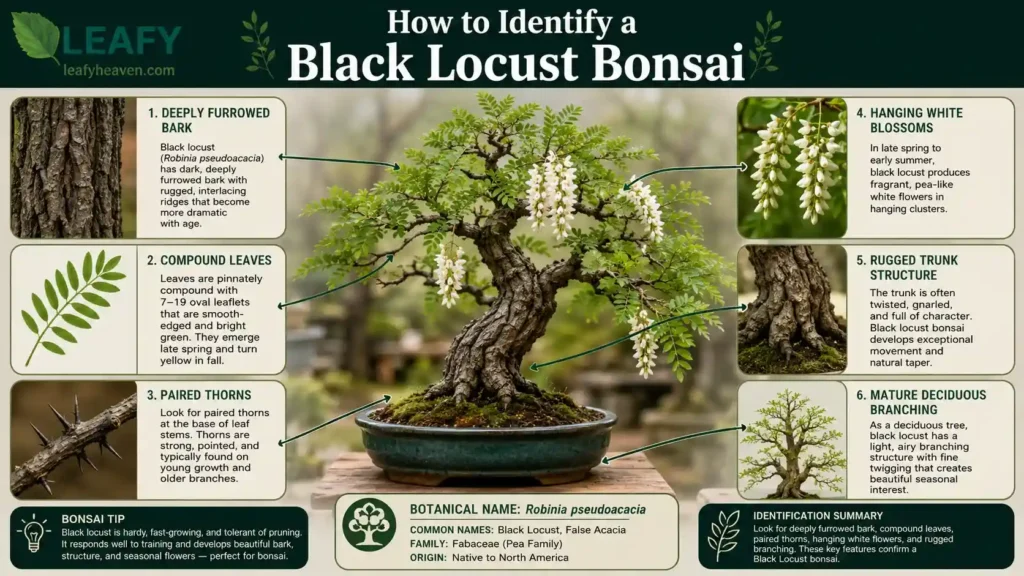
Black locust trees are known for rough bark, compound leaves, fragrant blossoms, and strong hardwood growth. These natural characteristics help create a rugged and mature bonsai appearance that many outdoor bonsai growers prefer.
The black locust tree bark becomes deeply furrowed and heavily textured with age. Mature Robinia pseudoacacia bark develops dark gray ridges that give older bonsai trees a weathered and powerful appearance. This bark texture is one of the main reasons growers use black locust for rugged bonsai styling.
Locust tree leaves are compound leaves made up of multiple small oval leaflets arranged along a central stem. A typical Robinia pseudoacacia leaf appears soft and delicate despite the tree’s strong hardwood structure. Robinia pseudoacacia leaves also create fine seasonal movement and light filtering effects during the growing season.
Young branches often produce paired thorns near the leaf nodes. Thorn growth is usually stronger on vigorous shoots and younger trees, while mature bonsai specimens may develop fewer prominent thorns after repeated pruning cycles.
Black locust blossoms appear as hanging clusters of fragrant white flowers during late spring or early summer. These black locust blossoms resemble wisteria-like flower sprays and attract pollinators such as bees and butterflies. Flowering is more common on mature trees with strong sunlight exposure.
The root system is vigorous and fast spreading. Black locust roots naturally fix nitrogen in the soil, which supports rapid growth and strong recovery after pruning. Because of this aggressive root behavior, bonsai growers regularly prune roots to maintain compact growth and healthy container balance.
In natural conditions, black locust trees can reach mature heights of 40 to 80 feet or more. In bonsai cultivation, however, careful pruning, wiring, and root restriction keep the tree compact while preserving the appearance of an aged full-size hardwood tree.
Why Black Locust Works Well for Bonsai
Black locust adapts well to bonsai because it tolerates pruning, develops textured bark, and grows vigorously. Its fast growth rate and strong recovery ability make it a practical choice for growers who want quicker bonsai development compared to slower deciduous species.
Growers who want to build a strong foundation before attempting bonsai training will benefit from reviewing this complete gardening and plant care guide covering essential plant maintenance principles.
One of the biggest advantages of black locust bonsai is rapid trunk thickening. Young trees grow aggressively during the active season, allowing growers to build strong trunk taper and mature structure in fewer years. This faster development is especially useful for bonsai artists creating rugged or naturalistic tree forms.
Black locust also performs reliably as a hardy outdoor bonsai tree. It tolerates seasonal weather changes, wind exposure, and winter dormancy better than many tropical bonsai species. Because it naturally grows in temperate climates, it adapts well to outdoor bonsai cultivation with proper seasonal care.
To confirm your exact growing zone before cultivation, refer to the official USDA Plant Hardiness Zone Map for accurate regional zone data.
The species develops a naturally rugged appearance over time. Deep bark fissures, angular branching, and strong trunk movement give mature bonsai a weathered hardwood character. This rough texture helps even younger specimens look older and more established.
Another important feature is its nitrogen-fixing root system. Like many members of the Fabaceae family, black locust roots improve soil nitrogen balance through symbiotic bacteria. This supports vigorous foliage growth and strong recovery after pruning or repotting.
Seasonal changes also add visual interest throughout the year. Fresh green compound leaves appear in spring, fragrant blossoms may develop on mature trees, and bark texture becomes more visible during winter dormancy. These seasonal transitions help create a dynamic outdoor bonsai display.
Quick Takeaway
Black locust bonsai is best for growers wanting:
- Rugged bonsai appearance
- Hardy outdoor bonsai tree performance
- Fast trunk development
- Rapid growth for styling projects
- Strong bark texture and natural aging effects
- Vigorous recovery after pruning and root work
Black Locust Bonsai vs Other Popular Bonsai Trees
Black Locust Bonsai vs Honey Locust Bonsai
Black locust and honey locust bonsai differ in leaf texture, thorn structure, and growth habit. Although both belong to the legume family and are commonly grouped as locust species, they create very different bonsai aesthetics and maintenance experiences.
Black locust bonsai develops rugged bark and a heavier trunk appearance earlier in development. Its compound leaves are relatively compact, making the tree suitable for rugged deciduous bonsai styling. A honey locust bonsai, on the other hand, usually produces finer and more delicate foliage with a lighter visual texture.
Thorn growth is another major difference. Black locust typically produces smaller paired thorns near branch nodes, while a honey locust bonsai may develop large branched thorns that become more dramatic and aggressive-looking over time.
Growth habit also varies between species. A black locust bonsai tree often develops denser branching and stronger trunk taper, while a honey locust bonsai tends to appear more open and airy with softer canopy structure.
Comparison Table
| Feature | Black Locust | Honey Locust |
| Bark | Deep textured | Smoother |
| Leaves | Smaller compound | More delicate |
| Thorns | Moderate | Large branched thorns |
Black Locust Bonsai vs Jacaranda Bonsai
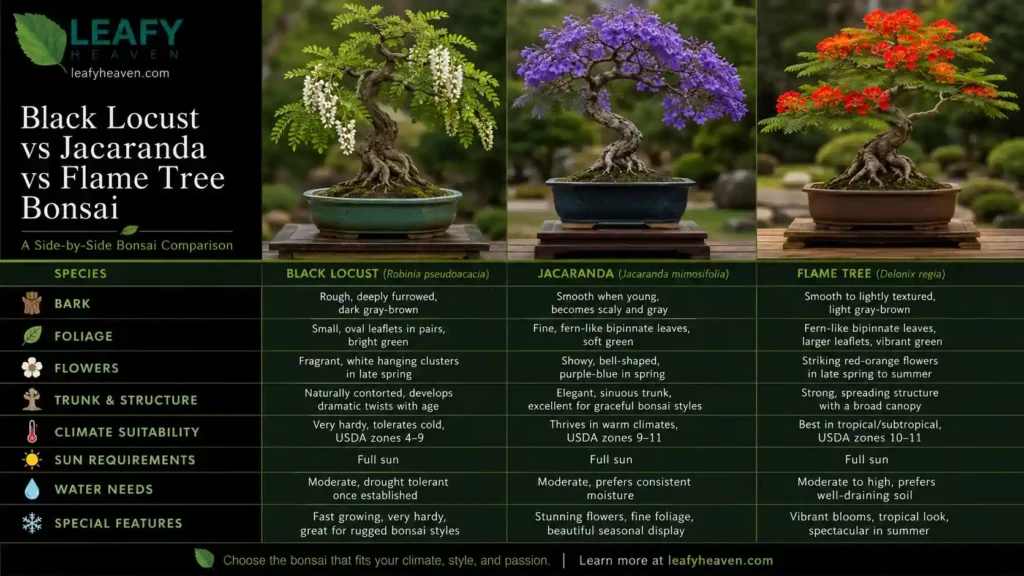
Jacaranda bonsai has softer tropical foliage, while black locust bonsai is more rugged and cold hardy. Both species are attractive bonsai choices, but they create very different visual styles and climate requirements.
A jacaranda bonsai tree is known for its soft fern-like foliage and ornamental flowering habit. Many growers choose blue jacaranda bonsai varieties for their striking purple-blue blooms and elegant canopy structure. In comparison, black locust bonsai focuses more on bark texture, trunk character, and hardy outdoor performance.
The flower appearance is one of the clearest differences. Jacaranda bonsai blue flowering varieties can produce vibrant lavender or blue-purple blossoms under warm growing conditions. Black locust trees instead produce hanging white fragrant flower clusters that appear more subtle and naturalistic.
Growth speed is relatively fast in both species, but Robinia pseudoacacia generally develops thicker trunks faster than Jacaranda mimosifolia. A bonsai jacaranda tree usually emphasizes graceful branching and soft foliage rather than rugged hardwood structure.
Leaf appearance also differs significantly. Robinia pseudoacacia produces compound leaves with oval leaflets, while jacaranda bonsai has much finer feathery foliage that creates a softer tropical silhouette.
Indoor and outdoor suitability is another important distinction. Most blue jacaranda bonsai tree specimens prefer warm climates and may need winter protection in cooler regions. Black locust bonsai performs far better as a cold-hardy outdoor bonsai tree with proper dormancy exposure.
Black Locust Bonsai vs Flame Tree Bonsai
Flame tree bonsai is tropical and flowering, while black locust bonsai is hardy and more structural. These two species are popular among growers who want fast-growing bonsai trees, but their appearance and care needs are very different.
A flame tree bonsai, also known as Delonix regia bonsai, is prized for its tropical canopy and dramatic red-orange flowers.
A flame tree bonsai, also known as Delonix regia bonsai, is prized for its tropical canopy and dramatic red-orange flowers.
Royal poinciana bonsai trees create vibrant ornamental displays with wide umbrella-shaped branching and soft fern-like leaves. In contrast, black locust bonsai emphasizes bark texture, rugged branching, and hardwood character.
Climate tolerance is one of the biggest differences. A bonsai flame tree requires tropical or subtropical warmth and struggles in freezing temperatures. Black locust bonsai tolerates winter dormancy much better and adapts to colder outdoor environments.
Floral appearance also separates the species clearly. Flamboyant bonsai and fire tree bonsai specimens are known for bright fiery blooms, while black locust flowers are smaller, white, and more understated.
Care difficulty varies depending on climate. A Delonix regia bonsai tree may require humidity management, frost protection, and careful seasonal care, while black locust bonsai is generally more resilient outdoors.
Comparison Table
| Bonsai Type | Climate | Flowers | Care Difficulty |
| Black Locust Bonsai | Temperate | White fragrant blossoms | Moderate |
| Flame Tree Bonsai | Tropical/Subtropical | Red-orange flowers | Higher |
| Royal Poinciana Bonsai | Warm tropical | Bright flamboyant blooms | Higher |
| Delonix Regia Bonsai | Tropical | Fiery ornamental flowers | Moderate to high |
How to Grow Black Locust Bonsai From Seed
Choosing Bonsai Seeds and Black Locust Seeds
Healthy black locust bonsai starts with viable seeds and proper seed preparation. Strong seed quality improves germination rates, early root development, and long-term bonsai health.
Many growers start locust bonsai from seed because it allows complete control over trunk shaping, root spread, and early bonsai structure. When selecting bonsai seeds or bonsai tree seeds, it is important to choose mature black locust seeds with hard outer shells and consistent coloration. Fresh seeds generally produce stronger germination results than older improperly stored seeds.
Reliable seed sourcing is important for successful propagation. Growers often collect seeds from mature healthy black locust trees or purchase them from specialized bonsai seed suppliers. Seeds taken from healthy parent trees usually produce stronger seedlings with better vigor and disease resistance.
Viability testing helps identify healthy seeds before planting. Viable black locust seeds are usually firm, dark brown, and heavy for their size. Damaged, cracked, or hollow seeds often fail to germinate properly.
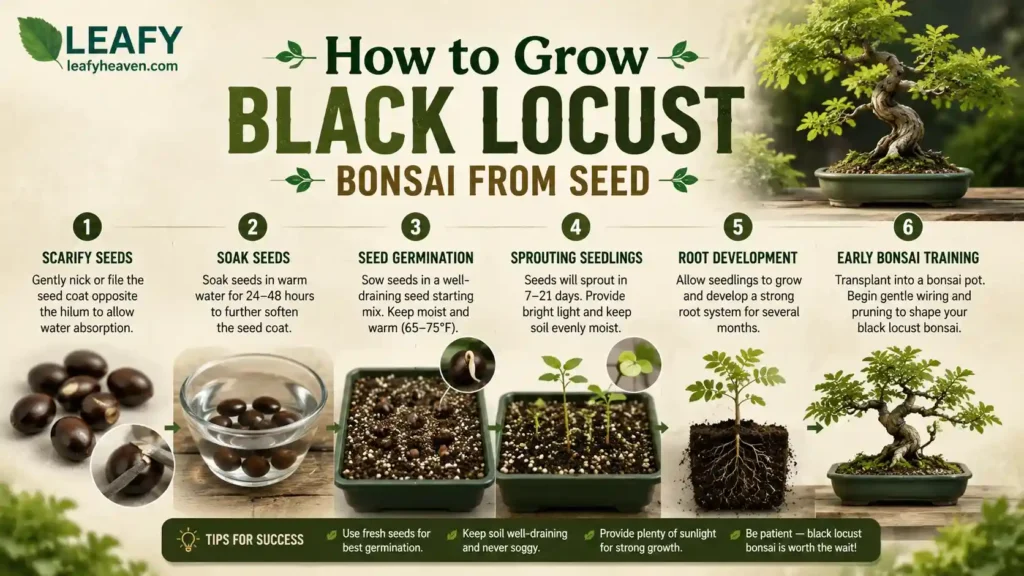
Scarification is one of the most important steps when learning how to grow locust tree from seed. Black locust seeds naturally have very hard outer coatings that slow water absorption. Lightly nicking or sanding the seed coat helps moisture enter the seed and improves germination speed.
Many growers also use soaking methods before planting. After scarification, seeds are commonly soaked in warm water for 12 to 24 hours. Proper soaking softens the outer shell and activates early germination processes.
Key preparation steps for locust bonsai from seed include:
- Selecting mature viable seeds
- Using clean propagation materials
- Scarifying hard seed coats
- Soaking seeds before planting
- Preparing well-draining bonsai soil
Seed Germination Process
Black locust seeds germinate best after scarification and warm moisture exposure. Consistent warmth, light moisture, and proper airflow help seedlings establish quickly and reduce early fungal problems.
Step-by-Step Germination Process
- Scarify Seeds
Lightly file, sand, or nick the hard outer shell of each seed. This allows water to penetrate the protective coating and speeds up germination. - Soak in Warm Water
Place scarified seeds in warm water for 12–24 hours. Healthy seeds often swell slightly after soaking, indicating successful moisture absorption. - Use Fast-Draining Soil
Plant seeds in a loose, well-draining bonsai soil mix. A combination of coarse sand, akadama, pumice, or seed-starting mix helps prevent waterlogging and root rot. - Maintain Warmth
Black locust seeds germinate best in warm temperatures between 70–85°F (21–29°C). Warmth accelerates root development and improves sprouting consistency. - Monitor Sprouts
Keep soil lightly moist but never soggy. Once sprouts appear, provide bright light and good airflow to encourage strong seedling growth.
The germination timeline for black locust seeds is usually fast after proper scarification. Many seeds sprout within 1–3 weeks under ideal conditions, although some may take longer depending on temperature and moisture consistency.
Humidity needs are moderate during germination. A lightly humid environment helps maintain seed moisture, but excessive humidity without airflow can increase fungal risks. Seed trays with ventilation holes usually provide a balanced environment.
Proper seedling care is important during the first growing season. Young seedlings should receive:
- Bright indirect to full sunlight
- Moderate watering
- Protection from heavy frost
- Good airflow
- Early root monitoring
Once seedlings establish several true leaves, growers can begin light shaping, trunk direction training, and early bonsai development techniques.
Early Seedling Training for Bonsai
Early pruning and root control help young locust seedlings develop bonsai structure faster. Training begins during the first stages of active growth, when young trees are still flexible and easier to shape.
Trunk shaping is usually the first major step in early bonsai development. Many growers introduce gentle bends while seedlings are young to avoid creating a perfectly straight trunk. Early movement helps the future bonsai develop a more natural and mature appearance. Fast-growing black locust seedlings respond quickly to directional pruning and trunk training during the active growing season.
Wiring basics should focus on light shaping rather than aggressive bending. Young branches and trunks remain flexible for a limited period, making early wiring easier than later corrective work. Aluminum bonsai wire is commonly used because it is easier to adjust and less likely to damage tender bark. Wire should always be monitored carefully since black locust seedlings can thicken rapidly during active growth.
Root pruning is important for controlling vigor and encouraging a compact bonsai root system. During early repotting stages, growers usually trim long downward roots and encourage radial surface root development. Controlled root pruning helps improve nebari formation and keeps the seedling suitable for shallow bonsai containers later in development.
Starter containers should provide enough space for healthy root growth while still supporting bonsai training goals. Many growers use:
- Small nursery pots
- Deep training containers
- Plastic bonsai training pots
- Pond baskets for airflow and root branching
Containers must always provide strong drainage because black locust seedlings dislike constantly wet soil. Fast-draining bonsai soil combined with proper container depth helps young roots establish quickly without rot problems.
During the first few years, the goal is not fine bonsai refinement but strong structural development. Early training focuses on:
- Building trunk thickness
- Creating trunk movement
- Developing healthy roots
- Establishing primary branch structure
- Improving long-term bonsai proportions
Consistent pruning and controlled growth during the seedling stage create a much stronger foundation for future black locust bonsai styling.
Black Locust Bonsai Care Guide
Sunlight Requirements
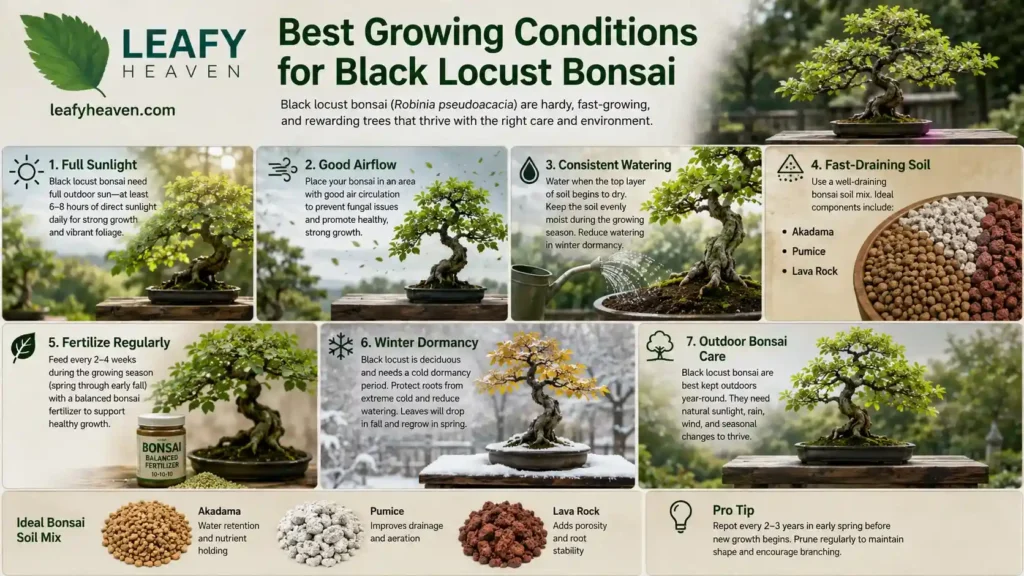
Black locust bonsai grows best in full sun outdoors. Strong sunlight supports healthy foliage growth, trunk thickening, bark development, and seasonal vigor.
As an outdoor bonsai tree, black locust requires natural weather exposure and changing seasonal conditions to grow properly. Many growers asking “can bonsai live outside” are surprised to learn that deciduous species like black locust actually perform far better outdoors than indoors.
Keeping a bonsai tree outside improves:
- Leaf density
- Branch strength
- Seasonal dormancy
- Bark texture
- Flower production potential
Black locust bonsai should generally receive at least 6–8 hours of direct sunlight daily during the active growing season. Insufficient light can cause weak shoots, oversized leaves, and poor branching structure.
Summer care is especially important during periods of intense heat. Although black locust is highly tolerant of sun exposure, shallow bonsai containers dry out quickly in midsummer. Growers may need more frequent watering and occasional afternoon shade in extremely hot climates.
Winter exposure also plays a major role in long-term tree health. Black locust bonsai requires winter dormancy, making outdoor placement important even during colder months. Mature trees tolerate freezing conditions relatively well, although shallow bonsai pots may need some root insulation during severe frost.
Airflow importance should never be overlooked. Good air circulation reduces fungal issues, improves foliage health, and helps soil dry evenly between waterings. Bonsai outside in stagnant or enclosed areas may develop moisture-related problems more easily.
Best Soil for Black Locust Bonsai
Fast-draining bonsai soil prevents root rot and improves root health. Because black locust roots grow vigorously, the soil must provide both oxygen flow and moisture control.
A balanced bonsai soil mix usually combines inorganic particles with moderate moisture retention. Akadama mixes are commonly used because they provide root aeration while holding enough moisture for healthy growth. Over time, akadama gradually breaks down and supports stable root development.
Pumice is valuable for drainage and oxygen movement within the soil structure. It helps prevent compacted roots and supports beneficial microbial activity around the root zone.
Lava rock improves long-term drainage balance and increases structural stability in the container. Many growers combine lava rock with pumice and akadama to create durable bonsai soil that handles repeated watering cycles efficiently.
Drainage balance is critical because black locust bonsai dislikes constantly wet roots. Heavy organic soils can trap moisture and increase the risk of fungal disease or root rot.
Soil Component Table
| Soil Component | Purpose |
| Akadama | Moisture retention and root development |
| Pumice | Aeration and drainage |
| Lava rock | Structural stability and airflow |
| Pine bark (optional) | Mild organic moisture retention |
Watering Needs
Black locust bonsai prefers moderate watering with partial drying between waterings. Consistent moisture control helps maintain healthy roots while preventing fungal problems.
The soil should never remain permanently saturated. Instead, growers should allow the upper layer of soil to dry slightly before watering again. Proper watering frequency depends on temperature, sunlight, humidity, container size, and seasonal growth activity.
Seasonal watering changes throughout the year:
- Spring: Increased watering during active growth
- Summer: Frequent monitoring due to heat and evaporation
- Autumn: Reduced watering as growth slows
- Winter: Minimal watering during dormancy
Overwatering signs often include:
- Yellowing leaves
- Weak growth
- Soft roots
- Persistent wet soil
- Fungal odor near roots
Underwatering signs may include:
- Crispy leaf edges
- Wilting foliage
- Dry compacted soil
- Premature leaf drop
Proper drainage and observation are more important than following a fixed watering schedule. Healthy black locust bonsai responds best to consistent but controlled moisture management.
Fertilizer Requirements
Balanced fertilizer supports vigorous foliage and trunk development. Because black locust grows rapidly, regular feeding helps maintain healthy energy production throughout the growing season.
Organic fertilizer is commonly preferred for bonsai because it releases nutrients gradually and improves soil biology. Organic feeding also reduces the risk of sudden nutrient overload compared to strong synthetic fertilizers.
Seasonal feeding usually follows active growth cycles:
- Spring: Strong feeding for foliage and branch development
- Summer: Moderate balanced feeding
- Autumn: Reduced nitrogen before dormancy
- Winter: Minimal or no fertilizer during dormancy
Nitrogen effects are especially noticeable in black locust bonsai. Higher nitrogen levels encourage vigorous foliage growth and rapid trunk thickening, but excessive nitrogen may produce oversized leaves and overly aggressive shoots. Balanced fertilizer ratios help maintain controlled bonsai proportions while still supporting healthy growth.
Black Locust Bonsai Pruning Techniques
Regular pruning maintains shape and encourages fine branching. Black locust responds strongly to pruning, making it suitable for structural bonsai development and long-term refinement.
Structural pruning focuses on major trunk and branch design. Growers usually remove heavy unwanted branches during dormancy or early spring before active growth begins. This helps establish primary bonsai structure and improves taper.
Maintenance pruning controls ongoing growth throughout the season. Fast-growing shoots are trimmed regularly to maintain compact foliage pads and balanced proportions.
Branch selection is important because black locust can quickly produce crowded branching. Removing poorly positioned branches improves airflow, light penetration, and overall bonsai structure.
Ramification develops through repeated trimming of new shoots. Over time, careful pruning creates finer branch networks and denser canopy structure, helping the bonsai appear more mature and refined.
Important pruning goals include:
- Improving trunk taper
- Building branch structure
- Encouraging compact foliage
- Reducing oversized shoots
- Developing balanced canopy density
Wiring and Bonsai Styling
Black locust branches can be wired carefully while young and flexible. Early shaping is easier because mature branches harden quickly and become more brittle with age.
Wiring should usually be done during active but controlled growth periods. Young shoots respond well to gentle directional shaping, while older branches require extra caution to avoid cracking.
Many traditional bonsai styles work well with black locust because of its rugged bark and natural hardwood appearance. Different bonsai shapes can emphasize movement, age, and seasonal character depending on trunk structure and branch placement.
Common bonsai tree styles suitable for black locust include:
- Informal upright
- Slanting
- Broom style
- Rugged natural form
An informal upright style highlights natural trunk movement and mature deciduous branching. Slanting designs create dramatic weathered appearances that match the species’ rugged character.
Broom style bonsai works well on older specimens with fine branching and balanced canopy structure. Many growers also prefer rugged natural form styling because it complements the tree’s textured bark and irregular growth habit.
A practical bonsai style guide for black locust focuses on:
- Strong trunk movement
- Natural branch spacing
- Weathered appearance
- Balanced root spread
- Seasonal silhouette quality
In many bonsai styles chart references, black locust is categorized as a deciduous outdoor species best suited for naturalistic or rugged hardwood styling rather than highly formal tropical forms.
Common Black Locust Bonsai Problems and Solutions
Yellow Leaves and Weak Growth
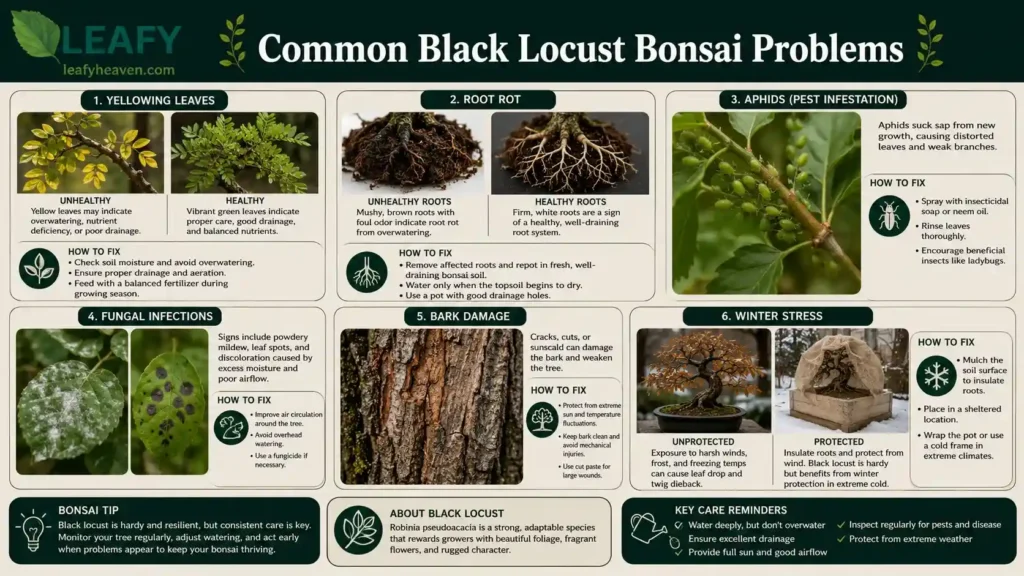
Yellow leaves are usually caused by watering stress, poor drainage, or nutrient imbalance. Black locust bonsai grows vigorously under proper conditions, so sudden discoloration or weak growth often signals an environmental problem.
Overwatering is one of the most common causes of yellow foliage. Constantly wet soil limits oxygen around the roots and weakens nutrient absorption. Poor drainage can produce similar symptoms, especially in compacted soil mixes.
Underwatering may also cause weak growth and premature yellowing during hot weather. Because black locust is a fast-growing outdoor bonsai tree, shallow containers can dry quickly in strong sun and wind exposure.
Nutrient imbalance sometimes develops when fertilizer schedules are inconsistent. Nitrogen deficiency may reduce foliage vigor, while excessive fertilizer can stress roots and damage leaf tissue.
To improve recovery:
- Check soil drainage immediately
- Adjust watering frequency
- Increase airflow around the tree
- Use balanced seasonal fertilizer
- Remove severely damaged foliage
Healthy roots, stable sunlight exposure, and proper moisture balance usually restore vigorous growth over time.
Root Rot Problems
Root rot develops when bonsai soil stays wet for long periods. Poor drainage and excessive watering create low-oxygen conditions that allow fungal pathogens to damage the root system.
Early symptoms often include:
- Yellow leaves
- Weak shoots
- Wilting despite wet soil
- Slow growth
- Foul-smelling roots
Severe root rot can eventually kill branches or the entire bonsai tree if not corrected quickly.
Prevention is the most effective solution. Black locust bonsai should always be planted in fast-draining bonsai soil containing components such as akadama, pumice, and lava rock. Containers must also have adequate drainage holes.
If root rot develops, growers typically:
- Remove the tree from the container
- Trim blackened or soft roots
- Replace old compacted soil
- Improve drainage balance
- Reduce watering temporarily
Healthy root systems are essential for vigorous foliage growth and long-term bonsai development.
Pest and Disease Issues
Aphids, borers, and fungal issues can occasionally affect black locust bonsai trees. Most pest problems develop during periods of stress, poor airflow, or excessive moisture.
Common issues include:
- Aphids
- Scale insects
- Fungal infections
- Bark damage
Aphids commonly gather on tender new growth and feed on plant sap, causing curling leaves and sticky residue. Scale insects attach to branches and bark, weakening the tree over time if left untreated.
Fungal infections are more likely in humid conditions with limited airflow or overly wet soil. Leaf spotting, branch dieback, and root disease may develop if moisture remains trapped around the foliage and roots.
Bark damage can occur from pests, wiring mistakes, sun stress, or mechanical injury. Damaged bark areas should be monitored carefully because wounds may invite secondary fungal problems or insect infestation.
Regular inspection, balanced watering, and proper airflow greatly reduce long-term pest and disease risks.
Winter Protection Tips
Young black locust bonsai need root protection during freezing temperatures. Although mature black locust trees tolerate cold climates well, bonsai roots are more vulnerable because they grow inside shallow containers.
Winter dormancy is essential for healthy long-term growth. During dormancy, the tree conserves energy and prepares for spring growth cycles. Outdoor placement during winter helps maintain natural seasonal rhythms.
Proper frost care becomes especially important during prolonged freezing periods. Repeated freeze-thaw cycles can damage delicate feeder roots inside bonsai pots.
Common overwintering methods include:
- Placing bonsai pots in protected cold frames
- Mulching around containers
- Moving trees near sheltered walls
- Protecting roots from severe wind exposure
- Reducing watering during dormancy
Overwintering should still allow exposure to cold temperatures while preventing extreme root freezing. Trees should never be kept in warm indoor environments during winter because lack of dormancy weakens long-term health and growth stability.
Young black locust bonsai usually require more winter protection than mature established specimens, especially during their first few years of development.
Is Black Locust Bonsai Good for Beginners?
Why Beginners Like Locust Bonsai
Black locust bonsai grows quickly and responds well to pruning, making it beginner friendly. Its vigorous growth allows new growers to see visible development faster than many slower bonsai species.
Many people searching for bonsai for beginners want a tree that recovers well from pruning mistakes and adapts easily to outdoor growing conditions.
Before starting any bonsai journey, understanding the deeper significance of a bonsai tree can help beginners approach the practice with the right mindset and long-term perspective.
Black locust bonsai fits this requirement because it is hardy, resilient, and capable of producing strong new growth after trimming or root work.
Compared to some delicate beginner bonsai trees, black locust tolerates seasonal weather changes more effectively and usually develops trunk thickness faster. This helps bonsai tree beginners learn structural pruning, wiring, and branch development without waiting many years for visible progress.
Another advantage is the tree’s rugged appearance. Even relatively young specimens can develop textured bark and natural-looking structure, giving beginners a rewarding bonsai aesthetic earlier in the growing process.
A black locust bonsai tree for beginners can also help growers practice important bonsai techniques such as:
- Seasonal pruning
- Root control
- Outdoor bonsai care
- Branch selection
- Early trunk shaping
Because it grows vigorously, the species provides repeated opportunities to improve bonsai skills through ongoing maintenance and styling practice.
Challenges New Growers Should Know
Fast growth and thorn development can require more maintenance than slower bonsai species. While vigorous growth is helpful for development, it also means black locust bonsai may need more frequent pruning during the active season.
Unchecked shoots can quickly become long and coarse, reducing compact bonsai proportions if not maintained regularly. Beginners must learn to balance strong growth with controlled structural refinement.
Thorns are another challenge for some growers. Young shoots often develop sharp paired thorns that can make pruning and wiring more difficult compared to softer deciduous bonsai species.
Other beginner challenges may include:
- Rapid root growth requiring periodic repotting
- Large leaves if pruning is inconsistent
- Strong branching that may become crowded
- Increased watering needs during hot weather
- Winter dormancy management for outdoor care
Despite these challenges, many growers still consider black locust one of the more rewarding outdoor bonsai options for beginners who want fast progress and rugged tree character.
Indoor vs Outdoor Black Locust Bonsai
Can Black Locust Bonsai Grow Indoors?
Black locust bonsai performs poorly indoors because it requires strong sunlight and winter dormancy. As a temperate deciduous species, Robinia pseudoacacia depends on seasonal outdoor conditions to maintain healthy long-term growth.
Many indoor bonsai species are tropical or subtropical plants that tolerate stable indoor temperatures and lower humidity fluctuations. Black locust is different because it naturally grows outdoors in full sun and enters winter dormancy during colder months. Without this dormancy cycle, the tree gradually weakens over time.
An indoor bonsai tree environment usually lacks several conditions that black locust requires, including:
- Intense direct sunlight
- Natural airflow
- Seasonal temperature variation
- Winter cold exposure
- Outdoor humidity balance
Keeping black locust indoors often causes weak shoots, oversized leaves, poor vigor, and declining root health. Limited airflow and reduced sunlight may also increase fungal problems and pest stress.
For best results, black locust should be treated as a fully outdoor bonsai tree. Proper outdoor bonsai care allows the tree to experience seasonal changes naturally while supporting healthy bark development, compact growth, and long-term structural strength.
Growers who prefer indoor bonsai species are usually better suited to tropical varieties such as ficus, jade, or schefflera rather than deciduous hardwood species like black locust.
Comparison Block
| Indoor Bonsai | Outdoor Bonsai |
| Stable indoor temperatures | Natural seasonal temperature cycles |
| Lower direct sunlight | Full sun exposure |
| Tropical/subtropical species preferred | Temperate deciduous species suitable |
| No winter dormancy required | Winter dormancy essential |
| Limited airflow | Strong natural airflow |
| Better for ficus and tropical trees | Better for black locust bonsai |
Best Bonsai Companion Species for Similar Growing Styles
Juniper Bonsai
Juniper bonsai is one of the most popular outdoor bonsai companions for growers who enjoy rugged tree structure and long-term styling development. Like black locust bonsai, many juniper varieties develop aged bark texture, dramatic trunk movement, and strong outdoor performance.
A bonsai juniper is especially valued for its evergreen foliage and ability to tolerate extensive shaping techniques. While black locust creates a deciduous hardwood appearance, juniper bonsai emphasizes dense green foliage pads and sculptural deadwood features.
Many growers interested in juniper bonsai care appreciate its suitability for classic bonsai forms such as:
- Informal upright
- Cascade
- Slanting
- Windswept
- Literati
Juniper bonsai tree care focuses heavily on sunlight, airflow, careful watering, and controlled pruning. Like black locust, junipers perform best outdoors where they can receive strong light and natural seasonal conditions.
Although the foliage texture differs greatly between the two species, both trees appeal to growers who enjoy rugged outdoor bonsai styling and long-term structural refinement.
Pigeon Pea Bonsai
Pigeon pea bonsai is a tropical fast-growing bonsai alternative with soft foliage and rapid growth. Many growers use it as a warm-climate substitute for deciduous outdoor species because it develops quickly and responds well to pruning.
A pigeon pea bonsai tree is created from the pigeon pea plant (Cajanus cajan), a fast-growing leguminous shrub commonly cultivated in tropical and subtropical regions. Unlike black locust, which prefers winter dormancy, pigeon pea bonsai continues active growth in warm climates for much of the year.
Tropical use is one of the biggest differences between these species. Black locust bonsai is better suited for temperate outdoor conditions, while pigeon pea bonsai care focuses on warmth, sunlight, and frost protection.
Many growers start pigeon pea bonsai from seed because pigeon pea seeds germinate quickly and establish vigorous seedlings in warm soil. Young pigeon pea seedlings develop flexible stems that are easy to wire and shape during early bonsai training.
Growth comparison between the two species shows several similarities and differences:
- Both species grow rapidly
- Both respond well to pruning
- Both develop quickly from seed
- Black locust develops harder bark faster
- Pigeon pea maintains softer tropical growth
Foliage differences are also significant. A pigeon peas plant produces softer and lighter green foliage compared to the stronger compound leaves of black locust. The pigeon pea bush typically creates a more delicate tropical appearance, while black locust develops a rugged deciduous hardwood structure.
Some growers also use pigeon peas tree varieties for experimental tropical bonsai because they tolerate aggressive pruning and recover quickly after shaping. However, the overall aesthetic is usually softer and less rugged than mature black locust bonsai.
Black Locust Bonsai Safety and Toxicity
Is Black Locust Toxic?
Black locust bark, seeds, and leaves contain toxic compounds if ingested. Although black locust bonsai is valued for its rugged appearance and hardy growth, growers should understand the tree’s toxicity risks before keeping it around pets or small children.
The highest concentration of toxic compounds is usually found in:
- Bark
- Seeds
- Leaves
- Young shoots
Ingestion may cause digestive upset, weakness, nausea, vomiting, or other toxic reactions in both humans and animals. Because of this, pet safety is an important consideration when placing black locust bonsai outdoors or in accessible garden areas.
Dogs, cats, and grazing animals are generally more vulnerable if they chew fallen leaves, bark, or seed pods. Growers with curious pets should keep bonsai containers elevated or placed in restricted areas where accidental ingestion is less likely.
Child safety is also important because young children may handle seeds or broken branches without understanding the risks. Bonsai tools, cuttings, and pruning debris should always be cleaned up after maintenance work.
Basic handling precautions help reduce unnecessary exposure during routine bonsai care:
- Wear gloves while pruning
- Wash hands after handling sap or bark
- Avoid contact with eyes or mouth
- Keep seeds away from children and pets
- Dispose of pruning waste carefully
Despite its toxicity, black locust bonsai is generally safe to grow when handled responsibly. Most risks occur through ingestion rather than casual contact, making normal bonsai maintenance relatively low risk with proper precautions.
Conclusion
Black locust bonsai is a rugged, fast-growing outdoor bonsai tree with textured bark, hardy growth, and strong bonsai potential. Its rapid trunk development, compound foliage, and weathered bark make it an attractive choice for growers who prefer natural hardwood bonsai styles with strong character.
Many bonsai enthusiasts like black locust because it responds well to pruning, develops mature bark relatively quickly, and adapts effectively to outdoor cultivation. The species performs best in temperate climates where it can receive full sun, seasonal airflow, and proper winter dormancy.
Successful black locust bonsai care mainly depends on:
- Full outdoor sunlight
- Fast-draining bonsai soil
- Balanced watering
- Seasonal pruning
- Winter root protection
The tree is also considered relatively beginner friendly because of its vigorous growth and strong recovery ability after pruning. While fast growth and thorn development require regular maintenance, many growers appreciate how quickly the species develops trunk structure and rugged visual appeal.
Long-term styling potential is one of the biggest strengths of black locust bonsai. Over time, careful pruning, wiring, and branch refinement can create highly realistic deciduous bonsai forms with impressive bark texture and natural aging characteristics.
Growers interested in experimenting with seed-grown bonsai may find black locust especially rewarding because seedlings establish quickly and respond well to early shaping techniques. Exploring locust bonsai from seed can also help develop core bonsai training skills such as root pruning, trunk shaping, and branch development.
For growers interested in different bonsai aesthetics, comparing black locust with jacaranda bonsai and flame tree bonsai can be useful. Jacaranda offers softer tropical foliage and blue-purple flowering potential, while flame tree bonsai creates bold tropical canopies with dramatic red-orange blooms. Each species provides a very different bonsai style and growing experience.
Frequently Asked Questions About Black Locust Bonsai
How fast does black locust bonsai grow?
Black locust bonsai grows very quickly compared to many other deciduous bonsai species. Under full sun, proper watering, and balanced fertilizer, young trees can produce vigorous shoots and rapid trunk thickening during a single growing season. This fast growth makes black locust popular for growers wanting quicker bonsai development and faster structural progress.
Can black locust bonsai flower?
Yes, mature black locust bonsai can produce flowers under proper growing conditions. Healthy trees may develop hanging clusters of fragrant white blossoms during late spring or early summer. Flowering is more likely on older bonsai specimens receiving strong sunlight, seasonal dormancy, and balanced pruning management.
Is Robinia pseudoacacia good for bonsai?
Yes, Robinia pseudoacacia is considered a good outdoor bonsai species for growers who enjoy rugged deciduous trees. It tolerates pruning well, develops textured bark, and grows vigorously. Its fast trunk development and hardy nature make it suitable for naturalistic bonsai styles and long-term outdoor cultivation.
How do you grow locust bonsai from seed?
Locust bonsai from seed is usually grown by scarifying hard seed coats, soaking seeds in warm water, and planting them in fast-draining soil. Seeds germinate best in warm conditions with moderate moisture and good airflow. Once seedlings establish, early pruning, root control, and trunk shaping help begin bonsai development.
Can black locust bonsai stay outdoors year-round?
In most temperate climates, black locust bonsai can remain outdoors year-round because it requires winter dormancy for healthy growth cycles. Mature trees tolerate cold weather relatively well, although shallow bonsai containers may need root protection during severe freezing temperatures. Young trees generally require additional overwintering protection.
What is the difference between black locust and honey locust bonsai?
Black locust bonsai and honey locust bonsai differ in bark texture, foliage appearance, and thorn structure. Black locust usually develops rougher bark and smaller compound leaves, while honey locust tends to produce finer foliage and larger branched thorns. Black locust often creates a heavier rugged bonsai appearance, while honey locust appears lighter and more delicate.
Why are black locust bonsai leaves turning yellow?
Black locust bonsai leaves usually turn yellow because of watering stress, poor drainage, nutrient imbalance, or root problems. Overwatering is one of the most common causes, especially in compacted soil with limited airflow. Underwatering, weak sunlight exposure, or seasonal stress may also contribute to yellow foliage and reduced vigor.

Written by the LeafyHeaven Editorial Team
LeafyHeaven shares practical gardening tips and simple plant care guides to help you grow, nurture, and enjoy your plants with ease. Our goal is to make gardening feel natural, approachable, and rewarding for everyone.