
Introduction
South Asia’s scorching summers push gardens to their limits — but the right summer flowers in india and across the region prove that heat is no barrier to beauty. From Pakistan’s dry desert heat to India’s pre-monsoon blaze and Bangladesh’s humid summers, drought tolerant plants offer a reliable solution for gardeners who refuse to give up on color and life. This guide covers the best indian summer flowers, top drought tolerant picks, monsoon-ready selections, rooftop gardening tips, and a complete month-by-month planting calendar built for South Asian climate resilience. This summer, these flowers will transform your South Asian garden.
What Are Summer Flowers and Why South Asia Needs Drought-Tolerant Plants
Summer season flowers in india and across South Asia face conditions that most plants simply cannot handle. Extreme temperatures, unpredictable rainfall, and chronic water scarcity make drought tolerant plants not just a preference — but a necessity. Understanding summer flowers name and their suitability for South Asian conditions starts with understanding the climate itself.
Understanding South Asian Summer Climate
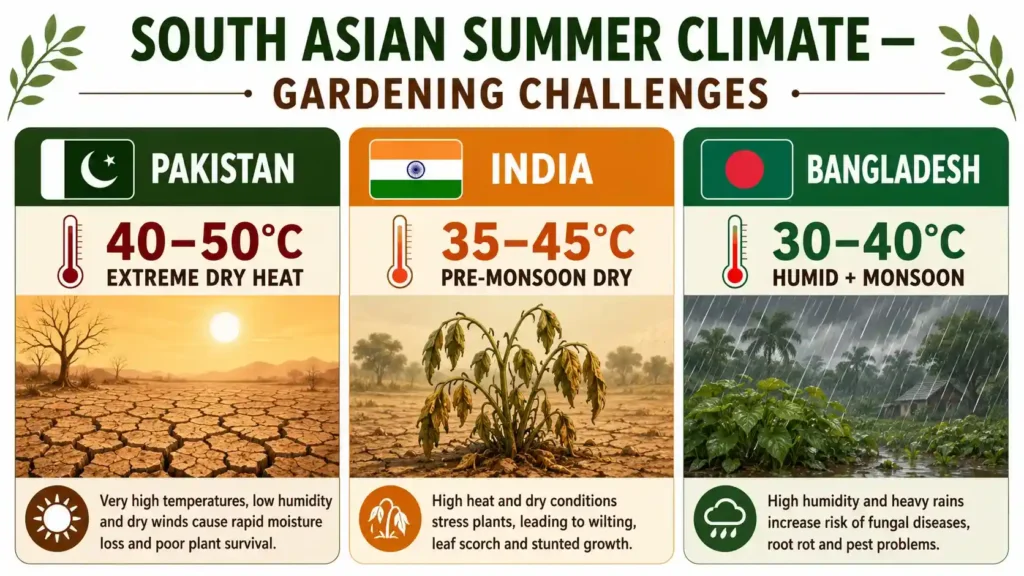
South Asian summer is one of the most demanding climates on earth for gardening. Extreme heat, humidity swings, and water scarcity combine to create conditions where only heat and drought tolerant plants genuinely thrive. Indian summer flowers that survive this season are built differently — with deep roots, thick leaves, or rapid bloom cycles that beat the worst of the heat.
Each country in South Asia presents a distinct challenge:
| Country | Summer Temp | Rainfall Pattern | Key Challenge |
| Pakistan | 40–50°C | Very Low | Extreme dry heat |
| India | 35–45°C | Pre-monsoon dry | Heat + water scarcity |
| Bangladesh | 30–40°C | Humid + monsoon | Humidity + flooding |
- Pakistan experiences some of the most intense dry climate conditions in South Asia — cities like Jacobabad and Sibi regularly record temperatures above 50°C in peak summer. Drought tolerance in plants is non-negotiable here.
- India faces a brutal pre-monsoon period from April to June where heat and drought tolerant plants are the only reliable bloomers. Rainfall is erratic and water scarcity affects millions of gardeners.
- Bangladesh deals with a different challenge — high humidity combined with monsoon flooding followed by dry spells — requiring plants that handle both extremes.
What Makes a Plant Drought Tolerant in South Asian Conditions
Drought tolerant plants are species that survive and actively bloom through extended dry periods with minimal supplemental watering. However, this drought tolerance behavior is not universal and can change significantly depending on climate conditions, as explained in drought-tolerant plants for different climates and regions, where plant survival strategies are compared across global environments. This is the core drought tolerant meaning every South Asian gardener needs to understand before selecting plants for summer.
Drought Tolerant vs Drought Resistant — Key Difference:
| Term | Meaning | South Asian Relevance |
| Drought Tolerant | Thrives through long dry periods with very little water | Essential for Pakistan + pre-monsoon India |
| Drought Resistant | Handles short dry spells but needs regular watering | Suitable for Bangladesh’s mixed wet-dry cycle |
What makes a plant truly drought hardy in South Asian heat:
- Deep or extensive root systems that access subsoil moisture
- Thick, waxy, or succulent leaves that store water internally
- Rapid bloom cycles that complete before peak heat arrives
- High heat tolerance combined with low water dependency
Drought Resistance Definition: The ability of a plant to maintain normal growth and flowering functions under water-deficit conditions — a critical survival trait for South Asian summer gardens.
Drought resistance in plants is not a single trait — it is a combination of physical, physiological, and behavioral adaptations that allow certain species to outperform conventional plants when water is scarce and temperatures are extreme.
Top 10 Summer Flowers in India and South Asia
South Asia is home to some of the most vibrant and resilient summer flowers in the world. The top 10 summer flowers in india and across the region share one critical quality — they bloom beautifully even when temperatures soar and water is scarce. These are the proven summer flowers name in india and Pakistan that gardeners rely on season after season. Every flower listed here is a genuine flowers in summer season in india performer — tested by the region’s most demanding conditions.
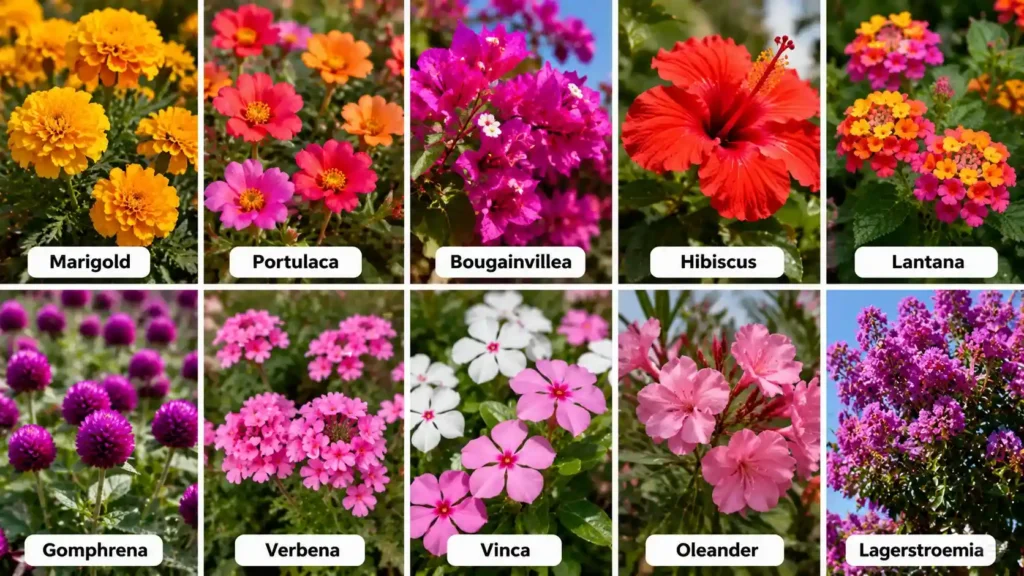
Marigold (Genda Phool)
Marigold is the most beloved and widely grown summer season flower plant in india and Pakistan. It is fully drought tolerant, thrives in full sun, and delivers bold orange and yellow blooms throughout the summer season.
Key Facts:
| Feature | Details |
| Sun Needs | Full sun — 6–8 hours minimum |
| Water Needs | Low — water deeply once or twice a week |
| Zones | Tropical and subtropical — ideal for all South Asia |
| Bloom Time | March through July (marigold flower season in india) |
| Soil | Well-draining, sandy loam |
Marigold is not strictly marigold evergreen — it is an annual that completes its cycle in one season. However, it self-seeds readily, making it appear perennial in South Asian gardens. It is widely available across Pakistan and India at extremely low cost, making it the most practical summer flower for every gardener.
Portulaca (Moss Rose)
Moss rose portulaca is one of the most heat-resistant flowers that bloom in summer across South Asia. It thrives in dry, sandy soil, requires almost no watering once established, and produces jewel-toned blooms in pink, red, orange, yellow, and white.
Key Facts:
| Feature | Details |
| Height | 6–12 inches |
| Bloom Colors | Pink, red, orange, yellow, white, magenta |
| Sun Needs | Full sun — blooms close in shade |
| Water Needs | Very Low — extremely drought tolerant |
| Soil | Sandy, poor, dry soil preferred |
Portulaca is among the finest summer flowering plants in india for dry conditions. Its succulent-type leaves store water internally — making it one of the most reliable flowers that bloom in summer even during Pakistan’s peak heat months.
Bougainvillea
Bougainvillea is South Asia’s most iconic summer blooming flower — a vigorous climber that explodes with color in the hottest months when other plants struggle. It is a defining feature of gardens across India, Pakistan, and Bangladesh.
Key Facts:
| Feature | Details |
| Zones | Tropical and subtropical — all South Asia |
| Bloom Colors | Pink, purple, red, orange, white, yellow |
| Sun Needs | Full sun — minimum 5–6 hours |
| Water Needs | Low once established — drought triggers blooming |
| Maintenance | Annual pruning after bloom cycle |
A key characteristic of bougainvillea as a summer flowering plant is that water stress actually triggers blooming — reducing irrigation in the weeks before flowering produces the most spectacular color displays. It thrives as flowering plants in summer in india along walls, trellises, fences, and as container plants on rooftops.
Hibiscus (Gurhal)
Hibiscus is one of the most recognizable summer blooming plants across South Asia. Known as Gurhal in Urdu and Hindi, it produces large, showy blooms in red, pink, yellow, and white — and handles South Asian summer heat with remarkable ease.
Key Facts:
| Feature | Details |
| Sun Needs | Full sun to partial shade |
| Water Needs | Moderate — more than most drought tolerant species |
| Bloom Season | Year-round in tropics; peak in summer |
| Height | 3–8 feet depending on variety |
Pruning Tips — When to prune hibiscus plant:
- Prune lightly after each bloom flush to encourage new growth
- Major pruning in late February before summer season begins
- Remove dead wood and crossing branches to improve air circulation
- Avoid heavy pruning during peak summer heat
Hibiscus is a staple among flowering plants india gardeners rely on — it tolerates heat, responds well to regular feeding, and produces blooms continuously through the summer months.
Lantana
Lantana is a tough, low-maintenance drought tolerant flowering plant that thrives in South Asian heat and produces cheerful clusters of multi-colored blooms all summer long. It is one of the best summer flowers to plant for gardeners who want color with minimal effort.
Key Facts:
| Feature | Details |
| Bloom Colors | Yellow, orange, pink, red, white — often multicolored |
| Zones | Tropical and subtropical — all South Asia |
| Water Needs | Very Low — highly drought tolerant |
| Sun Needs | Full sun |
| Special Feature | Strong pollinator attractor — butterflies love lantana |
Lantana is among the most heat tolerant plants available for South Asian summer gardens. Once established, it needs almost no supplemental irrigation and continues blooming even during the harshest pre-monsoon months.
Gomphrena (Globe Amaranth)
Gomphrena is one of the best long lasting summer flowers for South Asian conditions. The gomphrena flower season in india runs from late spring through monsoon — making it one of the most extended bloomers among summer season flowers name options available.
Key Facts:
| Feature | Details |
| Height | 12–24 inches |
| Bloom Colors | Purple, pink, white, red, orange |
| Bloom Duration | 3–4 months continuously |
| Sun Needs | Full sun |
| Water Needs | Low — drought tolerant once established |
Gomphrena’s globe-shaped papery blooms hold their color even when dried — making them popular for both garden display and decorative use. They are one of the most reliable summer blooming flowers for hot, dry conditions across Pakistan and India.
Verbena
Verbena is an excellent ground cover and border summer flowering plant that performs well in dry conditions across South Asia. The verbena flower season in india aligns perfectly with the hot summer months — producing clusters of small bright blooms in purple, pink, red, and white.
Key Facts:
| Feature | Details |
| Height | 6–18 inches (spreading habit) |
| Bloom Colors | Purple, pink, red, white, lavender |
| Sun Needs | Full sun |
| Water Needs | Low — tolerates dry spells well |
| Best Use | Ground cover, borders, hanging baskets |
Verbena is among the most reliable summer blooming flowers for filling gaps in garden beds and spilling over container edges. It stays compact, spreads attractively, and delivers continuous color through the hottest summer weeks as one of the most dependable summer flowering plants for South Asian home gardens.
Vinca (Periwinkle / Sadabahar)
Vinca is one of the most dependable all time flowering plants in india and across South Asia. Known as Sadabahar in Pakistan and India — meaning “always blooming” — it lives up to its name by producing consistent flowers through the harshest summer months with almost no special care.
Key Facts:
| Feature | Details |
| Sun Needs | Full sun to partial shade |
| Water Needs | Very Low — highly drought tolerant |
| Bloom Colors | Pink, white, red, purple, lavender |
| Height | 12–18 inches |
| Bloom Season | Year-round — peak in summer |
Vinca is a standout summer season flower plant for South Asian conditions because it handles both dry heat and humidity with equal reliability. In Pakistan, Sadabahar is one of the most commonly grown summer flowers in india with name recognition that extends across the entire subcontinent — found in home gardens, roadside plantings, and urban green spaces alike.
Quick Tip: Vinca requires almost no maintenance — deadheading is not necessary, and it self-branches naturally to produce a full, bushy display all season long.
Oleander (Kaner)
Oleander is a drought hardy shrub and small tree that produces beautiful clusters of blooms through intense South Asian summer heat. Oleander flowering peaks in summer — making it one of the most visually impactful drought resistant plants for large garden spaces and roadside plantings.
Key Facts:
| Feature | Details |
| Height | 6–12 feet (shrub to small tree form) |
| Bloom Colors | Pink, red, white, yellow, salmon |
| Zones | Tropical and subtropical — all South Asia |
| Sun Needs | Full sun |
| Water Needs | Very Low — extremely drought tolerant |
Oleander is commonly seen lining roads and highways across Pakistan and India — proof of its ability to thrive in compacted, poor soil with zero supplemental irrigation. It is among the toughest summer flowering trees in india and Pakistan available for large-scale planting.
⚠️ Important Toxicity Warning: All parts of oleander — leaves, flowers, stems, and sap — are highly toxic if ingested by humans, children, or animals. Handle with gloves and keep away from children and pets. Despite its beauty, oleander must be planted with full awareness of its toxicity.
Lagerstroemia (Pride of India / Crepe Myrtle)
Lagerstroemia speciosa — known as Pride of India — is one of South Asia’s most spectacular summer flowering trees. It produces large, crinkled blooms in pink, purple, and white during peak summer, and its drought tolerance makes it a premier choice among flowering trees of india for hot, dry conditions.
Key Facts:
| Feature | Details |
| Height | 15–30 feet (tree form) |
| Bloom Colors | Pink, purple, lavender, white |
| Bloom Season | May through August — peak summer |
| Sun Needs | Full sun |
| Water Needs | Low — drought tolerant once established |
| Soil | Well-draining, tolerates poor soil |
Lagerstroemia speciosa plant is widely planted across India and Pakistan in parks, avenues, and large gardens. Its peeling bark adds year-round ornamental interest, while its summer bloom display rivals almost any other flowering tree in the region.
Among summer flowering trees in india, Lagerstroemia stands out for combining genuine drought resilience with large-scale visual impact — producing hundreds of blooms simultaneously across its spreading canopy during the hottest months of the year.
Drought-Tolerant Summer Flowers for Small Spaces and Rooftop Gardens
Limited space is no barrier to a beautiful summer garden in South Asia. The right summer plants for home — chosen specifically for heat tolerance and low water needs — transform balconies, terraces, and rooftops into vibrant green spaces. Small flower plants in india and across South Asia that are drought tolerant deliver maximum color with minimum investment of space, water, and time. These are the summer flowers name every urban gardener needs to know.
Best Summer Flowers for Pots and Containers
Container gardening is the most practical solution for South Asian urban gardeners — and drought tolerant summer plants make it genuinely easy.
For broader seasonal growing techniques, watering practices, and soil preparation tips, our gardening and plant care guide covers the fundamentals every home gardener should understand before starting a summer garden.
Pots and containers allow full control over soil quality, drainage, and placement, making them ideal for balconies, courtyards, and rooftops.
Best Picks for Pots and Containers:
| Plant | Container Size | Sun Needs | Watering Frequency |
| Portulaca | Small–Medium | Full Sun | Every 5–7 days |
| Vinca (Sadabahar) | Small–Medium | Full/Part Sun | Every 5–7 days |
| Marigold | Medium | Full Sun | Every 3–4 days |
| Lantana | Medium–Large | Full Sun | Every 7–10 days |
Container Tips for South Asian Summer:
- Soil Mix: Use a well-draining mix of garden soil + coarse sand + compost in equal parts. Avoid heavy clay-based soil in containers — it retains too much moisture and causes root rot in summer heat.
- Drainage: Every pot must have drainage holes — standing water in containers is the fastest way to lose plants in South Asian humidity.
- Watering Frequency: Water seasonal plants for summer in containers in the early morning before 9 AM — containers dry out significantly faster than ground beds in South Asian heat.
- Pot Size: Bigger pots retain moisture longer — ideal for summer plant growth in extreme heat conditions.
Quick Tip: Terracotta pots breathe naturally but dry out faster. In peak South Asian summer, plastic or glazed ceramic pots retain moisture longer — better for plant summer flowers during the hottest weeks.
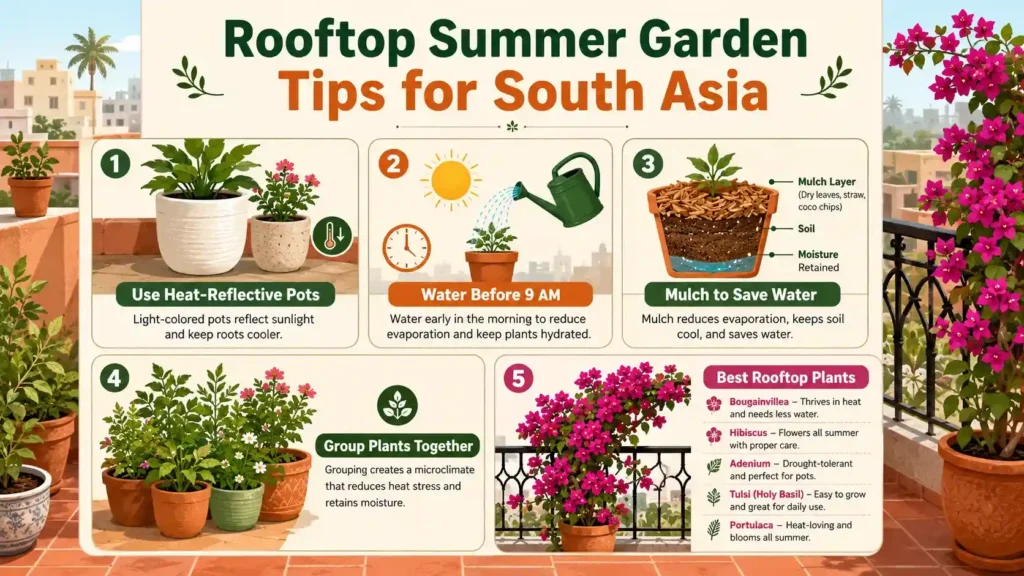
Rooftop Gardening in Pakistan, India, Bangladesh — Summer Tips
Rooftop gardens are rapidly becoming the most popular form of urban gardening across South Asian cities. In Karachi, Delhi, Mumbai, and Dhaka — where ground space is scarce — rooftop summer gardens offer a practical and beautiful solution. The right summer plants in india and South Asia make rooftop gardening viable even through the most intense heat.
Best Plants for Rooftop Summer Gardens:
- 🌸 Bougainvillea — trains along railings and walls, needs minimal water, provides dramatic color
- 🌺 Hibiscus — thrives in large containers on rooftops, handles full sun and heat
- 🌼 Portulaca — perfect for shallow rooftop containers, extremely drought tolerant
- 🌿 Vinca — cascades beautifully over rooftop container edges, blooms continuously
- 🌻 Lantana — attracts butterflies, handles rooftop wind and heat well
Rooftop Summer Garden Tips:
- Heat-Reflective Pots: Use light-colored or white pots on rooftops — dark pots absorb heat and can cook roots in South Asian summer temperatures
- Morning Watering: Always water rooftop summer season plants before 9 AM — midday watering evaporates instantly and can scorch leaves
- Mulching: Add a 1–2 inch layer of dry leaves or coco peat on top of container soil to reduce evaporation significantly
- Wind Protection: Rooftop wind increases water loss — group containers together and use taller plants as windbreaks for smaller ones
- Weight Consideration: Use lightweight plastic containers for rooftop summer garden setups to avoid structural overload
Water-Saving Tips for South Asian Summer Gardens
Water scarcity is the defining challenge of South Asian summer gardening. Drought resistance in plants helps — but smart watering practices reduce water consumption by up to 50% regardless of which plants you grow. Understanding drought tolerant meaning goes beyond plant selection — it includes how you manage water at every stage of your summer garden.
Top Water-Saving Techniques:
- Morning Watering Water all drought hardy plants early morning before 9 AM. Evaporation rates are lowest at this time — more water reaches roots rather than evaporating in the air.
- Deep Watering Water slowly and deeply rather than frequently and shallowly. Deep watering encourages roots to grow downward, making plants to plant in summer naturally more drought resilient over time.
- Mulching Apply 2–3 inches of dry grass, coco peat, or leaf litter around plant bases. Mulching reduces soil surface evaporation by up to 70% — critical in South Asian summer heat.
- Grouping Plants Together Place pots and plants close together. Grouped plants create a micro-humid environment that reduces individual water loss from each plant.
- Watering Frequency Guide:
| Plant Stage | Watering Frequency |
| Newly planted | Every 2–3 days |
| Establishing (weeks 3–6) | Every 4–5 days |
| Fully established | Once per week or less |
| Succulents/Portulaca | Every 7–10 days |
Quick Fact: South Asian gardeners who switch to morning deep watering combined with mulching typically reduce their garden water consumption by 40–50% through peak summer months.
Seasonal Flowering Plants for South Asian Summer — Month by Month
Understanding which seasonal flowers in india and South Asia perform best in each month is the foundation of a successful summer garden. Seasonal flowers for summer follow a clear pattern across Pakistan, India, and Bangladesh — and knowing which flowers grow in summer season month by month eliminates guesswork and maximizes bloom time. This summer season flowers name list in india covers every critical phase from pre-summer preparation through monsoon management.
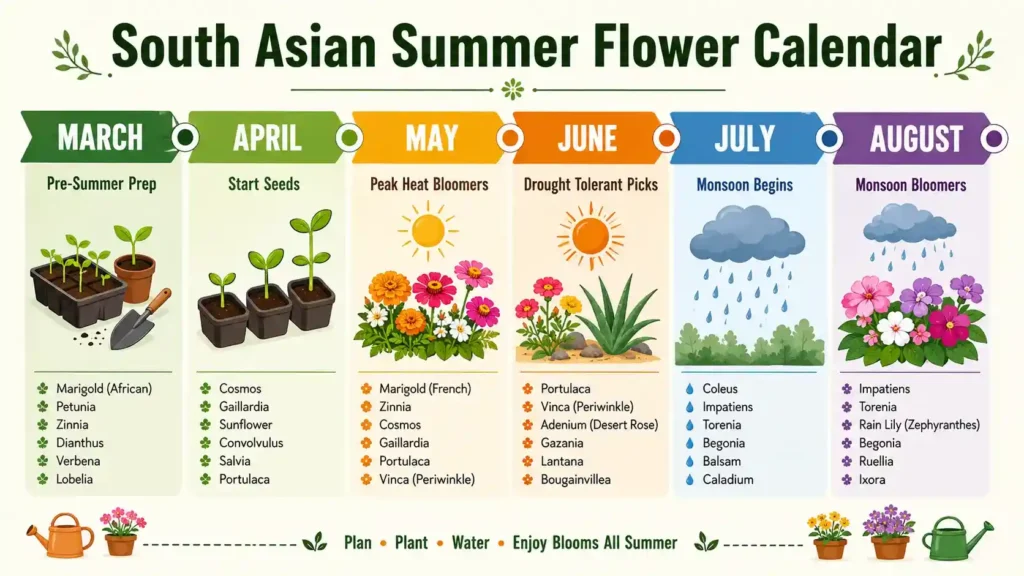
March–April — Pre-Summer Planting
March and April are the most important months for summer garden preparation across South Asia. These are the last comfortable weeks before peak heat arrives — the ideal window for starting spring season flowers in india and laying the groundwork for a full summer display.
Best Plants to Start in March–April:
- Marigold — sow seeds directly or transplant seedlings; establishes quickly before peak heat
- Portulaca — scatter seeds in well-draining soil; germinates fast in warming March temperatures
- Vinca (Sadabahar) — start from seeds or cuttings; establish root systems before summer heat intensifies
- Lantana — transplant established plants; roots settle well in April warmth
- Gomphrena — direct sow in April; heat-adapted and ready to bloom by June
Summer flowers to plant in March–April — Preparation Tips:
- Prepare beds with well-draining sandy loam + compost before planting
- Add a layer of mulch immediately after planting to retain early-season moisture
- Water newly planted seedlings every 2–3 days until established
- Avoid planting in low-lying areas that flood during monsoon — drainage problems begin here
- Harden off any indoor-started seedlings gradually before full outdoor exposure
Quick Tip: Flowers planted in summer preparation window of March–April develop stronger root systems and survive peak May–June heat far better than plants installed directly into summer conditions.
May–June — Peak Summer Blooms
May and June represent South Asia’s most intense summer period — temperatures regularly cross 40°C across Pakistan and northern India, and water scarcity peaks. Only truly heat-adapted summer flowers in india and South Asia continue blooming reliably during these months.
Summer season flowers in india during May–June must handle:
- Extreme soil surface temperatures
- Minimal rainfall and high evaporation
- Strong, drying winds in Pakistan and northwestern India
- High humidity in coastal India and Bangladesh
Best Picks for May–June Peak Summer:
| Plant | Why It Works in May–June |
| Bougainvillea | Thrives in heat + water stress triggers blooming |
| Lantana | Blooms continuously in full sun with minimal water |
| Gomphrena | Heat-adapted, long-lasting blooms through June |
| Oleander | Peak oleander flowering coincides with May–June heat |
| Portulaca | Stores water internally — performs best in dry June heat |
| Vinca | Reliable may flower plant india — blooms regardless of heat |
Flowers in summer season in india during May and June are dominated by these heat-hardy species. Conventional flowers like petunias and pansies fail completely in this window — only drought tolerant heat-adapted species deliver consistent garden color.
Quick Tip: Reduce watering frequency in June for Bougainvillea specifically — mild water stress during this period triggers its most spectacular bloom flush.
July–August — Monsoon Season Flowers
July and August bring the monsoon across most of South Asia — transforming the gardening challenge from drought management to humidity and waterlogging management. Summer flowering plants in india during monsoon must handle excess moisture, fungal pressure, and reduced sunlight while continuing to bloom.
Plants flowering in summer through the monsoon need different management than dry-season plants — drainage and disease prevention become the primary concerns.
Best Picks for July–August Monsoon Season:
- Hibiscus — thrives in monsoon warmth and humidity; produces its largest blooms in July–August
- Marigold — continues blooming through monsoon; self-seeds prolifically in wet conditions
- Vinca — handles both dry and wet cycles; monsoon actually boosts its growth
- Bougainvillea — reduce watering completely during monsoon; natural rainfall is sufficient
- Lantana — monsoon rain reinvigorates lantana; produces fresh bloom flushes after rain
Monsoon Garden Management Tips:
- Drainage First: Ensure all containers and garden beds have clear drainage — waterlogging kills roots faster than drought in monsoon conditions
- Fungal Disease Prevention: Increase air circulation between plants; avoid overhead watering during monsoon as leaves stay wet too long
- Reduce Fertilizing: Monsoon leaches nutrients rapidly — apply slow-release fertilizer at season start rather than frequent liquid feeding
- Stake Tall Plants: Heavy monsoon rain and wind can damage tall flowering plants in summer in india — stake Hibiscus, Marigold, and Gomphrena before monsoon arrives
- Watch for Root Rot: Even drought tolerant species can develop root rot in waterlogged monsoon soil — raise containers slightly to improve drainage
Quick Summary: July–August monsoon gardening is about protection, not planting. Manage drainage, prevent fungal issues, and let established plants respond naturally to the welcome rainfall.
Drought-Tolerant Flowering Trees of India and South Asia
South Asia is home to some of the most spectacular summer flowering trees in the world. These beautiful trees in india and Pakistan line avenues, shade gardens, and transform entire landscapes with seasonal color — all while requiring minimal water once established. The best flowering trees of india for summer combine genuine drought resilience with stunning visual impact and, in some cases, valuable fragrant trees in india qualities that add sensory richness to any garden or streetscape.
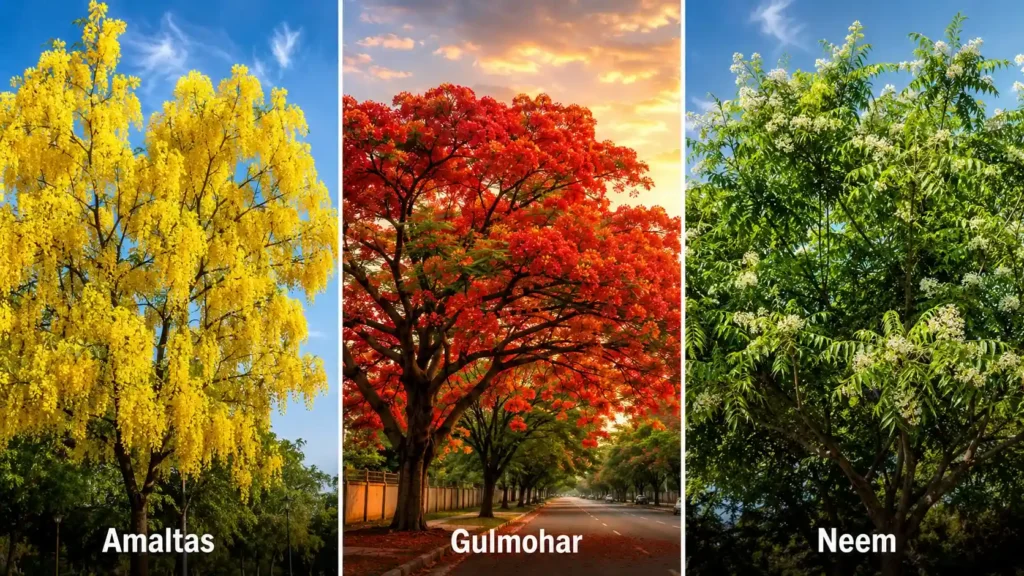
Amaltas (Golden Shower Tree)
Amaltas is one of the most iconic and most beautiful tree in india and Pakistan — a true symbol of South Asian summer. Its cascading golden-yellow flower clusters appear in May and June, transforming entire trees into stunning curtains of gold during peak drought conditions.
Key Facts:
| Feature | Details |
| Scientific Name | Cassia fistula |
| Height | 25–40 feet |
| Bloom Color | Bright golden yellow |
| Bloom Season | May–June — peak summer |
| Sun Needs | Full sun |
| Water Needs | Very Low — highly drought tolerant |
| Zones | Tropical and subtropical South Asia |
Amaltas is among the finest flowering trees of india for summer because it blooms most prolifically during the driest, hottest weeks of the year. It is the national flower of Thailand and is deeply embedded in South Asian cultural and religious traditions.
As one of the most reliable summer flowering trees in india, Amaltas requires no supplemental irrigation once established — its deep root system accesses groundwater effectively even during prolonged dry spells across Pakistan and northern India.
Quick Tip: Amaltas blooms before its leaves fully emerge in summer — giving it a spectacular bare-tree-full-of-flowers appearance that makes it one of the most visually dramatic flowering trees of india during May and June.
Gulmohar (Flame Tree / Delonix regia)
Gulmohar is arguably South Asia’s most spectacular summer flowering tree — and one of the most beautiful trees in india by any measure. Its fiery red-orange blooms cover the entire canopy in May and June, creating one of the most dramatic natural color displays in any South Asian city or garden.
Key Facts:
| Feature | Details |
| Scientific Name | Delonix regia |
| Height | 30–50 feet |
| Bloom Color | Brilliant red-orange with yellow accents |
| Bloom Season | May–July — peak summer |
| Sun Needs | Full sun |
| Water Needs | Low — drought tolerant once established |
| Canopy Spread | Up to 50 feet wide |
Gulmohar is the most recognizable tree flower name in South Asian cities — its flame-colored blooms are impossible to miss against a clear summer sky. Flowers grow on trees in india in many forms, but none match the sheer visual intensity of a mature Gulmohar in full summer bloom.
Its wide spreading canopy provides valuable shade — reducing ground temperature beneath the tree significantly and creating a cooler microclimate for surrounding plants and people during South Asian summer.
Quick Tip: Gulmohar is a fast-growing tree — it can reach flowering size within 5–7 years from planting. It is best planted where its wide canopy has room to spread without obstruction.
Neem Tree (Azadirachta indica)
Neem is Pakistan and India’s most drought hardy and ecologically valuable tree — a true survivor that thrives in the harshest South Asian conditions. As one of the most important fragrant trees in india, Neem produces small white flowers in summer that release a distinctive mild fragrance across entire neighborhoods.
Key Facts:
| Feature | Details |
| Scientific Name | Azadirachta indica |
| Height | 50–65 feet at maturity |
| Flower Color | Small white fragrant clusters |
| Bloom Season | March–May |
| Sun Needs | Full sun |
| Water Needs | Extremely Low — supreme drought resistance plant |
| Lifespan | 150–200 years |
Neem is the ultimate drought resistance plant for South Asian conditions. It grows in rocky, sandy, and poor soils where virtually no other tree survives — making it invaluable for reforestation, urban planting, and farm boundary use across Pakistan, India, and Bangladesh.
Beyond its role as a summer flowering trees in india species, Neem delivers exceptional practical value:
- Medicinal: Leaves, bark, and seeds used in traditional medicine across South Asia
- Pest Control: Neem oil is a natural pesticide widely used in organic gardening
- Air Quality: Dense canopy filters dust and pollutants — critical in South Asian cities
- Shade: Provides deep cooling shade that reduces surrounding temperatures in summer
Quick Fact: Neem is one of the few trees that can survive Pakistan’s extreme Thar Desert conditions and India’s arid Rajasthan — making it the most climate-resilient flowering tree in all of South Asia.
How to Grow Summer Flowers Successfully in South Asian Heat
Growing summer flowers to plant successfully in South Asian conditions requires more than just choosing the right species. Soil preparation, watering discipline, and sunlight management are the three foundational practices that determine whether flowers to plant in summer thrive or struggle. Plants to plant in summer across Pakistan, India, and Bangladesh need a complete support system — not just good genetics. These are the expert techniques that make summer growing flowers genuinely successful in the region’s most demanding conditions.
Soil Preparation for South Asian Summer Gardens
Well-draining soil combined with organic matter is the single most important foundation for any South Asian summer garden. Drought resistance in plants starts from the ground up — even the most heat-adapted dry climate plants will fail in compacted, waterlogged, or nutrient-depleted soil.
The Ideal South Asian Summer Soil Mix:
| Component | Proportion | Purpose |
| Sandy Loam | 50% | Base drainage + aeration |
| Compost | 30% | Nutrients + moisture retention balance |
| Perlite or Coarse Sand | 20% | Additional drainage + root aeration |
Soil Preparation Tips:
- Sandy Loam Base: Sandy loam drains excess water quickly while retaining just enough moisture for root uptake — the ideal balance for South Asian summer conditions
- Compost Addition: Well-decomposed compost improves soil structure, adds slow-release nutrients, and supports beneficial microbial activity that strengthens plant health through summer stress
- Perlite Use: Adding perlite to container mixes and heavy garden soils improves drainage significantly — critical for preventing root rot during monsoon transition
- Avoid Pure Clay: Heavy clay soil retains too much moisture around roots in monsoon and bakes rock-hard in dry summer heat — both conditions are lethal for most summer flowers
- Bed Depth: Prepare beds to at least 12 inches depth — shallow soil limits root development and reduces drought tolerance naturally
Quick Tip: For drought tolerant crops and flowers in South Asian gardens, lean soil actually performs better than overly enriched soil. Excess nitrogen from heavy fertilizing produces lush foliage but reduces flowering and drought hardiness.
Watering Schedule for South Asian Summer
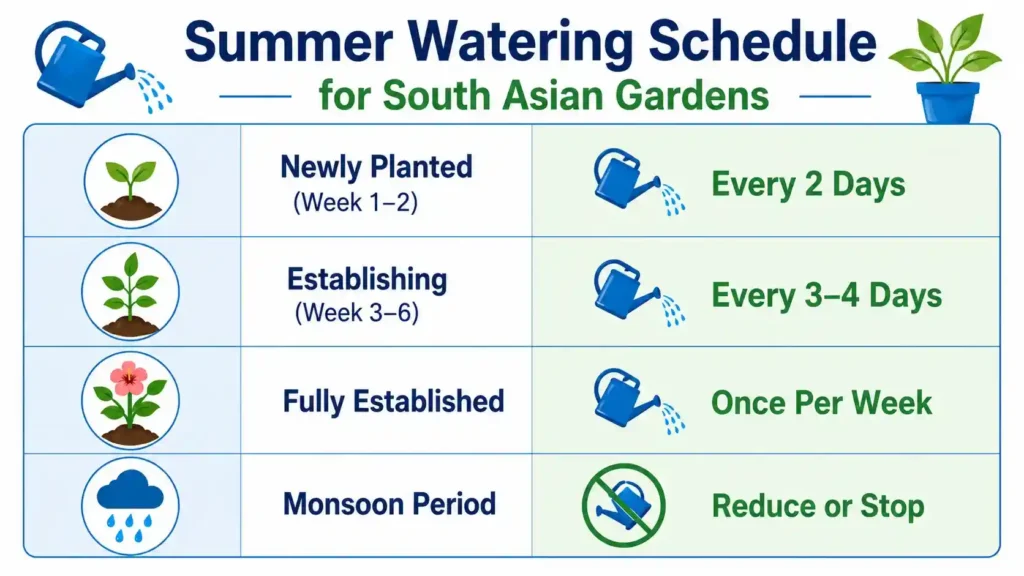
Morning watering combined with deep root watering is the most effective irrigation approach for South Asian summer plants. This single practice — done consistently — dramatically improves plant health, reduces water consumption, and strengthens drought tolerant meaning in practice rather than just theory.
When to Water:
- Best time: Early morning — before 9 AM
- Why: Evaporation rates are lowest; water reaches roots before heat intensifies
- Avoid: Midday watering — water evaporates before reaching roots and wet foliage scorches in direct sun
- Avoid: Evening watering — leaves stay wet overnight, encouraging fungal disease in South Asian humidity
How to Water:
- Water slowly and deeply at the base of plants
- Allow water to penetrate 6–8 inches into the soil
- Avoid frequent shallow watering — it creates surface-dependent roots that are more vulnerable to drought
Watering Frequency Guide:
| Plant Stage | Summer Plants Frequency | Notes |
| Newly planted (week 1–2) | Every 2 days | Establishment critical |
| Establishing (week 3–6) | Every 3–4 days | Roots developing |
| Fully established | Once per week | Deep watering only |
| Peak heat (45°C+) | Every 5 days | Monitor wilting |
| Monsoon period | Reduce or stop | Natural rainfall sufficient |
Quick Answer: What is drought tolerant meaning in practice? It means that once established with proper deep watering habits, summer season plants need far less water than conventional gardening wisdom suggests — often 50–60% less.
Sunlight Management in Extreme Heat
Afternoon shade is one of the most underused and most effective tools for protecting plants heat tolerant species and even full sun drought tolerant plants from South Asian summer damage. While most summer season flower plant selections love full sun, the difference between 6 hours of morning sun and 6 hours of afternoon sun in South Asia is enormous — afternoon sun at 42°C causes heat stress even in the toughest species.
Sunlight Management Strategies:
- Shade Cloth: Install 30–40% shade cloth over vulnerable plants during May–June peak heat. This reduces leaf surface temperature by 5–8°C — enough to prevent heat scorch on even drought tolerant species during extreme events.
- East-Facing Placement: Position plants to receive morning sun (cooler, gentler) and natural shade in the afternoon. East-facing walls and beds are ideal for most South Asian summer flowers — they get sufficient light without the brutal 2–5 PM heat exposure.
- Companion Planting: Use taller plants like Hibiscus or Bougainvillea as natural shade providers for smaller, more sensitive summer flowers planted beneath or beside them. This creates a natural layered microclimate that reduces overall garden temperature.
- White Wall Reflection: Avoid planting directly against south-facing white walls in South Asian summers — reflected heat from white surfaces can create temperatures 10–15°C above ambient air temperature.
Sunlight Needs by Plant Type:
| Plant | Ideal Sun Exposure | Afternoon Protection Needed |
| Portulaca | Full Sun | No — thrives in full afternoon heat |
| Marigold | Full Sun | Light shade beneficial above 42°C |
| Hibiscus | Full/Part Sun | Yes — afternoon shade improves blooming |
| Vinca | Full/Part Sun | Partial afternoon shade extends bloom |
| Bougainvillea | Full Sun | No — heat stress triggers blooming |
Quick Summary: For most South Asian summer gardens, 5–6 hours of morning sun combined with natural afternoon shade produces better blooming, healthier plants, and longer-lasting color than unprotected full-day sun exposure during peak summer months.
Benefits of Growing Drought-Tolerant Summer Flowers in South Asia
Choosing drought tolerant plants for a South Asian summer garden delivers benefits that extend far beyond simply keeping flowers alive in the heat. Drought resistance plants actively contribute to water conservation, urban ecology, personal wellbeing, and household savings. Seasonal flowering plants that are heat and drought adapted are not a compromise — they are the smartest, most sustainable choice for South Asian gardeners. Here is why growing adaptable garden flowers this summer makes complete sense across Pakistan, India, and Bangladesh.
1. Water Conservation
Water scarcity is one of South Asia’s most pressing real-world challenges — and drought tolerant summer flowers are a direct, practical response to it.
- Established drought tolerant plants use 50–70% less water than conventional garden flowers
- In Pakistan, where water tables are critically low in many regions, drought-adapted gardens reduce household water consumption meaningfully
- India faces seasonal water crises in multiple states — drought tolerant gardens remove the conflict between beautiful outdoor spaces and responsible water use
- Bangladesh’s monsoon-to-dry-season cycle makes water-efficient plants essential for year-round garden sustainability
Quick Fact: A single traditional flower bed in South Asia can consume 200–300 liters of water per week in peak summer. An equivalent drought tolerant bed needs as little as 50–80 liters — a saving of over 60%.
2. Low Maintenance
Drought tolerant summer flowers are ideal for South Asia’s increasingly busy urban lifestyle — they deliver beauty without demanding constant attention.
- No daily watering schedules to manage
- Most species require minimal pruning and deadheading
- Drought adapted plants recover quickly from missed waterings — forgiving for busy gardeners
- Less fertilizing needed — most drought tolerant species thrive in lean soil conditions naturally
- Reduced pest pressure — stressed overwatered plants attract more pests than healthy drought tolerant ones
Many gardeners also combine these blooms with other outdoor low maintenance plants to create landscapes that stay attractive through extreme summer conditions with minimal upkeep.
3. Pollinator Support
South Asian drought tolerant summer flowers are among the most valuable plants for supporting local pollinator populations during the harshest season.
- Bees — Marigold, Lantana, and Vinca are premier nectar sources for bees through summer
- Butterflies — Lantana, Verbena, and Gomphrena attract multiple butterfly species consistently
- Birds — Hibiscus and Bougainvillea attract sunbirds and other nectar-feeding birds
Pollinator populations across South Asia face growing pressure from urbanization and pesticide use. A drought tolerant summer garden filled with adaptable garden flowers provides critical food sources through the months when wild flowering plants are most scarce.
4. Mental Wellness
Green spaces in dense South Asian cities deliver proven mental health benefits — and drought tolerant gardens make those spaces accessible to everyone regardless of water availability.
- Studies consistently show that exposure to flowering plants reduces stress, anxiety, and fatigue
- Rooftop and balcony gardens in Karachi, Delhi, Mumbai, and Dhaka provide psychological relief from urban density
- Tending a summer garden — even a small container display — provides meaningful daily routine and a sense of accomplishment
- Colorful seasonal flowering plants create visually stimulating environments that improve mood and focus in home and work spaces
5. Cost Savings
The financial benefit of drought tolerant summer flowers compounds over time — season after season.
- Lower monthly water bills throughout the entire summer period
- Drought tolerant perennials like Bougainvillea and Lantana return year after year — eliminating annual replanting costs
- Less spending on replacement plants — drought adapted species survive conditions that kill conventional flowers
- Reduced need for fertilizers and soil amendments — drought tolerant species perform well in naturally lean South Asian soils
Quick Estimate: South Asian households that convert conventional summer beds to drought tolerant plantings commonly report 30–50% reductions in summer gardening costs when water, plant replacement, and maintenance are calculated together.
6. Environmental Benefits
Beyond individual gardens, widespread adoption of drought tolerant summer flowers contributes to broader environmental health across South Asian cities.
- Urban Heat Island Reduction: Dense rooftop and balcony gardens with drought tolerant plants reduce surface temperatures in urban areas — a critical benefit in cities like Karachi, Delhi, and Dhaka where urban heat islands are intensifying
- Biodiversity Support: Native and adapted drought tolerant species support local insect, bird, and pollinator biodiversity
- Soil Health: Deep-rooted drought tolerant plants improve soil structure and prevent erosion — valuable in both urban and peri-urban South Asian environments
- Carbon Sequestration: Even small garden spaces with drought tolerant trees and shrubs like Neem and Bougainvillea contribute meaningfully to urban carbon absorption
- Air Quality: Leafy drought tolerant plants filter dust particles — particularly valuable in South Asian cities with high particulate pollution levels
Conclusion
A thriving summer garden in South Asia is not a luxury reserved for those with abundant water or large spaces. The seasonal plants and flowers covered in this guide prove that flowers during summer — even in Pakistan’s 50°C heat, India’s blazing pre-monsoon weeks, and Bangladesh’s humid summers — can be vibrant, colorful, and genuinely beautiful with the right plant choices.
Here is what this guide covered:
- Why South Asia’s summer climate demands drought tolerant plants specifically
- The top 10 summer flowers in india and across South Asia — from Marigold and Portulaca to Bougainvillea and Vinca
- Rooftop and container gardening solutions for small urban spaces
- A month-by-month seasonal planting calendar from March through August
- South Asia’s most spectacular drought tolerant flowering trees — Amaltas, Gulmohar, and Neem
- Complete growing guidance — soil preparation, watering schedules, and sunlight management
- The full range of benefits from water savings to urban environmental impact
June is here — and across Pakistan, India, and Bangladesh, summer gardens are at their most demanding and most rewarding simultaneously. The plants that thrive right now are the ones built for this exact moment — heat-adapted, drought tolerant, and genuinely gorgeous.
This summer, fill your South Asian garden with these beautiful drought-tolerant flowers. Whether you have a rooftop in Karachi, a balcony in Mumbai, or a courtyard in Dhaka — these plants will deliver color, life, and beauty through every hot week ahead.
📸 Growing a summer garden in South Asia? Share your garden photos in the comments — we would love to see how these flowers are thriving in your space.
🌿 Want more seasonal plants and flowers guides for South Asian gardens? Subscribe for monthly planting calendars, regional gardening tips, and the best drought tolerant plant recommendations for every season of the year.
Frequently Asked Questions (FAQs)
Which are the top 10 summer flowers in India and South Asia?
The top 10 summer flowers name in india and across South Asia are Marigold, Portulaca, Bougainvillea, Hibiscus, Lantana, Gomphrena, Verbena, Vinca, Oleander, and Lagerstroemia. All ten are proven indian summer flowers that handle South Asian heat and water scarcity while delivering consistent color and bloom performance through the entire summer season.
Which flowers bloom in summer season in India and Pakistan?
The most reliable flowers in summer season in india and Pakistan are Marigold, Vinca, Bougainvillea, Hibiscus, and Portulaca. These five represent the core summer season flowers name that gardeners across South Asia depend on — they bloom continuously through peak heat, require minimal water, and are widely available across the region.
What are the best summer plants for home gardens in South Asia?
The best summer plants for home and summer plants for home in india are Portulaca, Vinca, Marigold, and Lantana. All four thrive in containers and small spaces — making them ideal for urban homes, balconies, and rooftop gardens. These small flower plants in india are low maintenance, drought tolerant, and deliver maximum color with minimum space and water requirements.
How do I care for summer flowers in extreme South Asian heat?
Four core practices keep summer season plants and summer flowering plants healthy in extreme South Asian heat. First, water early morning before 9 AM to minimize evaporation. Second, use well-draining soil to prevent root rot during monsoon transition. Third, apply mulch around plant bases to reduce soil evaporation by up to 70%. Fourth, provide afternoon shade during peak heat months — even drought tolerance in plants has limits above 45°C. These four practices together significantly improve survival and blooming rates through the harshest summer weeks.
What is the difference between drought tolerant and drought resistant plants?
Drought tolerant meaning refers to plants that actively thrive through extended dry periods — surviving weeks or months with minimal water while continuing to grow and bloom. Drought resistant meaning refers to plants that can handle short dry spells but need regular watering to stay healthy long term. The drought resistance definition is narrower — it describes stress tolerance during brief water shortages, not sustained dry-season performance. For South Asian summer gardening, always prioritize genuinely drought tolerant species over merely drought resistant ones.
Which flowering trees are best for South Asian summer gardens?
The three best summer flowering trees in india and South Asia are Amaltas, Gulmohar, and Neem. Amaltas produces cascading golden blooms in May–June during peak drought. Gulmohar delivers the most visually spectacular red-orange canopy display of any of the most beautiful trees in india during summer. Neem is the supreme drought resistance tree — fragrant, medicinal, and capable of surviving the harshest conditions across all South Asian climates. All three are among the finest flowering trees of india for summer drought tolerance combined with ornamental value.

Written by the LeafyHeaven Editorial Team
LeafyHeaven shares practical gardening tips and simple plant care guides to help you grow, nurture, and enjoy your plants with ease. Our goal is to make gardening feel natural, approachable, and rewarding for everyone.