
Introduction
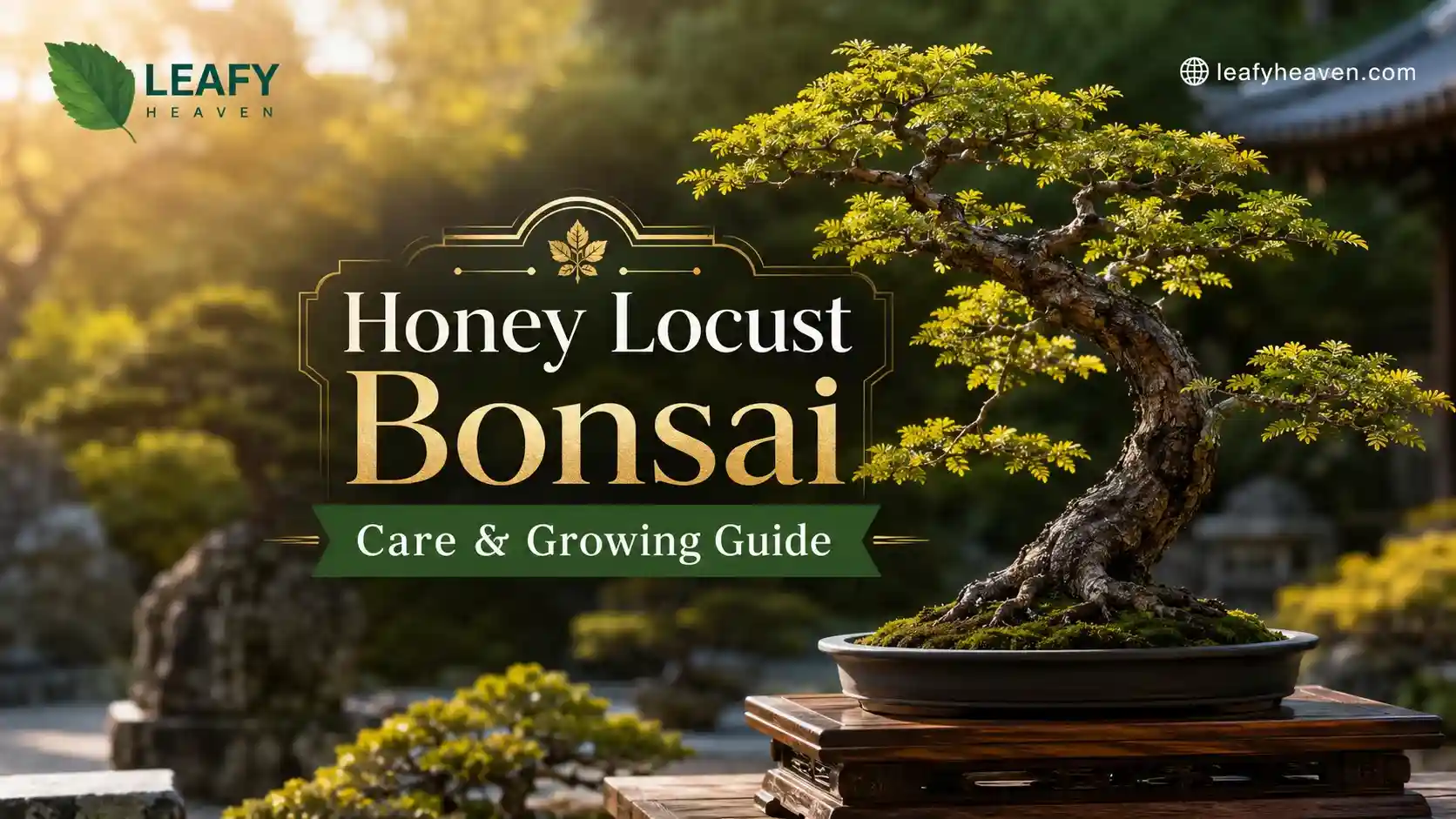
Honey locust bonsai is a fast-growing deciduous bonsai tree created from Gleditsia triacanthos, valued for its delicate foliage, rugged bark, airy canopy, and strong adaptability. Bonsai growers appreciate this species because it develops elegant branching quickly while tolerating pruning, drought, and seasonal climate changes well.
A honey locust bonsai is a miniature trained version of the honey locust tree. Through pruning, root restriction, wiring, and seasonal shaping, growers transform this naturally tall landscape tree into a compact bonsai with fine-textured foliage and an open canopy structure. Its naturally compound leaves create a light, refined appearance that suits many classic bonsai styles.
The botanical name of the species is Gleditsia triacanthos. It belongs to the Fabaceae family and is widely grown in Australia, the USA, and many temperate regions worldwide because of its durability and adaptability.
Several forms of locust bonsai are commonly confused with one another:
- Honey locust bonsai refers to bonsai developed from Gleditsia triacanthos
- Thorny locust bonsai includes traditional honey locust varieties with large branching thorns
- Thornless honey locust tree bonsai comes from thornless cultivars like Gleditsia triacanthos var. inermis
- Black locust bonsai refers to Robinia pseudoacacia bonsai, which is a different species with distinct leaves, bark, and thorn structure
Most bonsai enthusiasts prefer thornless honey locust varieties because they are easier to maintain and safer to handle during pruning and wiring work.
Honey locust bonsai trees are popular because they offer several bonsai-friendly characteristics:
- Fine compound leaves that create delicate foliage pads
- Elegant branching patterns with airy structure
- Fast trunk and branch development
- Strong drought tolerance once established
- Excellent response to pruning and training
These trees perform especially well in outdoor bonsai collections. They are suitable for many parts of Australia, large areas of the United States, and other temperate climates worldwide where seasonal dormancy naturally occurs.
Quick Summary
| Feature | Details |
| Growth Speed | Fast |
| Difficulty Level | Moderate |
| Indoor/Outdoor Suitability | Best outdoors |
| Thorn Presence | Thorny and thornless varieties available |
| Ideal Bonsai Styles | Informal upright, broom, forest, slanting |
What Is a Honey Locust Bonsai?
A honey locust bonsai is a miniature version of the honey locust tree trained through pruning, wiring, and root control techniques. It is developed from Gleditsia triacanthos, a deciduous tree species known for its delicate compound leaves, rugged bark texture, open branching habit, and rapid growth rate.
Unlike many slow-growing bonsai species, honey locust bonsai develops structure relatively quickly. Its airy canopy and fine foliage make it highly suitable for natural-looking bonsai designs, especially larger deciduous bonsai styles.
Scientific Classification & Botanical Information
The botanical name of honey locust is Gleditsia triacanthos. It belongs to the Fabaceae family, which includes legumes and many nitrogen-fixing tree species.
Botanical Information
| Category | Details |
| Botanical Name | Gleditsia triacanthos |
| Plant Family | Fabaceae |
| Common Name | Honey Locust |
| Native Regions | Central and Eastern North America |
| USDA Zones | 3–9 |
| Tree Type | Deciduous |
| Mature Growth Habit | Tall open-canopy shade tree |
Honey locust trees naturally lose their leaves during winter dormancy. Their deciduous nature makes them highly responsive to seasonal bonsai care techniques including pruning, defoliation, and structural shaping.
The species adapts well to different climates, including parts of Australia, the United States, and many temperate regions worldwide.
To identify your exact growing zone before planting, refer to the official USDA Plant Hardiness Zone Map for accurate regional hardiness data.
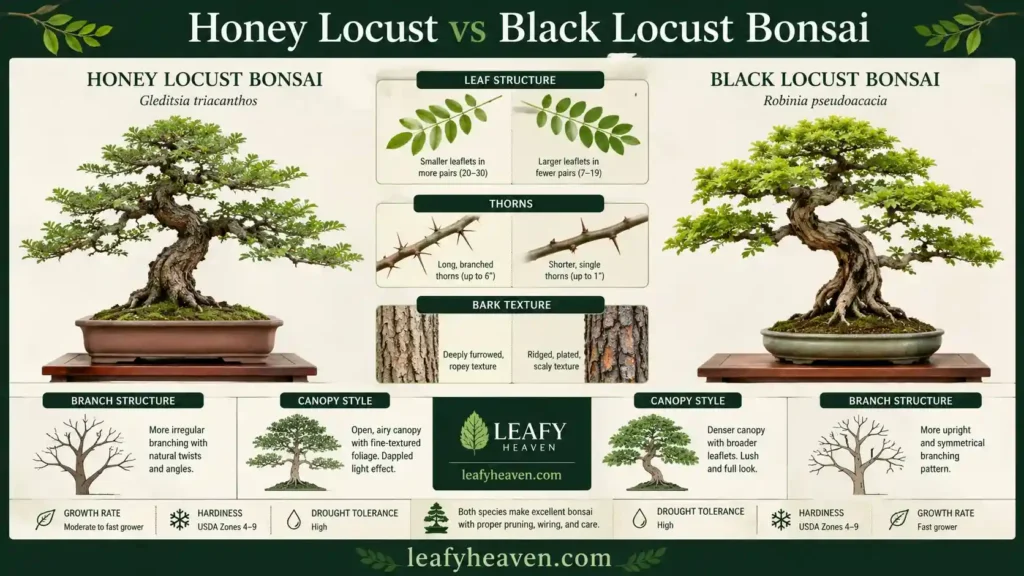
Honey Locust vs Black Locust Bonsai
Honey locust bonsai and black locust bonsai are often confused because both belong to the legume family and produce compound leaves. However, they are different tree species with distinct growth habits and bonsai characteristics.
Black locust bonsai comes from the Robinia pseudoacacia tree, commonly called the black locust or pseudoacacia tree. A Robinia pseudoacacia bonsai typically develops thicker foliage pads and a denser appearance compared to honey locust bonsai.
Black locust bonsai comes from the Robinia pseudoacacia tree, commonly called the black locust or pseudoacacia tree.
Quick Comparison Table
| Feature | Honey Locust Bonsai | Black Locust Bonsai |
| Scientific Name | Gleditsia triacanthos | Robinia pseudoacacia |
| Thorn Structure | Large branching thorns | Smaller paired thorns |
| Leaf Appearance | Fine compound leaves | Rounded leaflets |
| Growth Speed | Fast | Moderate |
| Bonsai Suitability | Excellent | Moderate |
Honey locust bonsai is generally preferred for refined deciduous bonsai styling because it produces lighter foliage and more elegant branching. In contrast, Robinia pseudoacacia bonsai often develops coarser growth and requires stronger pruning management.
Thorny vs Thornless Honey Locust Tree
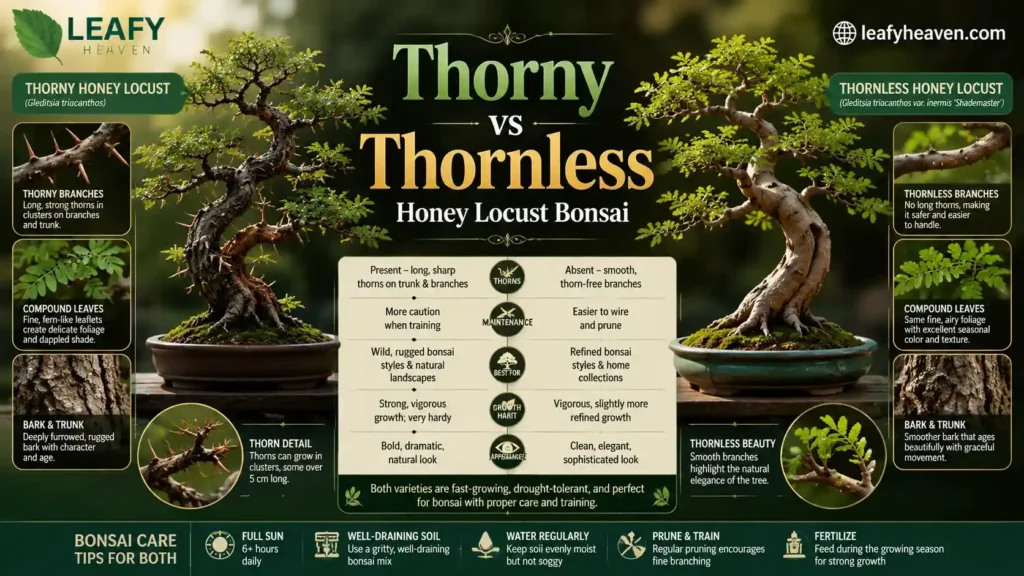
Honey locust trees are available in both thorny and thornless forms. Traditional wild honey locust trees develop large branching thorns along the trunk and branches, while cultivated thornless varieties are specifically bred for safer landscape and bonsai use.
Thorny Varieties
Traditional honey locust trees can produce long multi-branched thorns capable of growing directly from:
- Trunks
- Older branches
- Young shoots
These dramatic thorns create rugged visual character but can make bonsai maintenance difficult.
Thornless Honey Locust Tree Advantages
Thornless honey locust tree varieties are much more practical for bonsai training. The most popular thornless form is:
- Gleditsia triacanthos var. inermis
Advantages of thornless cultivars include:
- Safer pruning and wiring
- Easier branch positioning
- Cleaner bonsai silhouette
- Better handling during repotting
- Reduced injury risk
Most bonsai growers prefer thornless honey locust bonsai because it simplifies long-term maintenance without sacrificing the species’ elegant foliage and branching structure.
Honey Locust Tree Features
Honey locust trees have several characteristics that make them visually distinctive in bonsai form.
Honey Locust Leaf Structure
Honey locust leaves are usually:
- Pinnately compound
- Bipinnately compound on vigorous shoots
- Fine-textured and airy
This foliage structure creates soft-looking bonsai pads and improves visual scale in miniature tree designs.
Honey Locust Leaves Seasonal Color
Seasonal foliage color changes add strong ornamental value:
- Spring: fresh light green foliage
- Summer: medium to deep green canopy
- Autumn: yellow to golden fall color
The changing leaf color enhances seasonal bonsai displays.
Honey Locust Thorns
Thorny varieties develop:
- Large branching thorns
- Dark reddish-brown thorn clusters
- Sharp trunk protrusions
These features create a rugged wild appearance but are usually avoided in beginner bonsai collections.
Honey Locust Fruit Pods
Honey locust trees produce long twisted seed pods that contain sweet pulp surrounding the seeds. Mature pods can become decorative features on larger bonsai specimens.
Bark Appearance
As the tree matures, the bark develops:
- Deep furrows
- Gray-brown coloration
- Rough rugged texture
Older bonsai specimens gain strong visual age because of this bark development.
Canopy Structure
Honey locust naturally forms:
- Open branching patterns
- Light-filtering canopies
- Elegant layered branch structure
This airy canopy design is one of the main reasons why honey locust works so well as a deciduous bonsai tree.
Why Honey Locust Makes a Good Bonsai Tree
Honey locust trees are ideal for bonsai because they tolerate pruning well and naturally develop elegant branching structures. Their fine compound leaves, rapid growth, and adaptability make them highly suitable for growers who want a deciduous bonsai tree with graceful form and relatively fast development.
Unlike many slow-maturing bonsai species, honey locust responds quickly to training techniques. It also handles heat, drought, and seasonal pruning better than many delicate deciduous bonsai trees.
For growers who want to build stronger plant knowledge before diving into bonsai training, this complete gardening and plant care guide covers the core principles of healthy plant maintenance and seasonal care.
Key Benefits of Honey Locust Bonsai
Honey locust bonsai offers several characteristics that make it attractive for both beginners and experienced bonsai growers.
Fast Growth Rate
Honey locust trees grow quickly compared to many traditional bonsai species. Rapid branch extension and trunk thickening help growers build mature-looking bonsai structure faster.
Benefits of fast growth include:
- Faster trunk development
- Quicker branch formation
- Easier correction of design mistakes
- Faster recovery after pruning
This makes the species useful for long-term bonsai training projects.
Fine-Textured Foliage
The tree produces delicate compound leaves that create a refined bonsai appearance. The foliage naturally forms soft layered pads without looking overly dense.
Fine foliage improves:
- Scale proportion
- Ramification appearance
- Seasonal visual texture
- Overall bonsai elegance
The airy leaf structure also allows light to pass through the canopy, improving branch visibility.
Easy Shaping
Honey locust bonsai responds very well to:
- Structural pruning
- Wiring
- Clip-and-grow techniques
- Ramification development
Young branches remain flexible for shaping, making it easier to create natural bonsai movement and branch placement.
Strong Trunk Development
One major advantage of honey locust bonsai is its ability to thicken trunks relatively quickly. Mature specimens develop rugged bark and strong taper over time.
This helps create:
- Aged appearance
- Better trunk movement
- Strong nebari development
- More realistic miniature tree proportions
Drought Resistance
Established honey locust trees tolerate dry conditions better than many deciduous bonsai species. While bonsai still require regular watering, the species handles short dry periods more effectively than moisture-sensitive trees.
This drought tolerance helps reduce stress during:
- Summer heat
- Outdoor growing
- Temporary watering inconsistencies
- Hot Australian and American climates
Best Bonsai Styles for Honey Locust
Honey locust bonsai works best in styles that highlight open branching patterns and natural canopy structure.
Informal Upright Style
The informal upright style is one of the most popular choices for honey locust bonsai. The species naturally develops curved trunks and layered branching that suit this classic design.
Characteristics include:
- Gentle trunk movement
- Asymmetrical branch placement
- Natural deciduous tree appearance
Broom Style
The fine branching habit of honey locust makes it excellent for broom-style bonsai.
This style emphasizes:
- Rounded crown structure
- Fine twig ramification
- Balanced upper canopy
The delicate foliage enhances the elegant umbrella-like appearance.
Forest Planting
Honey locust trees also perform well in forest bonsai compositions because of their upright growth and open canopy structure.
Forest plantings create:
- Natural woodland appearance
- Layered canopy depth
- Seasonal deciduous landscapes
Using multiple honey locust trees together creates a realistic miniature forest scene.
Slanting Style
The slanting style works particularly well with younger honey locust bonsai because flexible trunks can be trained into angled growth forms.
This style highlights:
- Directional movement
- Wind-swept appearance
- Dynamic visual balance
Indoor vs Outdoor Growing
Honey locust bonsai performs best outdoors because it is a temperate deciduous tree that depends on seasonal climate changes for healthy growth cycles.
Why Honey Locust Bonsai Performs Best Outdoors
Outdoor growing provides the conditions needed for:
- Full sunlight exposure
- Strong seasonal growth
- Proper dormancy cycles
- Better branch development
- Healthier foliage density
Indoor conditions usually lack sufficient sunlight intensity and seasonal temperature variation.
Winter Dormancy Needs
Honey locust bonsai requires winter dormancy to remain healthy long term. During winter, the tree naturally drops its leaves and enters a resting phase.
Dormancy helps support:
- Energy storage
- Healthy spring growth
- Long-term vigor
- Seasonal growth regulation
Without dormancy, the tree may weaken gradually over time.
Climate Suitability
Honey locust bonsai adapts well to many temperate climates worldwide.
Suitable growing regions include:
- Large parts of Australia
- Most of the United States
- Southern Canada
- Europe
- Temperate Asian regions
The species tolerates heat, seasonal cold, and moderate drought, making it highly versatile for outdoor bonsai cultivation.
How to Grow Honey Locust Bonsai From Seed
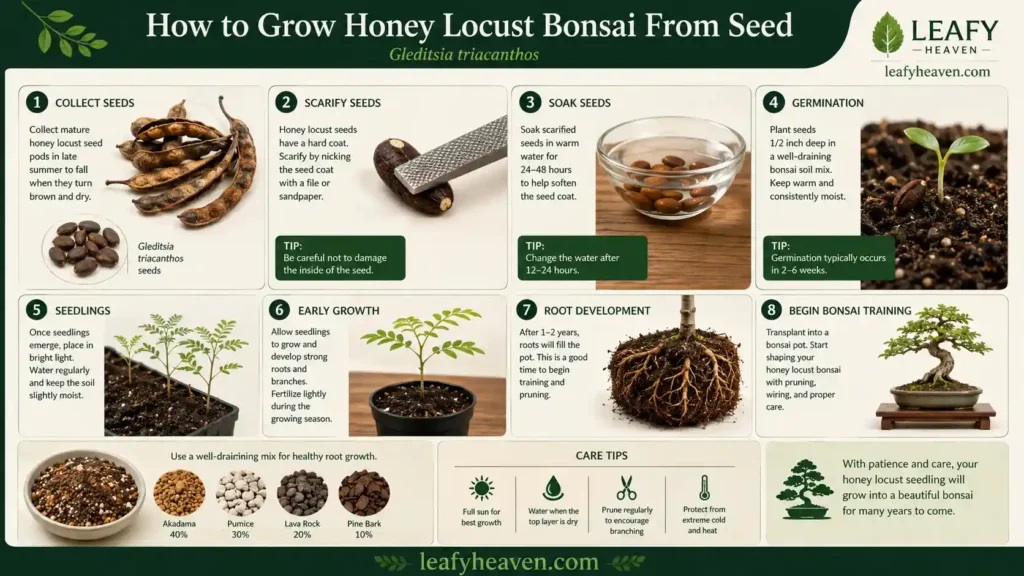
Honey locust bonsai can be grown from seed by scarifying seeds, soaking them, and planting in fast-draining bonsai soil. Because Gleditsia triacanthos seeds have a hard outer shell, proper seed preparation is important for successful germination.
Growing honey locust bonsai from seed allows growers to develop natural trunk movement, stronger root systems, and long-term bonsai structure from an early stage.
Honey Locust Seeds & Germination
Honey locust seeds develop inside long twisted seed pods produced by mature trees. These seeds have a hard protective coating that naturally slows germination until environmental conditions become suitable.
Honey Locust Seeds
Healthy honey locust seeds are usually:
- Dark brown
- Oval-shaped
- Hard-coated
- Smooth-textured
Fresh seeds generally germinate more reliably than old stored seeds.
Honey Locust Seed Pods
Honey locust seed pods can grow quite long and often contain multiple seeds embedded inside sweet pulp. Mature pods dry and darken during autumn.
Seed pods are commonly collected from:
- Mature landscape trees
- Thornless cultivars
- Wild honey locust trees
Gleditsia triacanthos Seeds
Gleditsia triacanthos seeds require scarification before planting because the outer seed coat naturally resists water absorption.
Without scarification:
- Germination becomes slow
- Sprouting rates decrease
- Seed dormancy may continue for months
Thornless Honey Locust Seeds
Thornless honey locust seeds are usually collected from:
- Gleditsia triacanthos var. inermis
- Sunburst honeylocust
- Skyline honey locust
- Shademaster honeylocust
These varieties are commonly preferred for bonsai because they produce safer and easier-to-maintain trees.
Seed Viability
Honey locust seed viability depends on:
- Seed age
- Storage conditions
- Moisture exposure
- Temperature stability
Fresh seeds stored in cool dry conditions typically provide the highest germination success.
How to Scarify Honey Locust Seeds
Honey locust seeds germinate more successfully after scarification. This process weakens the hard outer shell and allows moisture to enter the seed.
Step-by-Step Process
1. Nick Seed Coat
Use a small file, nail clipper, or sandpaper to lightly damage the outer seed coating.
Important points:
- Avoid cutting deeply into the seed
- Only weaken the hard outer shell
- Expose a tiny lighter-colored spot
2. Soak in Warm Water
Place scarified seeds in warm water for 12–24 hours.
Proper soaking helps:
- Soften seed coating
- Trigger germination
- Improve moisture absorption
Seeds that swell slightly are usually viable.
3. Plant in Moist Soil
Plant seeds in shallow containers filled with fast-draining bonsai soil.
Recommended planting depth:
- About 1–2 cm deep
Keep the soil lightly moist but never waterlogged.
4. Provide Warmth and Sunlight
Honey locust seedlings germinate best in warm bright conditions.
Ideal conditions include:
- Temperatures around 20–30°C
- Bright indirect sunlight
- Good airflow
- Consistent moisture
Most seeds germinate within a few weeks under proper conditions.
Soil Requirements for Seedlings
Good drainage is one of the most important factors when growing honey locust bonsai from seed.
Drainage Importance
Poor drainage can quickly damage young seedlings by causing:
- Root rot
- Fungus growth
- Weak root development
- Slow growth
Fast-draining soil encourages stronger root systems and healthier seedlings.
Recommended Bonsai Soil Mix
A balanced seedling mix should retain moisture while allowing excess water to drain easily.
Recommended components include:
- Akadama for moisture retention
- Pumice for drainage
- Lava rock for aeration
- Small amount of organic compost
Young seedlings usually perform best in slightly moisture-retentive but airy soil.
Organic vs Inorganic Media
| Media Type | Advantages | Disadvantages |
| Organic Soil | Holds moisture longer | Can compact over time |
| Inorganic Mix | Excellent drainage and aeration | Dries faster |
Many growers use a blended approach for young honey locust seedlings.
Seedling Growth Timeline
Honey locust bonsai development occurs gradually over several years.
| Stage | Time |
| Germination | 1–3 weeks |
| Seedling stage | 1–3 months |
| Early trunk growth | 1–2 years |
| Bonsai training stage | 2–4 years |
Initial growth is usually fast once seedlings establish healthy roots.
Common Seed Growing Problems
Several problems can affect young honey locust seedlings during early development.
Poor Germination
Poor germination is commonly caused by:
- Lack of scarification
- Old seeds
- Cold temperatures
- Dry soil
Proper seed preparation greatly improves success rates.
Root Rot
Root rot usually develops because of:
- Waterlogged soil
- Poor drainage
- Overwatering
- Fungal infection
Using fast-draining bonsai soil helps prevent root damage.
Weak Seedlings
Weak seedlings may result from:
- Low sunlight
- Poor airflow
- Nutrient deficiency
- Excessive moisture
Healthy seedlings need bright light and balanced moisture levels.
Drying Issues
Young seedlings can dry quickly during hot weather.
Common causes include:
- Direct harsh sun
- Small shallow containers
- Infrequent watering
- Excessive wind exposure
Consistent moisture management is essential during the early seedling stage.
Honey Locust Bonsai Care Guide
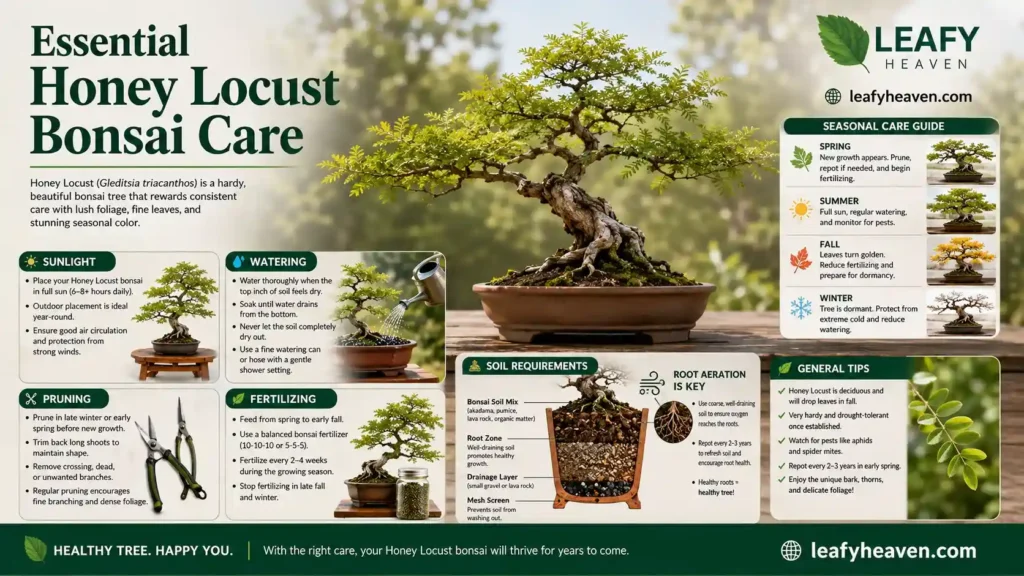
Proper sunlight, watering, pruning, and seasonal care are essential for maintaining a healthy honey locust bonsai. Because Gleditsia triacanthos is a fast-growing deciduous tree, consistent care helps maintain compact growth, healthy foliage, and strong branch development throughout the year.
Honey locust bonsai performs best when grown outdoors with balanced moisture, strong sunlight, and fast-draining soil.
Sunlight Requirements
Honey locust bonsai requires full sun for healthy growth and proper foliage development. Strong light exposure helps produce compact branching, vigorous growth, and better leaf density.
Full Sun Needs
Outdoor placement with direct sunlight encourages:
- Strong trunk growth
- Smaller foliage size
- Better ramification
- Healthier canopy structure
Insufficient light often causes weak elongated shoots and sparse foliage.
Light Exposure Duration
For best results, honey locust bonsai should receive:
- 6–8 hours of direct sunlight daily
Morning sunlight is especially beneficial during hot climates because it supports healthy growth without excessive afternoon stress.
Seasonal Adjustments
Seasonal light management is important throughout the year.
During summer:
- Protect shallow bonsai containers from extreme heat
- Monitor soil moisture closely
During winter:
- Maintain outdoor dormancy exposure
- Provide protection from severe freezing winds if necessary
Watering Needs
Honey locust bonsai prefers balanced moisture with good drainage. The soil should remain slightly moist but never constantly wet.
How Often to Water
Watering frequency depends on:
- Temperature
- Pot size
- Soil composition
- Tree size
- Seasonal growth activity
In active growing periods, watering may be needed daily in warm climates.
A simple rule is:
- Water thoroughly when the upper soil layer begins to dry slightly
Summer vs Winter Watering
Summer watering requirements are usually much higher because of:
- Faster evaporation
- Increased foliage growth
- Higher temperatures
During winter dormancy:
- Watering should be reduced significantly
- Soil should not remain constantly wet
Dormant trees use less moisture and are more vulnerable to root problems from excessive watering.
Avoiding Overwatering
Overwatering is one of the most common bonsai care mistakes.
Excess moisture may cause:
- Root rot
- Yellow leaves
- Weak growth
- Fungal issues
Fast-draining soil and proper watering habits help prevent these problems.
Best Soil for Honey Locust Bonsai
Honey locust bonsai requires soil that balances moisture retention with strong drainage and root aeration.
Heavy compact soil should be avoided because it restricts oxygen flow to roots.
Recommended Soil Mix Table
| Component | Purpose |
| Akadama | Moisture retention |
| Pumice | Drainage |
| Lava rock | Root aeration |
Many growers also add a small amount of organic material to improve nutrient retention for younger trees.
Well-draining bonsai soil helps support:
- Healthy root growth
- Stable moisture balance
- Better oxygen circulation
- Reduced fungal risk
Fertilizer Requirements
Honey locust bonsai benefits from regular feeding during the active growing season. Proper fertilization supports foliage growth, branch development, and overall tree vigor.
Growing Season Feeding
Feed regularly during:
- Spring
- Early summer
- Mid growing season
Fertilizer application is usually reduced during late autumn and stopped during winter dormancy.
Nitrogen Balance
Nitrogen affects foliage growth strongly in deciduous bonsai.
Balanced nitrogen levels help maintain:
- Healthy green foliage
- Controlled shoot extension
- Strong branch growth
Excess nitrogen may produce overly long shoots and coarse growth.
Organic Fertilizer Options
Organic fertilizers are commonly preferred because they release nutrients gradually.
Popular options include:
- Organic bonsai pellets
- Fish emulsion
- Seaweed fertilizer
- Compost-based feeds
Slow-release organic feeding helps maintain stable long-term growth.
Temperature & Humidity
Honey locust bonsai adapts well to a wide range of outdoor climates and tolerates both summer heat and winter cold better than many delicate bonsai species.
Heat Tolerance
Established honey locust bonsai handles heat relatively well when:
- Watered properly
- Protected from extreme root overheating
- Grown in well-draining soil
This makes the species suitable for many Australian and southern US climates.
Frost Tolerance
Because it is a deciduous temperate tree, honey locust bonsai tolerates moderate frost during winter dormancy.
However, bonsai containers expose roots to colder conditions than ground-grown trees.
Protection may be necessary during:
- Severe freezing temperatures
- Extended frost periods
- Cold drying winds
Wind Protection
Strong wind can damage foliage and dry bonsai soil rapidly.
Excessive wind exposure may cause:
- Leaf burn
- Faster dehydration
- Weak branch growth
- Stress during hot weather
Sheltered outdoor placement with good airflow is usually ideal for healthy honey locust bonsai development.
Pruning & Training Honey Locust Bonsai
Frequent pruning helps develop fine ramification and maintain compact growth in honey locust bonsai trees. Because honey locust grows quickly, regular training is necessary to control branch extension, improve canopy structure, and maintain bonsai proportions.
Proper pruning and training also help create the elegant airy branching pattern that makes Gleditsia triacanthos popular among deciduous bonsai enthusiasts.
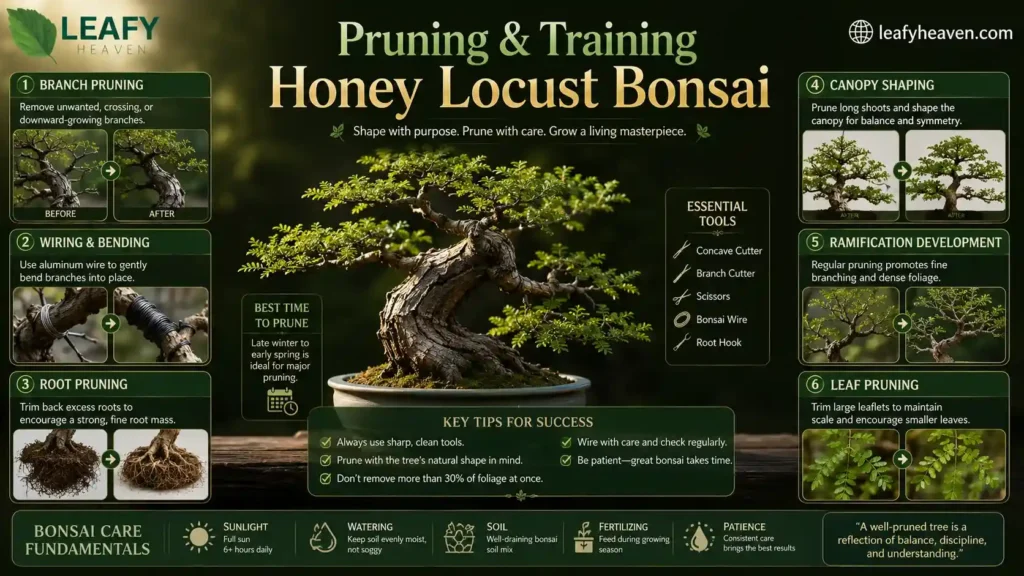
Structural Pruning
Structural pruning shapes the main framework of the bonsai tree. This process controls trunk movement, branch placement, and overall bonsai design.
Branch Selection
Careful branch selection improves structure and visual balance.
Branches commonly removed include:
- Weak interior shoots
- Downward-growing branches
- Competing leaders
- Overcrowded growth
Good branch spacing helps create:
- Better light penetration
- Cleaner ramification
- Balanced canopy structure
Trunk Shaping
Young honey locust trees are flexible and respond well to early shaping techniques.
Trunk development often focuses on:
- Gentle movement
- Natural taper
- Balanced proportions
- Stable visual flow
Growers usually establish primary trunk movement during the early training years.
Removing Crossing Branches
Crossing branches reduce airflow and create visual clutter.
Removing these branches helps:
- Improve branch clarity
- Reduce congestion
- Prevent rubbing damage
- Enhance bonsai aesthetics
Open branch structure is especially important for honey locust bonsai because of its naturally airy canopy style.
Leaf Pruning & Defoliation
Leaf pruning and defoliation techniques help improve foliage density and encourage smaller leaves.
Reducing Leaf Size
Honey locust naturally produces relatively fine foliage, but pruning techniques can improve scale even further.
Leaf reduction methods include:
- Trimming large leaves
- Partial defoliation
- Controlling fertilizer strength
- Increasing sunlight exposure
Smaller foliage improves miniature tree proportions.
Encouraging Finer Growth
Frequent trimming encourages:
- Secondary branching
- Tertiary ramification
- Denser canopy structure
- Compact shoot development
Fine twigging is one of the most desirable characteristics in deciduous bonsai.
Seasonal Timing
Leaf pruning is usually performed during active growing periods.
Best timing generally includes:
- Late spring
- Early summer
Heavy defoliation should be avoided on weak or recently repotted trees because it may reduce vigor.
Wiring Techniques
Wiring helps position branches and create refined bonsai structure. Honey locust branches are easiest to wire while still young and flexible.
Best Wiring Season
The best wiring periods are usually:
- Late autumn after leaf drop
- Early spring before strong growth begins
These periods improve branch visibility and reduce foliage interference.
Preventing Bark Damage
Honey locust bark can mark relatively quickly if wire becomes too tight.
To reduce damage:
- Monitor wire regularly
- Avoid excessive pressure
- Remove wire before scarring develops
- Use appropriate wire thickness
Fast-growing shoots may require frequent wire adjustment.
Wiring Young Branches
Young branches bend more safely and hold shape more easily.
Wiring young growth helps create:
- Natural branch movement
- Better branch spacing
- Balanced canopy design
- Improved ramification structure
Older branches become more rigid and difficult to reposition.
Root Pruning & Repotting
Root pruning and repotting maintain root health and prevent the bonsai from becoming pot-bound.
Repotting Intervals
Repotting frequency depends on tree age and growth rate.
Typical intervals include:
- Young trees: every 1–2 years
- Mature bonsai: every 2–4 years
Fast-growing honey locust bonsai often fills containers quickly.
Root Reduction Methods
During repotting, growers usually remove:
- Thick circling roots
- Damaged roots
- Overly long roots
- Dense root masses
Healthy root pruning encourages:
- Fine feeder root development
- Better nutrient uptake
- Compact root structure
Excessive root removal should be avoided on weak trees.
Best Containers
Honey locust bonsai performs best in containers with strong drainage and adequate root space.
Ideal bonsai pots typically include:
- Drainage holes
- Shallow profile
- Good airflow beneath the pot
- Stable structure for outdoor growing
Deciduous bonsai containers often use muted natural colors that complement the tree’s rugged bark and seasonal foliage changes.
Common Honey Locust Bonsai Problems & Solutions
Most honey locust bonsai problems are caused by improper watering, pests, or insufficient sunlight. Because honey locust is a fast-growing deciduous bonsai tree, environmental stress and care imbalances can quickly affect foliage quality, root health, and branch development.
Early identification of symptoms helps prevent long-term damage and keeps the bonsai healthy throughout the growing season.
Yellow Leaves
Yellow leaves are one of the most common honey locust bonsai problems. The cause may be environmental, nutritional, or seasonal.
Overwatering
Excess watering can suffocate roots and reduce oxygen availability in the soil.
Common symptoms include:
- Yellowing foliage
- Soft weak shoots
- Slow growth
- Wet compact soil
Improving drainage and reducing watering frequency usually helps restore root health.
Nutrient Deficiency
Nutrient imbalance may also cause pale or yellow foliage.
Common deficiencies include:
- Nitrogen deficiency
- Iron deficiency
- Magnesium deficiency
Balanced bonsai fertilizer during the growing season helps maintain healthy green foliage.
Seasonal Leaf Drop
As a deciduous tree, honey locust naturally sheds leaves during autumn dormancy preparation.
Normal seasonal leaf drop usually includes:
- Yellow autumn foliage
- Gradual leaf shedding
- Reduced growth activity
This process is natural and should not be confused with disease.
Pest Problems
Honey locust bonsai can occasionally attract common bonsai pests, especially during warm growing conditions.
Aphids
Aphids are small sap-feeding insects that cluster on tender shoots and young leaves.
Common signs include:
- Curled leaves
- Sticky residue
- Distorted new growth
Mild infestations can often be controlled using:
- Water spraying
- Insecticidal soap
- Neem oil treatments
Spider Mites
Spider mites become more active during hot dry weather.
Symptoms may include:
- Tiny pale leaf spots
- Fine webbing
- Weak foliage
- Dry leaf appearance
Increasing humidity and improving airflow may help reduce infestations.
Scale Insects
Scale insects attach themselves to branches and stems while feeding on plant sap.
Signs of infestation include:
- Brown shell-like bumps
- Sticky honeydew residue
- Weak branch growth
Careful manual removal and horticultural oil treatments are commonly used for control.
Root Rot Issues
Root rot is one of the most serious bonsai health problems and is usually linked to excessive moisture and poor drainage.
Poor Drainage
Compacted or waterlogged soil restricts oxygen flow around roots.
This may cause:
- Blackened roots
- Soft root tissue
- Leaf yellowing
- Weak overall growth
Fast-draining bonsai soil is essential for healthy root development.
Fungus Problems
Excess moisture encourages fungal growth inside the root zone.
Fungal root problems often develop when:
- Soil remains constantly wet
- Containers lack drainage
- Air circulation is poor
Severe root rot can permanently damage the bonsai if not corrected early.
Prevention Methods
Root rot prevention focuses on maintaining healthy growing conditions.
Important prevention methods include:
- Using well-draining bonsai soil
- Avoiding constant wetness
- Watering only when needed
- Using containers with drainage holes
- Maintaining good airflow
Healthy roots are critical for strong foliage and long-term bonsai vigor.
Weak Growth & Sparse Foliage
Weak growth usually indicates environmental stress or improper bonsai maintenance.
Low Sunlight
Honey locust bonsai requires strong sunlight for healthy branch and leaf development.
Insufficient light may cause:
- Long weak shoots
- Sparse foliage
- Large leaves
- Reduced ramification
Outdoor full-sun placement usually produces the best growth.
Poor Pruning
Irregular or improper pruning can weaken canopy structure over time.
Common pruning problems include:
- Overgrown branches
- Poor ramification
- Dense cluttered canopy
- Weak interior growth
Regular maintenance pruning encourages finer branching and balanced growth.
Nutrient Imbalance
Improper fertilization may lead to weak or uneven growth.
Problems may result from:
- Excess nitrogen
- Lack of feeding
- Poor soil nutrition
- Irregular fertilizing schedule
Balanced feeding during active growth helps maintain dense healthy foliage and stronger branch structure.
Popular Honey Locust Cultivars for Bonsai
Thornless cultivars are usually preferred because they are easier to shape and safer to maintain. Many cultivated honey locust varieties also develop finer branching, attractive foliage color, and more controlled growth habits that work well for bonsai training.
Most bonsai growers choose thornless forms of Gleditsia triacanthos because they simplify pruning, wiring, and long-term maintenance.
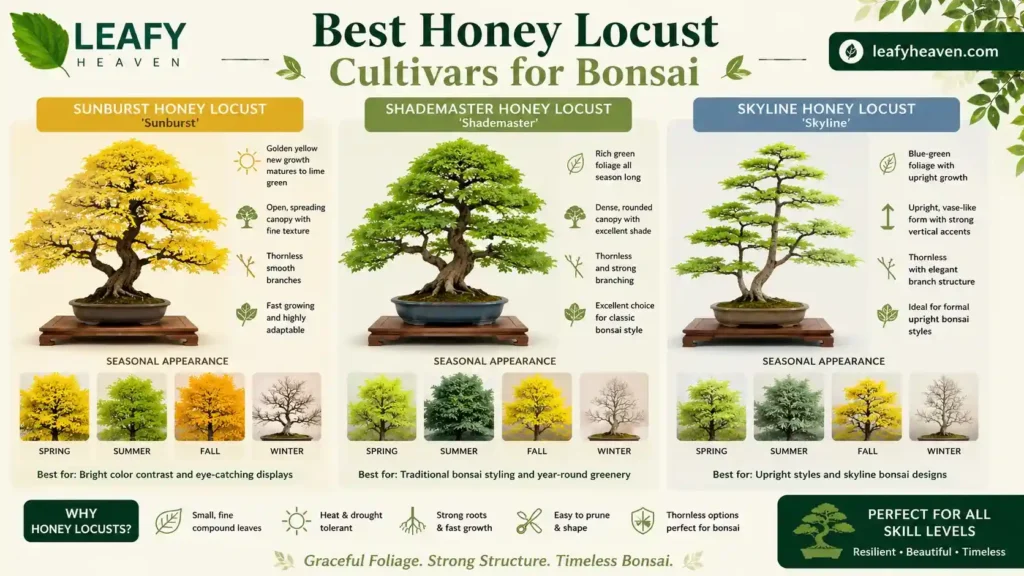
Sunburst Honeylocust
Sunburst honeylocust is one of the most visually distinctive honey locust cultivars used in ornamental planting and bonsai development.
Common names and related terms include:
- gleditsia sunburst
- honey locust sunburst
- sunburst honeylocust
Golden Foliage
One of the main attractions of Sunburst honeylocust is its bright golden-yellow new foliage.
Seasonal color changes often include:
- Bright yellow spring growth
- Soft lime-green summer foliage
- Warm golden autumn tones
This vibrant foliage color creates strong seasonal visual interest in bonsai form.
Compact Growth
Compared to some larger vigorous honey locust varieties, Sunburst often develops a more controlled canopy structure.
Benefits for bonsai include:
- Easier size management
- Better branch density
- More compact silhouette
- Improved ornamental appearance
Seasonal Color
The changing foliage tones make Sunburst especially attractive during spring and autumn display seasons.
Its colorful foliage works particularly well in:
- Informal upright bonsai
- Broom-style bonsai
- Deciduous display compositions
Shademaster Honeylocust
Shademaster honeylocust is a vigorous thornless cultivar valued for its rapid growth and strong branch development.
The cultivar is commonly known as:
- shademaster honeylocust
Vigorous Growth
Shademaster develops quickly and responds strongly to bonsai training techniques.
This vigorous growth helps support:
- Faster trunk thickening
- Rapid branch development
- Strong recovery after pruning
- Dense canopy formation
Because of its energy and growth speed, regular pruning is important to maintain bonsai proportions.
Shade Canopy
In landscape settings, Shademaster honeylocust is widely planted as a shade tree because of its broad airy canopy.
In bonsai form, this characteristic helps create:
- Elegant layered branching
- Open deciduous structure
- Natural canopy spread
The foliage allows filtered light to pass through, giving the bonsai a lighter visual appearance.
Strong Branching
Shademaster typically develops durable branch structure suitable for long-term bonsai shaping.
Advantages include:
- Better ramification potential
- Strong secondary branching
- Improved structural training
- Good clip-and-grow response
Skyline Honey Locust
Skyline honey locust is known for its upright growth habit and refined branching pattern.
Related botanical names include:
- gleditsia skyline
- gleditsia triacanthos skyline
Upright Structure
Skyline honey locust naturally develops a more vertical growth form compared to spreading cultivars.
This structure works especially well for:
- Informal upright bonsai
- Formal upright training
- Tall deciduous bonsai styles
Its upright habit also simplifies early trunk development.
Fine Branching
Skyline develops relatively fine branching and controlled canopy density.
Benefits for bonsai include:
- Better branch refinement
- Cleaner silhouette
- Improved ramification structure
- More elegant winter appearance
Its balanced branching habit makes it suitable for growers seeking refined deciduous bonsai aesthetics.
Thornless Cultivars Comparison Table
Many thornless honey locust bonsai trees come from Gleditsia triacanthos inermis selections developed for ornamental use.
| Cultivar | Features | Bonsai Suitability |
| Sunburst | Golden foliage | Excellent |
| Shademaster | Vigorous growth | Excellent |
| Skyline | Upright structure | Good |
Gleditsia triacanthos inermis cultivars remain the most practical option for bonsai growers because they combine safer handling with strong growth and attractive branching characteristics.
Honey Locust Bonsai vs Other Fast-Growing Bonsai Trees
Honey locust bonsai grows faster than many traditional bonsai species and develops a more open canopy. Its fine compound foliage, rapid branch extension, and strong pruning tolerance make it different from many tropical and flowering bonsai trees commonly used by beginners and collectors.
Compared to other fast-growing bonsai species, honey locust bonsai generally offers better deciduous structure, stronger seasonal character, and easier long-term ramification development.
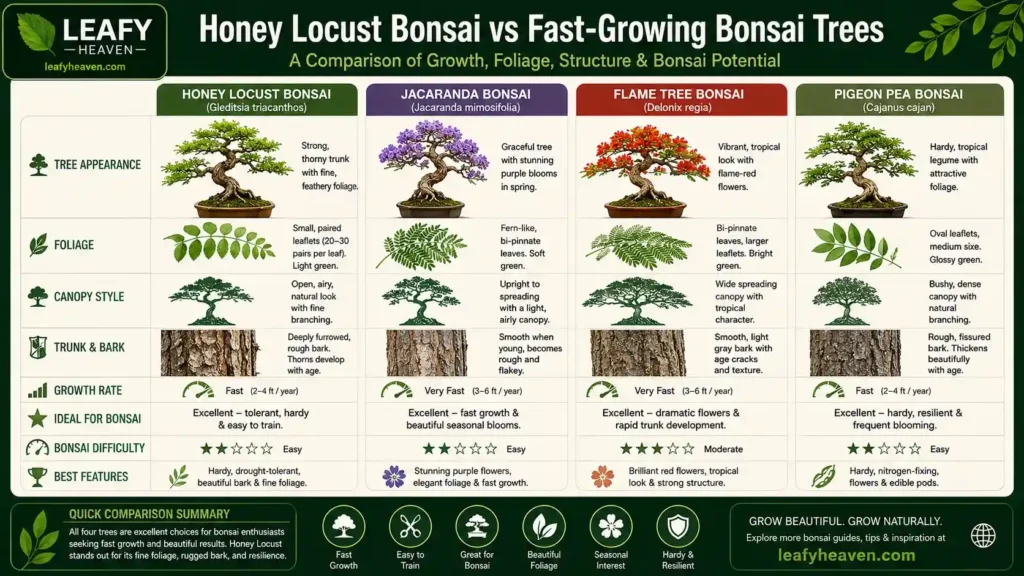
Comparison With Jacaranda Bonsai
Honey locust bonsai and jacaranda bonsai both produce delicate foliage, but they differ significantly in growth behavior and seasonal characteristics.
Leaf Differences
Honey locust bonsai develops:
- Fine compound leaves
- Airy deciduous foliage
- Smaller foliage pads with pruning
Jacaranda bonsai typically produces:
- Fern-like leaf structure
- Softer tropical appearance
- Larger overall foliage spread
Both species create elegant canopies, but honey locust often develops more refined winter branch structure after leaf drop.
Growth Habits
Honey locust bonsai usually grows:
- Upright and open
- Faster in temperate climates
- More structurally rigid over time
Jacaranda bonsai often develops:
- Softer branching
- More tropical growth patterns
- Faster extension in warm humid conditions
Honey locust generally tolerates stronger pruning and colder winters better than jacaranda.
Flower Potential
Jacaranda bonsai is valued for its purple-blue flowers, although flowering is uncommon in small bonsai containers.
Honey locust bonsai focuses more on:
- Branch structure
- Fine ramification
- Seasonal foliage color
- Rugged bark development
Comparison With Flame Tree Bonsai
Flame tree bonsai and honey locust bonsai both grow relatively quickly, but their care requirements are very different.
Flame tree bonsai and honey locust bonsai both grow relatively quickly, but their care requirements are very different.
Tropical vs Deciduous Care
Honey locust bonsai is:
- Deciduous
- Winter dormant
- Cold tolerant
- Outdoor-oriented
Flame tree bonsai is typically:
- Tropical or subtropical
- Frost sensitive
- Warm-climate dependent
- More sensitive to cold stress
This makes honey locust easier to grow in temperate climates.
Trunk Development
Honey locust develops trunk taper steadily with regular pruning and seasonal growth cycles.
Flame tree bonsai often develops:
- Rapid thickening
- Softer wood
- More aggressive tropical growth
However, honey locust generally develops stronger deciduous branch structure over time.
Pruning Differences
Honey locust bonsai responds well to:
- Clip-and-grow pruning
- Defoliation
- Ramification training
- Seasonal structural pruning
Flame tree bonsai often requires:
- Frequent tropical growth control
- Aggressive trimming
- Warm-season maintenance
Pruning schedules differ because of their distinct seasonal growth cycles.
Comparison With Pigeon Pea Bonsai
Pigeon pea bonsai is another fast-growing species commonly used for beginner bonsai projects.
Growth Speed
Both species grow quickly, but honey locust usually develops:
- Stronger long-term structure
- Better trunk taper
- More durable branch systems
Pigeon pea bonsai often grows rapidly but may become leggy without constant pruning.
Lifespan
Honey locust bonsai generally has a much longer lifespan than pigeon pea bonsai.
Honey locust trees can mature into long-term bonsai specimens with:
- Rugged bark
- Advanced ramification
- Mature deciduous structure
Pigeon pea bonsai is usually considered shorter-lived and less durable for advanced bonsai refinement.
Indoor Suitability
Pigeon pea bonsai tolerates warm indoor environments more easily than honey locust bonsai.
Honey locust bonsai performs best:
- Outdoors
- In seasonal climates
- With winter dormancy
Indoor growing is usually less suitable for long-term honey locust health.
Quick Bonsai Comparison Table
| Bonsai Tree | Growth Rate | Leaf Type | Difficulty |
| Honey Locust | Fast | Fine compound | Moderate |
| Jacaranda Bonsai | Moderate | Fern-like | Moderate |
| Flame Tree Bonsai | Fast | Tropical foliage | Advanced |
| Pigeon Pea Bonsai | Fast | Small leaves | Beginner |
Seasonal Care Calendar for Honey Locust Bonsai
Honey locust bonsai care changes throughout the year depending on dormancy and growth activity. Because Gleditsia triacanthos is a deciduous bonsai tree, seasonal maintenance is essential for healthy foliage, strong branching, and long-term bonsai development.
Adjusting watering, pruning, fertilizing, and protection methods throughout the seasons helps maintain balanced growth and proper dormancy cycles.
Spring Care
Spring is the main active growth season for honey locust bonsai. Buds begin opening, roots become active, and new shoots develop rapidly.
Repotting
Early spring is usually the best time for repotting before vigorous growth fully begins.
Repotting tasks include:
- Root pruning
- Soil replacement
- Drainage inspection
- Root spread correction
Young trees are often repotted more frequently than mature bonsai.
Fertilizing
Spring fertilizing supports strong foliage and branch development.
Balanced feeding during this period encourages:
- Healthy shoot growth
- Strong leaf production
- Trunk thickening
- Energy recovery after dormancy
Organic slow-release fertilizers are commonly used during active spring growth.
Wiring
Spring wiring is effective because young branches remain flexible.
This period is ideal for:
- Primary branch positioning
- Correcting branch angles
- Early canopy structure development
Fast-growing shoots should be monitored regularly to prevent wire scarring.
Summer Care
Summer is the peak growing season for honey locust bonsai. High temperatures and active foliage growth increase watering and maintenance needs.
Watering Frequency
Summer heat causes bonsai soil to dry much faster.
Depending on climate and container size, watering may be required:
- Once daily
- Twice daily during extreme heat
Consistent moisture is important, but waterlogging should still be avoided.
Pest Monitoring
Warm weather increases pest activity.
Common summer pests include:
- Aphids
- Spider mites
- Scale insects
Regular inspection helps detect problems before they spread through the canopy.
Leaf Pruning
Leaf pruning and shoot trimming help maintain compact growth during summer.
Benefits include:
- Smaller foliage size
- Improved ramification
- Better airflow
- Controlled canopy density
Heavy defoliation should be avoided during extreme heat stress.
Autumn Care
Autumn is the transition period between active growth and winter dormancy.
Reducing Fertilizer
Fertilizer application is usually reduced during autumn to slow vigorous growth.
Reducing feeding helps:
- Prepare the tree for dormancy
- Prevent weak late-season shoots
- Improve winter hardiness
High nitrogen fertilizer should generally be avoided late in the season.
Preparing for Dormancy
Honey locust bonsai naturally begins slowing growth during autumn.
Typical seasonal changes include:
- Yellow leaf coloration
- Reduced shoot extension
- Leaf drop initiation
This dormancy preparation is essential for long-term tree health.
Winter Care
Winter is the dormant resting period for honey locust bonsai. Proper winter care protects roots and maintains healthy seasonal cycles.
Dormancy Protection
Honey locust bonsai requires winter dormancy for proper yearly growth regulation.
Protection methods may include:
- Cold frames
- Sheltered outdoor placement
- Mulching around pots
- Wind protection
Trees should still experience natural cold conditions without severe root freezing.
Frost Management
Mature honey locust trees tolerate frost relatively well, but bonsai roots are more vulnerable because of shallow containers.
During severe freezing conditions:
- Protect root systems
- Avoid repeated freeze-thaw cycles
- Shield containers from icy wind exposure
Excessive freezing can damage fine bonsai roots.
Reduced Watering
Dormant trees require far less water during winter.
Overwatering during dormancy may cause:
- Root rot
- Fungal problems
- Weak spring growth
The soil should remain slightly moist but never constantly wet during the dormant season.
Is Honey Locust Bonsai Safe Around Pets & Children?
Thorny honey locust bonsai can be hazardous due to sharp thorns, while thornless varieties are generally safer. Safety concerns mainly involve physical injuries from thorns rather than severe toxicity issues. For households with children or pets, thornless cultivars are usually the preferred option.
Careful placement and proper handling can significantly reduce risks associated with honey locust bonsai trees.
Thorn Safety Concerns
Traditional honey locust trees are known for their large branching thorns, which can become dangerous in bonsai form if not managed carefully.
Locust Tree Thorn Injuries
Thorny honey locust varieties may produce:
- Long sharp trunk thorns
- Multi-branched thorn clusters
- Hard woody spikes on branches
Potential injuries include:
- Skin punctures
- Scratches
- Hand injuries during pruning
- Eye hazards from low branches
Thorns can become especially problematic during wiring, repotting, and branch maintenance.
Handling Precautions
Proper handling greatly improves safety when working with thorny honey locust bonsai.
Recommended precautions include:
- Wearing protective gloves
- Using long bonsai tweezers
- Keeping trees out of walkways
- Positioning bonsai above pet reach
- Pruning dangerous thorns early
Careful placement is particularly important around children and active pets.
Toxicity Information
Honey locust bonsai is generally considered less toxic than many ornamental plants, but some plant parts may still create digestive problems if consumed.
Seed Pod Concerns
Honey locust seed pods contain sweet pulp that may attract pets or children.
Possible concerns include:
- Mild digestive upset
- Choking hazards from pods or seeds
- Gastrointestinal discomfort if heavily consumed
Large quantities should not be eaten by pets or small children.
Pet Safety Considerations
Dogs and cats are usually more at risk from:
- Thorn injuries
- Chewing branches
- Swallowing seed pods
- Digging in bonsai soil
Pet-safe management practices include:
- Using thornless cultivars
- Removing fallen pods
- Keeping bonsai on elevated benches
- Supervising curious pets
Best Safe Alternatives
Thornless and beginner-friendly bonsai species are usually the safest option for family environments.
Thornless Cultivars
Most growers prefer thornless honey locust varieties such as:
- Gleditsia triacanthos var. inermis
- Sunburst honeylocust
- Shademaster honeylocust
- Skyline honey locust
These cultivars maintain the elegant foliage and branching characteristics of honey locust bonsai without dangerous thorn development.
Beginner-Friendly Bonsai Species
For maximum safety and easier maintenance, some growers may choose alternative bonsai species with no thorns at all.
Popular beginner-friendly options include:
- Chinese elm bonsai
- Ficus bonsai
- Jade bonsai
- Japanese maple bonsai
These species are often easier to manage indoors and around children or pets.
Conclusion
Honey locust bonsai is a beautiful fast-growing bonsai tree that combines elegant foliage, rugged structure, and excellent bonsai potential. Its fine compound leaves, open canopy, and strong adaptability make it one of the most distinctive deciduous bonsai species for outdoor cultivation.
Successful honey locust bonsai care depends on several key factors:
- Full outdoor sunlight
- Fast-draining bonsai soil
- Balanced watering
- Regular pruning and ramification work
- Seasonal dormancy protection
- Proper repotting intervals
Because the species grows quickly, consistent pruning and training are essential for maintaining compact structure and refined branching. Patience is also important, especially during trunk development and long-term canopy refinement.
Among the best varieties for bonsai are thornless cultivars such as:
- Sunburst honeylocust
- Shademaster honeylocust
- Skyline honey locust
- Gleditsia triacanthos inermis
These cultivars are easier to handle, safer to maintain, and highly suitable for bonsai shaping.
Honey locust bonsai works well for several types of growers:
- Beginners looking for a vigorous outdoor bonsai species
- Intermediate growers interested in deciduous ramification techniques
- Outdoor bonsai enthusiasts who enjoy seasonal growth cycles and natural canopy development
With proper care and long-term training, honey locust bonsai can develop into an impressive deciduous bonsai tree with mature bark, elegant branching, and strong seasonal character.
FAQs
How fast does a honey locust bonsai grow?
Honey locust bonsai grows relatively fast compared to many traditional bonsai species. Young trees can develop strong trunk thickness and branch structure within a few years when grown in full sun with proper fertilization and regular pruning. Active growth is especially vigorous during spring and summer.
Can you grow honey locust bonsai indoors?
Honey locust bonsai is not ideal for permanent indoor growing. Because it is a deciduous outdoor tree, it requires full sunlight and winter dormancy for long-term health. Temporary indoor display is possible, but the tree performs best outdoors in seasonal climates.
Are honey locust bonsai trees thorny?
Some honey locust bonsai trees are thorny, while others are thornless. Traditional Gleditsia triacanthos varieties may develop large branching thorns on trunks and branches. Thornless cultivars such as Gleditsia triacanthos var. inermis are generally preferred for bonsai because they are easier and safer to maintain.
How do you grow honey locust bonsai from seed?
Honey locust bonsai is commonly grown from seed by scarifying the hard seed coat, soaking the seeds in warm water, and planting them in fast-draining bonsai soil. Warm temperatures, consistent moisture, and bright light help improve germination success.
What is the best soil for honey locust bonsai?
The best soil for honey locust bonsai is a fast-draining bonsai mix that balances moisture retention and root aeration. A common mixture includes: Akadama for moisture retention Pumice for drainage Lava rock for airflow and root oxygen Well-draining soil helps prevent root rot and supports healthy root growth.
Is honey locust bonsai the same as black locust bonsai?
No, honey locust bonsai and black locust bonsai are different species. Honey locust bonsai comes from Gleditsia triacanthos, while black locust bonsai comes from Robinia pseudoacacia. Honey locust typically has finer foliage and better bonsai suitability, while black locust develops denser rounded leaflets and different thorn structures.
When should you repot a honey locust bonsai?
Honey locust bonsai is usually repotted during early spring before strong new growth begins. Young fast-growing trees may need repotting every 1–2 years, while mature bonsai are often repotted every 2–4 years depending on root growth and soil condition.
Which thornless honey locust cultivar is best for bonsai?
Popular thornless honey locust cultivars for bonsai include: Sunburst honeylocust Shademaster honeylocust Skyline honey locust Many growers prefer Sunburst for its golden foliage and Skyline for its upright branching structure. Thornless cultivars are generally easier to train and safer to handle during bonsai maintenance.

Written by the LeafyHeaven Editorial Team
LeafyHeaven shares practical gardening tips and simple plant care guides to help you grow, nurture, and enjoy your plants with ease. Our goal is to make gardening feel natural, approachable, and rewarding for everyone.