
Introduction
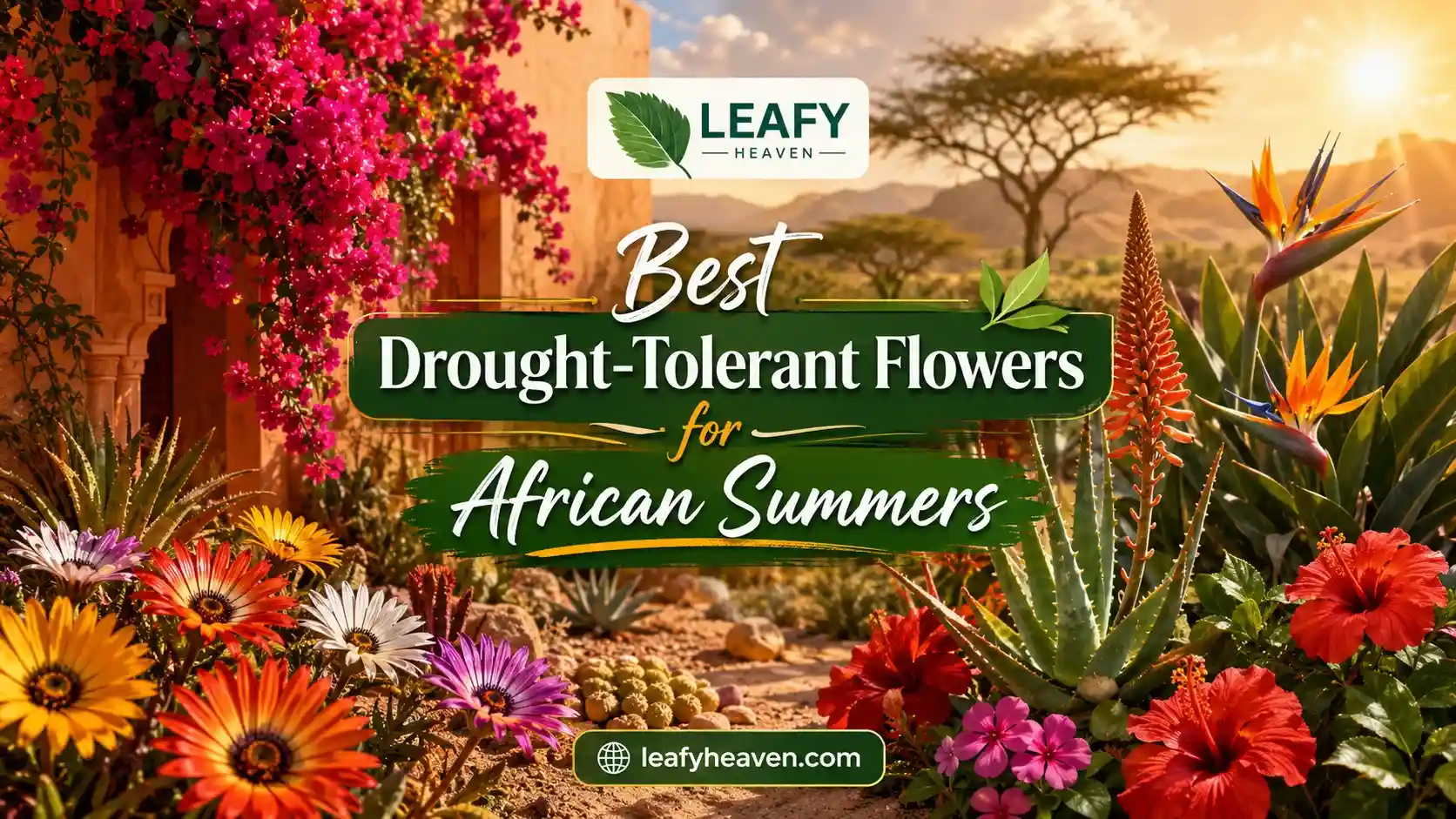
Africa’s summer heat is intense, relentless, and unforgiving for most garden plants.
But the right drought tolerant flowers africa offers — from North Africa’s Mediterranean coastlines to East Africa’s savannas and West Africa’s tropical landscapes — prove that stunning, colorful gardens are absolutely possible through the hottest months.
This guide covers the best summer flowers africa gardeners rely on, region-wise plant picks for Morocco, Kenya, Nigeria, and beyond, top african drought tolerant plants including native species, and complete growing tips for every African climate.
This summer, these flowers will transform your African garden.
Why Africa’s Summer Demands Drought-Tolerant Flowering Plants
Africa’s summer is not a single season — it is three completely different climate challenges happening simultaneously across the continent.
Summer flowers africa gardeners need must handle conditions ranging from North African desert heat to East African savanna drought to West African tropical humidity.
Choosing the right drought resistant plants africa requires understanding exactly which regional challenge your garden faces — and selecting african drought resistant plants specifically adapted to those conditions.
For a broader overview beyond Africa, this guide to drought tolerant flowers covers heat-adapted flowering plants suited to many different climates and growing conditions.
Understanding Africa’s Diverse Summer Climate
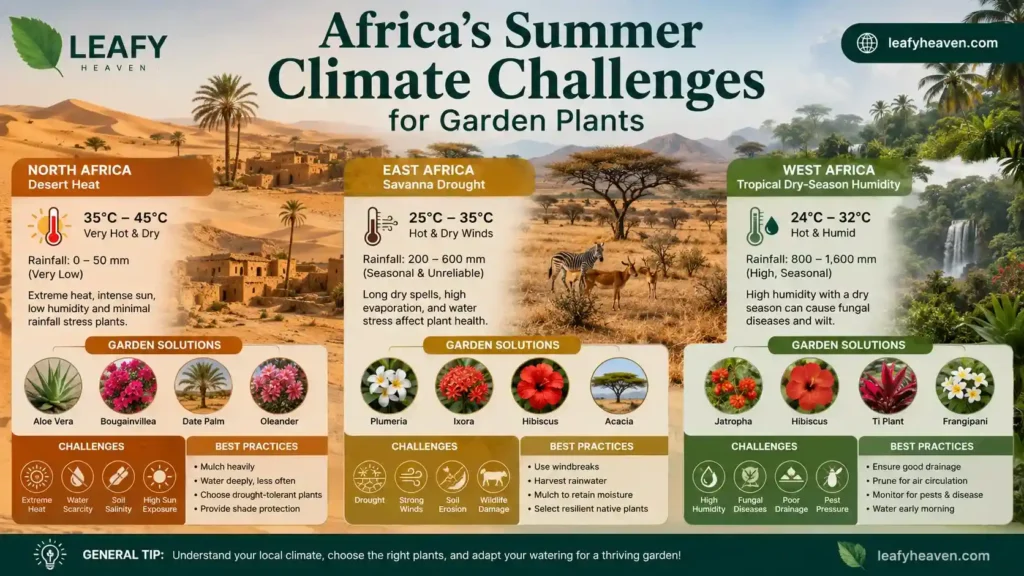
Africa’s summer is not uniform — North Africa faces dry desert heat, East Africa faces savanna drought conditions, and West Africa faces tropical humidity combined with dry spells.
Each region demands a completely different set of plants for hot dry climate africa and tropical drought tolerant flowers adapted to local conditions.
Africa Summer Climate — Key Facts by Region:
| Region | Countries | Summer Temp | Rainfall | Key Challenge |
| North Africa | Morocco, Egypt, Tunisia, Algeria | 35–45°C | Very Low | Desert heat + dry winds |
| East Africa | Kenya, Ethiopia, Tanzania | 25–35°C | Dry season | Savanna drought conditions |
| West Africa | Nigeria, Ghana | 28–38°C | Pre-monsoon dry | Humidity + dry spells |
North Africa’s desert conditions mirror the Middle East — extreme heat, alkaline soil, and near-zero summer rainfall create one of the most demanding gardening environments on earth.
Gardeners facing similar desert conditions can also explore proven flowering plants in extreme heat that have been tested across the Middle East’s equally demanding summer climate.
East Africa’s savanna flowering plants face a different challenge — long dry seasons between rainfall cycles that can last 3–6 months, requiring plants with deep root systems and efficient water storage.
West Africa’s tropical drought tolerant flowers must handle both intense humidity and sudden dry spells — a combination that eliminates both purely drought-adapted and purely humidity-adapted species.
What Makes a Flower Drought Tolerant in African Conditions
Drought tolerant flowers africa need three core survival traits — deep roots, water storage ability, and heat resistance — to genuinely thrive rather than simply survive African summer conditions.
African drought tolerant plants that master all three traits are the ones that deliver consistent blooms through the dry season without supplemental irrigation.
Key Traits of Drought Tolerant Flowers in Africa:
| Trait | Function | African Relevance |
| Deep Root System | Accesses subsoil moisture | Critical for savanna + desert conditions |
| Water Storage | Stores water in leaves/stems/roots | Essential for North African desert gardens |
| Heat Resistance | Maintains cell function above 35°C | Required across all three African regions |
| Rapid Bloom Cycle | Completes flowering before peak drought | Key for East African dry season gardens |
| Salt Tolerance | Handles alkaline soil conditions | Important for North African coastal gardens |
Drought Tolerant vs Drought Resistant — Key Difference:
| Term | Meaning | African Relevance |
| Drought Tolerant | Thrives through extended dry periods with minimal water | Essential for North + East Africa |
| Drought Resistant | Handles short dry spells but needs regular watering | Sufficient for West Africa’s mixed wet-dry cycle |
Quick Answer: Plants that survive dry season africa are not just drought resistant — they are genuinely drought tolerant, meaning they actively bloom and grow through extended rainless periods without irrigation support.
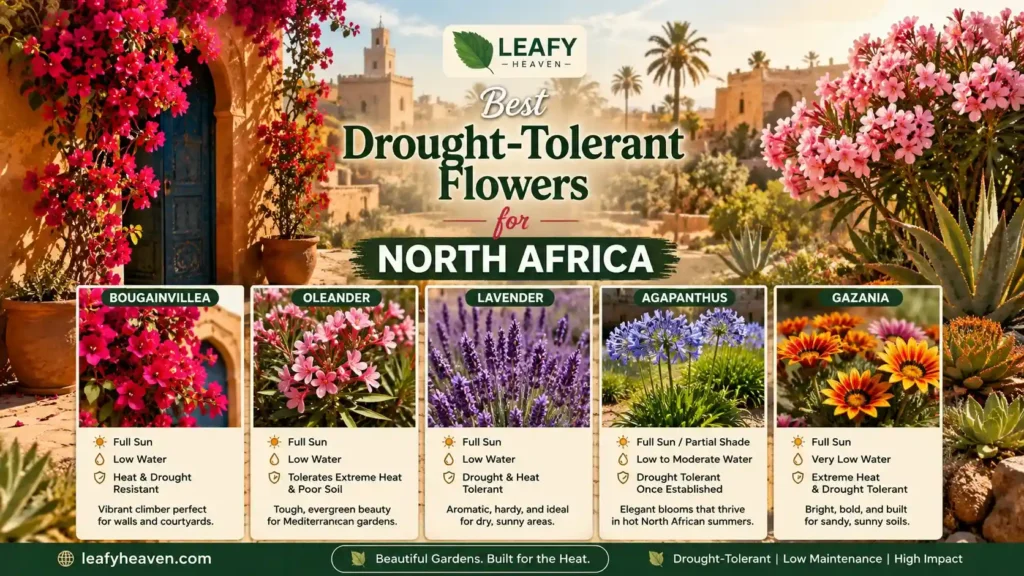
Best Drought-Tolerant Flowers for North Africa Summer
North Africa’s summer presents some of the most extreme gardening conditions on the continent — temperatures regularly exceeding 40°C, near-zero rainfall, and hot dry desert winds that strip moisture from soil and leaves simultaneously.
The best drought tolerant plants morocco, drought resistant flowers algeria, flowering plants egypt, and summer flowers north africa selections share one quality — they are genuinely built for Mediterranean and desert conditions, not just tolerant of them.
These proven mediterranean drought tolerant plants deliver stunning summer color across Morocco, Egypt, Tunisia, and Algeria with minimal water and maximum visual impact.
Bougainvillea
Bougainvillea is North Africa’s most iconic drought tolerant summer flower — thriving across Morocco, Egypt, Tunisia, and Algeria with spectacular color displays through peak summer heat.
As a drought tolerant flowers mediterranean performer, Bougainvillea is unmatched — water stress actively triggers its most prolific blooming, making North Africa’s dry summers ideal rather than challenging.
Key Facts:
| Feature | Details |
| Sun Needs | Full sun — minimum 6 hours daily |
| Water Needs | Very Low — drought triggers blooming |
| Bloom Colors | Pink, purple, red, orange, white |
| Height | 10–30 feet |
| Bloom Season | Spring through summer — peak in heat |
| Soil | Well-draining, alkaline tolerant |
As one of the finest heat tolerant plants north africa gardeners rely on, Bougainvillea thrives on walls, pergolas, fences, and as large statement plants in Moroccan riads and Egyptian garden courtyards.
Quick Tip: Reduce watering in the weeks before flowering — mild water stress produces Bougainvillea’s most spectacular North African summer bloom flush.
Oleander (Nerium)
Oleander is one of the toughest desert flowers north africa produces — delivering bold clusters of blooms through the most extreme summer heat and dry conditions across Algeria, Morocco, Egypt, and Tunisia.
As mediterranean drought tolerant plants go, Oleander is the most heat-resistant and drought-hardy shrub available for North African summer gardens — commonly seen lining roads, highways, and public spaces where zero irrigation is provided.
Key Facts:
| Feature | Details |
| Sun Needs | Full sun |
| Water Needs | Very Low — extreme drought tolerant |
| Bloom Colors | Pink, red, white, yellow, salmon |
| Height | 6–12 feet |
| Bloom Season | Late spring through summer |
| Soil | Any well-draining soil — alkaline tolerant |
Drought resistant flowers algeria and Morocco gardeners use most commonly in public landscaping are dominated by Oleander — its ability to survive compacted, poor, alkaline desert soil with zero supplemental water makes it the most practical large-scale drought tolerant shrub in North Africa.
⚠️ Important Toxicity Warning: All parts of Oleander — leaves, flowers, stems, and sap — are highly toxic if ingested by humans, children, or animals. Always handle with gloves and plant away from children and pets.
Lavender (North African Varieties)
Lavender is perfectly adapted to Morocco and Tunisia’s Mediterranean climate — a genuinely drought tolerant flowers mediterranean species that delivers fragrance, color, and low-water performance through North African summers.
North Africa is actually part of Lavender’s native Mediterranean range — making it one of the most naturally climate-appropriate heat tolerant plants north africa gardeners can choose.
Key Facts:
| Feature | Details |
| Scientific Name | Lavandula stoechas (Mediterranean variety) |
| Sun Needs | Full sun — essential for blooming |
| Water Needs | Very Low — deep drought tolerance |
| Bloom Colors | Purple, violet, white |
| Height | 1–3 feet |
| Bloom Season | Spring through early summer |
| Best Regions | Morocco, Tunisia, northern Algeria coastal areas |
Lavender performs best in North Africa’s cooler coastal Mediterranean zones — Morocco’s Atlantic coast and Tunisia’s northern regions provide ideal conditions.
In hotter inland desert areas of Egypt and southern Algeria, Lavender struggles with extreme heat — Rosemary or Salvia are better summer flowers north africa alternatives for those locations.
Quick Tip: Lavender blooms most prolifically in lean, sandy North African soil — avoid adding compost or fertilizer heavily, as rich soil produces lush foliage but reduces flowering significantly.
Agapanthus
Agapanthus is one of the most visually striking flowering plants egypt and North Africa gardens feature in summer — producing tall stalks of stunning blue-purple blooms with minimal water requirements.
As drought tolerant plants morocco and North Africa gardeners increasingly adopt, Agapanthus delivers a bold architectural flower display that conventional summer flowers simply cannot match.
Key Facts:
| Feature | Details |
| Scientific Name | Agapanthus africanus |
| Sun Needs | Full sun to partial shade |
| Water Needs | Low — drought tolerant once established |
| Bloom Colors | Blue, purple, white |
| Height | 2–4 feet |
| Bloom Season | Summer — June through August |
| Soil | Well-draining — tolerates sandy North African soil |
Agapanthus is one of the finest summer flowers north africa coastal gardens feature — its blue-purple flower heads add a distinctly South African native flair to Mediterranean North African garden designs.
Quick Tip: Agapanthus blooms most prolifically when slightly pot-bound — container growing in North African gardens actually produces better flowering than open ground planting in some conditions.
Gazania (African Daisy)
Gazania is a native African drought tolerant daisy that thrives in full sun and dry conditions — producing vivid jewel-toned blooms across North African summer gardens with almost no supplemental water.
As one of the true desert flowers north africa gardeners can grow from seed, Gazania represents genuinely native African drought tolerance — evolved specifically for the continent’s most challenging summer conditions.
Key Facts:
| Feature | Details |
| Scientific Name | Gazania rigens |
| Origin | Native to South and North Africa |
| Sun Needs | Full sun — blooms close in shade |
| Water Needs | Very Low — extreme drought tolerant |
| Bloom Colors | Orange, yellow, red, pink, white — often multicolored |
| Height | 6–12 inches |
| Bloom Season | Spring through summer |
| Soil | Sandy, poor, dry soil preferred |
Gazania is among the best drought resistant plants egypt and North Africa gardeners use for low-border planting, ground cover, and container displays — its vivid daisy-like blooms open fully in direct sun and close at night, creating a dynamic daily display through the summer season.
As one of the most reliable heat tolerant plants north africa offers, Gazania requires no special soil preparation, no fertilizing, and minimal watering — making it the most accessible drought tolerant summer flower for beginner North African gardeners.
Best Drought-Tolerant Flowers for East Africa Summer
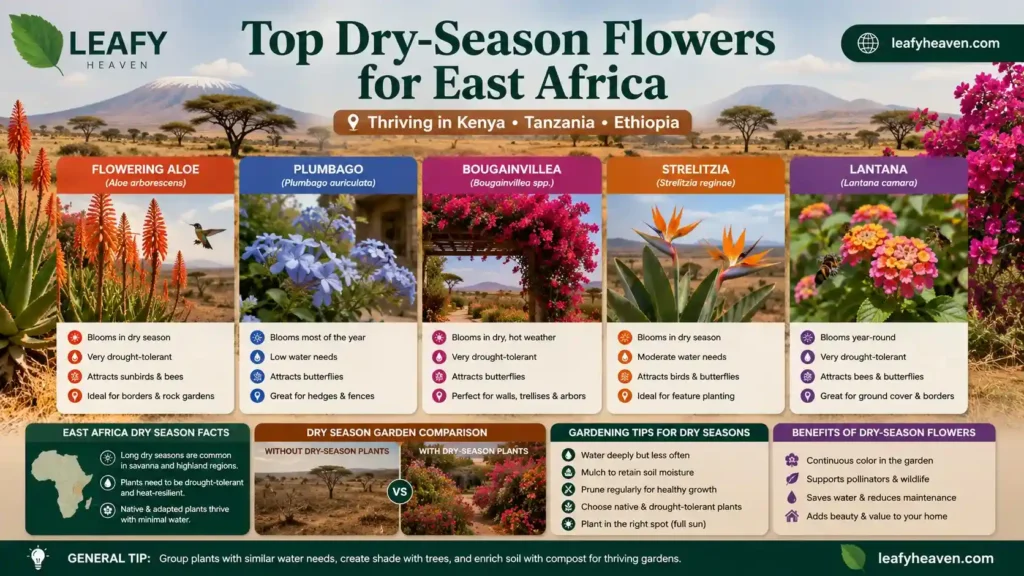
East Africa’s summer presents a unique drought challenge — long dry seasons stretching 3–6 months, savanna heat, and red laterite soils that drain rapidly and retain minimal moisture.
The best drought tolerant plants kenya, flowering plants east africa selections, and african drought resistant plants for this region must handle sustained dry season conditions while continuing to bloom reliably.
Plants that survive dry season africa in East African conditions have evolved specific adaptations — deep tap roots, water-storing tissues, and rapid bloom cycles timed to the dry season window.
Aloe Vera (Flowering Aloe)
Flowering Aloe is one of East Africa’s most naturally adapted savanna flowering plants — thriving in Kenya, Ethiopia, and Tanzania’s dry season conditions while delivering striking orange-red flower spikes and significant medicinal value.
As drought tolerant flowers africa go, Aloe species are among the most ecologically important — they provide nectar for sunbirds during East Africa’s dry season when few other plants bloom.
Key Facts:
| Feature | Details |
| Scientific Name | Aloe vera / Aloe secundiflora (East African species) |
| Sun Needs | Full sun |
| Water Needs | Very Low — succulent water storage |
| Bloom Colors | Orange, red, yellow flower spikes |
| Height | 1–3 feet |
| Bloom Season | Dry season — peak blooming |
| Soil | Sandy, rocky, well-draining |
| Medicinal Value | Gel used for burns, skin care, digestion |
Drought resistant plants ethiopia and Kenya gardeners grow most reliably include multiple Aloe species — from the widespread Aloe vera to indigenous Aloe secundiflora found naturally across East African savannas.
Quick Tip: East African Aloe species bloom most prolifically during the dry season — reduced rainfall actually triggers their most spectacular flower spike production, making them perfect dry season garden anchors.
Plumbago
Plumbago is one of the most visually impactful flowering plants east africa dry season gardens feature — producing masses of cool powder-blue blooms through Kenya, Tanzania, and Ethiopia’s hottest and driest months.
As heat tolerant flowers tanzania and summer flowers kenya selections, Plumbago stands out for delivering a rare cool blue tone against East Africa’s warm savanna landscape backdrop.
Key Facts:
| Feature | Details |
| Scientific Name | Plumbago auriculata |
| Sun Needs | Full sun to partial shade |
| Water Needs | Low — drought tolerant once established |
| Bloom Colors | Powder blue — distinctive cool tone |
| Height | 3–6 feet |
| Bloom Season | Year-round — peak in dry season |
| Soil | Well-draining — tolerates East African laterite soil |
| Growth Habit | Spreading shrub — ideal for borders and hedges |
Plumbago is widely planted across Nairobi, Dar es Salaam, and Addis Ababa in both private gardens and public landscaping — its near-continuous blooming through dry season conditions makes it one of the most reliable low-maintenance flowering shrubs in East Africa.
Quick Tip: Plumbago spreads vigorously in East African conditions — light pruning after each bloom flush keeps it compact and encourages continuous new flowering through the entire dry season.
Bougainvillea
Bougainvillea is the dominant summer flowering plant across East Africa — from Nairobi’s highland gardens to Dar es Salaam’s coastal landscapes, it delivers the most spectacular color display of any drought tolerant plants kenya and East Africa gardeners grow.
As african summer flowering plants go, Bougainvillea is the most universally recognized and widely planted across all East African countries — its vivid bracts covering entire walls and structures during peak dry season.
Key Facts:
| Feature | Details |
| Sun Needs | Full sun — minimum 5–6 hours |
| Water Needs | Very Low — water stress triggers blooming |
| Bloom Colors | Pink, purple, red, orange, white |
| Height | 10–30 feet |
| Zones | Tropical — ideal for all East Africa |
| Bloom Season | Dry season peak — most prolific blooming |
East Africa Regional Tips:
- Nairobi (Kenya): Bougainvillea thrives in Nairobi’s highland climate — cooler nights actually enhance bloom intensity and color vibrancy compared to coastal areas
- Dar es Salaam (Tanzania): Coastal humidity combined with dry season heat produces year-round blooming — reduce irrigation completely during dry season for maximum flower production
- Addis Ababa (Ethiopia): Higher altitude means cooler temperatures — choose tropical drought tolerant flowers varieties that handle both heat and mild highland cold
Quick Tip: East Africa’s dry season is Bougainvillea’s peak performance window — stop supplemental irrigation completely when dry season begins and allow natural water stress to trigger the season’s most spectacular bloom display.
Strelitzia (Bird of Paradise)
Strelitzia is East Africa’s most spectacular native drought tolerant flower — producing iconic orange-blue bird-shaped blooms through the dry season with remarkable drought resilience.
As one of the finest savanna flowering plants and tropical drought tolerant flowers native to the African continent, Strelitzia combines genuine drought adaptation with one of the most visually distinctive bloom structures in the plant kingdom.
Key Facts:
| Feature | Details |
| Scientific Name | Strelitzia reginae |
| Origin | Native to southern and East Africa |
| Sun Needs | Full sun to partial shade |
| Water Needs | Low — drought tolerant once established |
| Bloom Colors | Vivid orange + electric blue |
| Height | 3–5 feet |
| Bloom Season | Dry season through summer |
| Soil | Well-draining — tolerates poor soil |
| Lifespan | Long-lived perennial — 10+ years |
Strelitzia is among the finest flowering plants east africa native gardens feature — its dramatic bloom structure, extended flowering period, and genuine drought tolerance make it equally valuable as a specimen plant, border anchor, and container subject across Kenya, Tanzania, and Ethiopia.
Quick Tip: Strelitzia blooms most prolifically when slightly root-bound — established clumps that have been in the ground 3–5 years produce significantly more flowers than newly planted specimens.
Lantana
Lantana is East Africa’s most reliable year-round drought tolerant flowering shrub — producing continuous multicolored bloom clusters through the dry season while actively supporting East Africa’s native butterfly and bee populations.
As plants that survive dry season africa consistently, Lantana performs across all East African regions — from coastal Tanzania to highland Kenya — delivering non-stop color through the most challenging drought conditions.
Key Facts:
| Feature | Details |
| Sun Needs | Full sun |
| Water Needs | Very Low — highly drought tolerant |
| Bloom Colors | Yellow, orange, pink, red, white — multicolored clusters |
| Height | 2–4 feet |
| Bloom Season | Year-round — continuous through dry season |
| Soil | Any well-draining soil |
| Special Feature | Premier butterfly + bee attractor |
Drought tolerant flowers africa selections that never stop blooming through dry season are rare — Lantana is the outstanding exception.
As heat tolerant flowers tanzania and Kenya gardens need through the longest dry periods, Lantana delivers continuous color, wildlife support, and extremely low maintenance simultaneously.
Quick Tip: Lantana spreads naturally across East African conditions — use it as a slope stabilizer, border filler, or wildlife garden anchor where its spreading habit is an asset rather than a management challenge.
Best Drought-Tolerant Flowers for West Africa Summer
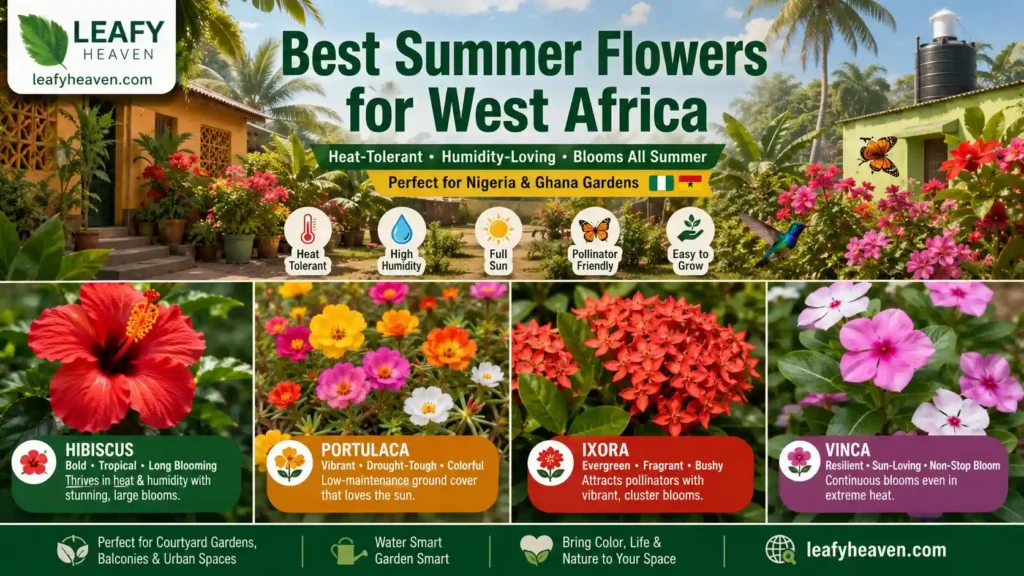
West Africa’s summer presents a unique dual challenge — intense tropical heat combined with pre-monsoon dry spells that can last weeks, followed by sudden humidity surges.
The best drought tolerant plants nigeria, drought tolerant flowers nigeria, flowering plants ghana, and tropical flowering plants africa selections for this region must handle both heat and humidity fluctuations simultaneously.
West African summer gardens need plants that thrive in high temperatures, tolerate dry spells between rainfall events, and continue blooming through the region’s distinctive tropical wet-dry cycle.
Hibiscus (Zobo / Roselle)
Hibiscus is West Africa’s most beloved drought tolerant summer flower — deeply embedded in Nigerian and Ghanaian culture, cuisine, and garden traditions across the entire region.
Known as Zobo in Nigeria and Sobolo in Ghana, Hibiscus sabdariffa is both a stunning flowering plant ghana and nigeria gardeners grow for beauty and a culturally significant plant used for food, drink, and traditional medicine.
Key Facts:
| Feature | Details |
| Scientific Name | Hibiscus rosa-sinensis / Hibiscus sabdariffa |
| Sun Needs | Full sun to partial shade |
| Water Needs | Low-Moderate — drought tolerant once established |
| Bloom Colors | Red, pink, yellow, white, orange |
| Height | 3–8 feet |
| Bloom Season | Year-round — peak in summer |
| Soil | Well-draining, slightly acidic to neutral |
Cultural Significance:
- Nigeria: Hibiscus sabdariffa (Zobo) calyces are used to make the iconic Zobo drink — a deep red beverage consumed across all social occasions
- Ghana: Known as Sobolo — the drink is equally popular and the plant is grown in home gardens across the country for both ornamental and culinary purposes
- Both countries use Hibiscus leaves and flowers in traditional medicine for blood pressure management and general wellness
As african summer flowering plants go, Hibiscus combines ornamental value, cultural significance, and drought tolerance in a single package that no other West African summer flower matches.
Quick Tip: Hibiscus blooms most prolifically in full sun with light pruning after each bloom flush — in West Africa’s tropical conditions, regular light pruning maintains a compact shape and continuous flowering through the entire summer season.
Portulaca (Moss Rose)
Portulaca is one of the most heat-resistant drought tolerant plants nigeria and West Africa gardens feature — producing jewel-toned blooms in intense heat and dry spells that would eliminate virtually all other flowering plants.
As drought hardy plants tropical africa gardeners rely on through the harshest dry spells, Portulaca’s succulent leaves store water internally — making it genuinely self-sufficient through West Africa’s pre-monsoon dry periods.
Key Facts:
| Feature | Details |
| Scientific Name | Portulaca grandiflora |
| Sun Needs | Full sun — blooms close in shade |
| Water Needs | Very Low — extreme drought tolerant |
| Bloom Colors | Pink, red, orange, yellow, white, magenta |
| Height | 6–12 inches |
| Bloom Season | Summer — continuous through dry spells |
| Soil | Sandy, poor, dry soil preferred |
| Special Feature | Blooms close at night and reopen each morning |
Portulaca is the ideal plants for dry season west africa solution for small spaces, container gardens, and ground cover applications — it spreads attractively, requires zero special care, and delivers vivid color through the most challenging tropical dry conditions.
Quick Tip: Portulaca self-seeds readily in West African conditions — scatter seeds once and it naturalizes across garden beds, returning season after season without replanting.
Ixora
Ixora is West Africa’s most popular drought tolerant flowering shrub for continuous summer color — producing dense clusters of red, orange, and pink blooms through Nigeria and Ghana’s hottest months with minimal care.
As tropical flowering plants africa selections go, Ixora is among the most widely planted in West African home gardens, roadside landscaping, and institutional grounds — its compact form, continuous blooming, and heat tolerance make it universally reliable.
Key Facts:
| Feature | Details |
| Scientific Name | Ixora coccinea |
| Sun Needs | Full sun to partial shade |
| Water Needs | Low — drought tolerant once established |
| Bloom Colors | Red, orange, pink, yellow, white |
| Height | 2–4 feet |
| Bloom Season | Year-round — continuous summer peak |
| Soil | Slightly acidic, well-draining |
| Growth Habit | Compact shrub — ideal for hedges and borders |
Flowering plants ghana and Nigeria gardeners use most consistently for low-maintenance borders and hedges are dominated by Ixora — its dense foliage, continuous blooming, and tolerance of West Africa’s humidity + dry spell cycle make it the most practical choice for large-scale planting.
As drought tolerant flowers nigeria selections go, Ixora delivers the longest continuous bloom period of any West African summer shrub — producing fresh flower clusters virtually year-round with only minimal pruning required.
Quick Tip: Ixora prefers slightly acidic soil — in West Africa’s neutral to alkaline soils, add a small amount of sulfur or acidic organic matter annually to maintain optimal flowering performance.
Vinca (Periwinkle)
Vinca is one of the most reliable year-round drought tolerant bloomers across West Africa — producing continuous pink, white, red, and purple flowers through Nigeria and Ghana’s summer heat with virtually zero maintenance requirements.
As african summer flowering plants go, Vinca is the most forgiving and most consistent performer available — it handles West Africa’s heat, humidity fluctuations, and occasional dry spells with equal reliability.
Key Facts:
| Feature | Details |
| Scientific Name | Catharanthus roseus |
| Sun Needs | Full sun to partial shade |
| Water Needs | Low — highly drought tolerant |
| Bloom Colors | Pink, white, red, purple, lavender |
| Height | 12–18 inches |
| Bloom Season | Year-round — peak in summer |
| Soil | Well-draining — tolerates West African clay-heavy soils |
| Maintenance | Very Low — no deadheading required |
Drought resistant plants west africa gardeners need for reliable color through dry spells are led by Vinca — it self-branches naturally, requires no deadheading, and produces fresh blooms continuously through the entire summer season.
As heat tolerant plants ghana and Nigeria gardens need for both borders and containers, Vinca delivers consistent performance across every West African growing condition — from humid coastal Lagos to drier inland Kano and Kumasi.
Quick Tip: Vinca has mild medicinal properties — its alkaloids have been documented in cancer treatment research and are used in chemotherapy drug development globally. Handle with basic precautions and avoid ingestion, but enjoy it confidently as a beautiful, safe-to-grow West African summer flowering plant.
African Native Drought-Tolerant Flowering Plants
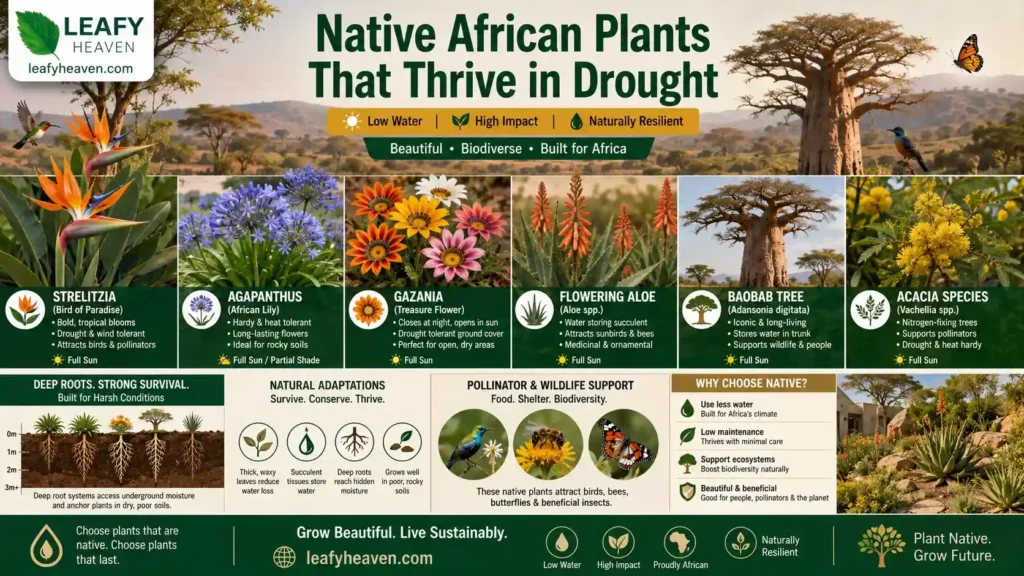
Africa is the origin continent for some of the world’s most spectacular and drought-hardy flowering plants.
African drought tolerant plants that are native to the continent represent the gold standard for summer garden performance — they evolved specifically for Africa’s most extreme heat, drought, and soil conditions over millions of years.
Understanding which drought tolerant flowers africa offers as native species gives every African gardener access to plants that require zero climate adaptation, zero soil amendment, and zero supplemental irrigation once established.
Why African Native Plants Are Best for Summer Gardens
African native plants are already perfectly calibrated for drought conditions — they survive and bloom through Africa’s harshest dry seasons with zero supplemental irrigation.
African drought resistant plants that are native have developed drought survival mechanisms over thousands of generations — mechanisms that no introduced garden plant can fully replicate.
Key Benefits of African Native Plants:
- Water Saving — established native plants survive purely on natural rainfall and groundwater — no irrigation system required even through 4–6 month dry seasons
- Biodiversity Support — native flowering plants support Africa’s native bees, butterflies, sunbirds, and other pollinators that depend specifically on indigenous plant species for survival
- Low Maintenance — no fertilizing, no soil amendment, no special pruning schedules — native plants thrive in the exact soil conditions that surround them
- Climate Resilience — drought resistant plants africa that are native handle extreme weather events — heat waves, flash floods, prolonged drought — without damage or plant loss
- Cost Savings — zero irrigation costs + zero replacement plant costs after establishment period
For plants for hot dry climate africa conditions, native species represent the most sustainable, most ecologically sound, and most practically reliable gardening choice available across all three African regions.
Quick Fact: African native flowering plants have survived continent-wide drought cycles, climate shifts, and extreme weather events for millions of years — their drought tolerance is not a cultivated trait but a fundamental survival mechanism built into their DNA.
Top African Native Flowering Plants
African drought tolerant plants that are native to the continent deliver stunning summer color while actively supporting local ecosystems across savanna flowering plants communities and beyond.
These are the most important and most ornamentally valuable drought tolerant flowers africa native selections for summer gardens.
Strelitzia reginae (Bird of Paradise)
| Feature | Details |
| Origin | Native to South and East Africa |
| Bloom Color | Vivid orange + electric blue |
| Height | 3–5 feet |
| Water Needs | Low — drought tolerant |
| Best Regions | East + South Africa gardens |
One of Africa’s most iconic native flowers — its dramatic bird-shaped bloom is instantly recognizable and performs reliably through dry season conditions across East African gardens.
Agapanthus africanus (African Lily)
| Feature | Details |
| Origin | Native to South and North Africa |
| Bloom Color | Blue, purple, white |
| Height | 2–4 feet |
| Water Needs | Low — drought tolerant once established |
| Best Regions | North Africa + East Africa gardens |
Agapanthus is one of Africa’s finest native savanna flowering plants — its tall blue flower stalks provide dramatic summer color with minimal water across a wide range of African garden conditions.
Gazania rigens (African Daisy)
| Feature | Details |
| Origin | Native to South and North Africa |
| Bloom Color | Orange, yellow, red, pink — multicolored |
| Height | 6–12 inches |
| Water Needs | Very Low — extreme drought tolerant |
| Best Regions | North Africa + coastal gardens |
Gazania is one of the most drought-hardy native African flowering ground covers available — its vivid daisy blooms open fully in direct sun and close at night, producing a dynamic daily display through the entire summer season.
Aloe species (Flowering Aloe)
| Feature | Details |
| Origin | Native across entire African continent |
| Bloom Color | Orange, red, yellow flower spikes |
| Height | 1–10 feet depending on species |
| Water Needs | Very Low — succulent water storage |
| Best Regions | All African regions |
With over 500 native Aloe species across Africa, this genus represents the continent’s most widespread and most diverse group of drought tolerant flowers africa offers — from tiny garden specimens to towering tree aloes that anchor entire East African savanna landscapes.
Baobab Tree (Adansonia digitata)
| Feature | Details |
| Origin | Native to sub-Saharan Africa |
| Bloom Color | Large white pendant flowers |
| Height | 50–80 feet at maturity |
| Water Needs | Near Zero — stores thousands of liters in trunk |
| Best Regions | West + East Africa large gardens |
The Baobab is Africa’s supreme drought survival tree — storing thousands of liters of water in its massive trunk and producing beautiful large white pendant flowers in summer.
As a savanna flowering plants icon, the Baobab is Africa’s most recognizable tree and one of the continent’s most important ecological and cultural symbols.
Acacia species
| Feature | Details |
| Origin | Native across all African regions |
| Bloom Color | Pale yellow fragrant clusters |
| Height | 15–40 feet depending on species |
| Water Needs | Very Low — deep tap root |
| Best Regions | All African regions |
Acacia trees are the defining plants of African savanna landscapes — producing fragrant yellow flower clusters in summer while providing critical shade, habitat, and food sources for Africa’s wildlife.
Their deep tap root systems access groundwater far below the surface, making them among the most drought-resilient flowering trees on the continent.
Quick Summary: Africa’s native drought tolerant flowering plants are not just garden specimens — they are ecological anchors that support entire food webs, provide cultural significance, and deliver stunning seasonal color through the continent’s most extreme summer conditions. Choosing native species for African summer gardens is simultaneously the most beautiful, most sustainable, and most ecologically responsible gardening decision available.
How to Grow Drought-Tolerant Flowers in African Summer
Growing drought tolerant flowers africa successfully requires more than choosing the right species — soil preparation, watering strategy, and region-specific management are equally critical.
Summer flowers africa gardeners grow most successfully share one foundation — they are planted into properly prepared conditions and supported with climate-appropriate techniques from day one.
Building that foundation becomes much easier with a solid understanding of core plant care principles — this complete gardening and plant care guide covers everything from soil preparation to seasonal maintenance for outdoor gardens.
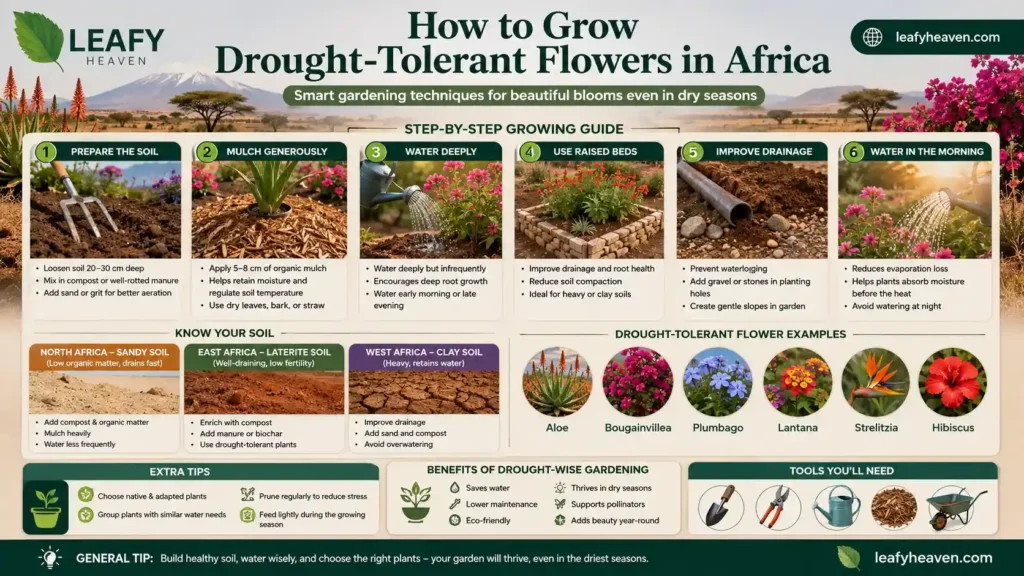
Plants for hot dry climate africa thrive long-term when the growing system matches the regional challenge — North Africa’s desert alkalinity, East Africa’s laterite drainage issues, and West Africa’s clay-heavy humid soils each require different preparation approaches.
Soil Preparation for African Summer Gardens
Well-draining soil combined with organic matter is the single most important foundation for any African summer garden — and each region’s soil requires a different amendment strategy.
Drought resistant plants africa perform significantly better in properly prepared soil — even the most heat-adapted african drought tolerant plants establish faster, bloom earlier, and require less supplemental irrigation when soil conditions are optimized.
African Summer Soil Challenges and Solutions:
| Region | Soil Type | Key Problems | Solution |
| North Africa | Sandy + alkaline | Fast drainage + nutrient lockout | Compost + coco peat + sulfur |
| East Africa | Red laterite | Compaction + poor nutrient retention | Drainage improvement + organic matter |
| West Africa | Clay-heavy | Waterlogging + poor aeration | Coarse sand + perlite + raised beds |
North Africa — Sandy + Alkaline Soil:
- Sandy North African desert soil drains too fast — water passes through before roots absorb it
- Add 30–40% well-decomposed compost to improve moisture retention without reducing drainage
- High alkalinity (pH 7.5–8.5) locks out essential nutrients — add agricultural sulfur to gradually lower pH
- Coco peat addition improves water retention in sandy soil without creating waterlogging risk
- Flowering plants for dry climate success in North Africa starts with this single amendment step
East Africa — Red Laterite Soil:
- East Africa’s characteristic red laterite soil compacts heavily when dry — blocking root penetration
- Loosen soil to minimum 12 inches depth before planting
- Add 25–30% organic compost to improve nutrient availability and soil structure
- Laterite drains adequately when loose but compacts rapidly — mulching is essential to maintain surface structure
- Raised beds improve drainage significantly for drought tolerant flowers in East African clay-laterite mixtures
West Africa — Clay-Heavy Soil:
- West African clay soil retains too much moisture — creating waterlogging risk during rainy season and hard cracking during dry spells
- Add 30% coarse sand + 20% perlite to clay soil before planting
- Raised beds are the most effective West African solution — elevating root zones above clay waterlogging level
- Improve drainage channels around garden beds before rainy season begins
- Apply thick organic mulch to prevent clay surface from cracking during dry spells
Quick Tip: Across all three African regions, applying 3 inches of organic mulch immediately after planting delivers the single most impactful improvement to drought tolerant flower establishment — it reduces soil temperature, slows evaporation, and gradually improves soil quality as it decomposes.
Watering Strategy for African Summer
Deep infrequent morning watering is the most effective irrigation strategy for summer flowers africa across all three regions — it builds genuine drought tolerance, conserves water, and produces stronger root systems than frequent shallow watering.
Drought tolerant plants for hot climate conditions establish their water independence through deep root development — and deep infrequent watering is the technique that drives this process most effectively.
When to Water:
- Best time: Early morning — before 8 AM across all African regions
- Why: Lowest evaporation rates + water reaches roots before peak heat
- Avoid: Midday watering — significant evaporation loss in African summer heat
- Avoid: Evening watering — wet foliage overnight encourages fungal disease, especially in West Africa’s humid conditions
Watering Frequency by Region:
| Plant Stage | North Africa | East Africa | West Africa |
| Newly Planted | Every 2–3 days | Every 3 days | Every 3–4 days |
| Establishing | Every 4–5 days | Every 5–6 days | Every 5–7 days |
| Fully Established | Once per week | Once per 10 days | Once per week |
| Native Species | Rainfall only | Rainfall only | Rainfall only |
| Peak Dry Season | Twice per week | Once per week | Once per week |
Drought hardy plants tropical africa — like Lantana, Vinca, and Portulaca — need even less water once established in West African conditions, often managing on natural rainfall alone after the first growing season.
Quick Fact: Established african drought tolerant plants typically require 60–70% less water than newly planted specimens — consistent establishment period watering produces plants that genuinely thrive independently through Africa’s longest dry seasons.
Region-Specific Growing Tips
Each African region requires specific management techniques beyond basic soil and watering practices — drought tolerant plants kenya, drought tolerant plants morocco, and drought tolerant plants nigeria all face distinct seasonal challenges.
North Africa — Key Tips:
- Shade Cloth: Install 30–40% shade cloth over vulnerable plants during peak afternoon hours (1–4 PM) in July–August — North African summer afternoon sun regularly exceeds 44°C and causes heat scorch even on drought tolerant species
- Alkaline Soil Management: Apply acidic organic mulch annually — pine needle mulch or citrus compost gradually lowers soil pH over time, improving nutrient availability for flowering plants
- Wind Protection: North Africa’s hot desert winds (Sirocco, Khamsin) strip moisture from leaves rapidly — plant windbreak shrubs like Oleander on prevailing wind sides before establishing smaller flowering plants
- Sandstorm Preparation: Stake all tall flowering plants before sandstorm season — rinse foliage with clean water after storms to remove sand accumulation that blocks photosynthesis
East Africa — Key Tips:
- Dry Season to Rainy Season Transition: Reduce watering gradually as rainy season approaches — sudden abundant rainfall after established drought tolerance can cause rapid growth followed by fungal issues
- Rainy Season Drainage: Ensure all garden beds and containers have clear drainage before rainy season — East Africa’s heavy rains can waterlog even well-adapted drought tolerant plants if drainage is inadequate
- Elevation Consideration: Kenya’s highland gardens (Nairobi at 1,795m) experience cooler temperatures — choose drought tolerant plants kenya highland varieties that handle both heat and mild cold rather than purely tropical species
- Dry Season Mulching: Apply 4 inches of mulch at dry season start — East Africa’s dry seasons can last 4–6 months, making deep mulching the most critical single practice for garden survival
West Africa — Key Tips:
- Humidity Management: Space plants generously in West African gardens — adequate air circulation between plants reduces fungal disease pressure that peaks during humid pre-monsoon periods
- Fungal Prevention: Apply copper-based fungicide preventively at season start — West Africa’s humidity + heat combination creates ideal conditions for powdery mildew and leaf spot on flowering plants
- Raised Bed Priority: Build raised beds 12–18 inches high for all drought tolerant flowers in West African clay soil areas — this single structural investment prevents waterlogging during rainy season and improves drainage through dry spells simultaneously
- Succession Planting: West Africa’s unpredictable dry spell timing makes succession planting valuable — stagger planting dates by 3–4 weeks to ensure continuous bloom coverage regardless of when dry spells occur
Quick Summary: Successful African summer gardening is fundamentally regional — North Africa needs wind and heat protection, East Africa needs dry-to-wet transition management, and West Africa needs humidity control and drainage solutions. Matching management techniques to regional conditions produces dramatically better results than applying generic gardening advice across the continent’s diverse summer climates.
Benefits of Growing Drought-Tolerant Flowers Across Africa
Drought tolerant flowers africa gardeners grow offer more than just beautiful summer blooms. These plants help conserve water, reduce maintenance, support biodiversity, and improve sustainability across both urban and rural African landscapes.
Water Conservation
Drought resistant plants africa regions rely on require far less irrigation than traditional flowering plants. This is especially important in areas facing recurring droughts, water shortages, and rising summer temperatures.
Deep-rooted and heat-adapted flowers can survive with minimal watering while still producing vibrant blooms throughout the dry season.
Low Maintenance for Urban and Rural Gardens
African drought tolerant plants are ideal for busy urban homeowners, community gardens, and rural landscapes because they require:
- Less watering
- Less fertilizing
- Minimal pruning
- Better heat tolerance
Plants like Gazania, Lantana, Bougainvillea, and Vinca continue thriving even in neglected summer conditions.
Food Security Support
Some drought-tolerant flowering plants also provide edible or medicinal value. This makes them practical choices for African home gardens and food-focused landscapes.
Examples include:
- Hibiscus (Roselle/Zobo) for drinks and herbal uses
- Aloe species for medicinal applications
- Certain Acacia species for livestock and ecological support
These plants combine beauty with functional benefits.
Pollinator Support
Flowering drought-tolerant plants attract important African pollinators including:
- Bees
- Butterflies
- Sunbirds
- Beneficial insects
Pollinator-friendly gardens help improve biodiversity and support local ecosystems during dry seasons when nectar sources become limited.
Mental Wellness in Dense Cities
Green flowering spaces can improve mental wellness in crowded African cities where heat and urban stress are increasing.
Colorful summer flowers help:
- Create calming outdoor spaces
- Reduce visual heat stress
- Improve home aesthetics
- Encourage gardening and outdoor activity
Even small balconies and courtyard gardens benefit from drought-tolerant blooms.
Environmental Benefits
Drought tolerant flowers africa landscapes use also contribute to long-term environmental protection.
Key environmental advantages include:
- Reduced soil erosion
- Lower water consumption
- Improved biodiversity
- Better resilience against climate change
- Support for native African ecosystems
Native drought-resistant plants are especially valuable because they are already adapted to Africa’s natural climate conditions.
Conclusion
Choosing the right drought tolerant flowers africa gardeners can grow is one of the smartest ways to create a beautiful, resilient, and low-maintenance summer garden. From the desert climates of North Africa to the savanna landscapes of East Africa and the tropical conditions of West Africa, many flowering plants are naturally adapted to intense heat and dry seasons.
Throughout this guide, we explored:
- The best summer flowers africa regions can grow
- Region-specific drought-tolerant flowering plants
- African native plants that thrive in harsh climates
- Water-saving gardening strategies
- Environmental and pollinator benefits of drought-resistant gardens
African drought tolerant plants like Bougainvillea, Gazania, Hibiscus, Flowering Aloe, Strelitzia, and Lantana continue delivering vibrant blooms even during extreme summer temperatures with minimal watering.
This summer, fill your African garden with these stunning drought-tolerant flowers and create a landscape that stays colorful, sustainable, and climate-resilient throughout the hottest months of the year.
As June temperatures rise across Africa, now is the perfect time to prepare your garden with heat-resistant flowering plants before peak summer drought conditions arrive.
Share your garden photos, favorite drought-resistant flowers, and regional growing experiences — and subscribe for more seasonal African gardening tips and summer planting guides.
FAQs
What are the best drought-tolerant flowers for North Africa summer?
The best drought tolerant plants morocco and other North African regions grow include Bougainvillea, Oleander, Lavender, Gazania, and Agapanthus. These summer flowers north africa gardens rely on are highly adapted to Mediterranean heat, dry winds, and low rainfall conditions. Most of these mediterranean drought tolerant plants bloom heavily in full sun with minimal watering.
Which drought-tolerant flowers grow best in East Africa?
Strelitzia, Plumbago, Lantana, Bougainvillea, and Flowering Aloe are among the top drought tolerant plants kenya and East African gardeners prefer. These flowering plants east africa landscapes use can survive long dry seasons and high temperatures while continuing to produce vibrant blooms. They are also excellent plants that survive dry season africa conditions naturally.
What are the best summer flowers for West Africa gardens?
Hibiscus, Portulaca, Ixora, and Vinca are some of the best drought tolerant plants nigeria and Ghana gardeners can grow. These summer flowers nigeria landscapes commonly feature are well suited to tropical heat, seasonal drought, and humid conditions. Many tropical flowering plants africa regions grow also flower continuously throughout summer.
Which flowers are native to Africa and drought tolerant?
Several african drought tolerant plants are native to the continent and naturally adapted to dry climates. Popular examples include Strelitzia, Agapanthus, Gazania, Flowering Aloe, and Acacia species. These savanna flowering plants thrive in intense sunlight, poor soils, and limited rainfall while supporting biodiversity and pollinators.
How often should I water drought-tolerant flowers in African summer?
Most established drought tolerant flowers africa gardens contain only need deep watering once or twice per week during extreme summer heat. Plants for hot dry climate africa regions should always be watered deeply rather than lightly and frequently. Morning watering is usually the best strategy because it reduces evaporation and fungal problems while helping drought resistant plants africa conditions stay healthy.
Can drought-tolerant flowers grow in West Africa's humid conditions?
Yes — many drought tolerant plants nigeria gardeners use can also handle humidity effectively. Tropical drought tolerant flowers such as Hibiscus, Vinca, and Ixora perform very well in West Africa’s pre-monsoon humidity and seasonal dry spells. These drought hardy plants tropical africa regions grow are adapted to both heat and changing moisture conditions.

Written by the LeafyHeaven Editorial Team
LeafyHeaven shares practical gardening tips and simple plant care guides to help you grow, nurture, and enjoy your plants with ease. Our goal is to make gardening feel natural, approachable, and rewarding for everyone.