
Introduction
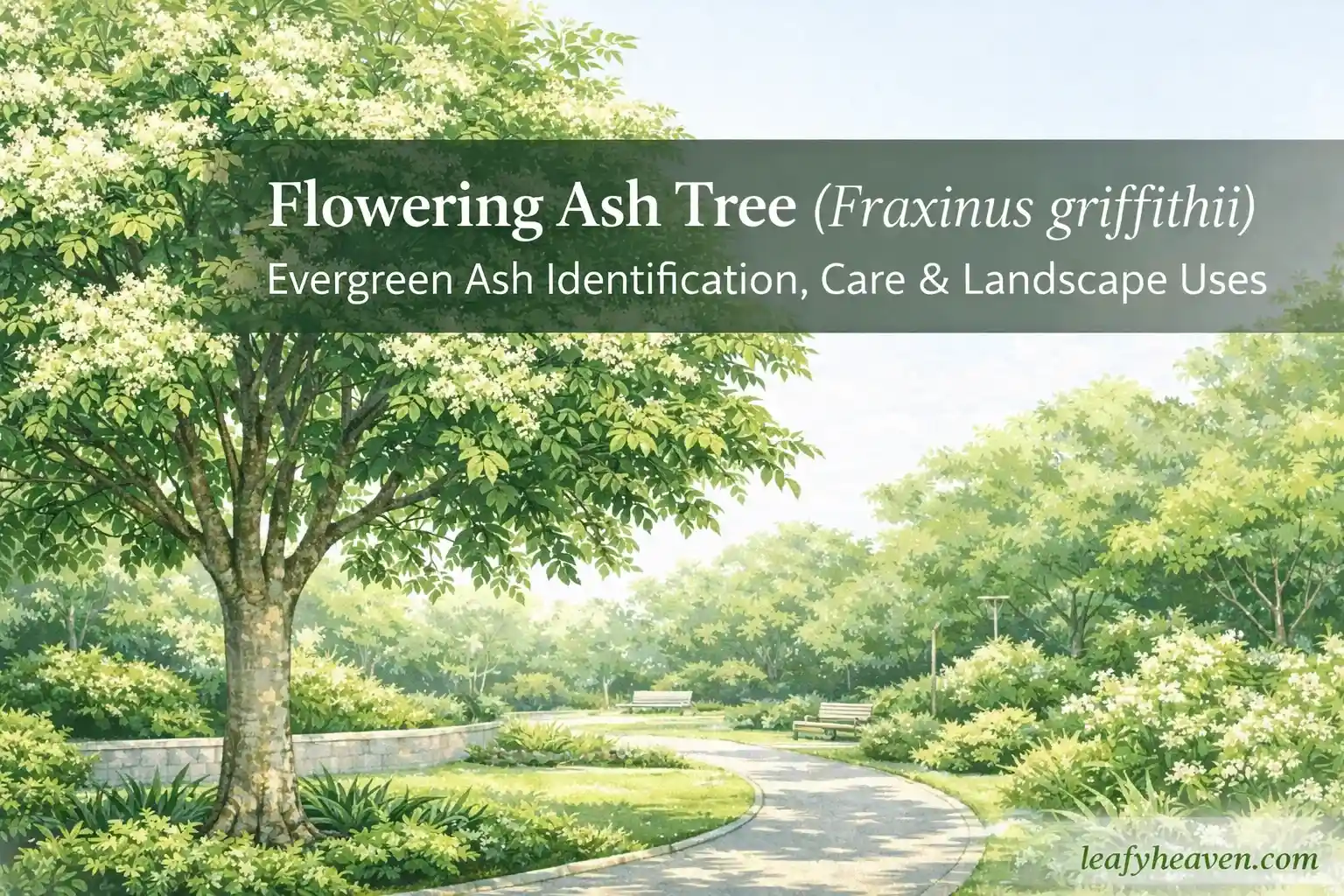
The flowering ash tree is widely valued in landscaping for its elegant structure, evergreen foliage, and attractive seasonal flowers. Known botanically as Fraxinus griffithii evergreen ash, this species is commonly referred to as evergreen ash or the evergreen flowering ash tree. Unlike many traditional ash species that lose their leaves in winter, this ash tree evergreen variety maintains foliage year-round in suitable climates, making it a dependable ornamental tree for gardens and urban spaces.
Native to parts of Asia and well adapted to warm regions, the evergreen ash is widely planted in areas such as Australia and other mild or subtropical climates. Landscapers often select this tree for its dense canopy, moderate growth rate, and ability to provide consistent shade while maintaining visual appeal. Because of its balanced shape, fragrant flowers, and adaptability to urban environments, the flowering ash tree has become a popular choice for streetscapes, parks, and residential gardens.
If you want a stronger foundation for caring for ornamental trees and landscape plants, this gardening and plant care guide explains the core principles of soil, watering, pruning, and long-term plant health.
What Is a Flowering Ash Tree?
Botanical Classification of Flowering Ash
The flowering ash tree commonly referenced in warm-climate landscaping is scientifically known as Fraxinus griffithii. This species belongs to the Oleaceae family, the same plant family that includes olives, lilacs, and jasmine. Within this family, it is part of the Fraxinus genus, a group that includes many ash tree species distributed across temperate regions of the world.
Scientific classification
- Scientific name: Fraxinus griffithii
- Genus: Fraxinus
- Family: Oleaceae
- Common names:
- flowering ash
- evergreen ash tree
- evergreen flowering ash
The fraxinus griffithii flowering ash is distinctive because it differs from most traditional ash species in its leaf behavior. While many ash trees found in Europe and North America are deciduous, meaning they lose their leaves during colder seasons, flowering ash fraxinus griffithii is typically evergreen in warm climates. This allows the tree to maintain foliage throughout the year where temperatures remain mild.
Another defining feature is its ornamental value. The evergreen ash produces clusters of small white flowers that add visual interest during its blooming period. Because of this combination of flowering display and evergreen foliage, the tree is widely planted in urban landscapes, gardens, and street plantings in regions with suitable climates. For additional botanical information about this species, you can review the Fraxinus griffithii plant profile.
Key Characteristics of the Flowering Ash
The flowering ash is recognized for several distinctive features that make it a desirable ornamental tree in landscapes and urban environments. As a well-adapted ash plant, it combines evergreen foliage with decorative flowering and a structured canopy that offers both visual appeal and functional shade.
Evergreen Foliage
Unlike many ash species that are deciduous, the flowering ash maintains its leaves throughout the year in warm climates. The evergreen foliage creates a consistent green canopy, which makes the tree attractive for gardens, streets, and public landscapes where year-round greenery is preferred.
Small Fragrant White Flowers
During its blooming season, the tree produces clusters of small white flowers. These blossoms are lightly fragrant and appear in loose panicles, adding ornamental value and seasonal interest to the landscape. The flowering display is one of the main reasons the tree is commonly planted in decorative environments.
Smooth Grey Bark
The trunk of the flowering ash typically develops smooth to slightly textured grey bark. This subtle bark color complements the green foliage and gives the tree a refined appearance, especially as it matures.
Dense Canopy Suitable for Shade
The tree forms a dense and rounded canopy with evenly distributed branches. This structure allows the flowering ash to function as an effective shade tree, making it suitable for residential gardens, sidewalks, and park landscapes where filtered shade and visual structure are desired.
Evergreen Ash Tree Identification Guide
Leaves, Flowers and Bark
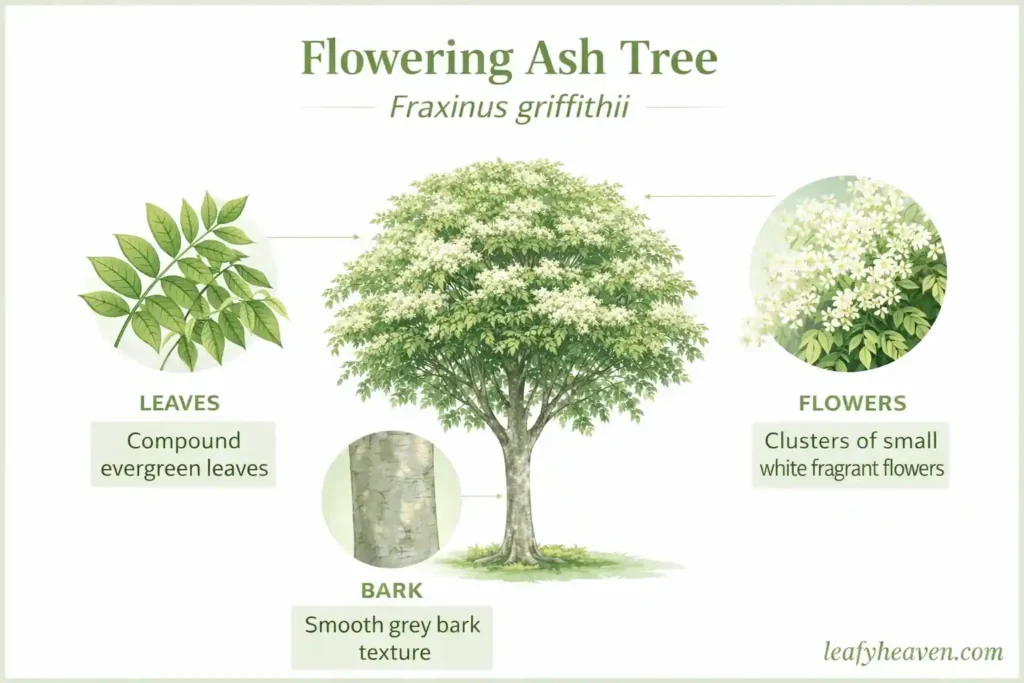
Correctly identifying an evergreen ash tree involves observing its foliage, flowers, and bark characteristics. These features help distinguish the flowering ash tree from many other ash species that are typically deciduous.
Leaf Structure and Evergreen Nature
The flowering ash tree has compound leaves made up of multiple leaflets arranged along a central stem. The leaflets are usually oval to lance-shaped with smooth or slightly serrated edges. In warm climates, the evergreen ash tree retains its foliage throughout the year, maintaining a consistent green canopy instead of shedding leaves seasonally like many other ash species.
Flower Appearance and Blooming Season
The flowering ash tree produces clusters of small white flowers that grow in loose panicles. These blossoms often appear in late spring to early summer, depending on the local climate. Although individually small, the flowers form noticeable clusters that add ornamental value and can produce a light fragrance during the blooming period.
Bark Texture and Color
The bark of an evergreen ash tree is typically smooth to lightly textured when the tree is young, developing a slightly rougher appearance as it matures. Its color is generally grey to grey-brown, providing a subtle contrast against the green foliage and helping with visual identification of the flowering ash tree in landscapes and urban plantings.
Tree Size, Height and Growth Rate
The Fraxinus griffithii, commonly known as evergreen ash, is considered a medium-sized ornamental tree. Its manageable size and balanced canopy make it suitable for residential landscapes, streetscapes, and public green spaces.
Average Height of Fraxinus griffithii
A mature Fraxinus griffithii typically reaches a height of 8 to 12 meters (26 to 40 feet) under favorable growing conditions. In warmer climates with adequate sunlight and well-drained soil, the tree can reach the upper end of this range. Its moderate height allows it to provide shade without becoming excessively large for urban or suburban planting.
Typical Spread and Canopy Width
The canopy of the evergreen ash generally spreads 5 to 8 meters (16 to 26 feet) wide. The branches form a rounded to slightly oval crown that becomes denser as the tree matures. This canopy structure contributes to its effectiveness as a shade tree in gardens, streets, and park landscapes.
Growth Speed and Maturity Timeline
- Growth rate: Moderate to moderately fast under suitable conditions
- Early growth stage: Establishes quickly during the first few years after planting
- Maturity timeline: Reaches a well-developed canopy within 8 to 12 years
- Full maturity: Structural maturity typically occurs in 15 to 20 years
Because of its relatively steady growth and predictable size, Fraxinus griffithii is frequently chosen for landscaping projects where a tree is needed to establish shade and structure within a reasonable timeframe.
Evergreen Ash Tree vs Other Ash Trees
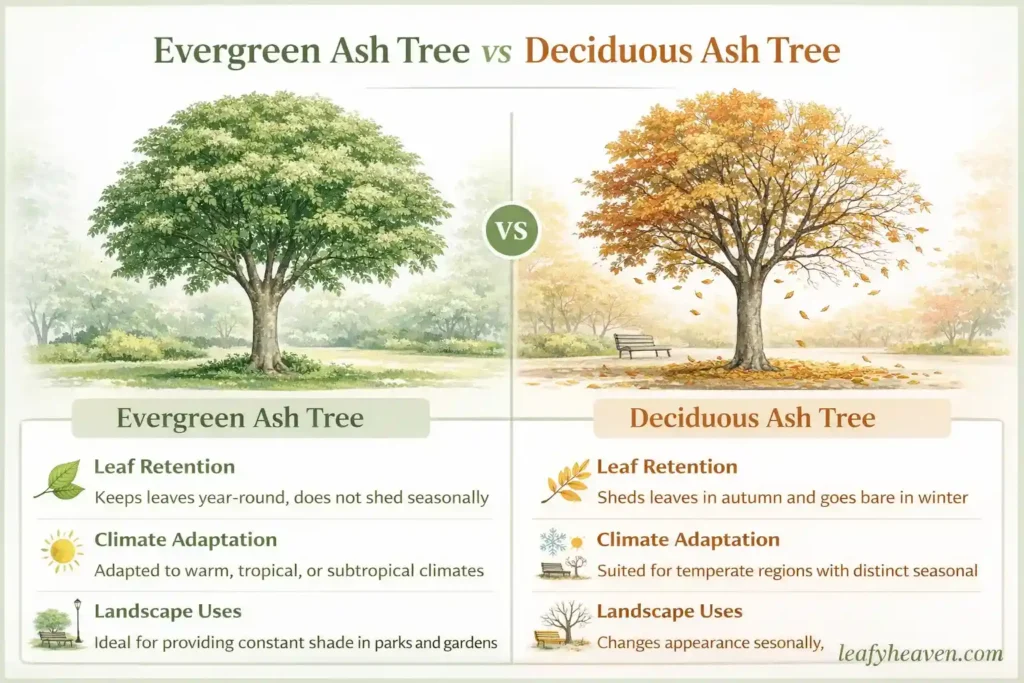
Evergreen Ash vs Deciduous Ash Trees
Ash trees belong to the Fraxinus genus, but different species show significant variation in leaf behavior, climate tolerance, and landscape use. The most notable distinction is between evergreen species such as Fraxinus griffithii and the many deciduous ash trees commonly planted in temperate regions.
Leaf Retention Differences
The primary difference lies in how the trees handle their foliage. Deciduous ash trees shed their leaves during colder seasons, entering a dormant phase in winter. In contrast, the ash tree evergreen species maintains its foliage throughout the year in warm climates. This continuous leaf coverage provides consistent greenery and shade, making evergreen ash particularly valuable for ornamental planting where year-round visual appeal is important.
Climate Adaptation
Deciduous ash species are generally adapted to cooler temperate climates where seasonal leaf drop helps the tree conserve energy during winter. Evergreen ash, however, is better suited to mild or warm regions, where freezing temperatures are rare. In these environments, the tree can sustain its evergreen canopy and continue photosynthesis throughout the year.
Landscape Usage
Because of these biological differences, the two types of ash trees are used differently in landscaping:
- Evergreen ash trees: commonly used in urban landscapes, residential gardens, and warm-climate street plantings where constant shade and greenery are desired.
- Deciduous ash trees: often planted in parks or temperate landscapes where seasonal leaf changes are acceptable or even preferred.
This contrast in leaf behavior and climate tolerance explains why evergreen ash species are frequently selected for warmer regions, while deciduous ash varieties remain more common in cooler environments.
Why Evergreen Ash Is Popular in Landscaping
The popularity of evergreen ash trees in landscaping comes from their balanced combination of ornamental beauty, shade production, and adaptability to urban environments. Landscapers and urban planners often select this ash evergreen tree because it offers both visual appeal and practical benefits in residential and public spaces.
Ornamental Flowers
Evergreen ash trees produce clusters of small white flowers that add seasonal decorative value. Although the blossoms are delicate, they appear in noticeable groups that enhance the tree’s ornamental character. This flowering display makes the tree suitable for gardens, parks, and landscaped streets where aesthetic value is important.
Shade Tree Benefits
A mature ash evergreen tree develops a dense canopy that provides effective shade. The evergreen foliage helps maintain year-round greenery in warm climates, making the tree particularly useful for areas where continuous shade and visual coverage are desired. Because of this structure, evergreen ash trees are often planted along sidewalks, in parks, and in residential yards.
Urban Planting Suitability
Evergreen ash trees are well suited to urban environments due to their moderate size and adaptability. They can tolerate common city conditions such as limited planting space, moderate drought, and varying soil quality. Their predictable growth pattern and manageable canopy make the ash evergreen tree a practical option for street planting, urban gardens, and landscaped public areas.
Flowering Ash Trees in Australia
Growing Conditions in Australia
The flowering ash tree (Fraxinus griffithii) adapts well to many regions of Australia where mild winters and warm growing seasons support evergreen growth. Because of its tolerance to urban conditions and moderate drought resistance, the ash tree Australia landscapers often choose is well suited to residential gardens, parks, and street plantings. Understanding its preferred growing conditions helps ensure healthy growth and long-term stability.
Climate Suitability
The flowering ash thrives in warm to mild climates, which is why ash trees in Australia are commonly planted in temperate and subtropical regions. The tree performs best where severe frost is rare and temperatures remain relatively moderate throughout the year. In these environments, the evergreen canopy can remain active year-round.
Soil Preferences
For healthy development, ash trees Australia gardeners grow should be planted in:
- Well-drained soils that prevent waterlogging
- Loamy or sandy soils that allow root expansion
- Moderately fertile soil with balanced nutrients
Although the tree can adapt to different soil types, proper drainage is essential to avoid root stress.
Sunlight Requirements
The flowering ash performs best when planted in full sun to partial sun conditions.
- Full sun: promotes stronger growth and better canopy density
- Partial sun: still supports healthy development in warmer climates
- Shaded locations: may slow growth and reduce canopy density
Providing sufficient sunlight helps maintain the tree’s evergreen foliage and encourages healthy flowering during the growing season.
Why Evergreen Ash Trees Are Popular in Australia
The widespread use of evergreen ash trees Australia landscapes feature is largely due to their adaptability, moderate size, and reliable performance in urban environments. Many Australian ash trees planted in cities and residential areas provide practical benefits while maintaining an attractive appearance throughout the year.
Urban Street Planting
Evergreen ash trees are commonly selected for street and roadside planting in Australian cities. Their upright structure and controlled canopy spread allow them to fit well along sidewalks, road medians, and urban corridors. Because the tree maintains evergreen foliage in warm climates, it contributes consistent greenery and shade to city landscapes.
Drought Tolerance
Once established, evergreen ash shows a moderate level of drought tolerance, which is important in regions that experience dry seasons. This characteristic makes evergreen ash trees Australia landscapers choose suitable for areas where water availability may fluctuate, provided the trees receive adequate irrigation during early growth stages.
Low Maintenance Characteristics
Another reason Australian ash trees are widely planted is their relatively manageable maintenance needs:
- Moderate growth that is easier to control with occasional pruning
- Adaptability to different soil conditions when drainage is adequate
- A naturally balanced canopy that requires minimal shaping
These qualities make evergreen ash a dependable option for both public landscapes and residential gardens throughout suitable regions of Australia.
Flowering Ash Tree Australia Landscape Uses
The flowering ash tree Australia landscapers commonly plant serves multiple purposes in urban and residential landscapes. Because of its balanced canopy, evergreen foliage, and ornamental flowers, it functions well as both a decorative and practical landscape tree. Across many regions, flowering ash trees Australia gardeners use are valued for their adaptability and visual appeal in different outdoor settings.
Garden Feature Tree
In private gardens, the flowering ash is often used as a feature tree. Its structured canopy and seasonal white flowers create a focal point in landscape design. The evergreen foliage also helps maintain year-round greenery, which enhances the overall aesthetic of outdoor spaces.
Shade Tree for Parks
In public parks and recreational areas, the flowering ash tree provides reliable shade and visual structure. Its medium height and spreading canopy allow it to create comfortable shaded areas without overwhelming surrounding plantings. This makes it suitable for open lawns, pathways, and seating areas in landscaped parks.
Residential Landscaping
For residential properties, the flowering ash tree Australia homeowners choose is valued for its manageable size and ornamental appearance. It is commonly planted in front yards, along driveways, or as part of garden borders where it adds shade, structure, and seasonal flowering interest. Because of these characteristics, flowering ash trees Australia landscapes feature frequently appear in suburban developments and home gardens.
How to Grow and Care for a Flowering Ash Tree
Ideal Soil and Climate Conditions
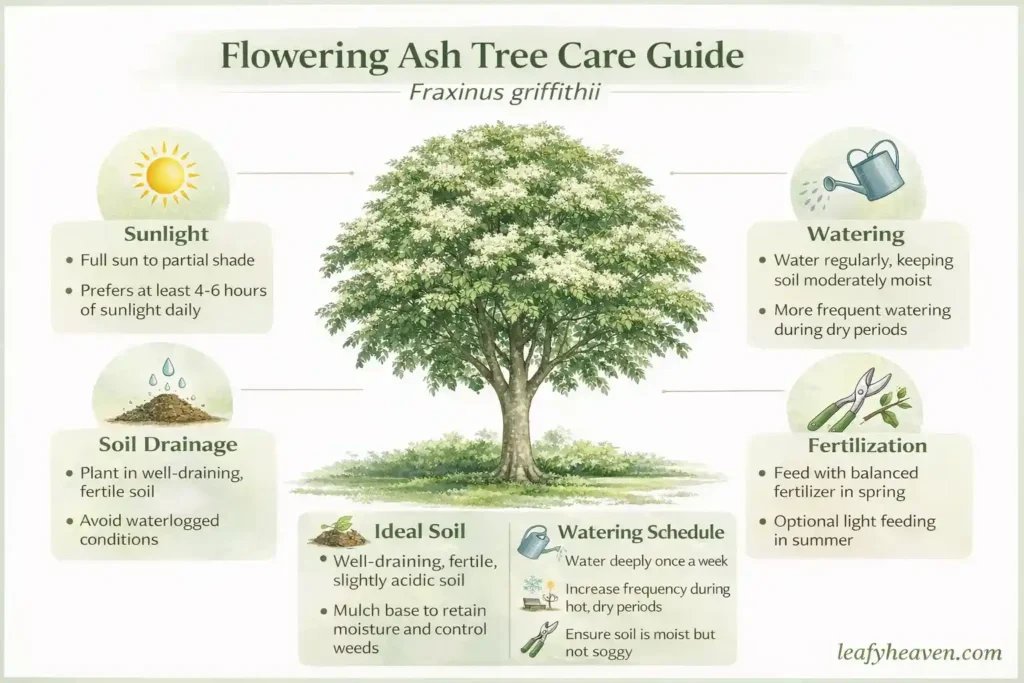
Successful growth of a flowering ash tree depends largely on planting it in the right soil conditions and climate. Fraxinus griffithii performs best in environments that provide adequate warmth, proper drainage, and balanced soil structure. When these conditions are met, the tree develops a healthy canopy and stable root system.
Soil Drainage Needs
Proper soil drainage is essential for the long-term health of the tree. The flowering ash prefers soil that allows water to move through easily rather than remaining saturated.
- Well-drained loamy or sandy soils support healthy root growth
- Soil that retains excessive moisture can lead to root stress or decline
- Slightly fertile soil with organic matter improves overall tree vitality
Planting the tree in areas where water does not collect after rainfall helps maintain stable root conditions.
Temperature Tolerance
Fraxinus griffithii grows best in warm to mild climates where severe frost is uncommon.
- Performs well in subtropical and warm temperate regions
- Tolerates seasonal heat once established
- Sensitive to extended periods of very low temperatures
Consistent warmth allows the tree to maintain its evergreen foliage throughout the year.
Best Growing Zones
The flowering ash tree is most suitable for regions with moderate winters and warm growing seasons. Ideal environments typically include:
- Warm temperate climates
- Subtropical regions
- Urban landscapes with mild winter conditions
In these zones, the tree can grow steadily, develop a dense canopy, and maintain its ornamental qualities.
Watering and Maintenance Needs
Proper watering and routine care help a flowering ash tree establish strong roots and maintain healthy foliage. While Fraxinus griffithii is considered relatively adaptable once mature, consistent maintenance during early growth stages improves long-term stability and canopy development.
Watering Schedule
- Young trees: require regular watering to help roots establish. Deep watering once or twice per week is usually sufficient depending on climate and soil conditions.
- Established trees: become more drought tolerant and typically need less frequent watering. Irrigation may only be necessary during extended dry periods.
- Avoid overwatering: excessive moisture can lead to root stress, particularly in soils with poor drainage.
Providing deep but infrequent watering encourages roots to grow deeper into the soil, which strengthens the tree over time.
Fertilization Basics
Fertilization helps maintain healthy growth, particularly in soils with limited nutrients.
- Apply a balanced slow-release fertilizer during the early growing season.
- Fertilizing once a year is generally adequate for mature trees.
- Adding organic compost or mulch around the base can improve soil fertility and moisture retention.
Maintaining a moderate nutrient supply supports steady growth and healthy foliage.
Seasonal Care
Seasonal maintenance helps keep the tree structurally sound and visually attractive.
- Spring: monitor new growth and check soil moisture levels.
- Summer: ensure adequate watering during hot or dry conditions.
- Autumn: inspect the canopy for weak or damaged branches.
- Winter: minimal care is required in warm climates where the tree remains evergreen.
Regular observation and basic seasonal care allow the flowering ash tree to maintain strong growth and a well-formed canopy.
Pruning and Growth Management
Proper pruning helps maintain the structure, health, and appearance of a flowering ash tree. Although Fraxinus griffithii naturally develops a balanced canopy, occasional pruning ensures stable branch structure and controlled growth.
How to Maintain Shape
Maintaining the tree’s natural shape requires selective pruning rather than heavy cutting.
- Remove dead, damaged, or crossing branches to improve airflow through the canopy.
- Thin crowded branches to help light reach inner foliage.
- Preserve the tree’s central structure to support balanced canopy development.
Light pruning helps the tree maintain its natural form while supporting healthy growth.
Best Pruning Time
The most suitable time for pruning is during late winter or early spring, just before the main growth season begins.
- Pruning at this time encourages strong new growth during the growing season.
- Avoid heavy pruning during periods of extreme heat or active flowering.
- Occasional light pruning can also be done during the growing season if necessary.
Timing pruning correctly reduces stress on the tree and promotes healthy regeneration.
Managing Tree Size
Growth management is important in urban landscapes or residential gardens where space may be limited.
- Periodically trim long or overextended branches to maintain canopy balance.
- Maintain appropriate clearance from buildings, pathways, and power lines.
- Gradual pruning over time helps keep the tree within a manageable size without affecting its health.
With careful pruning and monitoring, a flowering ash tree can maintain an attractive structure and remain well suited for landscape use.
Evergreen Flowering Ash Tree Problems
Common Evergreen Ash Tree Problems
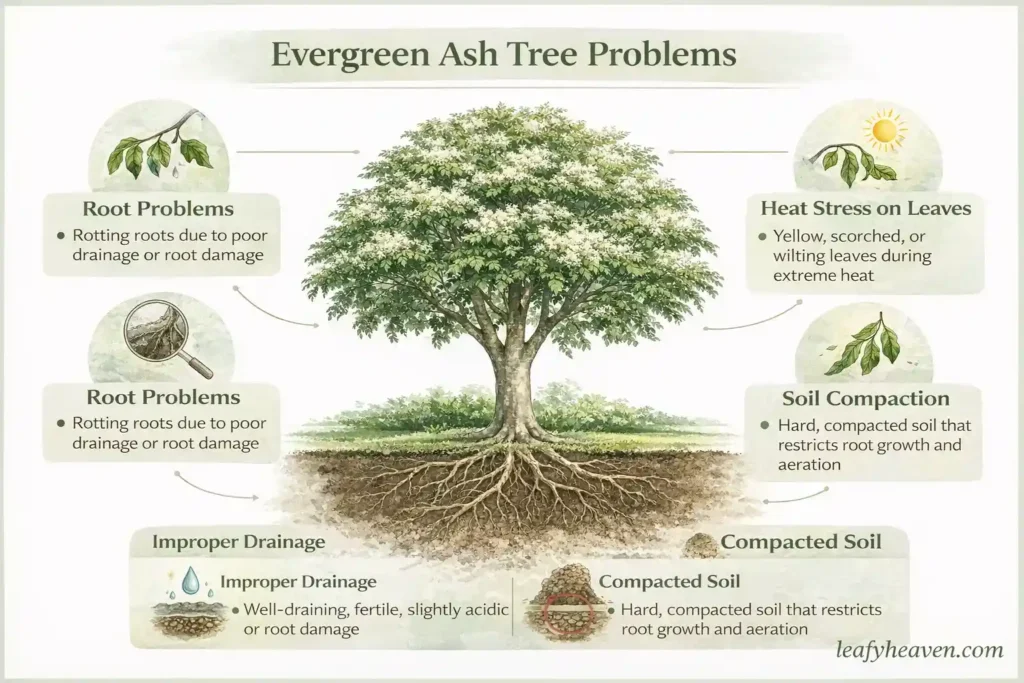
Although the flowering ash is valued for its ornamental qualities and adaptability, certain issues can affect its health and structural stability. Understanding these evergreen ash tree problems helps gardeners and landscapers manage the tree properly and prevent long-term damage.
Root Issues
Root-related problems are among the most common concerns for evergreen ash trees.
- Poorly drained soil can cause root stress or root rot, particularly if water remains around the base of the tree.
- Compacted soil may limit oxygen availability, restricting healthy root development.
- Shallow root systems in some planting conditions may also affect tree stability.
Planting the tree in well-drained soil and avoiding waterlogged areas significantly reduces the risk of root problems.
Weak Branches
Another structural concern involves branch strength.
- Some trees may develop weak branch attachments, especially when growth is rapid.
- Heavy canopies or strong winds can increase the risk of branch breakage.
- Lack of early structural pruning can contribute to uneven branch development.
Regular inspection and selective pruning help improve structural stability and reduce this risk.
Environmental Stress
Environmental conditions can also contribute to evergreen ash tree problems.
- Extended drought periods may weaken the tree if watering is insufficient during establishment.
- Excessive heat combined with poor soil conditions can slow growth or affect foliage quality.
- Urban conditions such as soil compaction, pollution, or restricted root space may also stress the tree.
Proper planting location, soil management, and routine care can minimize these environmental stresses and support long-term tree health.
Flowering Ash Tree Problems in Australia
In warm regions, most flowering ash tree problems Australia gardeners observe are related to climate conditions, soil structure, and local environmental stress. Although Fraxinus griffithii adapts well to many Australian landscapes, certain factors can affect its growth and stability if not properly managed.
Heat Stress
High summer temperatures in some regions can place pressure on the tree’s foliage and moisture balance.
- Extended heat waves may cause leaf scorch or temporary leaf drop.
- Insufficient watering during extreme heat can weaken young trees.
- Trees planted in exposed areas with reflective surfaces such as pavement may experience higher heat stress.
Providing adequate irrigation during hot periods and applying mulch around the root zone can help reduce temperature-related stress.
Soil Compaction
Urban and suburban environments often create compacted soil conditions that limit root development.
- Heavy foot traffic or construction activity can compress soil around the root zone.
- Compacted soil restricts air circulation and water infiltration needed for healthy roots.
- Poor root development may affect the tree’s long-term stability.
Improving soil structure and avoiding excessive ground pressure around the base can reduce this issue.
Pest Susceptibility
While generally resilient, flowering ash trees may occasionally experience pest-related issues.
- Certain sap-feeding insects can affect leaves and young shoots.
- Stressed trees may become more vulnerable to minor infestations.
- Regular inspection helps detect pests before they cause noticeable damage.
Monitoring tree health and maintaining proper watering and soil conditions helps minimize flowering ash tree problems Australia landscapers sometimes encounter.
Fraxinus Griffithii Problems and Limitations
Although the flowering ash offers ornamental value and adaptability, there are several fraxinus griffithii problems and limitations that should be considered before planting. Understanding these characteristics helps gardeners and landscapers determine whether the tree is suitable for a specific location.
Shorter Lifespan Compared to Other Ash Species
One of the commonly discussed fraxinus griffithii problems is its relatively shorter lifespan compared with some traditional ash species.
- Many deciduous ash trees can live for several decades longer under ideal conditions.
- Fraxinus griffithii is often considered a medium-lifespan tree, particularly in urban environments.
- Environmental stress, soil conditions, and climate can influence how long the tree remains healthy.
Because of this, it is sometimes selected more for ornamental landscaping rather than very long-term canopy planning.
Root Spread Issues
Root behavior can also create limitations in certain planting locations.
- The root system may spread outward in search of moisture and nutrients.
- In confined urban spaces, roots can compete with nearby plants or infrastructure.
- Shallow soil or compacted ground may cause roots to grow closer to the surface.
Careful placement away from structures and paved areas helps reduce potential root-related concerns.
Structural Weaknesses
Another factor sometimes associated with fraxinus griffithii problems is branch structure.
- Some trees may develop weak branch attachments if growth is rapid.
- Heavy canopy development can increase the risk of branch breakage in strong winds.
- Without proper early pruning, uneven branch structure may develop.
Routine structural pruning during the early years can strengthen the canopy and improve the overall stability of the tree.
Benefits of Planting a Flowering Ash Tree
Ornamental Landscape Value
One of the main reasons gardeners and landscapers choose the flowering ash tree is its strong ornamental appeal. The tree combines decorative flowering with evergreen foliage, making it visually attractive throughout most of the year in suitable climates.
Beautiful Flowering Display
The flowering ash produces clusters of small white blossoms that appear during its blooming season. These flowers grow in loose panicles and create a noticeable decorative effect across the canopy.
- The flowers provide seasonal visual interest in gardens and landscaped areas.
- Large clusters of blooms give the tree a soft, ornamental appearance.
- The blossoms can add subtle fragrance and enhance the overall aesthetic of outdoor spaces.
Because of this flowering display, the tree is often planted in locations where ornamental value is important, such as gardens, parks, and landscaped streets.
Evergreen Foliage
Another important ornamental feature is the tree’s evergreen foliage.
- Leaves remain on the tree throughout the year in warm climates.
- The canopy maintains a consistent green appearance, even outside the flowering season.
- Evergreen foliage provides structure and visual continuity in landscape design.
This combination of flowering beauty and year-round greenery makes the flowering ash tree a reliable decorative element in many landscape settings.
Environmental Benefits
Beyond its ornamental value, the flowering ash tree also contributes several environmental advantages in urban and residential landscapes. Its canopy structure and evergreen foliage help support local ecosystems while improving outdoor comfort.
Shade Creation
A mature flowering ash tree develops a dense canopy that provides effective shade.
- The wide canopy helps reduce direct sunlight in gardens, streets, and parks.
- Shaded areas create more comfortable outdoor spaces for people and plants.
- Consistent foliage coverage allows the tree to provide shade for much of the year in warm climates.
Because of this shade-producing ability, the tree is often planted along sidewalks, in public parks, and in residential yards.
Urban Cooling
Trees play an important role in reducing heat buildup in cities, and the flowering ash contributes to this effect.
- The canopy blocks sunlight from reaching pavement and buildings.
- Leaf transpiration helps cool surrounding air temperatures.
- Increased tree coverage supports healthier urban microclimates.
Planting shade trees like flowering ash can help reduce the impact of urban heat in densely built environments.
Habitat for Birds
Flowering ash trees can also support local wildlife.
- The canopy offers shelter and nesting space for small birds.
- Branch structure provides safe resting areas within gardens and parks.
- Trees contribute to overall biodiversity in landscaped environments.
By offering shade, cooling effects, and habitat opportunities, the flowering ash tree supports both ecological balance and comfortable urban living.
Practical Benefits for Home Gardens
In addition to its ornamental and environmental value, the flowering ash tree offers several practical advantages for residential landscapes. Its growth pattern, adaptability, and structured canopy make it a useful choice for many home gardens.
Fast Growth
The flowering ash tree is known for its moderate to relatively fast growth rate when planted in suitable conditions.
- Young trees establish quickly after planting.
- The canopy develops within a reasonable timeframe, providing shade earlier than slower-growing species.
- Faster establishment makes the tree suitable for gardens where shade or structure is needed within a few years.
Adaptability
Another practical benefit is the tree’s ability to adapt to a variety of growing environments.
- Tolerates different soil types when drainage is adequate.
- Performs well in warm climates and urban settings.
- Once established, the tree can tolerate periods of limited rainfall better than many ornamental species.
This adaptability makes the flowering ash suitable for both suburban and urban residential gardens.
Attractive Structure
The flowering ash tree develops a naturally balanced canopy that enhances landscape design.
- The tree forms a rounded or slightly oval crown as it matures.
- Branch distribution creates a visually appealing structure.
- The canopy provides shade while maintaining an orderly appearance.
Because of this combination of growth, adaptability, and structural beauty, the flowering ash tree remains a practical and decorative option for home landscapes.
If you want to build a healthier planting space around ornamental trees, this companion planting guide explains how supportive plant pairings can improve biodiversity, soil balance, and garden structure.
Is Flowering Ash the Right Tree for Your Garden?
When It Is a Good Choice
The flowering ash tree can be an excellent option for many landscapes when planted in the right environment. Its evergreen foliage, moderate size, and ornamental flowers make it particularly suitable for certain climates and garden settings.
Warm Climates
The flowering ash performs best in warm or mild climates where severe frost is uncommon.
- Evergreen foliage remains active throughout the year in these regions.
- The tree grows steadily in areas with long, warm growing seasons.
- Warm climates allow the tree to maintain healthy canopy density and flowering cycles.
Because of this climate preference, flowering ash is commonly planted in subtropical and warm temperate regions.
Urban Landscapes
The tree adapts well to urban planting conditions, which makes it a reliable choice for city environments.
- Moderate height and canopy spread fit well along streets and sidewalks.
- Tolerates typical urban challenges such as limited planting spaces and varying soil conditions.
- Provides shade and greenery that enhance the visual quality of urban areas.
These characteristics make the flowering ash a practical option for streetscapes, parks, and urban gardens.
Small to Medium Gardens
The flowering ash tree also works well in small to medium-sized residential gardens.
- Its canopy provides shade without becoming excessively large.
- The balanced growth pattern fits comfortably within typical residential spaces.
- Ornamental flowers and evergreen foliage add year-round landscape value.
For homeowners looking for a decorative shade tree with manageable size, the flowering ash can be a suitable addition to garden landscapes.
When You Should Consider Alternatives
While the flowering ash tree can perform well in many landscapes, certain environments may not be ideal for its long-term health and stability. In these situations, choosing a different tree species may provide better results.
Cold Climates
The flowering ash is best suited to warm or mild climates and may struggle in regions with severe winters.
- Extended periods of freezing temperatures can damage foliage and branches.
- Cold climates may cause the tree to lose its evergreen characteristics.
- Growth may slow significantly in areas with frequent frost.
In regions with harsh winters, deciduous tree species adapted to colder environments are often a better choice.
Areas with Heavy Storms
Locations that frequently experience strong winds or storms may present challenges for this tree.
- Some flowering ash trees can develop structural weaknesses in branches.
- Strong winds may increase the risk of limb breakage.
- Storm-prone regions may require trees with stronger branch structure.
Selecting a species known for higher wind resistance can reduce maintenance and safety concerns.
Locations with Shallow Soil
The flowering ash tree benefits from adequate soil depth for healthy root development.
- Shallow soil can restrict root growth and reduce stability.
- Limited root space may increase the risk of leaning or poor anchorage.
- Compacted or rocky soil conditions may also hinder proper root expansion.
Planting in areas with deeper, well-drained soil allows trees to develop stronger root systems and healthier growth.
Conclusion
The flowering ash tree (Fraxinus griffithii) is an ornamental evergreen species valued for its balanced structure, decorative flowers, and adaptability in warm climates. Often known as evergreen ash, this tree stands out among ash species because it can maintain foliage year-round in suitable environments. Its moderate size and dense canopy make it a practical choice for landscapes that require both shade and visual appeal.
In regions such as Australia, the tree is widely used in urban landscaping, parks, and residential gardens due to its ability to adapt to warm conditions and varied soil types. The combination of fragrant white flowers, evergreen foliage, and a structured canopy gives the flowering ash strong ornamental value while also contributing shade and environmental benefits.
However, like any tree species, it also has limitations. Potential concerns such as structural weaknesses, root behavior, and environmental stress should be considered when selecting planting locations. By understanding both the advantages and possible challenges, gardeners and landscapers can make informed decisions and determine whether the flowering ash tree is suitable for their climate, soil conditions, and landscape design goals.
Frequently Asked Questions (FAQs)
What is a flowering ash tree?
A flowering ash tree commonly refers to Fraxinus griffithii, an ornamental species known for its evergreen foliage and clusters of small white flowers. This tree belongs to the Fraxinus genus in the Oleaceae family and is widely used in landscaping for its balanced canopy, decorative blooms, and adaptability to warm climates. Because of its attractive structure and year-round greenery in suitable regions, it is often planted in gardens, parks, and urban streetscapes.
Is flowering ash an evergreen tree?
Yes, evergreen ash trees such as Fraxinus griffithii can retain their leaves throughout the year in warm and mild climates. Unlike many traditional ash species that are deciduous and lose their leaves during winter, evergreen ash maintains foliage when temperatures remain moderate. In cooler climates, however, the tree may behave differently depending on environmental conditions.
How tall does a flowering ash tree grow?
A mature flowering ash tree typically reaches a height of 8 to 12 meters (26 to 40 feet). The canopy usually spreads about 5 to 8 meters (16 to 26 feet) wide. Its moderate size and rounded canopy make it suitable for residential gardens, parks, and street plantings where a medium-sized shade tree is desired.
Do flowering ash trees grow in Australia?
Yes, ash trees in Australia, particularly Fraxinus griffithii, are commonly planted in landscaping projects. The species adapts well to warm temperate and subtropical climates, making it suitable for many Australian regions. Because of its evergreen foliage, moderate drought tolerance, and attractive flowers, the tree is often used in urban streets, parks, and residential gardens across Australia.
What problems do evergreen ash trees have?
Some common evergreen ash tree problems include structural weaknesses in branches, root-related issues in poorly drained soil, and environmental stress from extreme heat or compacted soil. In some cases, the tree may also have a shorter lifespan compared to other ash species. Regular pruning, proper watering, and planting in well-drained soil can help reduce these maintenance concerns.
How fast does a flowering ash tree grow?
The flowering ash tree has a moderate to moderately fast growth rate. Under suitable soil, sunlight, and climate conditions, young trees establish quickly and begin forming a canopy within several years. A well-developed tree structure typically forms within 8 to 12 years.
Where should a flowering ash tree be planted?
A flowering ash tree grows best in full sun with well-drained soil. Ideal planting locations include residential gardens, parks, and streetscapes where the tree has enough space for its canopy to spread. Avoid planting in areas with shallow or compacted soil that could restrict root development.
Are flowering ash trees good shade trees?
Yes, the flowering ash is considered a good shade tree because it develops a dense canopy of evergreen leaves in warm climates. This canopy provides consistent shade in gardens, sidewalks, and park areas while maintaining an attractive ornamental appearance.
Do flowering ash trees require a lot of maintenance?
Flowering ash trees are generally considered low to moderate maintenance trees. Once established, they require occasional pruning, periodic watering during dry conditions, and basic monitoring for structural or environmental stress. Proper early care helps maintain a healthy canopy and balanced growth.

Written by the LeafyHeaven Editorial Team
LeafyHeaven shares practical gardening tips and simple plant care guides to help you grow, nurture, and enjoy your plants with ease. Our goal is to make gardening feel natural, approachable, and rewarding for everyone.