
Introduction
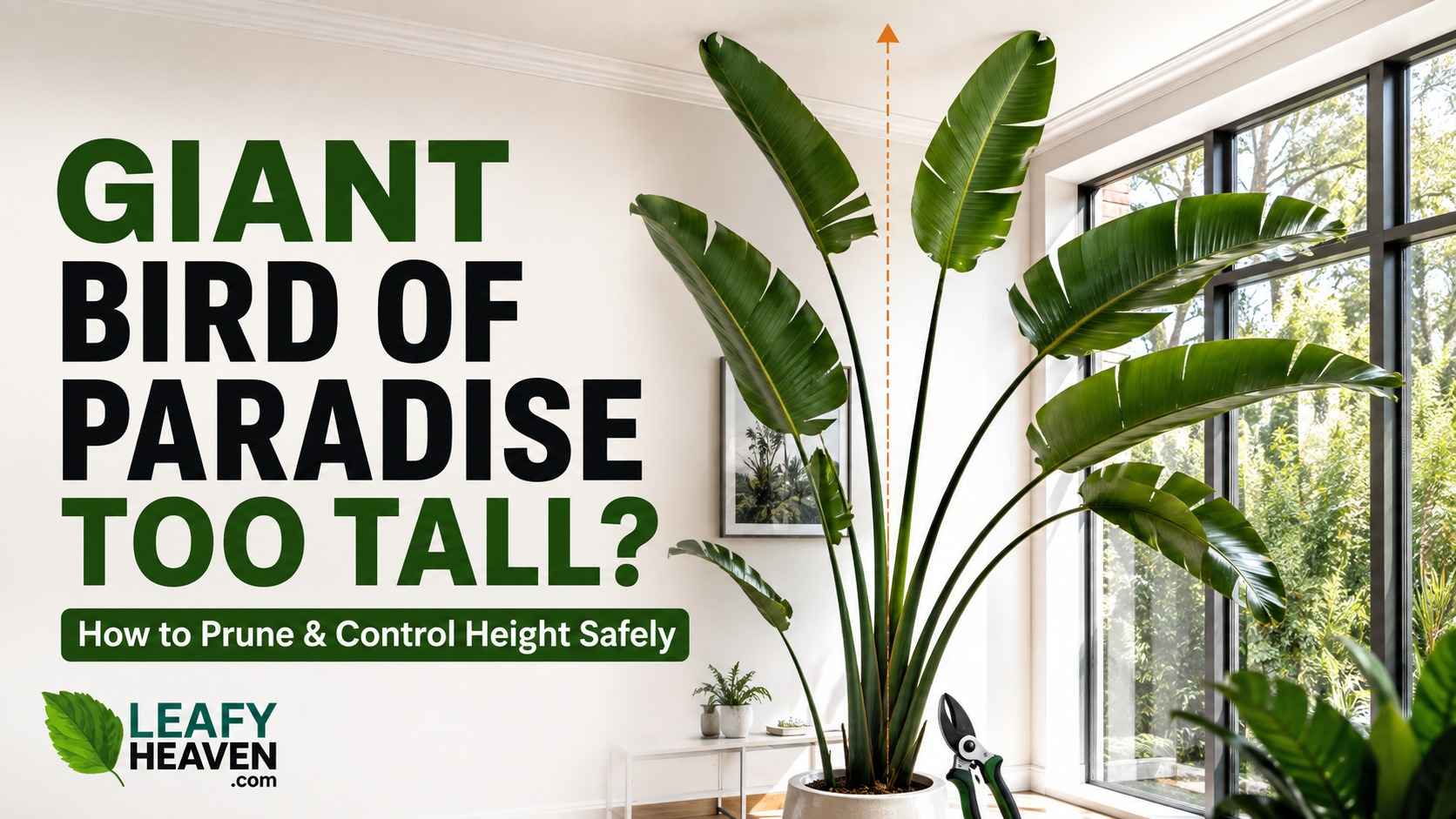
If your giant bird of paradise too tall problem is becoming difficult to manage, the safest approach is usually to selectively remove oversized or damaged stems close to the base instead of cutting healthy leaves halfway. The giant bird of paradise, botanically known as Strelitzia nicolai, naturally develops tall upright stems and large foliage as it matures. Gardeners wanting a full overview of this species before tackling height management will find everything they need in this detailed guide to White Bird of Paradise care, covering light, watering, soil, and seasonal needs. A giant strelitzia indoors may eventually reach the ceiling or crowd a room, while an outdoor giant strelitzia nicolai can outgrow its allotted space.
- Remove only stems that create a real height or space problem.
- Avoid random cuts through healthy leaf stalks.
- Focus on safe trimming, pruning, and long-term height management.
How Tall Can a Giant Bird of Paradise Get?
A Giant Bird of Paradise is naturally a large-growing Strelitzia, so gaining significant height with maturity is normal. The plant becomes a practical problem only when its foliage and upright stems exceed the vertical or horizontal space available indoors or outdoors.
What Is a Normal Height for Giant Strelitzia Nicolai?
The normal height of giant strelitzia nicolai depends on plant maturity, growing conditions, root space, and whether it is grown indoors, outdoors in a container, or directly in the ground.
Young plants remain relatively compact, but mature giant strelitzia plants develop increasingly tall stalks and much larger leaves. Indoors, a container-grown specimen commonly stays much smaller than an established outdoor plant because pot size, ceiling clearance, and growing conditions naturally restrict its development.
Outdoors in favorable climates, a mature plant can eventually reach roughly 20 to 30 feet tall, while indoor specimens are often maintained at considerably smaller sizes. A large bird of paradise plant should therefore not automatically be considered overgrown. Having a bird of paradise plant large enough to dominate its growing area is part of the species’ natural mature form.
In general:
- Young plants: Shorter stems and smaller overall spread.
- Indoor container plants: Usually more restricted by pot size and available space.
- Outdoor container plants: Can become substantial but remain more limited than ground-grown specimens.
- Ground-grown mature plants: Have the greatest potential for height and spread.
When Is a Bird of Paradise Actually Too Tall?
A bird of paradise too tall for its location is one that has begun interfering with its available space, accessibility, or natural stem position. Height alone is not necessarily a problem if the plant still has enough room to grow normally.
A practical height problem is developing when:
- Leaves are touching or pressing against the ceiling.
- Tall stems are bending or leaning because they lack clearance.
- The plant is becoming difficult to inspect, clean, or maintain.
- Large foliage is blocking walkways or crowding nearby areas.
- Leaves are becoming torn or damaged because there is insufficient vertical space.
These signs indicate that the plant’s mature size is beginning to exceed its location and that selective height management may be necessary.
Why Is My Giant Bird of Paradise Growing So Tall?
A Giant Bird of Paradise grows tall mainly because this is the species’ natural growth habit. Maturity, available root space, light direction, and the surrounding growing environment can further influence how upright, stretched, or oversized the plant appears.
Natural Growth Habit of Giant Bird of Paradise
Strelitzia nicolai is naturally an upright, vigorous, large-growing plant, so completely preventing height increase is not realistic. As it matures, it produces taller upright stems, broader mature foliage, and continued vertical growth.
This growth pattern is normal rather than a sign that something is wrong. Even with regular pruning, a healthy mature plant will continue producing new leaves and tall stalks because large size is part of its natural form.
For broader guidance on managing tropical plants and ornamental specimens in the home and garden, this comprehensive resource on gardening and plant care covers care fundamentals for a wide range of species.
Indoor Conditions That Can Make the Plant Look Excessively Tall
Indoor conditions can make a Giant Bird of Paradise appear excessively tall because the plant is growing within fixed ceiling height and limited room space.
Several factors can make the height problem more noticeable:
- Limited ceiling clearance: Tall leaves quickly reach the ceiling even when the plant is growing normally.
- Plant placement: A plant positioned in a narrow corner may look more oversized because it has little space to spread.
- Directional light: Strong light from one side can cause stems and leaves to angle toward the light source.
- Stem leaning or stretching: Uneven light exposure can make some stems appear longer or less balanced.
- Limited horizontal space: When foliage cannot spread outward comfortably, the plant’s vertical size becomes more dominant.
These conditions do not necessarily mean the plant is growing abnormally. In many cases, the available indoor space simply no longer matches the mature size of the plant.
Can You Reduce the Height of a Giant Bird of Paradise?
Yes, you can reduce the overall height of a Giant Bird of Paradise through selective pruning. However, simply shortening existing stems does not usually produce the same natural regrowth pattern seen in branching woody plants, so removing selected tall stalks is generally the cleaner approach.
Should You Cut Tall Leaves or Remove Entire Stems?
For effective trimming bird of paradise plants, removing an entire unwanted leaf stalk or stem close to the base is usually better than cutting it halfway. This preserves a more natural appearance and avoids leaving obvious cut stalks.
When gardeners prune birds of paradise, the goal should be to remove only the stems creating a height, damage, or crowding problem. Proper birds of paradise pruning is selective rather than aggressive.
| Method | Best Use | Main Consideration |
| Remove full tall stem | Height reduction | Cleaner appearance |
| Cut leaf blade halfway | Usually cosmetic only | Cut edge remains visible |
| Remove damaged stem | Maintenance | Helps reduce crowding |
| Hard pruning | Severe size problem | More stressful to plant |
Whole-stem removal is especially useful when a healthy but oversized stalk is touching the ceiling, leaning badly, or interfering with the plant’s available space.
Does Cutting the Top Make Bird of Paradise Grow Shorter?
Cutting the top off a Giant Bird of Paradise is not a reliable long-term height-control technique because the plant does not branch like a woody tree. New leaves emerge from the basal growth structure rather than developing side branches from a topped stem.
Randomly shortening tall stalks can therefore leave visible stubs or awkward cut foliage without improving the plant’s natural shape. It may reduce immediate height, but it does not change the species’ tendency to produce new upright growth.
Selective removal of complete problem stems is preferable because it:
- Reduces the plant’s current height more cleanly.
- Maintains a more natural overall shape.
- Avoids unattractive halfway-cut stalks.
- Allows healthy, well-positioned foliage to remain intact.
How to Prune a Giant Bird of Paradise That Is Too Tall
To prune an overgrown Giant Bird of Paradise, identify the tallest, damaged, or poorly positioned stems and remove selected stalks as close to the base as practical with a clean, sharp cutting tool. This reduces height while preserving healthy foliage and the plant’s natural form.
Step 1 — Identify Which Tall Stems Should Be Removed
Start by selecting only the stems that are creating a genuine height, damage, or crowding problem. Healthy lower foliage should remain whenever possible.
Prioritize:
- Tallest stems that touch or press against the ceiling.
- Damaged stems with badly torn or declining foliage.
- Bent stems that lean into walkways or surrounding areas.
- Crowded stems that make the plant excessively dense.
- Healthy lower growth to retain for balance and continued photosynthesis.
Avoid removing healthy stems simply because they are mature. Selective pruning gives better control over the plant’s shape and reduces unnecessary stress.
Step 2 — Use Clean, Sharp Pruning Tools
Use clean, sharp pruning shears or another cutting tool suitable for the thickness of the stalk. A smooth cut causes less unnecessary tissue damage than crushing or repeatedly sawing through the stem with a dull blade.
Before pruning:
- Sanitize cutting blades before making cuts.
- Use strong pruning shears or loppers for thicker mature stalks.
- Avoid crushing, splitting, or tearing the stem.
- Clean the tool again when moving between questionable or damaged growth.
Using the correct tool becomes especially important on mature Giant Bird of Paradise plants because older stalks can be thick and fibrous.
Step 3 — Cut the Stem Close to the Base
Remove the selected stalk near the soil line or basal clump rather than shortening it halfway. This usually creates a cleaner appearance and provides more meaningful height reduction.
If you are learning how to prune a giant bird of paradise, the key principle is whole-stalk removal rather than random shortening. The same approach applies when deciding how to trim giant bird of paradise plants that have exceeded their available space.
For effective giant bird of paradise pruning:
- Follow the selected stalk downward toward its base.
- Make a clean cut as close to the basal growth area as practical.
- Avoid damaging neighboring stems or emerging shoots.
- Remove the detached stalk from the plant after cutting.
This method of pruning giant bird of paradise plants is generally cleaner than leaving a long cut stub. When considering how to trim a giant bird of paradise, remember that trimming giant bird of paradise foliage halfway may reduce visible height temporarily but does not maintain the plant’s natural structure as effectively.
Step 4 — Avoid Removing Too Much Growth at Once
Keep height reduction gradual because removing excessive healthy foliage in one pruning session can place unnecessary stress on the plant. Focus on the few stems causing the biggest space or height problems first.
After those stems are removed, reassess the plant’s overall shape before making additional cuts. Enough healthy foliage should remain to support normal growth and maintain a balanced appearance.
Quick takeaway: Prioritize the tallest problem stems instead of drastically reducing the entire plant at once.
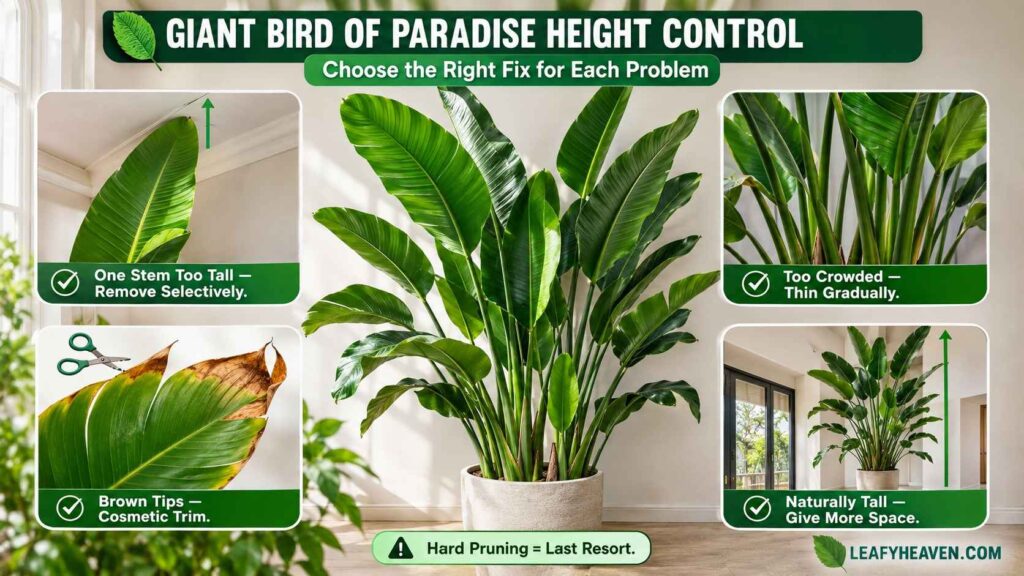
How Much Can You Prune a Giant Bird of Paradise?
How much you can prune depends on the plant’s health, maturity, and degree of overgrowth. Selective pruning is generally the safer approach, while severe reduction should be reserved for plants that have genuinely become unmanageable.
What Is Hard Pruning on a Bird of Paradise?
Hard pruning bird of paradise means removing a substantial amount of mature growth rather than taking out only a few problem stems. It is a much more aggressive approach than routine height management.
Selective pruning focuses on removing individual tall, damaged, bent, or crowded stalks while preserving most healthy foliage. Hard pruning removes a larger portion of the plant and may be considered when the plant is severely overgrown, badly damaged, or no longer manageable through gradual thinning.
Healthy foliage should be preserved whenever possible because the leaves support photosynthesis and overall plant recovery. For most height problems, removing a few oversized stems first is preferable to drastically reducing the entire plant.
Can I Cut Bird of Paradise to the Ground?
If you are wondering, can I cut bird of paradise to the ground, the answer is that ground-level cutting is an extreme rejuvenation-style pruning method and should not be the first choice for ordinary height control.
Severe cutting may be considered when a mature plant is extremely overgrown, heavily damaged, or requires major renovation. However, removing nearly all visible growth is considerably more stressful than selective stem removal.
For routine height management:
- Remove the tallest problem stems first.
- Preserve healthy, well-positioned foliage.
- Use gradual thinning before considering severe pruning.
- Reserve ground-level cutting for exceptional situations rather than regular maintenance.
Recovery after very hard pruning can take considerable time because the plant must produce substantial new foliage before regaining its previous fullness and appearance.
When Is the Best Time to Prune a Giant Bird of Paradise?
Major pruning is generally more practical during the plant’s active growth period, when a healthy Giant Bird of Paradise is better positioned to replace removed foliage. Dead, broken, or severely damaged stems can be removed whenever necessary rather than waiting for a specific season.
Should You Prune Bird of Paradise in Winter or Summer?
For bird of paradise pruning winter or summer, the stronger growing season is generally preferable for significant height reduction. Aggressive pruning during slower winter growth can mean the plant takes longer to replace removed foliage.
If you are deciding when to prune bird of paradise, plan substantial trimming around spring through the warmer growing period when possible. The same principle applies when determining when to prune birds of paradise that have become excessively tall or crowded.
In practical terms:
- Perform major height reduction during active growth when possible.
- Keep winter pruning lighter if the plant is growing slowly.
- Remove only the stems necessary to solve the height problem.
- Avoid severe pruning simply because a particular season has arrived.
When Should Tall or Damaged Stems Be Removed Immediately?
Broken, badly damaged, diseased-looking, or dangerously leaning stems can be removed when they become a problem, even if it is not the ideal season for major pruning.
Immediate removal may be appropriate when a stalk:
- Is broken or sharply bent.
- Is rubbing heavily against a ceiling or structure.
- Is leaning into a walkway or creating a hazard.
- Has severe physical damage that cannot recover.
- Shows concerning decline that is clearly limited to that stalk.
In these situations, removing the individual problem stem is usually more sensible than waiting for the next scheduled pruning period.
How to Trim an Indoor Giant Bird of Paradise That Hits the Ceiling
If an indoor Giant Bird of Paradise is touching the ceiling, selectively remove the tallest problem stems and leave enough healthy foliage intact. The goal is to create practical vertical clearance without aggressively cutting back the entire plant.
What Should You Do When Leaves Touch the Ceiling?
When the tallest leaves repeatedly press or rub against the ceiling, removing those individual stalks close to the base can provide a cleaner long-term solution than repeatedly trimming damaged tips.
For a large bird of paradise houseplant, ceiling contact can cause bent stalks, torn foliage, and damaged leaf edges. Identify only the leaves creating the height problem and remove their stalks near the basal clump while preserving shorter, healthy growth.
This approach:
- Creates real vertical clearance.
- Reduces repeated ceiling damage.
- Maintains a more natural plant shape.
- Avoids leaving partially shortened stalks.
Should You Cut Only the Leaf Tips?
Brown or physically damaged leaf tips can be trimmed for cosmetic reasons, but tip trimming does not reduce the plant’s actual height in a meaningful way.
- Tip trimming = cosmetic improvement
- Whole stem removal = actual height reduction
If only a small portion of the leaf is brown, trimming the damaged edge may improve appearance. However, if the entire stalk is too tall for the room, removing that stalk near the base is the more effective height-control method.
Can Moving the Plant Solve the Height Problem?
Yes. Moving the plant to a location with greater vertical clearance can reduce or even eliminate the need for aggressive pruning.
If practical, consider placing it in:
- A room with a taller ceiling.
- An area without low beams or overhead shelves.
- A brighter suitable location with enough vertical growing space.
- A position where large leaves can extend without hitting surrounding structures.
Relocating the plant is especially useful when it is healthy and naturally tall rather than genuinely overgrown. Providing enough vertical space allows its mature form to develop with less repeated pruning.
Common Mistakes When Pruning an Overgrown Giant Bird of Paradise
The most common pruning mistakes include randomly cutting leaves, removing too much healthy foliage at once, using dull or dirty tools, and treating the plant like a branching tree that can simply be topped.
Cutting Every Tall Leaf at Once
Removing many healthy tall leaves in a single session can create unnecessary stress and leave the plant looking unbalanced.
Instead, prioritize only the stems causing the biggest height or space problems. Gradual pruning allows the Giant Bird of Paradise to retain enough healthy foliage while still reducing excessive size.
Cutting Stalks Halfway for Height Control
Cutting stalks halfway often leaves unattractive stubs and does not improve the plant’s natural form.
A partially shortened stalk will not behave like a pruned tree branch. When a stem genuinely needs to be removed for height control, cutting it close to the base usually creates a cleaner result than leaving a visible shortened stalk.
Using Dull or Dirty Tools
Dull or dirty cutting tools can produce rough, crushed, or uneven wounds. Clean, sharp pruning tools are preferable because they make smoother cuts and reduce unnecessary tissue damage.
Before pruning:
- Clean or sanitize the cutting blade.
- Make sure the tool is sharp enough for the stalk thickness.
- Avoid repeatedly crushing or sawing through mature stems.
Expecting Pruning to Permanently Stop Height Growth
Pruning can reduce the plant’s current height, but it cannot permanently change the naturally tall growth habit of Giant Strelitzia nicolai.
The plant will continue producing new upright foliage as it grows. Pruning should therefore be viewed as ongoing height management rather than a permanent method of keeping the plant short.
How to Keep a Giant Bird of Paradise From Becoming Too Tall Again
Long-term height management works best through regular monitoring, selective removal of oversized stems, and giving the plant enough space for its naturally large mature form. This reduces the need for repeated aggressive pruning.
Inspect Height Before the Plant Reaches the Ceiling
Check the tallest new stems regularly and act before they begin pressing against the ceiling or surrounding structures.
Early intervention often means removing only one or two problem stalks instead of performing severe pruning later. This helps maintain a healthier, more balanced plant with less disruption.
Maintain a Balanced Plant Shape
Remove only the tallest or poorly positioned stems and retain enough healthy foliage to keep the plant proportionate and natural-looking.
A balanced approach should:
- Preserve healthy lower and mid-level foliage.
- Avoid removing all tall leaves at once.
- Reduce crowded or badly leaning growth selectively.
- Maintain an even overall plant shape.
Plan for the Mature Size of Strelitzia Nicolai
Strelitzia nicolai is naturally a large, upright species, so long-term placement should account for its mature height and spread.
Choose a location with generous vertical clearance whenever possible. Planning for the plant’s mature size reduces repeated ceiling contact, minimizes the need for aggressive pruning, and makes ongoing height control much easier.
“Gardeners designing a low-effort landscape alongside large tropicals may also find useful suggestions in this guide to outdoor low maintenance plants suited to warm-climate gardens.”
Quick Giant Bird of Paradise Height-Control Guide
Selective pruning should be the first choice for managing a tall Giant Bird of Paradise, while aggressive cutting should be reserved for severe overgrowth. Match the pruning method to the actual height problem instead of removing healthy growth unnecessarily.
| Situation | Recommended Approach |
| One leaf hits ceiling | Remove problematic stalk if necessary |
| Several stems too tall | Selectively remove tallest stems |
| Damaged tall growth | Remove damaged stalk near base |
| Plant badly overcrowded | Gradual thinning |
| Plant severely overgrown | Consider careful hard pruning |
| Only brown leaf tips | Cosmetic tip trim only |
| Healthy plant naturally tall | Provide more vertical space if
possible |
Conclusion — Managing a Giant Bird of Paradise That Is Too Tall
A giant bird of paradise too tall for its space is best managed through selective stem removal, sensible pruning timing, and enough room for the plant’s naturally large mature form.
Remove only the stems creating real height, crowding, or damage problems. Avoid random halfway cuts, preserve healthy foliage whenever possible, and reserve hard pruning for genuinely severe overgrowth.
Because Strelitzia nicolai naturally develops tall upright growth, pruning will manage its size rather than permanently keep it short. Check the tallest stems regularly and address excessive growth early, before ceiling contact or overcrowding makes more aggressive pruning necessary.
Frequently Asked Questions About a Giant Bird of Paradise That Is Too Tall
Q1: What should I do if my giant bird of paradise is too tall?
Remove only the tallest problem stems close to their base instead of randomly shortening every leaf. Focus on stalks that touch the ceiling, lean badly, block space, or have become damaged.
Selective removal reduces height while preserving healthy foliage and the plant’s natural shape.
Q2: How do you prune a giant bird of paradise plant?
If you are wondering how do you prune bird of paradise plant growth safely, first identify unwanted mature stalks, then use clean, sharp pruning tools to remove selected stems close to the base.
Avoid cutting every tall stalk at once. Gradual pruning helps maintain healthy foliage while reducing excessive height.
Q3: Can I cut the top off a giant bird of paradise?
Traditional topping is generally not the best way to control a Giant Bird of Paradise because it does not respond like a branching woody tree.
Cutting stalks halfway can leave visible stubs without changing the plant’s natural growth habit. Removing complete problem stalks near the base usually provides a cleaner result.
Q4: Can I cut a bird of paradise all the way to the ground?
Ground-level pruning may be possible in extreme cases, but it is not the preferred approach for routine height control.
Severe pruning removes a large amount of mature foliage and can require considerable recovery time. Selective stem removal should normally be attempted first.
Q5: When should I prune a giant bird of paradise?
Significant pruning is generally best performed during the plant’s active growing period, when healthy new growth is more likely to replace removed foliage efficiently.
Broken, badly damaged, or hazardous stems can be removed whenever necessary rather than waiting for a specific season.
Q6: How do I trim a bird of paradise that is touching the ceiling?
Remove the individual stalks responsible for the ceiling contact close to their base rather than repeatedly trimming only the leaf tips.
Tip trimming may improve appearance, but whole-stalk removal provides actual height reduction and creates more useful vertical clearance.
Q7: Will a giant bird of paradise grow tall again after pruning?
Yes. Pruning reduces the plant’s current height, but Strelitzia nicolai naturally continues producing large, upright foliage as it grows.
Regular monitoring and selective pruning may therefore be necessary when the plant is kept in a space with limited ceiling height.

Written by the LeafyHeaven Editorial Team
LeafyHeaven shares practical gardening tips and simple plant care guides to help you grow, nurture, and enjoy your plants with ease. Our goal is to make gardening feel natural, approachable, and rewarding for everyone.