
Introduction — Heliconia vs Birds of Paradise: Are They the Same Plant?
Heliconia vs birds of paradise compares two tropical-looking plants that are often confused because of their bold foliage and colorful blooms. However, Heliconia and the true bird of paradise are not the same plant. Heliconia belongs to the genus Heliconia, while birds of paradise belong to the genus Strelitzia.
The heliconia vs bird of paradise difference becomes clearer when you compare their flowers, leaf structure, growth habit, and growing requirements. The term false Bird of Paradise is commonly associated with some Heliconia species, which explains names such as heliconia bird of paradise and bird of paradise heliconia.
This comparison focuses on practical identification and the key features that separate these two tropical plants.
Quick answer: Heliconia is not a true Bird of Paradise. Heliconia belongs to the genus Heliconia, while true Bird of Paradise belongs to Strelitzia.
Is Heliconia the Same as Bird of Paradise?
No. Heliconia and Bird of Paradise are different plants, even though their large tropical leaves and striking flowers can make them look similar. They belong to separate botanical genera and plant families, which is the clearest scientific distinction between them.
Heliconia Belongs to the Heliconiaceae Family
Heliconia belongs to the Heliconiaceae family and the genus Heliconia. This group includes numerous tropical heliconias that vary in height, flower color, and growth form.
A typical heliconia plant grows from underground rhizomes and forms dense clumps of broad foliage. Different heliconia plants, often collectively referred to as Heliconia spp., may produce upright or hanging inflorescences with brightly colored bracts.
Bird of Paradise Belongs to the Strelitziaceae Family
True Bird of Paradise belongs to the genus Strelitzia within the Strelitziaceae family. This botanical classification separates every true bird of paradise plant from Heliconia.
Although phrases such as birds of paradise plant, bird paradise plant, and paradise bird plant are sometimes used interchangeably in everyday searches, true Bird of Paradise plants belong to Strelitzia, not Heliconia.
Why Is Heliconia Called False Bird of Paradise?
Some Heliconia species are called false Bird of Paradise because their bright tropical flower structures resemble true Bird of Paradise blooms. The name describes visual similarity rather than botanical relationship.
A heliconia false bird of paradise may have dramatic red, orange, yellow, or pink bracts that create a similarly exotic appearance. However, a false bird of paradise plant remains a Heliconia, and even plants described as false birds of paradise do not belong to the Strelitzia genus.
False Bird of Paradise: A common name used for certain Heliconia plants; it does not mean they belong to the Strelitzia genus. A heliconia false bird of paradise plant is botanically classified as Heliconia.
Heliconia vs Bird of Paradise Flowers — What Is the Difference?
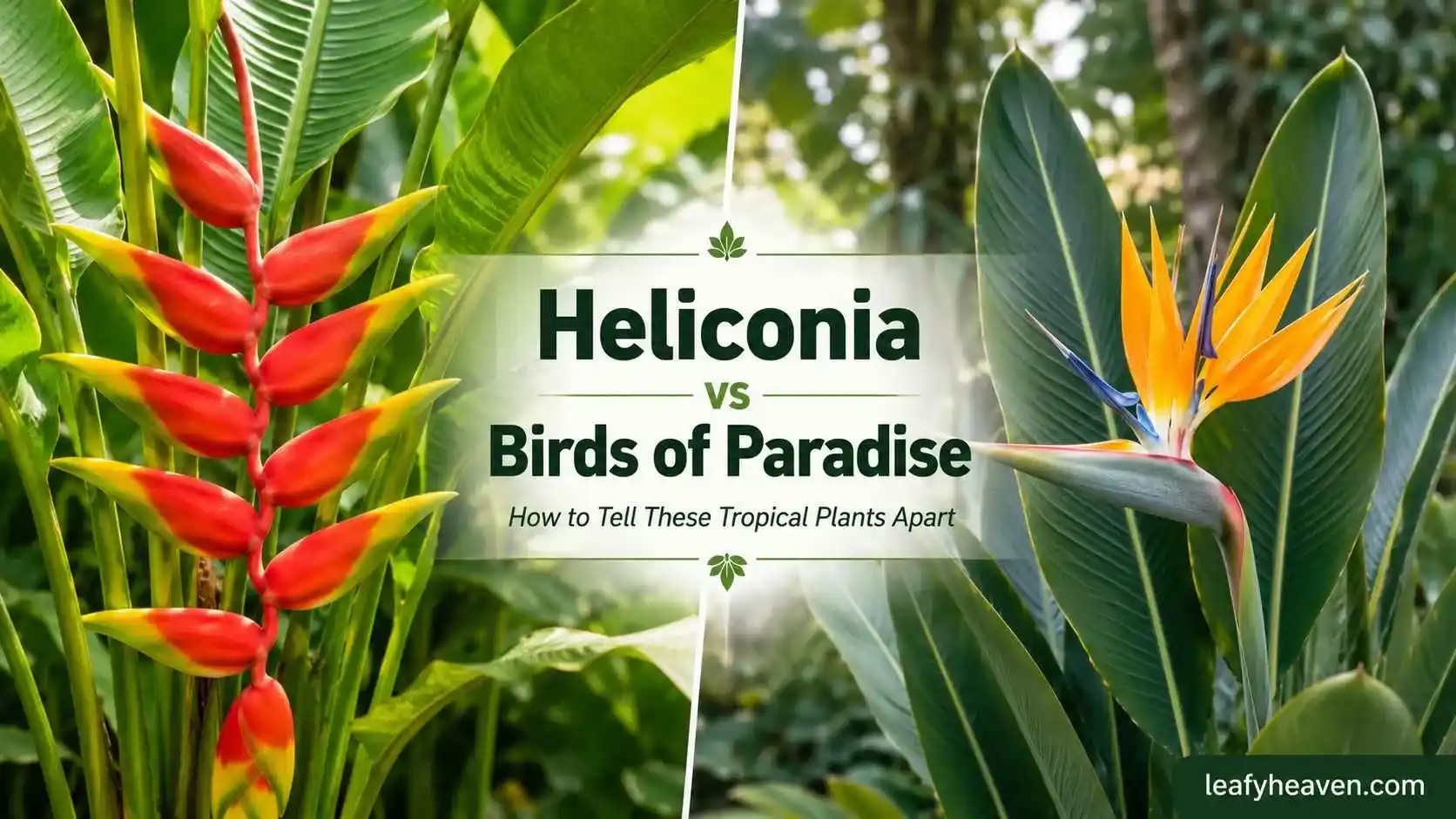
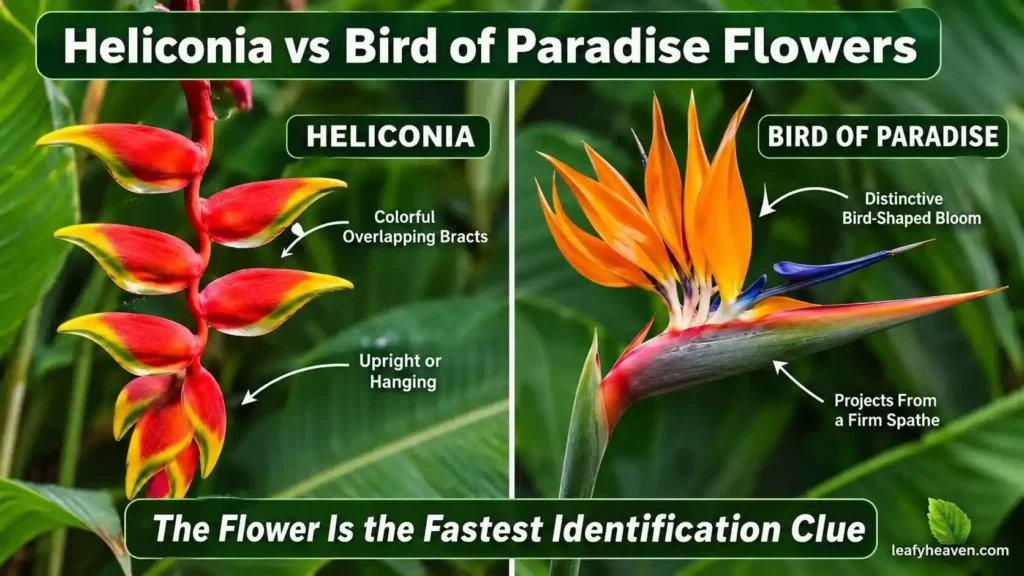
The easiest way to distinguish these plants is by examining their flowers. Heliconia produces prominent, colorful bracts, while the true Bird of Paradise develops a more open bloom that resembles the head and beak of a tropical bird.
What Do Heliconia Flowers Look Like?
Heliconia flowers develop within brightly colored bracts that may be red, orange, yellow, pink, or multicolored. Depending on the species, the flower structure may stand upright or hang downward from the plant.
The showy parts commonly mistaken for the heliconia flower are actually modified leaves called bracts. The true heliconia flowers are smaller and develop inside these protective structures.
Different species create considerable variation in heliconia colors, bract shape, and inflorescence position. Because of this diversity, heliconias flowers may appear very different from one species to another, although the bold bracts remain an important identification feature.
When examining a flower Heliconia plant produces, look at the overall arrangement rather than color alone. Layered, stacked, or hanging bracts are much more characteristic of Heliconia than of true Bird of Paradise.
What Does a Bird of Paradise Flower Look Like?
A Bird of Paradise flower has a distinctive bird-like structure formed by a firm spathe and projecting sepals and petals. The bloom often resembles the head, crest, and pointed beak of an exotic bird.
The familiar Strelitzia reginae typically produces orange and blue flowers, while some other Strelitzia species produce white and blue blooms. Regardless of color, the structured, projecting shape of the bird of paradise flower provides a strong identification clue.
Lobster Claw vs Bird of Paradise Flower
A lobster claw flower usually refers to the layered, claw-shaped bracts of Heliconia, while Bird of Paradise produces a more open, bird-shaped bloom. Their flower structures are therefore visually distinct once you know what to examine.
A lobster claw plant or lobster claws plant typically develops thick, overlapping bracts arranged in an upright or hanging sequence. The term lobster claw heliconia describes this characteristic shape, especially in Heliconia species with strongly curved bracts.
In comparison, a true Bird of Paradise does not produce the stacked claw-like structure associated with heliconia lobster claw forms. Instead, its floral parts project outward from a rigid spathe, creating the recognizable bird-head appearance.
Look for this:
- Heliconia: Stacked or hanging colorful bracts, often forming a lobster-claw shape.
- Bird of Paradise: Bird-head-shaped bloom emerging from a firm spathe.
Heliconia vs Bird of Paradise Leaves
Both plants have large tropical leaves, but their foliage differs in shape, thickness, posture, and overall arrangement. Heliconia leaves usually look more banana-like and spreading, while Bird of Paradise leaves tend to appear thicker, more upright, and paddle-shaped.
Heliconia Leaf Shape and Growth
Heliconia produces broad leaves on elongated stalks, often forming dense tropical clumps. The foliage generally has a softer, more banana-like appearance, with wide leaf blades extending outward from long petioles.
As the plant matures, Heliconia commonly develops a fuller and more spreading growth pattern. Leaf width and orientation can vary by species, but the overall foliage often appears lush and densely layered.
Bird of Paradise Leaf Shape and Growth
Bird of Paradise produces large, structured leaves from a basal clump, creating a more upright and architectural appearance. Its paddle-shaped leaves are supported by strong petioles and often stand more vertically than Heliconia foliage.
Mature Bird of Paradise plants usually show a more organized foliage arrangement, with large leaves extending upward and outward from the base. This structured growth habit can help distinguish the plant even when flowers are absent.
For identification, compare these key foliage features:
- Leaf width: Both can have broad leaves, but Heliconia often looks more banana-like.
- Petiole structure: Bird of Paradise typically has strong, upright leaf stalks.
- Upright vs spreading appearance: Heliconia often forms a denser, spreading clump, while Bird of Paradise usually looks more vertical.
- Mature foliage arrangement: Bird of Paradise generally develops a more structured, architectural form.
Heliconia vs Bird of Paradise Size and Growth Habit
Both plants can become large, but mature size depends heavily on the species being compared. Heliconia ranges from relatively compact forms to tall tropical clumps, while Bird of Paradise includes medium-sized Strelitzia reginae and the much larger Strelitzia nicolai.
How Big Does Heliconia Get Compared With Bird of Paradise?
There is no single size difference that applies to every Heliconia and Bird of Paradise. A heliconia plant may stay moderately sized or develop into a tall, dense clump depending on the species and growing conditions.
Different heliconias plants can vary considerably in height and spread. Bird of Paradise also varies by species, with Strelitzia reginae remaining smaller than Strelitzia nicolai, which can develop a tall, tree-like appearance and is sometimes informally described as a bird of paradise tree.
For accurate comparison, identify the species first rather than relying only on overall height.
Clumping and Rhizomatous Growth
Both Heliconia and Bird of Paradise can expand through underground structures and develop clumps over time. Their final density, spread, and overall form depend on species, climate, available space, and growing conditions.
Heliconia commonly produces vigorous clusters of shoots from underground rhizomes, often creating a dense and spreading tropical mass. Bird of Paradise also forms expanding clumps, but its growth is usually more upright and architectural.
As the plants mature, this difference in structure can become a useful identification clue: Heliconia often appears denser and more spreading, while Bird of Paradise commonly develops a stronger vertical form.
Heliconia vs Bird of Paradise Growing Conditions
Both plants prefer warmth, strong light, and well-draining soil, but their environmental preferences are not identical. Heliconia generally needs more consistently tropical moisture and humidity, while Bird of Paradise can adapt more easily to subtropical and indoor conditions.
Which Needs More Sunlight?
Both Heliconia and Bird of Paradise perform best in strong light, but their exact sun tolerance depends on species and climate. Bright light supports healthy foliage and flowering in both groups.
Heliconia can grow well in partial sun or bright filtered light, while some species also tolerate stronger direct tropical sun when moisture is adequate. Bird of Paradise generally performs best in very bright conditions and can tolerate direct sun once properly acclimated.
Indoors, Bird of Paradise is usually more practical because it can adapt to bright window light. Heliconia often requires stronger light levels to maintain vigorous growth and flowering.
Gardeners exploring a wider range of tropical and ornamental plant care will find practical growing guides across many species through this comprehensive resource on gardening and plant care.
Which Needs More Water?
Heliconia generally prefers more consistent soil moisture during active growth, while Bird of Paradise usually benefits from slight drying between waterings.
Heliconia should not be allowed to remain excessively dry for long periods in warm growing conditions. Bird of Paradise prefers regular watering but is generally more tolerant when the upper layer of soil dries before the next watering.
Neither plant performs well in permanently saturated soil because poor drainage can reduce root health.
Humidity and Temperature Differences
Heliconia performs best in consistently warm, humid conditions, while Bird of Paradise usually tolerates a wider range of indoor and subtropical environments.
High humidity supports healthy Heliconia foliage and vigorous tropical growth. Bird of Paradise also prefers warmth and moderate to high humidity, but it is commonly more adaptable to average indoor humidity than many Heliconia species.
Both plants should be protected from prolonged cold conditions, especially species adapted to tropical climates.
Soil and Drainage Comparison
Both plants require fertile, well-draining soil, and neither should remain waterlogged. Good drainage allows roots and underground growth structures to receive sufficient oxygen while still retaining useful moisture.
| Growing Condition | Heliconia | Bird of Paradise |
| Light | Bright light to partial or direct sun, depending on species | Bright light to direct sun when acclimated |
| Water | Prefers consistently moist soil during active growth | Allows some upper-soil drying between waterings |
| Humidity | Usually prefers high tropical humidity | Prefers humidity but adapts better indoors |
| Temperature | Best in consistently warm tropical conditions | Warm tropical to subtropical conditions |
| Soil | Fertile, moisture-retentive but well-draining | Fertile, well-draining soil |
| Drainage | Essential; avoid waterlogging | Essential; avoid waterlogging |
Heliconia vs Bird of Paradise as an Indoor Plant
Bird of Paradise is generally more suitable as an indoor plant than Heliconia. Many Heliconia species require consistently high humidity, strong light, tropical warmth, and more growing space, while Bird of Paradise adapts more readily to typical indoor environments.
Why Is Bird of Paradise More Common Indoors?
Bird of Paradise is more common indoors because its large foliage, container adaptability, and tolerance of household conditions make it easier to maintain. A bird of paradise houseplant can grow successfully in a bright indoor location when provided with adequate light, suitable watering, and enough room for its mature foliage.
Its upright growth habit also makes it more practical for containers. Although it still prefers warmth and good humidity, Bird of Paradise generally tolerates indoor conditions better than many tropical Heliconia species.
Can Heliconia Be Grown Indoors?
Heliconia can be grown indoors, but successful growth depends strongly on species and environmental conditions. It usually needs abundant light, sustained warmth, higher humidity, and enough space for its spreading tropical growth.
Compared with Bird of Paradise, Heliconia can be more demanding indoors because dry air, limited light, or restricted space may reduce healthy growth and flowering. For this reason, Bird of Paradise is generally the more adaptable indoor choice, while Heliconia performs best indoors only when its tropical requirements can be maintained consistently.
White Bird of Paradise vs Heliconia
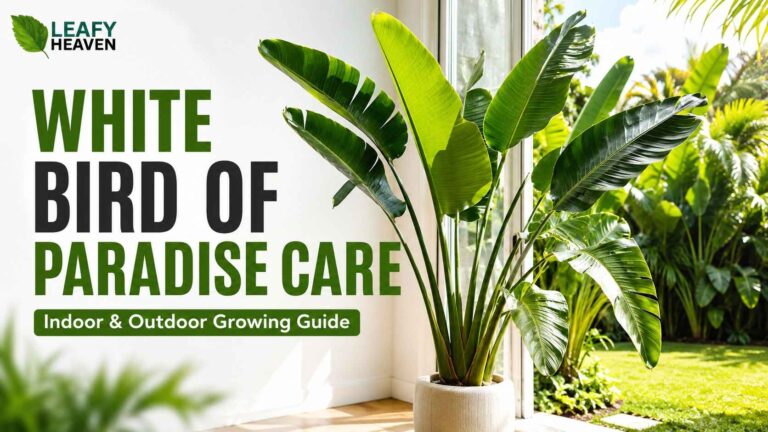
White Bird of Paradise is Strelitzia nicolai, not a Heliconia. The two can look similar when they are not flowering because both develop large tropical leaves, but they differ in botanical identity, growth structure, and bloom shape.
Gardeners wanting a full growing and maintenance guide for this species can explore everything they need in this dedicated guide to White Bird of Paradise care, including light, watering, pruning, and common problems.
How to Identify Strelitzia nicolai
Strelitzia nicolai is identified by its tall growth, very large paddle-shaped leaves, and mature white-and-blue flowers. The white bird of paradise plant develops an upright, architectural form that can become much larger than the familiar orange-flowering Strelitzia reginae.
The white bird of paradise has broad leaves supported by long, sturdy petioles. Mature specimens can develop a trunk-like appearance, which helps explain why this plant is often recognized as a large structural tropical species.
The botanical name Strelitzia nicolai white bird of paradise confirms that it belongs to the Strelitzia genus. Search variations such as Strelitzia nicolai white bird, Strelitzia white bird plant, and white bird paradise plant all refer to this same true Bird of Paradise species.
Although phrases such as birds of paradise plant white may be used informally, the important identification point is that Strelitzia nicolai is a true Bird of Paradise and not part of the Heliconia genus.
White Bird of Paradise vs Heliconia at a Glance
Without flowers, leaf arrangement and overall plant structure provide the best clues; once flowers appear, distinguishing White Bird of Paradise from Heliconia becomes much easier.
| Feature | White Bird of Paradise | Heliconia |
| Leaf arrangement | Large, upright paddle-shaped leaves | Broad, often more banana-like leaves |
| Mature height | Can become very tall and tree-like | Varies from compact to tall clumping forms |
| Bloom shape | White-and-blue bird-shaped flowers | Colorful upright or hanging bracts |
| Indoor suitability | Commonly grown indoors in bright spaces | Generally more demanding indoors |
The clearest difference appears during flowering. Strelitzia nicolai produces a structured white-and-blue bird-like bloom, while Heliconia develops brightly colored bracts that may be upright, stacked, or hanging.
Common Heliconia Types That Are Confused With Bird of Paradise
Heliconia rostrata and Heliconia psittacorum are sometimes confused with Bird of Paradise because of their vivid tropical flowers, but both are true Heliconia species. Their bloom structure is one of the easiest ways to separate them from plants in the Strelitzia genus.
Heliconia rostrata vs Bird of Paradise
Heliconia rostrata is recognized by its pendant red-and-yellow lobster-claw bracts, which differ clearly from the bird-shaped flowers of true Bird of Paradise. A mature heliconia rostrata plant typically produces dramatic hanging inflorescences rather than upright bird-like blooms.
This species is commonly associated with names such as hanging lobster claw, hanging lobster claw plant, and hanging lobster claw heliconia because of the way its layered bracts curve downward. The term lobster claw heliconia rostrata describes the same characteristic flower structure.
In comparison, Bird of Paradise produces a firm spathe with projecting floral parts that resemble the head and beak of a bird. This makes rostrata heliconia relatively easy to distinguish once it is flowering.
Heliconia psittacorum vs Bird of Paradise
Heliconia psittacorum is usually smaller and produces slender, brightly colored upright inflorescences instead of the large bird-shaped bloom typical of Strelitzia. Its floral structure is narrower and more vertical than that of true Bird of Paradise.
A heliconia psittacorum plant may produce vivid combinations of orange, red, yellow, or similar tropical shades, but the bloom does not form the distinctive bird-head shape associated with Strelitzia.
For identification, compare the overall flower structure rather than color alone. Psittacorum heliconia has upright bracts and a slimmer floral form, while Bird of Paradise has a more rigid, projecting bloom with a recognizable bird-like profile.
False Bird of Paradise vs Bird of Paradise
False Bird of Paradise generally refers to Heliconia, while true Bird of Paradise refers to plants in the genus Strelitzia. The two names can cause confusion because both plants have bold tropical foliage and colorful floral structures, but they are botanically different.
In a false bird of paradise vs bird of paradise comparison, the flower structure provides the clearest distinction. Heliconia develops colorful bracts that may be stacked, claw-shaped, upright, or hanging, while Strelitzia produces the distinctive bird-shaped bloom associated with true Bird of Paradise.
Fastest Way to Tell False and True Bird of Paradise Apart
The fastest identification method is to check the flowers first, followed by growth form and botanical name. A false bird of paradise flower usually has colorful overlapping Heliconia bracts, while true Bird of Paradise produces a more open flower resembling a bird’s head and beak.
The term false birds of paradise plant may be used for different Heliconia species, but all true false bird of paradise plants remain members of the genus Heliconia, not Strelitzia.
Use this quick identification checklist:
- Examine the flower or bract shape. Layered or lobster-claw-like bracts usually indicate Heliconia, while a bird-shaped bloom indicates Strelitzia.
- Check the bloom position. Some Heliconia inflorescences hang downward or stand vertically, while Bird of Paradise flowers typically project outward from a firm spathe.
- Compare the leaf arrangement. Heliconia often has a denser, more banana-like appearance, while Bird of Paradise usually develops more upright, paddle-shaped foliage.
- Check the botanical label. Common names can be misleading, so the scientific name provides more reliable identification.
- Confirm the genus. Heliconia indicates false Bird of Paradise terminology, while Strelitzia identifies a true Bird of Paradise.
Heliconia vs Bird of Paradise — Which One Is Easier to Grow?
Bird of Paradise is usually easier to grow in indoor and subtropical conditions, while Heliconia generally needs a more consistently tropical environment. The difference mainly comes down to humidity, moisture, temperature stability, light, and available growing space.
Choose Heliconia When…
Heliconia is better suited to environments that provide sustained warmth, high humidity, consistent moisture, and enough room for vigorous tropical growth. These conditions more closely match the climate in which many Heliconia species perform naturally.
Heliconia may be the easier plant to maintain when the growing environment stays reliably warm and humid throughout the active season. Its moisture requirements are also easier to manage where soil does not dry too quickly and strong light is readily available.
Gardeners in hot, sunny regions looking for bold ornamental choices can also explore this selection of warm-climate flowering plants that thrive in similar tropical and subtropical conditions.
Choose Bird of Paradise When…
Bird of Paradise is generally more adaptable when growing conditions are indoor or subtropical rather than consistently tropical. Its upright, architectural growth and greater tolerance of typical household conditions make it easier to manage in many environments.
Compared with Heliconia, Bird of Paradise usually copes better with moderate indoor humidity, slight drying between waterings, and container growing. However, it still performs best with bright light, warmth, good drainage, and sufficient space for its mature foliage.
Heliconia vs Bird of Paradise — Key Differences Summary
Heliconia and Bird of Paradise share a bold tropical appearance, but they differ in botanical family, flower structure, mature growth habit, and environmental preferences. The fastest identification usually comes from examining the blooms, although foliage and plant structure also provide useful clues.
Quick Summary Table
| Feature | Heliconia | Bird of Paradise |
| Botanical family | Heliconiaceae | Strelitziaceae |
| Genus | Heliconia | Strelitzia |
| Common names | Heliconia, False Bird of Paradise, Lobster Claw | Bird of Paradise, Crane Flower |
| Flower/bract structure | Small flowers surrounded by colorful overlapping bracts | Distinctive bird-shaped flowers emerging from a firm spathe |
| Leaf appearance | Broad, often banana-like tropical leaves | Large, thicker, paddle-shaped leaves |
| Typical size | Varies from compact species to tall tropical clumps | Ranges from medium-sized Strelitzia reginae to very large Strelitzia nicolai |
| Moisture preference | Generally prefers more consistent moisture | Usually tolerates some drying of the upper soil |
| Humidity preference | Favors consistently high tropical humidity | Prefers humidity but is usually more adaptable |
| Indoor suitability | Less commonly grown indoors and often more demanding | Commonly grown indoors in bright conditions |
| Best identification feature | Colorful upright or hanging lobster-claw-like bracts | Distinctive bird-shaped Strelitzia bloom |
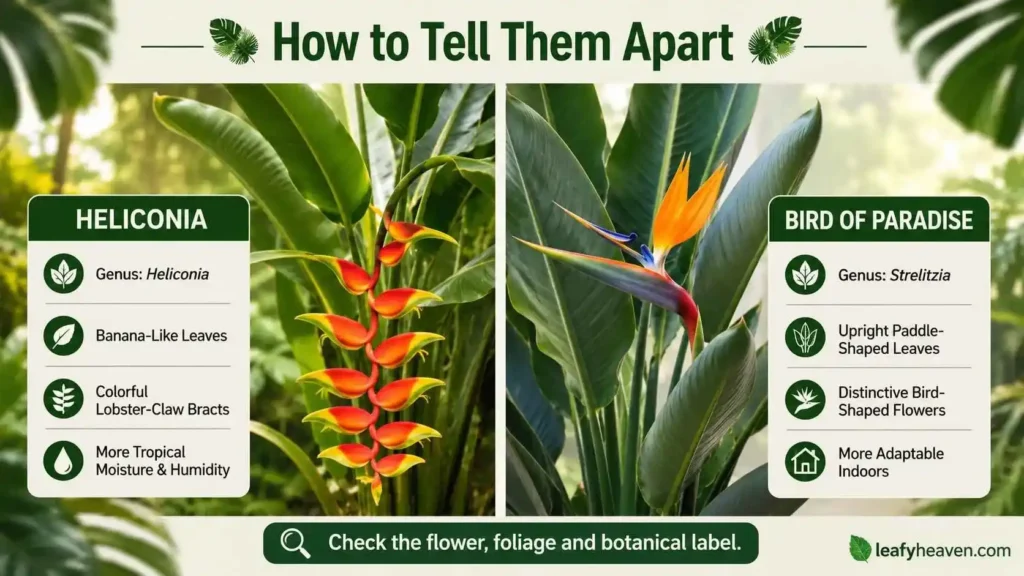
Closing takeaway: If the plant has colorful lobster-claw-like bracts, it is likely a Heliconia. If it produces the distinctive bird-shaped Strelitzia bloom, it is a true Bird of Paradise.
Conclusion — Heliconia vs Birds of Paradise
Heliconia and Bird of Paradise may look similar at first glance, but their flower structure, botanical classification, foliage, and growth habit make them clearly distinguishable. Heliconia belongs to the genus Heliconia, while true Bird of Paradise belongs to the genus Strelitzia.
The name false Bird of Paradise can create confusion because some Heliconia species have bright tropical bracts that resemble Bird of Paradise flowers. However, the bloom remains the fastest identification clue: Heliconia usually develops colorful overlapping or lobster-claw-like bracts, while Strelitzia produces the distinctive bird-shaped flower.
For a quick side-by-side check, compare the plant’s flower shape, leaf structure, and botanical label. These three features can usually confirm whether you have a Heliconia or a true Bird of Paradise.
FAQs About Heliconia vs Birds of Paradise
Q1. Is Heliconia a Bird of Paradise plant?
No. Heliconia and Bird of Paradise are botanically different plants. Heliconia belongs to the genus Heliconia and the Heliconiaceae family, while true Bird of Paradise belongs to the genus Strelitzia and the Strelitziaceae family.
Some Heliconia species are commonly called false Bird of Paradise, which is why the two plants are sometimes confused.
Q2. Why is Heliconia called false Bird of Paradise?
Heliconia is called false Bird of Paradise because its bright, exotic floral structures can resemble true Bird of Paradise blooms. The name refers to visual similarity rather than botanical classification.
Despite the common name, Heliconia remains a member of the genus Heliconia and is not a true Strelitzia.
Q3. What is the easiest way to tell Heliconia and Bird of Paradise apart?
The easiest way to distinguish Heliconia from Bird of Paradise is to examine the flowers. Heliconia typically produces colorful overlapping bracts that may be upright or hanging, while true Bird of Paradise develops a distinctive bird-shaped flower.
If the plant is not flowering, compare its leaf arrangement, overall growth habit, and botanical label for additional identification clues.
Q4. Is lobster claw the same as Bird of Paradise?
No. Lobster claw usually refers to certain Heliconia species, not true Bird of Paradise. The name comes from the layered, curved bracts that resemble lobster claws.
True Bird of Paradise belongs to the genus Strelitzia and produces a more open, structured bloom resembling a bird’s head and beak.
Q5. Is White Bird of Paradise a Heliconia?
No. White Bird of Paradise is Strelitzia nicolai, not a Heliconia. It is a true member of the Bird of Paradise group and belongs to the Strelitziaceae family.
Its large paddle-shaped leaves may resemble Heliconia foliage, especially when the plant is not flowering, but mature white-and-blue blooms clearly distinguish it.
Q6. Which grows better indoors, Heliconia or Bird of Paradise?
Bird of Paradise is generally more practical for indoor growing than Heliconia. It usually adapts better to containers, bright indoor light, and typical household conditions.
Many Heliconia species require consistently high warmth, humidity, strong light, and more growing space, making them more demanding indoors.
Q7. Do Heliconia and Bird of Paradise need the same care?
Their care requirements overlap, but they are not identical. Both prefer warmth, good light, fertile soil, and effective drainage, but Heliconia generally needs more consistent moisture and tropical humidity.
Bird of Paradise typically tolerates slightly drier soil between waterings and adapts more readily to indoor and subtropical growing conditions.

Written by the LeafyHeaven Editorial Team
LeafyHeaven shares practical gardening tips and simple plant care guides to help you grow, nurture, and enjoy your plants with ease. Our goal is to make gardening feel natural, approachable, and rewarding for everyone.