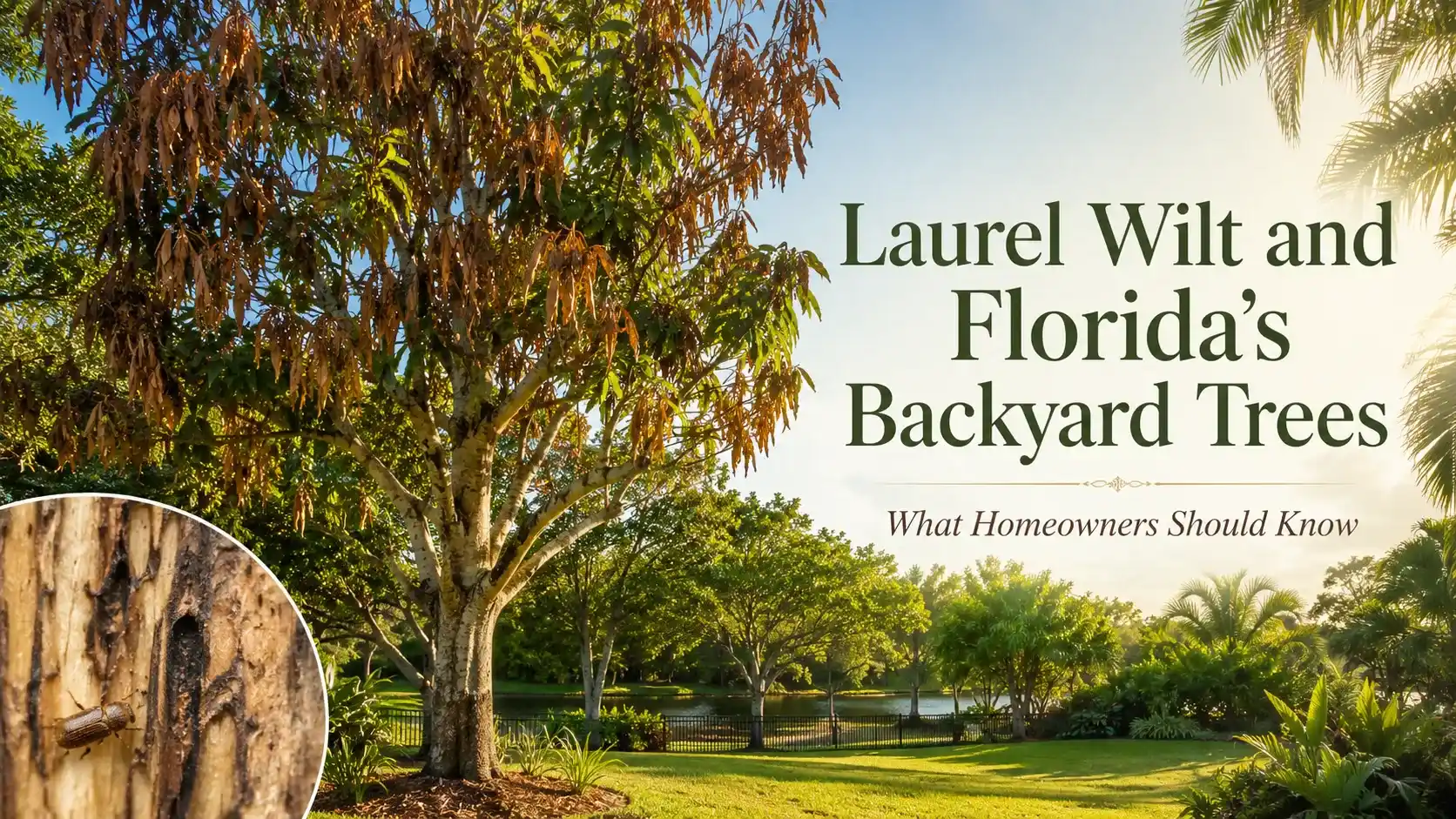

A redbay in your yard can look completely normal on a Monday. Have a canopy of dead brown leaves by the end of the month. That speed is the most important thing to understand about laurel wilt a vascular disease caused by the fungus Harringtonia lauricola (published for years under its older name, Raffaelea lauricola) and carried tree to tree by an introduced insect the redbay ambrosia beetle. By the time symptoms are obvious the tree is usually already lost. Now what matters the most is to watch what is about to happen next. Watch for: how the wood is handled, whether neighboring trees are at risk and what goes back in the ground.
In 2002 Laurel wilt reached Georgia. In the spring of 2005 , it was found in Florida Duval County. It has since been confirmed in 300 counties across the Southeast and has moved through Florida’s peninsula into the avocado groves of Miami-Dade County, where it was first found in 2011. For homeowners this is no longer a threat on a distant map. It is a cause of tree death, in Florida yards. To everyone who is responsible for tree care in tampa bay area, they must have already known the history of laurel wilt and look after them before the next wilt shows up.
What trees are at risk in your yard?
Laurel wilt affects trees that are from their laurel family. The laurel family is called Lauraceae. In Florida landscapes that means:
- Two species that hit hard are Redbay (Persea borbonia) and Swampbay (Persea palustris).
- Backyard varieties including Avocado (Persea americana).
- North Florida species Sassafras (Sassafras albidum).
- Non-native species Camphor tree (Cinnamomum camphora).
- Pondberry, both imperiled natives.
- Species that are grown in pots and herb beds, Bay laurel (Laurus nobilis).
The non-host trees include Oaks, maples, pines, palms, citrus, and mangoes. If this kind of tree is declining, the laurel wild is not the problem. If you work on this, you will waste your time by chasing the wrong problem.
One important fact to remember: the beetle prefers larger stems. Young avocado trees are rarely attacked directly which is why planting a tree after a loss is realistic rather than futile.
How to Tell Laurel Wilt From Everything Else?
Florida trees can wilt for reasons, such as root rot, drought, girdling roots or storm damage. Laurel wilt has a pattern that’s fairly specific when you look at the entire sequence, not just one symptom alone.
The wilting begins green, turns brown and stays hanging. Leaves and green stems may take on a purplish or bluish‑green tint before they dry. The dead leaves cling to the branches of falling off which is the opposite of what most stressed trees do. On trees the leaf drop can happen faster.
Check for streaks, inside the sapwood. Peel the back of the bark on a limb and look for Laurel wilt. Then look for any wood underneath. Black streaks that run ways through the sapwood are the best sign a homeowner can find. The fungus makes the tree close up its water pipes. That is what actually kills the tree.
Sawdust tubes. Redbay ambrosia beetle is dark and shiny with bores holes. It pushes out compacted sawdust. The sawdust forms protruding tubes. The sawdust also forms a white crystalline dust. The white crystalline dust is dried sap. These tubes crumble in rain and wind so their absence proves nothing.
Speed. Redbay and swampbay trees often die within a week. Avocado trees usually take from three weeks to three months. A tree that has been slowly thinning for two years is certainly suffering from something else.
Spread to the tree next door. Beetles fly on their own. The fungus can also travel through natural root grafts between neighboring trees of the same species. A cluster of dying redbays, in one corner of a property is a pattern.
The First Steps After You Suspect It
Report it before you cut any part. When detections are confirmed they guide the response at the county level and a diagnosis does not cost you anything. Send a sapwood sample to a UF/IFAS Plant Diagnostic Center. In Miami‑Dade the UF/IFAS commercial tropical fruit extension office in Homestead handles inquiries directly.
Do not cut off the wilted limb. Wait. Laurel wilt spreads throughout the system. Thus cutting away wood does not clear the infection. Fresh cuts on a tree, in an area where laurel wilt is active, invite more disease.
Do not move the wood off your property. This is the most important action a homeowner can take. Long‑distance jumps in the disease map follow the movement of wood and firewood by people, not just beetle flight.
Removal and Wood Disposal, Done Correctly
Soon as you see that laurel wilt is there, that dying tree becomes a place for beetles to live. If you leave wood stacked in your yard that wood will make beetles. Those beetles will then fly over. Attack the trees in your neighbors yard.
The current advice from UF/IFAS for home yards is to focus on chipping. Chipping the wood helps a lot because chipping the infested wood stops many beetles from coming out. If you cover the wood chips under a tarp for at least seven days you will stop even more beetles. After that you can put the wood chips and debris in your trash or yard waste or you can compost the wood chips if your local rules say it is okay. You should not use burning because burning wood is regulated in Florida and you usually need permission to burn. Burning is not the way people should handle this in their yards anymore.
There are two habits you should follow when you remove a tree. First take out the stump and as many roots as you can. This step is very needed because root grafts can move the fungus to nearby trees. After cutting an infected tree, it is important to sterilize your saws, loppers and blades. Do not let your saws, loppers or blades touch another laurel-family plant until they are clean.
If the tree is very big, close to a house or very brittle because it has been dying for months, you should hire an insured crew. You want a crew that will chip the wood there instead of hauling heavy logs all over the county. In the Tampa Bay area a licensed tree removal service crew can take the tree. Stump down and process all the debris on your property. Hiring a tree removal service Tampa crew is the best way to keep the beetles contained.
Can a Valuable Tree Be Protected?
Only in advance.
For high-value landscape trees the fungicide propiconazole delivered by trunk injection or infusion is the option with real research behind it. A trial published in Arboriculture & Urban Forestry in 2023 found that 86 percent of microinjected sassafras survived 52 or more weeks after inoculation against 11 percent of untreated controls and that 77 percent of micro-infused trees survived with less than half their crown lost. UF/IFAS notes that injections repeated every two years have been used successfully on high-value landscape trees.
The caveats are as important as the numbers. Propiconazole is preventive not curative. Does nothing for a tree that is already wilting. Protection is not absolute; some treated trees still decline applications made after budbreak caused leaf-margin discoloration in a majority of trees in the sassafras trial and Propiconazole must be repeated indefinitely by an applicator. Propiconazole makes sense for a specimen redbay with landscape or historical value. Propiconazole does not make sense for a row of volunteer swampbays at the back of a lot.
For avocado specifically UF/IFAS states plainly that there are no approved fungicide treatments to prevent or cure laurel wilt in trees. A repellent, verbenone has shown some effect against the beetle and is used in research and grove settings but verbenone is a supplement to sanitation rather than a substitute.
Keeping a Backyard Avocado in Play
I have watched the Florida avocado experience unfold over the years. The Florida avocado experience is the guide for homeowners and the recent news is genuinely better than it was ten years ago.
The damage was severe. Over 300,000 trees have been removed in South Florida since 2010, including more than 140,000 avocado trees. UF/IFAS estimates that the losses are over $54 million. Commercial production is down 60 percent and the area planted is down about 45 percent since 2012. However losses have slowed a lot in the two years. UF tropical fruit specialist Jonathan Crane says the change is due to three things: grove care, replanting with young trees that are not root‑grafted to neighbors and a fall in the share of ambrosia beetles that carry fungus from about 50 percent to about 10 percent.
The management piece translates directly to a backyard tree:
- Prune for light and air flow. The beetle stays away from sunlight and moving air. An open canopy is less appealing than a dense shaded one. Structural thinning on a tree is worth giving to a Tampa tree trimming professional instead of topping it yourself because careless cuts make wounds and stress that lure beetles.
- You should try to keep the tree healthy. If you give the tree watering and use proper fertilizing you help the tree defend itself. It is a shame because stressed trees emit smells that attract beetles.
- Avoid wounds and schedule major pruning carefully instead of cutting into an active outbreak.
- Buy from registered nurseries. I always check any nursery stock before it comes home. I reject any nursery stock that has pinholes, sawdust or unexplained wilting.
- Watch the avocado tree every week during summer. Early detection does not save the tree but it protects the trees around it.
What to Plant After a Loss?
Replacing a redbay with another redbay in an area where laurel wilt’s already present is a temporary solution. If you want fruit from the laurel family, planting an avocado is an idea because trees that stay below a size rarely get struck by the disease. You can grow the avocado for years before the danger comes up.
For landscape value leaving the Lauraceae family entirely stops the risk. I really think you should go with Florida trees. You can pick trees such as oak, southern magnolia, dahoon holly, red maple, sweetbay magnolia and slash pine. I like these because Florida-friendly native trees can fill the spots without carrying laurel wilt. It is a safer way to garden. Just make sure you pick a plant that fits your soil moisture and salt level. I also suggest that you look at the UF/IFAS Landscaping guide before you buy any plants.
A Practical Homeowner Checklist
- Identify your laurel-family trees now before any problems appear.
- Inspect your laurel-family trees monthly. Inspect them weekly during summer looking for wilted green leaves and clinging brown leaves.
- Cut into a wilted limb of your laurel-family trees. Look for dark sapwood streaking before assuming anything.
- Call 1‑888‑397‑1517 to report a suspected case of laurel wilt.
- Never move cut wood or firewood from your laurel-family trees off the property.
- Chip the wood on site, tarp the chips for least a week and remove the stump of your laurel-family trees.
- Sterilize pruning tools between each of your laurel-family trees.
- Consider propiconazole injections only for high-value laurel-family trees and only before infection.
- Replant with a non‑host species. Plant a young avocado if you want fruit after removing your laurel-family trees.
- Buy nursery stock for your laurel-family trees from registered sources.
If you are unsure whether what you are looking at is laurel wilt have a local expert who works with laurel-family trees examine it. In Hillsborough and Pinellas counties a certified arborist can confirm the sapwood streaking, examine the rest of your laurel-family trees and plan removal so that the next outbreak does not spread down the street.
Laurel wilt is not something a homeowner can cure and pretending otherwise wastes money. What a homeowner can do is spot laurel wilt handle the wood responsibly and choose replacements that will still be standing in twenty years. Across Florida those three decisions repeated at the property scale are what actually slows this disease down.
Written by the LeafyHeaven Editorial Team
LeafyHeaven shares practical gardening tips and simple plant care guides to help you grow, nurture, and enjoy your plants with ease. Our goal is to make gardening feel natural, approachable, and rewarding for everyone.