
Introduction
Mulberry varieties in Australia include black, white, red, weeping, and dwarf mulberry trees that thrive in different climates and garden spaces. As more homeowners focus on growing productive backyard gardens, mulberries Australia gardeners prefer are becoming increasingly popular for their sweet fruit, rapid growth, and low-maintenance nature.
A well-grown mulberry tree Australia gardeners plant can adapt successfully to many regions, including Queensland, New South Wales, Victoria, and Western Australia. This adaptability makes mulberry in Australia an excellent choice for both beginner and experienced gardeners looking to establish reliable fruit trees mulberry varieties at home.
Mulberries are one of the easiest fruit trees to manage when following a proper tropical fruit trees grow guide, especially in warm and subtropical Australian regions.
One major reason australia mulberry trees are gaining attention is their ability to produce large harvests with minimal care. Many varieties tolerate heat, seasonal drought, and varying soil conditions while still delivering flavorful berries year after year. From compact dwarf trees for patios to large shade-producing black mulberries, there are options suitable for nearly every Australian garden size.
In addition to fresh fruit production, mulberry trees also provide valuable home orchard benefits. They offer summer shade, attract beneficial wildlife, and can produce fruit for decades when properly maintained. Their combination of productivity, resilience, and easy cultivation continues to make mulberries a preferred backyard fruit tree across Australia.
What Is a Mulberry Tree?
A mulberry tree is a deciduous fruit tree from the Morus plant family that produces sweet edible berries and grows well in many Australian regions. Mulberry trees are valued for their fast growth, productive fruiting habits, and ability to adapt to temperate and subtropical climates across Australia.
These trees are commonly planted in home orchards, backyards, and edible gardens because they require relatively low maintenance while producing large quantities of fruit during the growing season.
Scientific Classification of Mulberry Trees
Mulberry trees belong to the Moraceae family, a plant group that also includes figs and breadfruit. The scientific genus for mulberries is Morus, which contains several species cultivated for fruit, shade, and ornamental purposes. For gardeners interested in exploring different naming styles and classifications, you can also check this guide on mulberry plant names for more detailed variety ideas and inspiration.
The Morus plant is known for its hardy growth and long lifespan. A mature Morus tree can live for decades while continuing to produce fruit annually under suitable conditions.
One of the most widely grown species is the Morus nigra tree, commonly known for producing rich, dark berries with intense flavor. The Morus nigra mulberry tree is especially popular in Australian home gardens because of its sweet fruit and strong adaptability to warm climates.
Key scientific classifications include:
- Family: Moraceae
- Genus: Morus
- Common Species:
- Morus nigra (Black mulberry)
- Morus alba (White mulberry)
- Morus rubra (Red mulberry)
Common Types of Mulberry Trees
Several mulberry varieties are grown in Australia, each offering different fruit flavors, growth habits, and landscaping benefits.
Black Mulberry
Black mulberry trees are known for producing deep purple-black berries with a rich, sweet flavor. These trees are popular for fresh eating, jams, and desserts.
White Mulberry
White mulberry varieties grow quickly and often produce lighter-colored fruit ranging from white to pinkish-purple. They are highly adaptable and commonly used as shade trees.
Red Mulberry
Red mulberry trees produce medium-to-large reddish fruit with a balanced sweet-tart taste. They are less common but still valued in some gardens.
Weeping Mulberry Tree
The weeping mulberry tree is primarily grown as an ornamental feature. Its cascading branches create an attractive landscape shape while still producing edible fruit.
Dwarf Mulberry Tree
A dwarf mulberry tree is ideal for compact gardens, patios, and containers. These smaller trees are commonly grown in pots and require less space than standard varieties.
English Mulberry Tree
The English mulberry tree is a traditional heritage variety appreciated for its strong fruit flavor and classic spreading canopy structure.
Are Mulberry Trees Deciduous?
Yes, mulberry trees are deciduous. If gardeners ask, “do mulberry trees lose their leaves,” the answer is yes. Mulberry trees naturally shed their foliage during cooler months as part of their seasonal dormancy cycle.
For those wondering, “are mulberry trees deciduous,” this dormancy period helps the tree conserve energy before new spring growth begins.
This seasonal behavior becomes clearer when understanding the difference between deciduous and evergreen trees, especially in how they respond to winter dormancy and leaf drop cycles.
In Australia, leaf drop usually occurs during autumn and winter, depending on regional climate conditions.
During dormancy:
- Leaves turn yellow before falling
- Fruit production stops temporarily
- Growth slows significantly
- Trees prepare for spring regrowth
In warmer Australian regions such as Queensland, some mulberry trees may retain foliage longer, while cooler regions like Victoria experience more noticeable seasonal leaf drop.
Quick Summary
| Feature | Details |
| Plant Type | Deciduous fruit tree |
| Botanical Name | Morus spp. |
| Fruit Type | Mulberry berries |
| Climate | Temperate to subtropical |
Best Mulberry Varieties Australia Gardeners Can Grow
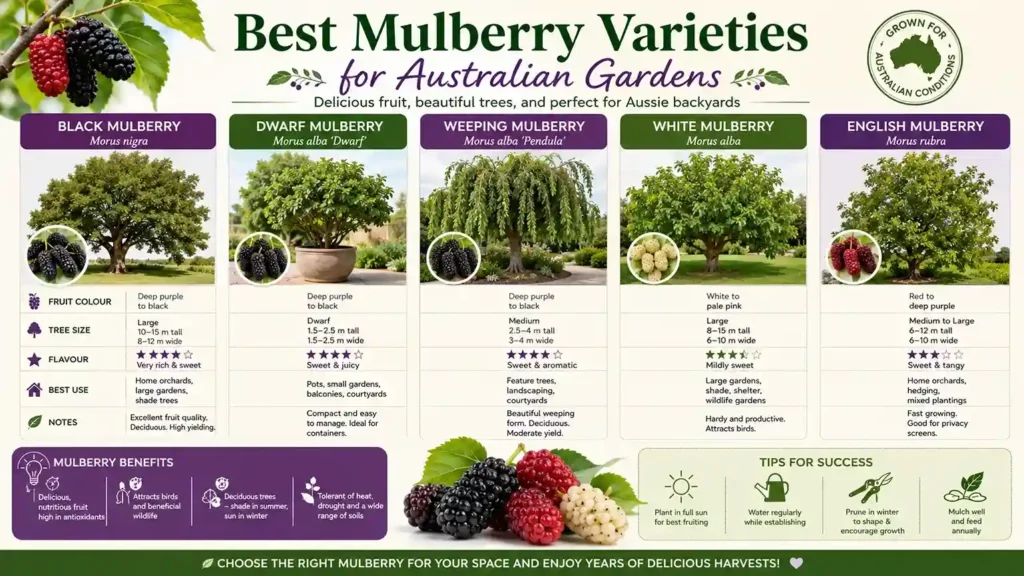
The best mulberry varieties in Australia depend on climate, fruit quality, tree size, and maintenance needs. Some varieties are ideal for large backyard orchards, while others are better suited for compact urban gardens, pots, or ornamental landscaping.
Australian gardeners commonly choose mulberry trees based on fruit sweetness, growth habits, and adaptability to local weather conditions. From productive black mulberries to compact dwarf varieties, there are suitable options for almost every garden size and climate zone.
Black Mulberry (Morus Nigra)
The Black Mulberry is one of the most popular and highly valued mulberry varieties grown in Australia. The morus nigra black mulberry tree is known for producing large dark berries with a rich, sweet flavor and soft texture.
A mature black mulberry plant develops a broad canopy and can provide both fruit production and shade for home gardens. The fruit is deep purple to black when fully ripe and is commonly used for fresh eating, desserts, jams, and preserves.
Key characteristics of the mulberry tree black variety include:
- Rich and intense berry flavor
- Large juicy fruit
- Long productive lifespan
- Excellent suitability for home orchards
- Strong heat tolerance in many Australian climates
Black mulberry trees grow best in full sun and well-drained soil. They are especially popular in temperate regions where warm summers support heavy fruiting.
White Mulberry
White mulberry is a fast-growing variety valued for its adaptability and vigorous growth. A healthy white mulberry plant can establish quickly and produce fruit within a relatively short time.
The mulberry white tree often develops pale berries that range from white and pink to light purple depending on the cultivar. Some varieties are planted mainly for shade, while others are grown for edible fruit production.
Benefits of white mulberry trees include:
- Rapid growth rate
- High adaptability to different soils
- Good drought tolerance once established
- Suitable for large gardens and rural properties
White mulberries are commonly used in Australian gardens because they handle varying climate conditions well, including warmer and drier regions.
Dwarf Mulberry Tree
A dwarf mulberry tree is ideal for small gardens, patios, balconies, and container growing. Many gardeners choose dwarf mulberry varieties because they remain compact while still producing sweet edible fruit.
A properly maintained dwarf mulberry performs well as a mulberry tree in pot setups where garden space is limited. These compact trees are especially popular in urban areas where large fruit trees may not be practical.
Advantages of growing dwarf mulberry in containers include:
- Easy maintenance
- Smaller root system
- Suitable for pruning and shaping
- Convenient harvesting
- Excellent for decorative edible gardens
When growing mulberry in pot conditions, gardeners should use quality potting mix, ensure good drainage, and provide regular watering during hot weather. A large mulberry tree pot helps support healthy root growth and long-term fruit production.
Weeping Mulberry Tree
The weeping mulberry tree is primarily grown for ornamental landscaping purposes. Its graceful cascading branches create an attractive umbrella-like shape that works well in decorative gardens.
A mature mulberry weeping tree provides visual appeal while also producing edible berries in many varieties. These trees are commonly used as focal points in Australian landscapes because of their unique structure and manageable size.
Some gardeners also maintain a pollarded mulberry tree form by regularly trimming upper branches to control canopy shape and encourage dense growth.
Common uses for weeping mulberries include:
- Ornamental garden design
- Shade features
- Courtyard landscaping
- Small backyard feature trees
Weeping mulberries generally require periodic pruning to maintain their attractive cascading form.
English Mulberry Tree
The English mulberry tree is a traditional heritage variety known for its historic cultivation and flavorful fruit. Many gardeners appreciate english mulberry varieties for their strong berry taste and classic spreading canopy.
An established english mulberry tree can become a long-lasting feature in home orchards, often producing fruit for many years with proper maintenance.
Key characteristics include:
- Traditional heritage appearance
- Sweet aromatic berries
- Strong branching structure
- Suitable for larger gardens
English mulberries are often selected by gardeners seeking older-style fruit tree varieties with reliable fruit quality and shade benefits.
Native and Australian Mulberry Types
Some gardeners also explore native mulberry tree options and locally adapted selections suited to Australian conditions. These varieties may offer improved tolerance to local climates, pests, and soil conditions.
The austral mulberry is sometimes referenced in discussions about mulberry trees adapted for Australian landscapes and native-style edible gardens.
Australian-grown mulberry selections are increasingly valued for:
- Climate adaptability
- Productive fruiting
- Low maintenance requirements
- Suitability for sustainable home gardening
Comparison Table
| Variety | Fruit Flavor | Tree Size | Best For |
| Black Mulberry | Sweet-rich | Large | Home orchards |
| Dwarf Mulberry | Sweet | Compact | Pots |
| Weeping Mulberry | Mild | Small-medium | Landscaping |
How Big Do Mulberry Trees Grow?
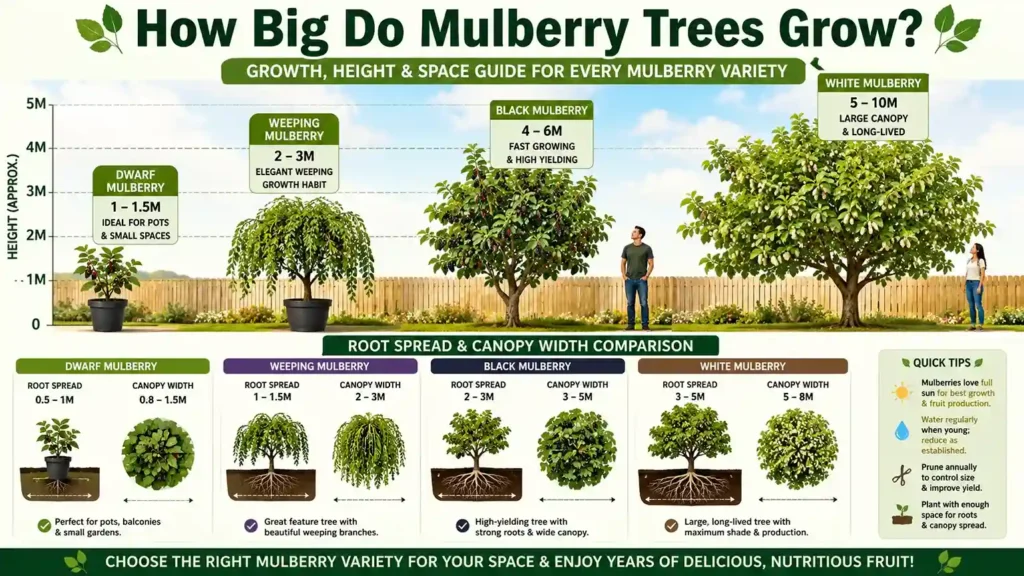
Mulberry tree size varies by species, with some dwarf types staying under 3 meters while full-grown mulberry trees can exceed 10 meters.
This makes them comparable in growth performance to some fast growing evergreen trees Australia, especially in landscapes where rapid canopy development is desired.
Growth depends on the variety, pruning practices, climate conditions, soil quality, and available space.
In Australia, mulberry trees are considered fast-growing fruit trees and can quickly develop large canopies when planted in suitable conditions. Some varieties are compact enough for container gardening, while others become large shade-producing trees over time.
Average Mulberry Tree Size
The average mulberry tree size depends mainly on the species and how the tree is maintained. Standard mulberry varieties can grow into medium or large trees with broad spreading branches and dense foliage.
A full grown mulberry tree commonly reaches:
- 6 to 10 meters in height
- 5 to 8 meters in canopy spread
- Large root systems in mature specimens
Certain vigorous varieties may grow even larger in ideal climates with rich soil and consistent moisture.
Typical mulberry size ranges include:
| Mulberry Type | Average Height | Growth Habit |
| Dwarf Mulberry | 2–3 meters | Compact |
| Weeping Mulberry | 3–5 meters | Ornamental spreading |
| Black Mulberry | 6–10 meters | Large canopy |
| White Mulberry | 8–12 meters | Fast-growing large tree |
Pruning can significantly reduce overall height and width, making many mulberry varieties easier to manage in residential gardens.
How Big Does a Mulberry Bush Get?
Many gardeners ask, “how big does a mulberry bush get?” The answer depends on whether the plant is naturally compact or intentionally pruned into a bush form.
Mulberries naturally prefer tree-like growth, but regular pruning can maintain a smaller bush structure suitable for compact spaces or easier harvesting.
Bush-style mulberries generally:
- Stay between 1.5 and 3 meters tall
- Develop multiple stems instead of a single trunk
- Produce dense branching
- Require annual trimming to maintain shape
The main difference between bush and tree growth habits is structure. Trees typically grow with one dominant trunk and wider canopy spread, while bush forms remain lower and denser with more compact branching.
Bush-trained mulberries are often preferred for:
- Small backyards
- Easier fruit collection
- Decorative edible gardens
- Container growing
Growth Rate of Mulberry Trees
Mulberry trees are widely considered a fast-growing fruit tree, especially during their early years of establishment. Under suitable conditions, some varieties can grow more than 1 meter annually.
Gardeners growing mulberries in Australia often notice rapid spring and summer growth due to warm temperatures and long sunlight hours.
Factors influencing mulberry growth rate include:
- Climate
- Soil fertility
- Sunlight exposure
- Water availability
- Variety selection
- Pruning practices
White mulberry trees are generally the fastest-growing varieties, while black mulberries often grow slightly slower but produce richer-flavored fruit.
Young trees usually establish quickly when planted in:
- Full sun
- Well-drained soil
- Warm climates
- Nutrient-rich garden beds
Because of their vigorous growth, mulberry trees benefit from regular pruning to maintain manageable size and improve airflow.
Best Mulberry Trees for Small Spaces
Compact mulberry varieties are ideal for smaller Australian gardens, patios, balconies, and urban landscapes. A dwarf mulberry tree is one of the best options for gardeners with limited growing space.
Dwarf varieties remain manageable while still producing sweet edible berries. They are commonly grown as:
- Patio fruit trees
- Courtyard plants
- Balcony container trees
- Small edible landscape features
Growing a mulberry in pot conditions is especially popular in urban areas. Container-grown trees can be moved easily and kept smaller through root restriction and pruning.
For successful container growing:
- Use a large pot with drainage holes
- Choose high-quality potting mix
- Water regularly during hot weather
- Prune annually to maintain shape
Compact mulberry varieties offer the benefits of fruit production without requiring the large space needed for full-sized trees.
How to Grow Mulberry Trees Successfully in Australia
Mulberry trees grow best in full sun, well-drained soil, and warm Australian conditions with moderate watering. These adaptable fruit trees perform well across many parts of the country and are considered one of the easier backyard fruit trees to maintain.
Successful mulberry cultivation depends on selecting the right planting location, maintaining healthy soil, and providing seasonal care during active growth periods. Once established, mulberry trees are generally hardy, productive, and drought tolerant.
Best Climate for Mulberries Australia
Mulberry trees grow successfully in many Australian climate zones, including temperate, subtropical, and some warm semi-arid regions. Their adaptability is one reason mulberries Australia gardeners continue to plant them in both urban and rural landscapes.
Suitable Australian growing regions include:
- Queensland
- New South Wales
- Victoria
- South Australia
- Western Australia
- Parts of Tasmania with milder winters
In warmer areas, the mulberry season QLD gardeners experience often begins earlier due to higher spring temperatures. Trees in Queensland may fruit from late spring into summer depending on variety and local weather.
A mulberry tree Perth gardeners grow typically performs well because of the region’s warm summers and relatively dry climate. However, additional watering may be needed during extended heat periods.
Ideal climate conditions include:
- Warm summers
- Moderate winter chill
- Full sun exposure
- Protection from severe frost when young
Mulberries adapt well to different Australian zones, although fruit production is generally strongest in sunny locations with long growing seasons.
Soil Requirements
Mulberry trees prefer fertile, well-drained soil that supports healthy root development and prevents excess moisture around the roots.
Important soil requirements include:
- Good drainage
- Moderate moisture retention
- Organic-rich structure
- Loose soil texture
Poor drainage can lead to root rot and reduced tree vigor. Heavy clay soils should be improved with compost and organic matter before planting.
Mulberries generally prefer slightly acidic to neutral soil conditions with a pH range between:
- 6.0 and 7.0
Adding compost, aged manure, or mulch improves:
- Soil fertility
- Moisture retention
- Microbial activity
- Root health
Healthy soil encourages stronger growth, better fruiting, and improved drought resistance.
Sunlight and Temperature Needs
Mulberry trees require full sun for strong fruit production and healthy canopy growth. Most varieties perform best with:
- At least 6 to 8 hours of direct sunlight daily
Insufficient sunlight may reduce fruit yield and slow overall growth.
Mulberries are known for their strong heat tolerance and can handle hot Australian summers once established. Mature trees often continue growing well during extended warm periods if they receive occasional deep watering.
Temperature tolerance varies slightly between species, but many mulberries also show moderate frost tolerance during winter dormancy.
Young trees are more sensitive to:
- Severe frost
- Cold winds
- Sudden temperature drops
In cooler climates, planting in a sheltered sunny position helps protect young trees during establishment.
Watering Requirements
Mulberry trees need regular watering during establishment but become relatively drought tolerant once mature.
Young trees require:
- Consistent watering
- Deep root-zone moisture
- Extra irrigation during hot weather
During the first few years, watering deeply once or twice weekly is often more effective than shallow daily watering.
Mature trees generally:
- Need less frequent irrigation
- Tolerate dry conditions better
- Develop deeper root systems
However, prolonged drought can reduce fruit quality and overall productivity.
Signs of inadequate watering include:
- Wilting leaves
- Reduced fruit size
- Premature fruit drop
- Slower growth
Applying mulch around the base helps conserve moisture and stabilize soil temperature.
Mulberry Tree Fertilizer Needs
Using the right mulberry tree fertilizer supports healthy foliage growth, stronger roots, and improved fruit production.
Mulberries benefit from balanced feeding during active growth periods. A quality mulberry fertilizer should contain:
- Nitrogen
- Phosphorus
- Potassium
- Trace minerals
Organic fertilizers and compost-based feeds are commonly recommended for home gardens.
A basic seasonal feeding schedule includes:
| Season | Fertilizer Focus |
| Early Spring | Balanced fertilizer for new growth |
| Late Spring | Light feeding during fruiting |
| Autumn | Organic compost or mulch |
| Winter | Usually no feeding during dormancy |
Avoid excessive nitrogen because it may encourage heavy leaf growth at the expense of fruit production.
Container-grown mulberries may require more frequent feeding because nutrients wash out faster through regular watering.
Quick Care Checklist
- Full sun
- Deep watering
- Annual pruning
- Balanced fertilizer
Planting Mulberry Tree Correctly
Planting a mulberry tree correctly improves fruit production, root establishment, and long-term tree health. Proper planting techniques help young trees adapt faster, develop stronger root systems, and grow more productively in Australian conditions.
Mulberry trees are generally easy to establish, but selecting the right location, spacing, and soil preparation can significantly improve future growth and fruit quality.
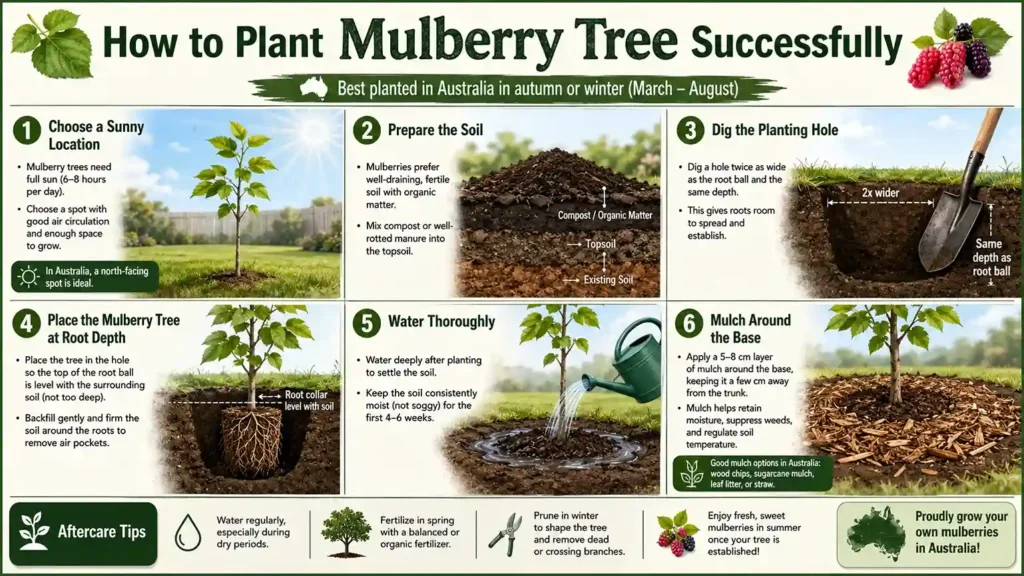
Best Time for Planting Mulberry Tree in Australia
The best time for planting mulberry tree varieties in Australia is usually during late winter to early spring while the tree is dormant or just beginning active growth.
Seasonal timing is important because cooler conditions reduce transplant stress and allow roots to establish before extreme summer heat arrives.
Recommended planting periods by region include:
| Region | Best Planting Time |
| Queensland | Late winter to early spring |
| New South Wales | Winter to early spring |
| Victoria | Early spring |
| Western Australia | Late winter to spring |
Climate considerations also affect planting success. In warmer subtropical regions, autumn planting may also work well because soil temperatures remain suitable for root development.
Avoid planting during:
- Extreme summer heat
- Heavy waterlogged periods
- Severe frost conditions
Young trees establish more successfully when moderate temperatures support steady root growth.
How to Plant Mulberry Tree Step by Step
Understanding how to plant mulberry correctly helps prevent root stress and improves long-term tree performance.
The basic process for how to plant mulberry tree varieties is straightforward and suitable for most Australian gardens.
Before planting:
- Select a sunny location
- Ensure good drainage
- Prepare nutrient-rich soil
- Remove nearby weeds or grass
When planting a mulberry tree:
- Dig a hole twice as wide as the root ball
- Keep the planting depth equal to the original nursery depth
- Loosen surrounding soil to encourage root spread
- Position the tree upright
- Backfill gently without compacting heavily
- Water deeply after planting
Successful mulberry tree planting also benefits from adding compost or organic matter to improve soil structure and moisture retention.
Avoid burying the trunk too deeply because excess soil around the stem can encourage rot and poor growth.
Spacing Requirements
Mulberry trees require enough space for both canopy expansion and root spread. Proper spacing improves airflow, reduces disease risk, and prevents overcrowding as trees mature.
Spacing depends on variety and expected canopy size.
General spacing recommendations include:
| Tree Type | Recommended Spacing |
| Dwarf Mulberry | 2–3 meters |
| Weeping Mulberry | 3–5 meters |
| Standard Black Mulberry | 6–8 meters |
| Large White Mulberry | 8–10 meters |
Mulberry roots can spread widely over time, so trees should not be planted too close to:
- Buildings
- Pipes
- Driveways
- Small garden beds
Adequate spacing also improves sunlight exposure and simplifies future pruning and harvesting.
Growing Mulberry in Pots
Growing a mulberry tree in a pot is a practical solution for patios, balconies, and small urban gardens. Compact varieties perform especially well in containers when properly maintained.
A large mulberry tree pot provides enough room for healthy root development while helping control overall tree size.
Important container-growing considerations include:
- Good drainage holes
- Quality potting mix
- Regular watering
- Seasonal fertilizing
- Routine pruning
Container depth is important because mulberries develop strong root systems. Most potted mulberries require:
- At least 40–60 cm depth for healthy growth
A dwarf mulberry tree is usually the best option for pots because it naturally remains compact and manageable.
Potted mulberries should be placed in:
- Full sun locations
- Protected areas with good airflow
- Spaces with easy watering access
Mulch also helps retain moisture in container-grown trees during hot Australian summers.
Numbered Steps Block
- Choose sunny location
- Improve soil drainage
- Plant at root depth
- Water deeply
- Mulch around base
Mulberry Tree Care and Maintenance
Mulberry tree maintenance mainly involves watering, pruning, fertilizing, and controlling excessive growth. These trees are generally hardy and low maintenance, but regular care improves fruit production, canopy health, and long-term tree performance.
A healthy mulberry tree can remain productive for decades when provided with proper seasonal care, suitable soil conditions, and periodic pruning.
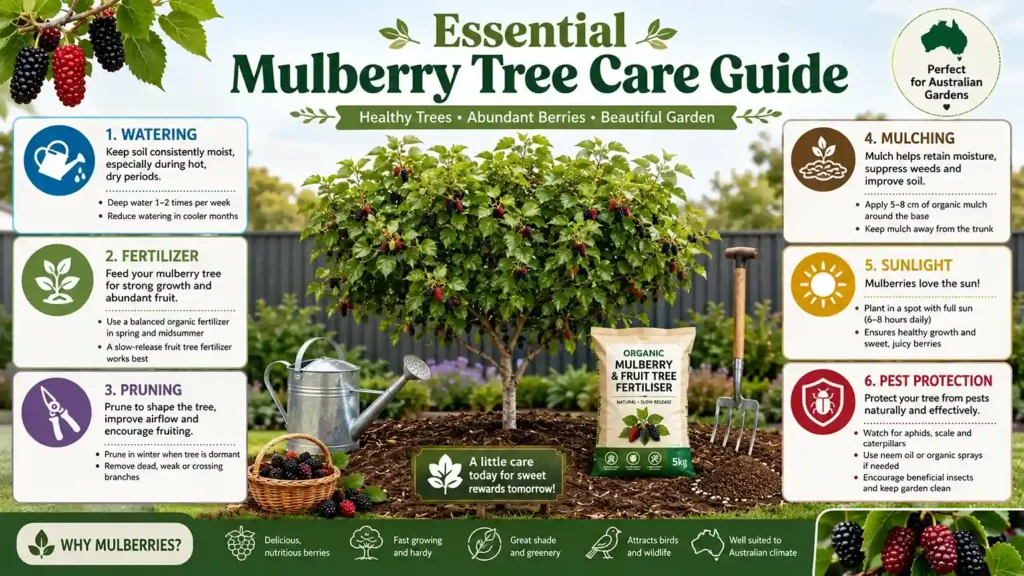
Mulberry Plant Care Basics
Basic mulberry tree care focuses on maintaining healthy growth conditions throughout the year. Most mulberry varieties adapt well to Australian climates, making them suitable for beginner gardeners and home orchards.
Essential mulberry plant care practices include:
- Deep watering during dry periods
- Annual pruning
- Applying balanced fertilizer
- Maintaining healthy soil
- Monitoring pests and diseases
Mulberry bush care for compact or dwarf varieties follows similar principles but may require more frequent shaping to maintain smaller growth habits.
Healthy mulberry trees benefit from:
- Full sun exposure
- Good airflow
- Mulched root zones
- Seasonal feeding
Routine observation also helps identify early signs of stress before larger problems develop.
Mulberry Tree Maintenance Throughout the Year
A simple seasonal care schedule helps maintain strong growth and consistent fruit production.
| Season | Maintenance Tasks |
| Spring | Fertilize, monitor new growth, water regularly |
| Summer | Harvest fruit, deep watering during heat |
| Autumn | Apply mulch, remove fallen debris |
| Winter | Prune dormant branches, inspect tree structure |
During spring and summer, mulberry trees focus on active growth and fruiting. Water demand increases during hot weather, especially for young or container-grown trees.
Autumn maintenance often includes:
- Mulching
- Soil improvement
- Cleaning fallen fruit and leaves
Winter is generally the best time for:
- Structural pruning
- Controlling excessive growth
- Removing damaged branches
A regular maintenance routine helps reduce disease risk and encourages stronger seasonal fruiting.
Mulching and Soil Protection
Mulching plays an important role in maintaining healthy mulberry trees, especially in hot Australian climates.
Benefits of mulching include:
- Improved moisture retention
- Weed suppression
- Reduced soil temperature fluctuations
- Better soil structure over time
Organic mulch materials commonly used around mulberry trees include:
- Sugar cane mulch
- Straw
- Compost
- Wood chips
- Leaf mulch
Mulch should be spread around the root zone while keeping a small gap around the trunk to prevent moisture buildup against the bark.
Proper soil protection also helps:
- Reduce evaporation
- Support beneficial soil organisms
- Improve root stability
Regular mulching is especially valuable during dry summers and drought conditions.
Common Mulberry Tree Problems
Although mulberry trees are generally resilient, several issues can affect growth, foliage, and fruit quality.
Yellow Leaves
Yellow leaves may result from:
- Overwatering
- Poor drainage
- Nutrient deficiencies
- Seasonal leaf drop
- Root stress
Checking soil moisture and improving drainage often helps resolve this issue.
Fungal Diseases
Fungal diseases occasionally affect mulberry trees in humid or poorly ventilated environments. Symptoms may include:
- Leaf spots
- Premature leaf drop
- Fruit damage
- Branch dieback
Good airflow, proper pruning, and avoiding excessive moisture around foliage help reduce fungal problems.
Root Rot
Root rot is commonly linked to waterlogged soil and poor drainage. Affected trees may show:
- Wilting
- Slow growth
- Yellowing leaves
- Branch decline
Preventing standing water around roots is one of the best ways to avoid root rot in mulberry trees.
Pest Issues in Australia
Several pests may affect mulberry trees in Australian gardens, particularly during fruiting season.
Birds
Birds are one of the most common challenges because they feed heavily on ripe mulberries. Netting is often used to protect fruit crops.
Fruit Flies
Fruit flies may damage ripening berries in warmer regions. Good garden hygiene and removing fallen fruit help reduce infestations.
Caterpillars
Caterpillars sometimes feed on mulberry leaves and young growth. Minor infestations are usually manageable, but severe feeding may weaken young trees.
Regular inspection helps detect pest activity early and reduces the need for stronger control measures. Healthy, well-maintained trees are generally more resistant to pest and disease problems.
When and How to Prune Mulberry Trees
Mulberry trees should be pruned during dormancy to control size, improve airflow, and increase fruit production. Proper pruning helps maintain a healthier canopy structure while preventing excessive growth that can make harvesting difficult.
Regular pruning also encourages stronger branch development, improves sunlight penetration, and reduces the risk of disease in dense foliage.
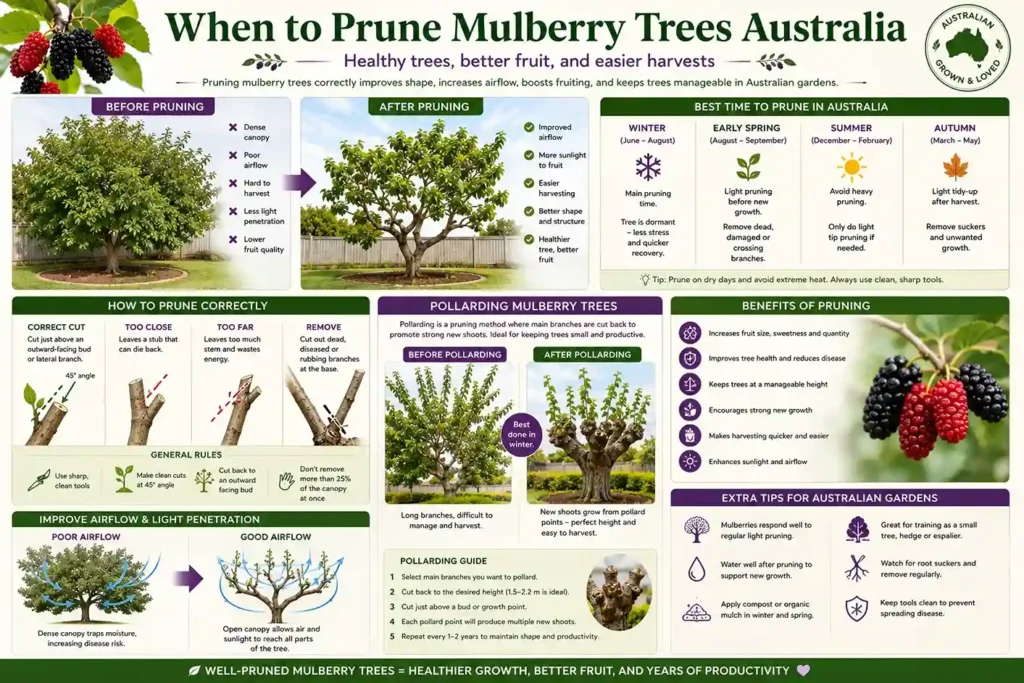
When to Prune Mulberry Tree
The best time for when to prune mulberry trees is during winter dormancy after leaves have dropped and active growth has slowed.
For gardeners asking “when to prune mulberry” or “when to prune mulberry trees,” late winter is generally the safest and most effective period in most Australian climates.
Pruning mulberry trees Australia gardeners grow is easier during dormancy because:
- Tree structure is more visible
- Sap flow is reduced
- Growth stress is lower
- Disease risk is minimized
Typical pruning periods include:
| Australian Region | Recommended Pruning Time |
| Queensland | Late winter |
| New South Wales | Winter to early spring |
| Victoria | Mid to late winter |
| Western Australia | Late winter |
Avoid heavy pruning during:
- Active fruiting periods
- Extreme summer heat
- Wet humid conditions
- Early spring sap flow
Light maintenance trimming can still be performed outside dormancy if necessary to remove damaged or overcrowded branches.
Pruning a Mulberry Tree Australia Guide
A proper pruning mulberry tree Australia approach focuses on maintaining manageable growth while supporting healthy fruit production.
When pruning a mulberry tree Australia gardeners should first remove:
- Dead branches
- Diseased wood
- Crossing limbs
- Weak shoots
- Damaged growth
Basic pruning goals include:
- Improving airflow
- Increasing sunlight penetration
- Controlling overall height
- Encouraging productive branching
A step-by-step pruning approach includes:
- Remove dead or damaged wood
- Thin crowded internal branches
- Reduce excessive height if needed
- Shape the canopy evenly
- Remove low or weak growth
Using clean, sharp tools helps reduce stress and lowers the risk of infection.
Large cuts should be made carefully to avoid bark tearing or unnecessary trunk damage.
Mulberry Tree Trimming Techniques
Mulberry tree trimming techniques vary depending on tree size, desired shape, and available garden space.
Common pruning styles include:
- Open canopy pruning
- Height reduction
- Bush shaping
- Pollarding methods
Pollarding is a more aggressive pruning technique where upper branches are regularly cut back to maintain a compact structure. A pollarded mulberry tree develops dense new shoots each growing season and remains easier to manage in smaller gardens.
Benefits of pollarding include:
- Controlled canopy size
- Easier harvesting
- Increased shade management
- Reduced branch spread
However, pollarding should be performed consistently and correctly to avoid weakening the tree.
Light annual trimming is often enough for smaller mulberries, while larger mature trees may require more substantial structural pruning every few years.
Benefits of Proper Pruning
Correct pruning provides several long-term benefits for mulberry trees.
Healthier Fruiting
Proper pruning improves:
- Sunlight exposure
- Air circulation
- Fruit quality
- Berry accessibility
Removing overcrowded branches allows the tree to direct energy toward healthier fruit production.
Manageable Growth
Mulberry trees grow rapidly in Australian climates, and regular pruning helps maintain a practical size for:
- Home gardens
- Small yards
- Urban landscapes
- Container-grown trees
Controlled growth also reduces:
- Branch breakage
- Overcrowding
- Excessive shade
- Difficult harvesting
Well-pruned mulberry trees are typically healthier, more productive, and easier to maintain over time.
Propagating Mulberry Trees
Mulberry trees can be propagated from cuttings, seeds, or seedlings depending on the desired growth speed and variety preservation. Each propagation method offers different advantages based on gardening experience, available space, and the type of mulberry being grown.
Many Australian gardeners prefer vegetative propagation methods because they produce faster results and help preserve the characteristics of established parent trees.
Growing Mulberry From Cuttings
Growing mulberry from cuttings is one of the easiest and most reliable propagation methods for home gardeners. Mulberry cuttings typically root well under warm, moist conditions and often produce faster fruiting compared to seed-grown trees.
Hardwood cuttings are usually taken during dormancy in late winter, while softwood cuttings may also be used during active growth periods.
Basic steps for propagating mulberry cuttings include:
- Select healthy disease-free branches
- Cut sections approximately 15–25 cm long
- Remove excess leaves if present
- Dip the base in rooting hormone if desired
- Plant in moist well-drained growing mix
- Keep warm and lightly humid until roots develop
Successful growing mulberry from cuttings depends on:
- Consistent moisture
- Warm temperatures
- Good airflow
- Healthy parent material
Cutting-grown trees usually maintain the same fruit quality and growth habits as the original tree.
How to Propagate Mulberry Trees
Gardeners often ask how to propagate mulberry successfully in Australian conditions. Several methods work well depending on the variety and desired results.
The most common approaches for how to propagate mulberry trees include:
- Hardwood cuttings
- Softwood cuttings
- Seed propagation
- Seedling transplantation
- Grafting in some cultivars
When propagating mulberry trees, choosing healthy parent material is important for strong growth and disease resistance.
General propagation tips include:
- Use sterile cutting tools
- Avoid waterlogged soil
- Provide indirect sunlight during rooting
- Protect young plants from frost
Propagating mulberry successfully often requires patience during early root establishment, especially for slower-growing varieties.
Mulberry From Seed
Growing a mulberry tree from seed is possible, although it generally takes longer than propagation from cuttings or seedlings.
Mulberry seeds are typically collected from fully ripe berries. After cleaning and drying, seeds may require a short cold treatment period before planting to improve germination.
Basic steps for growing mulberry from seed include:
- Collect ripe mulberries
- Separate and clean the seeds
- Dry seeds briefly before sowing
- Plant in moist seed-starting mix
- Maintain warmth and consistent moisture
A mulberry tree from seed may take several years to produce fruit, and the resulting plant may not always match the parent tree exactly.
Seed propagation is often used for:
- Experimental growing
- Breeding purposes
- Large-scale planting
- Native or wild-type mulberries
Although slower, seed-grown mulberries can still develop into healthy long-lived trees under suitable conditions.
Using Mulberry Seedlings
Mulberry seedlings provide a convenient option for gardeners who want quicker establishment than seed propagation while avoiding the rooting stage required for cuttings.
Young mulberry tree seedlings are commonly available from:
- Nurseries
- Garden centers
- Online fruit tree suppliers
Healthy mulberry seedlings should have:
- Strong stems
- Healthy leaves
- Well-developed roots
- No visible disease signs
Seedlings establish best when planted during cooler seasons with moderate moisture and good sunlight exposure.
Advantages of using seedlings include:
- Faster establishment
- Easier planting process
- Reduced propagation time
- Better survival rates for beginners
Proper watering and early protection from extreme heat or frost help young seedlings adapt successfully.
Comparison Block
| Propagation Method | Difficulty | Speed |
| Cuttings | Easy | Fast |
| Seeds | Moderate | Slow |
| Seedlings | Easy | Medium |
When Do Mulberry Trees Fruit in Australia?
Mulberry trees usually fruit from late spring to summer in most Australian climates. Fruiting times vary slightly depending on the variety, regional climate, and local growing conditions.
In warmer areas, fruit production may begin earlier, while cooler southern regions often experience slightly later harvest periods. Established mulberry trees can produce heavy crops annually when properly maintained.
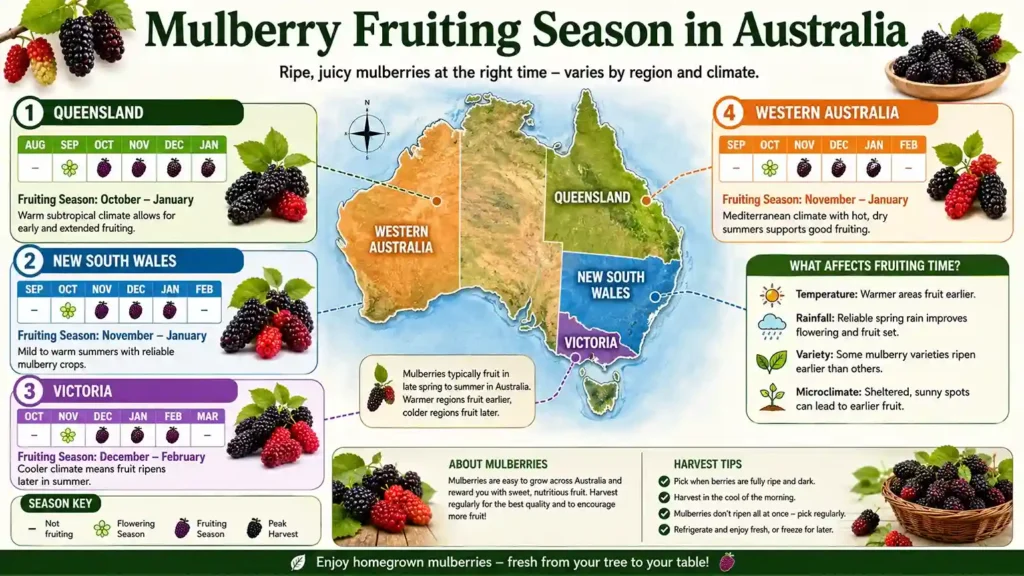
Mulberry Tree Season by Region
The mulberry season varies across Australia because of differences in temperature, rainfall, and seasonal patterns.
Typical mulberry tree season periods include:
| Region | Typical Fruiting Period |
| Queensland | October to December |
| New South Wales | November to January |
| Victoria | November to January |
| Western Australia | October to December |
The mulberry season QLD gardeners experience often starts earlier because subtropical temperatures encourage faster spring growth and flowering.
In warmer climates, some mulberry varieties may continue fruiting for extended periods if conditions remain favorable.
Mulberry harvest timing also depends on:
- Tree variety
- Winter chill exposure
- Spring temperatures
- Water availability
Most trees produce fruit gradually over several weeks rather than all at once.
When Do Mulberries Fruit?
Gardeners commonly ask, “when do mulberries fruit” or “when do mulberry trees fruit” after planting.
Most mulberry trees begin fruiting:
- Within 2–4 years for grafted or cutting-grown trees
- Around 5–7 years for seed-grown trees
Fruit develops after spring flowering and ripens progressively during warmer months.
Signs that mulberries are ready for harvest include:
- Deep color development
- Soft texture
- Easy detachment from branches
- Sweet flavor
Mulberries are delicate and ripen quickly, so regular harvesting is important during peak season.
Many mature trees produce large annual harvests, especially when grown in:
- Full sun
- Fertile soil
- Warm climates
- Well-maintained garden conditions
Factors Affecting Fruiting
Several important factors influence mulberry fruit production and overall harvest quality.
Sunlight
Mulberry trees require strong sunlight for healthy flowering and fruit development. Trees growing in shaded areas often produce:
- Fewer berries
- Smaller fruit
- Reduced sweetness
At least 6–8 hours of direct sun daily is ideal.
Pruning
Proper pruning improves airflow and sunlight penetration throughout the canopy. Well-pruned trees generally produce:
- Better-quality fruit
- More accessible harvests
- Healthier branch growth
Excessive or poorly timed pruning may temporarily reduce fruit production.
Fertilizer
Balanced fertilizer supports healthy growth and fruiting. However, excessive nitrogen may encourage heavy leaf growth instead of berry production.
Mulberries benefit most from:
- Moderate feeding
- Organic matter
- Balanced nutrients
- Seasonal fertilization
Tree Maturity
Young trees usually produce lighter harvests during their early years. As trees mature, fruit production increases significantly.
Established mulberry trees often:
- Produce larger harvests annually
- Develop stronger branching
- Maintain more consistent fruiting cycles
Healthy mature trees in Australian conditions can remain productive for many decades with proper care.
Mulberry Fruit Uses and Benefits
Mulberry fruit is rich in antioxidants, vitamins, and fiber and can be eaten fresh, frozen, or preserved. These sweet berries are valued not only for their flavor but also for their nutritional content and versatility in home cooking.
Mulberries are commonly enjoyed straight from the tree, but they are also widely used in jams, desserts, smoothies, and dried fruit products. Their soft texture and naturally sweet taste make them popular in many Australian home gardens.
Nutritional Benefits of Mulberries
Mulberries contain a range of beneficial nutrients that support overall health and wellness. Fresh mulberries are low in calories while providing important vitamins, minerals, and plant compounds.
Key nutritional benefits include:
Antioxidants
Mulberries are rich in antioxidants such as anthocyanins and resveratrol. These compounds help protect cells from oxidative stress and support overall health.
Dark-colored mulberries, especially black varieties, generally contain higher antioxidant levels.
Vitamin C
Mulberries provide vitamin C, which supports:
- Immune function
- Skin health
- Collagen production
- Cellular repair
Fresh berries are often most nutritious when eaten soon after harvest.
Iron
Mulberries also contain iron, an important mineral involved in oxygen transport and energy production within the body.
Additional nutrients found in mulberries include:
- Fiber
- Potassium
- Calcium
- Vitamin K
Because of their fiber content, mulberries may also support healthy digestion when included as part of a balanced diet.
Can You Freeze Mulberries?
Yes, you can freeze mulberries successfully for long-term storage. Freezing helps preserve excess harvests during peak fruiting season and allows berries to be used later in recipes.
For gardeners asking “can you freeze mulberries,” the process is simple and effective when berries are handled carefully.
Basic storage tips include:
- Wash berries gently
- Remove damaged fruit
- Pat dry thoroughly
- Spread berries on a tray for pre-freezing
- Transfer to sealed freezer containers or bags
Pre-freezing helps prevent berries from clumping together during storage.
Frozen mulberries are commonly used later for:
- Smoothies
- Baking
- Sauces
- Desserts
- Preserves
For best quality, frozen mulberries are usually consumed within several months.
Culinary Uses
Mulberries are highly versatile and can be used in both fresh and preserved recipes.
Popular culinary uses include:
Jams
Mulberries are commonly cooked into jams and preserves because of their naturally sweet flavor and rich color.
Smoothies
Fresh or frozen mulberries blend well into smoothies with:
- Yogurt
- Bananas
- Berries
- Plant-based milk
Desserts
Mulberries are frequently added to:
- Cakes
- Muffins
- Pies
- Tarts
- Ice cream
Their sweet-tart flavor works well in many baked dishes.
Dried Mulberries
Dried mulberries are a popular snack and are often used in:
- Granola
- Trail mixes
- Breakfast bowls
- Baking recipes
Drying concentrates the fruit’s sweetness and extends storage life significantly.
Can You Eat Mulberry Tree Leaves?
Yes, mulberry tree leaves are edible in many cases. For those asking “can you eat mulberry tree leaves,” young leaves are commonly used in teas and traditional food preparations in some cultures.
Common mulberry leaves uses include:
- Herbal tea preparation
- Traditional remedies
- Animal feed
- Compost material
Young tender leaves are generally preferred because they are softer and milder in flavor.
Mulberry leaf tea is sometimes consumed for its antioxidant content and nutritional compounds. However, leaves should only be harvested from healthy untreated trees free from chemical sprays or contamination.
As with any edible plant material, moderate consumption and proper identification are important.
Are Mulberry Trees Illegal in Australia?
Some mulberry tree species may face restrictions in certain Australian regions due to pollen or invasive concerns. While mulberry trees are widely grown across Australia, specific councils or local authorities may regulate certain non-fruiting or high-pollen varieties.
Most backyard fruiting mulberry trees remain legal to grow, especially well-managed female fruiting varieties commonly used in home gardens.
Why Are Mulberry Trees Illegal?
Gardeners sometimes ask, “why are mulberry trees illegal” in certain areas of Australia. Restrictions usually relate to pollen production, allergy concerns, or invasive growth potential rather than the fruit itself.
Male mulberry trees are often the primary concern because they produce large amounts of airborne pollen during flowering season. In some urban regions, this pollen has been associated with:
- Seasonal allergies
- Respiratory irritation
- Increased airborne allergens
Certain vigorous mulberry species may also spread aggressively under favorable conditions, leading to concerns about:
- Uncontrolled growth
- Seed dispersal
- Environmental impact
Because of these issues, some councils discourage or restrict the planting of specific non-fruiting male mulberry trees.
However, fruiting mulberry varieties commonly grown in home orchards are generally not prohibited in most Australian regions.
Local Council Regulations
Local council regulations regarding mulberry trees can vary between Australian states and municipalities. Some regions may impose restrictions on:
- Male mulberry trees
- Specific invasive species
- Large shade-producing varieties
Regional planting restrictions are more common in densely populated urban areas where pollen management is a concern.
Before planting, gardeners should:
- Check local council guidelines
- Review regional planting regulations
- Confirm approved species if required
Restrictions may differ between:
- Queensland
- New South Wales
- Victoria
- Western Australia
Most councils primarily focus on reducing nuisance pollen from non-fruiting trees rather than banning edible fruiting mulberries entirely.
Safe Varieties for Home Gardens
Many mulberry varieties remain suitable and widely accepted for Australian home gardens.
Safe choices often include:
- Dwarf mulberry varieties
- Female fruiting trees
- Grafted ornamental forms
- Compact container-grown cultivars
Dwarf mulberries are especially popular because they:
- Produce less excessive growth
- Fit smaller spaces
- Are easier to manage
- Generate edible fruit with lower nuisance concerns
Female fruiting varieties are generally preferred because they focus energy on berry production rather than heavy pollen release.
For most Australian gardeners, selecting a well-maintained fruiting mulberry variety is the safest and most practical option for home orchard planting.
Where to Buy Mulberry Trees in Australia
Mulberry trees can be purchased from nurseries, online fruit tree sellers, and Australian garden centers. Many Australian gardeners buy mulberry trees for home orchards, backyard gardens, patios, and edible landscapes because of their fast growth and reliable fruit production.
Both dwarf and full-sized varieties are commonly available depending on regional climate suitability and seasonal stock availability.
Mulberry Tree Sale Options
There are several reliable mulberry tree sale options available throughout Australia. Gardeners looking for mulberry for sale selections can often find trees through:
- Local nurseries
- Specialty fruit tree growers
- Online plant retailers
- Garden centers
- Seasonal plant markets
When searching for a mulberry tree to buy, common available varieties include:
- Black mulberry
- White mulberry
- Weeping mulberry
- Dwarf mulberry
- English mulberry
Some nurseries sell:
- Bare-root dormant trees
- Potted young plants
- Grafted advanced specimens
Availability often increases during winter and early spring when deciduous fruit trees are commonly sold for planting season.
Buying Mulberry Trees Online
Buying mulberry trees online has become increasingly popular because many specialty nurseries offer wider variety selections than local stores.
Before purchasing online, gardeners should consider:
- Climate suitability
- Tree size at maturity
- Rootstock type
- Shipping conditions
- Nursery reputation
Many online suppliers provide both bare-root and potted trees.
Bare-Root Trees
Bare-root mulberries are usually sold during dormancy and offer several advantages:
- Lower cost
- Easier shipping
- Strong root establishment after planting
However, they require prompt planting after delivery to prevent root drying.
Potted Trees
Potted mulberry trees are:
- Easier for beginners
- Less sensitive during transport
- Suitable for planting over longer periods
They may cost more but generally experience less transplant stress.
When ordering online, selecting reputable Australian nurseries improves the chances of receiving healthy disease-free plants.
Mulberry Tree Bunnings Availability
Many gardeners search for mulberry tree Bunnings availability because large garden retailers often stock seasonal fruit trees.
Mulberry trees Bunnings stores may carry include:
- Dwarf mulberries
- Weeping mulberries
- Standard black mulberries
- Potted young fruit trees
Availability can vary depending on:
- State
- Season
- Local demand
- Supplier stock
Fruit trees are typically most available during:
- Winter
- Early spring
- Seasonal gardening promotions
Gardeners should check local store inventory because not all locations stock the same mulberry varieties year-round.
Choosing Healthy Mulberry Plants
Selecting healthy mulberry plants is important for successful establishment and long-term productivity.
When inspecting trees before purchase, gardeners should check:
- Root health
- Trunk condition
- Leaf quality
- Graft unions
- Branch structure
Root Inspection
Healthy roots should appear:
- Moist but not waterlogged
- Firm and well-developed
- Free from rot or strong odors
Avoid plants with:
- Circling roots
- Mushy root systems
- Severe root binding
Graft Quality
For grafted mulberry trees, the graft union should:
- Be firmly healed
- Show no cracking
- Remain free from disease damage
Strong graft quality improves tree stability and long-term growth performance.
Healthy mulberry plants generally establish faster, resist stress better, and produce fruit more reliably in Australian garden conditions.
Common Questions About Mulberry Trees
Do Mulberry Trees Grow Fast?
Yes, mulberry trees are considered fast-growing fruit trees. Many varieties can grow more than 1 meter per year under suitable Australian conditions with full sun, healthy soil, and regular watering during establishment.
White mulberry varieties are often the fastest growing, while black mulberries may grow slightly slower but usually produce richer-flavored fruit. Proper pruning helps control rapid growth and maintains manageable tree size.
Can Mulberry Trees Grow in Pots?
Yes, mulberry trees can grow successfully in pots, especially compact and dwarf varieties. A dwarf mulberry tree is usually the best choice for container gardening because it remains smaller and easier to maintain.
For successful container growing:
- Use a large pot with drainage holes
- Choose quality potting mix
- Place the tree in full sun
- Water regularly during warm weather
- Prune annually to maintain shape
Growing mulberries in pots is popular for patios, balconies, and small urban gardens across Australia.
Are Mulberries Easy to Grow in Australia?
Yes, mulberries are generally easy to grow in Australia because they adapt well to many climates and require relatively low maintenance once established.
Mulberry trees grow successfully in:
- Queensland
- New South Wales
- Victoria
- Western Australia
- Other temperate and subtropical regions
Their popularity continues to increase because they:
- Grow quickly
- Produce large fruit harvests
- Tolerate heat well
- Require moderate care
- Suit home orchards
With proper sunlight, drainage, and seasonal pruning, most mulberry trees thrive in Australian backyard gardens.
How Long Do Mulberry Trees Live?
Mulberry trees are long-lived fruit trees that can survive for several decades when properly maintained. Some mature trees may continue producing fruit for 50 years or more under favorable conditions.
Factors influencing lifespan include:
- Variety selection
- Climate
- Soil quality
- Water availability
- Pruning practices
- Disease management
Regular maintenance helps extend productivity and maintain healthy canopy growth over time.
What Is the Best Mulberry Variety for Australian Backyards?
The best mulberry variety for Australian backyards depends on available space, climate, and gardening goals.
Popular choices include:
| Variety | Best For |
| Black Mulberry | Rich fruit flavor and home orchards |
| Dwarf Mulberry | Pots and small gardens |
| Weeping Mulberry | Ornamental landscaping |
| White Mulberry | Fast growth and shade |
For smaller urban gardens, dwarf mulberry trees are often the most practical option. Larger properties commonly benefit from black mulberry varieties because of their heavy fruit production and excellent berry flavor.
Conclusion
Mulberry varieties Australia gardeners grow successfully include black, dwarf, weeping, and white mulberry trees suited to different climates and garden sizes. These adaptable fruit trees perform well across many Australian regions, including Queensland, New South Wales, Victoria, and Western Australia.
Black mulberries are widely valued for their rich fruit flavor and large harvests, while dwarf varieties are ideal for pots and compact backyards. Weeping mulberries provide ornamental landscaping appeal, and white mulberries are known for their vigorous growth and adaptability.
Proper planting, watering, fertilizing, and seasonal pruning help mulberry trees remain healthy and productive for many years. With suitable care, mature trees can continue producing fruit season after season while also providing shade and visual appeal in home gardens.
Mulberries are also considered beginner-friendly fruit trees because they establish quickly, tolerate many Australian conditions, and require relatively simple maintenance compared to some other fruit crops.
Whether growing a compact patio tree or a full backyard orchard specimen, choosing the right variety for your climate and available space is important for long-term success.
Start growing mulberries at home by selecting a suitable variety for your region, garden size, and fruit preferences. With proper care and pruning, mulberry trees can become one of the most rewarding fruit trees in Australian gardens.
FAQs
Which mulberry variety grows best in Australia?
Black mulberry varieties are often considered the best for Australian home gardens because of their rich fruit flavor, strong productivity, and adaptability to many climates. Dwarf mulberries are ideal for smaller gardens and pots, while white mulberries are valued for fast growth and heat tolerance.
How long does a mulberry tree take to fruit?
Most grafted or cutting-grown mulberry trees begin fruiting within 2–4 years after planting. Trees grown from seed may take 5–7 years to produce fruit depending on growing conditions and variety.
Can mulberry trees grow in pots?
Yes, mulberry trees can grow successfully in pots, especially dwarf varieties. A large container with proper drainage, quality potting mix, and regular watering helps maintain healthy growth and fruit production.
When should mulberry trees be pruned in Australia?
Mulberry trees should usually be pruned during winter dormancy after leaves have fallen. Winter pruning helps control size, improve airflow, and support healthy fruiting in the following growing season.
Are mulberry trees deciduous in Australia?
Yes, mulberry trees are deciduous in Australia. They naturally lose their leaves during autumn and winter before producing new growth in spring.
Can you grow mulberry trees from cuttings?
Yes, mulberry trees are commonly propagated from cuttings. Hardwood cuttings taken during dormancy often root successfully and produce faster fruiting than seed-grown trees.
Why are some mulberry trees restricted in Australia?
Some mulberry tree varieties may face restrictions because of heavy pollen production or invasive growth concerns. Male non-fruiting mulberries are more commonly regulated in certain urban regions due to allergy-related pollen issues.
What fertilizer is best for mulberry trees?
A balanced fertilizer containing nitrogen, phosphorus, potassium, and trace minerals is generally best for mulberry trees. Organic compost and slow-release fruit tree fertilizers also support healthy growth and fruit production.
Do mulberry trees need full sun?
Yes, mulberry trees grow best in full sun. At least 6–8 hours of direct sunlight daily helps improve fruit production, tree vigor, and overall growth performance.
How tall do mulberry trees grow?
Mulberry tree size varies by variety. Dwarf mulberries may stay under 3 meters, while full-sized black or white mulberry trees can exceed 10 meters if left unpruned.
Are mulberries safe for home gardens?
Yes, fruiting mulberry trees are generally safe and popular for home gardens across Australia. Many gardeners grow them for fresh fruit, shade, and edible landscaping benefits.
How often should mulberry trees be watered?
Young mulberry trees require regular deep watering during establishment. Mature trees become more drought tolerant but still benefit from occasional deep watering during extended dry periods.
Can mulberries survive Australian heat?
Yes, established mulberry trees tolerate Australian heat well, especially when grown in full sun with occasional deep watering and mulched soil for moisture retention.
What is the easiest mulberry variety for beginners?
Dwarf mulberry and black mulberry varieties are often considered beginner-friendly because they are easy to maintain, productive, and adaptable to many Australian garden conditions.

Written by the LeafyHeaven Editorial Team
LeafyHeaven shares practical gardening tips and simple plant care guides to help you grow, nurture, and enjoy your plants with ease. Our goal is to make gardening feel natural, approachable, and rewarding for everyone.