
Introduction
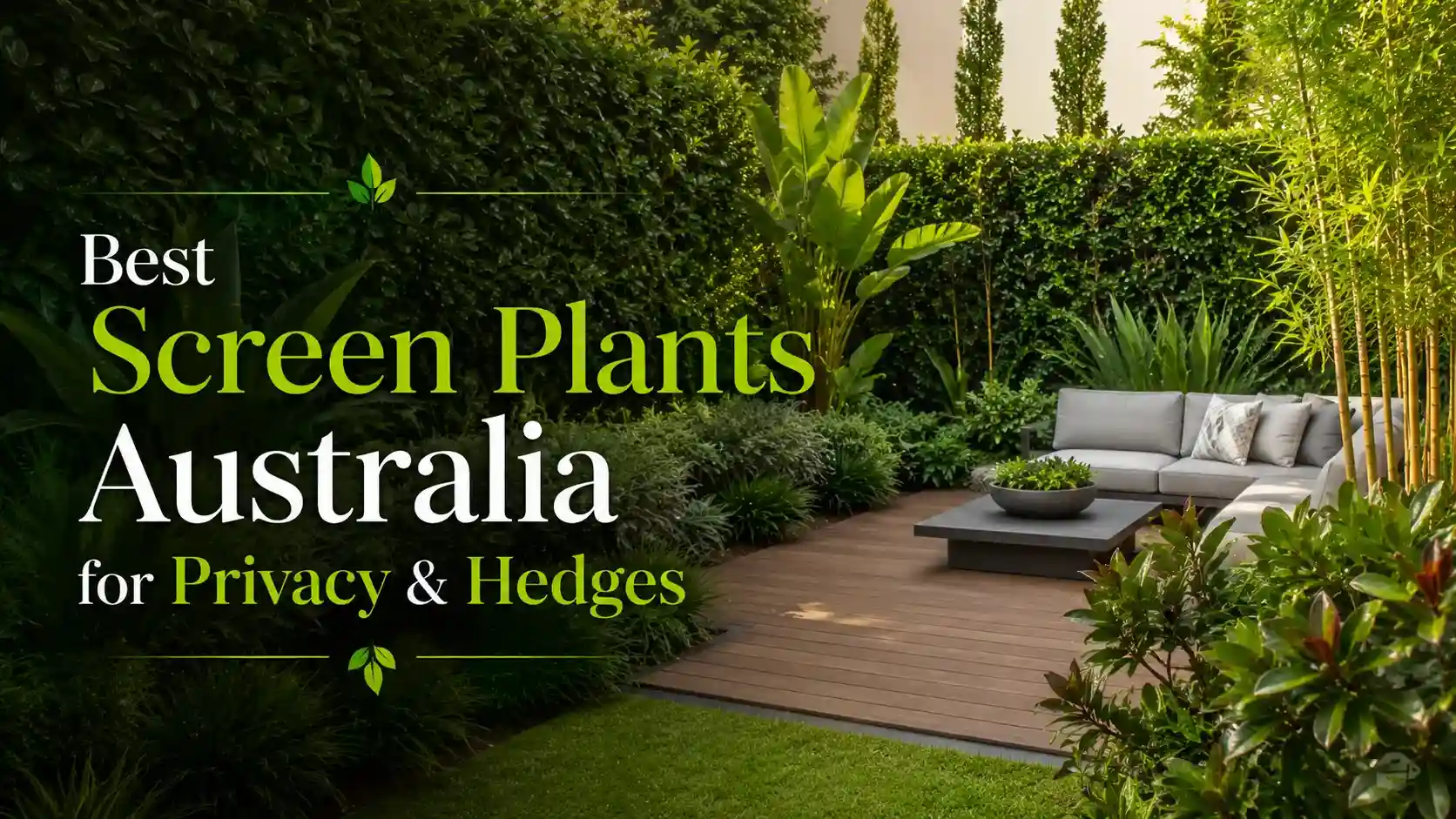
The best screen plants in Australia include fast-growing hedges, native screening plants, narrow screening trees, and low-maintenance privacy plants suitable for different climates and garden sizes. Australians commonly use plants for screening Australia properties to improve privacy, soften outdoor spaces, reduce noise, and create a greener landscape around homes and gardens.
Screening plants are trees, shrubs, hedges, or dense foliage plants grown to block unwanted views, cover fences, and separate outdoor areas naturally. Unlike artificial fencing, australian screening plants provide shade, support local wildlife, improve airflow, and help cool outdoor environments during hot Australian summers.
Many homeowners choose fast growing screen plants Australia gardens can support because they establish quickly and create dense privacy barriers in a shorter time. Popular choices include evergreen hedges, screening trees, tropical privacy plants, and native Australian species that thrive in local conditions.
Whether you need screening plants for privacy along fence lines, narrow screening plants for compact spaces, tropical screening plants for Queensland gardens, or hardy native plants for dry climates, there are suitable options for every Australian landscape style and maintenance level.
What Are Screen Plants and Why Are They Popular in Australia?
What Is a Screening Plant?
Screening plants are trees, shrubs, or hedges used to create privacy, block noise, hide fences, and improve outdoor spaces. These plants form natural green barriers that separate properties, soften landscapes, and enhance garden aesthetics while providing practical environmental benefits.
In Australia, screening plants are widely used in residential gardens, patios, pool areas, and fence lines because they offer a more attractive and environmentally friendly alternative to solid fencing.
Definition Block
| Term | Definition |
| Screening Plants | Plants grown to create privacy barriers and visual separation |
| Hedging Plants | Dense shrubs regularly pruned into formal hedge shapes |
| Screening Shrubs | Bushy plants used for medium-height privacy coverage |
| Privacy Trees | Taller trees used to block overlooking properties and reduce visibility |
| Fence Screen Plants | Plants specifically planted along fences for coverage and softening hard boundaries |
Difference Between Common Screening Plant Types
Hedging Plants
Hedging plants are usually trimmed into neat shapes and dense walls. They are ideal for formal gardens and boundary lines where structured appearance matters.
Screening Shrubs
Screening shrubs provide softer and more natural privacy coverage. They often require less shaping and work well in relaxed landscape designs.
Privacy Trees
Privacy trees grow taller than shrubs and are suitable for blocking neighboring buildings, reducing overlooking, and creating windbreaks.
Fence Screen Plants
Fence screen plants are planted directly beside fences to improve appearance, add greenery, and increase privacy without building higher structures.
Benefits of Using Screen Plants
Screen plants provide both practical and visual benefits for Australian homes and outdoor spaces. They improve comfort, support biodiversity, and help create more usable gardens.
Privacy Improvement
Dense foliage creates natural barriers that reduce visibility from neighboring properties, roads, and public areas.
Wind Protection
Tall hedges and screening trees reduce strong winds and protect outdoor living spaces, gardens, and delicate plants.
Noise Reduction
Thick screening plants absorb and soften traffic sounds, neighborhood noise, and urban disturbances.
Shade Creation
Large screening plants help cool outdoor areas by blocking direct sunlight and reducing heat exposure around patios and windows.
Wildlife Attraction
Many australian screening plants support local biodiversity by attracting:
- Birds
- Bees
- Butterflies
- Pollinators
- Beneficial insects
Native screening plants are especially valuable for supporting Australian wildlife habitats.
Cooling Outdoor Areas
Natural screening helps reduce surrounding temperatures through shade and moisture release from foliage. This creates more comfortable outdoor environments during hot Australian summers.
Natural Screening vs Artificial Fencing
Natural screening and artificial fencing both provide privacy, but they differ significantly in environmental impact, appearance, and long-term garden value.
| Feature | Screen Plants | Artificial Fence |
| Appearance | Natural | Hard structure |
| Cooling Effect | Yes | No |
| Biodiversity | Supports birds/pollinators | None |
| Maintenance | Moderate | Low |
Natural screening also improves landscape aesthetics while helping gardens feel softer, greener, and more connected to the surrounding environment. Artificial fencing provides immediate privacy, but it lacks the environmental and visual benefits that plants for screening Australia gardens can deliver.
Best Fast Growing Screen Plants Australia
Fast-growing screening plants like Lilly Pilly, Bamboo, Viburnum, and Photinia provide quick privacy and dense foliage. These plants are popular across Australian gardens because they establish rapidly, create effective natural barriers, and adapt well to different climates and garden sizes.
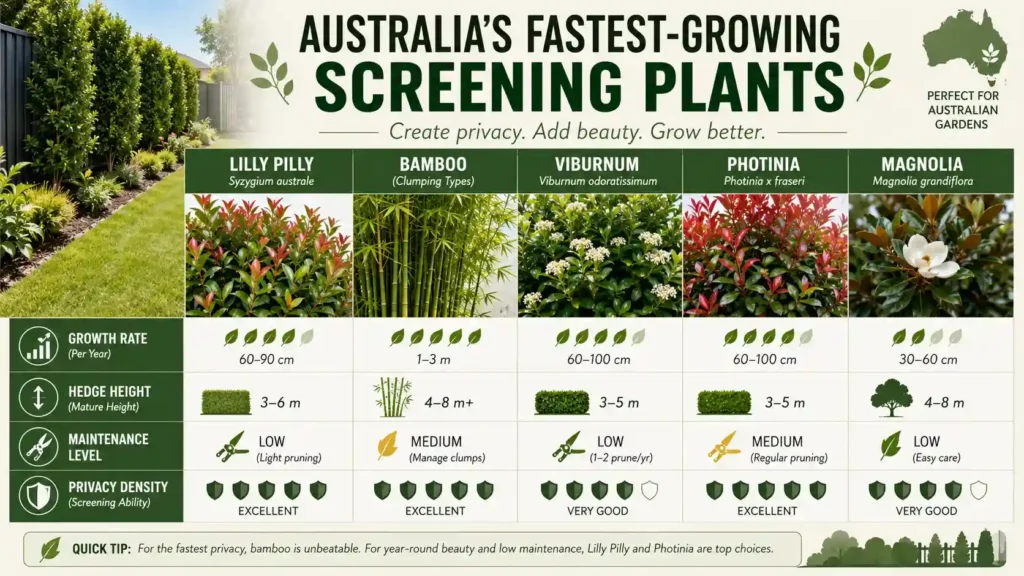
Many homeowners choose fast growing screen plants Australia landscapes can support to quickly block neighboring views, soften fence lines, and create private outdoor living spaces.
Fast Growing Hedge Australia Options
Fast growing hedge Australia gardeners prefer usually combines rapid growth, evergreen foliage, and easy maintenance. These hedges are ideal for creating dense green walls within a few growing seasons.
Popular Fast Growing Hedges Australia
Lilly Pilly
Lilly Pilly is one of the fastest growing hedge Australia options for suburban gardens. It produces dense evergreen foliage and responds well to regular pruning.
Best features:
- Fast establishment
- Thick privacy coverage
- Australian native varieties available
- Attractive glossy leaves
Viburnum
Viburnum is widely used for fast-growing hedges Australia properties because of its quick vertical growth and thick foliage.
Ideal for:
- Tall privacy hedges
- Fence line coverage
- Noise reduction
- Low-maintenance gardens
Bamboo
Clumping bamboo varieties are among the fastest growing hedge Australia solutions for modern gardens.
Benefits include:
- Rapid screening
- Narrow growth habit
- Tropical appearance
- Excellent height coverage
Photinia
Photinia grows quickly and produces vibrant red new foliage that adds visual interest to privacy hedges.
Best suited for:
- Decorative screening
- Medium-height hedges
- Formal landscaping
Fast Growing Hedging Plants Australia
Fast growing hedging plants Australia homeowners choose should provide dense foliage, reliable growth, and year-round coverage.
Growth Speed Comparison
Different screening plants grow at different rates depending on climate, watering, and soil conditions.
Typical growth rates:
- Bamboo: Very fast
- Lilly Pilly: Fast
- Viburnum: Fast
- Photinia: Moderate to fast
- Murraya: Moderate
Fast-growing species establish privacy faster, especially along exposed boundaries and fence lines.
Evergreen Options
Evergreen hedging plants maintain foliage throughout the year, making them highly effective for permanent privacy screening.
Popular evergreen options include:
- Lilly Pilly
- Viburnum
- Clumping Bamboo
- Magnolia
- Murraya
Evergreen screening ensures consistent coverage during all seasons.
Dense Foliage Benefits
Dense foliage improves both visual privacy and environmental protection.
Key benefits include:
- Better noise buffering
- Increased shade
- Reduced wind exposure
- Improved garden aesthetics
- Enhanced security screening
Dense hedges also create cooler outdoor spaces during hot Australian summers.
Fast Growing Screening Trees for Privacy
Fast growing screening tree varieties are ideal for larger properties and homeowners needing taller privacy solutions.
These trees create vertical coverage quickly while improving landscape structure and shade.
Homeowners looking for taller privacy options often prefer fast growing evergreen trees Australia landscapes can support for year-round screening and rapid canopy development.
Popular Fast Growing Screen Trees
Magnolia ‘Little Gem’
A compact evergreen tree with glossy leaves and dense growth habit.
Best for:
- Narrow gardens
- Formal landscapes
- Year-round screening
Leyland Cypress
A popular fast growing screen trees option for tall privacy barriers and wind protection.
Advantages:
- Rapid vertical growth
- Dense evergreen foliage
- Strong windbreak performance
Water Gum
Water Gum is an Australian native privacy screening tree suited to coastal and humid climates.
Features include:
- Attractive canopy
- Moderate maintenance
- Wildlife-friendly growth
Pencil Pine
Pencil Pine works well in narrow spaces because of its upright shape and compact width.
Ideal for:
- Tight fence lines
- Side boundaries
- Tall privacy walls
Evergreen Screening Trees
Evergreen screening trees provide permanent privacy without seasonal leaf drop.
Popular evergreen privacy screening trees include:
- Magnolia
- Lilly Pilly tree forms
- Water Gum
- Bamboo
- Cypress varieties
These trees are especially useful for blocking neighboring windows and multi-story buildings.
Many small evergreen trees are also suitable for privacy screening because they provide year-round foliage while remaining manageable for residential gardens.
Best Fast-Growing Plants for Fence Lines
The best plants for fence line Australia gardens should provide dense coverage, manageable roots, and fast establishment.
Fence line screening plants improve privacy while softening hard boundaries and reducing the visual impact of fences.
Good Fence Line Plants
Popular good fence line plants include:
- Lilly Pilly
- Viburnum
- Clumping Bamboo
- Murraya
- Photinia
- Mock Orange
These plants grow densely and adapt well to Australian suburban conditions.
Fence Plants for Privacy
Fence plants for privacy should create thick foliage from ground level upward to eliminate gaps and exposed sections.
Important qualities include:
- Dense branching
- Evergreen foliage
- Moderate root systems
- Easy pruning response
Plants for Fence Screening
Plants for fence screening are commonly used to:
- Cover unattractive fencing
- Reduce overlooking
- Create green garden borders
- Improve outdoor comfort
- Increase property appeal
Fast-growing species are especially valuable for newly built homes and exposed outdoor areas.
Comparison Table of Fast Growing Screening Plants
| Plant | Growth Rate | Height | Best For | Maintenance |
| Lilly Pilly | Fast | 3–8 m | Privacy hedges | Moderate |
| Clumping Bamboo | Very Fast | 4–10 m | Narrow screening | Moderate |
| Viburnum | Fast | 3–5 m | Dense fence screening | Low |
| Photinia | Moderate-Fast | 3–5 m | Decorative hedges | Moderate |
| Magnolia ‘Little Gem’ | Moderate | 4–6 m | Evergreen privacy | Low |
| Murraya | Moderate | 2–4 m | Small garden hedges | Low |
| Leyland Cypress | Very Fast | 8–15 m | Tall privacy screens | Moderate |
| Pencil Pine | Moderate | 4–8 m | Narrow spaces | Low |
Best Australian Native Screening Plants
Australian native screening plants are ideal for low-maintenance, drought-tolerant, and wildlife-friendly gardens. These plants naturally adapt to Australian conditions, making them highly reliable for privacy screening across different climates and soil types.
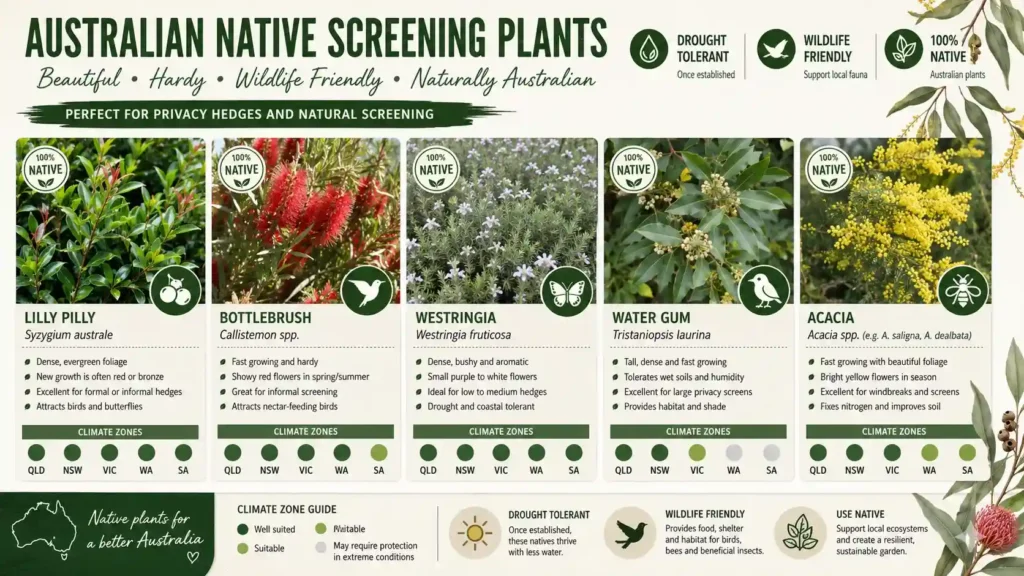
Many homeowners choose australian native screening plants because they require less water, handle harsh weather more effectively, and support local ecosystems better than many imported species.
Why Choose Native Screening Plants?
Native screening plants offer long-term environmental and practical benefits for Australian gardens. They are often easier to maintain and more resilient in local growing conditions.
Climate Adaptability
Australian native plants have evolved to survive in local climates, including:
- Heat
- Drought
- Coastal winds
- Poor soils
- Heavy rainfall regions
This natural adaptability makes them highly dependable for screening and hedging applications.
Water Efficiency
Many native screening plants are drought-tolerant once established, helping reduce water usage in Australian gardens.
Benefits include:
- Lower irrigation needs
- Better dry-season survival
- Reduced garden maintenance
- Improved sustainability
Water-efficient gardens are especially important in regions affected by water restrictions and hot summers.
Local Biodiversity Support
Native Australian screening plants support local wildlife by providing:
- Bird habitat
- Nectar for pollinators
- Shelter for beneficial insects
- Food sources for native species
Flowering native hedges and screening trees help improve biodiversity in suburban landscapes.
Best Australian Native Plants for Screening
Australian native plants for screening are available in many forms, including hedges, shrubs, tall trees, and narrow-growing species.
These native screening plants provide natural privacy while blending beautifully into Australian landscapes.
Lilly Pilly
Lilly Pilly is one of the most popular native australian screening plants because of its fast growth and dense evergreen foliage.
Best qualities:
- Excellent hedging plant
- Responds well to pruning
- Suitable for formal and informal gardens
- Wildlife-friendly berries
Bottlebrush (Callistemon)
Bottlebrush varieties create colorful native privacy screens with attractive flowers that attract birds and pollinators.
Ideal for:
- Coastal gardens
- Wildlife gardens
- Informal hedging
- Drought-prone areas
Sweet Viburnum Native Alternatives
While Viburnum itself is not native, many gardeners combine native shrubs with similar dense-growth habits for screening purposes.
Popular alternatives include:
- Acmena species
- Syzygium varieties
- Water Gum
Coastal Rosemary (Westringia)
Westringia is widely used in modern Australian landscaping because of its compact growth and excellent drought tolerance.
Benefits include:
- Low maintenance
- Coastal tolerance
- Neat appearance
- Dense foliage
Hop Bush (Dodonaea)
Hop Bush is a hardy native shrub used for fast-growing privacy screens in dry and inland regions.
Features include:
- Fast establishment
- Wind tolerance
- Attractive colored foliage
- Minimal watering needs
Fast Growing Australian Native Screening Plants
Fast growing australian native screening plants are ideal for homeowners wanting quick privacy while maintaining a natural Australian garden style.
These plants establish rapidly and adapt well to local environmental conditions.
Lilly Pilly Varieties
Fast-growing Lilly Pilly cultivars are among the most widely planted native screening plants fast growing enough for suburban privacy needs.
Popular varieties include:
- Resilience
- Straight and Narrow
- Backyard Bliss
- Neighbours-Be-Gone
These cultivars offer strong disease resistance and dense foliage.
Water Gum
Water Gum is a fast-growing evergreen native tree suitable for screening larger properties.
Advantages include:
- Dense canopy
- Attractive trunk structure
- Good shade production
- Wildlife attraction
Native Frangipani
Native Frangipani grows quickly in warm climates and produces lush foliage suitable for tropical-style screening.
Best suited for:
- Queensland gardens
- Coastal regions
- Warm humid climates
Acacia Species
Some Acacia species provide rapid screening growth and tolerate difficult growing conditions.
Benefits include:
- Quick establishment
- Drought resistance
- Nitrogen-fixing soil improvement
- Pollinator support
Best Native Screening Trees
Australian native screening trees provide taller privacy coverage while supporting biodiversity and improving landscape structure.
These trees are commonly used for:
- Boundary planting
- Windbreaks
- Large property screening
- Shade creation
Popular Native Screening Trees
Water Gum (Tristaniopsis laurina)
A reliable evergreen native screening tree with dense foliage and attractive growth habit.
Best for:
- Urban gardens
- Driveways
- Medium-sized properties
Lemon-Scented Gum
A tall australian native tree for screening with smooth bark and aromatic foliage.
Ideal for:
- Large gardens
- Rural properties
- Wind protection
Native Magnolia (Port Wine Magnolia)
A compact evergreen native screening tree suitable for smaller Australian gardens.
Features include:
- Fragrant flowers
- Dense growth
- Evergreen foliage
Brush Box
Brush Box is commonly used as a large-scale native screening tree in Australian landscaping.
Advantages:
- Strong canopy coverage
- Long lifespan
- Excellent shade
Best Native Plants by Australian Climate Zone
Choosing native screening plants based on climate zone improves long-term growth, resilience, and maintenance performance.
Queensland
Best native screening plants for Queensland include tropical and humidity-tolerant species such as:
- Lilly Pilly
- Native Frangipani
- Water Gum
- Bottlebrush
These plants handle warmth, rainfall, and coastal conditions effectively.
New South Wales (NSW)
Suitable native screening plants for NSW include:
- Lilly Pilly
- Westringia
- Brush Box
- Acacia species
These varieties perform well in coastal and temperate regions.
Victoria
Victoria’s cooler climate supports native screening plants such as:
- Pittosporum
- Westringia
- Water Gum
- Native Daphne
Cold-tolerant species are preferred in southern regions.
Western Australia (WA)
WA gardens benefit from drought-tolerant native screening plants including:
- Coastal Rosemary
- Acacia varieties
- Geraldton Wax
- Native Hop Bush
These plants tolerate sandy soils and dry summers.
South Australia (SA)
South Australian gardens commonly use hardy native species such as:
- Saltbush
- Westringia
- Acacia
- Bottlebrush
These plants are well suited to dry climates and water-wise landscaping.
Best Narrow Screening Plants for Small Spaces
Narrow screening plants are ideal for tight fence lines, side yards, and compact Australian gardens. These plants provide privacy without taking up excessive horizontal space, making them perfect for urban homes, courtyards, balconies, and small landscape designs.
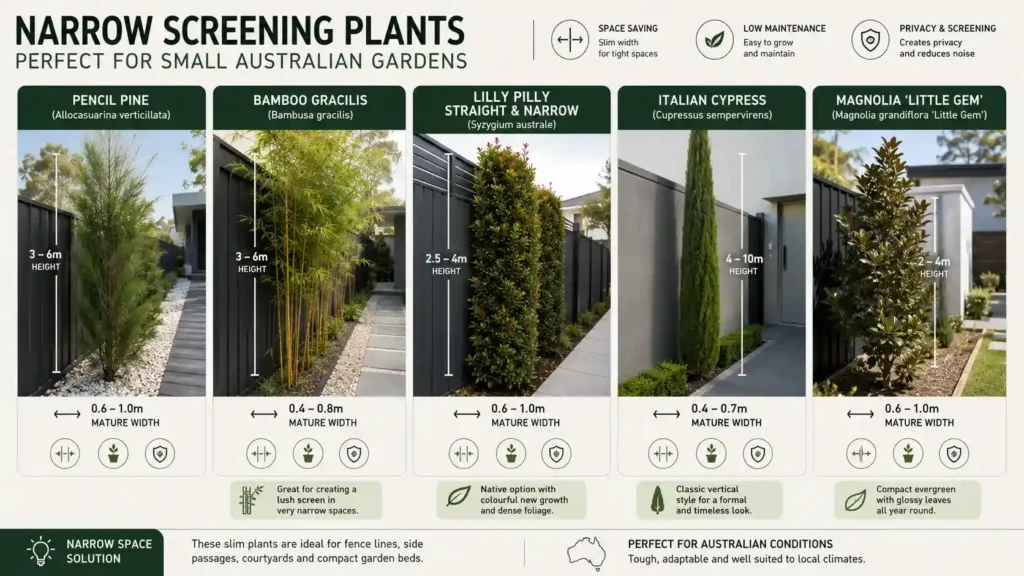
Many homeowners choose narrow screening plants Australia gardens can support because they create vertical privacy while keeping pathways, garden beds, and outdoor living areas open and functional.
Best Narrow Screening Plants Australia
The best narrow screening plants Australia homeowners use combine upright growth habits with dense foliage and manageable root systems.
These plants work especially well in:
- Side access areas
- Small backyards
- Courtyard gardens
- Narrow fence lines
- Pool boundaries
Popular Narrow Hedge Plants Australia
Lilly Pilly ‘Straight and Narrow’
This upright Lilly Pilly variety is one of the most popular narrow hedging plants Australia landscapes feature for compact spaces.
Benefits include:
- Slim growth habit
- Dense evergreen foliage
- Fast growth
- Excellent pruning response
Pencil Pine
Pencil Pine is widely used for formal narrow screening because of its tall column-like shape.
Best suited for:
- Tight spaces
- Modern landscapes
- Vertical privacy walls
- Minimal-width planting zones
Bamboo ‘Gracilis’
Clumping Bamboo ‘Gracilis’ is highly valued for narrow screening applications.
Advantages include:
- Fast vertical growth
- Compact clumping roots
- Tropical appearance
- Excellent fence screening
Magnolia ‘Little Gem’
This compact evergreen tree works well as a narrow screening feature in smaller gardens.
Features include:
- Dense foliage
- Decorative flowers
- Controlled width
- Year-round greenery
Tall Narrow Screening Plants Australia
Tall narrow screening plants Australia gardeners prefer provide vertical privacy without overwhelming limited spaces.
These plants are especially effective for blocking overlooking windows and neighboring properties.
Best Tall Thin Screening Plants
Slender Weavers Bamboo
A fast-growing bamboo variety ideal for tall privacy screening in compact spaces.
Typical features:
- Upright growth
- Dense foliage
- Narrow footprint
- Strong screening performance
Italian Cypress
Italian Cypress creates elegant tall screening walls in formal landscapes.
Best uses include:
- Driveway borders
- Boundary planting
- Mediterranean-style gardens
Syzygium ‘Pinnacle’
A tall narrow shrub Australia homeowners often use for privacy hedging.
Advantages include:
- Compact width
- Thick foliage
- Australian climate adaptability
Benefits of Tall Narrow Shrubs Australia
Tall narrow shrubs offer several practical benefits:
- Save garden space
- Maintain airflow
- Reduce visual bulk
- Create layered landscaping
- Improve vertical privacy
These plants are highly suitable for high-density suburban developments.
Fence Line Screening Plants for Narrow Spaces
Fence line screening plants for narrow spaces should provide dense coverage while maintaining controlled root growth and manageable width.
Choosing suitable plants for narrow fence line areas helps prevent overcrowding and maintenance issues.
Best Plants for Narrow Fence Lines
Popular options include:
- Clumping Bamboo
- Pencil Pine
- Lilly Pilly ‘Straight and Narrow’
- Magnolia ‘Little Gem’
- Water Gum
These plants provide effective privacy without spreading aggressively into pathways or neighboring properties.
Screening Plants Narrow Space Gardens Need
Small-space screening plants should have:
- Upright growth habits
- Compact roots
- Dense foliage
- Easy maintenance
- Controlled width
Narrow-growing species are particularly useful in townhouse gardens and side access pathways.
Screening Plants for Narrow Spaces in Pots
Container-grown screening plants are ideal for renters, balconies, patios, and paved outdoor spaces where in-ground planting is limited.
Container-Friendly Options
Best screening plants for pots include:
- Clumping Bamboo
- Dwarf Lilly Pilly
- Ornamental Grasses
- Magnolia ‘Little Gem’
- Compact Viburnum
These species adapt well to large containers and raised planters.
Root Control Benefits
Growing screening plants in pots helps manage root spread and prevents invasive growth near structures or drainage systems.
Container planting also allows:
- Easier repositioning
- Better soil control
- Reduced maintenance
- Flexible garden layouts
Balcony Privacy Solutions
Tall potted screening plants create natural privacy barriers for balconies and courtyards.
Effective balcony screening combinations include:
- Bamboo in trough planters
- Vertical hedging
- Layered potted shrubs
- Narrow evergreen trees
These solutions improve privacy while softening urban outdoor spaces.
Best Plants for Narrow Garden Beds Australia
Plants for narrow garden beds Australia homeowners select should maximize vertical growth while minimizing horizontal spread.
These plants work well along:
- Boundary walls
- Side fences
- Driveways
- Pathways
- Pool edges
Recommended Plants for Narrow Spaces Australia
| Plant | Width | Height | Best Feature |
| Pencil Pine | Very Narrow | 4–8 m | Formal vertical screening |
| Bamboo ‘Gracilis’ | Narrow | 4–6 m | Fast tropical privacy |
| Lilly Pilly ‘Straight and Narrow’ | Narrow | 5–8 m | Dense evergreen hedge |
| Magnolia ‘Little Gem’ | Compact | 4–6 m | Decorative evergreen screening |
| Italian Cypress | Very Narrow | 6–12 m | Tall architectural screening |
These narrow screening plants help create functional privacy solutions without overcrowding compact Australian gardens.
Best Low Maintenance Screening Plants Australia
Low-maintenance screening plants require less pruning, watering, and fertilizing while still providing excellent privacy. These plants are ideal for Australian homeowners who want attractive natural screening without constant upkeep.
Many low maintenance screening plants Australia gardens use are drought-tolerant, evergreen, and naturally resilient to local weather conditions. They help reduce garden work while maintaining year-round greenery and privacy.
Low Maintenance Screening Plants
The best low maintenance screening plants combine slow-to-moderate growth, strong disease resistance, and reliable evergreen foliage.
These plants are suitable for:
- Busy households
- Investment properties
- Large gardens
- Low-water landscapes
- Modern Australian landscaping
Popular Low Maintenance Screening Plants Australia
Westringia (Coastal Rosemary)
Westringia is one of the most reliable low maintenance screening plants Australia homeowners choose for dry and coastal gardens.
Benefits include:
- Drought tolerance
- Minimal pruning
- Salt tolerance
- Compact growth
Lilly Pilly ‘Resilience’
This improved Lilly Pilly variety offers strong psyllid resistance and dense foliage with relatively low upkeep.
Best features:
- Fast establishment
- Pest resistance
- Evergreen screening
- Adaptability to different climates
Viburnum
Viburnum remains a popular low-maintenance hedge because it grows densely while requiring moderate pruning only a few times each year.
Ideal for:
- Privacy hedges
- Fence screening
- Wind reduction
- Urban gardens
Clumping Bamboo
Non-invasive clumping bamboo varieties create excellent privacy screens with manageable maintenance.
Advantages include:
- Fast vertical growth
- Narrow footprint
- Evergreen foliage
- Strong screening coverage
Evergreen Hedging Plants Australia
Evergreen hedge plants Australia gardeners prefer provide year-round privacy without seasonal leaf loss. These plants maintain dense foliage during all seasons and create consistent outdoor screening.
Benefits of Evergreen Hedging Plants Australia
Evergreen screening plants provide:
- Permanent privacy
- Continuous shade
- Improved garden appearance
- Better wind protection
- Reduced visual gaps
They are especially valuable in suburban areas where year-round screening is important.
Best Evergreen Hedge Plants Australia
Lilly Pilly
A highly popular evergreen hedging plant Australia landscapes commonly feature for privacy and formal hedges.
Magnolia ‘Little Gem’
This compact evergreen tree provides glossy foliage and elegant screening for modern gardens.
Murraya
Murraya creates soft evergreen hedges with fragrant flowers and relatively low maintenance requirements.
Viburnum
Viburnum forms thick evergreen screening walls ideal for larger boundary hedges.
Water Gum
Water Gum is an Australian native evergreen tree suitable for larger privacy screens and shade creation.
Drought-Tolerant Screen Plants
Drought-tolerant screen plants are increasingly important in Australian gardens due to water restrictions and hotter summers.
These plants survive with less irrigation once established while still providing strong privacy coverage.
Water-Wise Options
Popular water-wise screening plants include:
- Westringia
- Bottlebrush
- Acacia varieties
- Hop Bush
- Olive trees
These species are commonly used in sustainable Australian landscaping.
Heat-Resistant Species
Heat-resistant screening plants tolerate prolonged sun exposure and high temperatures.
Best heat-tolerant options include:
- Clumping Bamboo
- Lilly Pilly
- Bottlebrush
- Coastal Rosemary
- Native grasses
These plants maintain foliage quality even during extreme summer conditions.
Wind-Tolerant Hedges
Some screening plants handle strong coastal or exposed winds more effectively than others.
Reliable wind-tolerant hedges include:
- Westringia
- Viburnum
- Lilly Pilly
- Coastal Tea Tree
- Bamboo
Dense wind-tolerant hedges also help protect outdoor living areas and delicate garden plants.
Best Screen Plants for Busy Homeowners
Busy homeowners often prefer screening plants that require minimal trimming, infrequent watering, and strong natural resilience.
Choosing hardy low-maintenance species reduces long-term garden labor and maintenance costs.
Minimal Pruning Plants
Plants requiring less shaping and trimming include:
- Pencil Pine
- Magnolia ‘Little Gem’
- Clumping Bamboo
- Water Gum
- Westringia
These plants naturally maintain tidy growth habits.
Pest-Resistant Plants
Pest-resistant screening plants reduce the need for chemical treatments and ongoing monitoring.
Strong pest-resistant choices include:
- Lilly Pilly ‘Resilience’
- Westringia
- Viburnum
- Acacia species
Healthy pest-resistant plants maintain denser foliage and stronger screening performance.
Hardy Australian Species
Hardy Australian species adapt well to local soils, weather, and environmental stress.
Top hardy screening plants include:
| Plant | Best Feature | Maintenance Level |
| Westringia | Drought tolerance | Very Low |
| Lilly Pilly ‘Resilience’ | Pest resistance | Low |
| Viburnum | Dense evergreen growth | Low |
| Water Gum | Native adaptability | Low |
| Clumping Bamboo | Fast narrow screening | Moderate |
| Bottlebrush | Heat and drought tolerance | Low |
These low-maintenance screening plants help create attractive privacy barriers while keeping Australian gardens easier to manage year-round.
Tropical Screening Plants for Australian Gardens
Tropical screening plants create lush green privacy screens ideal for warm and humid Australian regions. These plants are valued for their dense foliage, rapid growth, and ability to transform outdoor spaces into private tropical-style retreats.
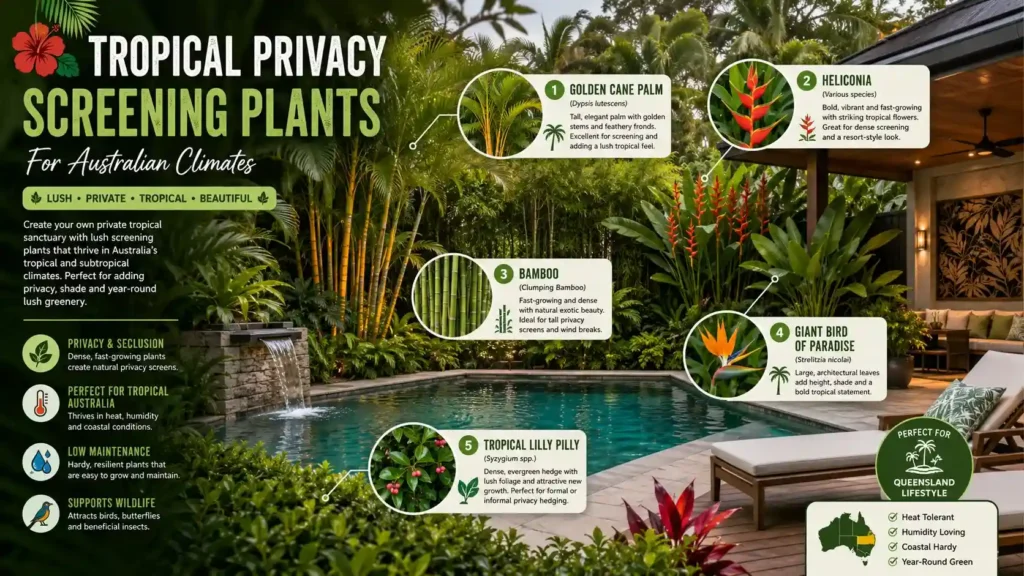
Tropical plants thrive particularly well in Queensland and other warm coastal regions where humidity and mild winters support year-round growth. Many homeowners use tropical screening plants to soften fences, create poolside privacy, and add vibrant greenery to outdoor living areas.
Best Tropical Screening Plants
The best tropical screening plants combine fast growth, dense foliage, and strong adaptability to Australian warm-climate conditions.
These tropical plants for screening are popular for:
- Pool areas
- Tropical landscape designs
- Coastal gardens
- Courtyard privacy
- Fence line coverage
Clumping Bamboo
Clumping Bamboo is one of the most widely used tropical hedging plants in Australia because of its fast growth and upright screening habit.
Benefits include:
- Rapid privacy coverage
- Narrow footprint
- Evergreen foliage
- Strong tropical appearance
Non-invasive clumping varieties are preferred over running bamboo species.
Heliconia
Heliconia creates bold tropical screening with large leaves and vibrant flowers.
Best suited for:
- Humid climates
- Tropical-style gardens
- Poolside landscaping
- Layered privacy planting
Giant Bird of Paradise
This architectural tropical plant provides dense foliage and vertical privacy.
Advantages include:
- Large screening leaves
- Strong visual impact
- Low pruning needs
- Tropical garden aesthetics
Golden Cane Palm
Golden Cane Palm is commonly used for natural tropical privacy screens around patios and pools.
Popular features include:
- Clumping growth
- Soft tropical appearance
- Good shade production
- Moderate maintenance
Lilly Pilly
Many Lilly Pilly varieties also work exceptionally well in tropical Australian gardens due to their dense evergreen growth and adaptability.
Fast Growing Tropical Privacy Plants
Fast growing plants for privacy are ideal for homeowners wanting rapid screening in tropical and subtropical climates.
These plants establish quickly and produce dense foliage that creates natural green walls within a short period.
Best Fast-Growing Plants for Privacy
Clumping Bamboo
One of the fastest-growing tropical privacy hedge plants available in Australia.
Typical benefits:
- Fast vertical growth
- Dense foliage
- Excellent narrow screening
- Strong wind resistance
Golden Cane Palm
This palm develops dense clumps that create soft tropical privacy barriers.
Best uses include:
- Pool screening
- Courtyard privacy
- Resort-style landscaping
Tropical Hibiscus
Tropical Hibiscus provides flowering privacy hedges with colorful visual appeal.
Features include:
- Bright flowers
- Dense branching
- Warm-climate adaptability
Mock Orange (Murraya)
Murraya grows well in warm climates and forms attractive evergreen privacy hedges with fragrant flowers.
Advantages:
- Dense foliage
- Easy shaping
- Compact growth
- Low-to-moderate maintenance
Benefits of Tropical Privacy Hedge Plants
Tropical screening plants improve outdoor living spaces by providing:
- Dense greenery
- Cooling shade
- Natural humidity balance
- Soft landscape appearance
- Resort-style aesthetics
They also help reduce harsh visual lines created by fences and walls.
Best Tropical Plants for Queensland
Fast growing screening plants Queensland homeowners prefer must tolerate humidity, intense sun, and seasonal rainfall.
Queensland’s subtropical and tropical climate supports a wide range of lush screening plants that grow rapidly and remain evergreen year-round.
Best Fast-Growing Screening Plants Queensland Gardens Use
Bamboo ‘Gracilis’
Highly popular for narrow tropical privacy screens and fence line planting.
Golden Cane Palm
Ideal for creating soft layered privacy around pools and outdoor entertaining spaces.
Native Frangipani
A fast-growing tropical Australian tree suitable for larger privacy screens.
Heliconia
Excellent for dense tropical garden borders in humid climates.
Lilly Pilly
Queensland gardens commonly use Lilly Pilly hedges because they tolerate humidity and grow quickly with regular watering.
Important Considerations for Queensland Screening Plants
When selecting fast-growing screening plants Queensland gardens require, consider:
- Humidity tolerance
- Cyclone and wind resistance
- Root management
- Sun exposure
- Water requirements
Choosing climate-appropriate tropical screening plants improves long-term growth, foliage density, and overall garden performance.
Lilly Pilly Hedge Guide for Australian Gardens
Lilly Pilly is one of the most popular hedge plants in Australia due to its fast growth, dense foliage, and versatility. It is widely used for privacy hedges, fence screening, wind protection, and decorative garden borders across many Australian climate zones.
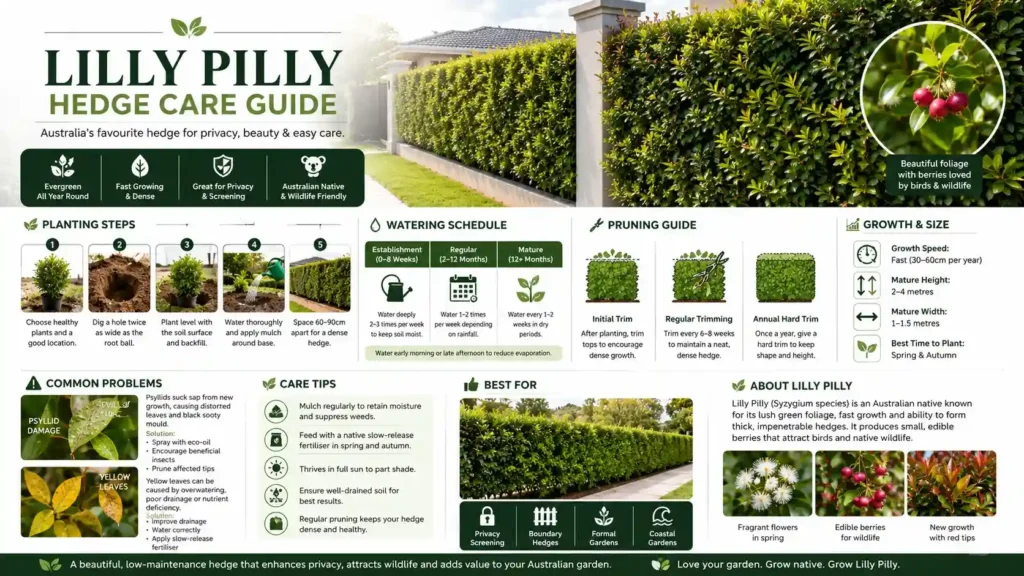
Lilly Pilly hedges are valued for their evergreen appearance, strong pruning response, and ability to create thick natural screens in both large and compact gardens.
Why Lilly Pilly Is Popular
Lilly Pilly hedge plants are among the most widely planted screening species in Australia because they combine beauty, privacy, and practicality.
These plants suit:
- Formal hedges
- Natural privacy screens
- Narrow garden spaces
- Coastal gardens
- Urban landscapes
Dense Evergreen Foliage
Lilly Pilly hedging creates thick green coverage throughout the year, making it highly effective for privacy screening.
The dense foliage helps:
- Block neighboring views
- Reduce noise
- Improve shade
- Create cooler outdoor spaces
Fast Growth Rate
Many Lilly Pilly varieties establish quickly and form mature hedges faster than slower-growing shrubs.
This makes them ideal for homeowners wanting rapid privacy solutions.
Strong Pruning Response
Lilly Pilly hedge plants tolerate regular trimming very well and can be shaped into:
- Formal hedges
- Narrow screens
- Tall privacy walls
- Decorative topiary forms
Wide Variety Selection
Different Lilly Pilly cultivars are available for specific garden needs.
Popular varieties include:
| Variety | Best Feature |
| Resilience | Psyllid resistance |
| Backyard Bliss | Fast dense growth |
| Straight and Narrow | Slim upright shape |
| Neighbours-Be-Gone | Tall privacy screening |
How Fast Do Lilly Pilly Grow?
Fast growing Lilly Pilly varieties can establish dense privacy screens within a few years when planted in suitable conditions.
Growth speed depends on:
- Climate
- Soil quality
- Watering
- Sunlight
- Variety selection
Average Growth Rate
Most Lilly Pilly hedges grow approximately:
- 30 cm to 1 meter per year
Fast-growing cultivars may grow even quicker in warm climates with regular watering and fertilizing.
How Fast Do Lilly Pilly Grow in Different Conditions?
Warm Humid Climates
Growth is generally faster in Queensland and coastal regions where temperatures remain mild year-round.
Cooler Climates
Growth slows slightly in southern Australian regions but remains reliable with proper care.
Container Growth
Potted Lilly Pilly plants grow more slowly due to limited root space.
Lilly Pilly Hedge Height
Lilly Pilly hedge height varies depending on the cultivar and pruning style.
Typical mature heights include:
| Variety Type | Approximate Height |
| Dwarf varieties | 1–2 m |
| Standard hedge varieties | 3–5 m |
| Tall screening cultivars | 6–10 m |
Regular pruning helps maintain desired hedge height and density.
How to Plant and Maintain Lilly Pilly Hedges
Proper planting and maintenance improve hedge density, growth speed, and long-term health.
How to Plant Lilly Pilly Hedge
Step 1: Choose the Right Location
Select an area with:
- Good drainage
- Full sun to partial shade
- Adequate airflow
- Sufficient spacing
Step 2: Prepare the Soil
Improve soil before planting by adding:
- Organic compost
- Aged manure
- Slow-release fertilizer
Healthy soil encourages faster root establishment.
Step 3: Plant at Proper Spacing
Spacing depends on the desired hedge density.
General spacing recommendations:
- 50 cm to 1 meter apart
Closer spacing creates faster dense screening.
Step 4: Water Thoroughly
Newly planted hedges require deep watering during establishment.
Pruning Tips
Regular pruning encourages bushier and denser foliage growth.
Best pruning practices include:
- Light trimming during active growth
- Removing weak branches
- Maintaining even hedge shape
- Avoiding severe pruning during extreme heat
Frequent light pruning usually produces better density than heavy cutting.
Watering Schedule
Proper watering is important during the first growing seasons.
Newly Planted Hedges
Water deeply:
- 2–3 times weekly during hot weather
Established Hedges
Once mature, Lilly Pilly hedges become moderately drought tolerant and require less frequent watering.
Fertilizing Guide
Use balanced slow-release fertilizer during spring and early summer to support healthy foliage and rapid growth.
Important nutrients include:
- Nitrogen for leaf growth
- Potassium for plant strength
- Organic matter for soil improvement
Avoid excessive fertilizing, which may encourage weak growth.
Common Problems and Solutions
Although Lilly Pilly plants are generally hardy, some issues can affect hedge appearance and growth.
Psyllid Damage
Psyllids are small sap-sucking insects that commonly attack susceptible Lilly Pilly varieties.
Symptoms
- Pimpled leaves
- Distorted foliage
- Reduced growth quality
Solutions
- Choose psyllid-resistant varieties like Resilience
- Prune affected growth
- Improve airflow around hedges
Yellow Leaves
Yellowing foliage may indicate:
- Nutrient deficiency
- Poor drainage
- Water stress
- Soil imbalance
Solutions
- Improve soil drainage
- Apply balanced fertilizer
- Adjust watering frequency
- Check soil pH if necessary
Overwatering Issues
Excessive watering can damage roots and weaken hedge growth.
Signs of Overwatering
- Yellow leaves
- Root rot
- Wilting despite wet soil
- Slow growth
Solutions
- Reduce watering frequency
- Improve drainage
- Avoid waterlogged soil conditions
Proper maintenance helps Lilly Pilly hedges remain dense, healthy, and highly effective as long-term privacy screens in Australian gardens.
How to Choose the Best Screening Plants in Australia
The best screening plant depends on climate, garden size, maintenance level, and desired privacy height. Choosing the right species improves long-term growth, reduces maintenance problems, and creates more effective natural screening for Australian outdoor spaces.
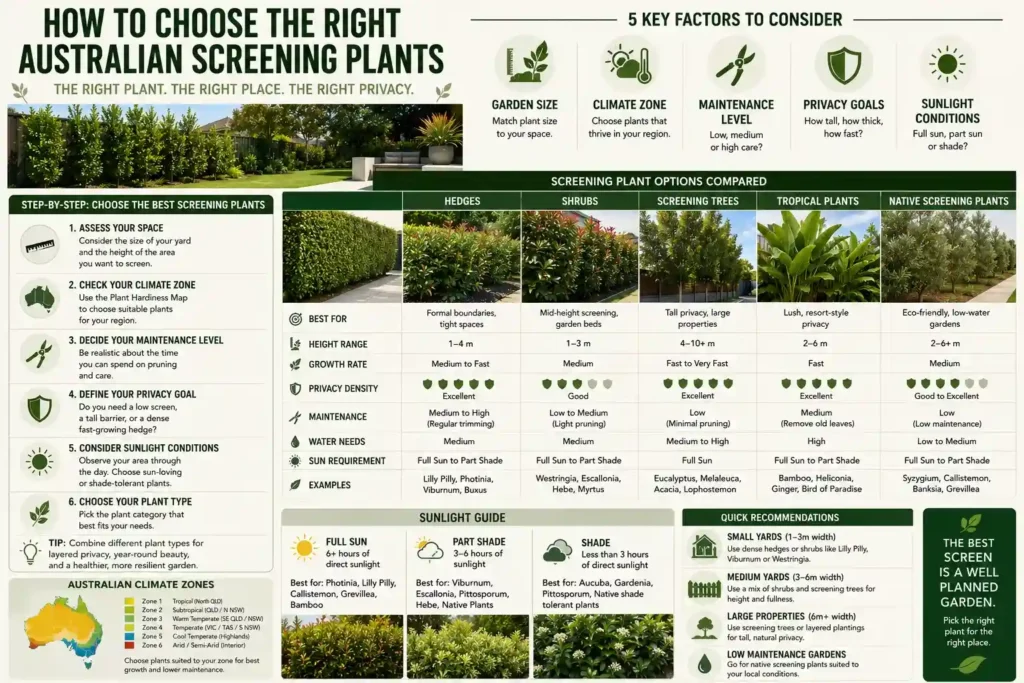
Different screening plants perform better in specific conditions, so selecting plants based on practical requirements is essential for healthy and attractive results.
Factors to Consider Before Planting
Several important factors influence how well screening plants grow and perform in Australian gardens.
Climate Zone
Australia has diverse climate regions ranging from tropical and coastal zones to dry inland and cool southern climates.
Choose screening plants suited to local conditions such as:
- Humidity
- Frost tolerance
- Heat resistance
- Coastal wind exposure
- Rainfall patterns
Native species often adapt best to local environmental conditions.
Soil Type
Healthy soil supports stronger root growth and denser foliage development.
Common Australian soil considerations include:
- Sandy soil drainage
- Clay soil compaction
- Soil pH balance
- Organic matter content
Improving soil before planting helps screening plants establish faster.
Sunlight
Different screening plants require different levels of sun exposure.
Typical requirements include:
| Sun Requirement | Suitable Plant Types |
| Full Sun | Bamboo, Lilly Pilly, Bottlebrush |
| Partial Shade | Murraya, Magnolia |
| Filtered Light | Tropical palms, some native shrubs |
Selecting plants suited to available sunlight improves growth quality and foliage density.
Space Availability
Garden size and planting width strongly influence plant selection.
Consider:
- Fence line width
- Root expansion space
- Mature plant size
- Height restrictions
- Nearby structures
Narrow screening plants work best in compact urban gardens and side access areas.
Growth Speed
Fast-growing screening plants provide quicker privacy but may require more pruning and maintenance.
Slower-growing plants often need:
- Less shaping
- Reduced watering
- Lower maintenance over time
Balancing growth speed with maintenance expectations is important for long-term garden management.
Choosing Between Trees, Hedges, and Shrubs
Trees, hedges, and shrubs each provide different types of privacy screening depending on garden layout and functional needs.
| Type | Best Use | Growth Speed | Space Needed |
| Trees | Tall privacy, shade, windbreaks | Moderate to fast | Larger spaces |
| Hedges | Formal boundaries, dense screening | Fast to moderate | Medium spaces |
| Shrubs | Informal screening, layered gardens | Moderate | Flexible spacing |
Trees
Screening trees are best for:
- Blocking overlooking buildings
- Creating shade
- Reducing wind exposure
- Large property boundaries
Tall evergreen trees provide long-term vertical privacy.
Hedges
Hedges create structured privacy barriers and are ideal for suburban fence lines.
Popular hedge benefits include:
- Dense foliage
- Easy shaping
- Consistent screening
- Decorative garden structure
Shrubs
Screening shrubs work well for softer natural privacy and layered landscaping.
They are commonly used in:
- Informal gardens
- Native landscapes
- Courtyards
- Mixed garden beds
Best Screen Plants by Purpose
Different screening plants perform better for specific landscaping goals and outdoor needs.
Privacy
For maximum privacy, choose dense evergreen species such as:
- Lilly Pilly
- Viburnum
- Clumping Bamboo
- Magnolia ‘Little Gem’
These plants create thick visual barriers year-round.
Fence Covering
Plants best suited for fence covering include:
- Photinia
- Murraya
- Bamboo
- Star Jasmine on trellises
These species soften hard fence lines and improve garden appearance.
Noise Reduction
Dense foliage helps absorb sound and reduce urban noise.
Best plants for noise reduction include:
- Viburnum
- Bamboo
- Lilly Pilly
- Cypress varieties
Layered planting often improves sound buffering performance.
Shade
Large screening trees provide shade while improving outdoor comfort during hot Australian summers.
Best shade-producing screening plants include:
- Water Gum
- Magnolia
- Brush Box
- Native Frangipani
Windbreaks
Wind-tolerant screening plants protect gardens and outdoor living areas from harsh weather conditions.
Reliable windbreak species include:
- Westringia
- Bamboo
- Coastal Tea Tree
- Bottlebrush
- Cypress trees
Dense windbreak planting also helps reduce moisture loss and protect delicate garden plants.
Common Problems With Screening Plants and Solutions
Screening plants can experience growth, root, pest, and maintenance problems if they are planted in unsuitable conditions or not properly maintained. Identifying issues early helps maintain dense foliage, healthy growth, and long-term privacy performance.
Most common screening plant problems can be corrected through proper watering, pruning, soil improvement, and plant selection.
Why Screening Plants Stop Growing
Screening plants may stop growing because of poor soil conditions, limited sunlight, root stress, incorrect watering, or nutrient deficiencies.
Understanding the cause helps restore healthy development and foliage density.
Poor Soil Quality
Compacted or nutrient-poor soil limits root growth and reduces plant vigor.
Common symptoms include:
- Slow growth
- Pale foliage
- Weak branching
- Sparse leaves
Solution
Improve soil with:
- Organic compost
- Mulch
- Slow-release fertilizer
- Proper drainage materials
Healthy soil encourages stronger root establishment and faster screening growth.
Lack of Sunlight
Many screening plants require full sun or partial sun to maintain dense foliage.
Insufficient sunlight may cause:
- Thin growth
- Leaning branches
- Reduced leaf production
Solution
- Trim surrounding vegetation
- Relocate container plants if possible
- Choose shade-tolerant species for low-light areas
Incorrect Watering
Both underwatering and overwatering can slow plant growth.
Underwatering Signs
- Dry soil
- Wilting leaves
- Brown leaf edges
Overwatering Signs
- Yellow leaves
- Root rot
- Weak stems
Solution
Use deep watering schedules based on climate, soil type, and plant maturity.
Root Problems Near Fence Lines
Root problems commonly occur when screening plants are installed too close to fences, retaining walls, paving, or drainage systems.
Poor spacing can lead to overcrowding and restricted root development.
Common Root Issues
Typical root-related problems include:
- Root competition
- Damaged fencing
- Drainage interference
- Stunted growth
- Soil compaction
Plants With Aggressive Roots
Some species develop stronger root systems than others.
Plants requiring careful placement include:
- Running bamboo
- Large eucalyptus trees
- Some fig species
Solution
To reduce root problems:
- Use clumping plant varieties
- Maintain proper planting distance
- Install root barriers if necessary
- Avoid planting large trees too close to structures
Selecting narrow-rooted screening plants improves long-term fence line stability.
Pest and Disease Issues
Pests and diseases can weaken screening plants, reduce foliage density, and damage overall appearance.
Healthy plants with proper airflow and balanced watering are generally more resistant.
Common Pest Problems
Psyllids
Common on Lilly Pilly varieties.
Symptoms include:
- Pimpled leaves
- Distorted growth
- Damaged new foliage
Aphids
Aphids feed on soft new growth and may weaken young plants.
Scale Insects
Scale insects attach to stems and leaves, reducing plant health over time.
Disease Issues
Root Rot
Usually caused by poor drainage or overwatering.
Fungal Leaf Spot
Appears as dark spots or discoloration on leaves.
Powdery Mildew
White fungal coating that develops in humid conditions with poor airflow.
Solutions
Prevent pest and disease problems by:
- Improving airflow
- Avoiding overwatering
- Removing damaged growth
- Using resistant plant varieties
- Applying appropriate horticultural treatments when necessary
Healthy soil and balanced fertilizing also improve natural plant resistance.
Overgrown Hedge Management
Fast-growing screening plants can become oversized if not regularly maintained.
Overgrown hedges may block pathways, reduce airflow, and create uneven growth patterns.
Signs of Overgrown Screening Plants
Common indicators include:
- Sparse lower foliage
- Excessive height
- Uneven hedge shape
- Thick woody branches
- Reduced density
Proper Hedge Trimming
Regular pruning encourages compact and healthier growth.
Best practices include:
- Light frequent trimming
- Shaping wider at the base
- Removing dead branches
- Avoiding severe pruning during extreme heat
Rejuvenation Pruning
Older hedges sometimes require harder pruning to restore density and shape.
This process involves:
- Cutting back leggy branches
- Encouraging fresh shoots
- Gradually reshaping the hedge
Some species recover faster than others after heavy pruning.
How to Improve Dense Screening Growth
Dense foliage is essential for effective privacy screening and visual coverage.
Several maintenance practices help improve hedge thickness and plant health.
Regular Pruning
Frequent light pruning stimulates branching and fuller growth.
Benefits include:
- Increased density
- Better shape control
- Stronger foliage coverage
Proper Fertilizing
Balanced fertilizing supports healthy leaf and root development.
Important nutrients include:
- Nitrogen for foliage growth
- Potassium for plant strength
- Organic matter for soil improvement
Mulching
Mulch helps:
- Retain soil moisture
- Reduce weeds
- Improve soil temperature
- Support healthy roots
Organic mulch also gradually improves soil quality.
Adequate Spacing
Plants spaced too closely compete for nutrients, sunlight, and airflow.
Correct spacing allows:
- Better root development
- Improved airflow
- Healthier foliage growth
- Reduced disease risk
Deep Watering
Deep watering encourages stronger root systems and more resilient screening plants.
Established plants generally benefit from less frequent but deeper watering rather than shallow daily irrigation.
Best Practices for Planting and Maintaining Screen Plants
Proper planting and maintenance help screening plants establish faster, grow denser, and remain healthy for many years. Good garden practices also reduce pest problems, improve foliage coverage, and strengthen long-term privacy performance.
Whether planting native hedges, tropical screening plants, or evergreen privacy trees, consistent care is essential during the establishment period.
Proper watering, pruning, and soil preparation techniques covered in our gardening and plant care guide can help screening plants establish faster and maintain denser foliage year-round.
Soil Preparation Tips
Healthy soil provides the foundation for strong root growth and dense screening foliage.
Preparing the soil properly before planting improves water retention, nutrient availability, and long-term plant health.
Improve Soil Structure
Different Australian gardens have varying soil conditions, including sandy, clay, and compacted soils.
Improve soil quality by adding:
- Organic compost
- Aged manure
- Soil conditioners
- Well-rotted mulch
Organic matter improves both drainage and moisture retention.
Check Drainage
Poor drainage can cause root rot and slow plant establishment.
To improve drainage:
- Break up compacted soil
- Raise garden beds if necessary
- Avoid waterlogged planting areas
Well-drained soil is especially important for hedges and evergreen screening plants.
Test Soil pH
Most screening plants prefer slightly acidic to neutral soil.
If required, adjust soil using:
- Lime for acidic soil
- Sulfur for alkaline soil
Balanced soil conditions improve nutrient uptake and foliage health.
Watering Schedule for New Plants
Newly planted screening plants require consistent watering while roots establish.
The first growing season is critical for healthy development.
Initial Watering After Planting
Water deeply immediately after planting to settle the soil and reduce root stress.
Deep watering encourages roots to grow downward rather than remaining shallow.
Recommended Watering Schedule
General watering guidelines for new plants:
| Plant Age | Watering Frequency |
| First 2 weeks | Every 2–3 days |
| First 2 months | 2–3 times weekly |
| Established plants | Deep watering as needed |
Watering frequency may increase during:
- Heatwaves
- Dry windy conditions
- Sandy soil conditions
Avoid Overwatering
Excessive watering can weaken roots and encourage fungal diseases.
Signs of overwatering include:
- Yellow leaves
- Soft stems
- Wet soil for extended periods
- Slow growth
Allow soil to partially dry between watering sessions when possible.
Mulching and Fertilizing
Mulching and fertilizing improve plant health, moisture retention, and foliage density.
These practices are especially important for fast-growing screening hedges.
Benefits of Mulching
Mulch helps:
- Retain moisture
- Suppress weeds
- Regulate soil temperature
- Improve soil quality over time
Organic mulch options include:
- Bark chips
- Sugar cane mulch
- Compost mulch
- Leaf litter
Apply mulch evenly while keeping it away from direct trunk contact.
Fertilizing Screening Plants
Balanced fertilizing encourages:
- Faster growth
- Greener foliage
- Stronger root systems
- Better hedge density
Best Fertilizer Types
Suitable fertilizers include:
- Slow-release granular fertilizer
- Organic compost blends
- Native-specific fertilizers for Australian plants
Fertilizing Schedule
Most screening plants benefit from fertilizing during:
- Early spring
- Early summer
Avoid heavy fertilizing during extreme heat or winter dormancy periods.
Pruning for Dense Growth
Regular pruning is essential for maintaining compact, healthy, and visually attractive screening plants.
Pruning stimulates branching and improves hedge density.
Benefits of Proper Pruning
Correct pruning helps:
- Create thicker foliage
- Maintain shape
- Control height
- Improve airflow
- Remove damaged growth
Frequent light trimming is usually more effective than occasional severe cutting.
Best Pruning Techniques
Important pruning practices include:
- Trim lightly and regularly
- Shape hedges wider at the base
- Remove dead or crossing branches
- Use clean sharp tools
This approach improves sunlight exposure across the entire hedge.
Timing for Pruning
Most Australian screening plants respond best to pruning during active growing seasons such as:
- Spring
- Early summer
- Early autumn in mild climates
Avoid heavy pruning during frost periods or extreme summer heat.
Seasonal Care Tips for Australian Gardens
Australian screening plants experience different seasonal stresses depending on climate zone and weather conditions.
Seasonal maintenance improves long-term health and appearance.
Spring Care
Spring is the primary growth season for most screening plants.
Recommended tasks include:
- Fertilizing
- Mulching
- Pruning
- New planting
This is also the best time to encourage fresh dense growth.
Summer Care
Hot Australian summers can stress newly planted hedges and shrubs.
Important summer practices:
- Deep watering
- Heat protection for young plants
- Monitoring pests
- Avoiding excessive pruning
Mulch becomes especially valuable during hot weather.
Autumn Care
Autumn is ideal for root establishment because soil temperatures remain warm while evaporation decreases.
Autumn tasks include:
- Planting new hedges
- Light pruning
- Soil improvement
- Weed removal
Winter Care
In cooler regions, winter growth slows significantly.
Winter maintenance includes:
- Reduced watering
- Frost protection for sensitive plants
- Structural pruning if required
Evergreen screening plants continue providing privacy throughout winter while requiring less active maintenance.
Before choosing hedges or privacy trees, it also helps to explore popular screen plants names commonly used in Australian gardens for fence screening, privacy, and landscape design.
Conclusion
The best screen plants Australia offers include fast-growing hedges, native screening plants, tropical privacy plants, and narrow-space screening trees suitable for every garden style. From dense evergreen hedges to compact vertical screening plants, Australian homeowners have many effective options for creating natural privacy and improving outdoor spaces.
Fast growing screening plants such as Lilly Pilly, Viburnum, and clumping Bamboo are ideal for quickly establishing dense privacy barriers along fences and boundaries. For sustainable and wildlife-friendly gardens, native screening plants provide excellent drought tolerance, climate adaptability, and lower maintenance requirements across Australian conditions.
Low maintenance options like Westringia, Water Gum, and pest-resistant Lilly Pilly varieties are especially suitable for busy homeowners wanting reliable screening with less pruning and watering. In smaller properties and urban gardens, narrow screening plants such as Pencil Pine and slim-growing Lilly Pilly cultivars help maximize privacy without overcrowding limited spaces.
The best screening plant ultimately depends on:
- Climate conditions
- Privacy goals
- Maintenance preferences
- Available garden space
- Desired hedge or tree height
By selecting plants suited to local Australian conditions and maintaining them properly, homeowners can create long-lasting natural screens that improve privacy, comfort, biodiversity, and overall landscape appeal.
FAQs
What are the best screen plants in Australia for privacy?
The best screen plants in Australia for privacy include Lilly Pilly, Viburnum, clumping Bamboo, Magnolia ‘Little Gem’, and Water Gum. These plants provide dense evergreen foliage, fast growth, and reliable screening for suburban gardens, fence lines, and outdoor living areas.
Which screening plants grow the fastest in Australia?
Some of the fastest-growing screening plants in Australia include clumping Bamboo, Lilly Pilly, Leyland Cypress, Viburnum, and certain Acacia species. Fast-growing varieties establish privacy quickly and are commonly used for new homes and exposed gardens.
What are the best narrow screening plants for small gardens?
The best narrow screening plants for compact Australian gardens include Pencil Pine, Lilly Pilly ‘Straight and Narrow’, Bamboo ‘Gracilis’, and Italian Cypress. These plants grow vertically without taking up excessive horizontal space.
Are native Australian screening plants low maintenance?
Yes, many native Australian screening plants are low maintenance because they are naturally adapted to local climates and soil conditions. Plants such as Westringia, Bottlebrush, Water Gum, and Lilly Pilly often require less watering and fertilizing once established.
Which hedge plants are best for fence lines in Australia?
Popular hedge plants for fence lines in Australia include Lilly Pilly, Viburnum, Murraya, Photinia, and clumping Bamboo. These plants create dense privacy screens while improving the appearance of boundary fences.
What is the fastest growing hedge in Australia?
Clumping Bamboo is often considered one of the fastest growing hedge plants in Australia. Some Lilly Pilly varieties and Leyland Cypress also grow rapidly and create dense screening within a few years.
Can screening plants grow in pots?
Yes, many screening plants grow successfully in large pots and planters. Bamboo, compact Lilly Pilly varieties, Magnolia ‘Little Gem’, and ornamental grasses are commonly used for balcony privacy and courtyard screening.
Which screening plants work best in Queensland climates?
Queensland gardens benefit from tropical and humidity-tolerant screening plants such as Bamboo, Golden Cane Palm, Lilly Pilly, Heliconia, Native Frangipani, and Bottlebrush. These plants handle warm temperatures and high humidity effectively.
What are the best low maintenance screening plants in Australia?
Some of the best low maintenance screening plants include Westringia, Viburnum, Water Gum, Lilly Pilly ‘Resilience’, and clumping Bamboo. These plants require less pruning and watering while still providing excellent privacy coverage.
Which evergreen plants are best for year-round screening?
Evergreen screening plants such as Lilly Pilly, Magnolia ‘Little Gem’, Viburnum, Bamboo, and Murraya provide year-round privacy because they retain dense foliage throughout all seasons.
How far apart should screening plants be planted?
Most screening plants should be spaced approximately 50 cm to 1 meter apart depending on the plant variety and desired hedge density. Closer spacing creates faster privacy coverage and fuller hedge growth.
Do screening plants help reduce noise?
Yes, dense screening plants can help reduce traffic noise and neighborhood sounds by absorbing and diffusing sound waves. Bamboo, Viburnum, Lilly Pilly, and dense evergreen hedges are especially effective for noise reduction.
What are the best drought-tolerant screening plants for Australia?
Westringia, Bottlebrush, Hop Bush, Acacia species, and Coastal Tea Tree are excellent drought-tolerant screening plants for Australian gardens. These species perform well in dry climates and water-wise landscapes.
Can screening plants damage fences or foundations?
Some large trees and invasive-rooted plants may cause problems if planted too close to fences or foundations. Choosing clumping varieties, maintaining proper spacing, and using root barriers can help prevent structural damage.
When is the best time to plant screening plants in Australia?
Autumn and spring are generally the best seasons for planting screening plants in Australia. Mild temperatures and improved soil moisture help roots establish more effectively before extreme summer or winter conditions arrive.

Written by the LeafyHeaven Editorial Team
LeafyHeaven shares practical gardening tips and simple plant care guides to help you grow, nurture, and enjoy your plants with ease. Our goal is to make gardening feel natural, approachable, and rewarding for everyone.