
Introduction
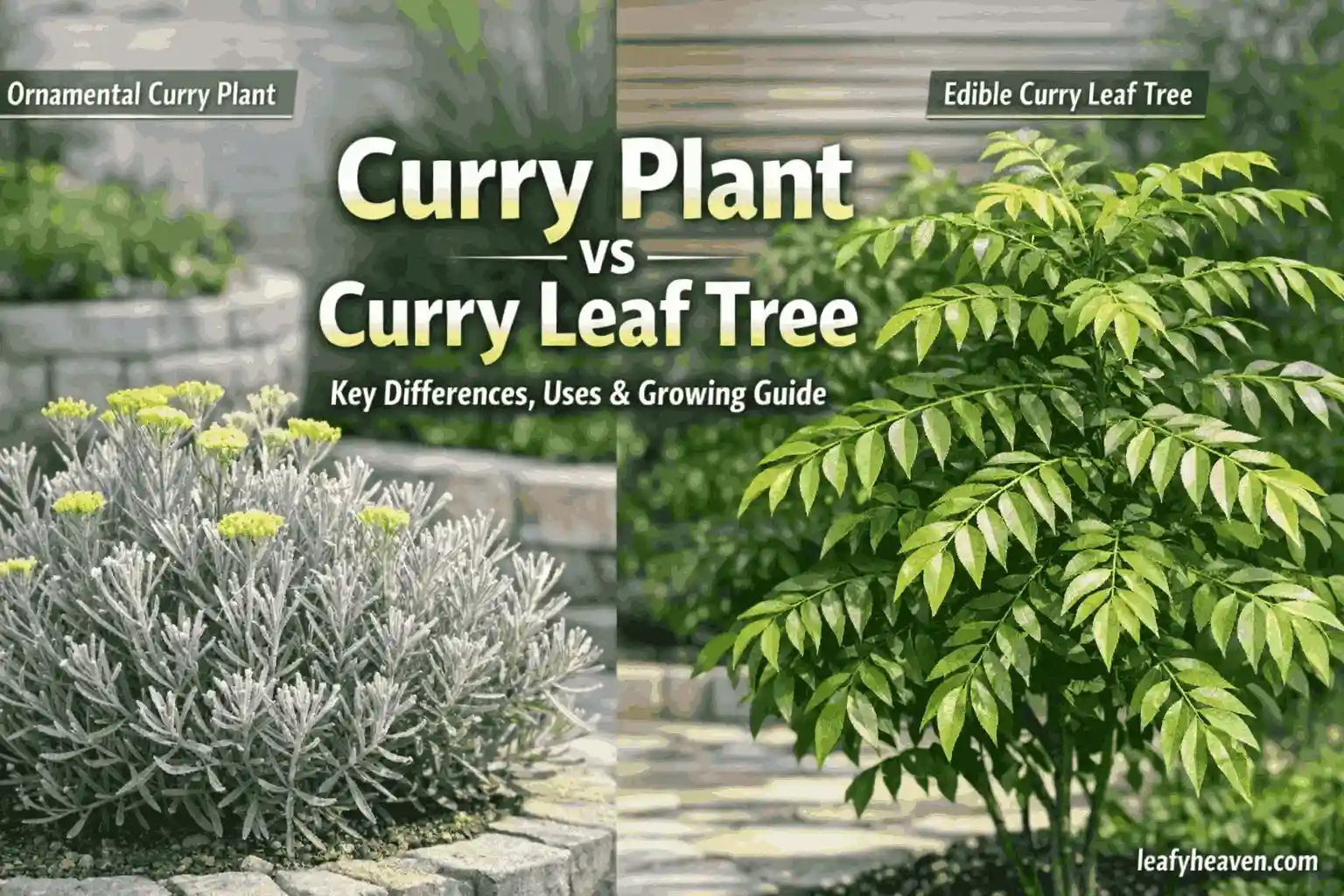
The confusion between curry plant vs curry leaf tree is very common, especially among beginners and home gardeners. Many people assume both plants are the same because of their similar aroma and name, but they are entirely different in origin, appearance, and use. This misunderstanding often leads to buying the wrong plant—especially when looking for edible curry leaves for cooking.
To clarify, curry leaves come from a specific plant used widely in Asian cuisine, while the so-called “curry plant” is mostly ornamental. This raises common questions like what is curry leaves, is curry a plant, and what does curry look like. In this guide, you’ll get a clear comparison, helping you understand their differences, uses, and how to grow the right one for your needs.
What Is a Curry Plant? (Helichrysum Italicum Explained)
The curry plant is a Mediterranean herb known for its strong curry-like fragrance, but it is not the same as the plant used to produce real curry leaves. Scientifically called helichrysum italicum curry plant, it belongs to a completely different botanical group and is mainly grown for ornamental and aromatic purposes. This curry herb plant is popular in gardens due to its unique scent and drought tolerance, but its role in cooking is often misunderstood.
Scientific Name & Botanical Identity
The helichrysum plant is scientifically known as Helichrysum italicum plant. It is commonly referred to as the curry plant because its leaves release a scent similar to curry spices when touched.
However, it is important to understand:
- It is not related to true curry leaves
- It is often labeled as a curry herb, which creates confusion
- It belongs to the Asteraceae family, unlike the curry leaf tree
This distinction is essential when identifying plants for culinary use.
Appearance & Characteristics
The curry plant has a very distinctive look that sets it apart from edible curry leaf plants.
Key features include:
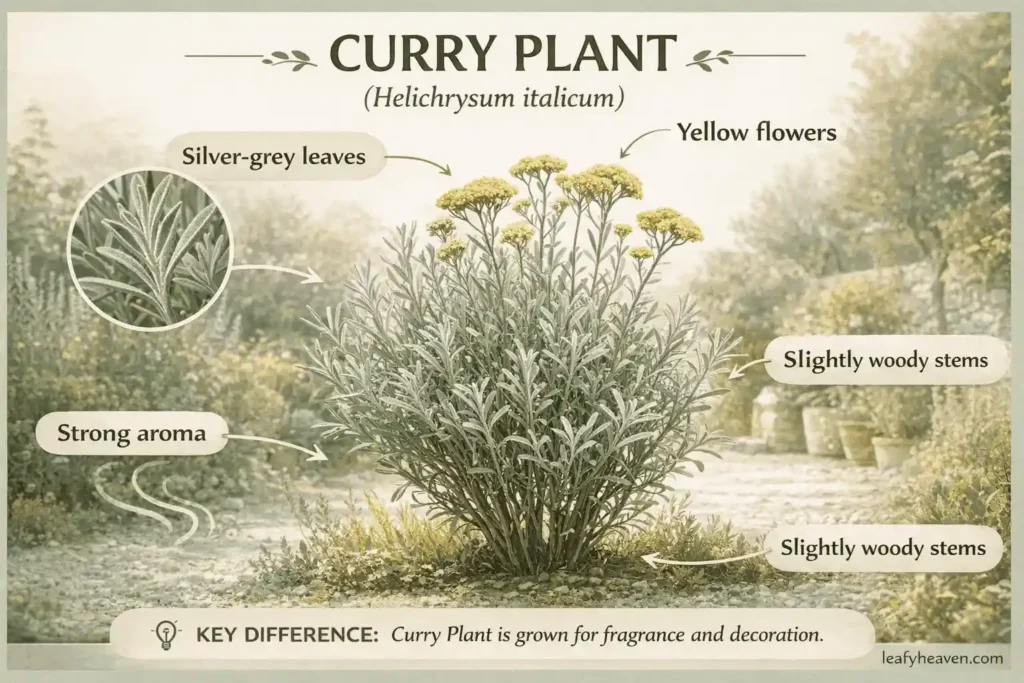
- Silver-grey, narrow leaves with a soft texture
- A strong, spicy aroma similar to curry powder
- Small, bright yellow curry plant flowers that bloom in clusters
- Compact, bushy growth habit (shrub-like structure)
If you’re wondering what does curry look like, the curry plant does not resemble the green leafy structure commonly associated with curry leaves used in cooking. Instead, it has a more ornamental and herbal appearance suited for decorative gardens.
Is Curry Plant Edible or Not?
One of the biggest misconceptions is whether the curry plant edible or suitable for cooking.
Here is the clear answer:
- The curry plant is not commonly used for cooking
- It is sometimes used for flavor infusion, but not eaten directly
- Helichrysum italicum cooking is rare and not recommended for regular consumption
⚠️ Safety Note:
The curry plant is not toxic, but it is also not considered a true edible herb like curry leaves. Its strong flavor can be overpowering, and it does not provide the same culinary value. For cooking purposes, always use real curry leaves from the curry leaf tree.
This clarification helps avoid a common mistake when choosing between a decorative plant and an edible herb.
What Is a Curry Leaf Tree? (Murraya Koenigii Guide)
The curry leaf tree is the true source of edible curry leaves widely used in Asian cooking. Known as the curry patta plant or Indian curry leaf tree, this plant is valued for both its culinary and medicinal properties. Unlike the ornamental curry plant, this tree produces leaves that are essential in traditional dishes and herbal remedies.
Scientific Name & Botanical Details
The curry leaf tree is scientifically known as Murraya koenigii.
Important botanical details include:
- Curry leaves scientific name: Murraya koenigii
- Botanical name of curry patta: Murraya koenigii
- Belongs to the Rutaceae (citrus) family
- Native to India and South Asia
This plant is completely different from the helichrysum plant and is the only authentic source of edible curry leaves.
Appearance & Growth Features
The curry leaf tree has a distinct appearance that makes it easy to identify when compared to the curry plant.
Key characteristics:
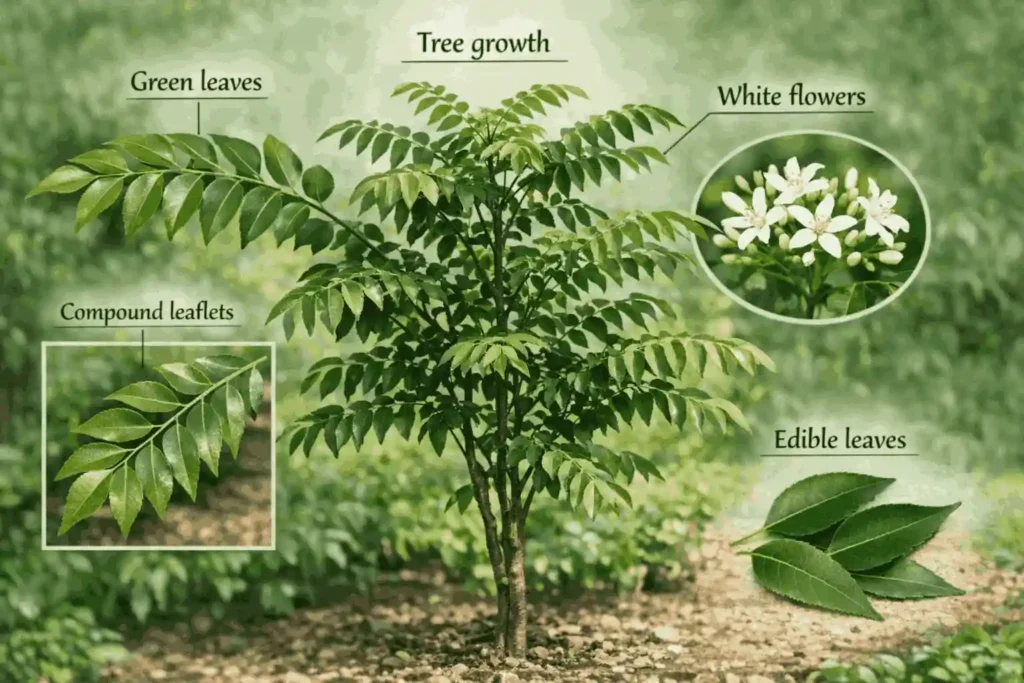
- Deep green, glossy leaves arranged in small leaflets
- A tree-like structure, not a soft shrub
- Produces small white flowers and dark berries
- A full grown curry leaf tree can reach heights of 6–15 feet (1.8–4.5 meters) depending on conditions
- The curry leaf tree height varies based on pruning and climate
Its lush green foliage and upright growth make it suitable for both garden planting and container growing.
Culinary & Medicinal Uses
The main value of the curry leaf tree lies in its edible and beneficial leaves.
Culinary uses:
- Fresh curry leaves are used in tempering (tadka) for dishes
- Common in Indian, Sri Lankan, and South Asian cuisine
- Add a distinct earthy, slightly citrusy flavor
- If you wonder what do curry leaves taste like, they offer a mildly bitter, aromatic, and savory taste
Curry leaf plant uses include:
- Flavoring curries, dals, chutneys, and rice dishes
- Used fresh or dried, though fresh leaves provide stronger flavor
Medicinal value:
- Yes, curry leaves are a medicinal plant
- Traditionally used for:
- Supporting digestion
- Managing blood sugar levels
- Promoting hair and skin health
This makes the Indian curry leaf tree both a culinary essential and a valuable herbal plant.
Scientific evidence is limited and these uses should not replace medical treatment.
Curry Plant vs Curry Leaf Tree: Key Differences
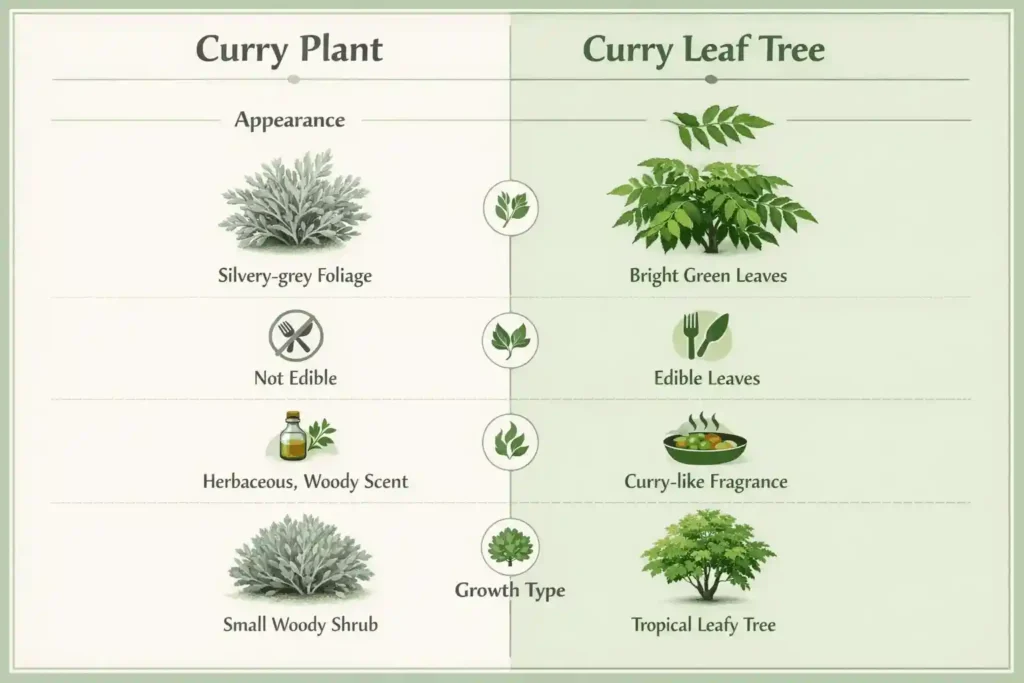
Understanding the difference between curry plant vs curry leaf tree is essential to avoid confusion, especially when choosing a plant for cooking or gardening. While both may share a similar scent, they differ completely in botanical identity, edibility, structure, and purpose.
Botanical Difference
The most fundamental difference lies in their scientific classification:
- Curry plant: Helichrysum italicum
- Curry leaf tree: Murraya koenigii
Key distinction:
- Helichrysum italicum belongs to the Asteraceae family (daisy family)
- Murraya koenigii belongs to the Rutaceae family (citrus family)
These plants are not related botanically, despite the similarity in name.
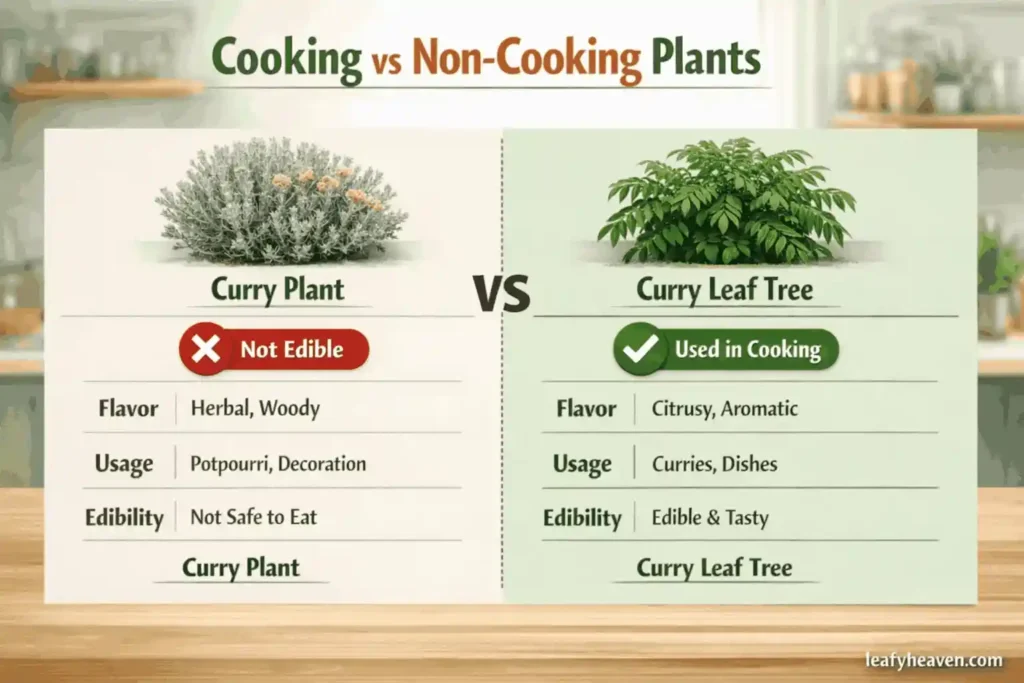
Edibility & Cooking Use
This is the most important difference for most users:
- Curry plant:
- Not a true edible herb
- Sometimes used for aroma, but not suitable for regular cooking
- Curry leaf tree:
- Produces real edible curry leaves
- Widely used in cooking for authentic flavor
👉 If your goal is cooking, only the curry leaf tree is the correct choice.
Appearance & Leaf Structure
The visual difference is clear when you compare them side by side:
| Feature | Curry Plant | Curry Leaf Tree |
| Leaf Color | Silver-grey | Deep green |
| Leaf Texture | Soft, narrow, slightly fuzzy | Smooth, glossy |
| Structure | Fine, needle-like leaves | Compound leaflets |
| Overall Look | Ornamental herb | Tropical tree foliage |
This difference helps easily identify whether you’re looking at a decorative herb or an edible plant.
Aroma & Taste Difference
Although both plants are associated with a curry-like scent, their actual properties are very different:
- Curry plant:
- Strong, pungent aroma similar to curry powder
- No real culinary taste value
- Curry leaf tree:
- Mild, complex flavor with citrus and earthy notes
- Enhances dishes when cooked
👉 The curry plant smells strong, but the curry leaf tree delivers actual flavor.
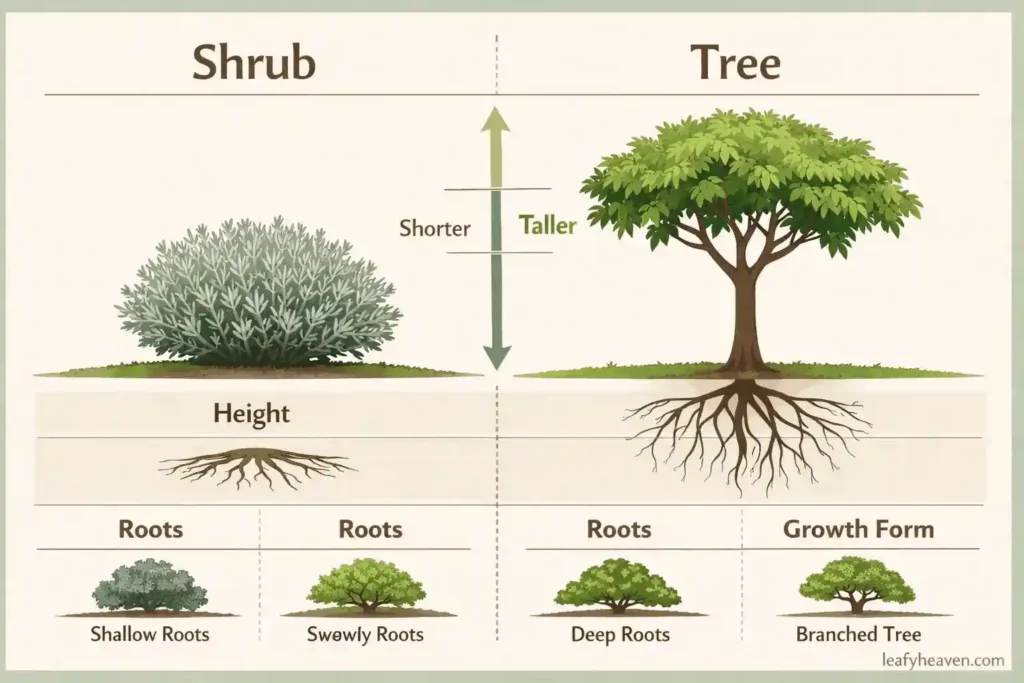
Growth Habit (Shrub vs Tree)
Their growth pattern is another major difference:
- Curry plant:
- Grows as a curry shrub
- Compact, bushy structure
- Ideal for decorative gardens
- Curry leaf tree:
- Grows as a small to medium-sized tree
- Upright growth with branching canopy
- Requires more space for proper development
In simple terms, curry shrub vs curry tree growing comes down to ornamental vs functional use.
Which One Should You Grow? (Decision Guide)
Choosing between a curry plant and a curry leaf tree depends entirely on your purpose—whether you want a functional kitchen plant or a decorative aromatic herb. This quick decision guide will help you select the right option based on your needs.
For Cooking & Kitchen Use
If your goal is to use fresh leaves in cooking, the correct choice is the curry leaf plant.
- Produces real edible curry leaves
- Essential for authentic flavor in many dishes
- Can be grown in pots or gardens
- Leaves can be harvested regularly once established
👉 For any culinary use, always choose the curry leaf tree. The curry plant is not a substitute.
For Decoration & Aroma
If you are looking for a plant mainly for visual appeal and fragrance, the curry plant is the better option.
- Attractive silver-grey foliage
- Strong, pleasant aromatic scent
- Works well in ornamental gardens and borders
- Low maintenance and drought-tolerant
👉 Ideal for gardeners who want a unique-looking and fragrant herb rather than an edible plant.
Climate Suitability
Climate plays a major role in deciding which plant will thrive in your space.
| Factor | Curry Leaf Tree | Curry Plant |
| Climate Type | Tropical to subtropical | Mediterranean |
| Temperature Needs | Warm, frost-sensitive | Tolerates dry, mild climates |
| Sunlight | Full sun preferred | Full sun to partial shade |
| Water Needs | Moderate watering | Low watering (drought-tolerant) |
- The curry leaf tree grows best in warm, humid environments
- The curry plant prefers dry, well-drained conditions
👉 Choose based on your local climate to ensure healthy growth and long-term success.
How to Grow Curry Leaf Tree Successfully
Learning how to grow curry tree properly ensures healthy leaf production and long-term growth. The growing curry leaf tree process is simple when the right conditions are provided. If you’re wondering curry leaves plant how to grow, follow these essential care guidelines.
Soil, Sunlight & Water Needs
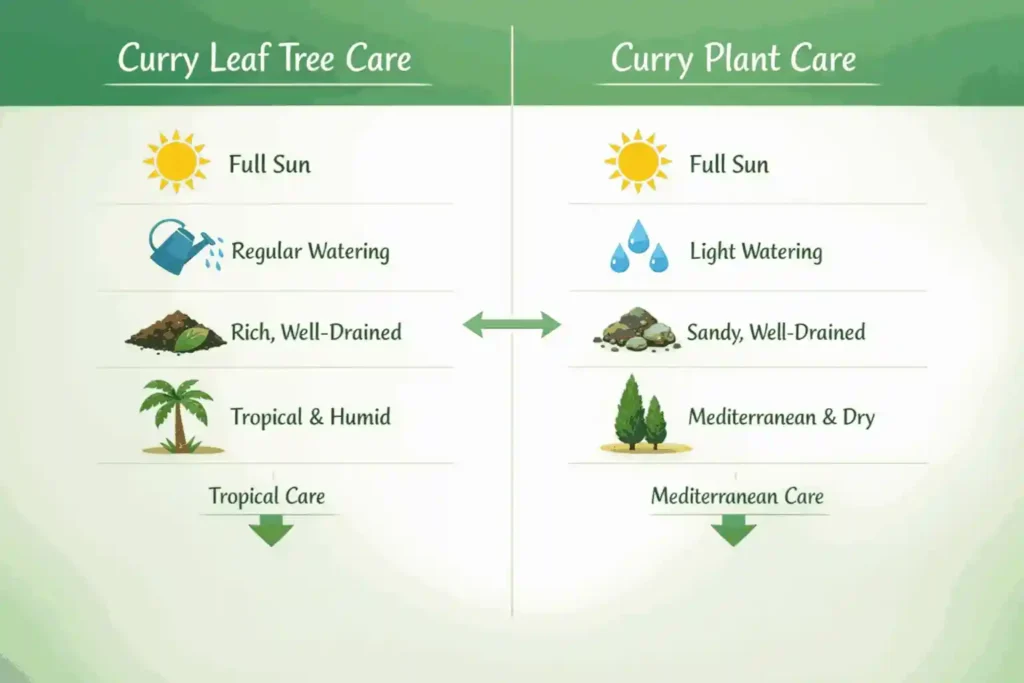
For strong and consistent growth, the curry leaf tree requires balanced environmental conditions:
- Soil:
- Well-draining, slightly acidic to neutral soil
- Mix garden soil with sand and compost for best results
- Sunlight:
- Needs full sunlight (6–8 hours daily)
- Can tolerate partial shade but grows slower
- Watering:
- Keep soil slightly moist but not waterlogged
- Allow the top layer of soil to dry before watering again
👉 Proper drainage is critical to prevent root rot.
Understanding how tropical plants respond to soil, sunlight, and climate becomes easier when you follow the fundamentals in a complete tropical fruit trees grow guide, especially for edible plants grown at home.
Propagation Methods
There are two common methods for propagation when learning how to plant curry leaves:
- From Seeds:
- Use fresh seeds from ripe berries
- Sow in moist soil and keep in warm conditions
- From Stem Cuttings:
- Method known as how to plant curry leaves from stem
- Select a semi-hard stem and plant in well-draining soil
- Maintain humidity for successful rooting
👉 Seed propagation is more reliable, while stem propagation requires more care.
Similar beginner-friendly propagation methods are also explained in how to plant lemongrass, where step-by-step techniques help establish healthy plants quickly.
Growth Timeline & Care Tips
Understanding curry leaves growth helps set realistic expectations:
- Initial growth is slow in the first 6–12 months
- Faster growth begins once the plant is well-established
- Leaves can be harvested after 1–2 years
Care tips for healthy growth:
- Regular pruning encourages bushier growth
- Use organic fertilizers every few weeks
- Traditional method: buttermilk for curry leaf plant can improve soil microbes and support growth
- Protect from frost and extreme cold
👉 Consistent care and warmth are the key factors for a thriving curry leaf tree.
Maintaining proper soil balance is equally important, as explained in the firestick plant root system, where excess moisture can quickly affect root health.
How to Grow Curry Plant (Helichrysum Care Guide)
Proper curry plant care is simple when you understand its natural Mediterranean habitat. If you’re growing a curry plant, the focus should be on dry conditions, sunlight, and well-draining soil. Whether from cuttings or learning how to grow curry plant from seed, this plant thrives with minimal maintenance.
Ideal Growing Conditions
The curry plant prefers warm, dry environments similar to its native region.
- Soil:
- Light, sandy, and well-draining soil
- Avoid heavy or water-retaining soil
- Sunlight:
- Requires full sun exposure (6–8 hours daily)
- Best grown outdoors in bright conditions
- Temperature:
- Thrives in warm climates
- Sensitive to frost and prolonged cold
👉 Good drainage and sunlight are the most important factors for healthy growth.
Watering & Maintenance
Unlike many herbs, the curry plant prefers less water.
- Watering:
- Water sparingly
- Allow soil to dry completely between watering
- Maintenance:
- Prune lightly to maintain shape and encourage bushy growth
- Avoid over-fertilizing, as it prefers low-nutrient soil
- Suitable for pots, containers, and garden beds
👉 Overwatering is the most common mistake and should be avoided.
Common Problems & Fixes
Even though it is low-maintenance, some issues can occur if conditions are not ideal.
- Root rot:
- Cause: Overwatering or poor drainage
- Fix: Improve soil drainage and reduce watering
- Leggy growth:
- Cause: Lack of sunlight
- Fix: Move plant to a brighter location
- Weak aroma:
- Cause: Low sunlight or excessive moisture
- Fix: Increase sun exposure and reduce watering
- Pest issues (rare):
- Occasionally affected by aphids
- Treat with mild organic spray if needed
👉 Maintaining dry soil and full sun prevents most problems when growing a curry plant.
Uses of Curry Plant vs Curry Leaf Tree
Understanding the practical uses of both plants helps clarify why they should not be confused. While they may share a similar aroma, their applications are completely different—one is mainly decorative, while the other is essential in cooking and traditional medicine.
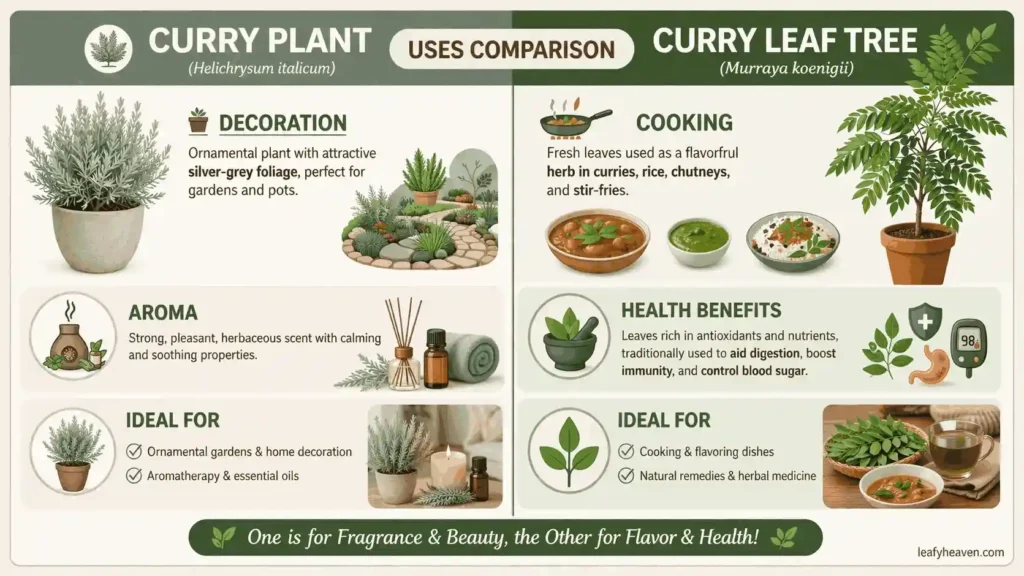
Uses of Curry Plant
The curry plant is valued more for its fragrance and visual appeal than for culinary use. Its strong scent makes it useful in specific non-edible applications.
Common curry plant uses:
- Aromatherapy:
- Leaves release a strong curry-like scent
- Used in dried arrangements and herbal sachets
- Ornamental gardening:
- Attractive silver-grey foliage adds contrast to gardens
- Ideal for borders, rock gardens, and containers
- Decorative herbal use:
- Often included in herb gardens for its unique aroma
- Recipes using curry plant (limited use):
- Occasionally used to infuse flavor in oils or dishes
- Leaves are typically removed before serving
- Not commonly eaten due to strong taste and texture
👉 The curry plant is best suited for fragrance and decoration, not as a primary cooking herb.
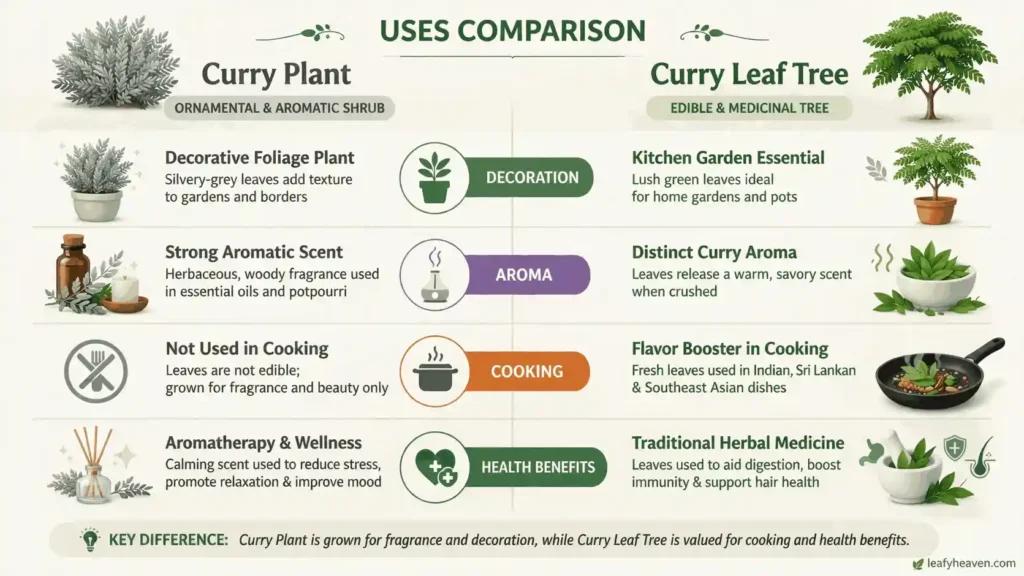
Uses of Curry Leaf Tree
The curry leaf tree is highly valued for its edible leaves and wide range of benefits. It plays a major role in both cooking and traditional wellness practices.
Curry leaf tree uses include:
- Cooking:
- Essential ingredient in many dishes
- Used in tempering, curries, soups, and chutneys
- Provides a distinct, authentic flavor
- Curry leaves plant benefits:
- Supports digestion and gut health
- Traditionally used for blood sugar management
- Known to promote hair growth and scalp health
- Contains antioxidants and essential nutrients
Scientific information about plant compounds and their health effects can be explored through the National Center for Biotechnology Information (NCBI).
- Herbal medicine:
- Used in traditional remedies for various health benefits
- Consumed fresh, dried, or as extracts
👉 The curry leaf tree is both a culinary essential and a functional medicinal plant, making it far more versatile than the curry plant.
Common Mistakes People Make
Many beginners misunderstand the difference between these plants, which leads to wrong purchases and poor results. Avoiding these common mistakes will help you choose and use the right plant effectively.
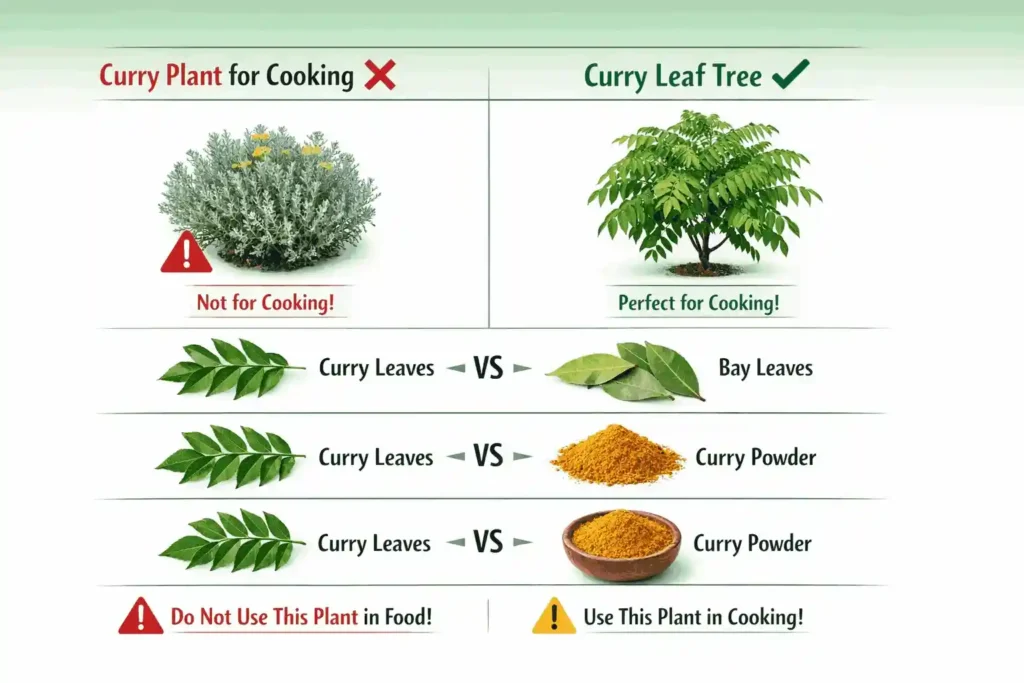
- Confusing curry plant with curry leaves
- The curry plant is often mistaken for the source of real curry leaves
- In reality, it is an ornamental herb, not the edible plant used in cooking
- This confusion is the main reason people end up with the wrong plant
- Buying the wrong plant for cooking
- Many buyers purchase a curry plant expecting edible leaves
- This leads to disappointment because it does not provide authentic flavor
- Always check for curry leaf tree (Murraya koenigii) when buying for culinary use
- Thinking curry leaves and bay leaves are the same
- A common misconception: are curry leaves and bay leaves the same? → No
- Curry leaves have a unique citrusy, aromatic flavor
- Bay leaves have a completely different taste and are used differently in cooking
- Confusing curry leaves with curry powder
- Another frequent misunderstanding: curry leaves vs curry powder
- Curry leaves are fresh or dried leaves used directly in dishes
- Curry powder is a spice blend, not a plant
👉 Avoiding these mistakes ensures you select the right plant and use it correctly for your intended purpose.
Conclusion
The comparison of curry plant vs curry leaf tree clearly shows that these two plants serve completely different purposes. The curry plant (Helichrysum italicum) is an ornamental herb valued for its aroma and decorative appeal, while the curry leaf tree (Murraya koenigii) is the true source of edible curry leaves used in cooking and traditional medicine.
Final verdict:
- Choose the curry leaf tree if your goal is cooking, flavor, and health benefits
- Choose the curry plant if you want fragrance, aesthetics, and low-maintenance greenery
Understanding this difference helps you avoid common mistakes and ensures you get the exact results you expect from your plant.
👉 Choose wisely based on your needs—whether it’s for your kitchen or your garden.
FAQs
Is curry plant the same as curry leaf tree?
No, the curry plant and curry leaf tree are completely different. The curry plant (Helichrysum italicum) is an ornamental herb, while the curry leaf tree (Murraya koenigii) produces real edible curry leaves used in cooking.
Can you eat curry plant leaves?
Curry plant leaves are not commonly eaten. While they are not toxic, they are not suitable for regular cooking and do not provide the same flavor as true curry leaves.
What is the scientific name of curry leaves?
The scientific name of curry leaves is Murraya koenigii. It is also known as the curry patta plant in many regions.
How do I identify a curry leaf plant?
You can identify a curry leaf plant by its glossy green leaves arranged in small leaflets and its tree-like growth. It looks very different from the silver-grey, soft leaves of the curry plant.
Which plant is used in Indian cooking for curry?
The curry leaf tree (Murraya koenigii) is used in Indian cooking. Its leaves are essential for authentic flavor in many traditional dishes.
Can I grow curry leaf tree indoors?
Yes, the curry leaf tree can be grown indoors if it receives enough sunlight. Place it near a bright window and ensure proper drainage to maintain healthy growth.
How long does a curry leaf tree take to grow?
A curry leaf tree typically takes 1–2 years to establish and start producing leaves suitable for harvesting. Growth is slow initially but improves with proper care.
Can curry plant survive in pots?
Yes, the curry plant grows well in pots and containers. It prefers well-draining soil and full sunlight, making it ideal for balconies and small gardens.
Why are my curry leaf plant leaves turning yellow?
Yellow leaves are usually caused by overwatering, poor drainage, or lack of nutrients. Adjust watering and ensure the plant receives adequate sunlight.
Do curry leaves grow all year round?
In warm climates, curry leaves can grow throughout the year. In cooler regions, growth slows down during winter and resumes in warmer seasons.

Written by the LeafyHeaven Editorial Team
LeafyHeaven shares practical gardening tips and simple plant care guides to help you grow, nurture, and enjoy your plants with ease. Our goal is to make gardening feel natural, approachable, and rewarding for everyone.