
Introduction to Dwarf Fruit Trees
Dwarf fruit trees are compact versions of traditional fruit-bearing trees that are specifically developed to grow in limited space while still producing full-quality fruit. These fruit trees dwarf in size due to controlled growth habits, making them highly suitable for modern gardening needs. Unlike large orchard trees, small fruit trees are designed for easy maintenance, efficient space use, and adaptability to containers or compact landscapes.
They are ideal for urban homes, balconies, patios, and small gardens where space is restricted. Their manageable height allows easier pruning, harvesting, and care without requiring specialized equipment. This makes them a practical solution for home gardeners who want productivity without complexity.
Difference Between Standard, Semi-Dwarf, and Dwarf Trees
|
Tree Type |
Average Height | Space Requirement | Maintenance Level | Ideal Use Case |
|
Standard Trees |
20–40 ft | Large gardens/orchards | High | Traditional farming |
|
Semi-Dwarf Trees |
10–20 ft |
Medium spaces | Moderate | Backyard gardening |
|
Dwarf Trees |
3–10 ft | Small spaces, containers | Low |
Urban homes, patios |
Dwarf trees are the most space-efficient option, making them the preferred choice for modern, small-scale gardening environments.
What Makes a Fruit Tree Dwarf? (Scientific Explanation)
Dwarf fruit trees are created through biological control of growth rather than genetic weakness. Their reduced size is primarily achieved using specialized root systems and propagation techniques that limit vertical and lateral growth while maintaining fruit productivity.
Role of Rootstocks
Rootstocks are the foundational component that determines the final size of a fruit tree. A dwarf tree is typically produced by grafting a desired fruit variety (scion) onto a size-controlling rootstock.
- M27 Rootstock (ultra dwarf)
Produces extremely compact trees, often under 6 feet tall. Suitable for containers and very small garden spaces. Requires staking and consistent care due to weaker root systems. - M9 Rootstock (common dwarf)
One of the most widely used dwarfing rootstocks. Trees generally reach 6–10 feet in height and offer a balance between size control and fruit yield. Common in modern home orchards. - Size control through grafting
Grafting combines the fruit-producing upper part (scion) with a dwarfing rootstock. The rootstock restricts nutrient flow and growth hormones, resulting in a smaller tree without affecting fruit size or quality.
Naturally Dwarf vs Grafted Trees
Dwarf fruit trees can be either naturally compact species or artificially controlled through grafting.
- Citrus trees
Many citrus varieties naturally grow smaller, especially when cultivated in containers. Some dwarf citrus are also grafted for additional size control. - Apples
Almost all dwarf apple trees are grafted onto rootstocks like M27 or M9, as natural dwarfing is rare in apple species. - Tropical plants
Certain tropical fruits, such as banana or papaya, have naturally shorter growth habits. These are often classified as dwarf due to their inherent genetic traits rather than grafting.
Size, Height & Growth Habit
Dwarf fruit trees typically grow within a controlled height range of 3 to 10 feet, depending on the species and rootstock used. Their growth habit is more compact, with shorter branches and a denser canopy, making them easier to manage.
For example, the dwarf lime tree size usually ranges between 4 to 8 feet tall, making it ideal for pots, patios, and small garden spaces. This compact growth allows efficient fruit production without the space demands of full-sized trees.
Complete List of Dwarf Fruit Trees (With Scientific Names & Types)
Dwarf fruit trees include a wide range of species and cultivars specifically adapted for compact growth, container gardening, and small-space cultivation. These dwarf apple trees, dwarf citrus trees, and other miniature fruit varieties provide full-sized fruits while maintaining controlled height and manageable structure. Below is a complete scientific breakdown of major dwarf fruit tree categories.
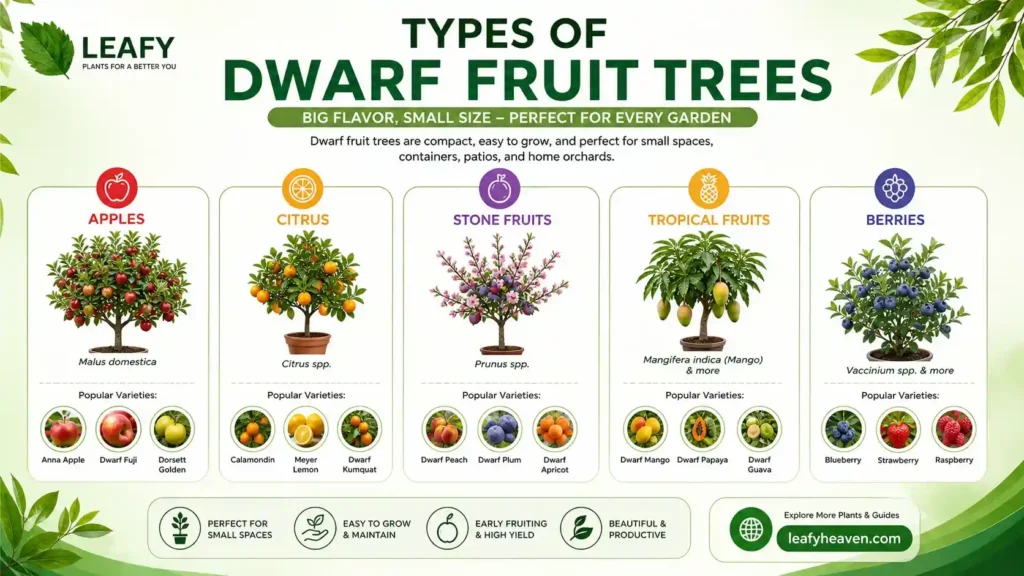
🍎 Dwarf Apple Trees — Malus domestica
Dwarf apple varieties are among the most popular miniature apple trees, widely grown using dwarfing rootstocks like M27 and M9 for size control and early fruiting.
- Dwarf Apple — Malus domestica
- M27 Rootstock Apple — ultra-compact growth form
- M9 Rootstock Apple — standard dwarf orchard type
- Columnar Apple — upright growth habit, space-efficient
- Mini Fig Apple Types — compact hybrid-style apple forms used in restricted spaces
These dwarf apple trees are highly productive and suitable for pots, patios, and small gardens due to their controlled canopy spread.
🍐 Dwarf Pear Trees — Pyrus spp.
Dwarf pear trees are valued for their elegant shape and reliable fruit production in limited spaces.
- Dwarf Pear — Pyrus communis
- Asian Pear (Dwarf) — Pyrus pyrifolia
These species are commonly used in small orchards where space efficiency is essential.
🍊 Dwarf Citrus Trees — Citrus spp.
Dwarf citrus trees are some of the most widely grown container fruit trees due to their continuous flowering and fruiting ability.
- Dwarf Orange — Citrus sinensis
- Dwarf Lemon — Citrus limon
- Dwarf Lime — Citrus aurantiifolia
- Dwarf Mandarin — Citrus reticulata
- Dwarf Grapefruit — Citrus paradisi
- Dwarf Kumquat — Citrus japonica
These dwarf citrus trees thrive in containers and controlled environments. Popular selections include the dwarf meyer lemon tree (Citrus × meyeri), known for its sweeter fruit and compact growth, and the dwarf meyer lemon, which is widely used in indoor and patio gardening. Another popular variety is the dwarf tahitian lime tree, which performs well in warm climates and containers. In mixed citrus planting systems, the concept of a lemon lime dwarf tree is often used to describe compact multi-citrus growing arrangements.
🍑 Dwarf Stone Fruits — Prunus spp.
Stone fruit trees in dwarf form are ideal for backyard orchards and patio cultivation.
- Dwarf Peach — Prunus persica
- Dwarf Nectarine — Prunus persica var. nucipersica
- Dwarf Plum — Prunus domestica
- Dwarf Apricot — Prunus armeniaca
- Dwarf Cherry — Prunus avium / cerasus
- Patio Peach — compact ornamental fruiting peach
- Patio Nectarine — space-saving nectarine variety
These varieties maintain high fruit quality while staying manageable in size.
🥭 Tropical Dwarf Fruit Trees
Tropical dwarf fruit trees are adapted for warm climates and container growing.
- Dwarf Mango — Mangifera indica
- Dwarf Banana — Musa spp.
- Dwarf Papaya — Carica papaya
- Dwarf Guava — Psidium guajava
- Dwarf Sapodilla — Manilkara zapota
These are commonly grown in subtropical and tropical home gardens due to their adaptability and productivity.
For gardeners interested in warm-climate species, our tropical fruit tree growing guide covers ideal conditions and care strategies for many compact tropical varieties.
🍇 Dwarf Vining Fruits
Vining fruits in dwarf form are trained for compact growth using supports or trellises.
- Dwarf Grape — Vitis vinifera
- Dwarf Passion Fruit — Passiflora edulis
- Dwarf Kiwi — Actinidia arguta
These species are ideal for vertical gardening systems and small backyard setups.
🍒 Dwarf Berry & Shrub Fruits
Berry-producing dwarf plants are highly productive in limited space.
- Dwarf Blueberry — Vaccinium corymbosum
- Dwarf Strawberry Tree — Arbutus unedo
- Dwarf Mulberry — Morus spp.
- Dwarf Raspberry — Rubus idaeus
- Dwarf Blackberry — Rubus fruticosus
These are excellent choices for edible landscaping and container gardening.
A dwarf mulberry tree guide can help you understand growth habits, fruiting expectations, and container suitability for this productive compact berry tree.
🍈 Rare & Exotic Dwarf Fruits
Rare dwarf fruit trees offer diversity and ornamental value.
- Dwarf Fig — Ficus carica
- Dwarf Pomegranate — Punica granatum
- Dwarf Olive — Olea europaea
- Dwarf Avocado — Persea americana
- Dwarf Loquat — Eriobotrya japonica
- Dwarf Dragon Fruit — Hylocereus spp.
These species combine aesthetic appeal with edible yield in compact environments.
If you’re considering avocado for compact spaces, explore these small avocado tree varieties suited for patios and container gardens.
🍍 Container-Friendly Compact Fruits
These fruiting plants are especially suited for pots and indoor-friendly setups.
- Pineapple — Ananas comosus
- Dwarf Coffee — Coffea arabica
- Dwarf Cocoa — Theobroma cacao
- Mini Fig — Ficus carica
They are widely used in decorative edible gardening and controlled container cultivation.
Benefits of Growing Dwarf Fruit Trees
Dwarf fruit trees are designed for modern gardening systems where space efficiency, productivity, and ease of maintenance are essential. These compact trees allow gardeners to grow a wide range of fruits even in limited environments, making them a practical solution for urban and small-scale cultivation.
Space-Saving Gardening
One of the most important advantages of dwarf fruit trees is their compact size. Unlike standard orchard trees, they require minimal ground space while still producing high-quality fruit. This makes them ideal for dense urban environments where traditional gardening space is limited.
- Efficient use of small garden areas
- Suitable for vertical and container-based setups
- Allows multiple fruit varieties in a single compact space
Ideal for Pots, Balconies, and Patios
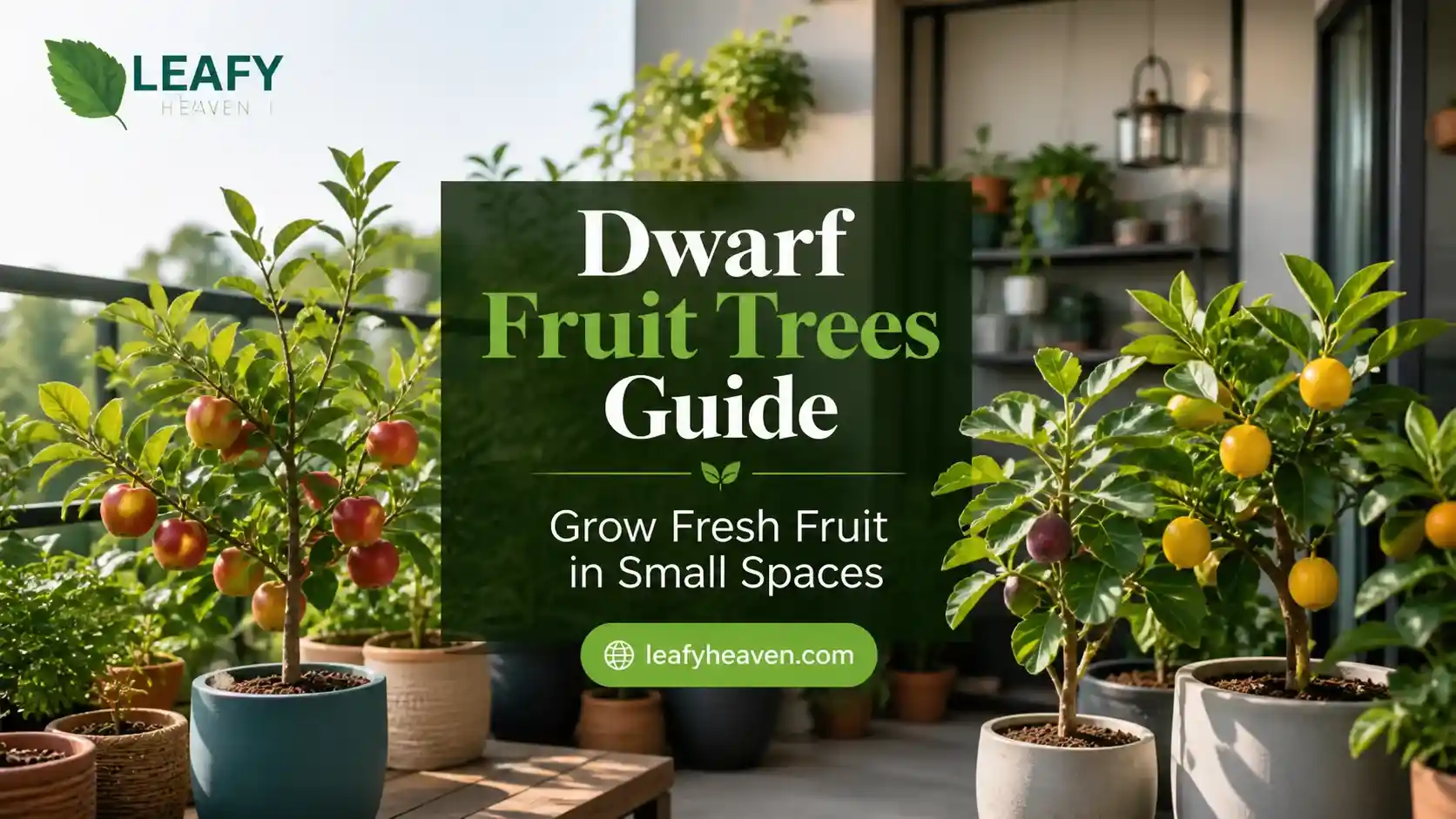
Dwarf fruit trees are highly adaptable to container gardening, making them perfect for modern living spaces. Many gardeners specifically choose dwarf fruit trees for pots because they can thrive in controlled environments such as balconies, rooftops, and patios.
- Can be grown in medium to large containers
- Easily moved based on sunlight requirements
- Perfect for apartments and terrace gardens
- Enhances decorative green space while producing edible fruit
This flexibility makes them one of the most practical choices for urban gardening systems.
Easier Pruning & Harvesting
Due to their reduced height and compact canopy, dwarf fruit trees are significantly easier to maintain compared to standard trees.
- No need for ladders during pruning or harvesting
- Simple canopy management and shaping
- Faster inspection for pests and diseases
- Reduced labor and maintenance effort
This accessibility makes them suitable even for beginner gardeners.
Faster Fruit Production
Dwarf fruit trees often reach maturity and begin fruiting earlier than full-sized trees. This is mainly due to controlled growth energy, which is redirected toward fruit production instead of excessive vegetative growth.
- Earlier fruiting cycle compared to standard trees
- More predictable harvest timelines
- Efficient energy use for fruit development
- Suitable for quick yield home gardening systems
Overall, dwarf fruit trees provide a balanced combination of productivity, convenience, and space efficiency, making them a strong choice for modern edible landscaping and home gardening setups.
Best Dwarf Fruit Trees for Different Climates
Dwarf fruit trees perform differently depending on climate conditions such as temperature range, humidity, and seasonal variation. Selecting the right species for your environment ensures healthier growth, better fruit production, and long-term sustainability. Below is a climate-based breakdown of suitable dwarf fruit trees for various regions.
Warm & Tropical Regions
Warm and tropical climates support fast-growing and highly productive dwarf fruit trees that thrive in consistent heat and humidity.
Common options include:
- Mango (Mangifera indica) – compact dwarf varieties adapt well to warm climates
- Banana (Musa spp.) – naturally fast-growing with dwarf cultivars available
- Citrus (Citrus spp.) – oranges, lemons, limes, and mandarins perform exceptionally well
- Guava (Psidium guajava) – hardy and highly productive in tropical conditions
In these regions, dwarf fruit trees benefit from year-round warmth, which often results in continuous flowering and extended fruiting cycles.
Temperate Regions
Temperate climates require dwarf fruit trees that can tolerate seasonal temperature changes, including cold winters.
Suitable options include:
- Apple (Malus domestica) – one of the most reliable temperate dwarf fruit trees
- Pear (Pyrus communis) – adapts well to cooler climates with proper care
- Cherry (Prunus avium / cerasus) – requires winter chill for proper fruiting
- Plum (Prunus domestica) – hardy and productive in seasonal climates
These trees typically enter dormancy in winter and resume active growth in spring, ensuring a natural fruiting cycle.
Example: Growing in Australia
Australia offers a diverse climate range, making dwarf fruit trees highly adaptable across different regions. Choosing the right variety depends on local conditions such as heat, frost levels, and rainfall patterns.
- dwarf fruit trees australia are widely grown in both urban and rural gardens due to their adaptability and space efficiency
- In warmer zones like Queensland, dwarf fruit trees queensland thrive especially well, with strong performance from citrus, mango, and guava varieties
- Many gardeners prefer small fruit trees australia for balconies, courtyards, and compact backyard spaces where full-sized trees are impractical
- In cooler regions such as southern areas, dwarf fruit trees victoria are commonly selected for apples, pears, cherries, and plums due to their frost tolerance
This regional adaptability makes dwarf fruit trees a practical choice across most Australian growing conditions, from tropical north to temperate south.
How to Grow Dwarf Fruit Trees (Complete Care Guide)
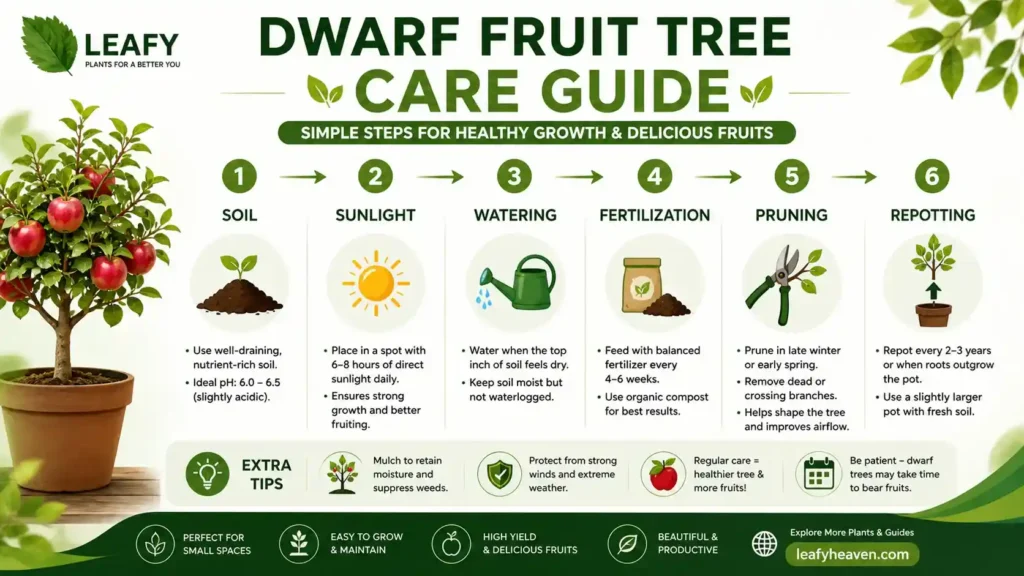
Growing dwarf fruit trees successfully depends on providing balanced conditions that support controlled growth and consistent fruit production. Although these trees are smaller in size, they still follow the same biological needs as standard fruit trees, especially in terms of soil, light, water, and nutrition.
Soil Requirements
Dwarf fruit trees require well-draining, nutrient-rich soil to prevent root stress and encourage healthy growth.
Key soil requirements:
- Loose, aerated structure for proper root expansion
- Well-draining mix to avoid waterlogging
- Organic matter such as compost for long-term fertility
- Slightly acidic to neutral pH (generally 6.0–7.0 for most species)
For container-grown plants, a high-quality potting mix blended with perlite or sand improves drainage and root health.
Sunlight Needs
Sunlight plays a critical role in fruit development and overall tree vigor.
- Most dwarf fruit trees require 6–8 hours of direct sunlight daily
- Citrus, apple, and stone fruits perform best in full sun conditions
- Indoor or balcony trees should be placed near bright, south-facing light sources
- Insufficient light can reduce flowering and fruit yield
Proper light exposure directly influences fruit quality, size, and sweetness.
Watering Schedule
Water management is essential for maintaining healthy root systems in dwarf fruit trees.
Guidelines include:
- Water deeply but infrequently to encourage strong root growth
- Allow the top 2–3 cm of soil to dry before watering again
- Increase watering frequency during hot summer months
- Reduce watering in winter when growth slows
Overwatering is a common issue and can lead to root rot, especially in container-grown trees.
Fertilization
Dwarf fruit trees require balanced nutrition to support steady growth and fruit production.
- Use a balanced fertilizer (NPK 10-10-10 or similar) during growing season
- Apply organic compost or slow-release fertilizers for long-term feeding
- Increase potassium levels during flowering and fruiting stages
- Avoid excessive nitrogen, which promotes leaf growth over fruit production
Regular feeding ensures consistent yield and healthier fruit development.
Pruning & Training
Pruning is essential for maintaining shape, controlling size, and improving airflow.
Best practices:
- Remove dead or weak branches regularly
- Shape the canopy to allow sunlight penetration
- Encourage horizontal growth for better fruit production
- Train young trees using supports or trellises when needed
Proper pruning improves fruit quality and reduces disease risk.
Repotting & Root Care
Container-grown dwarf fruit trees require periodic repotting to maintain root health.
- Repot every 2–3 years or when roots become crowded
- Choose a slightly larger container each time
- Trim circling or damaged roots during repotting
- Refresh soil mix to restore nutrients and drainage capacity
Healthy root systems are the foundation of long-term productivity in dwarf fruit trees.
Dwarf Fruit Trees for Pots & Containers
Dwarf fruit trees are highly suited for container gardening due to their compact root systems and controlled growth patterns. Growing them in pots allows full flexibility in placement, mobility, and environmental control, making them ideal for balconies, patios, rooftops, and small urban gardens. However, success depends on choosing the right varieties and providing proper container conditions.
Best Varieties for Containers
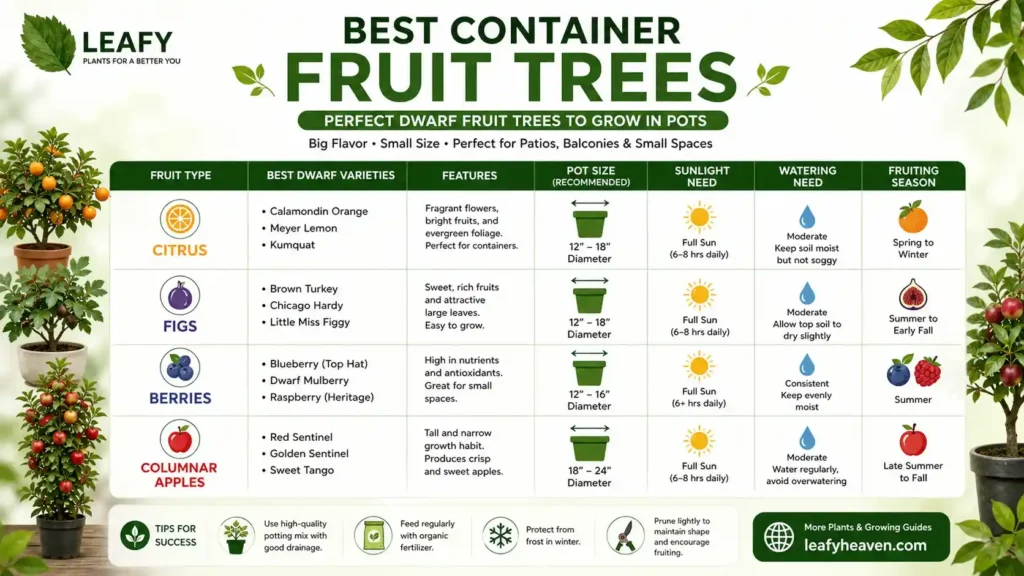
Certain dwarf fruit trees perform exceptionally well in pots due to their natural adaptability and manageable size.
- Citrus (Citrus spp.)
Citrus trees such as lemon, lime, orange, and mandarin are among the most reliable container fruit trees. Compact types like dwarf meyer lemon tree are especially popular for home gardening due to continuous flowering and fruiting. - Figs (Ficus carica)
Dwarf fig trees adapt well to pots and tolerate root restriction better than many other fruit species. They produce sweet fruit even in limited soil volumes. - Berries (Vaccinium, Rubus spp.)
Blueberries, raspberries, and blackberries are naturally compact and thrive in containers with acidic or well-balanced soil conditions. - Columnar Apples (Malus domestica)
Columnar apple varieties grow vertically rather than outward, making them highly space-efficient for pots. They are ideal for narrow spaces like balconies.
These selections are widely used in dwarf fruit trees for pots gardening systems because they maintain productivity while staying compact.
Pot Size & Drainage Tips
Proper container selection is critical for healthy growth and long-term fruit production.
Recommended pot sizes:
- Small dwarf trees (berries, young citrus): 12–16 inches diameter
- Medium trees (figs, apples, mature citrus): 18–24 inches diameter
- Larger dwarf varieties: 24+ inches diameter for stability and root expansion
Drainage guidelines:
- Always use pots with multiple drainage holes
- Add a base layer of gravel or coarse material to improve water flow
- Use a well-draining potting mix (avoid heavy garden soil)
- Ensure excess water can escape freely to prevent root rot
Good drainage combined with the right pot size ensures that dwarf fruit trees remain healthy, productive, and stable in container environments.
Common Problems & Solutions
Even though dwarf fruit trees are easier to manage than full-sized orchard trees, they can still face certain growth and health challenges. Most issues are related to container conditions, watering balance, or nutrient management. Understanding these problems early helps maintain healthy growth and consistent fruit production.
Root-Bound Issues
Root-bound conditions occur when the tree’s roots outgrow the container and begin circling tightly around the pot. This restricts nutrient and water absorption.
Common signs:
- Stunted growth despite proper care
- Roots visible on soil surface or drainage holes
- Soil drying out very quickly after watering
Solutions:
- Repot the tree into a larger container every 2–3 years
- Gently prune circling roots during repotting
- Refresh soil with a nutrient-rich, well-draining mix
- Ensure the new pot allows sufficient root expansion
Overwatering
Overwatering is one of the most common issues in dwarf fruit tree care, especially in containers where drainage is limited.
Common signs:
- Yellowing leaves
- Soft or mushy roots
- Fungal growth on soil surface
- Drooping despite wet soil
Solutions:
- Allow topsoil to dry before watering again
- Use pots with proper drainage holes
- Switch to a well-draining soil mix
- Reduce watering frequency in cooler seasons
Balanced moisture is essential to prevent root rot and maintain healthy growth.
Pests & Diseases
Dwarf fruit trees can attract common garden pests and fungal diseases, particularly in warm or humid conditions.
Common pests:
- Aphids
- Spider mites
- Scale insects
- Whiteflies
Common diseases:
- Powdery mildew
- Root rot
- Leaf spot fungi
Solutions:
- Regularly inspect leaves and stems
- Use neem oil or insecticidal soap for pests
- Improve air circulation around the plant
- Avoid wetting leaves during watering
- Remove infected plant parts immediately
Early detection is key to preventing widespread damage.
Nutrient Deficiencies
Limited soil volume in containers can lead to nutrient depletion over time, affecting growth and fruit quality.
Common signs:
- Pale or yellow leaves
- Poor flowering or fruit drop
- Weak, slow growth
Solutions:
- Apply balanced fertilizer during the growing season
- Use compost or organic matter to replenish soil nutrients
- Supplement with potassium and micronutrients during fruiting
- Refresh potting soil periodically
Proper nutrition ensures strong development and consistent fruit yield in dwarf fruit trees.
Landscaping & Home Use Ideas
Dwarf fruit trees are not only productive but also highly versatile in landscape design. Their compact structure allows them to be integrated into decorative and functional spaces, making them a key element in modern edible landscaping. They bring both aesthetic value and fresh harvests into small and urban environments.
Balcony Gardens
Balcony gardening is one of the most popular uses for dwarf fruit trees, especially in apartments and urban homes where ground space is limited.
- Ideal for containers placed along railings or corners
- Suitable for compact species like citrus, figs, and berries
- Can be arranged to create a green privacy screen
- Provides fresh fruit production in small outdoor spaces
This setup transforms even a small balcony into a productive green zone.
Patio Orchards
Patio orchards allow gardeners to grow multiple dwarf fruit trees in a structured and visually appealing layout.
- Combination of citrus, apples, figs, and stone fruits
- Trees can be arranged in pots for easy movement and sunlight adjustment
- Creates a mini orchard environment in compact outdoor areas
- Supports diverse fruit production in a controlled space
Patio orchards are especially effective for maximizing yield in limited areas.
Indoor Placement (Bright Light Areas)
Some dwarf fruit trees can be grown indoors if proper light conditions are provided.
- Best suited near large windows or glass doors
- Requires strong natural light for healthy growth and fruiting
- Compact citrus varieties perform well indoors
- Supplemental grow lights may be needed in low-light spaces
Indoor placement works best for decorative edible plants that also enhance home aesthetics.
Decorative Edible Landscaping
Dwarf fruit trees are widely used in decorative edible landscaping, where beauty and productivity are combined.
- Blends ornamental plants with fruit-bearing species
- Adds seasonal flowers and fruit color to garden design
- Can be structured into borders, pathways, or focal points
- Enhances biodiversity in small home gardens
This approach creates a visually appealing landscape while also providing a continuous supply of fresh fruit.
Conclusion
Dwarf fruit trees are a practical solution for modern lifestyles where space, time, and maintenance efficiency are important factors. Their compact structure allows them to fit into small gardens, balconies, and container setups while still delivering reliable fruit production. Unlike traditional large orchard trees, they are easier to manage, faster to maintain, and highly adaptable to both urban and suburban environments. This makes them an ideal choice for home gardeners who want productivity without requiring large outdoor spaces.
Their versatility also supports a wide range of growing conditions, from indoor bright areas to outdoor patios and terraces. With proper care, they provide consistent harvests and long-term gardening value.
For beginners, it is best to start with proven and easy-to-manage varieties such as dwarf apple trees and dwarf citrus trees. These options are highly adaptable, productive, and well-suited for learning essential fruit tree care techniques while ensuring early success in small-space gardening.
FAQs
What are dwarf fruit trees?
Dwarf fruit trees are specially cultivated fruit trees that are kept small in size through dwarfing rootstocks or natural compact growth habits. They produce full-sized fruits but remain significantly smaller than standard orchard trees, making them ideal for limited spaces.
How big do dwarf fruit trees grow?
Most dwarf fruit trees grow between 3 to 10 feet tall, depending on the species, rootstock, and growing conditions. Their controlled height makes them suitable for pots, patios, and small gardens.
Which dwarf fruit trees are best for pots?
Some of the best dwarf fruit trees for pots include citrus varieties (lemon, lime, orange), figs, blueberries, columnar apples, and compact stone fruits like peaches and cherries.
Do dwarf trees produce full-size fruit?
Yes, dwarf fruit trees produce normal-sized fruit. The “dwarf” term refers only to the tree’s size, not the fruit size or quality.
How long do dwarf fruit trees take to fruit?
Many dwarf fruit trees start producing fruit within 1 to 3 years, which is generally faster than standard-sized trees due to their faster maturity cycle.
Can dwarf citrus trees grow indoors?
Yes, dwarf citrus trees can grow indoors if they receive sufficient sunlight. They need at least 6–8 hours of bright light daily, preferably near a sunny window or under grow lights.
Are dwarf fruit trees suitable for beginners?
Yes, dwarf fruit trees are excellent for beginners because they are easier to manage, require less pruning, and are more convenient to harvest compared to standard fruit trees.
What is the best way to maintain dwarf fruit trees long-term?
To maintain healthy growth, ensure proper pruning, use well-draining soil, repot every few years, and provide balanced fertilization during the growing season.

Written by the LeafyHeaven Editorial Team
LeafyHeaven shares practical gardening tips and simple plant care guides to help you grow, nurture, and enjoy your plants with ease. Our goal is to make gardening feel natural, approachable, and rewarding for everyone.