
Introduction
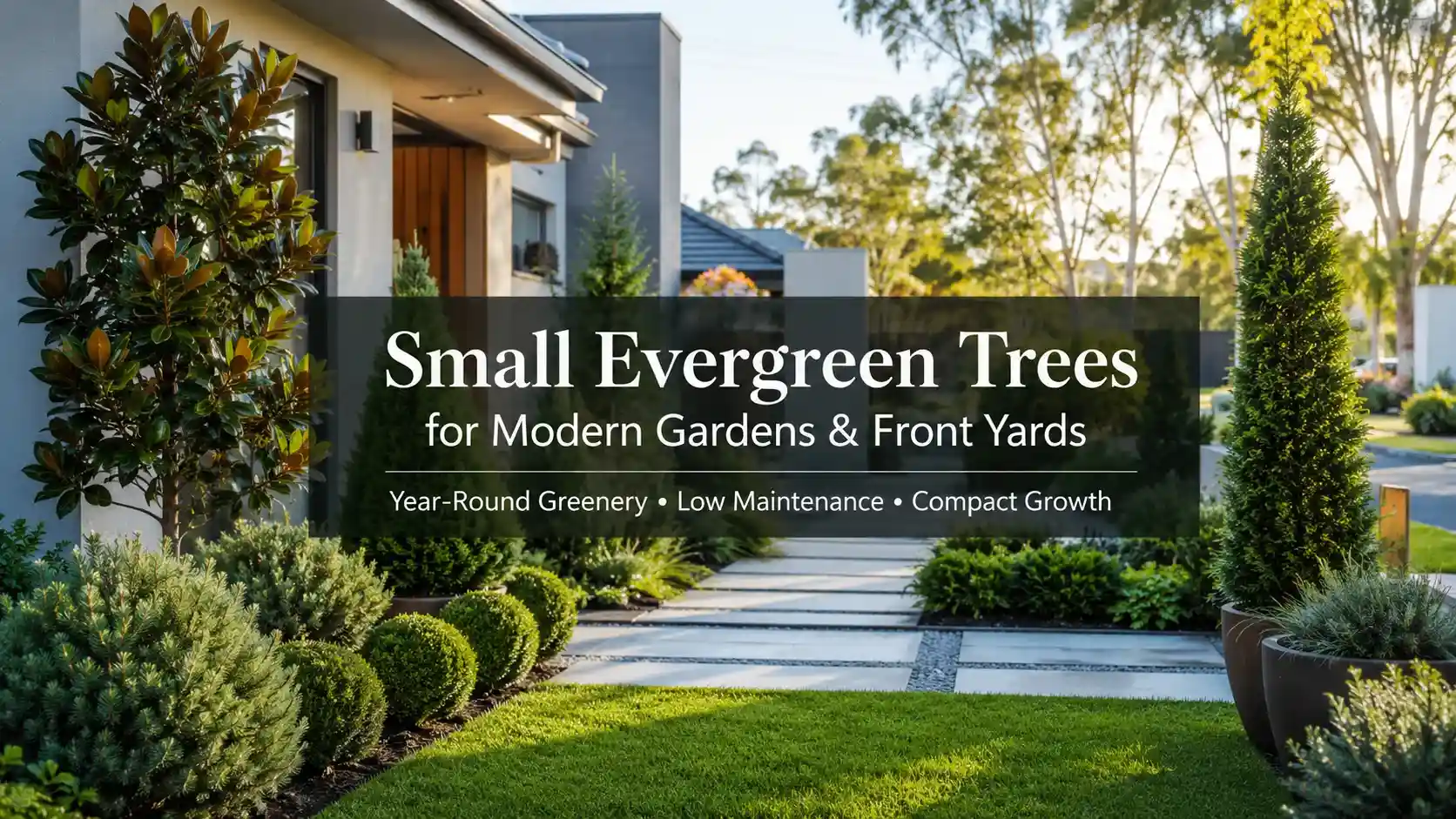
Small evergreen trees are compact, non-deciduous plants that retain their foliage throughout the year, making them a reliable choice for consistent greenery in outdoor spaces. Unlike seasonal plants, evergreen trees maintain structure, color, and visual appeal in all climates. Whether referred to as an evergreen small tree or small trees evergreen, these plants are valued for their ability to deliver year-round foliage with minimal upkeep.
One of the key advantages of small evergreen trees is their low maintenance nature combined with controlled, compact growth. This makes them especially suitable for modern landscapes where space is limited. Dwarf evergreen trees, in particular, are ideal for tight areas, offering the same aesthetic benefits as larger trees without overwhelming the space.
From small evergreen trees for garden layouts to small evergreen trees for small gardens, these versatile plants fit seamlessly into both residential and urban designs. Their adaptability is evident across regions, including evergreen trees Australia and a wide range of Australian evergreen trees, where climate-resilient varieties thrive in diverse conditions.
What Are Small Evergreen Trees? (Types, Features & Classification)
Evergreen Tree Meaning & Characteristics
Small evergreen trees are a category of non deciduous trees that retain their leaves or needles throughout the year instead of shedding them seasonally. These trees maintain continuous foliage, ensuring stable structure, color, and coverage in all seasons. Among different tree types evergreen, they are especially valued for consistent visual appeal and functional use in landscapes.
Key characteristics of evergreen tree varieties include:
- Continuous foliage retention (no seasonal leaf drop)
- Gradual leaf replacement instead of complete shedding
- Strong adaptability to various climates
- Dense canopy structure for privacy and screening
The lifecycle of evergreen trees differs from deciduous species. Instead of losing all leaves at once, older foliage is replaced gradually, allowing the tree to remain green year-round. This biological trait is what defines evergreen tree varieties and makes them highly reliable for long-term landscaping.
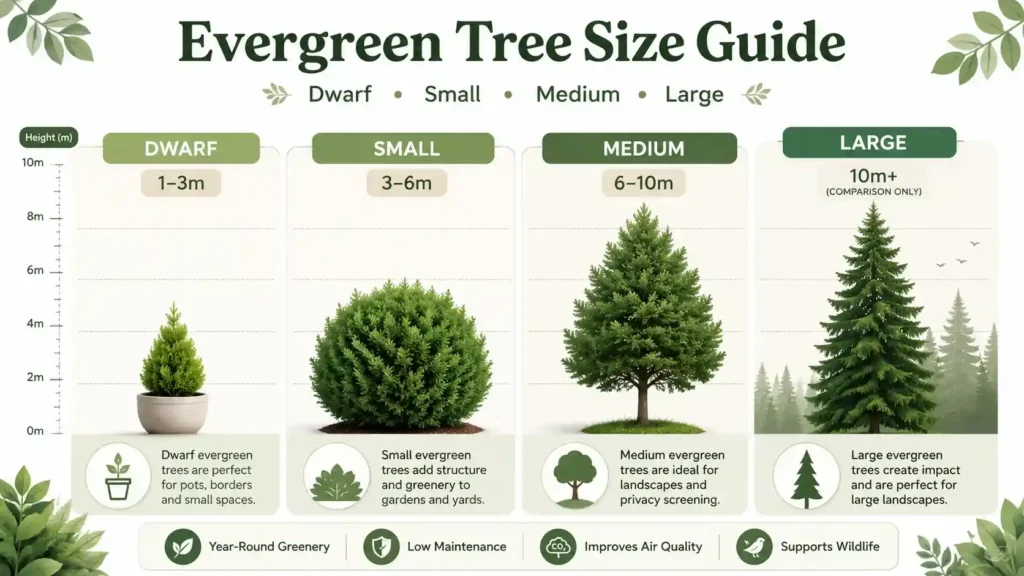
Size Categories (Dwarf, Small, Medium)
Evergreen trees are classified based on their mature height and growth potential. Understanding these categories helps in selecting the right tree for specific garden sizes and purposes.
- Dwarf evergreen trees (1–3 meters)
- Compact and slow-growing
- Ideal for containers, borders, and tight spaces
- Suitable for patios and small gardens
- Small evergreen trees (3–6 meters)
- Balanced size for residential landscapes
- Common choice for front yards and decorative planting
- Provide moderate shade and structure
- Medium evergreen trees (6–10 meters)
- Larger canopy and faster growth compared to smaller types
- Used for screening, windbreaks, and privacy
- Large evergreen trees (10m+) (for comparison)
- Suitable for large landscapes and open areas
- Not ideal for compact or urban gardens
This classification ensures proper spacing, long-term growth planning, and effective landscape design.
Growth Habits & Structure
Small evergreen trees vary significantly in shape, density, and structural growth patterns. Their form directly influences how they are used in landscaping.
Common growth habits include:
- Dwarf narrow evergreen trees
- Upright, columnar form
- Ideal for tight spaces, pathways, and boundary planting
- Rounded or bushy forms
- Dense foliage with symmetrical shape
- Used for ornamental and decorative purposes
- Spreading canopy types
- Wider horizontal growth
- Suitable for shade and ground coverage
- Evergreen medium tree structures
- Balanced height and spread
- Used for both decorative and functional landscaping
- Evergreen large trees
- Broad canopy and deep root systems
- Primarily used in large-scale landscapes
Understanding these structural variations helps in selecting trees that align with spatial constraints, design goals, and maintenance expectations.
Benefits of Small Evergreen Trees for Gardens & Landscapes
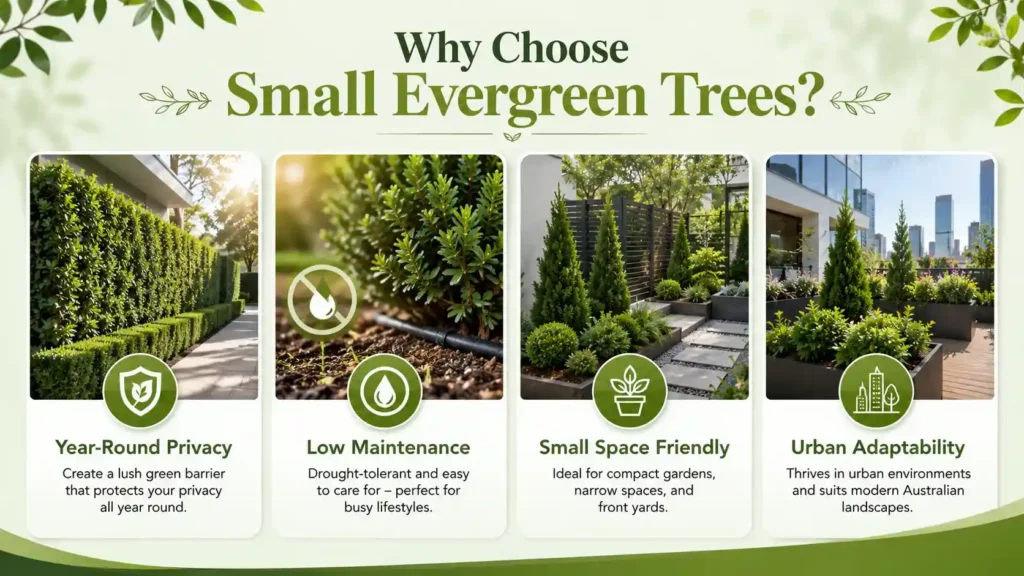
Year-Round Privacy & Aesthetic Appeal
Small evergreen trees provide continuous visual structure and coverage, making them highly effective for privacy and landscape enhancement. Unlike seasonal plants, they maintain dense foliage throughout the year, ensuring uninterrupted screening and greenery.
Key advantages:
- Consistent privacy due to full-year foliage retention
- Strong visual structure in all seasons
- Enhanced curb appeal with clean, defined shapes
- Suitable for both formal and natural garden designs
Many evergreen decorative trees and ornamental evergreen trees are specifically selected for their foliage texture, color variation, and symmetrical growth, making them ideal focal points in both front yards and landscaped gardens.
Low Maintenance & Hardy Nature
Small evergreen trees are widely preferred for their durability and minimal care requirements. Once established, most varieties require less watering, pruning, and overall management compared to deciduous species.
Core benefits:
- Reduced watering needs after establishment
- Minimal seasonal cleanup (no heavy leaf drop)
- Strong resistance to environmental stress
- Adaptability to different soil and climate conditions
Hardy evergreen trees are particularly suitable for challenging environments, including dry or variable climates. In regions like Australia, low maintenance 2 metre high trees australia are commonly used in residential landscapes where easy care and long-term sustainability are priorities.
Ideal for Small Spaces & Urban Gardens
Compact growth and controlled size make small evergreen trees highly effective for limited spaces and urban environments. They provide greenery without overcrowding, making them ideal for modern garden layouts.
Best use cases:
- Courtyards and narrow garden beds
- Boundary planting and space division
- Container gardening and patio design
- Urban landscapes with limited ground space
Options such as very small trees for small gardens australia and narrow trees for small gardens australia are specifically suited for tight layouts, offering vertical growth and efficient space utilization without compromising on aesthetic or functional value.
Best Small Evergreen Trees
Popular Worldwide Small Evergreen Trees
Globally, several small evergreen trees are widely used for their compact size, adaptability, and ornamental value. These trees perform well across different climates and are commonly selected for structured landscaping and decorative planting. Juniper varieties are also a popular choice in this category due to their hardy nature and diverse landscaping applications. You can explore more creative naming ideas and varieties of juniper in this detailed guide on Juniper tree names.
Popular examples:
- Dwarf Alberta Spruce (Picea glauca ‘Conica’)
- Dense, conical shape
- Slow-growing and highly compact
- Ideal for formal gardens and entryways
- Alberta Spruce
- Classic evergreen form with symmetrical growth
- Suitable for containers and small landscapes
- Boxwood Tree (Buxus sempervirens – trained form)
- Pruned into small tree shapes
- Common in formal garden design
- Olive Tree (Evergreen varieties)
- Silver-green foliage
- Suitable for Mediterranean-style landscapes
These small ornamental evergreen trees are preferred for their neat structure, low maintenance, and consistent visual appeal in both residential and commercial settings.
Top Australian Small Evergreen Trees
Australia offers a wide range of native evergreen species adapted to diverse climates, from coastal regions to dry inland areas. These trees are valued for their resilience, low water requirements, and compatibility with local ecosystems.
Common categories and examples:
- Evergreen native Australian trees
- Lilly Pilly (Syzygium species) – dense foliage, ideal for hedging and screening
- Callistemon (Bottlebrush) – flowering evergreen with vibrant blooms
- Australian native canopy trees (small forms)
- Water Gum (Tristaniopsis laurina) – compact canopy, suitable for streets and gardens
- Native Frangipani (Hymenosporum flavum) – fragrant flowers, controlled height
- Regional adaptability
- Small evergreen trees Melbourne – suited to temperate climates (e.g., Magnolia, Lilly Pilly)
- Small evergreen trees South Australia – drought-tolerant species (e.g., Olive, Eucalyptus dwarf varieties)
- Small evergreen trees Tasmania – cool-climate tolerant species (e.g., Camellia, conifers)
- Small evergreen trees Adelaide – heat- and drought-resistant varieties
These small evergreen trees Australia are widely used due to their environmental adaptability and low maintenance requirements.
Feature Tree Options for Front Yards
Small evergreen trees are excellent choices as focal points in front yard landscaping. Their structured growth and year-round foliage create a strong visual anchor without overwhelming the space.
Best options for feature planting:
- Magnolia ‘Little Gem’
- Glossy leaves and white flowers
- Compact and visually striking
- Lilly Pilly (standard form)
- Dense foliage, easily shaped
- Suitable for modern front yards
- Japanese Box (trained tree form)
- Clean, formal appearance
- Ideal for symmetrical designs
- Dwarf Conifers
- Structured, geometric shapes
- Perfect for minimalist landscapes
Use cases:
- Feature tree front yard Australia designs for curb appeal
- Single small feature tree as a focal point
- Multiple small feature trees Australia for symmetry and balance
- Functional and decorative trees for front yard Australia
- Enhancing entryways with structured front yard trees Australia
These trees combine aesthetic value with practicality, making them ideal for both decorative and functional front yard landscaping.
Spotlight Tree: Magnolia Little Gem
Overview & Botanical Details
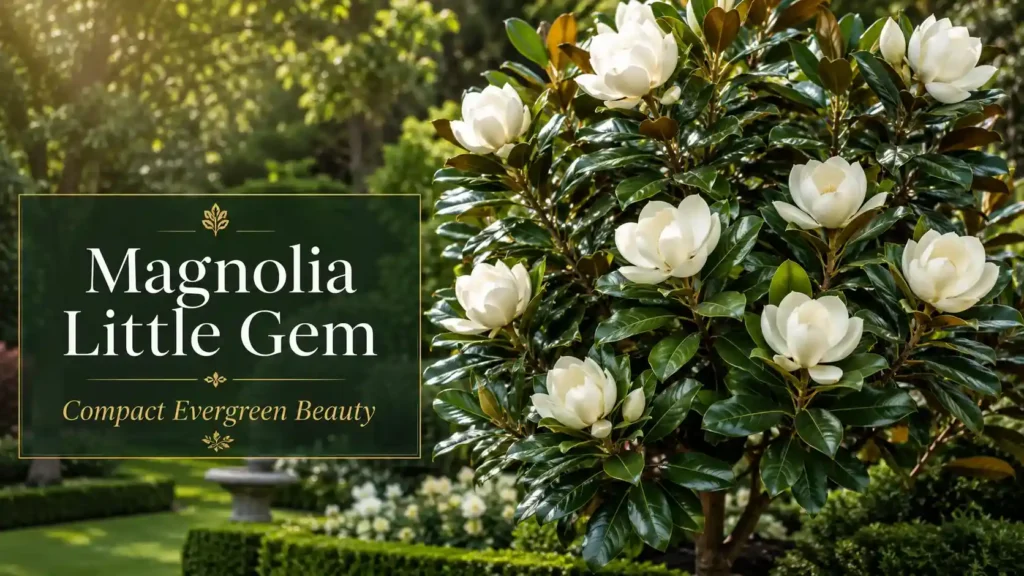
Magnolia Little Gem is a compact evergreen variety of Southern Magnolia, widely valued for its manageable size and ornamental appeal. Commonly referred to as little gem magnolia or magnolia tree little gem, this cultivar is specifically developed for smaller landscapes while retaining the classic magnolia characteristics.
Key botanical details:
- Scientific name: Magnolia grandiflora ‘Little Gem’
- Type: Evergreen flowering tree
- Origin: Cultivated variety (adapted for urban and residential planting)
- Foliage: Dark green, glossy leaves with bronze undersides
- Growth habit: Upright, dense, and compact
This tree is a popular choice in both global and Australian landscapes due to its structured form and year-round visual consistency.
If you are comparing cultivars, reviewing other types of magnolia trees in Australia can help you choose the best magnolia variety for your landscape.
Growth Size, Features & Flowering
Magnolia Little Gem is known for its compact growth, making it ideal for small gardens and front yard applications.
Growth characteristics:
- Mature height: 4–6 meters
- Spread: 2–3 meters
- Growth rate: Moderate
Key features:
- Dense, compact canopy suitable for limited spaces
- Glossy evergreen leaves that provide year-round structure
- Produces large, fragrant white flowers during the flowering season
- Extended blooming period compared to larger magnolia varieties
As one of the most popular evergreen flowering trees Australia, it combines ornamental foliage with seasonal blooms. It also fits well within the category of small flowering trees Australia, making it highly suitable for decorative landscaping without requiring excessive space.
Care Guide (Soil, Sun, Water)
Proper care ensures healthy growth and optimal flowering performance of Magnolia Little Gem.
Soil requirements:
- Well-drained, slightly acidic soil
- Enriched with organic matter for better root development
Sunlight needs:
- Full sun to partial shade
- Performs best with at least 5–6 hours of direct sunlight daily
Watering guidelines:
- Regular watering during establishment phase
- Moderate watering once established
- Avoid waterlogged conditions
Additional care tips:
- Light pruning to maintain shape and remove dead branches
- Mulching helps retain soil moisture and regulate temperature
Contextual comparison:
Compared to conifers like those requiring picea glauca care Australia, Magnolia Little Gem generally prefers richer soil and slightly more consistent moisture. While Picea glauca varieties are more tolerant of colder climates and drier conditions, magnolias perform best in balanced, well-maintained garden environments.
This combination of manageable size, ornamental value, and straightforward care makes Magnolia Little Gem a leading choice for small evergreen tree applications.
How to Choose the Right Small Evergreen Tree
Based on Garden Size & Space
Selecting the right tree begins with understanding available space and long-term growth expectations. Small evergreen trees must be matched carefully with garden dimensions to avoid overcrowding and maintenance issues later.
Key considerations:
- Measure planting space before selection
- Account for mature height and canopy spread
- Avoid planting large species in restricted areas
For compact landscapes, small garden evergreen trees are the most practical choice because they maintain structure without overwhelming the layout. Similarly, evergreen trees for a small garden should be selected based on slow to moderate growth patterns and controlled root systems to ensure long-term balance in the space.
Sunlight & Climate Considerations
Sun exposure and regional climate play a major role in determining tree health, growth rate, and longevity. Different evergreen species respond differently to heat, cold, and light intensity.
Important factors:
- Full sun exposure (6+ hours daily) supports dense foliage development
- Partial shade species are better for protected or indoor-adjacent gardens
- Drought tolerance is essential in hot or dry regions
In warmer regions like Australia, small trees for full sun Australia are widely preferred due to their ability to withstand heat while maintaining consistent growth and foliage density. Selecting climate-appropriate varieties reduces maintenance and improves long-term survival rates.
Purpose-Based Selection
Choosing a small evergreen tree also depends on its intended function in the landscape. Each purpose requires different growth habits, density, and structural characteristics.
Common purposes include:
- Privacy
- Dense foliage and upright growth
- Acts as a natural screen between properties
- Decoration
- Aesthetic appeal with flowers, foliage texture, or shape
- Often used as focal or feature points
- Screening
- Medium-density trees that block wind, noise, or visibility
- Suitable for boundary planting
For these applications, evergreen feature trees are commonly selected due to their strong visual presence and year-round structure. In landscape design, evergreen feature tree Australia options are especially popular because they combine functionality with ornamental value while remaining adaptable to local climate conditions.
Root System, Growth Rate & Size Expectations
Root System Behavior
Small evergreen trees vary in root structure depending on species, soil type, and maturity. Understanding root behavior is essential for safe planting in limited spaces such as urban gardens and residential landscapes.
Key root system types:
- Shallow root systems
- Spread horizontally near the soil surface
- Common in dwarf and small evergreen varieties
- Suitable for compact gardens and containers
- Require mulching to protect surface roots
- Deep root systems
- Grow vertically into the soil
- Provide strong anchorage and drought resistance
- More common in medium evergreen trees
- Require more underground space
For small landscapes, shallow-rooted varieties are generally preferred because they reduce the risk of structural interference with pathways, walls, and foundations.
Growth Timeline
Growth rate plays a major role in selecting evergreen trees for landscaping, especially when long-term garden planning is required.
- Slow-growing trees
- Take longer to reach maturity
- Lower maintenance requirements
- Ideal for formal gardens and structured designs
- Moderate growth trees
- Balanced development rate
- Common in residential front yards
- Provide quicker visual impact without becoming unmanageable
- Fast-growing native trees South Australia
- Adapted to local climate conditions
- Rapid establishment in suitable soil
- Often used for screening and windbreaks
- Require regular pruning to maintain shape
Selecting the right growth rate ensures long-term control, especially in small or medium-sized garden environments.
Mature Height & Spread Table
|
Tree Type |
Height | Growth Rate |
Use Case |
| Dwarf Evergreen Trees | 1–3m | Slow |
Small gardens |
|
Small Evergreen Trees |
3–6m | Moderate | Front yards |
| Medium Evergreen Trees | 6–10m | Fast |
Screening |
This classification helps in selecting the correct tree based on available space, maintenance capacity, and landscape purpose. Proper planning of mature height and spread ensures balanced garden design and prevents overcrowding over time.
How to Plant & Care for Small Evergreen Trees
Planting Guide (Step-by-Step)
Proper planting is the foundation of healthy growth for small evergreen trees. Correct soil preparation, spacing, and watering directly impact long-term establishment and structure.
Following a complete gardening and plant care guide can help ensure proper planting techniques, healthier root establishment, and stronger long-term growth.
Soil preparation:
- Choose well-drained soil to prevent root rot
- Mix organic compost to improve nutrient content
- Avoid heavy clay soil unless properly amended
Planting steps:
- Dig a hole twice the width of the root ball and equal in depth
- Gently loosen roots before placing the tree in the hole
- Position the tree upright and center it carefully
- Backfill with soil and lightly compact to remove air pockets
- Water deeply immediately after planting
Spacing guidelines:
- Dwarf varieties: 1–2 meters apart
- Small evergreen trees: 2–4 meters apart
- Adjust spacing based on canopy spread at maturity
Watering:
- Water regularly during the first 6–12 months
- Keep soil moist but not waterlogged
- Reduce frequency once the tree is established
Maintenance Tips
Small evergreen trees are generally low maintenance, but regular care ensures healthy structure and long-term growth.
Pruning:
- Remove dead or damaged branches annually
- Light shaping helps maintain form and density
- Avoid heavy pruning, especially in young trees
Fertilizing:
- Apply slow-release fertilizer during growing season
- Use balanced nutrients (NPK) for steady foliage growth
- Compost mulch helps improve soil quality naturally
Consistent maintenance improves foliage density and supports strong structural development.
Common Problems & Solutions
Even hardy evergreen trees can face occasional issues. Early identification and treatment help prevent long-term damage.
Pests:
- Aphids and scale insects are common on evergreen foliage
- Solution: Use insecticidal soap or natural neem oil treatments
- Regular inspection reduces infestation risk
Diseases:
- Root rot caused by overwatering or poor drainage
- Fungal infections in humid conditions
- Solution: Improve drainage, reduce watering, and apply fungicide if necessary
Maintaining proper soil conditions, airflow, and watering balance significantly reduces the risk of pests and diseases in small evergreen trees.
Landscaping Ideas Using Small Evergreen Trees
Front Yard Design Ideas
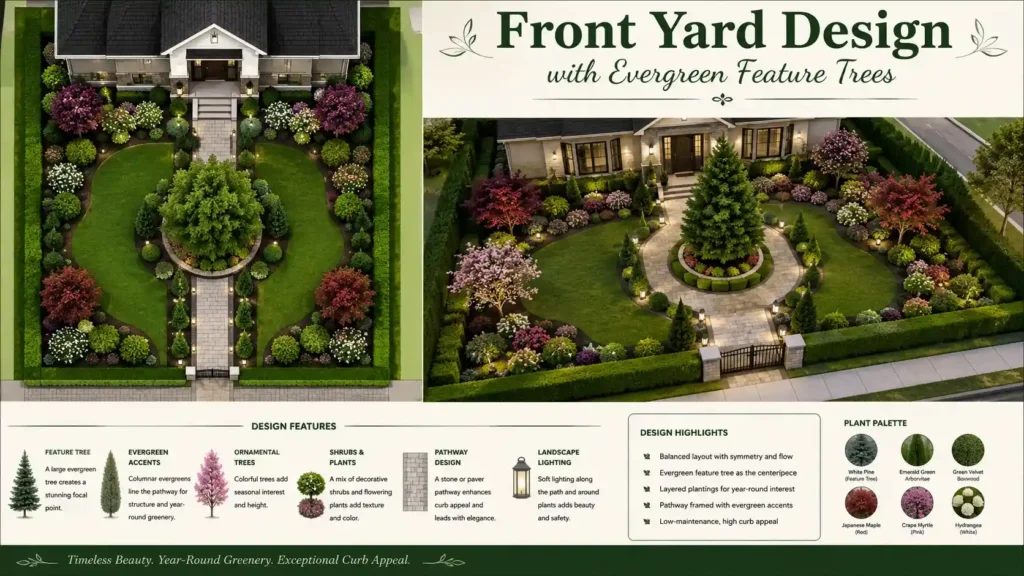
Small evergreen trees play a key role in creating structured and visually appealing front yard landscapes. Their year-round foliage provides consistent curb appeal while maintaining a clean and organized appearance.
Effective design uses:
- Single focal planting near entryways for strong visual impact
- Symmetrical placement on both sides of pathways
- Layered planting with shrubs for depth and structure
In front yard tree Australia designs, small evergreen species are widely used because they handle varying climates well and maintain form throughout the year. Carefully selected trees for front yard landscaping also improve property value and enhance first impressions without requiring excessive maintenance.
Small Garden Layouts
Small evergreen trees are ideal for compact garden spaces where efficient use of area is essential. Their controlled growth allows gardeners to create structured layouts without overcrowding.
Best layout ideas:
- Corner planting to maximize central open space
- Boundary planting for natural green borders
- Mixed layering with groundcovers and shrubs
- Vertical accents to add height variation
Small evergreen trees for garden designs focus on balance between greenery and space efficiency. These trees help maintain structure while ensuring the garden does not feel congested, making them ideal for modern residential landscapes.
Decorative & Ornamental Use
Beyond functional landscaping, small evergreen trees are widely used for decorative and ornamental purposes. Their shape, foliage texture, and seasonal consistency make them highly versatile design elements.
Common applications:
- Entryway decoration for homes and commercial spaces
- Patio and courtyard focal points in containers
- Garden centerpieces for structured visual appeal
Ornamental small trees are often chosen for their refined appearance and manageable size. In regions like Australia, small ornamental trees Australia are especially popular due to their adaptability, aesthetic value, and ability to thrive in diverse environmental conditions while maintaining year-round greenery.
Quick Comparison: Evergreen Trees vs Deciduous Trees
Understanding the difference between evergreen and deciduous trees is important when planning long-term garden structure, privacy, and maintenance needs. Both types serve different landscape functions depending on climate, design goals, and seasonal preferences.
Comparison Table
|
Feature |
Evergreen Trees | Deciduous Trees |
| Leaves | Year-round |
Seasonal (shed annually) |
|
Maintenance |
Low | Medium |
| Privacy | High |
Low (winter loss of leaves) |
Key Differences Explained
Evergreen Trees
- Retain foliage throughout the year
- Provide continuous privacy and screening
- Require less seasonal cleanup
- Maintain consistent landscape structure in all seasons
Deciduous Trees
- Shed leaves in autumn or dry seasons
- Offer seasonal shade variation
- Require more cleanup due to leaf fall
- Provide less privacy during leafless periods
A more detailed breakdown of deciduous vs evergreen trees can help clarify which tree type better suits your climate and landscaping goals.
Practical Landscaping Insight
Evergreen trees are generally preferred in modern residential landscaping where year-round coverage and low maintenance are priorities. Deciduous trees, on the other hand, are often selected for seasonal aesthetics, shade variation, and autumn color effects. Choosing between them depends on whether the goal is consistent privacy or seasonal visual change.
Conclusion / Final Thoughts
Small evergreen trees remain one of the most reliable choices for modern landscaping due to their year-round foliage, structured growth, and low maintenance requirements. They provide consistent greenery in all seasons, making them highly valuable for both functional and decorative garden designs. Whether used in residential landscapes, urban spaces, or compact outdoor areas, they offer long-term stability and visual balance without demanding intensive care.
Among these, dwarf evergreen trees stand out as especially suitable for today’s compact living environments. Their controlled height and narrow growth habit make them ideal for small gardens, courtyards, and front yard designs where space efficiency is essential.
Ultimately, selecting the right evergreen tree should always be based on local climate conditions, available space, and intended purpose. A well-matched choice ensures healthier growth, better landscape performance, and long-lasting aesthetic value.
FAQs
What are the best small evergreen trees for small gardens?
Some of the best options include dwarf conifers, Magnolia Little Gem, Lilly Pilly (compact varieties), and boxwood. These trees stay compact, retain foliage year-round, and fit well in small evergreen trees for garden layouts without overcrowding the space.
Which dwarf evergreen trees grow the fastest?
Most dwarf evergreen trees are naturally slow-growing, but faster options include certain compact cypress varieties and some grafted conifers. Even fast dwarf types remain manageable in size, making them ideal for structured small gardens.
Are evergreen trees low maintenance?
Yes, most evergreen trees are low maintenance once established. They require minimal pruning, moderate watering, and occasional feeding. Hardy varieties reduce workload further, especially in climates where hardy evergreen trees naturally adapt well.
What is the best evergreen tree for front yard landscaping?
Popular choices include Magnolia Little Gem, dwarf conifers, and Lilly Pilly standards. These are commonly used as evergreen feature trees because they provide strong visual appeal and year-round structure in front yard trees Australia designs.
Can small evergreen trees grow in full sun?
Yes, many species thrive in full sun conditions. In fact, several small trees for full sun Australia are specifically adapted to handle heat and bright exposure while maintaining dense, healthy foliage.
Which evergreen trees are best for Australia climates?
In Australia, popular choices include Lilly Pilly, Callistemon, Magnolia Little Gem, and native Eucalyptus dwarf varieties. These small evergreen trees Australia options are well-suited to diverse regions like Melbourne, Adelaide, Tasmania, and South Australia due to their climate adaptability.
Are small evergreen trees suitable for low-water gardens?
Yes, many varieties such as native Australian evergreens and olive trees are drought-tolerant once established. They are commonly used in sustainable landscaping where water efficiency is important.
Do small evergreen trees grow well in containers?
Yes, dwarf evergreen trees are excellent for pots and containers. They are often used in patios, balconies, and entryways where space is limited but greenery is desired year-round.

Written by the LeafyHeaven Editorial Team
LeafyHeaven shares practical gardening tips and simple plant care guides to help you grow, nurture, and enjoy your plants with ease. Our goal is to make gardening feel natural, approachable, and rewarding for everyone.