
Introduction
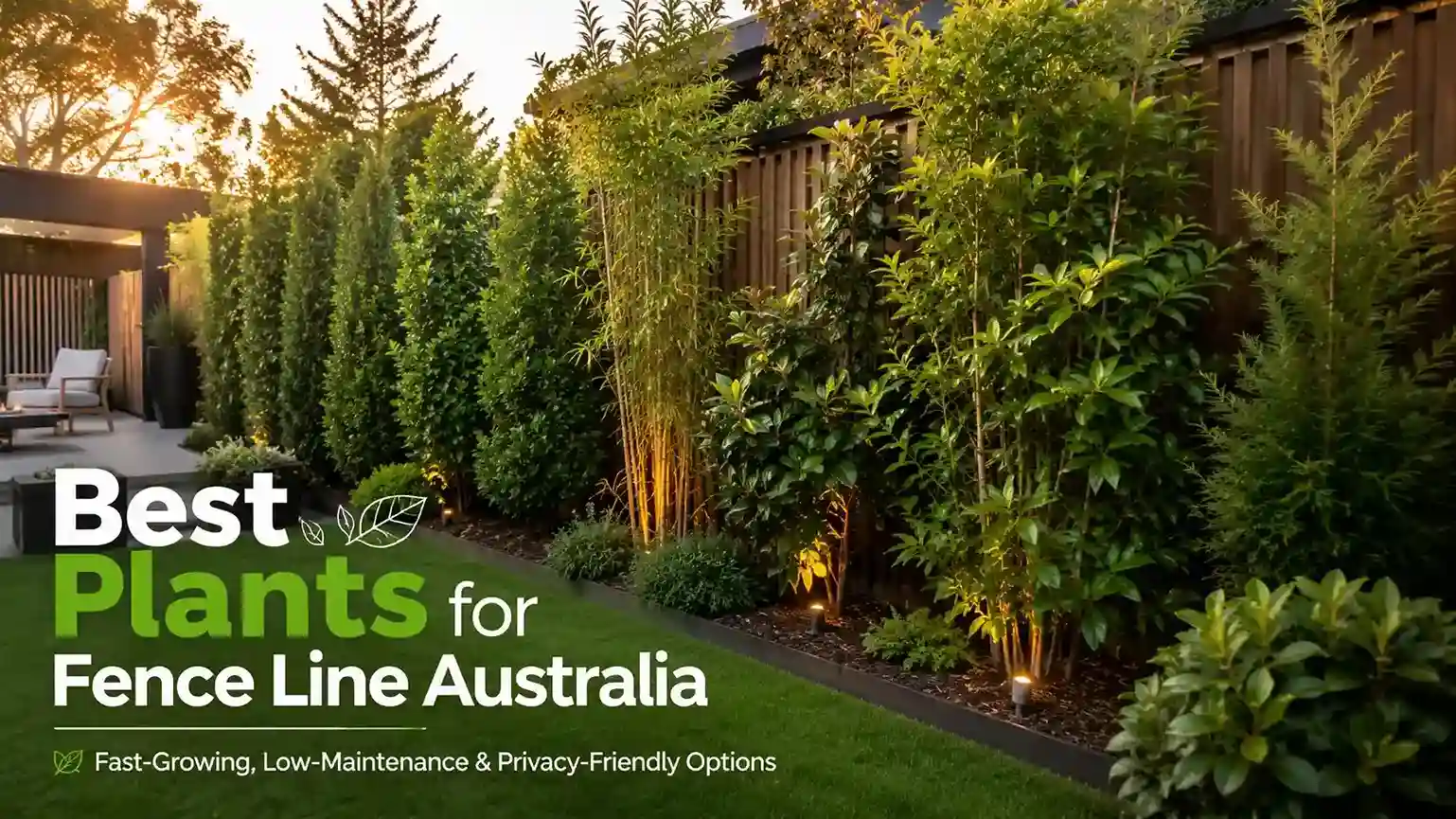
The best plants for fence line Australia include fast-growing hedges, narrow screening plants, evergreen trees, and low-maintenance native species that improve privacy, reduce noise, block harsh winds, and enhance outdoor landscaping. Many Australian homeowners use plants for screening Australia properties because they create natural boundaries while adding greenery and year-round visual appeal. From compact suburban yards to large rural properties, the right fence privacy plants can transform exposed outdoor spaces into more comfortable and functional environments.
Australians commonly install privacy screen plants along boundaries to block neighbours, create shade, soften fencing, and improve backyard aesthetics. In coastal areas, screen plants Australia gardeners choose often need salt and wind tolerance, while tropical regions require heat- and humidity-resistant species. Temperate climates support a wide range of evergreen hedges and ornamental trees, while dry inland regions benefit from drought-tolerant native screening plants.
Choosing the best screening plants Australia gardens require depends heavily on climate compatibility, soil quality, sunlight exposure, root behaviour, and ongoing maintenance needs. Some trees to plant along fence line Australia homes are better suited for narrow spaces, while others perform best as dense privacy hedges or tall evergreen screens. Selecting climate-suitable species helps improve long-term growth, reduces maintenance problems, and creates healthier, more sustainable fence line landscaping.
Best Fast Growing Hedge Plants for Fence Lines in Australia
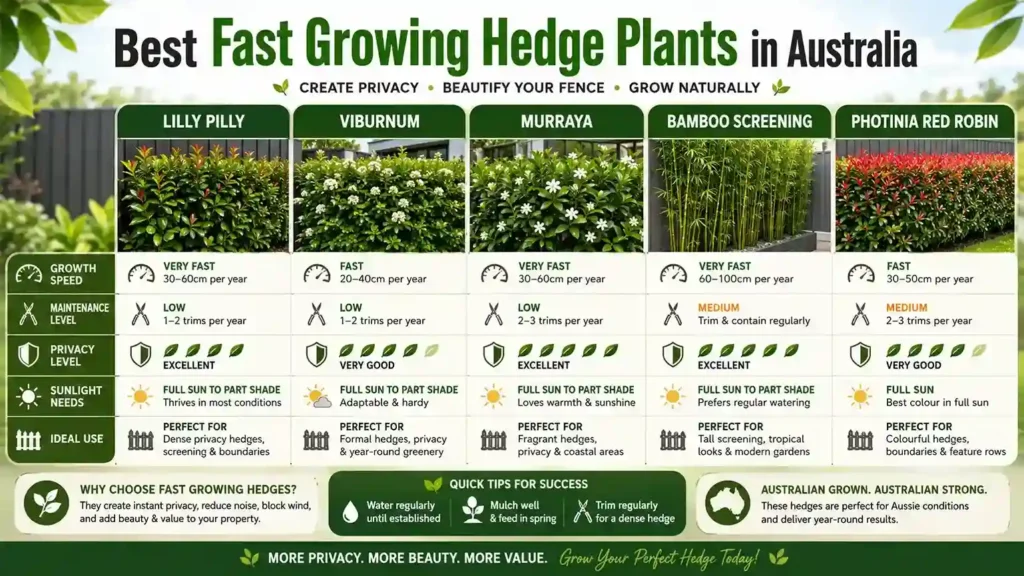
Fast-growing hedge plants are one of the most effective ways to create natural privacy, reduce noise, and improve fence line landscaping in Australian gardens. The best hedge species combine dense foliage, strong growth rates, and climate adaptability while remaining manageable for long-term maintenance.
Quick Summary Block
| Plant Type | Growth Speed | Privacy Level | Maintenance |
| Lilly Pilly | Fast | High | Medium |
| Viburnum | Fast | High | Low |
| Murraya | Medium-Fast | Medium | Low |
| Bamboo Screening | Very Fast | Very High | Medium |
| Photinia | Fast | High | Medium |
Lilly Pilly
Lilly Pilly is one of the most popular fast-growing hedges Australia homeowners use for dense privacy screening.
Lilly Pilly is widely planted along residential fence lines because of its thick evergreen foliage, rapid growth, and strong adaptability to Australian climates. Many varieties can grow between 30 centimetres and 2 metres per year depending on soil quality, watering, and sunlight exposure, making them one of the most reliable fast-growing hedges Australia gardens commonly use.
For gardeners looking to understand long-term plant health, spacing, and maintenance principles, the complete gardening and plant care guide provides a deeper foundation for building strong and sustainable fence line landscapes.
Native Australian varieties such as Acmena smithii and Syzygium australe are especially popular for suburban privacy hedges. These plants respond well to pruning, creating dense screening that effectively blocks neighbouring properties and improves outdoor privacy.
Modern pest-resistant cultivars have also improved Lilly Pilly performance in many regions. Psyllid-resistant varieties help prevent leaf damage and maintain healthier foliage, particularly in humid climates where pests can affect traditional species.
Lilly Pilly performs best in:
- Temperate climates
- Coastal regions
- Subtropical areas
- Well-drained fertile soils
As one of the most versatile fast-growing hedges Australia landscapes rely on, Lilly Pilly is suitable for:
- Full fence line screening
- Poolside privacy
- Boundary hedging
- Wind protection
- Formal garden shaping
Many homeowners also choose these fast growing hedge plants Australia gardens support because they provide year-round greenery without excessive maintenance.
Viburnum
Viburnum creates a thick evergreen hedge suitable for suburban fence boundaries.
Viburnum is a fast-establishing hedge known for its dense foliage and reliable privacy coverage. Its broad leaves and naturally bushy growth make it highly effective for screening neighbouring properties and softening hard fence lines.
One of Viburnum’s biggest advantages is its strong screening performance. When planted correctly, the hedge quickly forms a compact green wall that reduces visibility and helps absorb noise from surrounding areas.
Viburnum generally grows best in:
- Full sun
- Partial shade
- Well-drained soil
- Mild to warm Australian climates
Compared to many other screening plants, Viburnum requires relatively low maintenance once established. Regular watering during early growth stages encourages faster hedge development, while occasional pruning helps maintain a tidy shape and dense coverage.
Its evergreen structure makes it particularly valuable for year-round privacy in suburban gardens.
Murraya (Mock Orange)
Murraya is a fragrant low-maintenance hedge ideal for decorative privacy screens.
Murraya, also called Mock Orange, is a compact evergreen hedge valued for its glossy foliage and highly fragrant white flowers. It is commonly used in smaller Australian gardens where homeowners want both privacy and ornamental appeal.
This hedge grows at a moderate-to-fast rate and naturally forms a neat rounded shape, making it easier to maintain than many vigorous screening plants. Murraya responds well to trimming, allowing gardeners to shape it into formal hedges or softer natural borders.
Key advantages of Murraya include:
- Sweet-smelling flowers
- Compact growth habit
- Attractive glossy leaves
- Easy pruning and shaping
- Lower maintenance needs
Because of its controlled growth and manageable root system, Murraya is especially suitable for:
- Small backyards
- Courtyard gardens
- Side fence screening
- Decorative privacy borders
Its combination of fragrance, evergreen foliage, and low upkeep makes it one of the most practical privacy hedge choices for compact residential landscapes.
Bamboo Screening Plants
Clumping bamboo offers one of the fastest privacy screening solutions for Australian fence lines.
Bamboo is highly valued for its rapid vertical growth and exceptional screening ability. Many clumping varieties can establish dense privacy barriers within a short period, making them ideal for exposed yards and modern landscaping projects.
Unlike invasive running bamboo species, non-invasive clumping bamboo grows in controlled clumps that are easier to manage near fences and garden beds. Popular varieties for Australian gardens include:
- Bambusa textilis Gracilis
- Slender Weavers Bamboo
- Alphonse Karr Bamboo
These varieties work especially well in narrow spaces because they grow upright with limited horizontal spread. As a result, bamboo is frequently used in compact suburban gardens where width is restricted but tall screening is required.
Clumping bamboo also provides:
- Excellent wind resistance
- Fast privacy coverage
- Dense evergreen foliage
- Strong noise reduction
- Modern landscaping appeal
Many homeowners searching for fast-growing screening trees or a fast growing screening tree alternative choose bamboo because it creates immediate vertical greenery while maintaining a relatively slim footprint. Among popular screen plants Australia landscapes use today, clumping bamboo remains one of the fastest-growing and most effective privacy options.
Photinia Red Robin
Photinia provides colourful evergreen screening with fast-growing foliage.
Photinia Red Robin is a popular fence line hedge known for its striking red new growth and dense evergreen structure. Its colourful foliage adds decorative value while still providing effective privacy screening throughout the year.
As fresh leaves emerge, they display vibrant red tones before gradually turning deep green. This colour contrast makes Photinia especially attractive in modern landscaping designs where visual impact is important.
Photinia offers several benefits for fence line planting:
- Fast hedge establishment
- Dense evergreen coverage
- Decorative seasonal colour
- Reliable privacy screening
- Easy shaping through pruning
The plant grows well in full sun to partial shade and performs best in fertile, well-drained soil. Regular trimming encourages thicker foliage and maintains a compact hedge shape.
Because of its strong screening ability and ornamental appearance, Photinia is commonly used for:
- Boundary hedges
- Front fence landscaping
- Backyard privacy screens
- Decorative evergreen borders
Its combination of privacy coverage and colourful foliage makes Photinia Red Robin a versatile hedge choice for Australian residential gardens.
Best Screening Trees for Fence Lines in Australia
Screening trees are ideal for homeowners who want taller privacy coverage, shade, and long-term landscape structure along fence boundaries. The best fence line trees combine controlled growth, dense foliage, and climate suitability while remaining manageable for residential gardens.
Magnolia Little Gem
Magnolia Little Gem is a compact evergreen screening tree ideal for modern Australian homes.
Magnolia Little Gem is widely used for fence line privacy because of its upright growth habit, glossy green foliage, and dense evergreen structure. Unlike larger magnolia varieties, this compact tree remains relatively narrow, making it suitable for suburban gardens where space is limited.
Its attractive white flowers bloom during warmer months and add ornamental value while still maintaining strong privacy coverage. The foliage also features soft brown undersides that create visual texture and year-round interest.
Key benefits of Magnolia Little Gem include:
- Narrow growth habit
- Evergreen foliage
- Fragrant white flowers
- Dense privacy screening
- Suitable for modern landscaping
Many homeowners looking for evergreen small trees Australia gardens can support choose Magnolia Little Gem because it provides vertical screening without becoming excessively wide. It also works well as a formal hedge alternative for boundary planting.
Among the best small trees for fence line Australia properties commonly use, Magnolia Little Gem stands out for its balance of privacy, aesthetics, and manageable maintenance.
Pencil Pines
Pencil Pines are tall narrow screening plants perfect for tight fence line spaces.
Pencil Pines are one of the most effective vertical screening solutions for narrow suburban gardens. Their upright column-shaped growth allows homeowners to create tall privacy barriers without sacrificing valuable yard space.
These evergreen conifers maintain a very slim spread while growing several metres tall, making them especially useful for:
- Side boundaries
- Driveways
- Courtyard screening
- Compact urban gardens
Pencil Pines provide a formal and symmetrical appearance that suits modern and structured landscape designs. Their consistent vertical growth also creates a neat architectural effect along fence lines.
Homeowners exploring more options for quick privacy can also compare other fast growing evergreen trees Australia landscapes commonly use for efficient fence line screening.
Advantages of Pencil Pines include:
- Minimal horizontal spread
- Strong vertical privacy
- Low pruning requirements
- Evergreen year-round coverage
- Clean formal appearance
Because of their compact shape, they are often recommended as narrow trees for fence line planting where wider hedges would become overcrowded. They are also highly suitable as tall plants for narrow spaces Australia homeowners frequently need in townhouse and small-lot developments.
Native Australian Screening Trees
Native trees are often more drought-tolerant and lower maintenance for Australian conditions.
Australian native screening trees are highly valued for their adaptability, resilience, and environmental benefits. Many native species tolerate heat, dry conditions, poor soils, and local pests better than exotic alternatives.
Popular native screening tree options include:
- Acmena
- Callistemon
- Water Gum
- Bottlebrush
Acmena varieties are commonly used for dense evergreen privacy hedges because they respond well to pruning and produce compact foliage. Callistemon and Bottlebrush species provide screening while also attracting birds and pollinators through their colourful flowers.
Water Gum is another excellent fence line tree due to its elegant growth habit and dense foliage, making it suitable for privacy and shade.
Benefits of native screening trees include:
- Lower water requirements
- Better drought tolerance
- Reduced fertilizer needs
- Strong adaptation to Australian climates
- Wildlife-friendly landscaping
Many native screening plants for narrow spaces also feature upright growth habits that suit compact residential gardens. For homeowners searching for the best trees for fence line Australia landscapes can support long term, native species often provide a more sustainable and lower-maintenance solution.
Ornamental Pear Alternatives for Evergreen Privacy
Evergreen alternatives are better than deciduous trees when year-round screening is needed.
Ornamental Pear trees are popular for their symmetrical shape and seasonal colour, but they are deciduous and lose leaves during cooler months. This seasonal leaf drop reduces privacy and leaves fence lines more exposed during parts of the year.
For homeowners prioritizing consistent screening, evergreen trees are usually a better option because they maintain dense foliage throughout all seasons.
Deciduous trees:
- Lose leaves seasonally
- Provide reduced winter privacy
- Require seasonal cleanup
- Offer changing seasonal colour
Evergreen trees:
- Maintain year-round foliage
- Deliver constant privacy screening
- Reduce visual gaps along fences
- Provide more reliable wind protection
Evergreen alternatives such as Magnolia Little Gem, Lilly Pilly, Water Gum, and Pencil Pines generally perform better for fence privacy because they maintain continuous coverage and require less seasonal management.
Choosing evergreen screening trees is especially important in suburban environments where neighbour blocking, noise reduction, and permanent visual screening are key landscaping priorities.
To better understand seasonal differences and why some plants lose privacy coverage during winter, the comparison of evergreen vs deciduous trees helps clarify which option is more suitable for year-round screening.
Best Low Maintenance Plants for Fence Line Privacy
Low-maintenance fence line plants are ideal for homeowners who want reliable privacy screening without constant pruning, watering, or fertilizing. In many Australian regions, choosing hardy drought-tolerant species can significantly reduce long-term garden upkeep while still maintaining dense greenery and visual appeal.
Drought-Tolerant Fence Plants
Drought-resistant plants reduce watering needs and perform better during Australian summers.
Water-wise screening plants are especially valuable in regions affected by hot weather, water restrictions, and dry seasonal conditions. These species typically develop deeper root systems and stronger heat tolerance, helping them survive extended dry periods with less irrigation.
Popular drought-tolerant fence plants include:
- Lilly Pilly
- Callistemon
- Westringia
- Viburnum
- Water Gum
- Clumping Bamboo
Many of these plants continue performing well during intense Australian summers while maintaining healthy foliage and effective privacy coverage.
Heat-tolerant screening plants offer several benefits:
- Reduced watering requirements
- Improved survival in hot climates
- Lower long-term maintenance
- Better resilience during dry conditions
- Sustainable landscaping performance
Mulching is also important for drought-resistant fence plants because it helps retain soil moisture, regulate root temperature, and reduce evaporation. Organic mulch layers around hedge bases can improve plant health while minimizing weed growth and watering frequency.
For best results:
- Apply mulch evenly around root zones
- Avoid placing mulch directly against trunks
- Maintain healthy soil drainage
- Water deeply during establishment periods
Choosing drought-tolerant species helps create more sustainable and resilient privacy screens for Australian gardens.
Low Pruning Hedge Plants
Slow-spreading dense plants require less trimming while still providing privacy.
Some screening plants naturally maintain compact growth habits, making them easier to manage over time. These hedges require fewer shaping cuts while still forming dense evergreen coverage suitable for fence line privacy.
Compact hedge plants are especially useful for:
- Busy households
- Small suburban gardens
- Investment properties
- Low-maintenance landscaping designs
Plants with strong shape retention remain tidy for longer periods and are less likely to become overgrown. Slow-spreading varieties also reduce the need for aggressive pruning and help maintain cleaner fence lines.
Popular low maintenance screening plants Australia homeowners commonly use include:
- Murraya
- Viburnum
- Westringia
- Magnolia Little Gem
- Compact Lilly Pilly cultivars
These low-maintenance plants for fence line privacy generally require:
- Less trimming
- Moderate watering
- Minimal reshaping
- Lower fertilizer input
Selecting dense but controlled-growing hedge species can significantly reduce ongoing maintenance while still delivering effective year-round screening.
Best Native Low-Maintenance Screening Plants
Native Australian species often require less fertilizer, less water, and fewer pest treatments.
Native screening plants are highly adapted to Australian soils and climate conditions, making them one of the most practical low-maintenance choices for residential fence lines. Many native species tolerate heat, drought, and poor soil conditions better than exotic hedge plants.
Common native low-maintenance screening plants include:
- Callistemon
- Acmena
- Water Gum
- Lilly Pilly
- Westringia
- Bottlebrush
One major advantage of native plants is their reduced resource demand. Many species grow successfully with limited watering once established and often require fewer chemical treatments for pests and diseases.
Native screening plants also support local ecosystems by:
- Attracting birds and pollinators
- Providing habitat for beneficial insects
- Improving biodiversity in urban gardens
From a sustainability perspective, native species are often more environmentally suitable because they adapt naturally to regional rainfall patterns and local climate conditions. Their lower maintenance needs can also reduce long-term gardening costs and water consumption.
For homeowners seeking durable and environmentally friendly privacy screens, native Australian plants offer an effective balance of performance, resilience, and landscape value.
Best Fence Line Plants for Narrow Spaces
Definition Block
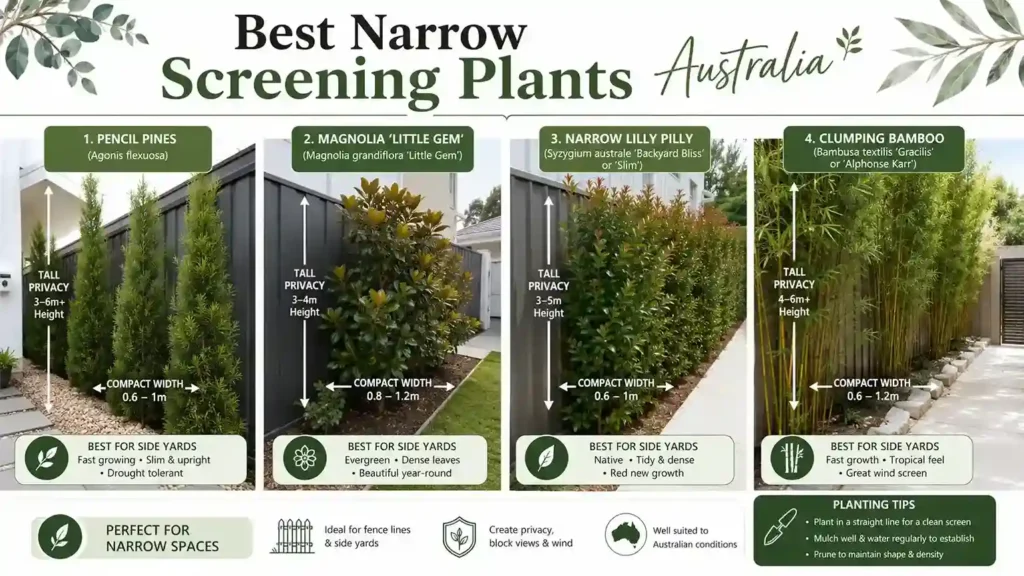
Narrow screening plants are upright-growing hedges or trees designed for compact spaces where width is limited but vertical privacy is needed.
These plants are commonly used in modern Australian gardens where homeowners need effective fence screening without sacrificing usable outdoor space. Narrow-growing species are especially useful for side access paths, townhouse boundaries, pool areas, and smaller suburban backyards.
Tall Narrow Hedge Plants
Tall narrow hedges maximize privacy without taking up excessive yard space.
Many Australian properties have limited boundary width, making vertical hedging plants a practical privacy solution. Narrow hedge plants Australia homeowners commonly choose provide dense foliage while maintaining a slim footprint that fits compact landscapes.
Tall upright hedges work particularly well for:
- Small suburban gardens
- Side fence screening
- Pool boundaries
- Courtyard privacy
- Driveway borders
Popular narrow hedging plants Australia landscapes frequently use include:
- Pencil Pines
- Magnolia Little Gem
- Slender Weavers Bamboo
- Lilly Pilly slim cultivars
- Viburnum in narrow hedge form
Tall narrow screening plants Australia gardeners prefer are often evergreen, allowing year-round privacy without large spreading branches. These plants also create cleaner visual lines that suit contemporary landscaping styles.
Choosing upright hedge species can help maximize available yard space while still delivering strong privacy and wind protection along fence lines.
Screening Plants for Side Yards
Side yards benefit from slim screening plants that improve privacy while maintaining airflow.
Side access areas are often narrow and partially shaded, requiring plants with controlled growth habits and manageable root systems. Slim screening plants help soften fences and improve privacy without overcrowding walkways or blocking ventilation.
When selecting screening plants for side yards, important considerations include:
- Root control near paving and fences
- Adequate sunlight access
- Air circulation between properties
- Easy long-term maintenance
Plants with invasive roots can damage paving, retaining walls, and nearby structures, so compact-rooted species are generally safer for narrow side spaces.
Neighbor-friendly screening plants are also important in suburban environments because oversized hedges may create shading or maintenance disputes. Upright evergreen species that remain contained within boundary areas are usually the most practical choice.
Suitable side yard screening options include:
- Murraya
- Pencil Pines
- Clumping Bamboo
- Magnolia Little Gem
- Compact native hedges
These plants provide privacy while still maintaining openness and airflow in tighter outdoor areas.
Fast Growing Narrow Screening Plants
Some upright plants combine rapid growth with compact width for faster privacy.
Fast-growing narrow plants are ideal for homeowners who want quick fence coverage without planting wide-spreading hedges. These species establish privacy screens faster while remaining suitable for restricted garden spaces.
Popular fast-growing narrow screening plants include:
- Slender clumping bamboo
- Pencil Pines
- Upright Lilly Pilly cultivars
- Viburnum in column form
- Water Gum varieties with compact growth habits
These plants are frequently used as fence line screening plants for narrow spaces because they:
- Grow vertically rather than outward
- Create dense privacy quickly
- Require less yard width
- Suit modern suburban landscapes
Fast upright screening plants also help reduce visual exposure in newly built homes where fencing alone may feel harsh or insufficient. Proper spacing and regular early maintenance encourage denser foliage and more effective long-term screening performance.
How to Choose the Right Fence Line Plants in Australia
Selecting the right fence line plants involves more than choosing attractive foliage. Australian climate conditions, available space, sunlight exposure, soil quality, and root behaviour all influence how well screening plants perform over time. Choosing suitable species early helps improve hedge density, reduce maintenance problems, and support healthier long-term growth.
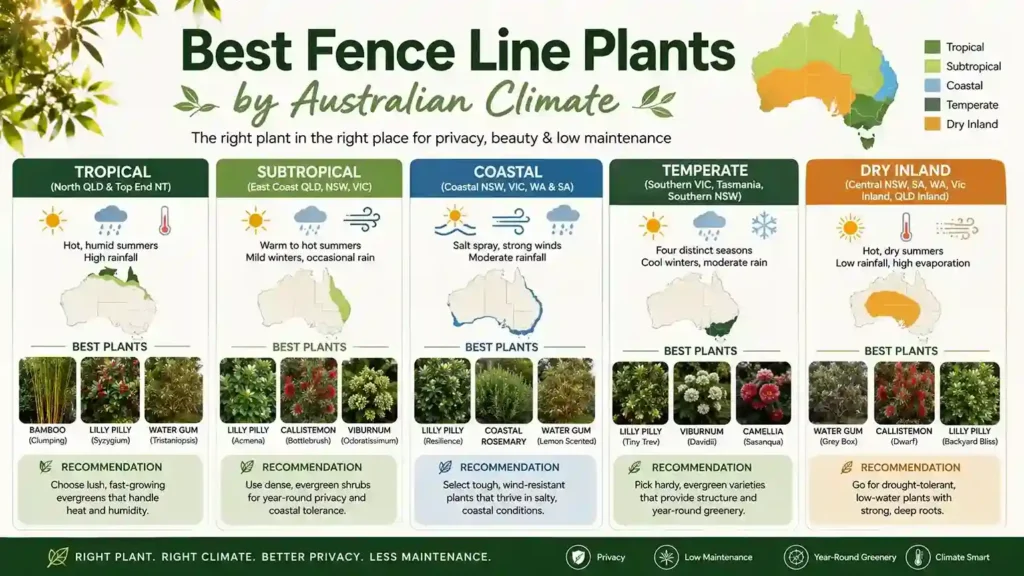
Match Plants to Your Climate Zone
Australia’s climate zones affect plant growth speed, watering needs, and long-term survival.
Australia has highly varied growing conditions, so plants that perform well in one region may struggle in another. Matching screening plants to local climate conditions improves resilience, reduces stress, and lowers maintenance requirements.
Tropical Regions
Tropical areas with high humidity and rainfall support fast-growing evergreen screening plants that tolerate heat and moisture. Suitable options include:
- Clumping Bamboo
- Lilly Pilly
- Murraya
- Water Gum
These species generally grow quickly and maintain dense foliage in warm humid environments.
Subtropical Regions
Subtropical climates support a wide range of privacy hedges and ornamental screening trees. Common choices include:
- Viburnum
- Magnolia Little Gem
- Photinia
- Native Bottlebrush
Moderate rainfall and warm temperatures help encourage faster hedge establishment.
Coastal Areas
Coastal gardens require plants that tolerate:
- Wind exposure
- Salt spray
- Sandy soils
Popular coastal screening plants include:
- Westringia
- Coastal Banksia
- Lilly Pilly
- Clumping Bamboo
Salt-tolerant species generally perform better near ocean-facing properties.
Dry Inland Regions
Dry inland climates benefit from drought-tolerant and heat-resistant plants that survive extended dry periods with less watering. Recommended species include:
- Callistemon
- Bottlebrush
- Acacia varieties
- Westringia
- Water Gum
Selecting climate-suitable plants improves long-term hedge health while reducing water consumption and maintenance costs.
Consider Root Systems Near Fences
Some trees can damage fences, pipes, or paving if planted too close.
Fence line planting requires careful consideration of root behaviour because aggressive root systems can eventually lift paving, crack retaining walls, or interfere with underground drainage pipes.
Larger trees with invasive roots should generally be planted further away from:
- Timber fencing
- Concrete paths
- Retaining structures
- Underground plumbing
Safe planting distances vary depending on plant size and root spread, but many screening trees benefit from at least:
- 1–3 metres clearance from structures
- Additional spacing for large canopy trees
Root-friendly screening species are usually better suited to suburban gardens where space is limited. Plants with more controlled root systems include:
- Magnolia Little Gem
- Pencil Pines
- Murraya
- Clumping Bamboo
- Compact Lilly Pilly cultivars
Proper spacing also helps improve airflow, reduces overcrowding, and supports healthier hedge development over time.
Understand Sunlight Requirements
Full sun and shade tolerance vary significantly between hedge species.
Some screening plants thrive in direct sunlight, while others perform better in partially shaded areas. Understanding light requirements helps prevent slow growth, poor foliage density, and plant stress.
Full-Sun Performers
Many fast-growing hedges and screening trees require strong sunlight for optimal density and growth speed. Full-sun species commonly include:
- Viburnum
- Photinia
- Pencil Pines
- Clumping Bamboo
- Bottlebrush
These plants generally perform best with at least six hours of direct sunlight daily.
Shade-Friendly Options
Partially shaded gardens and narrow side yards often require more shade-tolerant species. Suitable options include:
- Murraya
- Magnolia Little Gem
- Lilly Pilly
- Water Gum
Shade-tolerant plants can still provide effective privacy while adapting better to reduced light conditions between buildings and fences.
Evaluating daily sunlight exposure before planting helps improve long-term screening performance and overall hedge health.
Soil Preparation Tips
Healthy soil improves screening plant growth, root development, and hedge density.
Good soil preparation helps fence line plants establish faster and develop stronger root systems. Poor soil conditions can slow growth, reduce foliage density, and increase stress during hot weather.
Before planting:
- Remove weeds and debris
- Loosen compacted soil
- Improve organic matter content
- Check drainage quality
Adding compost helps improve soil fertility and supports healthier root development. Organic matter also increases moisture retention while improving soil structure.
Drainage is equally important because waterlogged soil can damage roots and encourage fungal diseases. If drainage is poor, raised garden beds or soil conditioning may help improve growing conditions.
Mulching around hedge plants provides several benefits:
- Retains soil moisture
- Reduces weed growth
- Protects roots from heat
- Improves long-term soil quality
Maintaining healthy soil conditions allows screening plants to establish more quickly and produce thicker, more effective privacy coverage along fence lines.
Common Fence Line Plant Problems & Solutions
Fence line plants can occasionally develop growth, pest, or maintenance issues that reduce screening performance and overall plant health. Early identification and proper care help maintain dense foliage, stronger root systems, and long-term privacy coverage.
Yellow Leaves and Poor Growth
Nutrient deficiencies and drainage issues are common causes of unhealthy fence plants.
Yellowing leaves, weak growth, and thinning foliage are often signs that screening plants are struggling with poor soil conditions or incorrect watering practices. In many Australian gardens, compacted soil and inconsistent drainage can limit root development and reduce nutrient absorption.
Common causes of yellow leaves include:
- Nitrogen deficiency
- Iron deficiency
- Overwatering
- Poor drainage
- Compacted soil
- Root stress
Plants growing in waterlogged soil may develop root rot, while dry nutrient-poor soil can slow hedge establishment and reduce foliage density.
To improve plant health:
- Apply balanced slow-release fertilizer
- Improve soil drainage
- Add compost or organic matter
- Mulch around root zones
- Water deeply but less frequently
Monitoring plant colour and growth patterns helps identify problems early before hedge density and screening quality decline significantly.
Overgrown Hedge Maintenance
Regular light pruning is more effective than heavy annual trimming.
Many screening hedges become uneven or overly large when pruning is delayed for long periods. Heavy annual cutting can stress plants, expose bare branches, and reduce foliage density along fence lines.
Light but consistent trimming encourages:
- Thicker hedge growth
- Better branch development
- Cleaner hedge shape
- Improved airflow
- Stronger privacy coverage
Most evergreen screening plants respond best to maintenance pruning during active growing seasons. Removing small amounts of growth regularly helps maintain compact structure without damaging the plant’s natural form.
Overgrown hedges may also:
- Block sunlight
- Reduce airflow
- Encroach on neighbouring properties
- Increase pest and fungal problems
Using sharp clean tools and avoiding excessive pruning during extreme heat helps reduce plant stress and supports healthier regrowth.
Pest Problems in Screening Plants
Psyllids, scale insects, and fungal diseases affect many Australian hedges.
Fence line plants can occasionally attract pests and diseases that damage foliage and weaken overall hedge performance. Dense hedges with poor airflow are especially vulnerable to infestations and fungal growth.
Common hedge pests in Australia include:
- Psyllids
- Scale insects
- Aphids
- Caterpillars
Lilly Pilly varieties are particularly known for psyllid damage, which causes blistered or distorted leaves. Pest-resistant cultivars help reduce this problem in many modern landscapes.
Fungal diseases often develop when:
- Foliage remains wet for long periods
- Hedges are overcrowded
- Air circulation is poor
- Soil drainage is inadequate
Signs of disease may include:
- Black spots on leaves
- Leaf drop
- Mould growth
- Branch dieback
Preventative care is usually the most effective solution. Healthy soil, proper spacing, airflow management, and moderate watering all help reduce pest and disease risks.
In severe cases, horticultural oils, organic treatments, or professional pest management may be required to restore plant health.
Root Damage Concerns
Selecting non-invasive species prevents structural and drainage problems.
Some trees and large hedges develop aggressive root systems that can interfere with fences, paving, retaining walls, and underground pipes. Planting unsuitable species too close to structures may lead to expensive long-term damage.
Potential root-related problems include:
- Lifted paving
- Fence movement
- Cracked retaining walls
- Pipe intrusion
- Soil displacement
Fast-growing trees with large spreading roots generally require greater planting distances from built structures.
Safer non-invasive screening species commonly include:
- Magnolia Little Gem
- Murraya
- Pencil Pines
- Clumping Bamboo
- Compact native hedges
Proper spacing is essential for preventing overcrowding and minimizing root pressure near fences and drainage systems. Homeowners should also consider mature plant size rather than only initial nursery dimensions.
Choosing root-friendly screening plants helps maintain healthier landscapes while protecting nearby structures from long-term root damage.
Best Fence Line Plant Combinations for Privacy & Landscaping
Combining different fence line plants can improve privacy, texture, colour variation, and overall landscape balance. Mixing compatible hedges, screening trees, and native plants also helps create more visually appealing outdoor spaces while meeting specific privacy and maintenance goals.
Comparison Table
| Goal | Recommended Plants |
| Fast Privacy | Bamboo + Lilly Pilly |
| Low Maintenance | Viburnum + Native Bottlebrush |
| Narrow Space | Pencil Pines + Magnolia Little Gem |
| Native Garden | Callistemon + Water Gum |
| Modern Landscaping | Photinia + Clumping Bamboo |
Expert Tips for Creating a Dense Privacy Screen Faster
Creating a thick and healthy privacy screen requires more than simply planting hedges close together. Proper spacing, watering, soil care, and pruning techniques all influence how quickly fence line plants establish dense foliage and long-term coverage.
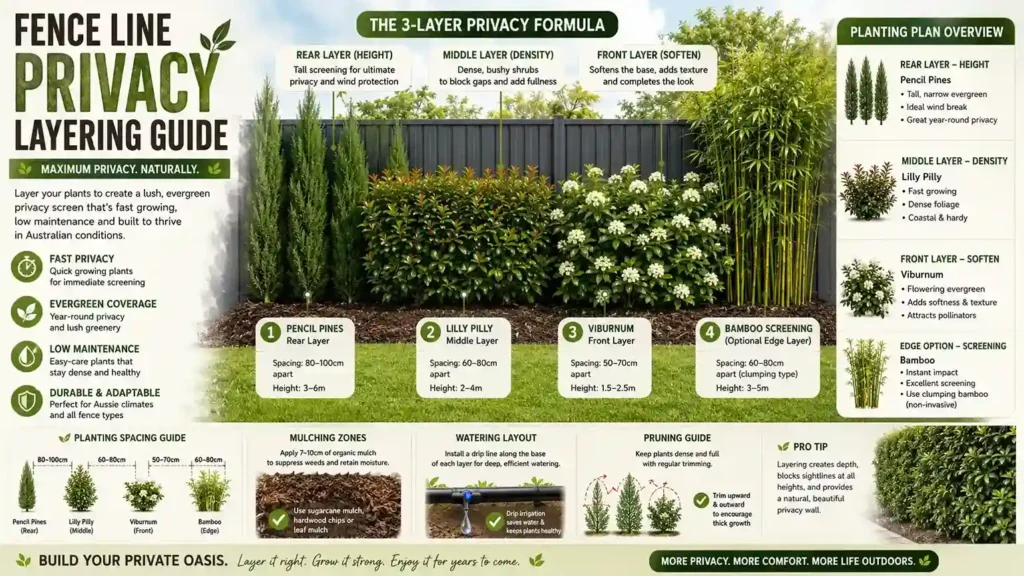
Proper Plant Spacing
Correct plant spacing improves airflow, root development, and hedge density.
Many homeowners plant screening hedges too closely in an attempt to create faster privacy, but overcrowding can reduce airflow, increase disease risk, and weaken long-term growth. Proper spacing allows roots to establish evenly while encouraging fuller foliage development.
Spacing requirements vary depending on plant type, mature width, and growth speed.
General spacing guidelines:
- Small hedges: 50–80 cm apart
- Medium screening plants: 1–1.5 metres apart
- Larger screening trees: 2–4 metres apart
Fast-growing plants such as clumping bamboo may require additional room to prevent overcrowding as they mature.
Proper spacing helps:
- Improve sunlight penetration
- Reduce fungal disease risk
- Encourage stronger root systems
- Create more balanced hedge growth
Well-planned spacing often produces thicker and healthier screening over time compared to tightly overcrowded planting.
Mulching for Faster Growth
Mulching helps retain moisture, regulate soil temperature, and support healthier hedge establishment.
A quality mulch layer around fence line plants improves growing conditions by protecting roots from heat stress and reducing water evaporation during hot Australian summers.
Benefits of mulching include:
- Better soil moisture retention
- Reduced weed competition
- Improved soil quality
- Lower watering frequency
- Protection against temperature extremes
Organic mulch materials commonly include:
- Bark chips
- Sugar cane mulch
- Compost-based mulch
- Wood mulch
For best results:
- Apply mulch 5–10 cm deep
- Keep mulch clear of plant trunks
- Extend mulch around root zones evenly
Consistent mulching can significantly improve early plant establishment and encourage faster foliage growth for privacy hedges.
Fertilizing Hedge Plants Correctly
Balanced fertilizing supports stronger root growth, healthier foliage, and faster hedge density.
Fence line plants benefit from nutrient-rich soil during their establishment phase. Applying appropriate fertilizers helps promote vigorous growth while improving leaf colour and overall hedge thickness.
Slow-release fertilizers are often preferred because they provide steady nutrient availability without excessive rapid growth.
Important nutrients include:
- Nitrogen for foliage development
- Phosphorus for root growth
- Potassium for plant strength and resilience
Over-fertilizing can create weak soft growth that requires excessive pruning and may increase pest vulnerability. Fertilizer application should always match plant type, soil condition, and seasonal growth patterns.
Native Australian plants may require lower-phosphorus fertilizers specifically formulated for native species.
Healthy fertilization practices improve:
- Screening density
- Growth speed
- Leaf colour
- Stress tolerance
Watering Schedule for New Fence Plants
Consistent watering is essential for establishing strong roots and dense privacy screening.
Newly planted hedges and screening trees require regular deep watering during their first growing seasons. Shallow watering can encourage weak surface roots, while deep watering supports stronger root establishment.
General watering recommendations:
- Water deeply 2–3 times weekly during establishment
- Increase watering during extreme heat
- Reduce watering gradually once plants mature
- Avoid constant waterlogging
Soil type also affects watering frequency:
- Sandy soil dries faster
- Clay soil retains moisture longer
- Well-drained soil supports healthier roots
Signs of underwatering may include:
- Wilting foliage
- Brown leaf edges
- Slow growth
Overwatering can lead to root rot and fungal disease, especially in poorly drained soil. Monitoring soil moisture regularly helps maintain healthier hedge development.
Pruning Techniques for Thick Screening
Regular pruning encourages denser branching and stronger privacy coverage.
Many screening plants become fuller and more compact when lightly pruned during active growth periods. Controlled trimming stimulates side branching, helping hedges develop thicker foliage from top to bottom.
Effective pruning techniques include:
- Frequent light trimming
- Removing weak or damaged branches
- Shaping young hedges early
- Avoiding severe hard pruning
Pruning hedge sides slightly tapered inward at the top can also improve sunlight distribution to lower branches, reducing bare patches near the base.
Different hedge species respond differently to pruning intensity, but most evergreen screening plants benefit from:
- Consistent maintenance trimming
- Seasonal shaping
- Gradual height control
Proper pruning not only improves privacy density but also enhances airflow, hedge appearance, and long-term plant health.
Conclusion
The best plants for fence line Australia depend on your climate, space, privacy goals, and maintenance preferences.
Fast-growing hedges such as Lilly Pilly, Viburnum, and clumping bamboo provide quicker privacy for exposed yards and suburban boundaries. Narrow screening trees like Pencil Pines and Magnolia Little Gem work especially well in compact spaces where width is limited but vertical screening is needed.
Low-maintenance native plants also remain a practical choice for Australian gardens because they generally require less water, fewer fertilizers, and reduced ongoing care. Evergreen privacy options are particularly valuable for maintaining year-round screening, wind protection, and visual coverage along fence lines.
When choosing fence line plants, it is important to consider:
- Available planting space
- Local climate conditions
- Desired hedge or tree height
- Long-term maintenance requirements
Selecting climate-suitable screening plants with appropriate growth habits helps create healthier, more sustainable, and visually appealing outdoor spaces. With the right combination of hedges, screening trees, and native species, Australian homeowners can achieve better privacy, improved landscaping, and long-lasting fence line coverage.
If you want to explore more creative and meaningful ideas for naming your garden borders and greenery, you can check this detailed guide on Fence Plants Names for extra inspiration.
FAQs
What are the best fast growing plants for fence line privacy in Australia?
Some of the best fast growing plants for fence line privacy in Australia include Lilly Pilly, clumping bamboo, Viburnum, Photinia, and Water Gum. These plants establish quickly, produce dense foliage, and provide effective screening for suburban and residential properties. Clumping bamboo is often the fastest option for vertical privacy, while Lilly Pilly remains one of the most popular evergreen hedge choices.
Which hedge grows the fastest in Australia?
Clumping bamboo is generally considered one of the fastest-growing privacy screening plants in Australia. Among traditional hedges, Lilly Pilly and Viburnum are commonly regarded as some of the fastest growing hedge options because they establish rapidly and create dense evergreen coverage.
What are the best low maintenance screening plants in Australia?
Popular low maintenance screening plants in Australia include Viburnum, Murraya, Magnolia Little Gem, Westringia, and native Bottlebrush varieties. These plants usually require less pruning, moderate watering, and fewer pest treatments while still providing reliable privacy screening.
Which narrow plants work best for small fence line spaces?
Pencil Pines, Magnolia Little Gem, slender clumping bamboo, and narrow Lilly Pilly cultivars are excellent choices for compact fence line areas. These upright plants provide strong vertical privacy without spreading too widely into limited garden spaces.
What are the best native screening plants for Australian gardens?
Some of the best native screening plants include Lilly Pilly, Callistemon, Water Gum, Acmena, and Bottlebrush varieties. Native plants are often more drought-tolerant, wildlife-friendly, and better adapted to Australian soil and climate conditions.
How far from a fence should screening trees be planted?
Most screening trees should be planted at least 1–3 metres away from fences depending on mature size and root spread. Larger trees generally require greater spacing to prevent root damage, overcrowding, and long-term maintenance issues.
Which evergreen trees are best for year-round fence privacy?
Magnolia Little Gem, Pencil Pines, Lilly Pilly, Water Gum, and Viburnum are among the best evergreen trees and hedges for year-round privacy screening. Evergreen species maintain foliage throughout all seasons, providing continuous visual coverage and wind protection.
What are the best plants for blocking neighbours in Australia?
Dense evergreen hedges such as Lilly Pilly, Viburnum, clumping bamboo, and Photinia are highly effective for blocking neighbours. Tall narrow screening trees like Pencil Pines are also useful for smaller suburban properties where space is limited.
Are bamboo screening plants invasive in Australia?
Clumping bamboo varieties are generally non-invasive and suitable for residential fence line screening. Running bamboo species, however, can spread aggressively and may become difficult to control. Choosing non-invasive clumping bamboo is usually the safer option for Australian gardens.
What is the best fence line plant for coastal areas?
Coastal gardens often benefit from salt- and wind-tolerant species such as Lilly Pilly, Westringia, Coastal Banksia, and clumping bamboo. These plants typically handle sandy soils and ocean exposure better than more delicate hedge varieties.
Do screening plants increase property value?
Well-maintained screening plants can improve curb appeal, increase backyard privacy, reduce noise, and enhance landscaping aesthetics, all of which may positively influence property value and buyer appeal.
How often should fence line hedges be pruned?
Most fence line hedges benefit from light pruning several times during active growing seasons rather than heavy annual trimming. Regular shaping encourages denser foliage, healthier branching, and more effective privacy coverage.
What are the best drought-tolerant privacy plants in Australia?
Callistemon, Westringia, Water Gum, Bottlebrush, and native Acacia varieties are among the best drought-tolerant screening plants for Australian climates. These species generally require less watering once established and perform well during hot summers.
Can screening plants help reduce noise?
Yes, dense hedges and evergreen screening trees can help reduce traffic and neighbourhood noise by acting as natural sound barriers. Thick foliage plants such as Viburnum, bamboo, and Lilly Pilly are especially effective for noise reduction.
Which fence line plants are safest near paving and pipes?
Plants with controlled root systems such as Magnolia Little Gem, Murraya, Pencil Pines, and clumping bamboo are generally safer near paving, fences, and underground pipes compared to large invasive-rooted tree species.

Written by the LeafyHeaven Editorial Team
LeafyHeaven shares practical gardening tips and simple plant care guides to help you grow, nurture, and enjoy your plants with ease. Our goal is to make gardening feel natural, approachable, and rewarding for everyone.