
Introduction
Summer heat is intense — and when rainfall drops, most gardens struggle to survive. But the right drought-tolerant flowers and plants can keep your outdoor space vibrant, colorful, and full of life even in the driest months. What are drought-tolerant plants? Simply put, they are plants built for climate resilience — capable of thriving with minimal water while still delivering stunning visual impact. In this guide, you will discover the best drought-tolerant flowering plants for summer, zone-by-zone recommendations, smart gardening tips, and design ideas that prove beauty and water-wise gardening go hand in hand. This summer, these plants will save your garden.
What Are Drought-Tolerant Plants? (And Why They Matter in Summer)
Drought-tolerant plants are species that have naturally adapted to survive and thrive with very little water. These are not just plants that tolerate occasional dryness — they are built for it. Understanding what drought-tolerant plants are helps gardeners make smarter, more sustainable planting choices, especially during hot summer months.
Definition — Drought Tolerant vs Drought Resistant
Drought tolerant and drought resistant are often used interchangeably — but they are not the same thing.
- Drought tolerant plants can survive and continue growing through extended dry periods without significant damage.
- Drought resistant plants can handle short dry spells but may struggle if water is withheld for too long.
| Term | Meaning |
| Drought Tolerant | Thrives through long dry periods with minimal water |
| Drought Resistant | Handles short-term water shortage but needs regular watering |
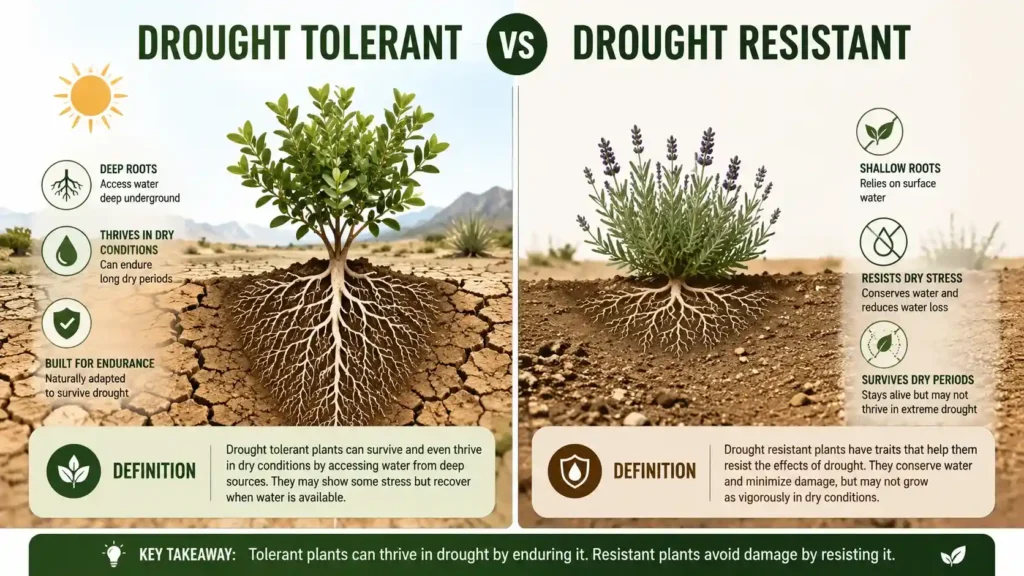
Quick Answer: If you live in a dry climate or want truly low-water landscaping, always choose drought tolerant over merely drought resistant plants.
Why Summer Is the Most Critical Season for Water-Wise Gardening
Summer is the hardest season for any garden. Heat and drought tolerant plants become essential during this period for one simple reason — evaporation rates peak in summer, pulling moisture out of soil faster than rain or irrigation can replace it.
During summer, plants face multiple stressors at once:
- High soil surface temperatures
- Rapid moisture loss through evaporation
- Increased transpiration from leaves
- Longer periods between rainfall
In dry climate areas like the American Southwest, California drought conditions have shown just how vulnerable traditional gardens are in summer. Heat stress on plants causes wilting, leaf scorch, and even plant death when water is scarce.
Summer flower planting with drought-smart species eliminates these risks. Plants during summer that are built for heat and low water don’t just survive — they actively bloom and grow, making them the most reliable choice for a beautiful, low-maintenance summer garden.
Best Drought-Tolerant Flowers That Look Beautiful in Summer
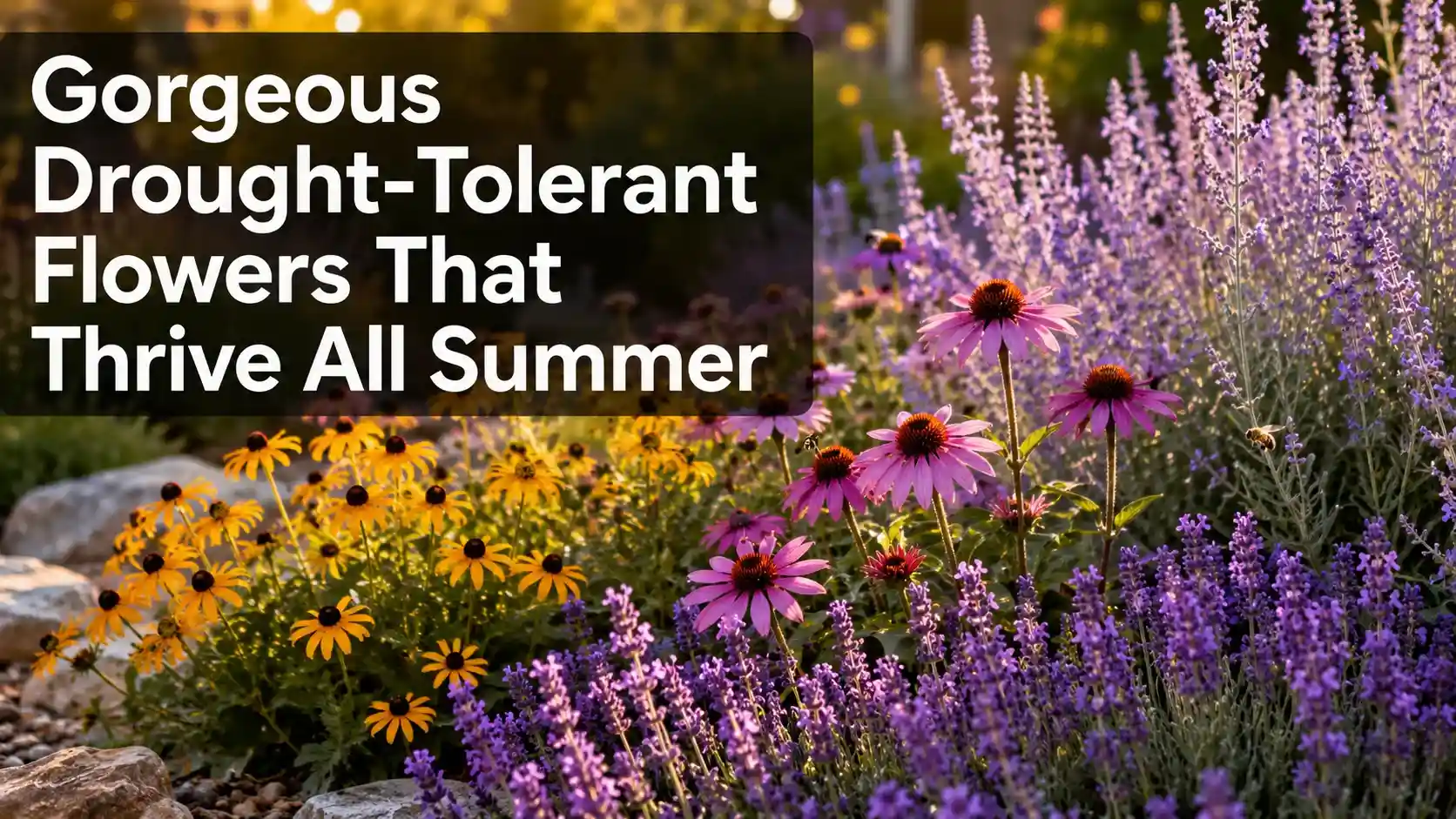
The best drought-tolerant flowers do more than just survive dry conditions — they deliver bold color, texture, and visual impact all summer long. From classic drought resistant flowers like lavender to colorful drought tolerant plants like echinacea, these are the prettiest drought tolerant plants you can grow. Each one is a proven drought tolerant flowering plant that thrives with minimal water while keeping your garden looking gorgeous.
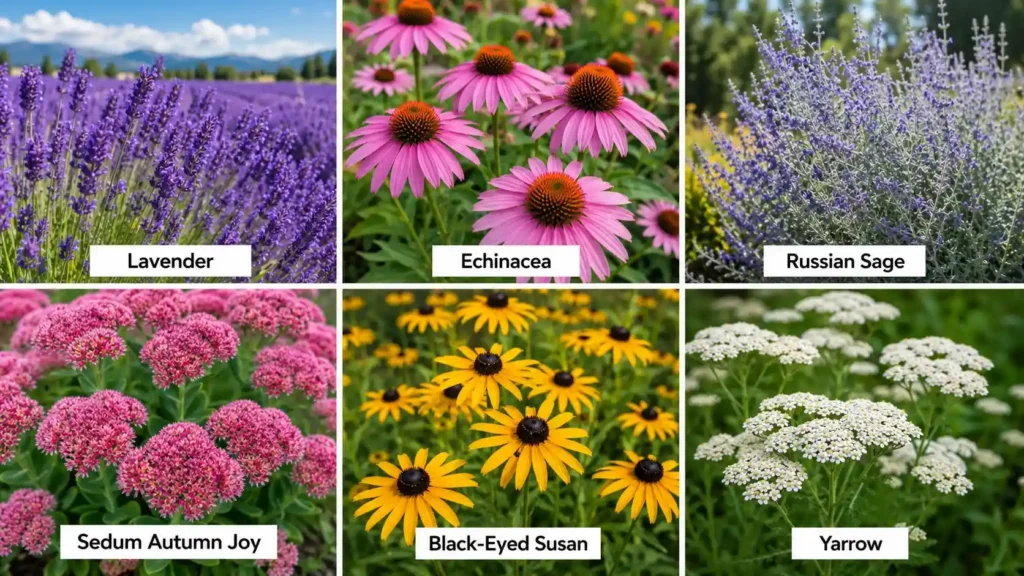
Lavender (Lavandula spp.)
Lavender is one of the best drought tolerant flowers available for summer gardens. It is fully lavender heat tolerant, thrives in full sun lavender conditions, and demands very little supplemental watering once established.
Key Facts:
| Feature | Details |
| Sun Requirements | Full sun — minimum 6–8 hours daily |
| Water Needs | Very low — water deeply but infrequently |
| USDA Zones | 5–9 |
| Bloom Time | Late spring through midsummer |
| Soil | Well-draining, sandy or rocky |
Does lavender like shade? No — lavender requires full sun to bloom well and stay healthy. How much sun for lavender is enough? At least 6 hours of direct sunlight daily is the minimum.
Quick Tip: Lavender is ideal for a lavender garden border. Plant it along pathways, garden edges, or as a low hedge for a fragrant, drought-smart design that looks stunning all summer.
Echinacea (Coneflower)
Echinacea is among the most reliable heat drought tolerant flowers for summer gardens. The echinacea purpurea flower — with its bold pink-purple petals and raised center cone — blooms vigorously even during dry, hot spells. An echinacea mix of different varieties adds multi-color impact to any bed.
Key Facts:
| Feature | Details |
| USDA Zones | 3–9 |
| Height | 2–4 feet |
| Bloom Colors | Pink, purple, white, orange, yellow |
| Sun Needs | Full sun to light shade |
| Water Needs | Low — drought tolerant once established |
Echinacea is a top-performing drought tolerant perennial flower that also attracts butterflies and pollinators, adding life and movement to the summer garden.
Russian Sage (Perovskia atriplicifolia)
Russian sage is one of the finest drought tolerant purple flowers available for hot, dry gardens. It looks similar to lavender at first glance — but when comparing russian sage vs lavender, Russian sage is actually more heat and drought tolerant, taller, and blooms later into summer.
Russian Sage vs Lavender — Comparison:
| Feature | Russian Sage | Lavender |
| Height | 3–5 feet | 1–3 feet |
| Bloom Time | Midsummer–Fall | Late Spring–Summer |
| Drought Tolerance | Very High | High |
| Heat Tolerance | Very High | High |
| USDA Zones | 4–9 | 5–9 |
| Fragrance | Mild, herbal | Strong, sweet |
Dwarf russian sage varieties work beautifully in smaller spaces. As a drought tolerant purple flowering plant, Russian sage creates a hazy, soft-blue visual effect that pairs well with yellow and orange summer bloomers.
Sedum (Stonecrop)
Sedum is a succulent-type perennial that stores water in its thick leaves — making it one of the most dependable drought tolerant flowering plants for summer. It grows well in rocky soil, poor soil, and even containers, delivering texture and bloom color with almost no maintenance.
Standout Varieties:
- Sedum Autumn Joy — tall, showy stonecrop sedum with dusty pink blooms that deepen to copper in late summer
- Hens and Chicks Sedum — low-growing rosette form, perfect for rock gardens and borders
- Shade Tolerant Sedum — certain low-growing varieties handle partial shade well
Key Facts:
| Feature | Details |
| Sun Requirements | Full sun to partial shade |
| Water Needs | Very low |
| USDA Zones | 3–9 |
| Bloom Time | Late summer–Fall |
Sedum is naturally deer resistant, making it even more practical for open gardens. In sedum spring growth, fresh rosettes emerge quickly. Sedum also attracts bees and butterflies — adding pollinator value alongside its visual appeal.
Black-Eyed Susan (Rudbeckia)
Black-Eyed Susan is a summer garden icon. With its bright golden-yellow petals and dark brown center, it delivers vivid color from midsummer through early fall — all with very little water.
How much sun do black eyed susans need? They perform best in full sun but tolerate light shade without significant bloom loss.
Key Facts:
| Feature | Details |
| USDA Zones | 3–9 |
| Height | 2–3 feet |
| Bloom Season | Midsummer–Fall |
| Sun Needs | Full sun preferred |
| Water Needs | Low — drought tolerant once established |
Do black eyed susans grow in shade? They can tolerate partial shade but produce fewer blooms. For maximum flowering, full sun is ideal.
Maintenance tip: Black eyed susan cutting back after the first bloom flush can encourage a second wave of flowers later in summer. Leave some seed heads standing for birds in late season.
Yarrow (Achillea millefolium)
Yarrow is one of the toughest drought tolerant border plants you can grow. Even in dry, poor soil, it produces flat-topped feathery blooms that add texture and color to summer gardens without demanding regular watering.
Wild achillea grows naturally across open meadows and roadsides — proof of its ability to thrive in harsh, dry conditions with zero supplemental care.
Achillea millefolium varieties offer a wide color range:
- Classic white and yellow
- Warm red and terracotta tones
- Soft pink and cream shades
- Bold mixed combinations
Key Facts:
| Feature | Details |
| USDA Zones | 3–9 |
| Height | 1–3 feet |
| Bloom Season | Early summer–Fall |
| Sun Needs | Full sun |
| Water Needs | Very low |
| Soil | Well-draining, even poor or rocky soil |
Yarrow is an excellent choice for drought resistant border plants along garden edges and wildflower borders. It naturalizes easily, spreads gradually, and attracts a wide range of pollinators including butterflies, bees, and beneficial wasps — making it both beautiful and ecologically valuable.
Salvia
Salvia is a standout drought tolerant flowering plant that keeps blooming through intense summer heat while actively attracting hummingbirds, bees, and butterflies.
Is salvia always purple? No — while purple and violet are the most common colors, salvia also comes in red, pink, white, and blue, giving gardeners plenty of variety for colorful summer displays.
Key Facts:
| Feature | Details |
| USDA Zones | 4–10 (varies by variety) |
| Height | 1–4 feet |
| Bloom Colors | Purple, red, pink, white, blue |
| Salvia Light Requirements | Full sun — minimum 6 hours daily |
| Water Needs | Low once established |
How often water salvia? Once established, salvia typically needs watering only once per week in summer — or even less in cooler periods. Deep, infrequent watering encourages strong root development and better drought tolerance.
Quick Tip: Red salvia varieties are especially powerful hummingbird magnets, while blue and purple varieties are top performers for bees and butterfly gardens.
Goldenrod (Solidago spp.)
Goldenrod is a late summer powerhouse — one of the most ecologically important drought tolerant flowers for the end of the season. When most summer bloomers are fading, goldenrod bursts into bright golden-yellow plumes that light up the garden.
The relationship between bees and goldenrod is well documented — it is one of the most critical late-season nectar sources for bees preparing for winter. Goldenrod and asters planted together create a classic late-summer pollinator garden combination that is both visually striking and wildlife-friendly.
Key Facts:
| Feature | Details |
| USDA Zones | 3–9 |
| Height | 2–4 feet |
| Bloom Season | Late summer–Fall |
| Sun Needs | Full sun to light shade |
| Water Needs | Low — very drought tolerant |
Is goldenrod edible? Yes — goldenrod leaves and flowers are edible and have traditionally been used in herbal teas. However, its primary garden value lies in its visual impact and exceptional support for pollinators.
Goldenrod performs reliably across a wide range of goldenrod weather conditions — from hot dry summers to cool temperate zones — making it one of the most adaptable drought resistant flowers for any summer garden.
Drought-Tolerant Perennials for Full Sun — Best Picks
Choosing the right drought tolerant perennials for full sun is one of the smartest investments a gardener can make. These plants come back year after year, require minimal water, and deliver reliable color through the hottest months. Full sun drought tolerant perennials eliminate the guesswork — once established, they are largely self-sufficient. Whether you need heat resistant perennial flowers for a border, a rock garden, or a large landscape bed, these low water perennials deliver maximum impact with minimum effort.
Top Full Sun Drought Tolerant Perennials at a Glance
The table below covers the most reliable drought tolerant full sun perennials — all proven performers as perennial drought tolerant flowers across a wide range of climates.
| Plant | Sun | Water Needs | Bloom Color | Zone |
| Lavender | Full Sun | Very Low | Purple | 5–9 |
| Echinacea | Full Sun | Low | Pink/Purple | 3–9 |
| Russian Sage | Full Sun | Very Low | Blue-Purple | 4–9 |
| Sedum | Full/Part Sun | Very Low | Pink/Red | 3–9 |
| Black-Eyed Susan | Full Sun | Low | Yellow | 3–9 |
| Yarrow | Full Sun | Very Low | Yellow/White | 3–9 |
| Salvia | Full Sun | Low | Purple/Red | 4–10 |
All of these full sun perennials drought tolerant selections are available as established plants or from seed, and each one returns reliably season after season with minimal care.
Zone-by-Zone Guide — Which Drought Tolerant Perennials Work Best
Selecting plants matched to your hardiness zone is the foundation of a successful drought garden. Gardeners can use the official USDA Plant Hardiness Zone Map to identify their growing zone and choose drought tolerant plants that are most likely to thrive locally. The right full sun drought tolerant perennials for Zone 5 will differ from the best choices for Zone 9 — and getting this right means healthier plants, less maintenance, and better results.
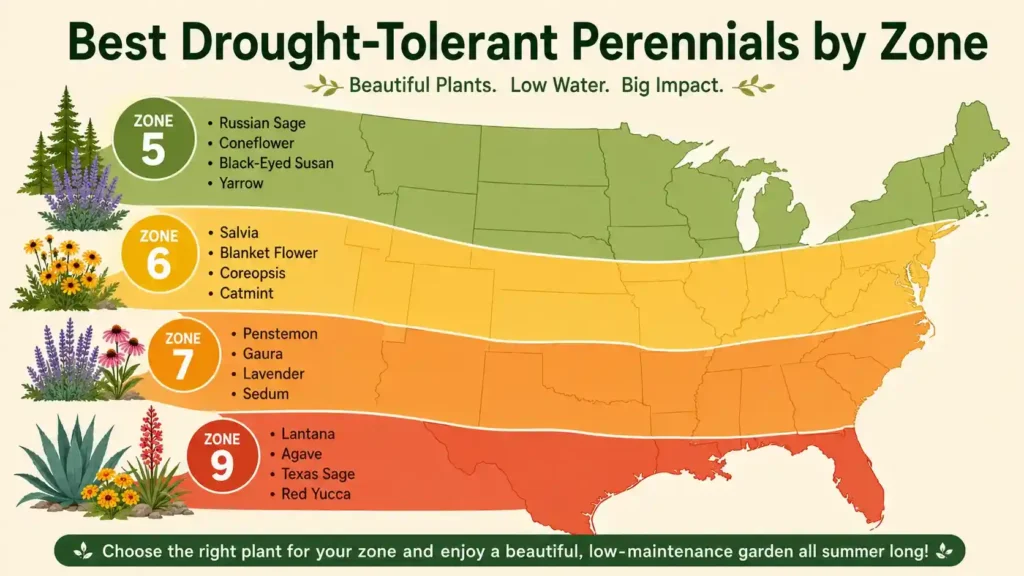
Zone 5 — Cold Winters, Hot Dry Summers (Keywords: full sun drought tolerant perennials zone 5, drought resistant perennials zone 5)
Zone 5 gardeners need perennials that handle both hard winters and summer drought.
- Echinacea purpurea
- Yarrow (Achillea millefolium)
- Black-Eyed Susan (Rudbeckia)
- Sedum Autumn Joy
- Russian Sage (cold-hardy varieties)
Zone 6 — Moderate Cold, Warm Summers (Keywords: zone 6 perennials full sun drought tolerant)
Zone 6 offers a wide range of options for drought tolerant full sun perennials.
- Lavender (Lavandula angustifolia)
- Salvia (hardy varieties)
- Echinacea mix
- Yarrow
- Sedum (showy stonecrop varieties)
Zone 7 — Mild Winters, Hot Humid Summers (Keywords: drought tolerant perennials zone 7, zone 7 drought tolerant perennials)
Zone 7 summers can be intense — heat and humidity combined. Best drought tolerant perennials zone 7 picks include:
- Russian Sage
- Salvia (multiple varieties)
- Black-Eyed Susan
- Lavender (with good drainage)
- Goldenrod
Zone 9 — Hot, Dry, Long Summers (Keywords: drought tolerant plants zone 9)
Zone 9 demands the most heat and drought resilient plants available.
- Salvia (tender perennial varieties)
- Russian Sage
- Lantana
- Yarrow
- Agave and succulent-type sedums
Quick Summary: The colder your zone, the more you should focus on cold-hardy drought resistant perennials like Echinacea and Yarrow. The warmer your zone, the more you can expand into heat-loving options like Salvia and Russian Sage.
How to Create a Beautiful Drought-Tolerant Garden in Summer
A well-planned drought resistant garden is not just about picking the right plants — it is about creating a complete system where soil, water, and plant selection work together. Smart landscaping with drought tolerant plants produces a low maintenance drought tolerant landscape that stays beautiful all summer without constant irrigation. These drought tolerant garden ideas will help you build a garden that thrives on less.
For more foundational growing, soil, and seasonal maintenance tips, explore our complete gardening and plant care guide for healthy outdoor spaces year-round.
Choosing the Right Soil for Drought-Tolerant Plants
The single most important factor for drought tolerant plants is well-draining soil. Heavy clay soil holds too much moisture around roots, causing rot — the opposite problem of drought, but equally damaging. Dry soil plants need soil that drains freely and allows air to reach the root zone.
Understanding the 3 Kinds of Soil for Drought Gardening:
| Soil Type | Drainage | Suitability for Drought Plants |
| Sandy Soil | Excellent | Ideal — drains fast, warms quickly |
| Rocky/Gravelly Soil | Excellent | Perfect for rock garden plants |
| Clay Soil | Poor | Needs significant amendment |
Tips for Improving Your Soil:
- Sandy soil — already ideal for most drought tolerant plants; add a thin layer of compost to improve nutrients without reducing drainage
- Plants in rocky soil — many drought tolerant plants for rock gardens actually prefer lean, rocky conditions; no amendment needed
- Clay soil — mix in coarse sand, perlite, or fine gravel to improve drainage before planting
Quick Answer: If your soil stays wet for more than 1 hour after heavy rain, it needs drainage improvement before planting drought tolerant species.
Watering Tips — When and How Much
Drought tolerant plants still need regular watering during their establishment period — typically the first 4–8 weeks after planting. After that, minimal irrigation is sufficient for most species.
When to Water:
The best time for watering plants in morning is early morning — before 10 AM. This is the single most effective watering practice for drought gardens.
- Morning watering allows water to reach roots before heat evaporates it
- Evening watering leaves foliage wet overnight, increasing disease risk
- Water plants in the morning or evening — but morning is always the better choice
How Much to Water:
- Avoid frequent shallow watering — it encourages shallow root systems
- Use deep root watering technique — water slowly and deeply, less often
- Deep root tree watering and deep bed watering trains roots to grow downward, making plants more self-sufficient during dry spells
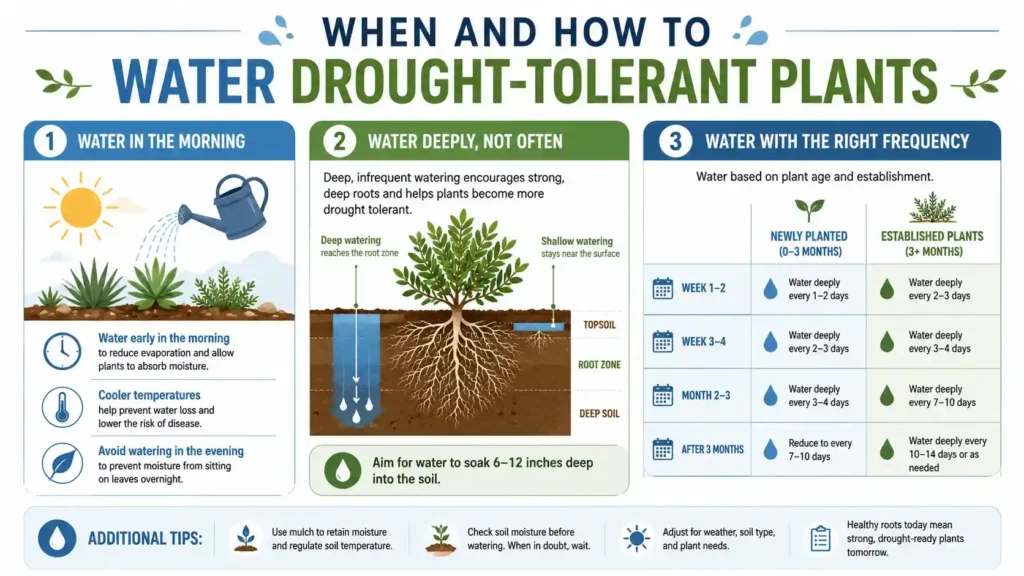
Watering Frequency Guide:
| Plant Stage | Watering Frequency |
| Newly planted (weeks 1–4) | Every 2–3 days |
| Establishing (weeks 5–8) | Once or twice per week |
| Fully established | Once per week or less |
| Succulents and sedums | Every 10–14 days in summer |
Quick Tip: How frequently water succulents in summer? Allow the soil to dry out completely between waterings — overwatering is the number one cause of succulent failure.
Designing a Beautiful Low-Water Garden Bed
A well-designed drought tolerant landscape is visually striking, seasonally dynamic, and almost entirely self-managing once established. The key is combining drought tolerant landscape plants thoughtfully — using height, color, and texture to create a bed that looks intentional and lush, not sparse or neglected.
Height Layering — The Foundation of Good Design:
Structure your low maintenance drought tolerant landscaping in three layers:
- Back layer (tall) — Russian Sage, Goldenrod, tall Salvia varieties (3–5 feet)
- Mid layer (medium) — Echinacea, Black-Eyed Susan, Yarrow (2–3 feet)
- Front layer (low) — Lavender, Sedum, Creeping Thyme (1–2 feet)
This layered approach ensures every plant is visible, receives full sun, and contributes to a full season of color.
Color Combinations That Work:
| Color Pairing | Plants |
| Purple + Yellow | Lavender + Black-Eyed Susan |
| Blue + Orange | Russian Sage + Echinacea |
| White + Yellow | Yarrow + Goldenrod |
| Pink + Silver | Echinacea + Lamb’s Ear |
Border and Edge Ideas:
A lavender border garden along pathways or garden edges is one of the most classic and effective drought tolerant garden ideas.
Lavender’s fragrance, structure, and silver-green foliage make it a perfect natural garden border plant.
For a more relaxed, naturalistic look, a wildflower border combining Yarrow, Echinacea, and Goldenrod creates a beautiful full sun flower bed that requires almost no maintenance after establishment.
A blue flower border using Russian Sage or Salvia paired with ornamental grasses like Blue Fescue adds cool-toned contrast that looks elegant against warm summer tones.
Design Tip: Group plants in odd numbers (3, 5, or 7) for a natural, flowing look. Avoid single specimen planting — drifts of the same plant create stronger visual impact and better pollinator habitat.
Drought-Tolerant Plants for Pots and Hanging Baskets
Container gardening with drought tolerant plants is especially practical in summer — pots and hanging baskets dry out significantly faster than garden beds, making drought resistant container plants the smartest choice for low-maintenance outdoor displays.
Best Drought Tolerant Flowers for Pots:
| Plant | Container Size | Sun Needs | Watering Frequency |
| Sedum | Small–Medium | Full/Part Sun | Every 10–14 days |
| Lavender | Medium–Large | Full Sun | Every 7–10 days |
| Salvia | Medium | Full Sun | Every 5–7 days |
| Echinacea | Large | Full Sun | Every 5–7 days |
Full sun drought tolerant plants for pots perform best when containers have drainage holes — without drainage, even drought tolerant species will suffer root rot.
Tips for Drought-Tolerant Hanging Baskets:
- Use a coco coir or peat-free mix blended with perlite for fast drainage
- Choose drought tolerant plants for hanging baskets like trailing Sedum, compact Salvia, or low-growing Lantana
- Water hanging baskets in the morning — they dry out faster than ground-level pots
- Group pots together to reduce individual evaporation rates
Quick Answer: The best drought resistant plants for pots combine ornamental value with genuine low-water performance — Sedum, Lavender, and Salvia are the top three choices for beautiful, low-maintenance container gardening in summer.
Drought-Tolerant Plants for Specific Climates and Regions
Not all drought tolerant plants perform equally in every region. Climate, humidity, soil type, and summer temperatures all influence which plants will truly thrive. Whether you are looking for drought tolerant plants california gardens demand, heat-hardy options for arizona, or reliable performers for florida summers — regional selection makes all the difference.
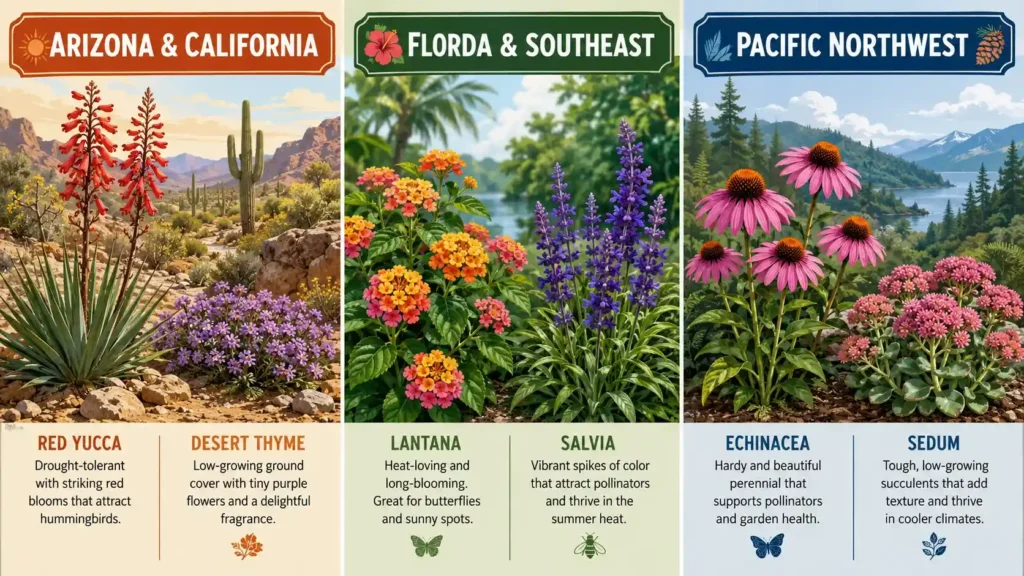
Drought-tolerant plants perform differently depending on climate and heat intensity. While these flowers thrive in US zones with dry summers, gardeners in extremely hot and humid regions like South Asia often need even more heat-adapted varieties.
Hot and Dry Climates — Arizona, Nevada, California
Native and Mediterranean plants offer the best drought resilience for arid, hot climates. Drought tolerant plants arizona and nevada gardens need species that handle extreme heat, intense sun, alkaline soil, and long dry summers simultaneously.
California drought conditions have pushed gardeners toward ca native drought tolerant plants and drought resistant plants southern california landscapes rely on — plants that evolved in dry conditions and need no supplemental irrigation once established.
Top Picks for Arizona, Nevada, and California:
| Plant | Type | Sun | Water Needs | Special Feature |
| Red Yucca | Perennial | Full Sun | Very Low | Hummingbird magnet |
| Prickly Pear Cactus | Succulent | Full Sun | Minimal | Edible fruit |
| Desert Thyme | Ground Cover | Full Sun | Very Low | Fragrant, bee-friendly |
| Lavender | Perennial | Full Sun | Low | Mediterranean native |
| California Poppy | Annual/Perennial | Full Sun | Very Low | CA native wildflower |
| Agave | Succulent | Full Sun | Minimal | Architectural statement |
Summer flowers in arizona benefit most from deep-rooted, heat-adapted species. Mediterranean landscape plants like Lavender, Rosemary, and Salvia are excellent drought resistant landscape plants for these regions — they evolved in climates nearly identical to the American Southwest.
Low maintenance plants for arizona should always be selected from native or desert-adapted species first. These plants require the least water, the least care, and deliver the most reliable performance year after year.
Many gardeners also use climate-adapted species similar to these Australian natives for small gardens because they thrive with very little water and maintenance.
Quick Tip: California drought tolerant plants perform best when mulched with 2–3 inches of gravel or decomposed granite — it reduces soil temperature, slows evaporation, and looks natural in dry landscape settings.
Humid Summer Climates — Florida and Southeast
Florida and the broader Southeast present a unique challenge — summers are hot and humid, but dry spells between rain events can be intense and prolonged. Drought tolerant plants florida gardeners need must handle both waterlogged periods and sudden drought without missing a beat.
Florida drought tolerant shrubs and hardy plants for florida need to tolerate sandy soil, salt air in coastal areas, and extreme heat alongside periodic dry conditions.
Top Picks for Florida and the Southeast:
| Plant | Type | Drought Tolerance | Special Feature |
| Lantana | Perennial/Shrub | Very High | Butterfly magnet |
| Salvia | Perennial | High | Hummingbird attractor |
| Black-Eyed Susan | Perennial | High | Long summer bloom |
| Muhly Grass | Ornamental Grass | High | Pink fall plumes |
| Portulaca | Annual | Very High | Vivid summer color |
| Coontie Palm | Native Shrub | High | Florida native |
Drought tolerant plants for florida should always prioritize Florida native species where possible — they are naturally adapted to the local soil, rainfall patterns, and heat cycles, requiring the least intervention.
Quick Tip: In humid climates, always ensure excellent soil drainage. Even drought tolerant species can suffer root rot in Florida’s heavy summer rains if soil drainage is poor.
Pacific Northwest and Temperate Zones
The Pacific Northwest presents a different drought challenge — mild, wet winters followed by surprisingly dry summers with little to no rainfall from July through September. Drought tolerant plants oregon and washington gardeners need must handle this distinct wet-dry cycle.
Drought resistant plants oregon selections focus on species that establish during the wet season and coast through summer drought on stored soil moisture and deep root systems.
Top Picks for Pacific Northwest and Temperate Zones:
- Drought resistant perennials zone 5 like Echinacea, Yarrow, and Russian Sage perform excellently
- Oregon Grape (Mahonia aquifolium) — native, shade tolerant, very drought hardy
- Penstemon — native western wildflower, extremely drought adapted
- Blue Fescue — ornamental grass, thrives in dry summer conditions
- Sedum — handles both wet winters and dry summers with ease
- Lavender — thrives in the Pacific Northwest’s well-draining hillside soils
Regional Tip: In the Pacific Northwest, the key to drought success is not amending soil too heavily. Native drought tolerant plants oregon soils support are adapted to lean, low-nutrient conditions — overly rich soil actually reduces their drought tolerance.
Drought-Tolerant Shrubs and Ground Covers for Summer Beauty
A complete drought tolerant landscape goes beyond flowers and perennials. Low maintenance drought tolerant shrubs provide structure, height, and year-round framework, while ground covers fill gaps, suppress weeds, and add texture at soil level. Together, drought tolerant bushes and shrubs combined with smart ground cover selections create a layered, finished garden that looks intentional and stays beautiful through the driest summer months.
Best Low-Maintenance Drought-Tolerant Shrubs
The best drought tolerant shrub selections for summer are those that thrive in direct sun, need minimal pruning, and deliver consistent visual interest without regular irrigation. These shrubs that love sun are structural workhorses — providing privacy, border definition, and seasonal color with almost no intervention.
Top Drought-Tolerant Shrub Picks:
| Plant | Height | Sun | Water Needs |
| Russian Sage | 3–5 feet | Full Sun | Very Low |
| Lavender (shrub form) | 2–4 feet | Full Sun | Low |
| Texas Sage (Leucophyllum) | 4–8 feet | Full Sun | Very Low |
| Hypericum (St. John’s Wort) | 1–3 feet | Full/Part Sun | Low |
| Sumac (low varieties) | 2–5 feet | Full Sun | Very Low |
| Rabbitbrush | 3–5 feet | Full Sun | Very Low |
Highlights:
- Russian Sage — technically a subshrub, it behaves as a drought tolerant shrub with woody base stems; excellent as a drought resistant hedge or informal border
- Lavender in shrub form — larger lavender varieties like Lavandula x intermedia grow into substantial shrubs for direct sun with outstanding fragrance and pollinator value
- Texas Sage — one of the best drought tolerant bushes for hot, arid climates; blooms purple after rain events, making it a reliable visual indicator of weather changes
- Hypericum — a versatile low-growing drought tolerant shrub with bright yellow flowers and ornamental berries; handles both full and part sun conditions well
Quick Tip: For drought resistant hedges, Texas Sage and Russian Sage are top choices — both tolerate hard pruning, regenerate quickly, and need no supplemental irrigation once established in suitable climates.
Ground Cover Plants for Dry Areas
Ground covers are one of the most practical tools in drought tolerant landscaping. They solve multiple problems simultaneously — suppressing weeds, reducing soil evaporation, preventing erosion, and adding low-level color and texture. The best heat resistant ground cover selections stay dense and attractive even through the hottest, driest summer weeks.
Top Drought-Tolerant Ground Cover Picks:
| Plant | Height | Sun | Water Needs | Special Feature |
| Creeping Thyme | 2–4 inches | Full Sun | Very Low | Fragrant, bee-friendly |
| Red Creeping Thyme | 2–3 inches | Full Sun | Very Low | Deep pink-red blooms |
| Blue Fescue | 6–12 inches | Full Sun | Low | Blue-silver ornamental grass |
| Sedum (low varieties) | 2–6 inches | Full/Part Sun | Very Low | Succulent ground cover |
| Ice Plant (Delosperma) | 3–6 inches | Full Sun | Very Low | Vivid magenta blooms |
| Lamb’s Ear | 6–12 inches | Full Sun | Low | Silver fuzzy foliage |
Highlights:
- Creeping Thyme — one of the finest drought tolerant ground cover flowers available; releases fragrance when walked on and produces a carpet of tiny pink-purple blooms in early summer
- Red Creeping Thyme — a more colorful variety with deeper bloom tones; excellent full sun drought resistant ground cover for slopes and pathways
- Blue Fescue — a clumping ornamental grass that forms neat blue-silver mounds; ideal heat resistant ground cover for borders and rock gardens
- Succulent ground cover plants like low Sedum varieties spread slowly but reliably, creating dense mats that need virtually no water and tolerate both heat and light frost
- Ice Plant — one of the most vivid drought tolerant ground cover flowers; produces masses of daisy-like blooms in intense pink, purple, and orange shades across full sun slopes and banks
Design Tip: Combine Creeping Thyme as a front-of-border filler with Blue Fescue as a mid-level accent and Russian Sage at the back — this three-layer combination delivers full season color, texture contrast, and complete drought resilience from ground level to eye height.
Common Mistakes to Avoid in Drought Gardening
Even experienced gardeners make critical errors when starting drought tolerant gardening. Plants in drought conditions are already managing stress — and common mistakes can push them past their limits. Understanding plant drought resistance means knowing not just which plants to choose, but how to manage them correctly from day one.
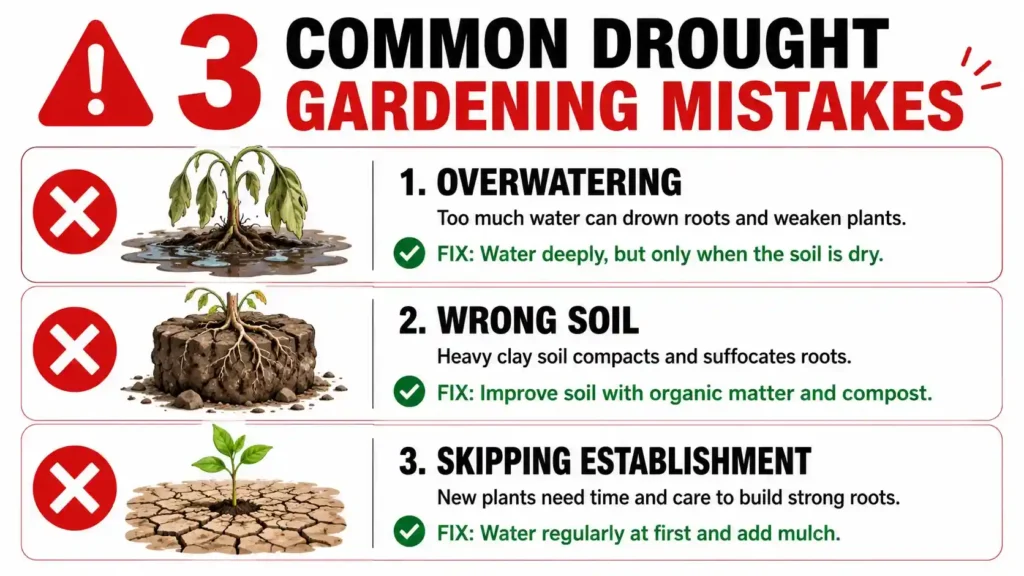
Overwatering Drought-Tolerant Plants
Overwatering is the single most common and damaging mistake in drought gardening. The assumption that more water equals healthier plants is simply wrong for drought tolerant species.
What overwatering does to drought tolerant plants:
- Suffocates roots by displacing oxygen in the soil
- Creates ideal conditions for root rot fungi
- Weakens the plant’s natural drought adaptation mechanisms
- Encourages shallow root development — making plants more vulnerable to dry spells, not less
Signs of overwatering to watch for:
- Yellowing leaves despite healthy-looking soil
- Soft, mushy stems at the base
- Wilting even when soil is wet
- Mold or algae on soil surface
Quick Answer: If your drought tolerant plant looks stressed and the soil is still moist — stop watering immediately. The problem is almost certainly too much water, not too little.
Overwatering succulents is especially damaging. Succulent leaves store water internally — when oversupplied, cells burst and leaves turn translucent, soft, and eventually rot. Under watering succulents is far easier to recover from than overwatering.
Wrong Soil Choices
Planting drought tolerant species in the wrong soil is the second most common mistake — and it undermines plant drought resistance before the plant even gets started.
The core problem: Heavy clay soil retains moisture for too long around roots, creating waterlogged conditions that rot drought tolerant root systems — even during dry weather.
Common soil mistakes and corrections:
| Mistake | Problem | Correction |
| Using heavy clay soil | Poor drainage, root rot risk | Amend with coarse sand and perlite |
| Over-enriching with compost | Too much moisture retention | Use lean, gritty mixes for true drought plants |
| Skipping drainage layer in pots | Water pools at container base | Always use pots with drainage holes |
| Planting in compacted soil | Roots cannot penetrate deeply | Loosen soil to at least 12 inches before planting |
Sandy or rocky, well-draining soil is the natural habitat of most drought tolerant plants. Replicating those conditions — rather than trying to enrich the soil unnecessarily — gives plants the environment their drought resistance was built for.
Ignoring the Establishment Period
A drought tolerant label does not mean a plant can be installed and immediately ignored. New plants have not yet developed the deep, extensive root systems that make them drought hardy — and this establishment period is where most losses occur.
What happens when establishment is ignored:
- Newly planted roots cannot access deep soil moisture
- Plants suffer drought stress within days of planting
- Survival rates drop significantly in hot summer planting conditions
Establishment period best practices:
- Water newly planted drought tolerant species every 2–3 days for the first 2–4 weeks
- Gradually reduce watering frequency over weeks 5–8
- Apply a 2–3 inch layer of mulch immediately after planting to retain soil moisture during establishment
- Avoid planting during peak summer heat where possible — late spring or early fall planting gives roots time to establish before extreme conditions arrive
Quick Summary: Think of the establishment period as an investment. Four to eight weeks of consistent watering produces a plant with a deep, strong root system that will then genuinely thrive with minimal water for years to come.
Benefits of Growing Drought-Tolerant Plants in Summer
Switching to drought tolerant gardening delivers benefits that go far beyond simply saving water. Resilient plants and adaptable garden flowers transform a summer garden into a low-effort, high-impact space that supports wildlife, reduces costs, and contributes to broader climate resilience. Here is why growing drought tolerant plants in summer is one of the smartest gardening decisions you can make.
1. Water Conservation
Water saving plants are the most direct and measurable benefit of drought tolerant gardening.
- Established drought tolerant gardens use 50–75% less water than traditional flower beds
- Reduces dependence on irrigation systems and municipal water supply
- Critically important in drought-prone regions like California, Arizona, Texas, and the broader American Southwest
- Supports responsible water use during summer restrictions and drought emergencies
Quick Fact: A single traditional garden bed can consume hundreds of gallons of water per week in peak summer. A equivalent drought tolerant bed may need watering once every 1–2 weeks or less.
2. Low Maintenance
Drought tolerant gardening dramatically reduces the time and effort required to keep a garden looking its best.
Many of the best outdoor low maintenance plants combine drought resistance with year-round color, making them ideal for modern low-water landscapes.
- No frequent watering schedules to manage
- Most species require minimal pruning and deadheading
- Resilient plants recover quickly from heat stress without intervention
- Less fertilizing needed — drought adapted species thrive in lean soil conditions
- Fewer pest and disease problems compared to high-water plants under heat stress
3. Pollinator Support
Drought tolerant flowers are among the most valuable plants for supporting bees, butterflies, and hummingbirds during summer.
- Bees — Lavender, Sedum, Goldenrod, and Yarrow are top nectar sources
- Butterflies — Echinacea, Lantana, and Black-Eyed Susan attract multiple butterfly species
- Hummingbirds — Salvia and Red Yucca are premier hummingbird plants
Pollinator populations face increasing pressure from habitat loss and climate change. A drought tolerant garden filled with adaptable garden flowers provides reliable food sources through the hottest, driest months when other plants stop blooming.
4. Year-Round Beauty
Resilient plants deliver visual interest across multiple seasons — not just summer.
| Season | Standout Drought Tolerant Plants |
| Spring | Lavender, Sedum, Creeping Thyme |
| Summer | Echinacea, Salvia, Black-Eyed Susan, Russian Sage |
| Late Summer–Fall | Goldenrod, Sedum Autumn Joy, Yarrow |
| Winter | Ornamental seed heads of Echinacea, Goldenrod, dried Lavender stems |
A well-planned drought tolerant garden never looks bare or finished — it transitions beautifully through every season.
5. Cost Savings on Water Bills
The financial benefit of water saving plants is significant and cumulative.
- Lower monthly water bills throughout the entire summer season
- Reduced need for irrigation equipment, timers, and maintenance
- Less spending on replacement plants — drought tolerant species are longer-lived and more resilient than high-water annuals
- Many drought tolerant perennials return year after year, eliminating annual replanting costs
Quick Estimate: Homeowners who convert traditional beds to drought tolerant landscaping commonly report 20–50% reductions in summer water bills, depending on garden size and local water rates.
6. Environmental Benefits
Beyond the individual garden, drought tolerant gardening contributes meaningfully to broader environmental health.
- Reduces urban water demand during critical drought periods
- Supports local biodiversity through pollinator habitat
- Decreases runoff and soil erosion — deep-rooted resilient plants stabilize soil effectively
- Contributes to climate resilience at a community level — widespread adoption of water-wise gardening reduces pressure on municipal water systems
- Reduces the carbon footprint associated with water pumping, treatment, and irrigation infrastructure
Adaptable garden flowers that thrive without intervention represent a genuinely sustainable approach to outdoor spaces — one that works with local climate conditions rather than against them.
Conclusion
A drought tolerant garden is not a compromise — it is an upgrade. The seasonal plants and flowers covered in this guide prove that plant drought conditions do not have to mean a dull, lifeless outdoor space. From the silvery fragrance of Lavender to the golden late-summer fire of Goldenrod, these flowers during summer deliver genuine beauty, ecological value, and season-long color — all while asking for very little in return.
Here is what this guide covered:
- What drought tolerant plants are and why they matter in summer
- The best drought tolerant flowers and plants for full sun summer gardens
- Zone-by-zone perennial recommendations for every climate
- Practical soil, watering, and design tips for building a low-water garden
- Regional plant selections for Arizona, California, Florida, and the Pacific Northwest
- Drought tolerant shrubs and ground covers for complete landscape coverage
- Common mistakes to avoid and how to get establishment right
- The full range of benefits — from water savings to pollinator support
Summer is here — and the gardens that will look most beautiful through the heat are the ones planted with intention, with climate-smart species, and with drought resilience built in from the ground up. June is the perfect month to get started — plants established now will reward you with full season color and almost zero maintenance through the hottest weeks ahead.
This summer, transform your garden with these beautiful drought-tolerant plants. Start with one bed, one border, or even one pot — and experience firsthand how little water a truly gorgeous garden actually needs.
📸 Have a drought tolerant garden you are proud of? Share your summer garden photos in the comments — we would love to see how these plants are thriving in your space.
🌿 Want more seasonal plants and flowers guides delivered straight to you? Subscribe for weekly gardening tips, zone-specific planting calendars, and the best low-water plant recommendations for every month of the year.
Frequently Asked Questions (FAQs)
What are the best drought-tolerant flowers for full sun in summer?
The best drought tolerant flowers for full sun summer gardens are Lavender, Echinacea, Black-Eyed Susan, Russian Sage, and Yarrow. All five are proven full sun drought tolerant flowers that deliver consistent color and bloom performance with minimal watering. Each one is widely available, easy to establish, and reliably returns season after season.
What is the difference between drought tolerant and drought resistant plants?
Drought tolerant plants can survive and actively thrive through extended dry periods with very little water. Drought resistant plants can handle short-term water shortage but need regular watering to stay healthy long-term. For true low-water gardening, always choose drought tolerant species — they are built for sustained dry conditions, not just occasional missed waterings.
Can drought-tolerant plants grow in pots and hanging baskets?
Yes — drought tolerant flowers for pots and drought tolerant plants for hanging baskets perform excellently in containers. Sedum, Lavender, and Salvia are the top three choices. Use a well-draining gritty potting mix, ensure containers have drainage holes, and water deeply but infrequently. Container plants dry out faster than garden beds, making drought tolerant species the smartest and most practical choice for summer pots.
How often should I water drought-tolerant perennials in summer?
Once fully established, most drought tolerant perennials need watering only once per week or less in summer. During the establishment period — the first 4–8 weeks after planting — water every 2–3 days to support root development. Always water in the morning for best results. For succulents and sedums specifically, allow soil to dry out completely between waterings — typically every 10–14 days in summer heat.
Which drought-tolerant plants attract pollinators like bees and butterflies?
The best drought tolerant pollinator plants are Lavender, Echinacea, Salvia, Goldenrod, and Yarrow. Lavender is a premier bee plant — bees and lavender are one of the most well-known pollinator relationships in the garden. Salvia attracts hummingbirds powerfully, especially red varieties. Goldenrod is a critical late-summer nectar source for bees preparing for winter. Together, these plants support a full season of pollinator activity from early summer through fall.
Are there drought-tolerant plants that grow in shade?
Yes — several drought tolerant plants that like shade perform well in partial or dappled shade conditions. Shade tolerant sedum varieties spread reliably in low-light dry spots. Lamb's Ear thrives in partial shade with very little water. Oregon Grape and certain native woodland plants are excellent shade and drought tolerant perennials for challenging spots under trees or along north-facing borders. Full deep shade combined with drought is more difficult — but partial shade drought tolerant selections are widely available for most garden zones.

Written by the LeafyHeaven Editorial Team
LeafyHeaven shares practical gardening tips and simple plant care guides to help you grow, nurture, and enjoy your plants with ease. Our goal is to make gardening feel natural, approachable, and rewarding for everyone.