
Introduction to Low Maintenance Driveway Border Plants
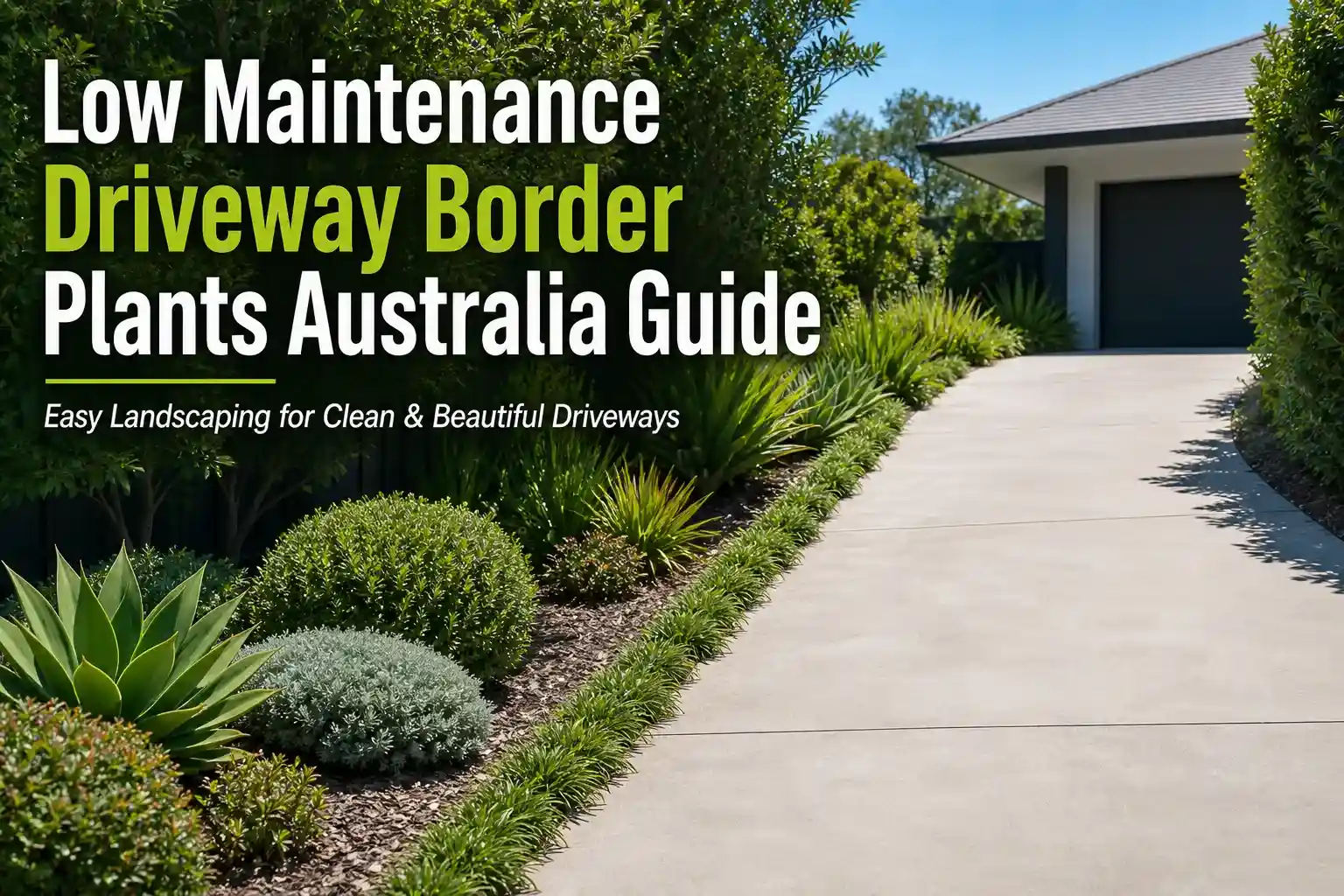
Low maintenance driveway border plants are specially selected driveway plants that require minimal watering, pruning, and ongoing care while still maintaining a clean and structured appearance. These plants are typically hardy, drought-tolerant, and slow-growing, making them ideal for defining driveway edges without constant upkeep.
In Australian conditions, where heat, dry spells, and water restrictions are common, choosing the right plants for driveways Australia is essential. Well-adapted driveway plants Australia are designed to thrive in full sun, tolerate poor soil conditions, and survive with limited irrigation. This makes them a practical and sustainable choice for modern landscaping.
Benefits of Low Maintenance Driveway Border Plants
- Clean driveway edges:
Provides a neat, defined border that enhances the overall landscape structure. - Weed control:
Dense planting helps suppress weed growth, reducing the need for frequent maintenance. - Visual appeal:
Adds greenery, texture, and sometimes color, improving curb appeal without high effort.
What Makes a Driveway Border Plant “Low Maintenance”?
Low maintenance driveway border plants are defined by their ability to grow with minimal intervention while maintaining structure, health, and visual appeal. In Australian landscapes, this means selecting plants that can tolerate heat, limited water, and variable soil conditions without constant care. The right combination of plant traits reduces long-term effort and ensures consistent performance along driveway edges.
For broader plant selection and maintenance fundamentals, see our gardening and plant care guide for practical landscaping and plant-care principles.
Key Characteristics to Look For
- Drought-tolerant plants (essential for Australian climate):
Plants that can survive with minimal watering are critical, especially in regions with water restrictions. Many hardy border plants Australia are naturally adapted to dry conditions, making them reliable for long-term use. - Slow-growing / low pruning needs:
Plants that maintain their shape without frequent trimming reduce maintenance time. Low maintenance shrubs Australia are often selected for their compact growth habit and ability to stay neat with minimal intervention. - Hardy and adaptable varieties:
Strong, resilient plants that can handle heat, wind, and poor soil conditions perform best. Low-maintenance shrubs Australia are typically chosen for their ability to adapt to different environments without requiring special care. - Pest & disease resistance:
Plants that naturally resist common pests and diseases reduce the need for chemical treatments and ongoing monitoring, making them ideal for low-effort landscaping.
Types of Plants Suitable for Driveway Borders
Low-Growing Border Plants
Low-growing border plants are one of the most practical choices for driveway edges, especially where visibility and neat structure are important. These plants stay close to the ground, creating a defined border without obstructing views for vehicles or pedestrians. They are widely used in modern landscaping for their clean appearance and minimal upkeep requirements.
Low-growing border plants are ideal for:
- Maintaining clear sightlines along driveways
- Creating sharp, structured edges
- Reducing the need for frequent pruning
- Preventing soil erosion and weed growth
In Australian landscapes, low growing perennial border plants Australia are particularly valuable because they return year after year without replanting. These plants are adapted to local conditions, making them reliable and cost-effective over time. Similarly, low-growing perennial border plants Australia offer consistent coverage and require minimal watering once established.
Use cases in modern landscaping:
- Lining concrete or paved driveways for a minimalist look
- Softening hard edges in contemporary home designs
- Defining pathways and transitions between driveway and garden beds
- Filling narrow strips where larger plants are not suitable
These plants provide a balance between functionality and aesthetics, making them a core element in low maintenance driveway border design.
Small Edging Plants (Compact Borders)
Small edging plants are ideal for tight driveway spaces where larger plants may feel crowded or interfere with movement. These compact varieties create a clean, defined border while keeping the overall landscape organised and visually balanced. They are especially useful for narrow strips between driveways, pathways, and garden beds.
Benefits of using edging plants for driveway borders:
- Maintain a structured and polished appearance
- Fit neatly into narrow or restricted spaces
- Require minimal trimming and upkeep
- Help separate hard surfaces from planting areas
Popular edging plants Australia are often selected for their compact growth habit, drought tolerance, and year-round structure. Many homeowners also prefer small edging plants Australia because they provide clear border definition without overwhelming the space.
Low-maintenance small border plants are particularly effective in modern Australian landscaping because they stay tidy naturally and need very little intervention. Similarly, low maintenance small border plants are suitable for homeowners wanting practical landscaping with long-term visual appeal.
Flowering Shrubs for Decorative Borders
Flowering shrubs are a great option for adding colour and texture to driveway borders without creating a high-maintenance garden. These plants offer seasonal blooms or year-round greenery while maintaining a manageable size and growth habit.
Benefits of flowering shrubs for driveway borders:
- Add decorative colour and softness to hard surfaces
- Improve curb appeal with minimal effort
- Provide seasonal interest or evergreen structure
- Work well in both formal and natural landscapes
When selecting low maintenance flowering shrubs Australia, it is best to choose varieties suited to local climate conditions, particularly those tolerant of heat and dry weather. Many low-maintenance flowering shrubs Australia are designed to bloom reliably while requiring limited pruning, feeding, or watering.
Seasonal vs evergreen options:
- Seasonal flowering shrubs: Provide bursts of colour during specific blooming periods
- Evergreen flowering shrubs: Maintain foliage year-round with additional flowering benefits
This combination allows homeowners to choose between year-round structure or stronger seasonal visual impact depending on their landscape style.
Tall & Screening Plants for Driveway Sides
Tall and screening plants are used along driveway sides to create privacy, define property boundaries, and soften hard structural lines. These plants are especially useful in modern Australian landscaping where narrow driveways require vertical greenery instead of wide-spreading shrubs. They help form a natural barrier without making the space feel closed or cluttered.
For larger boundary planting ideas, consider these fast-growing evergreen trees in Australia for stronger screening and year-round coverage.
Key benefits include:
- Strong privacy screening from сосед houses or roads
- Clear boundary definition along driveways
- Reduction of wind, dust, and visual noise
- Efficient use of limited ground space
For compact landscapes, screening plants for narrow spaces are specifically chosen for their upright growth habit and minimal lateral spread. These plants allow homeowners to maintain privacy without sacrificing usable driveway width.
In Australia, tall plants for narrow spaces Australia are particularly valuable due to heat tolerance and adaptability to dry conditions. These plants are selected to remain stable in challenging climates while still providing height and structure.
Similarly, tall narrow screening plants Australia are widely used in modern residential designs where space efficiency is essential. Their vertical growth pattern ensures effective screening while keeping maintenance low and landscaping clean and structured.
If you need vertical options for tight layouts, these tall plants for narrow spaces can provide structure and privacy without spreading too wide.
Best Low Maintenance Driveway Border Plants in Australia (Top Choices)
Full Sun Driveway Border Plants
Full sun driveway areas are common in Australian homes, especially where driveways are exposed to long hours of heat and direct sunlight. In these conditions, selecting the right heat-tolerant and sun-loving plants is essential to ensure long-term performance with minimal maintenance. The best choices are those that stay compact, resist drought stress, and maintain structure without frequent watering or pruning.
Small border plants full sun Australia are widely used because they can withstand intense sunlight while still providing neat, defined edges along driveways. These plants are ideal for creating a clean and modern landscape look without requiring constant care.
Low maintenance driveway plants are specifically chosen for their ability to survive harsh outdoor conditions while maintaining visual appeal year-round. They typically require minimal irrigation once established and adapt well to poor or sandy soils often found in Australian gardens.
Similarly, low-maintenance driveway plants are preferred for residential landscaping because they reduce ongoing upkeep while still delivering strong curb appeal. Their resilience to heat and dry conditions makes them a reliable choice for driveway borders exposed to full sun.
Drought-Tolerant & Hardy Plants
Drought-tolerant and hardy plants are essential for Australian driveways, where dry climates and water restrictions are common. These plants are specifically adapted to survive long periods with minimal irrigation while still maintaining structure and appearance. Their resilience makes them a practical choice for homeowners who want sustainable landscaping with low ongoing effort.
Low maintenance plants for driveway areas are designed to handle heat stress, poor soil conditions, and irregular watering without losing their form. Once established, they require very little attention, making them ideal for busy residential landscapes where upkeep needs to stay minimal.
Similarly, low maintenance border plants Australia are widely used in drought-prone regions because they offer consistent coverage and durability. These plants help maintain clean driveway edges even during hot summer months, reducing the need for constant watering or replacement.
Key advantages of drought-tolerant hardy plants:
- Survive long dry periods with minimal water
- Maintain structure in extreme heat conditions
- Reduce irrigation costs and maintenance effort
- Provide reliable year-round driveway border coverage
Plants for Narrow Driveway Spaces
Narrow driveways require carefully selected plants that do not spread aggressively but still provide structure, greenery, and definition. In these tight areas, space-saving plant selection becomes essential to avoid overcrowding while maintaining a clean and functional landscape layout. The goal is to enhance the driveway edges without reducing usable space or creating maintenance challenges.
Plants for driveway borders in narrow spaces are typically compact, upright, and slow-growing. These plants help create a clear separation between hard surfaces and garden areas while keeping the design visually balanced. They are also chosen for their ability to thrive in confined soil strips where root space is limited.
Border plants for driveways are especially effective in narrow layouts because they provide a consistent edge without overextending into walking or parking areas. Their controlled growth habit ensures long-term neatness with minimal pruning.
Driveway border plants suitable for narrow spaces also help improve drainage, reduce weed growth, and enhance curb appeal. When selected correctly, they create a streamlined and modern look while maximizing functionality in limited space conditions.
Driveway Border Design Ideas (Australia Landscaping Style)
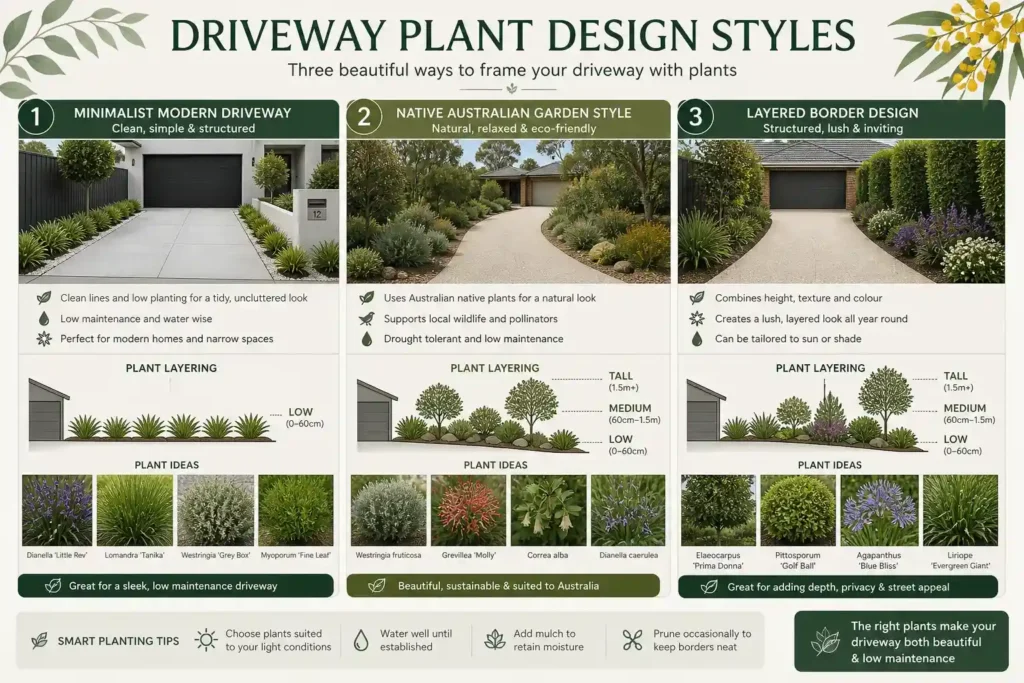
Minimalist Modern Driveway Borders
Minimalist modern driveway borders focus on clean geometry, uncluttered planting, and strong visual structure. This design style is widely used in contemporary Australian homes where simplicity and low maintenance are priorities. The key principle is to use straight lines, consistent spacing, and carefully selected edging plants to define the driveway without overwhelming the space.
Clean lines with edging plants help create a sharp contrast between hard surfaces like concrete or pavers and soft greenery. These plants are usually compact, slow-growing, and uniform in height, ensuring a neat appearance throughout the year with minimal trimming.
Natural Native Australian Garden Style
The natural native Australian garden style emphasizes resilience, biodiversity, and harmony with the local environment. It relies heavily on drought-tolerant species that are adapted to Australian soil and climate conditions. This approach reduces water usage while supporting long-term sustainability.
Using border plants Australia in this style ensures the landscape remains hardy and low maintenance, even in harsh weather conditions. These plants typically include native grasses, shrubs, and groundcovers that naturally thrive without excessive care.
Similarly, plants for borders Australia are selected for their ability to blend into the natural environment while still defining driveway edges clearly. This creates a soft, organic look that complements both modern and traditional Australian homes.
Layered Border Design (Height Variation)
Layered border design adds depth, texture, and visual interest by combining plants of different heights in a structured way. This method is highly effective for driveway landscaping because it balances aesthetics with functionality.
A well-planned layered design typically includes:
- Low-growing border plants: Create a neat edge along the driveway
- Medium shrubs: Add fullness and structure in the middle layer
- Tall screening plants: Provide privacy and vertical definition
This combination not only improves visual appeal but also enhances privacy, reduces wind exposure, and creates a more natural transition between driveway and garden areas.
Plants for Garden Beds Along Driveways
Extending driveway borders into garden beds is an effective way to create a unified and cohesive landscape design. Instead of treating the driveway as a separate element, integrating planting beds alongside it helps soften hard edges and improves overall visual flow. This approach is widely used in modern Australian landscaping to connect functional driveway spaces with surrounding greenery.
Plants for garden bed areas along driveways should be carefully selected to balance structure, durability, and low maintenance needs. These plants must tolerate sun exposure, occasional dust, and limited watering while still maintaining a tidy appearance throughout the year.
Low maintenance plants for borders are particularly suitable for this purpose because they provide consistent structure without requiring frequent pruning or replacement. They help maintain clean lines along the driveway while blending smoothly into surrounding garden beds.
Low maintenance border plants are ideal for creating continuity between different landscape zones. When used correctly, they reduce visual fragmentation and make the entire driveway area feel more intentional and professionally designed.
Key benefits of integrating garden beds along driveways:
- Creates a smooth transition between driveway and landscape
- Enhances curb appeal with layered greenery
- Reduces harsh edges of concrete or paved surfaces
- Supports low-effort, sustainable garden design
- Improves soil stability and weed control along borders
Low Maintenance Plants for Fence Line Near Driveways
Fence line planting near driveways serves both functional and aesthetic purposes, making it a key element in Australian landscaping design. These areas often face direct exposure to wind, dust, and heat, so selecting the right plants is essential for long-term performance with minimal upkeep. A well-planned fence line can improve privacy while also enhancing the overall appearance of the driveway.
Low maintenance plants for fence line areas are specifically chosen for their durability, upright growth habit, and ability to thrive in tough outdoor conditions. These plants require minimal pruning and watering once established, making them ideal for busy homeowners who want effective landscaping without constant maintenance.
Dual-Purpose Planting (Border + Privacy)
Fence line plants work as a dual-function solution by acting as both driveway borders and privacy screens. They help define property boundaries while softening hard fencing structures, creating a more natural and visually appealing transition between built and green spaces.
Wind and Dust Protection
Another important benefit of fence line planting is environmental protection. Dense, hardy vegetation helps:
- Reduce wind impact along driveways
- Minimize dust entering the property
- Improve comfort in outdoor areas
- Create a more sheltered landscape environment
By selecting the right low maintenance plants for fence line applications, homeowners can achieve a balance of privacy, durability, and aesthetic appeal with minimal long-term effort.
Care Tips for Low Maintenance Driveway Plants
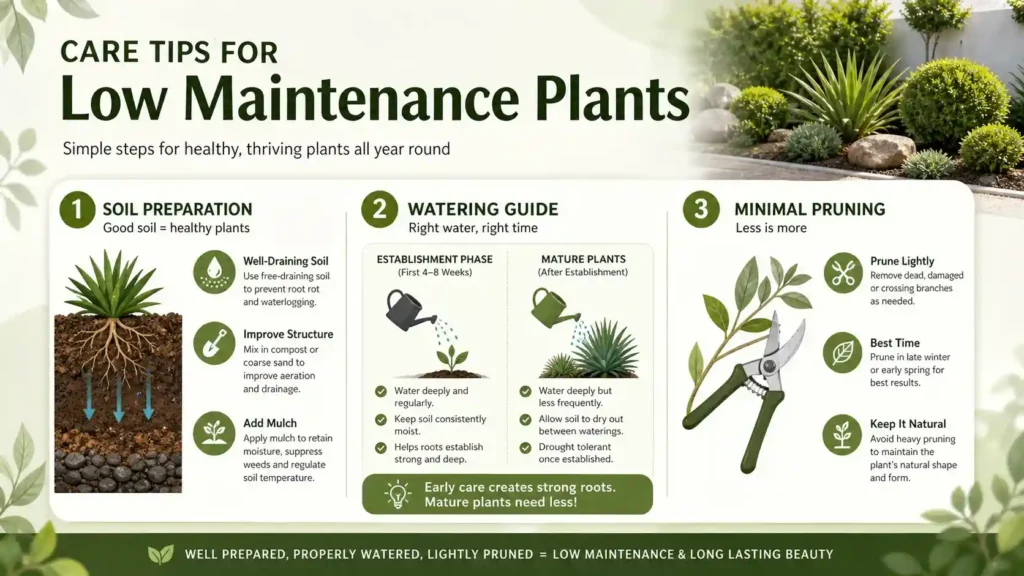
Even though low maintenance driveway plants are designed to reduce effort, proper initial care and simple ongoing practices are essential to keep them healthy and visually consistent. In Australian conditions, where heat and dry spells are common, basic maintenance ensures long-term plant performance along driveway borders.
Soil Preparation
Healthy soil is the foundation of successful driveway planting. Most low maintenance plants perform best in well-drained soil that prevents waterlogging and root rot. Improving soil before planting helps plants establish faster and reduces future maintenance needs.
Key soil preparation steps:
- Ensure well-drained soil structure to avoid excess moisture retention
- Mix organic matter such as compost to improve fertility
- Loosen compacted soil along driveway edges for better root growth
- Check drainage, especially in paved or sloped areas
Good soil preparation is especially important for long-lasting low maintenance border plants Australia, as it directly affects plant health and resilience.
Watering Needs
Watering requirements vary depending on the plant’s growth stage. Understanding the difference between establishment and mature phases is crucial for efficient maintenance.
- Establishment stage:
Newly planted driveway plants require regular watering to develop strong root systems. This phase is critical for long-term survival. - Mature plants:
Once established, most driveway plants need significantly less water and can often rely on natural rainfall, especially drought-tolerant varieties.
Proper watering habits reduce stress and ensure low maintenance plants for driveway areas remain healthy even in hot Australian climates.
Pruning & Upkeep
One of the main advantages of low maintenance driveway landscaping is reduced pruning requirements. However, occasional trimming helps maintain shape and prevent overgrowth.
Minimal trimming strategies include:
- Light seasonal pruning to maintain structure
- Removing dead or damaged branches only when necessary
- Avoiding heavy cutting that disrupts natural growth form
- Choosing slow-growing species to reduce trimming frequency
With the right approach, driveway plants can maintain a clean and structured appearance with very little ongoing effort, making them ideal for low maintenance landscaping designs.
Common Mistakes to Avoid
Designing driveway borders with low maintenance plants can still go wrong if the wrong choices or planning errors are made. These mistakes often lead to higher upkeep, poor plant performance, and an unbalanced landscape appearance. Avoiding them ensures long-lasting, clean, and functional driveway edges in Australian conditions.
Choosing High-Maintenance Plants
One of the most common mistakes is selecting plants that require frequent pruning, watering, or pest control. While they may look attractive initially, high-maintenance species quickly become difficult to manage along driveway edges.
Problems caused by this mistake:
- Constant trimming and upkeep
- Higher water consumption
- Increased risk of plant decline in harsh conditions
Instead, always prioritize low maintenance border plants Australia that are naturally suited to local climates and require minimal care once established.
Ignoring Sunlight Conditions
Sunlight exposure plays a critical role in plant survival and performance. Many driveway areas in Australia receive full sun for most of the day, and ignoring this factor can lead to weak or unhealthy plants.
Common issues include:
- Leaf burn or drying in full sun areas
- Poor growth in shaded selections placed in direct heat
- Increased watering needs due to stress
To avoid this, always match plant selection with site conditions, especially when choosing driveway plants or low maintenance plants for driveway borders.
Overcrowding Driveway Edges
Overplanting is another frequent mistake that affects both aesthetics and plant health. While it may seem like more plants create a fuller look, overcrowding often leads to competition for space, nutrients, and water.
Negative effects include:
- Restricted plant growth and poor airflow
- Higher risk of disease and pest problems
- A cluttered and untidy driveway appearance
Proper spacing is essential for border plants for driveways to ensure each plant has enough room to grow naturally and maintain a clean, structured edge.
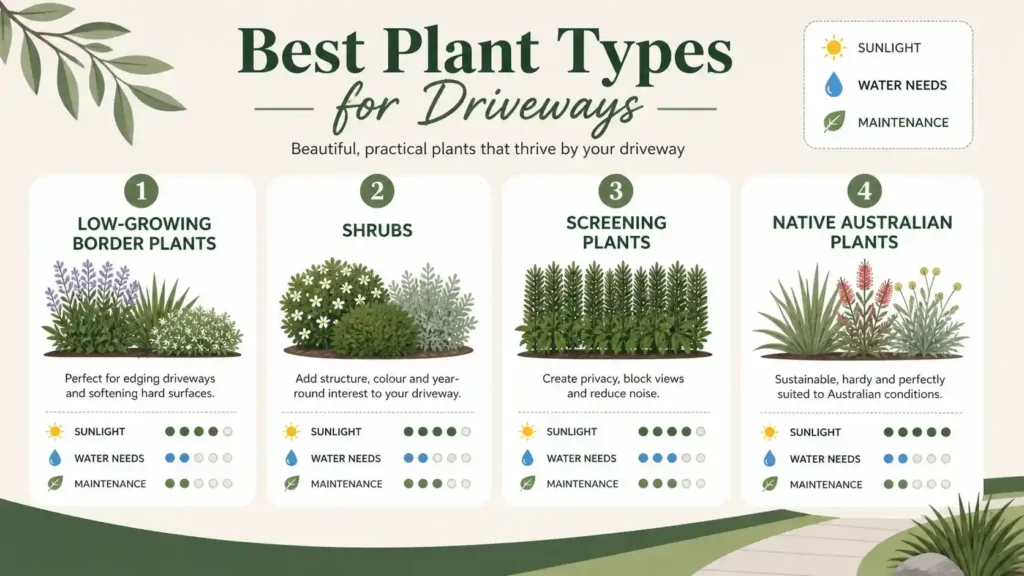
Quick Comparison Table (Best Plant Types for Driveway Borders)
Below is a quick overview of the most suitable plant types for driveway borders in Australian landscaping. This comparison helps in selecting the right plants based on maintenance level, purpose, and sunlight requirements.
| Plant Type | Maintenance Level | Best Use | Sun Requirement |
|
Low-growing plants |
Very Low | Edging | Full sun |
|
Shrubs |
Low | Decorative borders |
Full/partial |
| Screening plants | Low | Privacy |
Full sun |
| Native plants | Very Low | Australian landscapes |
Full sun |
This comparison shows that low-growing and native plants are the easiest options for long-term, low-effort driveway landscaping, especially in Australian climates where heat and dryness are common. Shrubs and screening plants add structure and privacy while still maintaining relatively low maintenance needs when chosen correctly.
Conclusion
Low maintenance driveway border plants offer a practical and visually appealing solution for Australian landscaping, especially in areas exposed to heat, dry conditions, and limited water availability. Throughout this guide, different plant types have been explored, including low-growing edging plants, hardy shrubs, screening plants, and native varieties, all designed to reduce upkeep while maintaining structure and beauty along driveways.
The key takeaway is that selecting climate-suitable plants is essential for long-term success. Choosing plants adapted to Australian conditions ensures better drought resistance, reduced maintenance, and consistent performance year-round. Options like low-growing border plants, screening plants for narrow spaces, and native species provide reliable solutions for both function and aesthetics.
By focusing on low maintenance driveway plants, homeowners can achieve clean edges, improved privacy, and enhanced curb appeal without the burden of constant care. Smart plant selection leads to a more sustainable, efficient, and easy-to-manage outdoor space that remains attractive for years.
In the end, successful driveway landscaping is about balance—combining durability, simplicity, and natural beauty for long-term easy maintenance.
FAQs
What are the best low maintenance driveway border plants in Australia?
The best options include drought-tolerant native plants, low-growing border plants, compact shrubs, and hardy ornamental grasses. These plants handle heat well and require minimal watering once established, making them ideal for Australian driveways.
Which plants are best for narrow driveway spaces?
For narrow driveways, upright and compact species work best. Screening plants for narrow spaces, slim ornamental grasses, and columnar shrubs are commonly used because they provide structure without spreading too much.
What are the best edging plants for driveways?
Edging plants that stay low and uniform in height are ideal. These include small edging plants Australia, groundcovers, and low-growing perennial varieties that create clean, defined borders with minimal maintenance.
Which driveway plants require the least watering?
Drought-tolerant native plants, succulents, and established hardy shrubs require the least watering. Once rooted, they adapt well to dry conditions and depend mostly on natural rainfall.
Can I use native Australian plants for driveway borders?
Yes, native Australian plants are highly recommended for driveway borders. They are naturally adapted to local soil and climate conditions, making them resilient, water-efficient, and low maintenance.
What plants work best in full sun driveways in Australia?
Full sun driveways are best suited to heat-tolerant plants such as low maintenance driveway plants, compact shrubs, native grasses, and drought-resistant groundcovers that can withstand strong sunlight and dry conditions.
How do I choose plants that won’t damage driveway surfaces?
Choose non-invasive root systems and slow-growing plants. Avoid large trees or aggressive root spreaders and prefer compact shrubs or groundcovers that stay within defined borders.
How far should plants be spaced from the driveway edge?
Spacing depends on plant type, but generally small edging plants can be placed 15–30 cm from the edge, while shrubs and screening plants should be spaced further to allow natural growth and airflow.
Do driveway border plants attract pests?
Most hardy and native low maintenance plants have good pest resistance. However, overcrowding or poor drainage can increase pest risk, so proper spacing and soil preparation are important.
How often should driveway border plants be pruned?
Most low maintenance varieties only need light pruning 1–2 times per year to maintain shape. Slow-growing and native species may require even less frequent trimming.

Written by the LeafyHeaven Editorial Team
LeafyHeaven shares practical gardening tips and simple plant care guides to help you grow, nurture, and enjoy your plants with ease. Our goal is to make gardening feel natural, approachable, and rewarding for everyone.