
Introduction
The Middle East’s brutal summer heat pushes most plants to their limits — but the right flowering plants in uae prove that a beautiful garden is absolutely possible, even in desert conditions.
From Dubai to Riyadh, carefully chosen drought tolerant plants deliver vibrant color and life through the harshest summer months.
This guide covers the best summer plants in uae, top desert plants uae selections, UAE native plant picks, and complete outdoor plants dubai gardening tips.
Whether you have a villa garden, rooftop terrace, or apartment balcony — this summer, these plants will transform your Middle East garden.
Why Middle East Summer Demands Drought-Tolerant Flowering Plants
Middle East summer is one of the most extreme gardening environments on earth.
Summer plants in uae and across the region face temperatures that regularly exceed 45°C, near-zero rainfall, and harsh desert winds — conditions where only specially selected drought resistant plants genuinely survive and bloom.
Many gardeners also combine these flowering varieties with other drought tolerant plants that survive extreme heat with minimal watering requirements.
Many gardeners also combine these flowering varieties with other drought tolerant flowers that survive extreme heat with minimal watering requirements.
Choosing the right outdoor plants dubai and Middle East gardeners need starts with understanding exactly what these plants must endure. Building that understanding starts with strong fundamentals — this complete gardening and plant care guide covers everything from soil preparation to seasonal plant management for outdoor gardens.
Understanding Middle East Summer Climate
Middle East summer means extreme desert heat, zero rainfall, and sandstorms — only desert plants in uae and specially adapted arabian desert plants survive these conditions without significant intervention.
Plants in uae desert environments face multiple simultaneous stressors that conventional garden plants simply cannot handle.
Middle East Summer Climate — Key Facts:
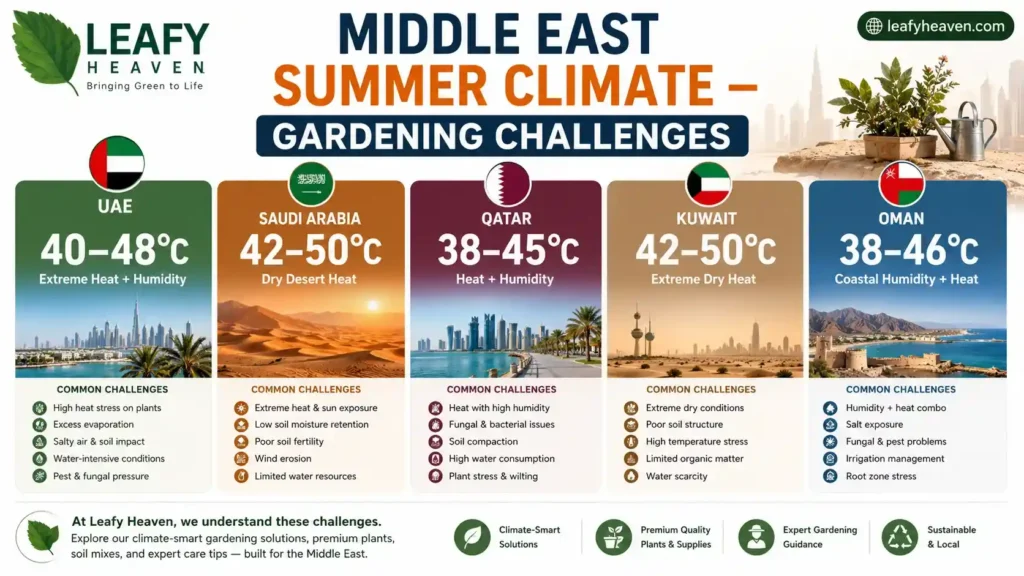
| Country | Summer Temp | Rainfall | Key Challenge |
| UAE | 40–48°C | Near Zero | Extreme heat + humidity |
| Saudi Arabia | 42–50°C | Very Low | Dry desert heat |
| Qatar | 38–45°C | Near Zero | Heat + humidity |
| Kuwait | 42–50°C | Very Low | Extreme dry heat |
| Oman | 38–46°C | Very Low | Coastal humidity + heat |
UAE experiences a unique combination of extreme heat and high coastal humidity — making it one of the most challenging environments for drought tolerant plants globally.
Saudi Arabia and Kuwait face purely dry desert heat — intense, relentless, and completely rainless for months at a stretch.
Oman’s coastal areas add salt air to the challenge — requiring plants with both drought tolerance and salt resistance.
What Makes a Plant Suitable for UAE and Middle East Summer
Plants that grow in uae summer must handle extreme heat, alkaline soil, and minimal water simultaneously — this combination eliminates the vast majority of conventional garden plants.
Flowering plants which grows best in uae share a specific set of physical and physiological traits that make them genuinely drought resistant plants rather than simply heat tolerant ones.
Key Traits of Middle East Summer-Suitable Plants:
- Deep Root Systems — access subsoil moisture during prolonged dry periods
- Thick or Waxy Leaves — reduce water loss through transpiration
- High Heat Tolerance — maintain cellular function above 40°C
- Salt Tolerance — handle alkaline UAE desert soil conditions
- Rapid Bloom Cycles — complete flowering before peak heat intensity
Drought Tolerant vs Drought Resistant — Key Difference:
| Term | Meaning | Middle East Relevance |
| Drought Tolerant | Thrives through extended dry periods with very little water | Essential for UAE + Saudi Arabia summer |
| Drought Resistant | Handles short dry spells but needs regular watering | Suitable for Oman coastal areas with occasional rain |
Quick Answer: For Middle East summer gardening, always choose genuinely drought tolerant species — drought resistant plants alone will not survive UAE’s months-long rainless summers without supplemental irrigation.
Best Flowering Plants in UAE and Middle East for Summer
The best flowering plants in uae for summer share one critical quality — they bloom beautifully even when temperatures soar past 45°C and rainfall is near zero.
These proven outdoor flowering plants deliver season-long color across Dubai, Abu Dhabi, and the wider Middle East without demanding constant irrigation or special care.
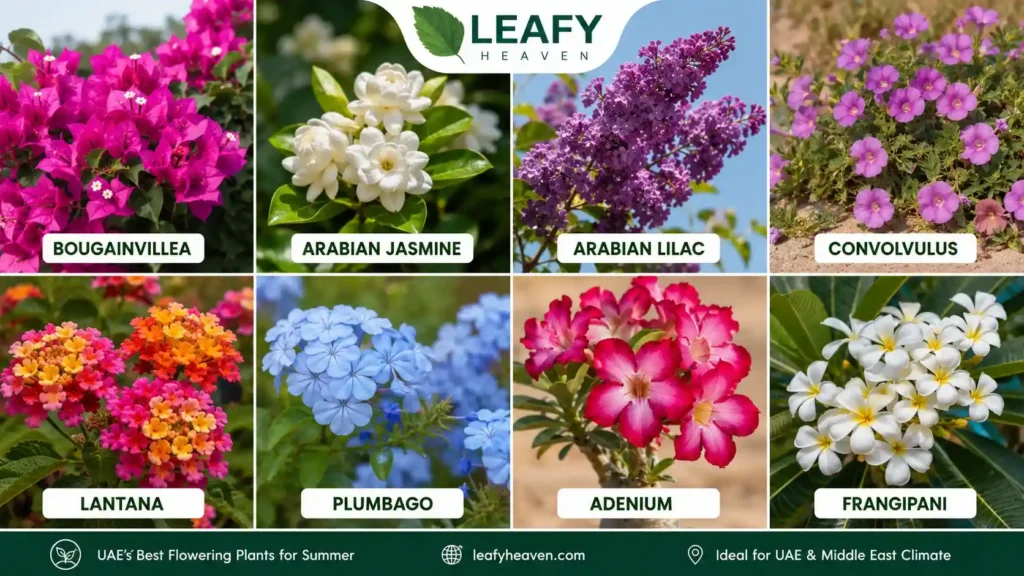
Every plant listed here is a tested seasonal flowers in uae performer — reliable, heat-adapted, and genuinely beautiful through the most demanding months.
Bougainvillea
Bougainvillea is the most iconic drought tolerant flowering plant in the Middle East — producing spectacular color displays in full peak summer heat when most other outdoor plants in dubai struggle to survive.
A defining characteristic of the bougainvillea plant is that water stress actually triggers blooming — making UAE’s dry summer conditions ideal rather than challenging.
Key Facts:
| Feature | Details |
| Sun Needs | Full sun — minimum 6 hours daily |
| Water Needs | Very Low — drought triggers blooming |
| Zones | Tropical + subtropical — all Middle East |
| Bloom Colors | Pink, purple, red, orange, white, yellow |
| Maintenance | Annual pruning after bloom cycle |
As summer plants in uae go, Bougainvillea is unmatched for sheer visual impact.
It thrives on walls, trellises, fences, and as large container plants on rooftop terraces across Dubai and Abu Dhabi.
Exploring different bougainvillea varieties can help you find the right color and growth habit for your specific UAE garden space.
Quick Tip: Reduce irrigation significantly in the weeks before flowering — mild water stress produces the most spectacular bloom flush on Bougainvillea in UAE summer conditions.
Jasmine (Arabian Jasmine)
Arabian Jasmine is one of the most beloved fragrant flowering plants across UAE and the wider Middle East — a jasmine plant outdoor performer that handles summer heat while releasing its iconic sweet fragrance through warm evenings.
Jasmine flower dubai gardens feature prominently — it is among the most popular jasmine plant dubai residents grow on balconies, pergolas, and garden walls.
Key Facts:
| Feature | Details |
| Fragrance | Strong sweet scent — intensifies in evening heat |
| Sun Needs | Full sun to partial shade |
| Water Needs | Low-moderate — drought tolerant once established |
| Bloom Season | Spring through summer — peak in May–July |
| Pruning | Light pruning after bloom flush to encourage new growth |
Arabian jasmine handles UAE humidity and heat better than most jasmine varieties — making it the most reliable fragrant summer flowering choice for Middle East gardens.
Quick Tip: Plant arabian jasmine near seating areas or windows — its evening fragrance is strongest in warm summer temperatures, creating a natural aromatherapy effect in outdoor spaces.
Arabian Lilac (Vitex trifolia)
Arabian Lilac is a UAE native plant that thrives naturally in desert conditions — producing beautiful soft purple blooms through summer without any supplemental irrigation once established.
As one of the true native plants of uae, Vitex trifolia is already perfectly adapted to alkaline desert soil, extreme heat, and near-zero rainfall — making it one of the lowest-maintenance summer flowering plants available.
Key Facts:
| Feature | Details |
| Scientific Name | Vitex trifolia |
| Native Habitat | UAE coastal and desert margins |
| Height | 3–8 feet |
| Bloom Color | Soft purple-lavender |
| Bloom Season | Summer — May through August |
| Drought Tolerance | Very High — native desert species |
| Water Needs | Minimal once established |
Arabian lilac supports local biodiversity — its blooms attract native bees and butterflies that are adapted to UAE desert conditions.
As a native plant, it requires no soil amendment, no special fertilizing, and no winter protection — a truly zero-effort summer flowering shrub for UAE gardens.
Convolvulus (Morning Glory / Convolvulus virgatus)
Convolvulus virgatus is a UAE native desert plant that produces delicate pink-purple blooms through summer with literally zero supplemental water — surviving purely on natural desert conditions.
As one of the most authentic desert plants in uae with names recognized by botanists and gardeners alike, it represents true climate-adapted beauty.
Key Facts:
| Feature | Details |
| Scientific Name | Convolvulus virgatus |
| Native Status | UAE and Arabian Peninsula native |
| Spread Habit | Low-growing, spreading ground cover |
| Bloom Color | Pink-purple with white center |
| Water Needs | Zero supplemental irrigation needed |
| Soil | Sandy desert soil — no amendment required |
Among uae native plants, Convolvulus virgatus is one of the most ecologically valuable — it stabilizes sandy desert soil, reduces erosion, and provides ground-level coverage in harsh conditions where almost nothing else grows.
Quick Tip: Convolvulus virgatus is ideal for naturalizing dry slopes, sandy borders, and unirrigated garden margins in UAE properties — it spreads naturally and requires no maintenance once established.
Lantana
Lantana is one of the toughest and most colorful outdoor flowering plants available for Middle East summer gardens — blooming continuously through intense heat while actively attracting butterflies and bees.
As a seasonal flowers in uae performer, Lantana stands out for its multi-colored flower clusters that change color as they mature — giving a single plant multiple color tones simultaneously.
Key Facts:
| Feature | Details |
| Bloom Colors | Yellow, orange, pink, red, white — multicolored clusters |
| Water Needs | Very Low — highly drought tolerant |
| Heat Tolerance | Excellent — thrives above 40°C |
| Sun Needs | Full sun |
| Zones | Tropical + subtropical — all Middle East |
| Special Feature | Strong butterfly and bee attractor |
Lantana is among the best summer flowers for UAE gardens because it never stops blooming — even during peak July and August heat when most other plants drop their flowers.
Its colorful blooms and hardy nature also make it popular in gardens built around easy-care outdoor landscaping plants.
Quick Tip: Lantana spreads vigorously in UAE conditions — plant it where it has room to grow, or use it as a trailing plant over walls and raised garden beds for maximum visual impact.
Plumbago (Cape Leadwort)
Plumbago is one of the most popular heat-tolerant flowering shrubs across Dubai and UAE gardens — producing masses of cool powder-blue blooms through the hottest summer months when most garden plants lose their color.
As outdoor plants in dubai go, Plumbago stands out for delivering a rare cool blue tone that contrasts beautifully against UAE’s warm desert landscape.
Key Facts:
| Feature | Details |
| Bloom Color | Powder blue — rare cool tone in desert gardens |
| Height | 3–6 feet |
| Sun Needs | Full sun to partial shade |
| Water Needs | Low — drought tolerant once established |
| Bloom Season | Spring through summer — near continuous |
| Growth Habit | Spreading shrub — ideal for borders and hedges |
Plumbago is among the finest garden plants dubai residents use for border planting, wall coverage, and large container displays.
It handles UAE heat, alkaline soil, and dry conditions with minimal intervention — making it a reliable low-maintenance summer plants in uae choice for both private gardens and public landscaping.
Quick Tip: Plumbago blooms most prolifically in full sun. Light pruning after each bloom flush encourages continuous flowering through the entire UAE summer season.
Adenium (Desert Rose)
Adenium is the ultimate desert flowering plant for Middle East gardens — a true succulent that stores water in its swollen base stem and produces strikingly beautiful blooms in the most extreme drought conditions.
As one of the most recognized desert plants in uae with names known by gardeners across the Gulf, Adenium perfectly represents the beauty that arabian desert plants are capable of delivering.
Key Facts:
| Feature | Details |
| Scientific Name | Adenium obesum |
| Succulent Nature | Stores water in swollen caudex base stem |
| Bloom Colors | Deep pink, red, white, bi-color varieties |
| Bloom Season | Spring + summer — triggered by heat |
| Sun Needs | Full sun — essential for blooming |
| Water Needs | Very Low — water every 10–14 days in summer |
| Height | 2–5 feet |
Adenium is one of the few desert plants in uae that actively blooms during peak summer heat rather than going dormant.
Its sculptural swollen trunk and vivid blooms make it equally valuable as an ornamental specimen plant and a low-water garden anchor across UAE properties.
⚠️ Important Note: Adenium sap is toxic — handle with gloves and keep away from children and pets. Despite its striking beauty, it requires careful placement in family garden settings.
Frangipani (Plumeria)
Frangipani is the Gulf region’s most fragrant summer flowering tree — a heat and drought tolerant outdoor flowering plant that fills UAE gardens with its iconic tropical fragrance through the hottest summer months.
As flowering plants in uae go, Frangipani delivers one of the most distinctive and universally loved sensory experiences — its waxy, star-shaped blooms release intense fragrance especially in warm evening temperatures.
Key Facts:
| Feature | Details |
| Fragrance | Strong tropical-sweet scent — strongest in evening |
| Height | 10–25 feet depending on variety |
| Bloom Colors | White, yellow, pink, red, multicolor |
| Sun Needs | Full sun — 6+ hours daily |
| Water Needs | Low — drought tolerant once established |
| Bloom Season | Late spring through summer — peak June–August |
| Soil | Well-draining — sandy desert soil ideal |
Frangipani is naturally adapted to hot, dry tropical and subtropical conditions — making UAE’s summer climate genuinely ideal rather than challenging for this species.
As one of the best summer flowers for UAE and Gulf region gardens, it requires minimal watering once established and responds to UAE’s full sun conditions with prolific blooming through the entire summer.
Quick Tip: Frangipani is deciduous in cooler months — it drops leaves in winter but returns vigorously in spring with fresh growth and blooms that peak exactly during UAE’s summer months.
UAE Native and Desert Plants That Flower in Summer
UAE native plants and arabian desert plants represent the most sustainable and lowest-maintenance flowering choices for Middle East summer gardens.
Native plants in uae have evolved over thousands of years specifically for desert conditions — extreme heat, alkaline soil, minimal rainfall, and sandstorms are their natural environment, not a challenge.
Understanding native plants of uae and desert plants in uae with names gives gardeners a powerful toolkit of proven summer performers that require zero compromise between beauty and water conservation.
Why Native Plants Are Best for UAE Summer Gardens
Plants that grow in uae natively are already perfectly calibrated for desert conditions — they need zero supplemental irrigation once established and thrive without soil amendment or special care.
Plants in uae desert environments have developed specific adaptations over millennia that no cultivated garden plant can fully replicate.
Key Benefits of UAE Native Plants:
- Water Saving — established native plants survive purely on natural rainfall and groundwater — no irrigation system required
- Low Maintenance — no fertilizing, no soil amendment, no special pruning schedules needed
- Local Biodiversity Support — native flowering plants support UAE’s native bee, butterfly, and bird species that depend on indigenous plant species
- Cost Savings — zero irrigation costs + zero replacement plant costs after establishment
- Climate Resilience — drought resistant plants that are native handle extreme weather events — sandstorms, heat waves, flash floods — without damage
Quick Fact: UAE native flowering plants can survive soil salinity levels and alkalinity that would kill virtually all conventional garden plants within days — a critical advantage in UAE’s naturally challenging desert soil conditions.
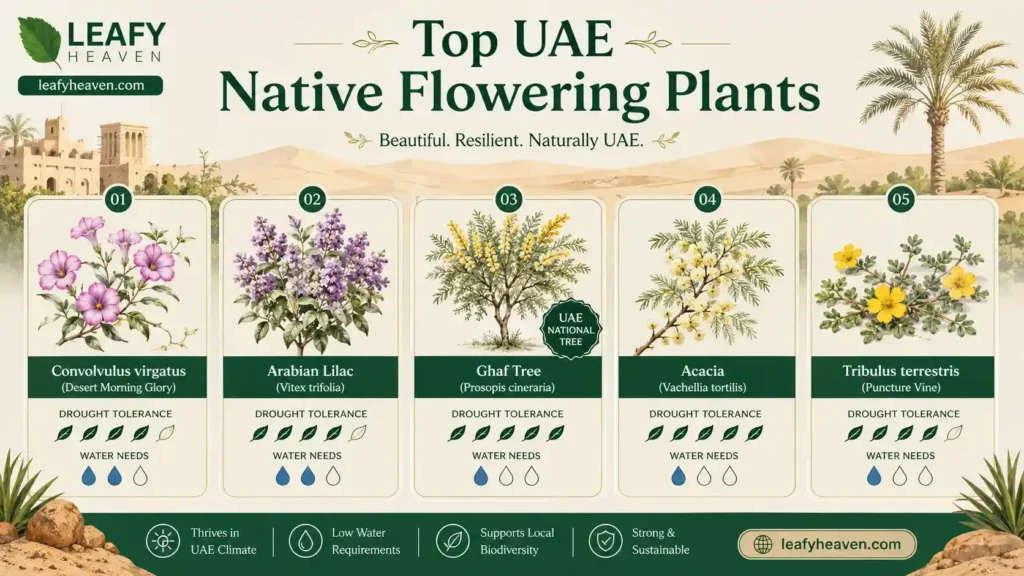
Top UAE Native Flowering Plants
Native plants of uae that flower in summer deliver genuine beauty with zero water dependency — these are the most climate-honest flowering choices available for UAE and Middle East gardens.
Desert plants in uae that are native represent the gold standard for sustainable summer gardening across the Gulf region.
Convolvulus virgatus
| Feature | Details |
| Bloom Color | Pink-purple with white center |
| Height | Low-growing — 6–12 inches |
| Water Needs | Zero supplemental irrigation |
| Best Use | Ground cover, sandy borders, slopes |
A true UAE desert native — spreads naturally across sandy soil and produces delicate blooms through summer with no human intervention.
Arabian Lilac (Vitex trifolia)
| Feature | Details |
| Bloom Color | Soft purple-lavender |
| Height | 3–8 feet |
| Water Needs | Minimal once established |
| Best Use | Hedges, borders, specimen shrub |
One of the most ornamentally valuable uae native plants — combines genuine drought tolerance with attractive summer blooms and fragrant foliage.
Ghaf Tree (Prosopis cineraria)
| Feature | Details |
| Bloom Color | Small pale yellow flower spikes |
| Height | 15–25 feet |
| Water Needs | Zero — deep tap root accesses groundwater |
| Special Feature | UAE national tree — sacred in Emirati culture |
The Ghaf is the most iconic of all native plants in uae — the national tree of the UAE and a supreme symbol of desert survival. Its deep tap roots access groundwater 30+ meters below desert surface.
Acacia (Salam Tree / Acacia tortilis)
| Feature | Details |
| Bloom Color | Pale yellow fragrant clusters |
| Height | 15–30 feet |
| Water Needs | Very Low — deep rooted desert survivor |
| Best Use | Large garden specimen, shade tree, wildlife support |
Acacia produces fragrant yellow blooms in summer and provides critical shade and habitat for native UAE wildlife — birds, insects, and small mammals all depend on it.
Tribulus terrestris
| Feature | Details |
| Bloom Color | Small bright yellow flowers |
| Height | Low-growing ground cover — 4–8 inches |
| Water Needs | Zero — extreme desert survivor |
| Best Use | Naturalistic desert planting, dry slopes |
One of the hardiest of all desert plants in uae — Tribulus terrestris produces cheerful yellow blooms across bare desert ground with no water, no soil preparation, and no maintenance whatsoever.
Quick Summary: UAE native flowering plants are not just drought tolerant — they are drought dependent. These species evolved in one of the world’s most extreme desert environments and perform at their best precisely when conditions are hottest, driest, and most challenging.
Best Outdoor Plants for Dubai and UAE — Summer Selection Guide
Choosing the best outdoor plants for dubai requires matching plants specifically to Dubai’s unique combination of full sun, sandy alkaline soil, extreme summer heat, and near-zero rainfall.
The right outdoor plants uae selections deliver year-round beauty with minimal water and maintenance — making them practical for both large villa gardens and compact apartment spaces.
This guide covers the top garden plants dubai residents rely on and the best plants to grow in dubai for every outdoor setting.
Full Sun Outdoor Flowering Plants for Dubai
Full sun outdoor flowering plants that handle both heat and sandy soil are the most reliable choice for Dubai’s year-round sunshine conditions.
Outdoor plants in dubai must tolerate direct sun for 8–10 hours daily through summer — a requirement that eliminates most conventional garden plants immediately.
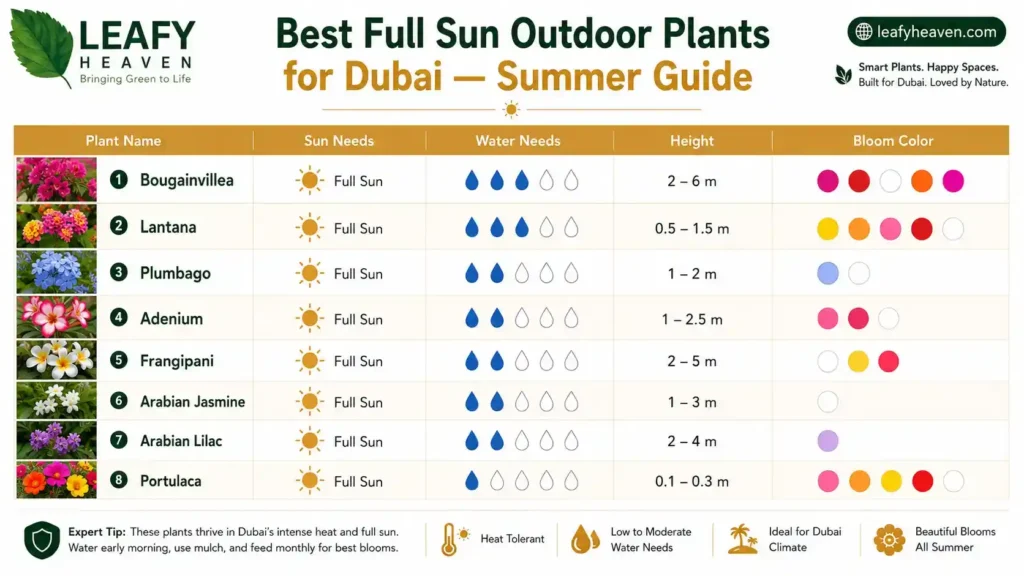
Top Full Sun Outdoor Plants with Flowers for Dubai:
| Plant | Sun | Water Needs | Height | Bloom Color |
| Bougainvillea | Full Sun | Very Low | 10–30 ft | Pink, Purple, Red, Orange |
| Lantana | Full Sun | Very Low | 2–4 ft | Yellow, Orange, Pink, Red |
| Plumbago | Full/Part Sun | Low | 3–6 ft | Powder Blue |
| Adenium | Full Sun | Very Low | 2–5 ft | Pink, Red, White |
| Frangipani | Full Sun | Low | 10–25 ft | White, Yellow, Pink |
| Arabian Jasmine | Full/Part Sun | Low | 3–8 ft | White |
| Arabian Lilac | Full Sun | Very Low | 3–8 ft | Purple-Lavender |
| Portulaca | Full Sun | Very Low | 6–12 in | Pink, Red, Orange, Yellow |
All of these outdoor flowering plants are proven performers in Dubai’s full sun conditions — tested across thousands of UAE gardens and public landscapes.
Quick Tip: Sandy soil in Dubai drains extremely fast — mix in compost and coco peat before planting to improve moisture retention without reducing drainage quality.
Outdoor Plants for Dubai Apartments and Balconies
Compact drought tolerant flowering plants are the ideal solution for Dubai apartment balconies and small outdoor spaces — they deliver maximum color in minimum space with minimum water requirements.
The right outdoor plants for home and balcony use in Dubai must handle direct sun exposure, reflected heat from glass and concrete, and the rapid drying that affects containers in summer.
Best Picks for Dubai Apartment Balconies:
- 🌸 Adenium (Desert Rose) — sculptural, stunning blooms, thrives in small containers
- 🌼 Lantana — compact varieties available, continuous blooms, butterfly attractor
- 💙 Plumbago — trails beautifully over balcony railings, cool blue blooms
- 🌺 Portulaca — perfect for shallow containers, jewel-toned blooms, extremely low water
- 🌿 Arabian Jasmine — fragrant, compact, ideal for balcony trellises
Container Tips for Dubai Balcony Gardens:
- Pot Selection: Use light-colored or white pots on Dubai balconies — dark pots absorb intense summer heat and can raise root zone temperatures to lethal levels. Glazed ceramic or light plastic pots are best for summer plants in uae container use.
- Soil Mix: Use a well-draining mix of 50% potting soil + 30% coarse sand + 20% perlite. Standard potting soil alone retains too much moisture in UAE humidity and causes root rot during summer.
- Drainage: Every flower plant container must have clear drainage holes. Standing water in Dubai’s summer humidity creates root rot conditions within 24–48 hours.
- Watering: Water balcony containers early morning before 9 AM. Containers dry out 2–3 times faster than garden beds in Dubai summer heat — check moisture levels daily during peak June–August period.
- Placement: Position containers to receive morning sun and natural shade from 1–4 PM where possible. Even full sun outdoor plants benefit from reduced afternoon heat exposure in Dubai’s extreme summer conditions.
Quick Summary: Dubai balcony gardening success depends on three non-negotiables — light-colored pots, excellent drainage, and early morning watering. Get these three right and even the most compact balcony space can be filled with vibrant flowering plants through the entire summer.
Indoor Flowering Plants for UAE Summer
UAE’s air-conditioned interiors create a unique indoor environment — cool temperatures, low humidity, and reduced natural light combine to create conditions very different from the harsh outdoor desert climate.
The right indoor flowering plants thrive in this controlled environment, bringing color, fragrance, and life into UAE homes and apartments throughout the summer months.
Indoor plants with flowers selected specifically for UAE indoor conditions deliver year-round beauty without the challenges of outdoor desert gardening.
Best Indoor Flowering Plants for UAE Homes
Beautiful flowering indoor plants thrive in UAE’s air-conditioned interiors when chosen correctly — the key is selecting indoor flowers that handle low humidity, indirect light, and cool AC temperatures simultaneously.
Indoor plants dubai residents grow most successfully are species that naturally prefer sheltered, temperature-controlled conditions over direct desert exposure.
Best Indoor Flowering Plants for UAE:
| Plant | Light Needs | Water Needs | Bloom Color | Special Feature |
| Peace Lily | Low-Medium indirect | Low | White | Air purifying + shade tolerant |
| Anthurium | Bright indirect | Low-Moderate | Red, Pink, White | Long-lasting waxy blooms |
| Jasmine (indoor) | Bright indirect | Moderate | White | Strong fragrance |
| Adenium | Bright direct/window | Very Low | Pink, Red, White | Desert succulent — low AC humidity tolerant |
| Kalanchoe | Bright indirect | Very Low | Red, Orange, Yellow, Pink | Succulent — thrives in AC conditions |
| Ixora | Bright indirect | Moderate | Red, Orange, Pink | Tropical — handles UAE indoor humidity well |
Highlights:
- Peace Lily — one of the best indoor flowers for UAE homes because it genuinely thrives in low light and low humidity AC environments that challenge most flowering plants
- Anthurium — its waxy blooms last weeks at a time, making it one of the most visually rewarding indoor flowering house plants for UAE interiors
- Adenium — already desert-adapted, it handles UAE’s dry AC air better than almost any other flowering indoor plant
- Jasmine — placed near a bright window, indoor jasmine fills UAE home interiors with fragrance — especially noticeable in the evening
Care Tips for Indoor Flowering Plants in UAE Climate
Indoor flowering plants in UAE need specific management for AC airflow, humidity levels, and light quality — getting these three factors right determines whether indoor plants and flowers thrive or merely survive.
UAE’s air conditioning creates conditions that differ significantly from both the outdoor desert and from typical indoor environments in other climates.
AC Airflow Management:
- Never place indoor plant with flowers directly in front of AC vents
- Cold direct airflow causes leaf drop, browning edges, and bloom loss in most indoor flowering house plants
- Position plants at least 3–4 feet away from direct AC output while still maintaining cool ambient temperature benefit
Humidity Management:
- UAE AC systems strip indoor humidity significantly — most indoor flowering plants prefer 40–60% humidity
- Place a shallow water tray with pebbles beneath pots — evaporation naturally raises local humidity around plants
- Group indoor plants and flowers together — clustered plants create a micro-humid environment that benefits all species in the group
- Mist leaves lightly every 2–3 days for humidity-loving species like Anthurium and Ixora
Light Management:
- Most indoor flowering plants need bright indirect light — position near east or north-facing windows in UAE homes
- South and west-facing windows in UAE receive intense direct sun that bleaches and burns most indoor flower plants
- Rotate pots quarterly so all sides of the plant receive equal light exposure
- If natural light is insufficient, a simple grow light for 6–8 hours daily supports continuous blooming in low-light UAE interiors
Watering in AC Environments:
- AC-cooled soil dries more slowly than outdoor soil — always check moisture before watering
- Overwatering is the primary cause of indoor flowering plant failure in UAE homes
- Water thoroughly but allow soil to dry partially between waterings for most species
Quick Summary: UAE indoor flowering plant success comes down to three adjustments — keep plants away from direct AC airflow, boost local humidity around plants, and position them in bright indirect light near windows. These three practices transform ordinary indoor spaces into thriving flowering plant displays year-round.
How to Grow Flowering Plants Successfully in UAE Summer
Growing flowering plants successfully in UAE summer requires understanding three non-negotiable fundamentals — soil preparation, smart watering, and heat and sandstorm protection.
Plants to grow in dubai that thrive long-term are those supported by the right growing system from day one — not just the right species selection.
Flowering plants which grows best in uae share one thing in common: they are planted into properly prepared conditions and managed with UAE-specific techniques that outdoor plants dubai gardeners have refined through years of desert gardening experience.
Soil Preparation for UAE Desert Conditions
UAE’s native sandy, alkaline desert soil needs targeted amendment before most flowering plants can establish successfully — even drought resistant plants perform significantly better in improved soil.
Plants in uae desert environments face two soil challenges simultaneously: rapid drainage that removes moisture before roots can absorb it, and high pH alkalinity that locks out essential nutrients.
UAE Desert Soil Problems and Solutions:
| Soil Problem | Impact on Plants | Solution |
| Sandy texture | Water drains too fast | Add compost + coco peat |
| High alkalinity (pH 7.5–8.5) | Nutrient lockout | Add sulfur + acidic compost |
| Low organic matter | Poor nutrient availability | Add well-decomposed compost |
| Salt accumulation | Root damage + leaf burn | Flush soil deeply with water monthly |
| Compaction | Poor root penetration | Loosen soil 12+ inches before planting |
Soil Preparation Tips:
- Compost Addition: Mix 30–40% well-decomposed compost into UAE desert soil before planting — this single amendment improves moisture retention, nutrient availability, and beneficial microbial activity simultaneously
- Coco Peat: Add 20% coco peat to sandy soil mixes — it retains moisture without reducing drainage, making it ideal for desert plants uae conditions
- Soil pH Management: UAE soil pH typically ranges from 7.5–8.5 — most flowering plants prefer 6.0–7.0. Add agricultural sulfur or acidic organic matter to gradually lower pH over time
- Drainage Layer: For container plants, add a 2-inch layer of coarse gravel at the pot base before adding soil — prevents waterlogging during UAE’s rare but intense rainfall events
Quick Tip: For established garden beds in UAE, apply a 3-inch layer of organic mulch annually — it reduces soil temperature, slows evaporation, and gradually improves soil quality as it decomposes into the sandy desert substrate.
Watering Strategy for Middle East Summer
Deep infrequent watering combined with early morning timing is the most effective irrigation strategy for summer plants in uae — it builds drought tolerance, conserves water, and produces healthier root systems than frequent shallow watering.
Drought tolerant plants establish their water independence through deep root development — and deep infrequent watering is the technique that drives this process.
When to Water:
- Best time: Early morning — before 8 AM
- Why: Lowest evaporation rates + water reaches roots before peak heat
- Avoid: Midday watering — 70%+ evaporates before reaching roots in UAE summer heat
- Avoid: Evening watering — wet foliage overnight in UAE humidity encourages fungal disease
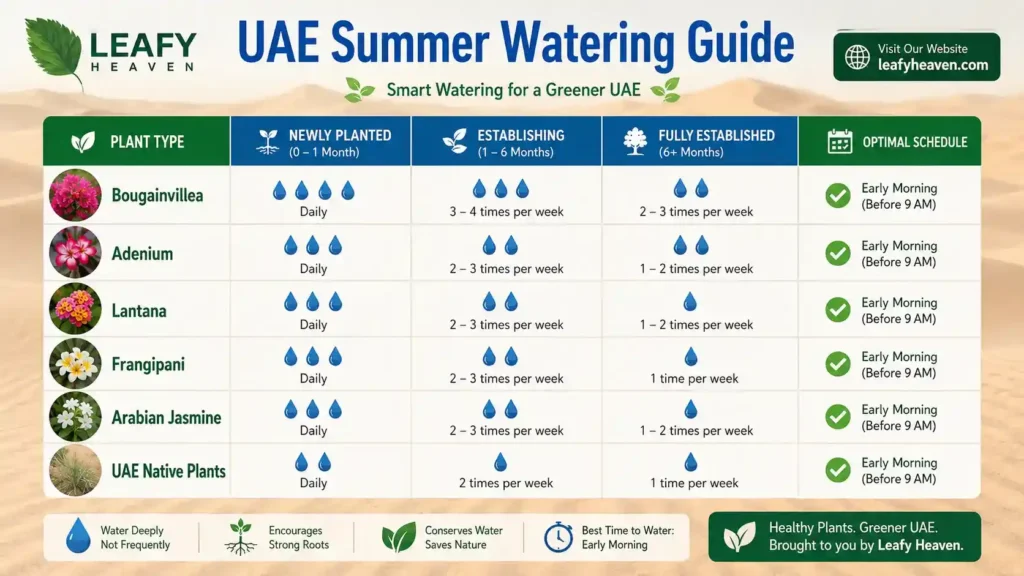
Watering Frequency Guide:
| Plant Type | Newly Planted | Establishing | Fully Established |
| Bougainvillea | Every 3 days | Every 5–7 days | Every 10–14 days |
| Adenium | Every 4 days | Every 7 days | Every 14 days |
| Lantana | Every 3 days | Every 5 days | Every 7–10 days |
| Frangipani | Every 3 days | Every 5–7 days | Every 10 days |
| Arabian Jasmine | Every 2–3 days | Every 4–5 days | Every 7 days |
| Plumbago | Every 2–3 days | Every 4–5 days | Every 7 days |
| UAE Native Plants | Every 4–5 days | Every 7–10 days | Rainfall only |
Quick Fact: Established outdoor flowering plants in UAE summer typically need 60–70% less water than newly planted specimens — the establishment period investment in consistent watering pays off in years of low-maintenance performance.
Dealing with Extreme Heat and Sandstorms
UAE summer sandstorms and extreme heat events are the two most damaging forces outdoor plants in dubai face beyond simple drought — and protecting plants from both requires specific preparation strategies.
Best outdoor plants for dubai survive sandstorms and heat waves better when physical protection systems are in place before the peak summer months arrive.
Extreme Heat Protection:
- Shade Cloth: Install 30–40% shade cloth over vulnerable plants during June–August peak heat — reduces leaf surface temperature by 6–10°C, preventing heat scorch even on summer plants in uae that are generally heat tolerant
- Mulching: Apply 3–4 inch organic mulch layer around plant bases — reduces soil surface temperature by up to 15°C and dramatically slows evaporation
- White/Light Pot Colors: Use only light-colored containers in UAE summer — dark pots absorb heat and raise root zone temperature to lethal levels above 50°C
- Afternoon Positioning: Even full sun plants benefit from natural shade between 1–4 PM during UAE peak summer — position new plantings accordingly
Sandstorm Protection:
- Windbreaks: Plant established shrubs like Bougainvillea or Arabian Lilac as natural windbreaks protecting smaller, more vulnerable plants behind them
- Staking: Stake all tall flowering plants before sandstorm season — unsupported stems snap easily in UAE’s strong shamal winds
- Post-Storm Leaf Cleaning: After sandstorms, rinse all plant foliage with clean water — sand accumulation on leaves blocks sunlight and clogs leaf pores, reducing photosynthesis efficiency
- Root Protection: Mound soil slightly around plant bases to prevent sand accumulation from burying root crowns during heavy sandstorm events
Quick Summary: UAE summer plant protection is about preparation, not reaction. Install shade cloth, apply mulch, stake tall plants, and establish windbreaks before peak summer arrives — these four steps protect even the toughest outdoor plants through the most extreme Middle East summer conditions.
Seasonal Flowers in UAE — Month by Month Summer Guide
Understanding seasonal flowers in uae month by month is the foundation of a successful Middle East garden strategy.
UAE’s summer does not follow a simple hot-cold pattern — it builds through April, peaks through June–August, and transitions in September, with each phase requiring different plant management approaches.
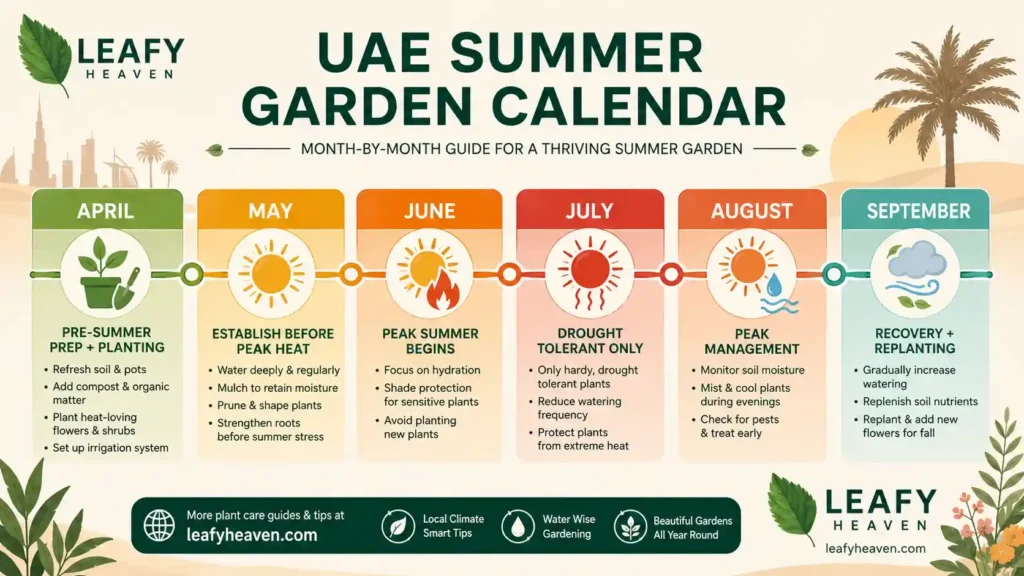
Knowing which seasonal plants perform in each window — and what actions to take — eliminates guesswork and maximizes bloom time through the entire summer season.
April–May — Pre-Summer Preparation
April and May are the most critical setup months for UAE summer gardens — the last comfortable window before peak heat arrives and the ideal time to establish plants before extreme conditions begin.
Best Plants to Establish in April–May:
- Bougainvillea — establish now; roots settle before June peak heat
- Adenium — April warmth triggers active growth; ideal establishment window
- Lantana — transplant established plants; roots develop strongly in April soil temperatures
- Frangipani — plant before humidity peaks; establishes well in April–May warmth
- Plumbago — April planting gives roots 6–8 weeks to establish before peak summer
- Arabian Jasmine — establish on trellises and walls now; blooms peak in May–June
- UAE Native Plants — ideal planting window; roots establish with minimal irrigation
Soil Preparation in April–May:
- Amend all garden beds with compost and coco peat before planting
- Check and improve drainage in all containers and raised beds
- Apply pre-season mulch layer — 3 inches minimum — before temperatures peak
- Test soil pH and add sulfur amendments if needed before planting season begins
Watering System Setup:
- Install drip irrigation systems before June if possible — manual watering becomes impractical in peak UAE summer heat
- Set timers for early morning operation — before 7 AM for maximum efficiency
- Check all irrigation emitters and connections before summer load begins
Quick Tip: Plants established in April with 4–6 weeks of consistent watering develop root systems deep enough to handle June–August heat with significantly less supplemental irrigation than plants installed directly into summer conditions.
June–August — Peak Summer Management
June through August is UAE’s most extreme summer period — temperatures regularly exceed 45°C, humidity peaks along the coast, and rainfall is essentially zero.
Only genuinely heat-adapted summer plants in uae continue blooming reliably during this window — conventional garden flowers drop blooms, go dormant, or die completely.
Best Summer Flowers Performers — June–August:
| Plant | Why It Thrives in June–August |
| Bougainvillea | Peak bloom triggered by heat + water stress |
| Adenium | Succulent storage + heat-triggered flowering |
| Lantana | Never stops blooming — heat increases flower production |
| Frangipani | Peak fragrant bloom period coincides with summer heat |
| Portulaca | Succulent leaves store water — thrives in full desert sun |
| Arabian Lilac | Native species — summer is its natural bloom season |
June–August Management Priorities:
- Reduce watering frequency for established plants — deep roots access subsoil moisture
- Stop fertilizing during peak heat — plants are in survival/bloom mode, not growth mode
- Check mulch layers weekly — replenish if below 2 inches
- Monitor for heat scorch — wilting before 10 AM indicates heat stress, not water stress
- Remove dead blooms promptly — decaying flowers in UAE summer heat attract pests rapidly
Quick Fact: Bougainvillea and Adenium actually produce their most spectacular blooms during UAE’s peak summer months — heat and mild water stress are bloom triggers for both species, making June–August their prime display season.
September–October — Recovery and Replanting
September brings gradual temperature relief across UAE — humidity drops, nights become cooler, and gardens begin their recovery from summer stress.
This transition window is equally important as pre-summer preparation — how gardens are managed in September–October determines their health and performance through winter and the following summer.
Transitioning to Cooler Season Plants:
- Begin introducing cool-season flowering plants as temperatures drop below 35°C consistently
- Bougainvillea, Lantana, and Adenium continue performing well through October — no rush to replace
- Start seeds for winter seasonal flowers like Petunia, Marigold, and Snapdragon in September for October–November transplanting
- Reduce shade cloth coverage gradually as temperatures moderate through October
Garden Recovery After Summer Stress:
- Pruning: Cut back any heat-damaged or leggy summer growth — September is the ideal pruning window for Bougainvillea, Plumbago, and Lantana
- Fertilizing: Resume feeding with balanced slow-release fertilizer in late September — plants are ready to absorb nutrients again after summer dormancy
- Soil Renewal: Top-dress garden beds with fresh compost in September — summer heat depletes organic matter rapidly in UAE soil
- Irrigation Adjustment: Gradually reduce irrigation frequency as temperatures drop — plants need less water as evaporation rates decrease through October
- Pest Check: Inspect all plants thoroughly in September — summer stress weakens plant immunity and pest populations often peak in late summer UAE conditions
Quick Summary: September–October is UAE gardening’s most rewarding window — summer survivors are vigorous and blooming, new cool-season plants establish quickly in comfortable temperatures, and the garden transitions from survival mode back to full thriving performance.
Benefits of Growing Drought-Tolerant Flowering Plants in Middle East
Choosing drought resistant plants for a Middle East garden delivers benefits that extend far beyond simply keeping flowers alive in desert heat.
Flowering plants in uae that are genuinely drought adapted contribute to water conservation, urban ecology, personal wellbeing, and long-term cost savings simultaneously.
Outdoor flowering plants and seasonal flowers in uae that require minimal water are not a compromise — they are the most intelligent, sustainable, and practical choice for every Middle East gardener.
1. Water Conservation
UAE faces one of the most severe water scarcity challenges on earth — according to global water stress research, it ranks among the most water-stressed countries globally, with virtually no natural freshwater resources.
Drought tolerant flowering plants directly address this critical challenge at the individual garden level.
- Established drought tolerant plants use 50–75% less water than conventional garden plants
- UAE relies heavily on energy-intensive desalination for freshwater — every liter saved in gardens reduces demand on this critical infrastructure
- Saudi Arabia, Qatar, and Kuwait face equally severe water scarcity — drought adapted gardens reduce household water consumption meaningfully across the entire region
- Native UAE plants like Ghaf Tree and Convolvulus virgatus survive on zero supplemental irrigation — the ultimate water conservation achievement
Quick Fact: The UAE average garden water consumption can exceed 500 liters per week in summer for conventional plantings. A drought tolerant equivalent uses as little as 100–150 liters — a saving of over 70%.
2. Low Maintenance
Drought tolerant flowering plants are ideal for UAE’s fast-paced urban lifestyle — they deliver consistent beauty without demanding daily attention.
- No daily watering schedules — established plants manage independently
- Most species require minimal pruning — once or twice yearly is sufficient
- Drought adapted plants recover quickly from missed waterings or irrigation system failures
- Less fertilizing needed — UAE native and desert-adapted species thrive in lean alkaline soil naturally
- Reduced pest pressure — healthy drought tolerant plants resist insect and fungal attacks far better than stressed overwatered conventional plants
3. Biodiversity Support
Native and drought tolerant flowering plants in uae support the region’s fragile desert ecosystem at every level.
- Native Bees — Arabian Lilac, Convolvulus, and Tribulus provide critical nectar for UAE’s native bee species
- Butterflies — Lantana and Plumbago attract butterfly species adapted to Gulf region conditions
- Birds — Frangipani, Acacia, and Ghaf Tree provide food, nesting sites, and shelter for UAE’s native and migratory bird species
- Ecological Connectivity — gardens planted with native species create green corridors that support wildlife movement through UAE’s increasingly urbanized landscape
4. Mental Wellness
Green spaces in desert cities deliver proven and significant mental health benefits — and drought tolerant gardens make those spaces accessible regardless of water availability or gardening experience.
- Research consistently shows flowering plants reduce stress, anxiety, and mental fatigue
- Rooftop, balcony, and courtyard gardens in Dubai, Abu Dhabi, and Riyadh provide psychological relief from intense urban density
- Fragrant flowering plants like Arabian Jasmine and Frangipani add sensory richness that enhances outdoor living spaces through UAE summer evenings
- Tending a drought tolerant garden provides meaningful daily routine — a proven wellbeing benefit for urban residents
5. Cost Savings
The financial benefits of drought tolerant flowering plants compound significantly over multiple seasons.
- Lower monthly water bills throughout the entire summer period — UAE water costs are significant for households with large gardens
- Drought tolerant perennials like Bougainvillea and Adenium return year after year — eliminating annual replanting costs entirely
- Less spending on replacement plants — drought adapted species survive UAE conditions that kill conventional plants repeatedly
- Reduced irrigation system running costs — established drought tolerant gardens require shorter, less frequent irrigation cycles
- Lower fertilizer costs — native and desert-adapted plants thrive without regular feeding
Quick Estimate: UAE households that convert conventional garden beds to drought tolerant plantings commonly report 40–60% reductions in total summer gardening costs when water, plant replacement, fertilizer, and maintenance are calculated together.
6. Environmental Benefits
Widespread adoption of drought tolerant flowering plants contributes meaningfully to broader environmental health across Middle East cities.
- Urban Heat Island Reduction — gardens with drought tolerant trees and shrubs like Ghaf, Frangipani, and Bougainvillea reduce surface temperatures in urban areas — critical in cities where summer heat islands intensify already extreme conditions
- Carbon Sequestration — established drought tolerant trees absorb carbon dioxide meaningfully — Ghaf trees in particular are significant carbon stores in UAE landscapes
- Soil Stabilization — deep-rooted drought tolerant plants prevent desert soil erosion and sand movement — a critical environmental service in UAE’s wind-exposed landscapes
- Reduced Desalination Demand — collective reduction in garden water use lowers demand on UAE’s energy-intensive desalination infrastructure, reducing associated carbon emissions
- Air Quality — leafy drought tolerant plants filter dust and particulate matter — especially valuable in UAE cities during and after sandstorm events
Conclusion
A beautiful Middle East garden in summer is not a dream reserved for those with unlimited water budgets or professional landscaping teams.
The flowering plants in uae and drought tolerant selections covered in this guide prove that stunning outdoor spaces are completely achievable — in Dubai villas, Abu Dhabi courtyards, Riyadh gardens, and apartment balconies across the Gulf.
Here is what this guide covered:
- Why Middle East summer demands specifically drought adapted plant selections
- The best flowering plants for UAE summer — from Bougainvillea and Arabian Jasmine to Adenium and Frangipani
- UAE native and desert plants that flower beautifully with zero supplemental water
- A complete outdoor plants dubai selection guide for full sun gardens and apartment balconies
- Indoor flowering plants for UAE’s air-conditioned home environments
- Complete growing guidance — soil preparation, watering strategy, and sandstorm protection
- A month-by-month seasonal flowers in uae calendar from April through October
- The full range of benefits from water conservation to urban environmental impact
Summer is at its peak across the Middle East right now — and the gardens that will look most spectacular through June, July, and August are the ones planted with heat-adapted, drought tolerant, genuinely beautiful summer plants in uae.
This summer, transform your UAE garden with these stunning drought-tolerant flowering plants.
Start with one plant, one pot, or one garden bed — and experience firsthand how little water a truly gorgeous Middle East garden actually needs.
📸 Growing flowering plants in your UAE or Middle East garden? Share your summer garden photos in the comments — we would love to see how these plants are thriving in your space.
🌿 Want more seasonal flowers in uae guides and Middle East gardening tips? Subscribe for monthly planting calendars, region-specific plant recommendations, and expert outdoor plants dubai advice for every season of the year.
Frequently Asked Questions (FAQs)
Which flowering plants grow best in UAE summer heat?
The best flowering plants in uae for summer heat are Bougainvillea, Adenium, Lantana, Frangipani, and Arabian Jasmine. These five are the most proven summer plants in uae — all tested across thousands of UAE gardens and capable of blooming continuously through peak June–August temperatures. Among flowering plants which grows best in uae, Bougainvillea and Adenium stand out as the most spectacular performers in extreme desert heat conditions.
What are the best outdoor plants for Dubai gardens?
The best outdoor plants for dubai are Bougainvillea, Plumbago, Lantana, and Frangipani — all full sun, low water performers that handle Dubai's sandy soil and extreme summer heat reliably. For garden plants dubai residents want year-round color from, these four species deliver the most consistent results with the least maintenance. Outdoor plants in dubai that combine drought tolerance with continuous blooming are the most practical long-term garden investment.
Which plants are native to UAE and survive desert conditions?
The top UAE native plants that flower in summer are Convolvulus virgatus, Arabian Lilac, Ghaf Tree, and Acacia. These native plants of uae require zero supplemental irrigation once established — they are already perfectly adapted to UAE's alkaline desert soil, near-zero rainfall, and extreme heat. Among desert plants in uae with names recognized by both botanists and gardeners, Ghaf Tree holds special status as the UAE's national tree and supreme symbol of desert survival.
How often should I water flowering plants in UAE summer?
Established outdoor flowering plants in UAE summer need deep watering 2–3 times per week during the establishment period, reducing to once per week or less once fully rooted. Summer plants in uae that are drought resistant — like Adenium and Bougainvillea — need even less once established, typically every 10–14 days. Always water in early morning before 8 AM for maximum efficiency — midday watering in UAE summer evaporates before reaching roots effectively.
Can I grow flowering plants on a Dubai apartment balcony?
Yes — Adenium, Lantana, Portulaca, and Plumbago are all excellent outdoor plants for home balconies in Dubai. These compact flowering plants thrive in containers on outdoor plants in dubai balcony settings when given light-colored pots, well-draining soil mix, and early morning watering. Every flower plant container must have drainage holes — standing water in Dubai's summer humidity causes root rot within 24–48 hours even in drought tolerant species.
What indoor flowering plants survive UAE's air-conditioned environment?
The best indoor flowering plants for UAE air-conditioned homes are Peace Lily, Anthurium, and indoor Jasmine. Peace Lily thrives in low light and low humidity AC conditions. Anthurium produces long-lasting waxy blooms in bright indirect light. Indoor Jasmine near a window fills UAE home interiors with fragrance. All three indoor flowers handle UAE's cool, dry AC environment far better than tropical high-humidity species — making them the most reliable indoor plants with flowers for UAE homes year-round.

Written by the LeafyHeaven Editorial Team
LeafyHeaven shares practical gardening tips and simple plant care guides to help you grow, nurture, and enjoy your plants with ease. Our goal is to make gardening feel natural, approachable, and rewarding for everyone.