
Introduction
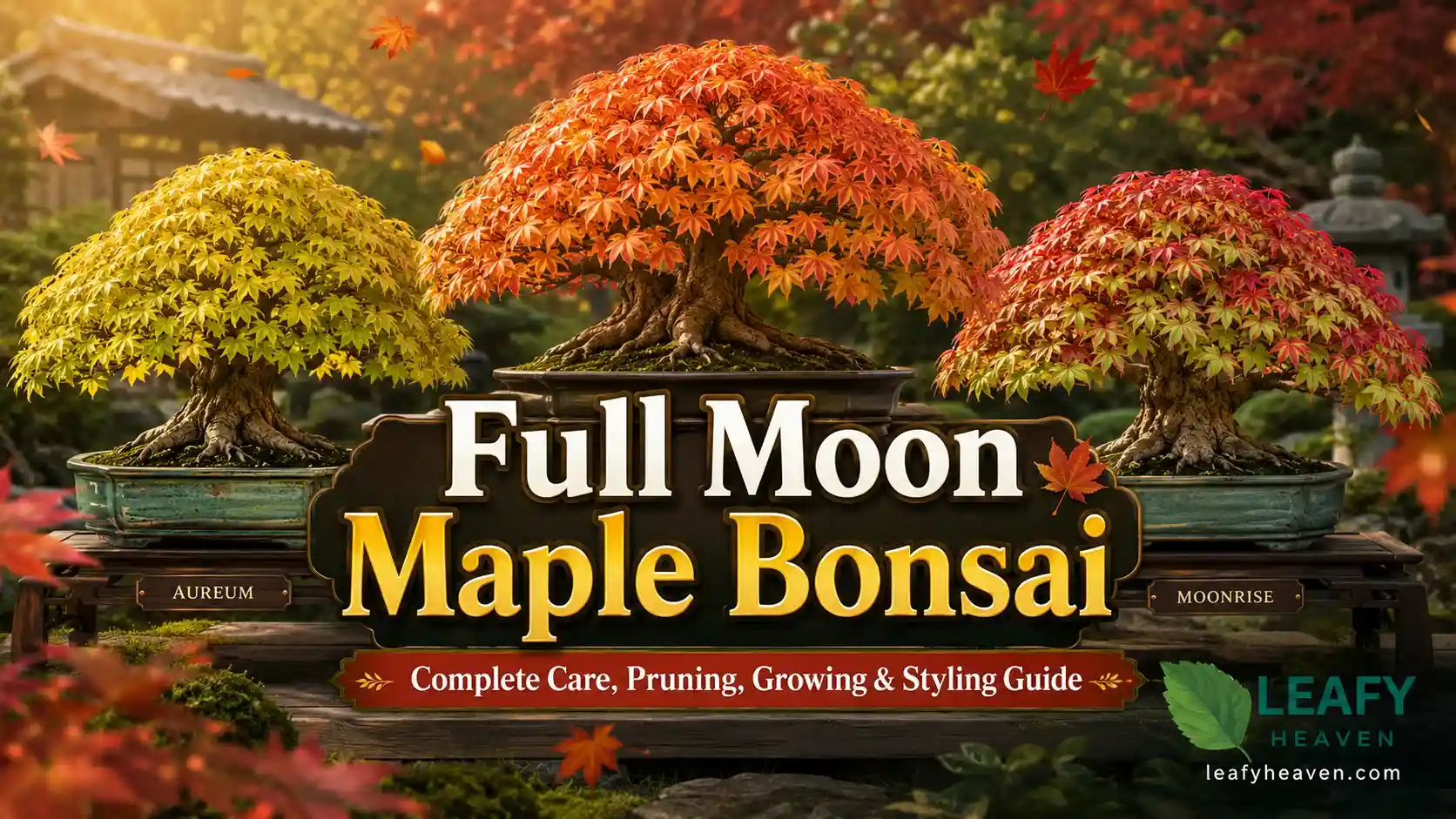
Full Moon Maple Bonsai is a bonsai created from Acer shirasawanum cultivars such as Aureum, Autumn Moon, and Moonrise, valued for their rounded leaves, seasonal color changes, and elegant branching structure.
Unlike many Japanese maple bonsai varieties derived from Acer palmatum, the Full Moon Japanese Maple is known for its broader, nearly circular leaves that create a softer and more refined appearance. This distinctive foliage gives the tree a unique silhouette throughout the growing season and makes it stand out in bonsai collections.
Many bonsai enthusiasts choose a full moon maple because of its exceptional seasonal beauty. Spring foliage can emerge in shades of gold, orange, lime green, or red depending on the cultivar. During autumn, full moon japanese maples often produce brilliant displays of yellow, orange, crimson, and scarlet tones that enhance their ornamental value.
A mature full moon maple tree also develops graceful branching patterns and balanced canopy structure. These characteristics make full moon maple trees particularly suitable for bonsai styles that emphasize natural elegance, fine ramification, and seasonal interest.
Whether grown from a young sapling, grafted stock, or carefully trained nursery material, a full moon acer offers long-term development potential. Popular cultivars such as Aureum, Autumn Moon, and Moonrise are especially prized for their foliage color, compact growth habits, and suitability for artistic bonsai design.
This guide covers everything needed to successfully grow and maintain a Full Moon Maple Bonsai, including identification features, variety selection, cultivation requirements, pruning techniques, styling methods, propagation options, seasonal maintenance, and common problem prevention.
What Is a Full Moon Maple Bonsai?
A Full Moon Maple Bonsai is a miniature tree developed from Full Moon Japanese Maple varieties, known for circular leaves, vibrant seasonal color, and refined bonsai aesthetics.
Derived primarily from Acer shirasawanum, the full moon maple is one of the most attractive deciduous bonsai species. It is valued for its distinctive foliage shape, elegant branching structure, and dramatic color changes throughout the year.
Unlike many other maple bonsai, a full moon japanese maple produces broader and more rounded leaves that create a softer, more balanced appearance. This unique characteristic makes it highly desirable among collectors and bonsai enthusiasts seeking a tree with strong ornamental appeal.
Scientific Classification
A Full Moon Maple Bonsai belongs to the species Acer shirasawanum, a deciduous maple native to Japan. It is closely related to other Japanese maple species but is recognized for its unique foliage and growth characteristics.
Scientific name: Acer shirasawanum
The scientific name of the Full Moon Maple is Acer shirasawanum. This species includes several popular bonsai cultivars such as Aureum, Autumn Moon, and Moonrise.
Plant family
Acer shirasawanum belongs to the Sapindaceae family. This family includes numerous maple species known for their ornamental value, attractive foliage, and seasonal color displays.
Native origin
The full moon japanese maple originates from mountainous regions of Japan. In its natural habitat, it grows in cool woodland environments with consistent moisture and protection from harsh afternoon sun.
These conditions explain why full moon japanese maples perform best when provided with moderate temperatures and partial shade during the hottest periods of the year.
Botanical characteristics
Key botanical characteristics of the full moon acer include:
- Deciduous growth habit
- Rounded palmate leaves
- Smooth gray bark
- Layered branch structure
- Moderate growth rate
- Strong seasonal color transitions
- Excellent ramification potential
These features contribute to the refined appearance that makes the species popular for bonsai cultivation.
Why Is It Called a Full Moon Maple?
The name Full Moon Maple comes from the tree’s distinctive rounded foliage, which resembles the shape of a full moon more closely than most other maple species.
This unique leaf structure is one of the easiest ways to distinguish a full moon maple from other Japanese maples.
Rounded leaf shape
The leaves of a full moon maple are broader and more circular than those of many standard Japanese maples.
Although the leaves still display multiple lobes, the overall outline appears rounded rather than deeply divided. This characteristic creates a fuller and softer canopy when the tree is trained as bonsai.
Seasonal color transitions
One of the most admired features of full moon maple trees is their changing foliage throughout the year.
Typical seasonal color progression includes:
- Spring: golden yellow, lime green, orange, or pink tones
- Summer: rich green, chartreuse, or golden foliage
- Autumn: bright orange, scarlet, crimson, and gold displays
Many cultivars are specifically selected because of their exceptional seasonal coloration.
Difference from standard Japanese maples
While both Full Moon Maple and Japanese Maple belong to the genus Acer, several differences separate them.
Full moon japanese maples generally have:
- More rounded leaves
- Softer overall appearance
- Slightly slower growth
- Distinctive foliage coloration
- Strong ornamental value in spring and autumn
These differences help explain why many bonsai growers choose Full Moon Maple varieties for display-focused bonsai projects.
Full Moon Maple Bonsai Quick Facts Table
| Characteristic | Details |
| Scientific Name | Acer shirasawanum |
| Common Names | Full Moon Maple, Full Moon Japanese Maple, Full Moon Acer |
| Mature Bonsai Size | Typically 12–36 inches (30–90 cm) |
| Growth Rate | Slow to moderate |
| USDA Zones | 5–7 |
| Lifespan | Several decades with proper care |
| Difficulty Level | Moderate |
A healthy full moon maple tree can remain attractive for generations when properly maintained. With careful pruning, seasonal care, and consistent cultivation practices, full moon maple trees can develop into highly valuable bonsai specimens that improve in beauty and character over time.
Full Moon Maple Bonsai Identification Features
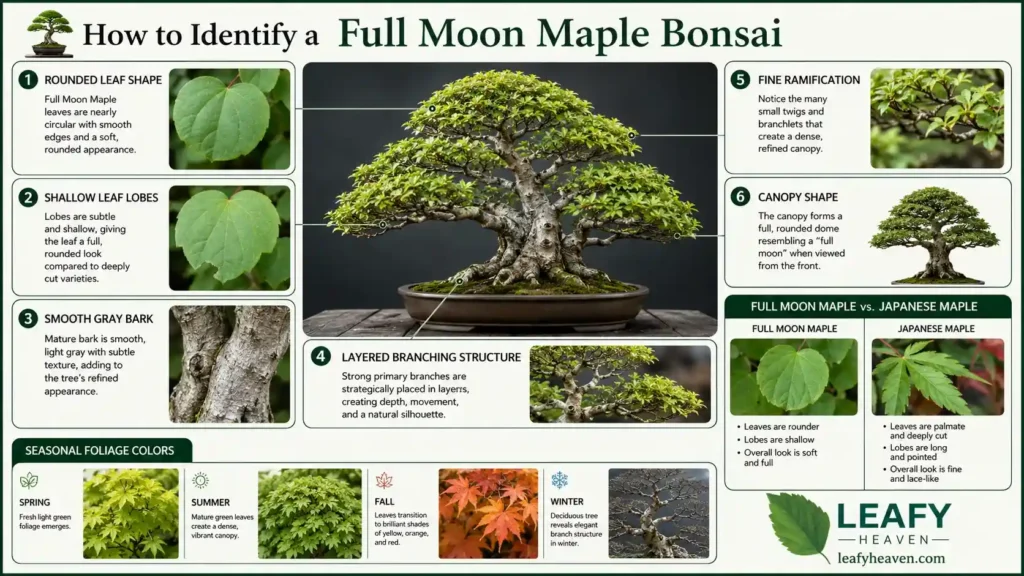
Full Moon Maple Bonsai is identified by its broad rounded leaves, layered branching, smooth bark, and dramatic spring-to-autumn foliage colors.
These characteristics distinguish it from many other maple bonsai species. The combination of unique foliage shape, refined structure, and seasonal color transitions makes the Full Moon Japanese Maple one of the easiest deciduous bonsai trees to recognize.
For bonsai enthusiasts, leaf shape and seasonal color are usually the most noticeable identification features, while bark texture and growth habit become more important as the tree matures.
Leaf Shape and Seasonal Color Changes
The foliage of a Full Moon Maple Bonsai is its most distinctive feature. The leaves are broader and rounder than those found on most standard Japanese maples, creating a softer and fuller canopy.
Full Moon Maple Leaf Structure
A full moon maple leaf typically has multiple shallow lobes arranged in a circular pattern. Unlike deeply cut Japanese maple leaves, the lobes are broader and less dissected.
This rounded structure gives the tree its common name and contributes to its elegant bonsai appearance.
Common leaf characteristics include:
- Rounded palmate shape
- Broad leaf surface
- Shallow lobes
- Fine leaf texture
- Dense seasonal canopy
Spring Foliage
Spring is often the most colorful season for many Full Moon Maple cultivars.
Depending on the variety, new growth may emerge in shades of:
- Golden yellow
- Lime green
- Orange
- Bronze
- Pink-red
Cultivars such as Autumn Moon and Moonrise are especially valued for their vibrant spring coloration.
Summer Foliage
During summer, the foliage typically matures into richer and more stable colors.
Common summer foliage colors include:
- Medium green
- Bright chartreuse
- Golden-green
- Yellow-green
Healthy trees maintain attractive foliage throughout the growing season when provided with proper moisture and protection from excessive heat.
Fall Color Display
Autumn delivers the most dramatic display of the year.
As temperatures cool, Full Moon Maple Bonsai can develop brilliant shades of:
- Scarlet red
- Crimson
- Orange
- Gold
- Deep yellow
This intense fall color is one of the primary reasons many bonsai growers choose Full Moon Japanese Maple varieties for their collections.
Bark, Branches and Growth Habit
Full Moon Maple Bonsai develops smooth gray bark that remains attractive throughout the tree’s life. Young branches are typically slender and flexible, making them suitable for early bonsai training.
As the tree matures, the branching pattern becomes increasingly refined and layered.
Notable structural features include:
- Smooth gray bark
- Fine twig development
- Elegant branch ramification
- Rounded canopy formation
- Balanced branch distribution
The natural growth habit is graceful rather than aggressive, which helps create refined bonsai silhouettes without extensive corrective pruning.
Mature Size and Growth Rate
Full Moon Maple Bonsai grows at a moderate pace compared with many other deciduous bonsai species.
Although growth varies by cultivar, climate, and cultivation practices, most trees develop steadily while maintaining compact proportions suitable for bonsai training.
Full Moon Japanese Maple Size
In landscape settings, Full Moon Japanese Maple size commonly ranges between 10 and 20 feet tall with a similar spread.
When cultivated as bonsai, the tree is maintained at a much smaller size through pruning, root management, and container culture.
Most bonsai specimens range from:
- 12–18 inches (small bonsai)
- 18–30 inches (medium bonsai)
- 30–36 inches (large bonsai)
Full Grown Autumn Moon Japanese Maple
A full grown Autumn Moon Japanese Maple in the landscape typically reaches 10–15 feet in height with a broad rounded crown.
Its moderate growth rate and colorful foliage make it one of the most popular Full Moon Maple cultivars.
Full Grown Autumn Moon Maple
A full grown Autumn Moon Maple develops a compact and balanced structure with excellent seasonal coloration.
The tree is especially admired for its orange-yellow spring growth and vibrant autumn display, making it highly suitable for bonsai development.
Full Moon Maple vs Standard Japanese Maple
While both species are excellent bonsai subjects, several differences separate Full Moon Maple from standard Japanese Maple.
| Feature | Full Moon Maple (Acer shirasawanum) | Standard Japanese Maple (Acer palmatum) |
| Leaf Shape | Broad, rounded, shallow lobes | More deeply divided and delicate |
| Growth Habit | Rounded and layered | More variable depending on cultivar |
| Bonsai Suitability | Excellent for elegant deciduous bonsai | Excellent with wider styling flexibility |
| Fall Color | Strong gold, orange, crimson displays | Wide range of red, orange, yellow tones |
| Maintenance | Moderate, prefers protection from heat | Moderate, often slightly more adaptable |
Both species are outstanding bonsai choices, but Full Moon Maple is generally preferred by growers seeking broader foliage, softer visual texture, and dramatic seasonal color transitions.
Best Full Moon Maple Varieties for Bonsai
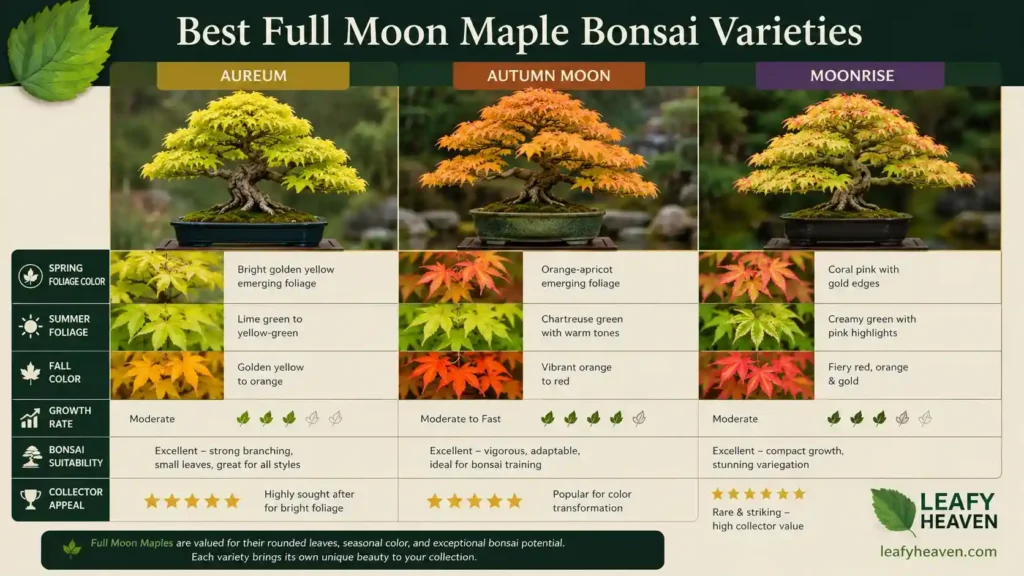
The best Full Moon Maple Bonsai varieties are Aureum, Autumn Moon, and Moonrise because they provide excellent foliage color and compact bonsai growth.
These cultivars are among the most sought-after selections of Acer shirasawanum. Each offers unique color characteristics, seasonal interest, and bonsai development potential while maintaining the signature rounded foliage that makes Full Moon Japanese Maples so distinctive.
Choosing the right variety depends on your preferred foliage color, climate conditions, and long-term bonsai goals.
Aureum (Golden Full Moon Maple)
Aureum is considered one of the most famous and traditional Full Moon Maple cultivars. It is widely admired for its bright golden foliage and elegant growth habit.
Acer shirasawanum aureum
Acer shirasawanum aureum is a classic cultivar that has been cultivated for decades by collectors and maple enthusiasts.
Its naturally compact structure and attractive foliage make it a strong candidate for bonsai training.
Aureum Japanese Maple
The Aureum Japanese Maple develops rounded leaves that emerge with vibrant yellow-green tones in spring.
As the growing season progresses, the foliage often maintains a golden appearance, especially when grown in suitable light conditions.
Key characteristics include:
- Bright golden foliage
- Rounded leaf structure
- Moderate growth rate
- Excellent fall color
- Elegant branching habit
Golden Full Moon Japanese Maple
The Golden Full Moon Japanese Maple is often considered one of the most visually striking Full Moon Maple cultivars.
Its luminous foliage creates strong visual impact throughout the growing season and provides excellent contrast within a bonsai collection.
Full Moon Maple Aureum
Full Moon Maple Aureum performs best in locations that provide morning sun and afternoon protection.
Excessive heat can reduce foliage quality, while proper placement helps preserve the cultivar’s signature golden coloration.
Autumn Moon Japanese Maple Bonsai
Autumn Moon is one of the most colorful Full Moon Maple cultivars available. Its changing foliage colors make it particularly desirable for bonsai enthusiasts seeking year-round visual interest.
Acer shirasawanum Autumn Moon
Acer shirasawanum Autumn Moon is known for producing vibrant foliage that changes dramatically throughout the growing season.
The spring flush often emerges in shades of orange, peach, and yellow before transitioning into softer summer colors.
Autumn Moon Maple
The Autumn Moon Maple combines attractive foliage with a manageable growth habit that adapts well to bonsai training.
Its naturally layered branching structure supports the development of refined deciduous bonsai forms.
Notable features include:
- Orange-yellow spring growth
- Attractive summer foliage
- Strong autumn coloration
- Moderate vigor
- Excellent ornamental value
Autumn Full Moon Maple
The Autumn Full Moon Maple is especially valued for its dynamic color transitions.
Few deciduous bonsai varieties can match the range of seasonal colors displayed by this cultivar.
Autumn Moon Japanese Maple Size
In landscape settings, Autumn Moon Japanese Maple size typically reaches 10 to 15 feet tall with a similar spread.
As a bonsai, regular pruning and root management maintain a compact size while preserving the cultivar’s attractive foliage and branch structure.
Moonrise Japanese Maple Bonsai
Moonrise is a modern Full Moon Maple cultivar known for exceptional color intensity and strong growth.
Many growers consider it one of the most dramatic foliage maples available for bonsai development.
Acer shirasawanum Moonrise
Acer shirasawanum Moonrise was selected for its vibrant foliage and excellent ornamental characteristics.
New growth often emerges in bright red-orange tones before gradually transitioning through multiple color stages.
Moonrise Maple
The Moonrise Maple offers striking color contrast throughout the growing season.
Spring growth can be especially dramatic, creating strong visual impact even in young bonsai specimens.
Important characteristics include:
- Bright red-orange spring foliage
- Strong seasonal color changes
- Vigorous growth
- Excellent branch development
- Good adaptability for bonsai training
Acer Moonrise
Acer Moonrise combines the classic rounded foliage of Full Moon Maples with enhanced color intensity.
This makes it particularly attractive for display-focused bonsai collections.
Japanese Maple Moonrise
Although Japanese Maple Moonrise belongs to the Full Moon Maple group, its vivid foliage often distinguishes it from many traditional Japanese maple cultivars.
Its colorful growth habit provides interest from spring through autumn.
Which Full Moon Maple Variety Is Best for Bonsai?
There is no single best cultivar for every grower. Aureum, Autumn Moon, and Moonrise each offer unique advantages depending on personal preferences and growing conditions.
| Feature | Aureum | Autumn Moon | Moonrise |
| Foliage Color | Golden yellow-green | Orange, peach, yellow | Red-orange to green |
| Spring Interest | High | Very High | Exceptional |
| Summer Appearance | Golden-green | Soft green with warm tones | Green with red highlights |
| Fall Color | Gold and orange | Orange, red, gold | Orange, crimson, red |
| Growth Rate | Moderate | Moderate | Moderate to vigorous |
| Bonsai Suitability | Excellent | Excellent | Excellent |
| Collector Appeal | Classic cultivar | Highly colorful | Modern premium cultivar |
| Best For | Golden foliage displays | Seasonal color variation | Maximum color intensity |
For traditional bonsai collections, the golden full moon maple Aureum remains a timeless choice. Growers seeking exceptional seasonal color often prefer the autumn moon japanese maple, while those wanting bold foliage contrast frequently select the moonrise japanese maple.
All three cultivars can develop into outstanding Full Moon Maple Bonsai specimens when provided with proper pruning, seasonal care, and long-term training.
Are Full Moon Japanese Maples Good for Bonsai?
Yes, Full Moon Japanese Maples are among the most attractive deciduous bonsai because of their refined foliage, seasonal color, and elegant branch structure.
Many experienced growers consider Acer shirasawanum one of the finest japanese maples for bonsai due to its distinctive rounded leaves and exceptional seasonal beauty.
Growers who are new to deciduous bonsai cultivation will benefit from this comprehensive guide to bonsai trees before beginning their Full Moon Maple training journey.
The species develops a graceful silhouette, responds well to long-term training, and offers strong ornamental value throughout the year.
While Full Moon Maple Bonsai may grow more slowly than some other maple species, its unique appearance often makes the extra patience worthwhile for bonsai enthusiasts and collectors.
Advantages for Bonsai Enthusiasts
Full Moon Japanese Maple offers several characteristics that make it highly desirable for bonsai cultivation.
One of its greatest strengths is its foliage. The rounded leaves create a softer and fuller canopy than many standard Japanese maples, producing a refined appearance that stands out in bonsai displays.
Key advantages include:
- Distinctive rounded leaf shape
- Exceptional spring foliage colors
- Brilliant autumn color displays
- Elegant branch structure
- Attractive ramification potential
- Long lifespan with proper care
- Strong display value in bonsai exhibitions
Another advantage is its seasonal interest. Few deciduous bonsai provide such dramatic color transitions from spring through autumn.
Popular cultivars such as Aureum, Autumn Moon, and Moonrise offer unique foliage characteristics that allow growers to select a tree that matches their artistic preferences.
Challenges and Limitations
Although Full Moon Maple Bonsai is highly rewarding, it does present some challenges that growers should understand before starting.
The species is generally less tolerant of extreme heat than some other maple varieties. Strong afternoon sun and prolonged high temperatures can cause leaf scorch, especially in warmer climates.
Common limitations include:
- Sensitive to excessive summer heat
- Requires consistent soil moisture
- Slower growth than some maple species
- Leaves may be larger than those of some refined bonsai cultivars
- Benefits from winter dormancy
- Can require additional protection in harsh climates
Proper placement, watering, and seasonal care are important for maintaining healthy foliage and preventing environmental stress.
Growers who can provide suitable growing conditions are usually rewarded with excellent long-term bonsai development.
Best Japanese Maples for Bonsai Compared
Several maple species are commonly used for bonsai. Each offers unique characteristics, growth habits, and styling opportunities.
The best japanese maple for bonsai often depends on the grower’s goals, climate, and preferred aesthetic style.
| Feature | Acer shirasawanum | Acer palmatum | Red Japanese Maple Bonsai | Japanese Red Maple Bonsai |
| Common Name | Full Moon Japanese Maple | Japanese Maple | Red Japanese Maple | Red Japanese Maple Cultivars |
| Leaf Shape | Rounded and broad | Deeply divided | Fine textured | Fine textured |
| Growth Rate | Slow to moderate | Moderate | Moderate | Moderate |
| Spring Color | Gold, orange, lime green | Green to red depending on cultivar | Red to burgundy | Red to burgundy |
| Fall Color | Brilliant gold, orange, crimson | Yellow, orange, red | Bright red | Bright red |
| Bonsai Suitability | Excellent | Excellent | Excellent | Excellent |
| Heat Tolerance | Moderate | Moderate to good | Good | Good |
| Beginner Friendly | Moderate | High | High | High |
| Collector Appeal | Very High | High | High | High |
For growers seeking unique foliage and exceptional seasonal color, Acer shirasawanum remains one of the best japanese maples for bonsai.
For beginners, Acer palmatum is often considered easier to source and slightly more adaptable. However, many experienced enthusiasts regard Full Moon Japanese Maple as one of the most beautiful and distinctive bonsai maples available.
Among the best japanese maples for bonsai, Full Moon Maple stands out for its rounded foliage, refined appearance, and remarkable seasonal transformation, making it a premium choice for collectors and serious bonsai growers.
How to Grow a Full Moon Maple Bonsai
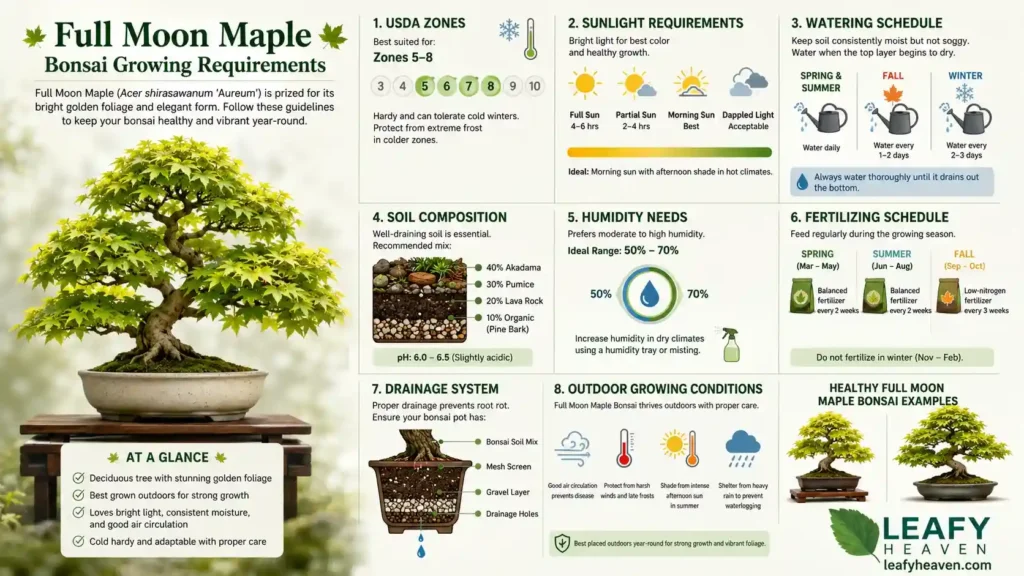
Full Moon Maple Bonsai grows best in well-draining soil, partial sun, consistent moisture, and seasonal outdoor conditions.
Successful cultivation depends on recreating the conditions that Acer shirasawanum experiences in its natural environment. Stable moisture, good drainage, moderate temperatures, and protection from extreme heat are essential for healthy growth and vibrant foliage color.
When these requirements are met, Full Moon Maple Bonsai develops strong roots, healthy branching, and attractive seasonal coloration year after year.
Ideal USDA Zones
According to the USDA Plant Hardiness Zone Map, Full Moon Japanese Maple performs best in Zones 5–7, where it experiences cool winters and moderate summer temperatures.
These climate conditions support proper dormancy during winter and healthy growth during spring and summer.
General growing recommendations include:
- USDA Zone 5: Excellent cold tolerance
- USDA Zone 6: Ideal growing conditions
- USDA Zone 7: Strong performance with summer protection
- Zone 8 and warmer: Additional shade and moisture management may be required
Trees grown outside their preferred climate range often require extra protection from temperature extremes.
Soil Requirements
Full Moon Maple Bonsai requires a soil mix that provides excellent drainage while retaining enough moisture to support steady root development.
Poorly drained soil can quickly lead to root problems, while overly dry soil may cause leaf scorch and reduced vigor.
A suitable bonsai soil mix typically contains:
- Akadama for moisture retention
- Pumice for root aeration
- Lava rock for drainage
- Fine pine bark or organic matter in small amounts
Characteristics of ideal soil include:
- Fast drainage
- Good oxygen flow
- Moderate moisture retention
- Stable structure over time
- Healthy root development
Regular repotting helps maintain soil quality and prevents compaction.
Sunlight Requirements
Full Moon Maple Bonsai prefers bright light and partial sun rather than prolonged exposure to intense afternoon heat.
Morning sunlight encourages healthy growth and vibrant foliage color while reducing the risk of leaf damage.
Recommended light exposure:
- Morning sun: Highly beneficial
- Filtered afternoon light: Preferred
- Dappled shade: Excellent during hot weather
- Harsh afternoon sun: Avoid when possible
Proper light management is especially important for colorful cultivars such as Aureum, Autumn Moon, and Moonrise.
Can Autumn Moon Japanese Maple Grow in Full Sun?
Autumn Moon Japanese Maple can grow in full sun in cooler climates, but it generally performs better with protection from intense afternoon heat.
In regions with mild summers, full sun may enhance foliage color. In hotter climates, excessive sunlight can increase the risk of leaf scorch and stress.
Young trees are usually more sensitive to sun exposure than mature specimens.
Autumn Moon Japanese Maple Full Sun Considerations
When growing Autumn Moon Japanese Maple in full sun, several factors should be monitored carefully.
Important considerations include:
- Increased watering requirements
- Greater risk of leaf scorch
- Faster soil drying
- Potential fading of delicate foliage colors
- Need for afternoon shade in hot climates
Providing morning sun and afternoon protection is often the safest approach for maintaining healthy foliage.
Watering Requirements
Full Moon Maple Bonsai prefers consistently moist soil but should never remain waterlogged.
Proper watering is one of the most important aspects of successful cultivation because both drought stress and excessive moisture can damage the root system.
General watering guidelines include:
- Water thoroughly when the soil begins to dry
- Avoid allowing the root ball to become completely dry
- Reduce watering frequency during winter dormancy
- Increase watering during active summer growth
Watering frequency varies according to:
- Pot size
- Soil composition
- Temperature
- Humidity
- Wind exposure
The goal is to maintain evenly moist soil without creating soggy conditions.
Temperature and Humidity Needs
Full Moon Maple Bonsai thrives in moderate temperatures and benefits from natural seasonal changes throughout the year.
The species requires winter dormancy and performs best when exposed to outdoor growing conditions.
Ideal temperature conditions include:
- Cool winters
- Mild springs
- Moderate summers
- Gradual seasonal transitions
During periods of extreme heat, additional protection may be necessary to prevent foliage stress.
Humidity requirements are generally moderate. Trees benefit from good air circulation while maintaining adequate soil moisture.
To support healthy growth:
- Protect trees during heat waves
- Avoid excessively dry conditions
- Maintain proper watering practices
- Ensure good airflow around foliage
Balanced moisture and temperature conditions help preserve foliage quality throughout the growing season.
Fertilizing Schedule
Regular fertilization supports healthy growth, branch development, and foliage production.
A balanced feeding program helps Full Moon Maple Bonsai maintain vigor without encouraging excessive coarse growth.
Recommended fertilizing schedule:
| Season | Fertilizing Recommendation |
| Early Spring | Begin feeding as new growth emerges |
| Mid Spring | Apply balanced bonsai fertilizer regularly |
| Summer | Continue moderate feeding during active growth |
| Late Summer | Reduce fertilizer strength if growth becomes excessive |
| Autumn | Light feeding until leaf drop |
| Winter | Do not fertilize during dormancy |
For most growers, a balanced fertilizer with moderate nitrogen levels provides reliable results.
Consistent feeding, combined with proper watering and sunlight management, allows Full Moon Maple Bonsai to develop healthy roots, strong branching, and attractive seasonal foliage.
How to Bonsai a Full Moon Maple Tree
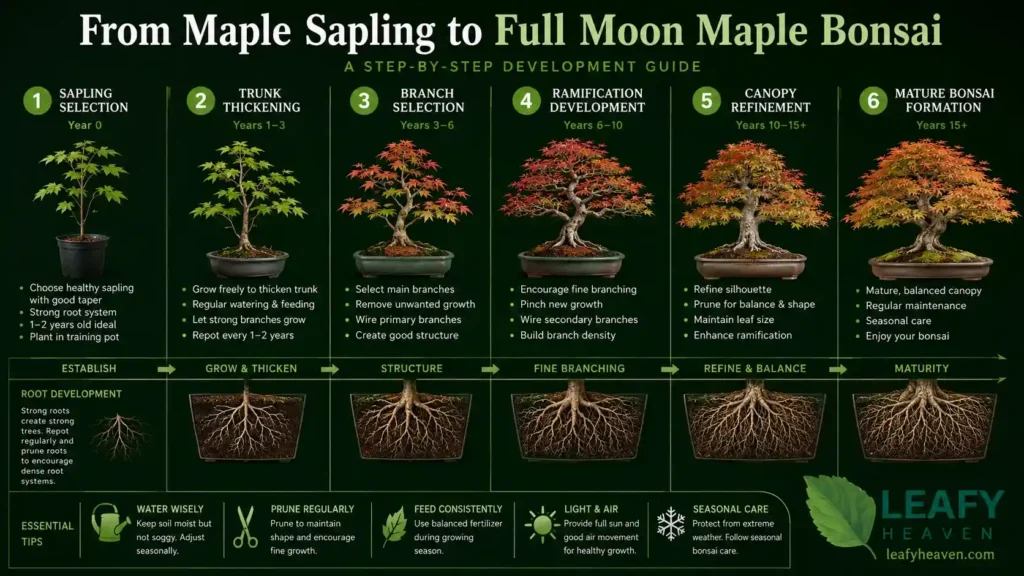
Creating a Full Moon Maple Bonsai involves selecting young material, developing trunk structure, pruning branches, and refining ramification over time.
Like most deciduous bonsai, a Full Moon Maple develops gradually through multiple stages of training. The process focuses on building a strong trunk, creating balanced branch placement, and producing fine twig ramification that enhances the tree’s mature appearance.
Growers who understand how to bonsai a Japanese maple tree can use similar techniques with Acer shirasawanum, while adapting them to the species’ slower growth and unique foliage characteristics.
Starting from a Maple Sapling
A healthy young tree provides the best foundation for future bonsai development.
Many enthusiasts begin with nursery stock, grafted cultivars, or a maple sapling bonsai project because young trees are easier to shape and train.
When selecting starting material, look for:
- Healthy root system
- Strong trunk base
- Visible trunk movement
- Good branch placement
- Vigorous growth
- No signs of disease or pest damage
Young Full Moon Maple specimens often require several years of development before entering the refinement stage.
For growers learning how to grow a Japanese maple bonsai, patience during the early years is one of the most important factors for long-term success.
Trunk Development
A well-developed trunk forms the foundation of every high-quality bonsai.
The goal during this stage is to create taper, movement, and visual age while maintaining healthy growth.
Common trunk development techniques include:
- Allowing sacrifice branches to grow
- Periodic trunk chopping
- Controlled directional pruning
- Ground growing or large training containers
- Gradual taper development
Full Moon Maple generally develops more slowly than some other deciduous species, so trunk development often requires several growing seasons.
Strong trunk structure should be established before focusing heavily on fine branch refinement.
Branch Selection
Branch selection determines the future structure and visual balance of the bonsai.
The primary framework should be developed early so that future growth supports the intended design.
When selecting branches, growers typically:
- Remove crossing branches
- Eliminate inward-growing shoots
- Reduce crowded areas
- Preserve well-positioned primary branches
- Create balanced branch spacing
A traditional deciduous bonsai design usually includes:
- Front-facing viewing angle
- First branch
- Back branch
- Secondary side branches
- Apex development
Careful branch selection helps create depth, movement, and visual harmony throughout the tree.
Ramification Development
Ramification refers to the fine network of twigs and branch divisions that create a mature bonsai canopy.
For Full Moon Maple Bonsai, ramification is one of the most important factors in achieving a refined appearance.
Techniques used to improve ramification include:
- Repeated pruning cycles
- Controlled extension growth
- Seasonal shoot trimming
- Careful branch refinement
- Balanced fertilization
Over time, each branch divides into smaller secondary and tertiary branches.
This process gradually creates the dense branch structure that is highly valued in deciduous bonsai.
Growers studying how to bonsai a Japanese maple tree often spend many years refining ramification because it significantly improves overall bonsai quality.
Long-Term Bonsai Training Plan
Full Moon Maple Bonsai develops through several stages, each with a different training focus.
A structured long-term plan helps prevent common mistakes and produces better results over time.
| Development Stage | Primary Goal |
| Years 1–3 | Root establishment and trunk development |
| Years 3–5 | Primary branch selection and structure building |
| Years 5–8 | Secondary branch development |
| Years 8–12 | Ramification refinement |
| 12+ Years | Mature bonsai maintenance and display refinement |
Long-term success depends on consistent seasonal care, proper pruning, and realistic expectations.
For growers learning how to grow a Japanese maple bonsai, understanding that development occurs over many years is essential. Full Moon Maple Bonsai rewards patience with exceptional seasonal color, refined branching, and increasing beauty as the tree matures.
Full Moon Maple Bonsai Pruning and Styling Guide
Regular pruning controls size, improves ramification, and enhances the natural structure of Full Moon Maple Bonsai.
Pruning and styling are essential for maintaining a healthy and visually balanced bonsai. Full Moon Maple responds well to careful branch management and long-term refinement, allowing growers to create elegant deciduous bonsai with attractive seasonal character.
The goal is not simply to reduce growth but to guide the tree toward a mature structure with balanced proportions, fine branching, and natural movement.
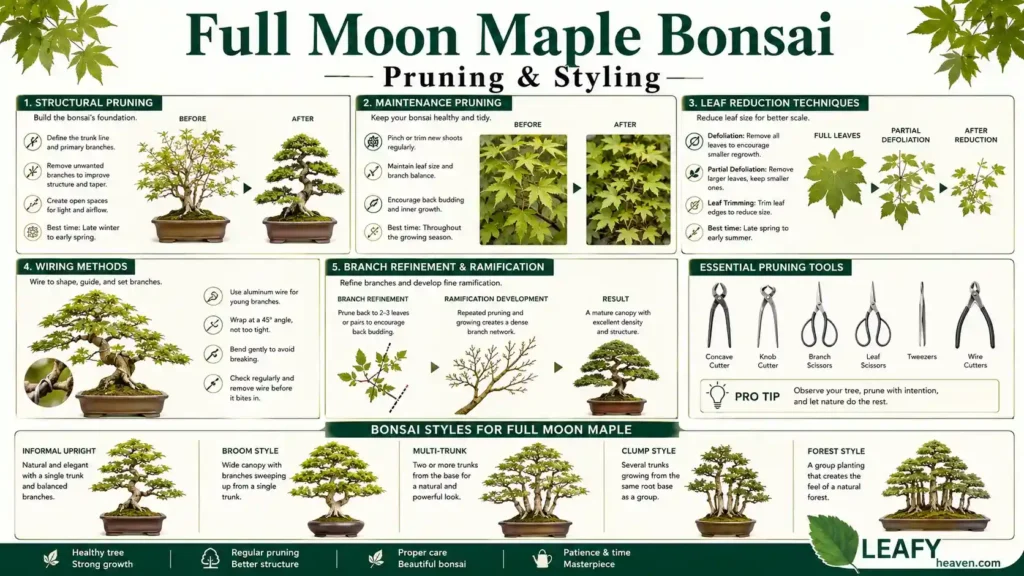
Structural Pruning
Structural pruning establishes the primary framework of the bonsai.
This type of pruning is typically performed during dormancy or at appropriate times when major branch removal can be carried out safely.
Structural pruning focuses on:
- Removing unwanted major branches
- Improving trunk visibility
- Creating branch taper
- Establishing primary branch placement
- Correcting design flaws
Common branches removed during structural pruning include:
- Crossing branches
- Inward-growing branches
- Excessively vertical shoots
- Competing leaders
- Crowded branch clusters
Major cuts should be planned carefully because they influence the future design of the tree for many years.
Maintenance Pruning
Maintenance pruning preserves shape and encourages fine ramification throughout the growing season.
This technique controls excessive growth while maintaining the overall design created through structural pruning.
Key objectives include:
- Maintaining silhouette
- Encouraging branching density
- Controlling internode length
- Improving light penetration
- Supporting balanced growth
Typical maintenance pruning involves:
- Trimming elongated shoots
- Removing weak growth
- Cutting back excessive extensions
- Managing canopy density
Regular maintenance pruning helps Full Moon Maple Bonsai maintain a refined appearance without becoming overly dense.
Leaf Reduction Techniques
Leaf reduction techniques improve visual scale and encourage finer growth patterns.
Because Full Moon Maple naturally produces broader leaves than many Japanese maple cultivars, careful foliage management can help create a more balanced bonsai appearance.
Methods commonly used include:
- Partial defoliation
- Selective leaf removal
- Balanced fertilization
- Controlled shoot pruning
- Increased ramification development
Benefits of leaf reduction include:
- Smaller average leaf size
- Improved light penetration
- Better branch development
- Enhanced visual proportion
- Increased interior budding
Complete defoliation is generally less common with Full Moon Maple than with some other deciduous bonsai species and should only be performed on strong, healthy trees when appropriate.
Wiring Guidelines
Wiring allows growers to position branches and refine the overall structure of the bonsai.
Young branches of Full Moon Maple are usually flexible enough for shaping, while older branches become more rigid with age.
When wiring, it is important to:
- Use appropriate wire thickness
- Apply wire carefully to avoid bark damage
- Monitor branch growth regularly
- Remove wire before scarring occurs
- Make gradual adjustments when possible
Important wiring considerations include:
- Wire during suitable seasons
- Avoid excessive bending
- Protect delicate branches
- Check wire frequently during active growth
Many growers rely heavily on pruning and directional growth techniques because Full Moon Maple can mark relatively easily if wire is left on too long.
Best Bonsai Styles for Full Moon Maple
Full Moon Maple Bonsai adapts well to several classic deciduous bonsai styles. Its rounded foliage and graceful branching make it particularly suitable for natural-looking designs.
Informal Upright
The Informal Upright style is one of the most popular choices for Full Moon Maple Bonsai.
Characteristics include:
- Gently curved trunk
- Natural movement
- Balanced branch structure
- Strong apex development
This style complements the species’ elegant growth habit and seasonal foliage display.
Broom Style
Broom Style highlights the fine branching and symmetrical canopy that Full Moon Maple can develop over time.
Key features include:
- Straight trunk
- Rounded crown
- Dense ramification
- Balanced branch distribution
The rounded leaf structure of Full Moon Maple works exceptionally well with this classic deciduous bonsai form.
Multi-Trunk
Multi-Trunk designs create the appearance of several trees growing from a common root system.
Benefits of this style include:
- Natural woodland appearance
- Increased visual interest
- Strong seasonal displays
- Enhanced trunk composition
Full Moon Maple’s graceful foliage helps unify the composition.
Clump Style
Clump Style features multiple trunks emerging from a shared base.
This design emphasizes:
- Natural forest-like growth
- Variation in trunk thickness
- Unified canopy structure
- Strong visual depth
The style is particularly effective for mature Full Moon Maple specimens with well-developed branching.
Forest Style
Forest Style uses multiple trees planted together to create the appearance of a miniature woodland landscape.
This style highlights:
- Seasonal color variation
- Group composition
- Depth and perspective
- Natural landscape aesthetics
The broad foliage and refined branching of Full Moon Maple make it an excellent candidate for forest plantings.
Quick Style Comparison
| Bonsai Style | Suitability | Main Visual Feature |
| Informal Upright | Excellent | Natural trunk movement |
| Broom Style | Excellent | Rounded deciduous canopy |
| Multi-Trunk | Very Good | Multiple connected trunks |
| Clump Style | Very Good | Shared root base composition |
| Forest Style | Excellent | Miniature woodland effect |
With consistent pruning, careful styling, and long-term refinement, Full Moon Maple Bonsai can develop into an elegant deciduous specimen that showcases exceptional branching structure and spectacular seasonal color.
Full Moon Maple Bonsai Seasonal Care Calendar
Seasonal care changes throughout the year, with active growth in spring, protection in summer, color development in fall, and dormancy in winter.
Full Moon Maple Bonsai follows a natural annual growth cycle that influences watering, fertilizing, pruning, and protection requirements. Understanding these seasonal changes helps maintain healthy growth, vibrant foliage, and long-term bonsai development.
Each season requires slightly different care practices to support the tree’s biological needs and maximize its ornamental value.
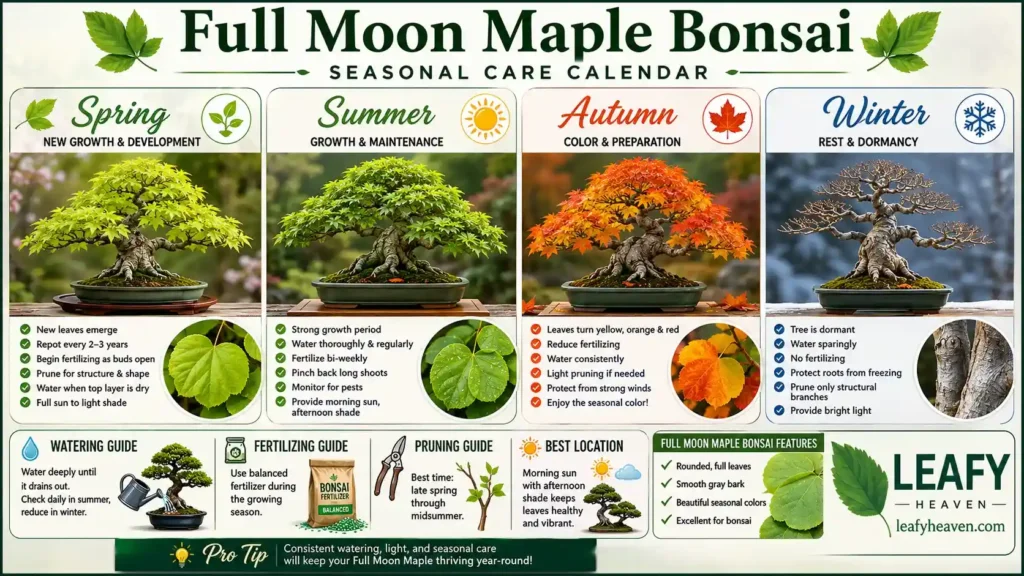
Spring Care
Spring is the most active growth period for Full Moon Maple Bonsai.
As buds begin to open and new foliage emerges, the tree requires increased attention to watering, fertilization, and growth management.
Key spring care tasks include:
- Resume regular watering
- Begin fertilizing as growth starts
- Monitor new shoots and buds
- Perform light maintenance pruning
- Repot if necessary before full leaf expansion
- Protect tender foliage from late frosts
Spring is also the season when many cultivars display their most dramatic foliage colors, including golden, orange, red, and lime-green tones.
Healthy spring growth establishes the foundation for the rest of the growing season.
Summer Care
Summer focuses on protecting the tree from heat stress while maintaining steady growth.
Full Moon Maple Bonsai can be sensitive to intense afternoon sun, especially during prolonged periods of hot weather.
Important summer care practices include:
- Water thoroughly and consistently
- Protect from harsh afternoon sunlight
- Monitor soil moisture daily
- Maintain good air circulation
- Continue balanced fertilization
- Watch for leaf scorch and pests
In warmer climates, filtered sunlight or partial shade helps preserve foliage quality and prevents excessive moisture loss.
Summer is also an important period for ramification development and maintenance pruning.
Autumn Care
Autumn is the season of color transformation and preparation for dormancy.
As temperatures begin to cool, Full Moon Maple Bonsai produces some of its most spectacular foliage displays.
Autumn care priorities include:
- Continue consistent watering
- Reduce fertilization gradually
- Enjoy peak fall color development
- Remove fallen leaves from the soil surface
- Monitor tree health before winter
- Prepare winter protection if needed
This season allows the tree to store energy reserves before entering dormancy.
Proper autumn care supports healthy bud formation for the following spring.
Winter Dormancy Care
Winter dormancy is essential for the long-term health of Full Moon Maple Bonsai.
As a temperate deciduous species, the tree requires a period of cold rest each year to complete its natural growth cycle.
During dormancy:
- Growth stops
- Leaves have dropped
- Water requirements decrease
- Energy is conserved for spring growth
Winter care recommendations include:
- Water only when necessary
- Protect roots from severe freezing
- Avoid fertilizing
- Reduce unnecessary handling
- Monitor for winter damage
- Maintain outdoor dormancy conditions
Although dormant, the tree should not be allowed to dry out completely.
Proper winter care ensures vigorous growth when spring arrives.
Seasonal Care Table
| Season | Growth Stage | Primary Tasks | Watering | Fertilizing |
| Spring | Active growth and bud break | Repotting, pruning, shoot management, growth monitoring | Moderate to high | Begin regular feeding |
| Summer | Full growth period | Heat protection, maintenance pruning, pest monitoring | High | Continue balanced feeding |
| Autumn | Color development and preparation for dormancy | Reduce fertilizer, monitor health, prepare for winter | Moderate | Gradually reduce |
| Winter | Dormancy | Root protection, minimal maintenance, dormancy management | Low | None |
Following a consistent seasonal care routine allows Full Moon Maple Bonsai to maintain healthy roots, strong branching, vibrant foliage color, and reliable long-term development. Matching care practices to each stage of the annual growth cycle is one of the most effective ways to build a healthy and attractive bonsai specimen.
Propagating Full Moon Maple Bonsai
Full Moon Maple Bonsai can be propagated from seeds, grafted stock, and occasionally cuttings, though cuttings are less reliable.
Propagation allows growers to produce new trees for bonsai development while preserving desirable maple characteristics. Among the available methods, seed propagation is commonly used for species development, while grafting is often preferred for maintaining specific cultivars such as Aureum, Autumn Moon, and Moonrise.
Although cuttings can sometimes be successful, they generally have lower success rates than seed or graft propagation.
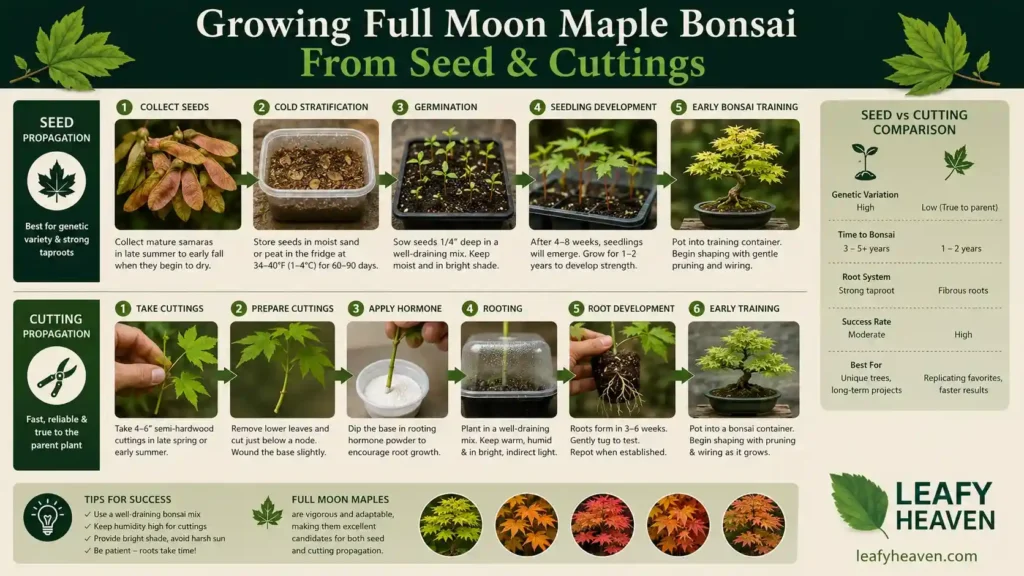
Growing From Seed
Growing a Full Moon Maple Bonsai from seed is a rewarding long-term project that allows complete control over the tree’s development from an early stage.
Many enthusiasts interested in creating a Japanese maple bonsai from seed choose this method because it produces strong root systems and allows gradual bonsai training from the beginning.
Japanese Maple Bonsai From Seed
A Japanese maple bonsai from seed requires patience because several years of development are needed before advanced bonsai training begins.
The general process includes:
- Collect mature seeds in autumn.
- Clean and prepare seeds for storage.
- Cold stratify seeds during winter.
- Sow seeds in spring.
- Grow seedlings until they are large enough for training.
Cold stratification is particularly important because maple seeds require a period of cold exposure before germination.
Maple Bonsai From Seed
When growing a maple bonsai from seed, young seedlings should initially focus on root and trunk development rather than immediate bonsai styling.
During the first few years:
- Encourage vigorous growth
- Develop trunk thickness
- Build a healthy root system
- Protect seedlings from extreme heat
- Maintain consistent moisture
This foundation supports future bonsai training and structural development.
Maple Bonsai Seed
High-quality maple bonsai seed should be collected from healthy parent trees or obtained from reputable sources.
Important considerations include:
- Fresh seed viability
- Proper winter stratification
- Well-draining seed-starting mix
- Consistent moisture
- Protection from drying winds
Seed-grown trees may display slight variations in foliage color and growth characteristics, especially when derived from cultivated varieties.
Growing From Cuttings
Growing Full Moon Maple from cuttings is possible, but success rates are generally lower than those achieved with seed propagation or grafting.
Root formation can be slow, and some cultivars root more readily than others.
Can You Grow Japanese Maple From Cuttings?
Yes, you can grow Japanese Maple from cuttings, but results vary significantly depending on cultivar, environmental conditions, and propagation techniques.
Some cuttings successfully develop roots, while others fail to establish despite careful care.
For this reason, many growers rely on grafted stock when propagating named cultivars.
How to Propagate Japanese Maple Cuttings?
Successful propagation usually begins with healthy semi-hardwood cuttings taken during the growing season.
The basic process includes:
- Select healthy shoots.
- Cut sections with several leaf nodes.
- Remove lower foliage.
- Apply rooting hormone.
- Place in a well-draining propagation medium.
- Maintain humidity and warmth.
- Monitor root development.
Consistent moisture and stable environmental conditions improve the likelihood of success.
Rooting Maple Cuttings
Rooting maple cuttings requires patience because root development can take several weeks or even months.
Factors that improve rooting success include:
- Healthy parent material
- Fresh cuttings
- Rooting hormone application
- High humidity
- Warm soil temperatures
- Bright indirect light
Even under ideal conditions, rooting percentages are often lower than with many other bonsai species.
Seed vs Cutting Comparison
Both propagation methods can produce future bonsai material, but each has advantages and limitations.
| Feature | Seed Propagation | Cutting Propagation |
| Success Rate | Moderate to High | Low to Moderate |
| Cost | Very Low | Low |
| Root System | Strong natural roots | Variable root development |
| Time to Bonsai Training | Longer | Faster if successful |
| Genetic Consistency | May vary from parent tree | Usually identical to parent |
| Difficulty Level | Moderate | Moderate to High |
| Best For | Long-term bonsai development | Cloning desirable trees |
| Reliability | More reliable overall | Less reliable overall |
For most growers, seed propagation remains the most accessible method for producing new Full Moon Maple Bonsai material. Cuttings can be worthwhile for experimentation, but grafted stock and seed-grown trees generally provide more predictable long-term results for bonsai cultivation.
Can Full Moon Maple Bonsai Be Grown Indoors?
No, Full Moon Maple Bonsai is primarily an outdoor bonsai because it requires seasonal dormancy and natural temperature cycles.
As a temperate deciduous species, Acer shirasawanum depends on changing seasons to maintain healthy growth patterns. Natural fluctuations in temperature, daylight duration, humidity, and winter dormancy are essential for long-term vigor.
While a Full Moon Maple Bonsai may be displayed indoors for short periods, it should not be treated as a permanent indoor bonsai. Long-term indoor cultivation typically leads to declining health and reduced growth.
Why Indoor Growing Is Difficult
Indoor environments rarely provide the seasonal conditions that Full Moon Maple Bonsai needs to thrive.
Most homes maintain relatively stable temperatures throughout the year, which prevents the tree from experiencing the natural dormancy cycle required by deciduous maples.
Common challenges of indoor cultivation include:
- Lack of winter dormancy
- Insufficient natural sunlight
- Low humidity levels
- Poor air circulation
- Weak seasonal growth cycles
- Increased stress and decline over time
Many people search for a japanese maple bonsai indoor setup, but even with bright windows and supplemental lighting, indoor conditions usually cannot fully replace outdoor seasonal exposure.
A healthy Full Moon Maple requires:
- Spring growth period
- Summer development
- Autumn dormancy preparation
- Winter rest period
Without these seasonal changes, the tree gradually loses vigor and becomes more susceptible to pests, disease, and weak growth.
Indoor vs Outdoor Bonsai Comparison
Outdoor cultivation is significantly more suitable for Full Moon Maple Bonsai than permanent indoor growing.
The following comparison highlights the differences between indoor and outdoor conditions.
| Factor | Indoor Japanese Maple Bonsai | Outdoor Full Moon Maple Bonsai |
| Seasonal Dormancy | Usually absent | Naturally occurs |
| Sunlight Quality | Limited | Natural full-spectrum light |
| Air Circulation | Often restricted | Excellent |
| Humidity Balance | Usually lower | More natural |
| Growth Quality | Often weaker | Stronger and healthier |
| Fall Color Development | Reduced | Excellent |
| Long-Term Health | Difficult to maintain | Highly suitable |
| Bonsai Success Rate | Low | High |
An indoor japanese maple bonsai may survive temporarily, but outdoor cultivation consistently produces healthier trees, stronger growth, and better seasonal coloration.
Similarly, keeping japanese maple bonsai indoors year-round often prevents the tree from entering proper dormancy, which can shorten its lifespan and reduce overall vigor.
For this reason, Full Moon Maple is not considered a true maple bonsai indoor species.
Winter Protection Options
Although Full Moon Maple Bonsai should remain outdoors, winter protection may still be necessary in regions with severe cold.
The goal is to protect the root system while still allowing the tree to experience natural dormancy.
Common winter protection methods include:
- Placing the bonsai in an unheated garage
- Using a cold frame
- Sheltering from harsh winter winds
- Mulching around bonsai pots
- Grouping trees together for insulation
- Positioning trees against protected walls
Protection is especially important because bonsai roots are more exposed than roots growing in the ground.
In very cold climates, root damage can occur if containers freeze repeatedly for extended periods.
A Full Moon Maple Bonsai benefits from outdoor dormancy but should be shielded from extreme weather conditions that could damage roots or branches.
For growers considering a japanese maple bonsai indoor arrangement during winter, a cold frame or unheated sheltered structure is usually a better alternative because it preserves dormancy while providing protection.
Maintaining this balance between winter protection and natural seasonal exposure is one of the keys to long-term success with Full Moon Maple Bonsai.
Common Full Moon Maple Bonsai Problems and Solutions
Most problems are caused by watering mistakes, excessive heat, poor drainage, or pests.
Full Moon Maple Bonsai is generally a resilient tree when grown under suitable conditions. However, environmental stress, improper watering, poor soil management, and pest infestations can affect foliage quality and overall health.
Identifying problems early allows growers to take corrective action before significant damage occurs.
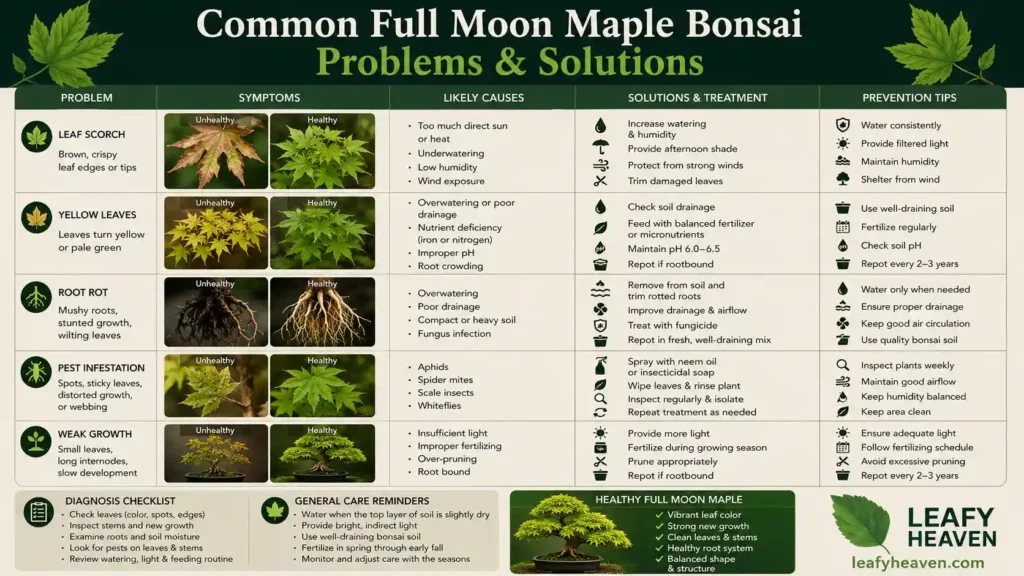
Leaf Scorch
Leaf scorch is one of the most common issues affecting Full Moon Maple Bonsai.
It usually appears as brown, dry, or crispy edges on leaves and is often associated with excessive heat or moisture stress.
Common causes include:
- Intense afternoon sun
- High summer temperatures
- Insufficient watering
- Dry winds
- Low humidity
- Shallow root moisture
Solutions:
- Move the tree to partial shade
- Increase watering frequency when necessary
- Protect from hot afternoon sun
- Improve humidity around the growing area
- Monitor soil moisture more closely
Preventing heat stress is often the most effective way to reduce leaf scorch.
Yellow Leaves
Yellow leaves can result from several different growing problems.
The cause is usually related to watering, nutrient availability, or seasonal change.
Common causes include:
- Overwatering
- Poor drainage
- Nutrient deficiency
- Root stress
- Seasonal leaf aging
- Soil compaction
Solutions:
- Check drainage quality
- Adjust watering practices
- Apply balanced fertilizer
- Inspect roots during repotting
- Replace compacted soil when necessary
If yellowing occurs during autumn, it may simply be part of the normal seasonal color transition.
Root Rot
Root rot is one of the most serious problems affecting Full Moon Maple Bonsai.
It develops when roots remain excessively wet for prolonged periods and oxygen levels within the soil decline.
Warning signs include:
- Persistent yellow leaves
- Wilting despite wet soil
- Weak growth
- Leaf drop
- Dark or soft roots
- Foul odor from the root zone
Solutions:
- Remove affected roots
- Repot into fresh bonsai soil
- Improve drainage immediately
- Reduce excessive watering
- Use a well-aerated soil mix
Healthy roots are essential for maintaining strong foliage and long-term bonsai development.
Pest Problems
Several pests may occasionally attack Full Moon Maple Bonsai.
While infestations are usually manageable, regular monitoring helps prevent serious damage.
Common pests include:
- Aphids
- Spider mites
- Scale insects
- Caterpillars
- Leaf-chewing insects
Possible symptoms:
- Distorted foliage
- Sticky residue
- Discolored leaves
- Fine webbing
- Visible insects
Solutions:
- Inspect foliage regularly
- Improve air circulation
- Remove pests manually when possible
- Apply appropriate bonsai-safe treatments
- Isolate heavily infested trees if necessary
Routine inspections often prevent minor pest issues from becoming major infestations.
Weak Growth
Weak growth generally indicates that one or more basic growing requirements are not being met.
The tree may produce small shoots, poor foliage development, or limited branch extension.
Potential causes include:
- Insufficient sunlight
- Nutrient deficiencies
- Restricted root growth
- Improper watering
- Poor soil quality
- Lack of dormancy
Solutions:
- Improve light exposure
- Follow a balanced fertilizing schedule
- Repot when rootbound
- Correct watering practices
- Refresh old soil
- Ensure proper winter dormancy
Consistent care usually restores vigor over time.
Troubleshooting Table
| Problem | Common Causes | Recommended Solution |
| Leaf Scorch | Excessive sun, heat, drought stress | Provide afternoon shade and maintain consistent moisture |
| Yellow Leaves | Overwatering, nutrient deficiency, poor drainage | Improve drainage and adjust fertilization |
| Root Rot | Waterlogged soil and poor aeration | Repot into well-draining soil and remove damaged roots |
| Pest Problems | Aphids, mites, scale, insects | Monitor regularly and apply appropriate treatment |
| Weak Growth | Poor light, nutrient deficiency, root issues | Improve growing conditions and feeding schedule |
Most Full Moon Maple Bonsai problems can be prevented through proper watering, well-draining soil, balanced fertilization, and protection from excessive heat. Consistent monitoring allows growers to identify issues early and maintain healthy, vigorous trees throughout the year.
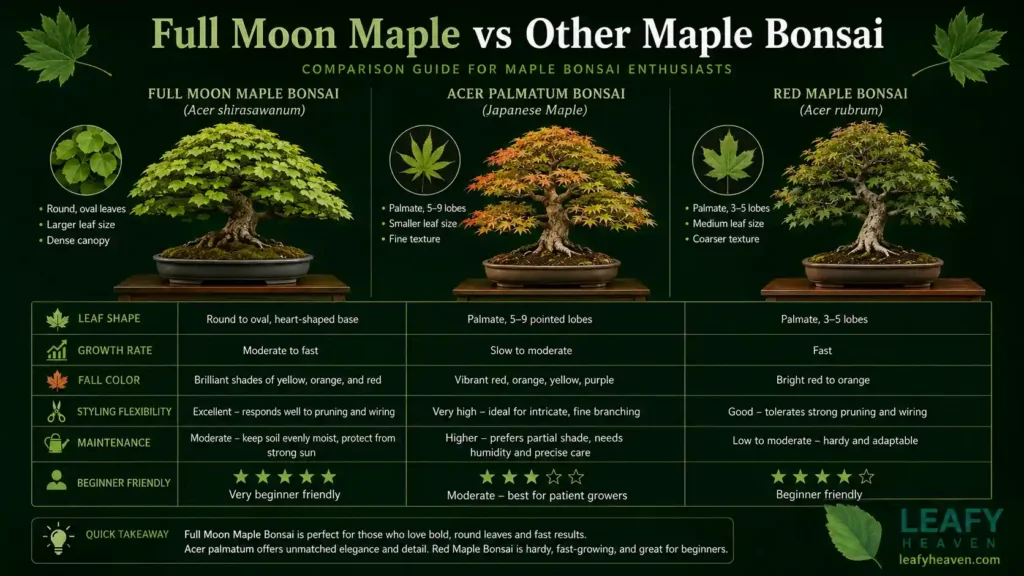
Full Moon Maple Bonsai vs Other Maple Bonsai Types
Full Moon Maple Bonsai is prized for foliage quality, while other maple species may offer faster growth or different styling characteristics.
Maple species are among the most popular deciduous bonsai trees because of their seasonal color, elegant branching, and long lifespan. However, each species has unique strengths that influence growth rate, maintenance requirements, and overall bonsai appearance.
Understanding these differences helps growers select the maple bonsai that best matches their experience level, climate, and design goals.
Full Moon Maple vs Japanese Maple Bonsai
Full Moon Maple Bonsai and Japanese Maple Bonsai are closely related, but they offer different visual characteristics.
Full Moon Maple Bonsai and Japanese Maple Bonsai are closely related, but they offer different visual characteristics.
Full Moon Maple is derived from Acer shirasawanum, while most traditional Japanese Maple Bonsai are developed from Acer palmatum cultivars.
The most noticeable difference is leaf shape. Full Moon Maple produces broader and more rounded foliage, while Japanese Maple typically develops finer, more deeply divided leaves.
| Feature | Full Moon Maple Bonsai | Japanese Maple Bonsai |
| Species | Acer shirasawanum | Acer palmatum |
| Leaf Shape | Rounded and broad | Deeply divided |
| Growth Rate | Slow to moderate | Moderate |
| Spring Color | Gold, orange, lime green | Green, red, purple depending on cultivar |
| Fall Color | Brilliant orange, gold, crimson | Red, orange, yellow |
| Bonsai Appearance | Soft and elegant | Delicate and refined |
| Difficulty Level | Moderate | Beginner to intermediate |
Full Moon Maple is often chosen for its unique foliage and seasonal color transitions, while Japanese Maple Bonsai offers greater cultivar diversity and wider availability.
Full Moon Maple vs Red Maple Bonsai
Red Maple Bonsai is typically developed from Acer rubrum, a species native to North America.
Compared with Full Moon Maple, Red Maple generally grows faster and develops more aggressively during the growing season.
Key differences include:
- Faster growth rate in Red Maple
- Larger leaves on mature Red Maple trees
- Better heat tolerance in many situations
- More dramatic red autumn coloration
- Stronger vigor during development stages
| Feature | Full Moon Maple Bonsai | Red Maple Bonsai |
| Species | Acer shirasawanum | Acer rubrum |
| Growth Rate | Moderate | Faster |
| Leaf Size | Medium | Larger |
| Heat Tolerance | Moderate | Better |
| Fall Color | Gold, orange, crimson | Bright red |
| Bonsai Refinement | Excellent | Good |
| Collector Appeal | Very High | High |
For refined deciduous bonsai displays, Full Moon Maple is often preferred. For growers seeking faster development, Red Maple Bonsai may be a practical option.
For refined deciduous bonsai displays, Full Moon Maple is often preferred. For growers seeking faster development, Red Maple Bonsai may be a practical option.
Full Moon Maple vs Acer Palmatum Bonsai
Acer palmatum is the species most commonly associated with Japanese Maple Bonsai.
While both species are excellent bonsai subjects, their characteristics differ enough to influence styling and maintenance decisions.
Full Moon Maple generally offers:
- Broader foliage
- Softer canopy appearance
- Distinctive spring coloration
- Unique collector value
Acer palmatum generally offers:
- More cultivar choices
- Faster availability
- Smaller leaf cultivars
- Greater styling versatility
| Feature | Full Moon Maple (Acer shirasawanum) | Acer Palmatum Bonsai |
| Leaf Structure | Rounded | Deeply divided |
| Cultivar Availability | Moderate | Extensive |
| Bonsai Popularity | Specialized | Extremely popular |
| Seasonal Interest | Excellent | Excellent |
| Growth Speed | Moderate | Moderate |
| Styling Flexibility | High | Very High |
| Availability | Limited | Widely available |
Many collectors grow both species because each provides a distinct bonsai aesthetic.
Which Maple Bonsai Is Best for Beginners?
The best maple bonsai for beginners depends on local climate, availability, and the grower’s experience level.
For most new bonsai enthusiasts, Acer palmatum is often considered the easiest starting point because it is widely available, adaptable, and supported by extensive bonsai cultivation information.
General beginner recommendations include:
- Acer palmatum (Japanese Maple) – Best overall beginner choice.
- Red Maple Bonsai (Acer rubrum) – Good vigor and faster development.
- Full Moon Maple Bonsai (Acer shirasawanum) – Excellent but slightly more specialized.
- Cultivars such as Aureum, Autumn Moon, and Moonrise – Best after basic bonsai experience is gained.
Growers seeking exceptional foliage quality and seasonal beauty often find Full Moon Maple Bonsai worth the additional care requirements. Its rounded leaves, elegant branching, and remarkable color transitions make it one of the most visually distinctive maple bonsai types available.
While Acer palmatum may be the most beginner-friendly option, Full Moon Maple remains a premium choice for enthusiasts who appreciate refined deciduous bonsai and long-term artistic development.
Benefits of Growing a Full Moon Maple Bonsai
Full Moon Maple Bonsai offers exceptional seasonal beauty, artistic styling potential, and long-term bonsai development opportunities.
Few deciduous bonsai species combine ornamental foliage, refined branching, and dramatic seasonal changes as effectively as Acer shirasawanum. Cultivars such as Aureum, Autumn Moon, and Moonrise provide visual interest throughout the year while offering rewarding long-term development for bonsai enthusiasts.
Beyond its aesthetic qualities, Full Moon Maple Bonsai can become a lasting living artwork that increases in character and value over time.
Seasonal Color Benefits
Seasonal color is one of the greatest advantages of Full Moon Maple Bonsai.
Many maple species produce attractive autumn displays, but Full Moon Maple is also admired for its colorful spring foliage. This extended period of visual interest helps distinguish it from many other deciduous bonsai trees.
Seasonal highlights often include:
- Golden spring growth
- Orange and peach-colored new leaves
- Fresh green summer foliage
- Brilliant autumn reds and oranges
- Multi-colored seasonal transitions
Popular cultivars can display different color combinations throughout the year, making the tree visually dynamic rather than attractive for only a single season.
This constant change is one reason Full Moon Maple Bonsai remains highly valued among deciduous bonsai collectors.
Landscape and Display Value
Full Moon Maple Bonsai possesses exceptional display qualities due to its balanced structure and attractive foliage.
The rounded leaf shape creates a soft and elegant canopy that works well in formal bonsai displays, exhibition settings, and private collections.
Display advantages include:
- Distinctive rounded foliage
- Elegant branch structure
- Strong seasonal presence
- Attractive silhouette
- Refined deciduous appearance
- Compatibility with display stands and accent plants
Whether displayed as a single specimen or as part of a broader bonsai collection, Full Moon Maple often becomes a visual focal point because of its unique foliage characteristics.
Its ability to change dramatically throughout the seasons further enhances its display value.
Collector Appeal
Full Moon Maple Bonsai holds strong appeal among bonsai collectors because it combines beauty, rarity, and long-term artistic potential.
Certain cultivars are less commonly available than traditional Japanese maple varieties, making them especially desirable for enthusiasts seeking unique specimens.
Reasons collectors value Full Moon Maple include:
- Distinctive foliage shape
- Premium cultivars such as Aureum, Autumn Moon, and Moonrise
- Exceptional seasonal color
- Refined deciduous bonsai characteristics
- Long-term development potential
- Strong exhibition value
Collectors often appreciate species that offer a combination of horticultural interest and artistic refinement, and Full Moon Maple fulfills both requirements exceptionally well.
Long Lifespan and Legacy Potential
A properly maintained Full Moon Maple Bonsai can remain healthy and attractive for many decades.
Like many high-quality bonsai trees, it has the potential to outlive its original grower and become a multigenerational living heirloom.
Long-term benefits include:
- Continuous refinement over time
- Increasing trunk character
- Improved ramification
- Greater artistic value
- Potential family heirloom status
- Long-lasting display specimen
As the tree matures, its branch structure becomes increasingly refined and its seasonal displays often become more impressive.
Many bonsai enthusiasts view long-term cultivation as one of the most rewarding aspects of the hobby. A Full Moon Maple Bonsai rewards patience by developing greater beauty, character, and value with each passing year.
For growers seeking a deciduous bonsai that combines seasonal beauty, artistic styling opportunities, collector interest, and long-term legacy potential, Full Moon Maple Bonsai remains one of the finest choices available.
Conclusion
Full Moon Maple Bonsai is one of the most beautiful Japanese maple bonsai options, especially cultivars like Aureum, Autumn Moon, and Moonrise.
Its rounded foliage, refined branch structure, and remarkable seasonal color transitions make it a standout choice among deciduous bonsai species. From vibrant spring growth to brilliant autumn displays, Full Moon Maple provides year-round interest and exceptional artistic potential.
Key Takeaways
- Full Moon Maple Bonsai is developed from Acer shirasawanum cultivars.
- Rounded leaves distinguish it from many standard Japanese maple bonsai.
- Aureum, Autumn Moon, and Moonrise are among the most popular bonsai varieties.
- The species performs best outdoors with seasonal dormancy.
- Proper pruning, watering, and seasonal care are essential for long-term success.
- Strong ramification and seasonal color improve with age and refinement.
Best Variety Recommendations
The ideal cultivar depends on your personal preferences and bonsai goals.
- Aureum – Best for classic golden foliage and traditional Full Moon Maple characteristics.
- Autumn Moon – Best for dramatic seasonal color transitions and warm spring tones.
- Moonrise – Best for bold red-orange foliage and strong visual impact.
All three cultivars offer excellent bonsai potential and can develop into outstanding display specimens with proper training.
Beginner Considerations
Full Moon Maple Bonsai is suitable for dedicated beginners, but it requires more attention than some highly adaptable bonsai species.
New growers should focus on:
- Consistent watering practices
- Well-draining bonsai soil
- Protection from extreme summer heat
- Proper winter dormancy
- Gradual long-term development
Beginners who understand these requirements can successfully grow healthy and attractive Full Moon Maple Bonsai trees.
Long-Term Care Reminder
Full Moon Maple Bonsai is a long-term project that improves with patience and consistent care.
Regular maintenance pruning, seasonal monitoring, root health management, and appropriate environmental conditions help the tree develop stronger ramification, improved structure, and greater visual maturity over time.
With proper cultivation, a Full Moon Maple Bonsai can remain healthy for decades, becoming an increasingly valuable and beautiful living artwork that showcases the finest qualities of Japanese maple bonsai.
FAQs
What is the best Full Moon Maple variety for bonsai?
The best Full Moon Maple variety for bonsai depends on the grower's goals and preferred foliage characteristics. Aureum is prized for its golden foliage and classic appearance, Autumn Moon is valued for its dramatic seasonal color changes, and Moonrise is known for its vibrant red-orange spring growth. All three cultivars offer excellent bonsai potential and are widely considered premium Acer shirasawanum selections.
How large does a Full Moon Maple Bonsai get?
Most Full Moon Maple Bonsai specimens are maintained between 12 and 36 inches (30–90 cm) tall through regular pruning and root management. The final size depends on the bonsai style, container size, training objectives, and the age of the tree. Larger specimens can be developed, but medium-sized bonsai are the most common.
Can Full Moon Maple Bonsai grow indoors year-round?
No, Full Moon Maple Bonsai should not be grown indoors year-round. As a temperate deciduous species, it requires natural seasonal changes and winter dormancy to remain healthy. While the tree can be displayed indoors for short periods, long-term indoor cultivation often leads to weakened growth, reduced vigor, and poor overall health.
Is Autumn Moon Japanese Maple good for bonsai?
Yes, Autumn Moon Japanese Maple is considered an excellent bonsai cultivar. It produces attractive orange, peach, yellow, and green foliage throughout the growing season and develops impressive autumn color. Its moderate growth rate and naturally elegant structure make it highly suitable for bonsai training and refinement.
How fast does a Full Moon Maple Bonsai grow?
Full Moon Maple Bonsai grows at a slow to moderate rate. Growth speed depends on the cultivar, climate, soil quality, watering practices, and fertilization program. Young trees typically develop faster than mature specimens, while refined bonsai are often maintained through pruning that intentionally slows vigorous growth.
What is the difference between Aureum and Moonrise Japanese Maple?
Aureum and Moonrise are both cultivars of Acer shirasawanum, but they differ significantly in foliage color. Aureum is known for its golden-yellow foliage and traditional Full Moon Maple appearance. Moonrise produces bright red-orange spring growth that gradually transitions through multiple color stages during the season. Moonrise generally offers stronger color contrast, while Aureum is favored for its classic golden display.
Can you grow Full Moon Maple Bonsai from seed?
Yes, Full Moon Maple Bonsai can be grown from seed. Seed propagation allows growers to develop trees from an early age and build strong root systems. However, seedlings may not always display the exact characteristics of named cultivars such as Aureum, Autumn Moon, or Moonrise. Growing from seed requires patience because several years of development are needed before advanced bonsai training begins.
Does Full Moon Maple Bonsai need winter dormancy?
Yes, winter dormancy is essential for the long-term health of Full Moon Maple Bonsai. During dormancy, the tree conserves energy, completes its natural growth cycle, and prepares for vigorous spring growth. Preventing dormancy by keeping the tree in warm indoor conditions throughout winter can weaken the bonsai and reduce its overall lifespan.

Written by the LeafyHeaven Editorial Team
LeafyHeaven shares practical gardening tips and simple plant care guides to help you grow, nurture, and enjoy your plants with ease. Our goal is to make gardening feel natural, approachable, and rewarding for everyone.