
Introduction:
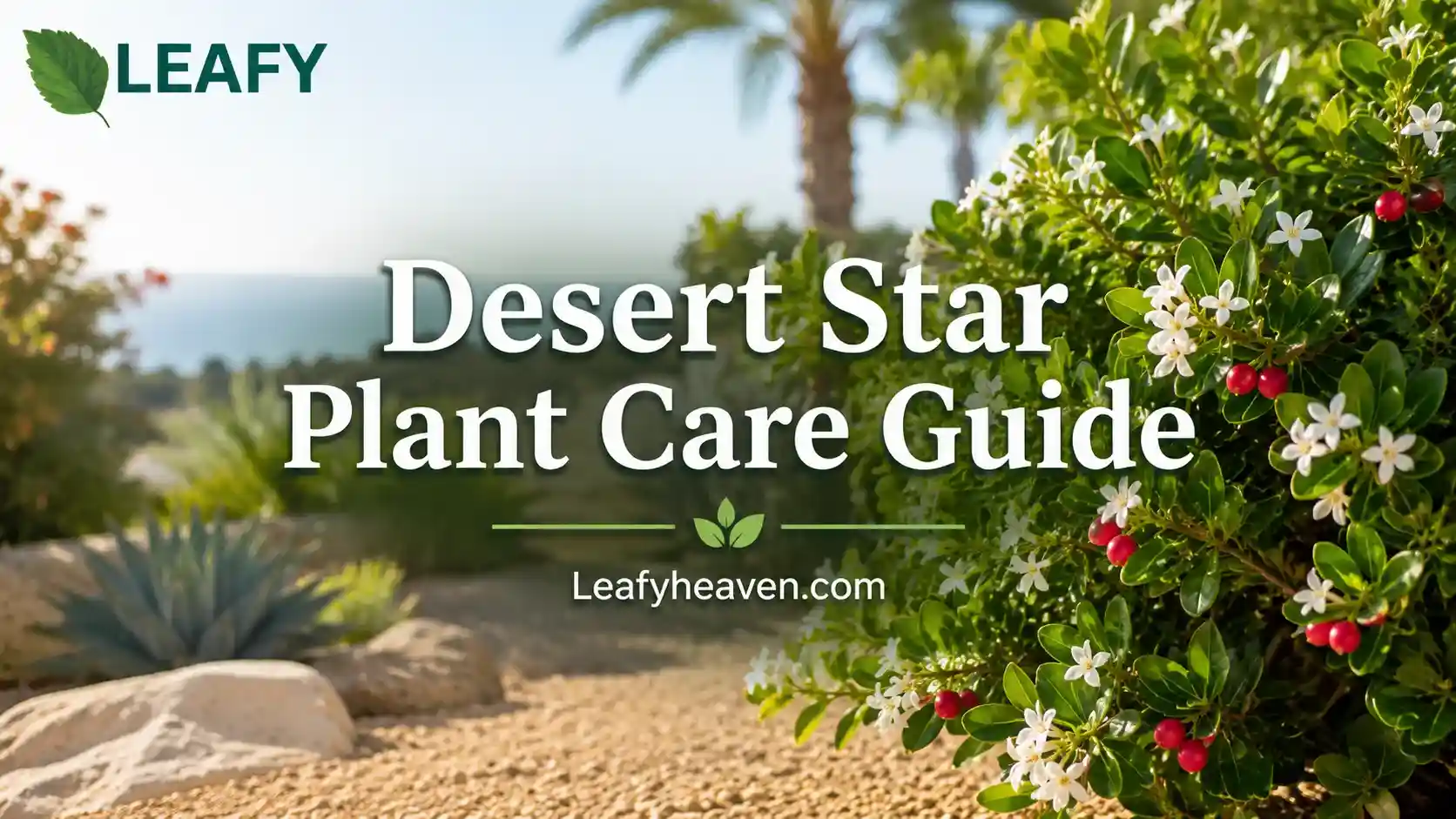
The desert star plant is a compact evergreen Carissa macrocarpa cultivar grown for glossy foliage, fragrant white flowers, red fruit, and dense growth in warm-climate landscapes.
The desert star plant is commonly searched as Carissa Desert Star, Carissa macrocarpa Desert Star, Carissa plant, and natal plum because it is closely connected with the Carissa macrocarpa group. This plant is popular for hedges, borders, coastal gardens, foundation planting, and low-maintenance landscaping where year-round structure is needed. Its neat growth, thorny branches, star-shaped flowers, and ornamental fruit make it useful in both practical and decorative garden designs. This guide covers identification, Carissa plant care, growing needs, common problems, safety, toxicity, flowers, fruits, hedge use, and landscaping ideas.
Quick answer: The desert star plant is a compact evergreen shrub related to natal plum. It is valued for glossy green foliage, fragrant white flowers, red fruit, and dense growth that works well for hedges, borders, and warm-climate landscaping.
What Is the Desert Star Plant?
The desert star plant is commonly understood as Carissa macrocarpa ‘Desert Star’, a compact form of natal plum used as an ornamental shrub, hedge, border plant, and low-maintenance landscape plant.
It belongs to the Carissa macrocarpa group, which is why gardeners often search for it as Carissa Desert Star, Carissa macrocarpa Desert Star, Carissa natal plum, or simply a Carissa plant. Its dense evergreen growth, glossy leaves, white flowers, red fruit, and thorny branching make it useful in warm gardens where structure, screening, and seasonal interest are needed.
Basic Identification
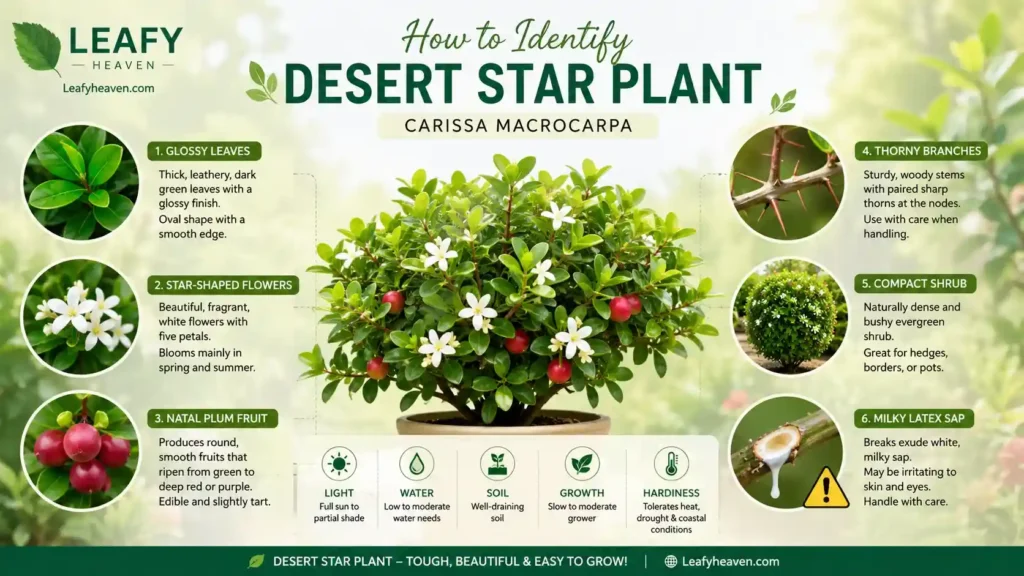
The desert star plant is identified by its compact evergreen habit, glossy foliage, star-shaped white flowers, red natal plum fruit, thorny stems, and milky latex sap.
| Identification Point | Desert Star Plant Details |
| Scientific name | Carissa macrocarpa ‘Desert Star’ |
| Common names | Desert Star plant, Carissa Desert Star, natal plum, Carissa natal plum |
| Family | Apocynaceae |
| Plant type | Evergreen shrub |
| Growth habit | Compact, dense, rounded, and spreading |
| Main foliage feature | Glossy green leaves with a leathery texture |
| Flower feature | White star-shaped flowers, often fragrant |
| Fruit feature | Red fruit associated with natal plum |
| Stem feature | Thorny branches that can form a protective hedge |
| Sap feature | Milky latex sap that should be handled with care |
Carissa macrocarpa ‘Desert Star’ is mainly valued as a compact landscape shrub rather than a large specimen plant. Its rounded, dense growth allows it to work well in borders, low hedges, coastal gardens, and foundation planting.
The plant’s glossy leaves give it a neat evergreen appearance throughout the year in suitable climates. Its white star-shaped flowers add ornamental value, while the red fruit connects it visually and botanically with the wider natal plum plant group.
Because the desert star plant has thorns and latex sap, it should be placed carefully in the landscape. It can be useful as a barrier hedge, but it is better kept away from narrow walkways, children’s play zones, and areas where pets may brush against the branches.
Is Desert Star the Same as Natal Plum?
Desert Star is closely connected with natal plum because natal plum usually refers to Carissa macrocarpa, the evergreen shrub species commonly grown for glossy leaves, white flowers, red fruit, and dense thorny growth.
The name Carissa Desert Star is generally used for a compact cultivar or landscape form associated with Carissa macrocarpa. This is why people often search for Carissa macrocarpa Desert Star, natal plum Carissa macrocarpa, or Carissa natal plum plant when looking for the same type of ornamental shrub.
In practical gardening terms, Desert Star and natal plum have very similar care needs. They prefer warm conditions, good sunlight, well-draining soil, moderate watering, and protection from waterlogged roots.
You may also see the phrase Carissa grandiflora natal plum in older botanical references or plant searches. Carissa grandiflora is commonly treated as an older synonym or related botanical name used for natal plum, not as a separate care topic for this guide.
For gardeners, the simplest way to understand it is this: natal plum is the broader common name linked to Carissa macrocarpa, while Desert Star is a compact ornamental form searched under the Carissa Desert Star name.
Native Origin and Regional Relevance
The desert star plant is linked to the natal plum group, which has a native range associated with Southern Africa and tropical parts of Africa.
Carissa macrocarpa is widely connected with South Africa and warm coastal regions, where plants must handle sun, wind, sandy soils, and periods of dry weather. This background helps explain why Carissa Desert Star performs well in warm, well-drained gardens with strong light and moderate watering.
The plant suits coastal gardens because it has good tolerance for salt exposure once established. It also fits dry, subtropical, and warm-climate landscapes where gardeners need a compact evergreen shrub that can handle heat better than many softer ornamental plants.
In regional searches, natal plum Australia often appears because the plant is used in Australian gardens, especially in coastal planting, sunny borders, and warm-climate landscaping. In these areas, drainage, frost exposure, and local soil type should guide how the plant is planted and maintained.
Quick takeaway: Desert Star belongs in warm, well-drained, sunny gardens where a compact evergreen shrub is needed.
Desert Star Plant Features and Characteristics
The desert star plant is recognized by its glossy evergreen foliage, fragrant white star-shaped flowers, red natal plum fruit, dense growth, and tough landscape performance.
These features make Carissa Desert Star useful in warm-climate gardens where year-round structure, flowering interest, and compact growth are important. It works well as an ornamental shrub, low hedge, border plant, coastal garden shrub, and landscape accent because it combines beauty with practical durability.
Leaves and Foliage
The desert star plant has glossy green evergreen leaves that create a neat, dense, and polished appearance in the garden.
The leaves are usually leathery in texture, which helps the plant tolerate heat, wind, and exposed landscape conditions better than many softer foliage plants. This firm leaf texture also supports its clean evergreen look through much of the year in suitable climates.
Dense foliage is one of the main reasons gardeners use the Carissa Desert Star plant for borders and hedges. The compact leaf coverage helps define garden edges, screen low views, and create structure around paths, lawns, patios, and planting beds.
Because the plant stays evergreen in warm climates, it does not rely only on flowers for ornamental value. Even when it is not blooming, its glossy leaves provide color, form, and a tidy background for other garden plants.
Desert Star Flower
The desert star flower is usually white, star-shaped, and valued for its clean ornamental look and light fragrance.
These flowers are one of the most attractive features of Carissa macrocarpa Desert Star. Their star-like shape stands out against the deep green foliage, giving the shrub a bright and refined appearance during flowering periods.
Flowering is more likely when the plant receives enough sunlight, warmth, and proper care. In suitable climates, blooms may appear during warm seasons, although the exact flowering period can vary by region, temperature, plant maturity, and growing conditions.
Sunlight has a strong effect on flowering. A Desert Star plant grown in full sun often develops denser growth and better bloom production, while a plant kept in too much shade may produce fewer flowers.
Pruning can also affect the desert star flower display. Light shaping is usually better than heavy cutting if flowers are desired, especially before or during the active growing season. Over-pruning may remove developing flower buds and reduce the seasonal bloom show.
Fruit and Edibility
The desert star plant can produce red fruit associated with natal plum, adding seasonal color and identity to the shrub.
The red fruit is one reason this plant is closely connected with the wider Carissa natal plum group. It can add visual interest after flowering and may also attract wildlife in some garden settings.
Ripe natal plum fruit is often discussed separately from the plant’s sap, leaves, stems, thorns, and unripe fruit. This distinction matters because safety information for Carissa plants is not the same for every plant part.
Gardeners should verify local guidance before eating fruit from any landscape plant. Identification, ripeness, chemical exposure, local recommendations, and personal sensitivity should all be considered before consuming anything grown in an ornamental setting.
For most homeowners, fruit is not the main reason to grow Carissa Desert Star. The plant is more commonly valued for its evergreen foliage, white flowers, compact habit, hedge performance, and warm-climate landscaping use.
Thorns, Latex, and Growth Habit
The desert star plant has thorny branches, milky latex sap, compact growth, and dense branching that make it useful but also important to handle carefully.
The thorns or spines can help the plant work as a barrier hedge. This makes a Desert Star hedge useful where gardeners want a dense, protective, evergreen boundary.
However, thorny growth also means placement matters. Carissa Desert Star should be used with caution near narrow walkways, seating areas, children’s play spaces, and areas where pets may brush against the branches.
The plant also produces milky latex sap when stems or leaves are cut. This sap should be treated as a handling consideration during pruning, shaping, or cleanup. Gloves are recommended when working with the plant.
Its compact, rounded, and spreading growth habit makes it suitable for low hedges, borders, containers, foundation planting, and coastal landscapes. Regular light pruning can help maintain a fuller shape and encourage dense branching.
| Feature | What It Means for Gardeners |
| Glossy leaves | Evergreen structure and neat appearance |
| White flowers | Fragrance and ornamental value |
| Red fruit | Seasonal interest and natal plum identity |
| Thorns | Useful for barrier hedges but needs careful placement |
| Latex sap | Safety caution during pruning and handling |
How to Grow Desert Star Plant Successfully
Grow the desert star plant in full sun to partial shade, well-draining soil, and warm conditions. Avoid waterlogged soil because poor drainage is one of the biggest causes of Carissa Desert Star problems.
Carissa macrocarpa Desert Star is a tough warm-climate shrub, but it performs best when its roots stay healthy. “Gardeners looking to build a low-maintenance warm-climate garden can explore a wide range of tips and plant guides through this comprehensive resource on gardening and plant care.” Light, drainage, watering, and temperature are the most important growing factors. Once established, the plant can tolerate dry periods better than many soft landscape shrubs, but it still needs careful watering during the first growing stage.
Sunlight Requirements
The desert star plant grows best in full sun because strong light supports dense growth, healthier foliage, and better flowering.
Full sun helps Carissa Desert Star develop compact branching and more reliable blooms. Plants grown in bright conditions usually look fuller, stronger, and more suitable for hedges, borders, and open landscaping.
Partial shade can work in very hot climates, especially where afternoon sun is intense. Light shade may reduce heat stress, but the plant should still receive enough brightness to maintain strong growth.
Too much shade can lead to weak stems, sparse foliage, slower growth, and fewer flowers. If the plant looks thin or does not flower well, low light should be one of the first conditions to check.
Soil Requirements
The desert star plant needs well-draining soil because wet roots are one of the main reasons Carissa Desert Star problems develop.
Sandy soil and loamy soil are usually better choices because they allow excess water to move away from the roots. Good drainage helps protect the plant from root rot, yellow leaves, black leaves, and weak growth.
Heavy clay soil should be improved before planting. Compost or organic matter can help improve soil structure, but the goal should be better drainage rather than overly rich soil.
Drainage matters more than soil fertility for this plant. A moderately fertile but free-draining planting site is usually safer than a rich, heavy soil that stays wet for too long.
Watering Needs
The desert star plant should be watered regularly during establishment, then watered less often once the roots are settled.
Newly planted Carissa Desert Star needs consistent moisture while it develops a stronger root system. Deep watering is better than frequent shallow watering because it encourages deeper root growth.
Once established, the plant usually needs moderate watering. The soil should be allowed to begin drying before watering again, especially in cooler weather or heavier soils.
Soggy soil should be avoided because it can damage roots and trigger common Carissa Desert Star problems. Overwatering may cause:
- Yellow leaves
- Black leaves or dark leaf patches
- Soft or weak roots
- Poor growth
- Wilting even when the soil is wet
Underwatering can also stress the plant, especially during hot weather or in containers. Signs of underwatering may include:
- Dry leaf edges
- Wilting during heat
- Slow growth
- Dull foliage
- Leaf drop during severe dryness
The best watering approach is to check the soil before watering. If the top layer is still wet, wait before adding more water.
Temperature and Climate Needs
The desert star plant grows best in warm climates and is well suited to coastal, subtropical, and dry warm-climate gardens.
Carissa Desert Star handles heat better than many delicate ornamental shrubs. It can fit well into coastal gardens, sunny borders, low-water landscapes, and warm residential planting designs once it is established.
The plant may be sensitive to frost, especially when young or newly planted. Mature plants may handle cooler conditions better than young plants, but frost risk depends on local climate, exposure, soil moisture, and plant health.
In Australian gardens, including warm coastal areas and Perth-style climates, the main care focus should be drainage, sunlight, and protection from unusual cold. Local soil type and seasonal rainfall should guide watering rather than a fixed schedule.
Fertilizer Needs
The desert star plant only needs light feeding when growth is weak or soil nutrients are limited.
A balanced slow-release fertilizer can be used during active growth if the plant needs support. This can help encourage healthy foliage, steady branching, and overall plant strength.
Excessive nitrogen should be avoided if the goal is flowers and fruit. Too much nitrogen may encourage leafy growth while reducing flowering performance.
Do not fertilize a stressed plant before checking the roots, soil moisture, and drainage. If the plant has yellow leaves, black leaves, or poor growth because of wet soil, fertilizer will not fix the main problem and may add more stress.
Quick summary: The strongest Desert Star plants grow in warm light, free-draining soil, and moderate watering. Most care problems begin when roots stay wet for too long.
Carissa Plant Care Guide for Beginners
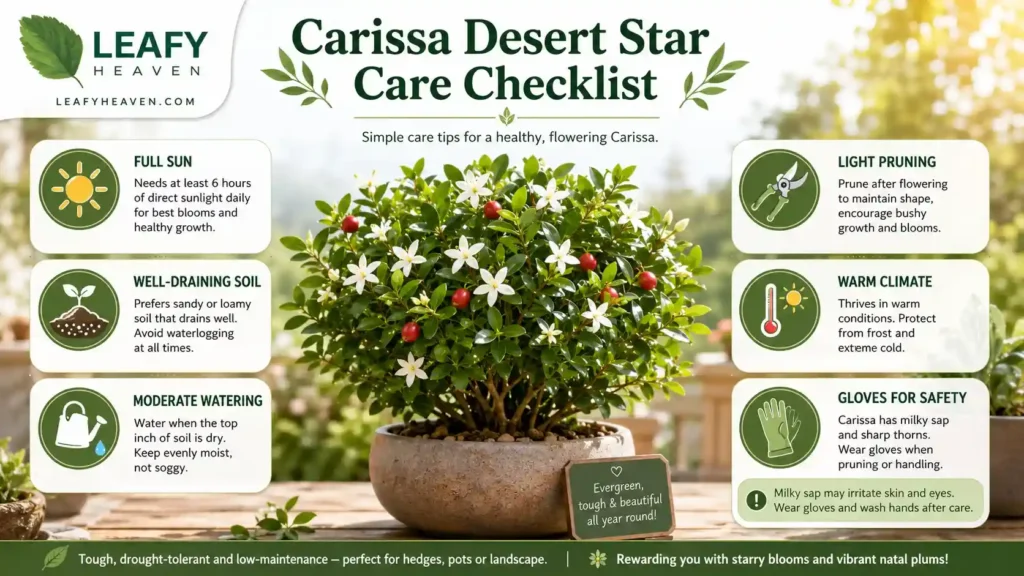
Carissa plant care is simple once the plant is established: give it sun, drainage, occasional pruning, moderate water, and enough space for airflow.
The Carissa Desert Star plant is considered low-maintenance in warm climates, but beginners should focus on the basics first. Healthy growth depends on proper watering, free-draining soil, bright light, and careful pruning. Most problems begin when the plant is kept too wet, planted in poor drainage, or placed where airflow and sunlight are limited.
First-Year Care
First-year care should focus on helping the Carissa plant develop strong roots without stress from drought, frost, waterlogging, or heavy pruning.
Water deeply after planting so moisture reaches the root zone. Deep watering is better than light surface watering because it encourages stronger root establishment.
Mulch can help protect the soil and reduce moisture loss, but it should be used carefully. Keep mulch away from the main stem to avoid trapping moisture against the base of the plant.
Check soil moisture before watering again. If the soil is still wet below the surface, wait before adding more water because young Carissa Desert Star plants can suffer in soggy soil.
Protect young plants from frost, cold winds, and waterlogged ground. New plants are usually more sensitive than established shrubs, especially when roots are still adjusting.
Avoid heavy pruning until the plant is settled. Light removal of damaged growth is fine, but major shaping should wait until the plant begins growing strongly.
Established Plant Care
Established Carissa plant care is easier because mature plants usually need less frequent watering, light shaping, pest checks, and occasional feeding.
Once the plant is established, reduce watering frequency. Carissa macrocarpa Desert Star can handle drier conditions better after its roots have spread, but the soil should not become extremely dry for long periods.
Shape the plant after flowering or during active growth. Light pruning helps maintain a compact form, supports dense branching, and keeps the shrub suitable for hedges, borders, and landscape edges.
Inspect the plant regularly for pests such as scale insects, mealybugs, or aphids. Early pest control is easier than treating a heavy infestation later.
Refresh mulch when needed, but keep the mulch layer light and away from the stem. This helps protect the soil without increasing the risk of stem or root problems.
Feed lightly if growth is weak, pale, or slow after drainage and watering issues have been ruled out. A balanced slow-release fertilizer during active growth is usually enough for general maintenance.
Indoor vs Outdoor Care
Outdoor care is usually easier for Carissa plants because they grow best with strong light, airflow, warm temperatures, and natural seasonal conditions.
In warm climates, Carissa Desert Star performs best outdoors in full sun to partial shade. Outdoor planting gives the shrub better airflow, stronger light, and more space for its compact but dense growth habit.
Indoor growing is possible, but it is more difficult. The plant needs very bright light, good air movement, careful watering, and a container that does not hold excess moisture.
If grown in a pot indoors or on a patio, the container must have drainage holes. Without drainage, water can collect around the roots and cause yellow leaves, root rot, black leaves, or weak growth.
Indoor plants should not be watered on a fixed schedule. Check the potting mix first, then water only when the upper layer begins to dry.
Potting and Repotting
Potting and repotting should focus on drainage because Carissa Desert Star does not perform well when roots stay wet for too long.
Use a pot with drainage holes so extra water can leave the container freely. A decorative pot without drainage can trap water and increase the risk of root rot.
Choose a free-draining potting mix instead of a heavy, moisture-retentive mix. A blend designed for shrubs, citrus, or drought-tolerant plants can work well if it drains quickly.
Repot when roots fill the container or growth slows because the plant has become root-bound. Repotting gives the roots more space and refreshes the growing medium.
Avoid oversized pots because they can hold too much unused moisture around the roots. A slightly larger pot is usually safer than a very large container.
After repotting, water carefully and allow the plant time to adjust. Do not overfertilize or heavily prune immediately after repotting unless damaged growth needs removal.
Beginner quick checklist:
| Care Point | Beginner Guidance |
| Sun | Full sun to partial shade |
| Soil | Well-draining soil |
| Water | Moderate, not soggy |
| Pruning | Light shaping |
| Safety | Use gloves because of thorns and sap |
| Best use | Hedge, border, coastal garden, ornamental shrub |
Common Carissa Desert Star Problems and Solutions
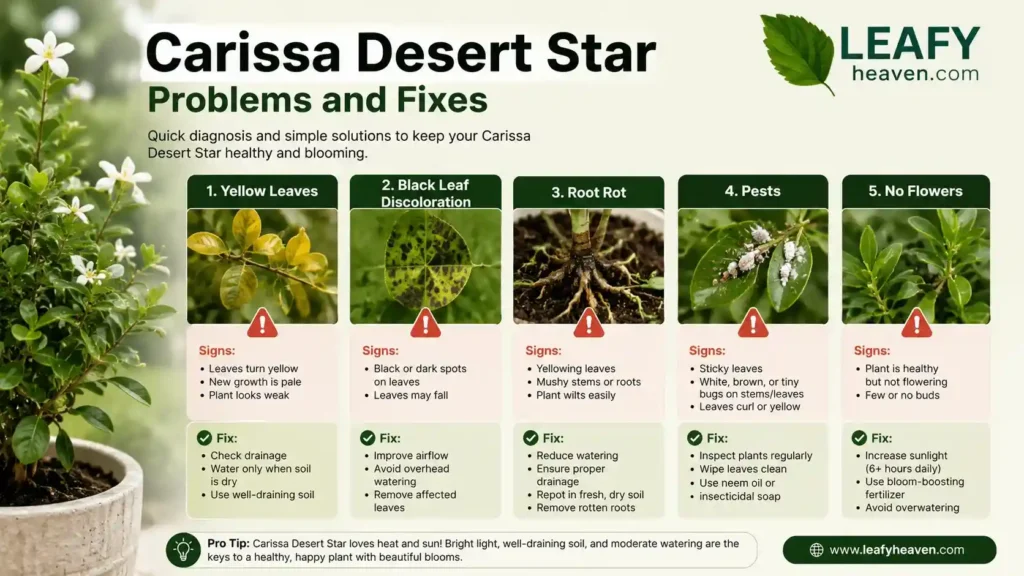
Most Carissa Desert Star problems come from poor drainage, overwatering, weak light, cold stress, pest pressure, or incorrect pruning.
The desert star plant is generally tough once established, but it can decline when its growing conditions are not balanced. The most important first step is to check the soil, light, water routine, and airflow before adding fertilizer or pruning heavily.
Yellow Leaves
Yellow leaves on Carissa Desert Star usually mean the plant is stressed by overwatering, poor drainage, nutrient deficiency, cold stress, or transplant shock.
Overwatering is one of the most common causes because Carissa macrocarpa Desert Star does not like roots sitting in wet soil. If the soil stays soggy, the roots cannot breathe properly, and the leaves may begin turning pale or yellow.
Poor drainage can create the same problem even when watering is not frequent. Heavy clay soil, compacted ground, or pots without drainage holes can hold too much moisture around the roots.
Possible causes include:
- Overwatering
- Poor drainage
- Nutrient deficiency
- Cold stress
- Transplant shock
The first fix is to check soil moisture before watering again. If the soil feels wet below the surface, reduce watering and allow the root zone to dry slightly.
Improve drainage if water collects around the plant after rain or irrigation. In containers, make sure the pot has drainage holes and the potting mix does not stay wet for too long.
Avoid daily watering unless the plant is newly planted in very hot weather and the soil is drying quickly. A balanced fertilizer can be applied only after root problems and drainage issues are ruled out.
Black Leaves or Leaf Discoloration
Black leaves or dark leaf discoloration on Carissa Desert Star often points to wet soil, root stress, cold damage, fungal pressure, or poor airflow.
Waterlogged soil can cause the roots to weaken, which may show above ground as dark, soft, or damaged foliage. If the plant is sitting in heavy wet soil, leaf discoloration should be treated as a warning sign.
Cold exposure can also darken leaves, especially on young plants, soft new growth, or shrubs planted in exposed areas. In cooler climates, cold wind and wet winter soil can make the damage worse.
Possible causes include:
- Waterlogged soil
- Root rot
- Cold damage
- Fungal stress
- Poor airflow
Inspect the soil first. If it is wet, compacted, or slow to drain, reduce watering and improve the planting area before applying any fertilizer.
Remove badly affected foliage if it is dead or diseased. Avoid wetting the leaves repeatedly during watering because constant moisture on foliage can increase fungal stress.
Better airflow can also help reduce leaf problems. Light pruning of crowded growth may improve air movement, but avoid heavy pruning while the plant is already stressed.
Root Rot
Root rot is a serious Carissa Desert Star problem that usually develops in heavy, wet, poorly drained soil.
When roots stay wet for too long, they can begin to decay. Damaged roots cannot absorb water and nutrients properly, so the plant may wilt even when the soil feels moist.
Common signs of root rot include:
- Soggy soil
- Wilting despite moisture
- Yellowing or blackening leaves
- Weak growth
- Bad root smell
Root rot is more likely in heavy clay, low planting spots, oversized containers, and areas where irrigation or rainfall keeps the soil constantly wet.
The first solution is to stop watering until the upper soil begins to dry. If the planting site holds water, the area may need to be lifted, amended, or improved with better drainage.
Raised beds can help in poor drainage areas because they keep the root zone above saturated ground. In containers, use a free-draining mix and a pot with open drainage holes.
Water only when the top soil begins to dry. This simple habit prevents many root-related Carissa Desert Star problems.
Pests on Carissa Plant
Pests on a Carissa plant are usually linked to scale insects, mealybugs, aphids, or ant activity around sap-feeding insects.
Scale insects may appear as small bumps on stems or leaf surfaces. Mealybugs often look like white cottony clusters, especially around leaf joints and protected growth.
Aphids may appear on soft new shoots where they feed on plant sap. Ant activity can be a warning sign because ants are often attracted to the sticky honeydew produced by sap-feeding pests.
Common pest signs include:
- Sticky leaves
- Small bumps on stems
- White cottony patches
- Distorted new growth
- Ants moving along stems
- Weak or yellowing foliage
Inspect leaf undersides, stems, and crowded growth regularly. Early detection makes pest control much easier.
Prune crowded or badly infested growth if needed. Better airflow can reduce pest pressure and make treatment more effective.
Horticultural oil or other safe pest control options may be used according to local label directions. Always follow the product instructions for plant safety, timing, and application rates.
No Flowers or Poor Growth
No flowers or poor growth on Carissa Desert Star usually comes from too much shade, excessive nitrogen, over-pruning, cold exposure, or an immature plant.
A desert star plant grown in too much shade may stay green but produce fewer flowers. Full sun usually supports stronger flowering, denser foliage, and better overall growth.
Too much nitrogen can also reduce flowering. It may encourage leafy growth while limiting the plant’s ability to produce flowers and fruit.
Over-pruning can remove developing flower buds, especially if the plant is cut heavily before or during the flowering season. Light shaping is usually better when blooms are desired.
Possible causes include:
- Too much shade
- Too much nitrogen
- Over-pruning
- Cold exposure
- Young plant not mature enough
If the plant is young, it may simply need more time to mature. Focus on proper light, drainage, moderate watering, and light pruning until growth becomes stronger.
| Problem | Likely Cause | First Fix |
| Yellow leaves | Overwatering or nutrient stress | Check drainage before feeding |
| Black leaves | Wet soil or cold stress | Reduce watering and improve soil |
| No flowers | Low light or hard pruning | Increase sun and prune lightly |
| Pests | Scale or mealybugs | Inspect stems and treat early |
| Weak hedge | Sparse growth or poor pruning | Tip prune during active growth |
Is Carissa Desert Star Poisonous?
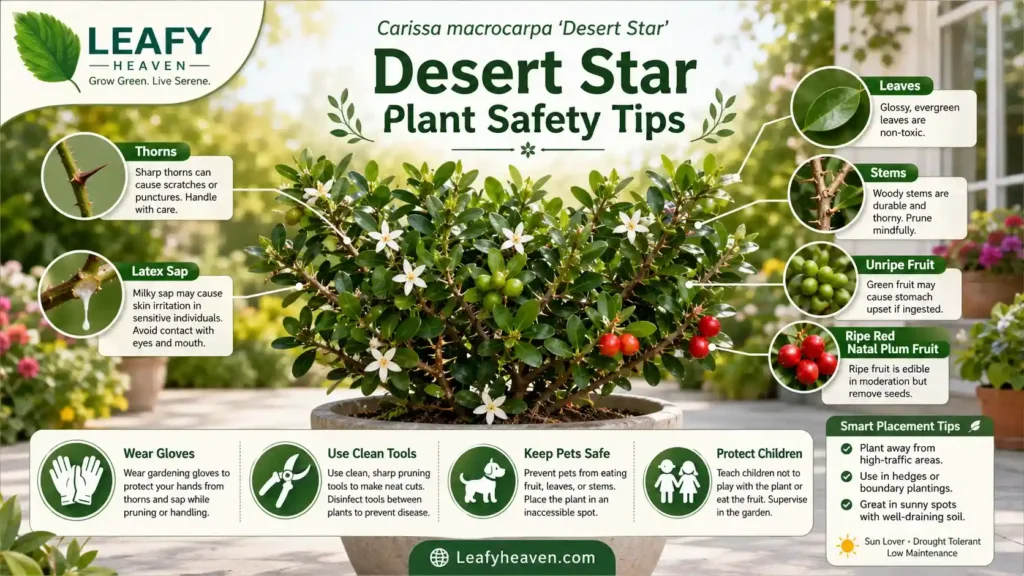
Carissa Desert Star should be treated with caution because the plant has latex sap, thorny stems, and safety discussions usually separate the ripe fruit from the rest of the plant.
The question is Carissa Desert Star poisonous needs a careful answer because not every part of the plant is discussed in the same way. The ripe natal plum fruit is commonly described differently from the leaves, stems, sap, thorns, and unripe fruit.
For home gardens, the safest approach is to treat Carissa Desert Star as an ornamental shrub and hedge plant. It should be handled carefully during pruning, placed thoughtfully in the landscape, and kept away from areas where children or pets may chew plant parts.
Which Parts Need Caution?
The main parts that need caution are the latex sap, leaves, stems, unripe fruit, and thorns.
Carissa Desert Star produces milky latex sap when stems or leaves are cut. This sap can be messy and may irritate sensitive skin, so direct contact should be avoided during pruning or cleanup.
The leaves and stems should not be eaten. They are part of the ornamental shrub structure and should be treated as unsafe for chewing or casual tasting, especially around pets and children.
Unripe fruit also needs caution. Even though ripe natal plum fruit is commonly described as edible, readers should avoid eating any fruit unless they are completely certain of plant identification, ripeness, local safety guidance, and chemical exposure history.
Thorns are another safety concern. They can scratch skin, catch clothing, and make the plant unsuitable for tight walkways or play areas.
Parts that need the most caution include:
- Latex sap from cut stems or leaves
- Leaves
- Stems
- Unripe fruit
- Thorny branches
- Any fruit from an unidentified or chemically treated landscape plant
Pet and Child Safety
Carissa Desert Star should be planted away from children’s play areas, pet zones, narrow paths, and places where people may brush against the shrub often.
The plant’s thorns make placement important. A Carissa Desert Star hedge can be useful as a protective barrier, but it is not ideal beside tight walkways, playground edges, or small courtyard paths where contact is likely.
Pets and children should not be allowed to chew the leaves, stems, unripe fruit, or fallen plant material. Even if the ripe fruit is discussed separately, casual chewing of unknown plant parts should always be prevented.
Use gloves while pruning or shaping the plant. This protects hands from thorns and reduces direct contact with latex sap.
After cutting latex-bearing stems, clean pruning tools properly. Sap residue can remain on blades, gloves, and nearby surfaces if the plant is trimmed heavily.
Safe Handling During Pruning
Safe pruning starts with gloves, eye protection, careful cutting, and proper cleanup.
Wear thick gardening gloves before pruning Carissa Desert Star. Gloves help protect the hands from sharp thorns and reduce contact with the plant’s milky latex sap.
Protect the eyes when cutting dense branches. Sap can splash during pruning, especially when stems are fresh, firm, or cut under pressure.
Dispose of cuttings safely after pruning. Thorny branches should not be left where children, pets, or barefoot gardeners may step on them.
Wash hands after handling the plant, even if gloves were used. Clean pruning tools after cutting latex-bearing stems so sap does not dry on the blades.
Safety quick takeaway: Use Desert Star as an ornamental and hedge plant, but handle it carefully because of thorns, latex sap, and ingestion concerns.
Desert Star Plant Landscaping Uses
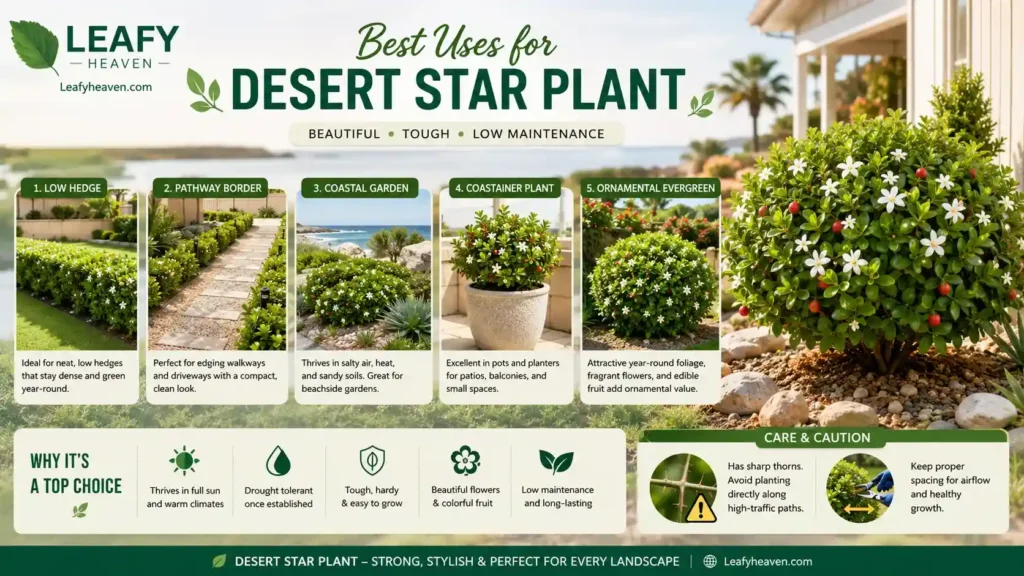
Carissa Desert Star landscaping works best in warm-climate gardens where a compact, glossy, flowering shrub is needed for borders, hedges, coastal gardens, and low-maintenance planting.
The desert star plant is useful because it gives structure, foliage, flowers, and barrier value in one shrub. “Gardeners designing low-effort landscapes may find additional inspiration in this guide to outdoor low maintenance plants suitable for warm-climate gardens.” Its evergreen leaves help define spaces year-round, while its white flowers and red fruit add seasonal interest. Because it has thorns and latex sap, placement should be planned carefully before planting.
Desert Star Hedge
A Desert Star hedge works well as a compact low hedge because the plant grows densely and responds well to light pruning.
The thick branching habit helps create a neat evergreen boundary along garden beds, driveways, open lawn edges, and landscape borders. With regular shaping, Carissa Desert Star can stay full and compact instead of becoming uneven or sparse.
Thorns can make a Carissa Desert Star hedge useful as a protective barrier. This is helpful where gardeners want a natural boundary that discourages foot traffic or unwanted access.
Pruning encourages compact growth and stronger branching. Light tip pruning during active growth can help the hedge fill out, especially when the goal is a dense, rounded shape.
Spacing depends on the desired hedge density and mature spread. Closer spacing creates a fuller hedge faster, while wider spacing gives each plant more room to develop naturally.
Borders, Edging, and Foundation Planting
Desert Star works well in borders, edging, and foundation planting because it provides evergreen structure, glossy foliage, and compact growth.
It can be used as a front-of-border shrub where a low, tidy, year-round plant is needed. The dense leaves help frame planting beds and create a clean edge between lawns, paths, patios, and garden spaces.
Use it along paths with caution because of the thorns. It should be planted far enough from walkways so people, pets, and children do not brush against the branches.
Carissa Desert Star is also useful for defining spaces around entrances, courtyards, driveways, and foundation beds. Its rounded form can soften hard edges without requiring constant maintenance.
The plant works well with gravel gardens, coastal planting styles, tropical landscapes, and drought-tolerant garden designs. Its glossy leaves contrast nicely with stones, mulch, grasses, succulents, and other warm-climate shrubs.
Coastal and Dry Gardens
Desert Star is useful in coastal and dry gardens because it can handle warm conditions, salt exposure, wind, and lower water needs after establishment.
Its connection to the natal plum group makes it suitable for coastal landscapes where plants may face salt air, sandy soil, and exposed conditions. Once established, it can tolerate these conditions better than many softer ornamental shrubs.
Wind exposure is another reason Carissa Desert Star landscaping works well in coastal gardens. Its leathery evergreen leaves and dense habit help it stay attractive in open, breezy locations when planted in suitable soil.
After establishment, the plant can fit into low-water landscapes. It still needs careful watering during the first year, but mature plants usually handle drier periods better when roots are healthy.
Warm-climate suitability is important. Desert Star performs best in sunny, well-drained gardens where frost is limited and soil does not stay wet for long periods. “Gardeners in hot, arid regions can also explore this selection of warm-climate flowering plants that thrive in similar sunny, low-rainfall conditions.”
Container and Courtyard Use
Desert Star can be grown in large containers and courtyards when drainage, sunlight, and safe placement are managed properly.
A large pot gives the plant enough space for root growth and helps support its compact shrub form. The container must have drainage holes because trapped water can quickly lead to root problems.
Use a free-draining potting mix and avoid oversized containers that hold too much moisture. The goal is steady moisture without soggy soil around the roots.
Prune lightly to keep the plant shaped and suitable for confined spaces. Regular light shaping is better than waiting until the plant becomes too large and then cutting it back heavily.
Place container-grown Desert Star where the glossy foliage and white flowers can be enjoyed, but where the thorns are not a hazard. Courtyard corners, sunny patios, and open entry spaces can work well if people do not need to brush against the plant.
| Use Case | Best Reason to Use Desert Star | Caution |
| Low hedge | Dense evergreen growth | Needs pruning |
| Coastal garden | Handles salt and wind better than many shrubs | Needs drainage |
| Pathway border | Glossy structure and flowers | Thorns need space |
| Container plant | Compact ornamental look | Pot must drain well |
| Security hedge | Thorny branches deter access | Not ideal near children’s areas |
Propagation and Maintenance
Desert Star can be maintained through pruning and may be propagated through cuttings, but healthy parent growth and warm conditions are important for success.
Good maintenance keeps the desert star plant dense, balanced, and suitable for hedges, borders, containers, and warm-climate landscaping. Propagation is possible, but results can vary depending on the season, plant health, cutting quality, and growing environment.
Propagation by Cuttings
Desert Star may be propagated from healthy semi-hardwood cuttings taken from strong parent growth.
Choose cuttings from a healthy Carissa Desert Star plant that is not stressed by drought, pests, root rot, or recent transplant shock. Semi-hardwood cuttings are usually firm enough to handle but not fully old and woody.
Remove the lower leaves from the cutting so the lower section can sit cleanly in the propagation medium. This helps reduce moisture loss and keeps buried leaves from rotting.
Use a free-draining medium rather than heavy garden soil. A light, airy mix helps hold enough moisture for rooting while allowing excess water to move away from the cutting.
Keep the cutting warm and lightly moist, not wet. Too much moisture can cause rot before roots develop, especially if airflow is weak or the medium stays soggy.
Rooting success depends on season, climate, cutting maturity, and overall plant health. Warm conditions and healthy parent growth usually give the best chance of success.
Pruning for Shape and Density
Pruning helps Desert Star stay compact, bushy, and useful as a hedge, border shrub, or ornamental landscape plant.
Tip pruning encourages bushier growth by helping the plant produce more side branches. This is especially useful when shaping a Desert Star hedge or improving a sparse plant.
Remove dead, damaged, diseased, or crossing stems whenever they appear. This improves structure, airflow, and overall plant health.
Avoid severe pruning right before flowering if flowers are desired. Heavy cutting can remove developing buds and reduce the desert star flower display.
Light shaping during active growth is usually better than hard pruning after the plant becomes overgrown. Regular small cuts help maintain a neat form with less stress.
Wear gloves when pruning because Carissa Desert Star has thorns and milky latex sap. Eye protection is also helpful when cutting dense branches.
Seasonal Maintenance
Seasonal maintenance keeps the desert star plant healthy by adjusting care according to growth, weather, and stress levels.
In spring, feed lightly if growth is weak and shape the plant as new growth begins. This is also a good time to inspect for winter damage and remove dead stems.
In summer, monitor watering and pests. Hot weather may increase water needs, while dense growth can hide scale insects, mealybugs, aphids, or ant activity.
In autumn, reduce feeding so the plant does not push too much soft growth before cooler weather. Continue checking drainage, especially if seasonal rain increases.
In winter, protect young plants in cooler climates and avoid waterlogging. Cold weather combined with wet soil can increase root stress, leaf discoloration, and weak spring recovery.
| Season | Maintenance Focus |
| Spring | Feed lightly, shape growth, remove damaged stems |
| Summer | Monitor watering, pests, heat stress, and airflow |
| Autumn | Reduce feeding and prepare for cooler conditions |
| Winter | Protect young plants and prevent waterlogged soil |
Desert Star Plant vs Similar Plants
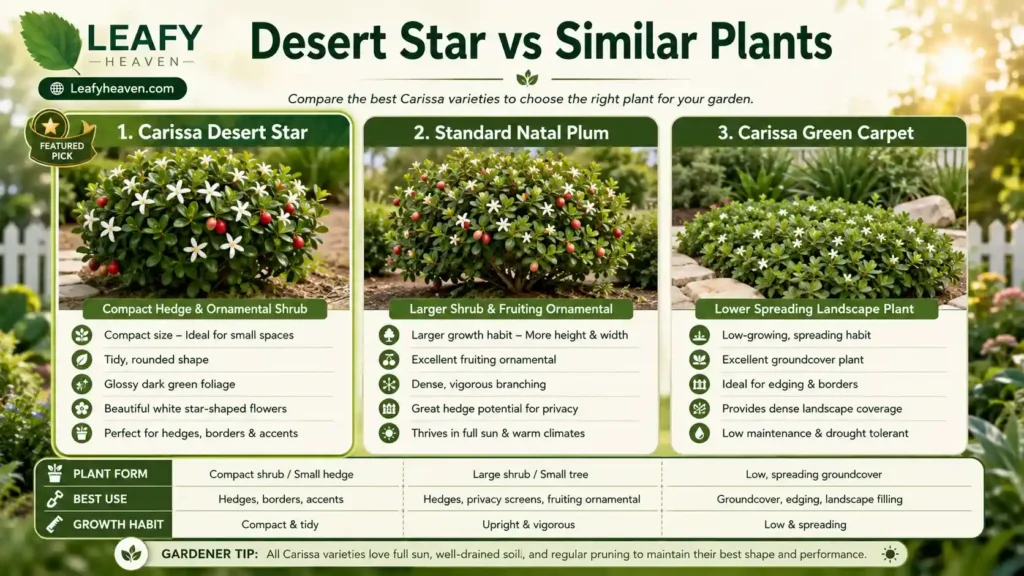
Desert Star is best compared with other compact shrubs and Carissa varieties because its main strengths are glossy foliage, flowers, red fruit, salt tolerance, and hedge performance.
This comparison helps gardeners understand where Carissa Desert Star fits in a landscape. It is not only a flowering shrub and not only a hedge plant. It combines ornamental foliage, seasonal flowers, natal plum fruit, thorny branching, and warm-climate toughness in one compact form.
Desert Star vs Standard Natal Plum
Desert Star is commonly searched as a compact landscape form, while standard natal plum may grow larger depending on the variety and growing conditions.
Both plants are connected with Carissa macrocarpa, which is why their care needs are similar. They usually prefer full sun to partial shade, well-draining soil, warm climates, and moderate watering after establishment.
The main difference is growth use. Carissa Desert Star is often chosen when gardeners want a smaller, denser, more controlled shrub for hedges, borders, foundation planting, and compact landscapes.
Standard natal plum can be better suited where a larger shrub, stronger fruiting ornamental, or broader landscape plant is desired. However, size can vary by cultivar, pruning, climate, and site conditions.
This is why cultivar choice matters. A compact Carissa macrocarpa Desert Star plant may suit a low hedge or small border better than a larger natal plum form that needs more space.
Desert Star vs Carissa Green Carpet
Desert Star is better for compact hedges and ornamental shrub use, while Carissa Green Carpet is usually discussed as a lower, spreading Carissa landscape plant.
Carissa Green Carpet appears in related searches because it belongs to the same general Carissa landscape group. It is often associated with low-growing, spreading use rather than upright hedge structure.
Desert Star has more value where gardeners want glossy foliage, flowers, red fruit, and a compact shrub shape. It can be shaped into a Desert Star hedge or used as a neat border plant.
Carissa Green Carpet is more suitable where a lower groundcover effect is needed. It can help cover open soil, soften edges, and create a spreading evergreen look.
Maintenance also differs by use. Desert Star may need light pruning to keep a hedge dense and rounded, while Green Carpet is managed more for spread, coverage, and low growth control.
Desert Star vs Other Hedge Shrubs
Desert Star differs from many common evergreen hedge shrubs because it offers flowers, fruit, thorns, salt tolerance, and compact ornamental value.
Many non-thorny hedge shrubs are grown mainly for soft formal structure. They may be easier to place near pathways, children’s areas, and narrow garden spaces because they do not have sharp spines.
Carissa Desert Star is more useful when the hedge needs extra features. It can work as a flowering hedge, coastal hedge, thorny barrier hedge, or low-maintenance border in warm climates.
Its thorns make it useful for protective planting, but they also make placement more important. A Carissa Desert Star hedge should not be crowded against tight paths or areas where people regularly brush against the plant.
For gardeners who want glossy leaves, white flowers, red fruit, and a stronger barrier effect, Desert Star can offer more visual and practical value than a typical soft hedge shrub.
| Plant | Best For | Main Difference |
| Carissa Desert Star | Compact hedge and ornamental shrub | Glossy leaves, flowers, fruit, thorns |
| Standard Natal Plum | Larger shrub or fruiting ornamental | May grow bigger |
| Carissa Green Carpet | Low groundcover effect | Lower spreading use |
| Typical non-thorny hedge shrub | Formal soft hedge | Usually safer near pathways |
Conclusion: Should You Grow the Desert Star Plant?
The desert star plant is a strong choice for warm-climate gardens when you want a compact evergreen shrub with flowers, fruit, hedge value, and low-maintenance appeal, but it needs drainage and careful handling.
Carissa Desert Star works especially well in hedges, borders, coastal gardens, containers, and ornamental evergreen planting. Its glossy foliage, white flowers, red natal plum fruit, and dense branching make it useful where structure and seasonal interest are needed in the same plant.
The main care priority is drainage. Avoid waterlogged soil because wet roots can lead to yellow leaves, black leaves, root rot, and weak growth. Full sun to partial shade, moderate watering, and light pruning usually keep the plant healthier.
The plant should also be handled with care because of its thorns and milky latex sap. Place it away from child and pet play zones, narrow paths, and high-contact areas. In colder regions, use local growing advice before planting because frost tolerance can vary by climate, exposure, and plant maturity.
Before planting or diagnosing problems, use the care checklist and troubleshooting table to check sunlight, soil drainage, watering habits, pests, pruning, and safety placement.
FAQs About Desert Star Plant
What is the desert star plant?
The desert star plant is a compact Carissa macrocarpa cultivar commonly grown as an evergreen ornamental shrub, hedge, or landscape border plant. It is valued for glossy green foliage, white star-shaped flowers, red natal plum fruit, thorny branching, and dense growth. In warm-climate gardens, Carissa Desert Star is often used for borders, low hedges, coastal planting, foundation beds, and low-maintenance ornamental landscaping.
Is Carissa Desert Star the same as natal plum?
Carissa Desert Star is closely connected with Carissa macrocarpa, commonly called natal plum. Desert Star is usually discussed as a compact landscape form or cultivar. Natal plum is the broader common name often used for Carissa macrocarpa, while Desert Star is searched as a specific compact ornamental form. Both share similar care needs, including full sun to partial shade, well-draining soil, moderate watering, and warm growing conditions.
Is Carissa Desert Star poisonous?
Carissa Desert Star should be handled cautiously because the plant has latex sap and thorny stems. Ripe fruit is commonly treated differently from sap, leaves, stems, and unripe fruit. For safe garden use, treat the plant as an ornamental shrub unless you are certain of identification, fruit ripeness, and local guidance. Keep children and pets from chewing leaves, stems, unripe fruit, or fallen plant parts. Gloves are recommended when pruning because of thorns and milky sap.
Why are my Carissa Desert Star leaves turning yellow?
Yellow leaves usually point to overwatering, poor drainage, nutrient stress, transplant shock, or cold stress. Check soil moisture and drainage before adding fertilizer. If the soil feels wet or drains slowly, reduce watering first. Carissa Desert Star does not like roots sitting in soggy soil, and feeding will not fix root stress caused by excess moisture. Improve drainage, avoid daily watering, and fertilize lightly only after root problems are ruled out.
Can Desert Star be used as a hedge?
Yes, Desert Star can be used as a low hedge because it grows densely and responds to pruning. Its thorns make placement important near paths, pets, and children. A Desert Star hedge works well where a compact evergreen barrier is needed. Light tip pruning during active growth encourages fuller branching and a neater shape. Avoid planting it too close to narrow walkways because the thorny stems can scratch skin or catch clothing.
Does the desert star plant flower?
Yes, the desert star plant can produce white star-shaped flowers, especially when grown in good light, warm conditions, and well-draining soil. The desert star flower adds fragrance and ornamental value against the plant’s glossy green leaves. Flowering may be reduced if the plant is kept in too much shade, over-pruned before bloom time, exposed to cold stress, or given too much nitrogen fertilizer.
How often should I water Carissa Desert Star?
Water regularly while the plant is establishing, then reduce watering once roots settle. The soil should drain well and should not stay soggy. New plants need deeper, more consistent watering during establishment, especially in warm weather. Established Carissa Desert Star plants usually need less frequent watering. Always check the soil first because watering needs change with season, temperature, rainfall, soil type, and container size.
Is Desert Star good for Australian gardens?
Desert Star can suit many warm Australian gardens, especially coastal or well-drained landscapes, but local frost, soil type, and watering conditions should guide planting decisions. In Australian gardens, the plant is often relevant for warm-climate landscaping, coastal planting, borders, and low hedges. It performs best where sunlight is strong, drainage is reliable, and frost exposure is limited. In cooler or frost-prone areas, local growing advice should be followed before planting.

Written by the LeafyHeaven Editorial Team
LeafyHeaven shares practical gardening tips and simple plant care guides to help you grow, nurture, and enjoy your plants with ease. Our goal is to make gardening feel natural, approachable, and rewarding for everyone.