
Introduction
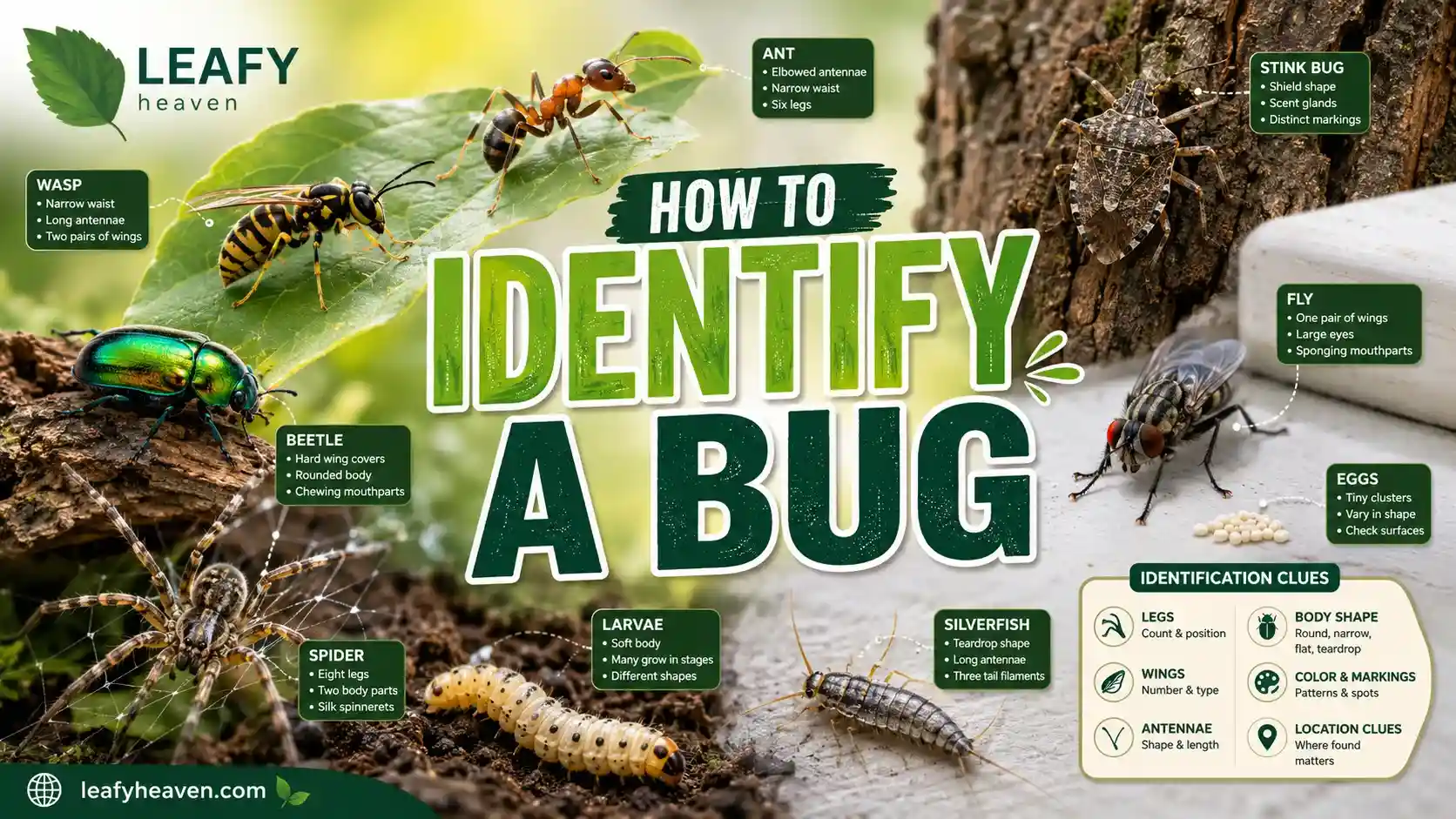
To identify a bug, observe its body shape, number of legs, wings, antennae, color pattern, movement, location, and any signs it leaves behind. This guide explains how to identify a bug using practical visual clues that help homeowners, gardeners, and curious readers make a clearer first match. The word “bug” is often used for insects, spiders, beetles, ants, wasps, roaches, silverfish, springtails, and other small arthropods. Accurate bug identification depends on body structure, behavior, habitat, damage signs, eggs, larvae, and context, not color alone. You will learn how to recognize common household bugs, garden pests, black and orange insects, red and black bugs, and possible infestation signs.
What Is a Bug?
A bug is commonly any small crawling or flying arthropod, but scientifically a true bug belongs to the order Hemiptera. In everyday language, people use “bug” for many small creatures, including insects, spiders, beetles, ants, wasps, roaches, silverfish, springtails, ticks, mites, centipedes, and millipedes.
Scientific bug identification is more specific. True bugs usually have piercing and sucking mouthparts, which they use to feed on plant sap, other insects, or organic fluids. Stink bugs, aphids, cicadas, assassin bugs, and boxelder bugs are common examples of true bugs.
For practical identification, the word bug is useful because most people are trying to name an unknown small creature quickly. Still, knowing the difference between a bug, an insect, and an arthropod helps you avoid common mistakes when comparing body shape, legs, wings, antennae, and behavior.
Bug vs Insect vs Arthropod
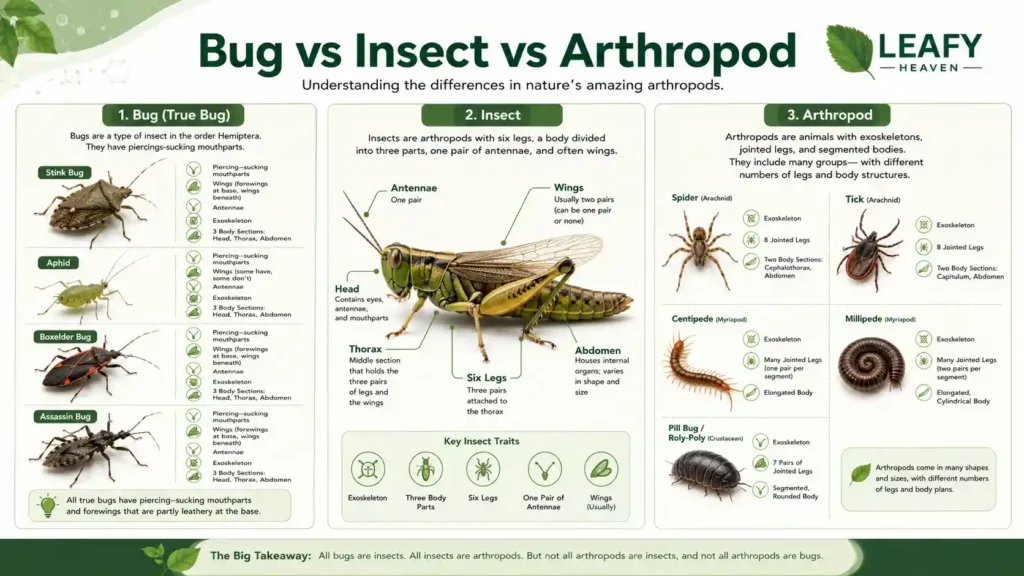
All insects are arthropods, but not all arthropods are insects. Arthropods are animals with jointed legs, segmented bodies, and an outer skeleton called an exoskeleton. This large group includes insects, spiders, ticks, mites, centipedes, millipedes, and crustaceans.
Insects are a smaller group within arthropods. Most insects have six legs, three main body segments, one pair of antennae, and sometimes wings. Ants, beetles, flies, wasps, roaches, true bugs, and mayflies are insects because they match these basic traits.
Spiders, ticks, and mites are arthropods, but they are not insects because they usually have eight legs and no antennae. Centipedes and millipedes are also arthropods, but they have many legs and long segmented bodies instead of the three part insect body plan.
This is why someone searching for identification of insect may still see results for spiders, pill bugs, mites, or centipedes. Many identification guides use “bug” in the common sense because users often describe any small crawling creature as a bug, even when it is not scientifically an insect.
What Makes an Insect?
An insect usually has six legs, one pair of antennae, and three main body parts. These three body parts are the head, thorax, and abdomen, and they are the main structure used in basic insect identification.
The head usually holds the antennae, compound eyes, and mouthparts. Antennae help insects sense smell, touch, movement, and chemicals in their environment. Mouthparts can vary widely, which is why some insects chew leaves, some pierce plants, and others sip liquids.
The thorax is the middle body section where the legs and wings are attached. Most adult insects have three pairs of legs. Some insects also have one or two pairs of wings, while others have no visible wings at all.
The abdomen is the rear body section and often contains digestive and reproductive organs. In some insects, the abdomen also helps with identification because it may show stripes, bands, spots, a stinger like structure, or a distinct color pattern.
If a question asks which of the following characteristics do all insects exhibit, the most reliable answer is six legs, three main body segments, and one pair of antennae. Wings are common in many insects, but they are not present in every insect species or every life stage.
How to Identify a Bug Step by Step
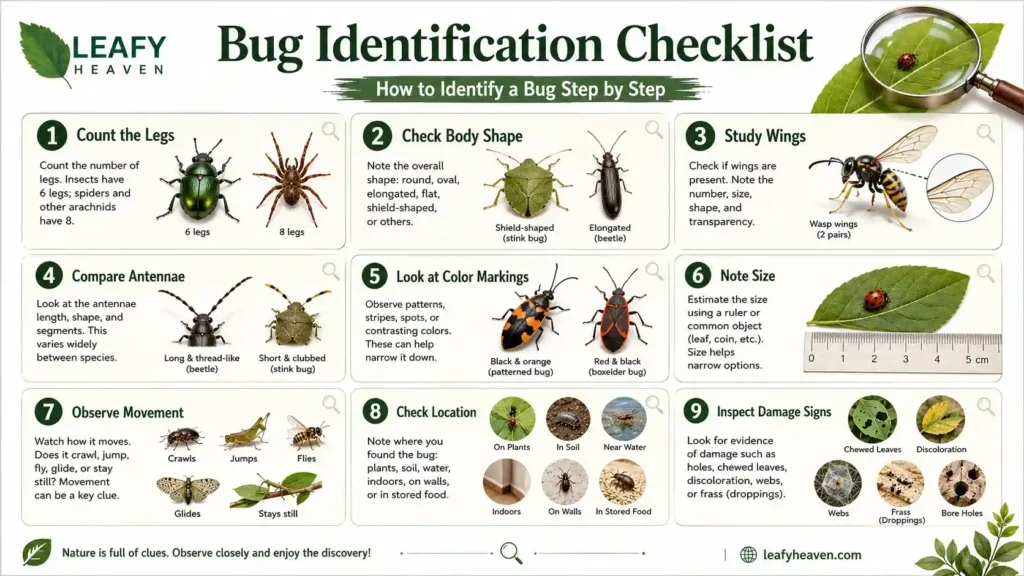
The easiest way to identify a bug is to check body parts, size, color, legs, wings, antennae, behavior, habitat, and damage signs in a clear order. A single clue can be useful, but accurate bug identification works best when several clues match together.
Start with visible features first. Look at how many legs the bug has, whether it has wings, what its body shape looks like, and where you found it. Then compare its color pattern, movement, antennae, and any damage signs around the area.
A clear step by step method helps reduce confusion between insects, spiders, beetles, ants, wasps, stink bugs, roaches, flies, and other small arthropods. This is especially helpful when the bug has strong colors like black, orange, red, or yellow.
Step 1: Count the Legs
Six legs usually suggest an insect, eight legs suggest a spider or mite, and many legs may suggest a centipede or millipede. Leg count is one of the fastest ways to separate insects from other arthropods.
Most insects have six legs attached to the thorax. Ants, beetles, flies, wasps, stink bugs, roaches, and true bugs all fit this basic insect pattern. If you see a black bug six legs visible, it is more likely to be an insect than a spider or mite.
An orange and black bug with 6 legs may be a beetle, true bug, wasp, or other insect group depending on its body shape and wings. A black and orange six legged bug should be checked for antennae, wing covers, markings, and where it was found.
Eight legged creatures usually belong to spiders, ticks, or mites. Spiders have eight legs, no antennae, and two main body sections. Ticks and mites can be smaller and harder to inspect, but they are not insects.
Many legged creatures may be centipedes or millipedes. Centipedes usually move quickly and have one pair of legs per body segment. Millipedes usually move more slowly and have many short legs along a rounded segmented body.
Quick leg count guide:
- Six legs usually means insect.
- Eight legs usually means spider, tick, or mite.
- Many legs usually means centipede or millipede.
- No clear legs may mean larva, maggot, worm like stage, or hidden appendages.
- Very tiny legs may require a close photo or magnifying lens.
Step 2: Look at Body Shape
Body shape helps separate beetles, ants, roaches, stink bugs, spiders, and flies. Color can change across species, but body structure often gives a stronger identification clue.
Oval bodies are common in beetles, roaches, and pill bugs. Beetles often have a firm shell and visible wing covers. Roaches usually have a flatter, longer oval body with long antennae and fast movement. Pill bugs have a rounded segmented body and may roll into a ball.
Shield shaped bodies often point toward stink bugs or related true bugs. These insects usually have a broad upper body and a triangular or shield like outline when viewed from above. A red and black stink bug or black and orange true bug may show this shape clearly.
A narrow waist is common in ants and wasps. Ants usually have elbowed antennae and social trail behavior. Wasps often have wings, longer bodies, and a narrow connection between the thorax and abdomen.
A round abdomen can suggest a spider, especially when the creature has eight legs and no antennae. Crab spiders, jumping spiders, orb weavers, and house spiders may all show different abdomen shapes, but the eight leg body plan is the main clue.
A long body with pincers at the rear may suggest an earwig. Earwigs are insects with six legs, long antennae, and forceps like appendages at the end of the abdomen.
Useful body shape clues:
- Oval body can suggest beetle, roach, or pill bug.
- Shield shaped body can suggest stink bug or true bug.
- Narrow waist can suggest ant or wasp.
- Round abdomen with eight legs can suggest spider.
- Long body with rear pincers can suggest earwig.
- Flat body with fast movement can suggest roach or certain household insects.
Step 3: Check Wings and Flight
Wings help identify whether the bug is a fly, wasp, beetle, mayfly, termite swarmer, or winged ant. Flying behavior can also show whether the insect is a strong flyer, weak flyer, glider, or short distance jumper.
Hard wing covers often indicate beetles. These covers protect the delicate flight wings underneath. If you see a black and orange beetle like insect with a firm shell, clear body division, and six legs, it may belong to a beetle group.
Clear wings may suggest flies, wasps, termites, or mayflies. Flies usually have one main pair of wings and short antennae. Wasps often have narrow waists, longer antennae, and more direct flight. Termite swarmers and winged ants may appear in groups near windows, lights, or damp wood areas.
Long dangling legs may suggest paper wasps or similar wasp like insects. Paper wasps often fly with legs hanging down and may be seen around eaves, fences, garden structures, or exposed nests. Unknown wasp like insects should not be handled.
An orange and black flying insect can be a wasp, beetle, fly, moth, or true bug depending on its wing type and body shape. Black and orange bugs that fly should be identified carefully because some may sting, some may feed on plants, and others may be harmless visitors.
An orange and black winged insect with a narrow waist may be wasp like, while one with hard wing covers may be beetle like. A bug with a shield shaped body and patterned wings may belong to the true bug group.
Wing and flight clues to check:
- Hard wing covers often suggest beetles.
- One pair of wings often suggests flies.
- Clear wings with a narrow waist may suggest wasps.
- Equal length wings in a swarm may suggest termites.
- Delicate wings and long tail like filaments may suggest mayflies.
- Wings plus ant like body shape may suggest winged ants.
- Dangling legs during flight may suggest paper wasps.
Step 4: Study Color and Markings
Color patterns are useful clues, but they should be matched with body shape and behavior. A black and orange bug, red and black bug, or insect with white spots may look easy to name at first, but color alone can lead to the wrong identification.
Black and orange markings are common in several insect groups. A black and orange insect may be a beetle, true bug, wasp, moth, boxelder bug, assassin bug, or garden pest. To narrow it down, check whether it has hard wing covers, a shield shaped body, clear wings, a narrow waist, or a soft body.
Red and black markings can also appear in many different bugs. Some red and black bugs are stink bugs, plant bugs, beetles, ants, or wasp like insects. A black and red ant may be a true ant, but a fuzzy red and black ant like insect may actually be a velvet ant, which is a wingless wasp.
White spots, stripes, bands, and wing markings are important because they create a more specific pattern. Look for orange stripes on a black body, red bands across the abdomen, black spots on red wing covers, or pale marks along the wings. These details often help separate similar looking insects.
Color can mislead identification because different insects may use similar warning colors. Bright orange, red, yellow, and black patterns may signal defense, mimicry, or camouflage. Some harmless bugs look like stinging insects, while some dangerous looking bugs may be harmless plant feeders.
Use color as a supporting clue, not the final answer. Match the markings with leg count, body shape, antennae, wings, location, movement, and feeding signs before deciding what the bug is.
Quick color and marking checklist:
- Black and orange markings may suggest beetles, true bugs, wasps, or garden insects.
- Red and black markings may suggest stink bugs, beetles, ants, or velvet ants.
- White spots can help separate beetles, plant bugs, and spider like arthropods.
- Stripes and bands should be checked on the back, abdomen, legs, and wings.
- Wing markings are especially useful for flies, moths, true bugs, and wasp like insects.
- Color should always be confirmed with body structure and behavior.
Black and Orange Bug Identification
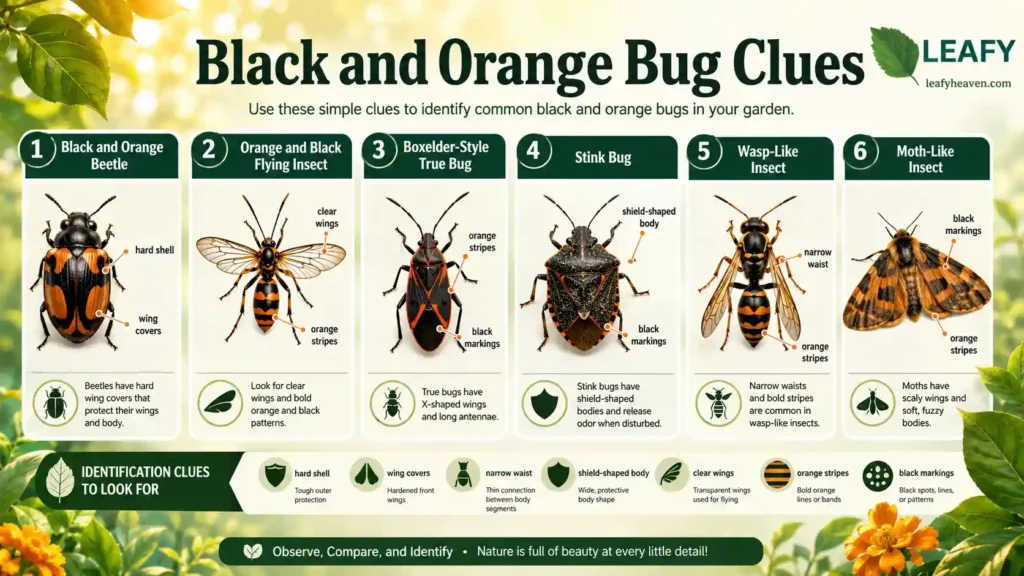
A black and orange bug may be a beetle, stink bug, boxelder bug, assassin bug, wasp, moth, or garden insect depending on shape and wings. The color pattern is helpful, but the final identification should come from body structure, leg count, wing type, antennae, movement, and where the bug was found.
Many orange and black bugs use bold markings as warning colors, camouflage, or mimicry. This means two unrelated insects can look similar from a distance. A harmless beetle, a plant feeding true bug, and a stinging wasp may all show black and orange coloring.
For accurate orange and black bug identification, start with the physical clues. Check whether the bug has a hard shell, soft body, narrow waist, shield shaped back, clear wings, fuzzy body, long antennae, or slow crawling behavior. These details help separate beetles, true bugs, wasps, moths, and garden pests.
Common Black and Orange Bugs
Black and orange insects often belong to beetles, true bugs, wasps, or plant feeding garden pests. A black and orange beetle may have a firm oval body, visible wing covers, and chewing mouthparts, while a true bug may have a flatter body and piercing mouthparts.
An orange black insect found on flowers may be a pollinator, beetle, moth, or wasp like insect. If it is feeding on leaves, stems, or seed pods, it may be a plant feeding bug. If it is flying near a nest or structure, it may need more careful observation.
A black bug with orange on the back can be difficult to identify from color alone. Look at the placement of the orange marking. Orange stripes, bands, spots, or patches on the wing covers can point toward beetles, while orange lines on a flatter body may suggest true bugs such as boxelder bugs or related species.
A black insect orange stripes pattern may appear on beetles, wasps, assassin bugs, and some moths. Bugs with orange and black stripes should be checked for waist shape, wing texture, and movement. A narrow waist can suggest a wasp, while hard wing covers can suggest a beetle.
A black insect with orange on back may also be a warning colored insect that looks more dangerous than it is. Some insects mimic wasps or other defended insects to avoid predators. This is why safe observation is better than touching an unknown bug.
Useful clues for common black and orange bugs:
- Hard shell and slow crawling may suggest a beetle.
- Shield shaped body may suggest a stink bug or true bug.
- Narrow waist and clear wings may suggest a wasp.
- Flat black body with orange lines may suggest a boxelder style bug.
- Long beak like mouthparts may suggest an assassin bug.
- Fuzzy body and patterned wings may suggest a moth or wasp mimic.
- Location on plants may suggest a garden insect or plant feeding pest.
Black and Orange Beetle Clues
A black and orange beetle usually has a hard shell, wing covers, six legs, and visible antennae. Beetles belong to one of the largest insect groups, so their colors and sizes can vary widely, but the hard wing covers are one of the strongest clues.
A beetle orange black pattern often appears as stripes, spots, bands, or patches across the back. A black beetle with orange stripe may have the stripe across the wing covers, along the body sides, or near the head. These markings should be compared with the beetle’s body shape and size.
Beetles usually have a compact body. Some are oval, some are long and narrow, and some look slightly flattened. Orange and black beetles may appear in gardens, on flowers, near lights, inside homes, in stored food areas, or around decaying organic material.
Hard wing covers separate beetles from many other black and orange insects. These covers meet in a straight line down the back and protect the softer wings underneath. If the bug opens the shell like covers before flying, it is likely a beetle.
Slow crawling behavior is also common in many beetles. Some beetles fly well, but many are first noticed walking on leaves, walls, windowsills, pantry shelves, or soil. A beetle with orange stripes in a garden may be feeding on plants, hunting smaller insects, or simply passing through.
Location gives important context. A black and orange beetle in the pantry may be connected to stored grain, flour, cereal, or dry food. A beetle in the garden may be linked to flowers, leaves, soil, compost, or tree bark. An indoor beetle near windows may have entered accidentally.
Common beetle identification clues:
- Six legs attached to the thorax.
- Hard wing covers on the back.
- Visible antennae near the head.
- Oval, rounded, or elongated body.
- Slow crawling or short flight.
- Orange stripes, spots, or bands on a black body.
- Garden, pantry, window, soil, or plant location.
Black and Orange Flying Bugs
A black and orange flying bug should be checked for wings, waist shape, sting risk, and whether it behaves like a wasp, fly, beetle, or true bug. Flying insects can look similar in color, so wing type and body structure are more reliable than color alone.
A wasp like waist is an important clue. If the insect has a narrow waist, clear wings, long antennae, and direct flight, it may be a wasp or wasp mimic. Some orange and black flying insects can sting, so they should not be handled.
A beetle like shell suggests a different identification. If the flying bug has hard wing covers that open before flight, it is more likely a beetle. Many black and orange bugs that fly are beetles, especially when they look compact, shiny, or oval.
A fly like single wing pair may suggest a fly rather than a wasp or beetle. Flies often have shorter antennae, large eyes, and only one main pair of wings. Some flies mimic wasps with orange and black markings, but they do not have the same narrow waist or stinger.
A stink bug or boxelder style body often looks flatter and more shield like. These insects may fly, crawl on walls, gather around windows, or appear on plants. Their wings may lie flat across the back and create a patterned shape.
An orange and black winged insect near flowers may be a pollinator, wasp, beetle, fly, or moth. One near vegetable plants or tree leaves may be a plant feeding true bug. One near eaves, porch ceilings, or paper like nests may require extra caution.
Safety note: avoid handling unknown black and orange flying insects. Observe from a safe distance, take a clear photo, and check wings, waist shape, antennae, body outline, and behavior before making an identification.
Quick flying bug comparison:
- Narrow waist with clear wings may suggest a wasp.
- Hard shell with wing covers may suggest a beetle.
- Large eyes and one wing pair may suggest a fly.
- Flat shield like body may suggest a stink bug or true bug.
- Orange lines on a black body may suggest a boxelder style insect.
- Fuzzy body with patterned wings may suggest a moth or mimic.
Red and Black Bug Identification
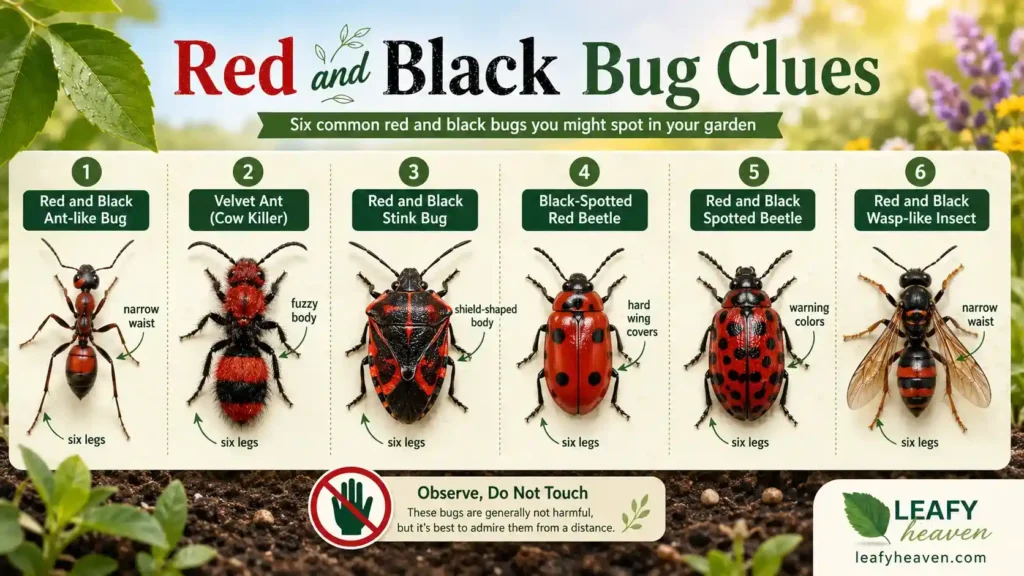
Red and black bugs may include ants, velvet ants, stink bugs, beetles, boxelder bugs, assassin bugs, or wasp-like insects. The best way to identify them is to compare body shape, leg count, wing type, antennae, texture, movement, and where the bug was found.
Red and black coloring is common in many insect groups, so it should not be used as the only identification clue. Some red and black bugs are harmless plant feeders, while others may bite, sting, or mimic more dangerous insects.
Look closely at the body outline. A narrow waist may suggest an ant or wasp-like insect. A shield-shaped back may suggest a stink bug. Hard wing covers may suggest a beetle. A fuzzy ant-like body may point toward a velvet ant, which is not a true ant.
Red and Black Ant-Like Bugs
A red and black ant-like bug may be an ant, velvet ant, wasp mimic, or beetle-like insect. The key clues are waist shape, antennae, body texture, wings, and whether the insect appears smooth, fuzzy, or armored.
A black and red ant usually has six legs, elbowed antennae, a narrow waist, and social behavior. True ants are often seen walking in trails, entering cracks, carrying food, or moving near soil, pavement, wood, kitchens, or garden beds.
A red ant with black stripe may still be a true ant, but the stripe pattern should be checked with body shape. Some ants have darker abdomens, reddish heads, or black bands. Color varies by species, age, and lighting, so structure matters more than shade.
A fuzzy red and black ant is often confused with a large ant, but it may be a velvet ant. Velvet ants are actually wingless wasps, not true ants. Females are usually wingless, hairy, and brightly colored, while males may have wings.
A red and black velvet ant should be observed carefully and not handled. Velvet ants can deliver a painful sting. Their bright colors often act as a warning signal, and their fuzzy body helps separate them from smooth-bodied ants.
A large black and orange ant-like insect may also be a velvet ant, wasp mimic, or beetle-like insect. Check whether it has hair, a narrow waist, strong legs, and ant-like movement. If it looks fuzzy and brightly colored, avoid touching it.
Quick identification clues:
- Elbowed antennae and trail behavior may suggest a true ant.
- Fuzzy red and black body may suggest a velvet ant.
- Narrow waist and wasp-like shape may suggest a wasp or mimic.
- Hard body and visible wing covers may suggest a beetle-like insect.
- Bright red, orange, and black coloring can be a warning sign.
- Unknown ant-like bugs should not be picked up by hand.
Red and Black Stink Bugs and Beetles
Red and black stink bugs and beetles can often be separated by body shape, wing covers, and shield-like appearance. A red and black stink bug usually has a broader, flatter body, while beetles often look harder, rounder, or more shell-like.
A stink bug body is often shield-shaped when viewed from above. The shoulders may look wide, and the body may form a pointed or triangular outline toward the rear. Red and black stink bug markings may appear as bands, patches, or contrasting edges across the back.
Beetles often have hard wing covers that meet in a straight line down the middle of the back. A black spotted red beetle may have rounded wing covers, visible antennae, and a firmer shell. Lady beetles and some plant beetles can show red bodies with black spots.
A red and black spotted beetle should be checked for body texture and movement. Beetles may crawl slowly on leaves, flowers, walls, windows, or stored products. Some are beneficial predators, while others may feed on plants, pantry goods, or organic material.
Red bugs with black spots may resemble lady beetles, plant bugs, or other small insects. Lady beetles are usually rounded and dome-shaped, while plant bugs and true bugs may look flatter or more angular. Wing position and body outline help separate them.
Use location as a supporting clue. A red and black bug on leaves may be a plant feeder or garden visitor. One near lights may be an accidental indoor insect. One inside stored dry food areas may need closer pantry pest identification.
Simple comparison block:
| Visible clue | More likely group | What to check next |
| Shield-shaped body | Stink bug or true bug | Flat back, wing pattern, plant location |
| Hard shell with center line | Beetle | Wing covers, antennae, crawling behavior |
| Red body with black spots | Lady beetle or plant beetle | Dome shape, size, plant activity |
| Flat body with red and black pattern | True bug | Piercing mouthparts, leaf feeding signs |
| Bright fuzzy body | Velvet ant | Hair, wingless body, sting caution |
| Narrow waist | Ant or wasp-like insect | Antennae, wings, trail behavior |
Color can help narrow the search, but body structure confirms the group. Always match red and black markings with wings, shape, antennae, legs, movement, and habitat before deciding whether the bug is a stink bug, beetle, ant, velvet ant, or wasp-like insect.
How to Identify Common Bug Groups
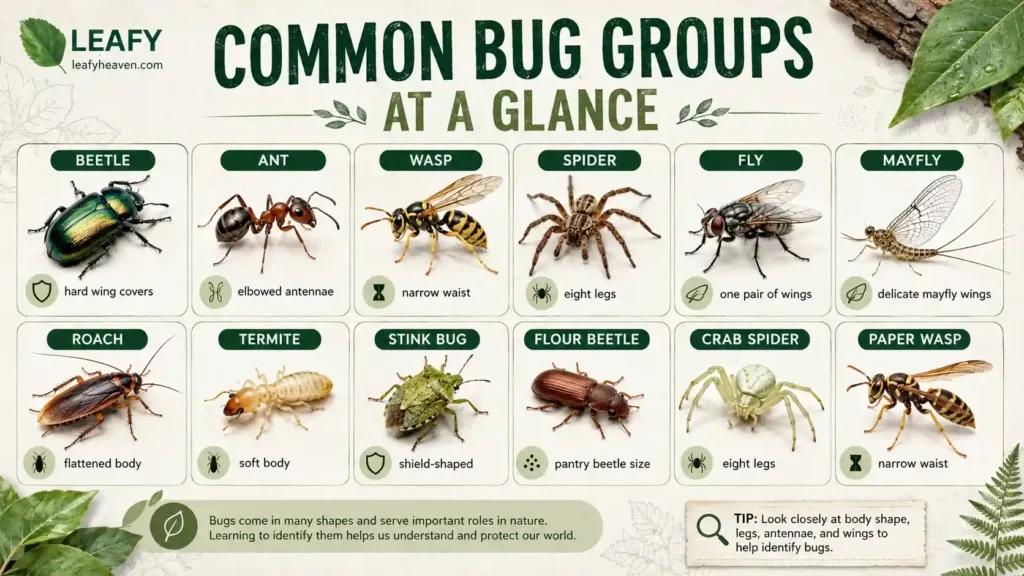
Most unknown bugs can be narrowed down by comparing them with common groups such as beetles, ants, wasps, flies, spiders, roaches, termites, and true bugs. Each group has a different combination of body shape, legs, antennae, wings, movement, mouthparts, and habitat clues.
This method is useful when color alone is not enough. A black and orange insect, red and black bug, tiny brown household bug, or flying insect near a window can belong to several groups. Comparing the bug with common categories helps you move from a broad guess to a more accurate identification.
Start with structure first. Check whether the bug has six legs or eight legs, hard wing covers or clear wings, a narrow waist or broad body, visible antennae or no antennae, and whether it was found in food, soil, wood, plants, lights, drains, or wall cracks.
How to Identify Beetles
Beetles usually have hard wing covers, chewing mouthparts, antennae, and a compact body. The hard back is one of the strongest beetle identification clues because beetles have protective wing covers that meet in a straight line down the middle.
A beetle may look oval, rounded, long, narrow, shiny, dull, striped, spotted, or dark colored. Beetles can be found in gardens, pantry products, stored grains, carpets, wood, flowers, soil, and around windows or lights.
Beetle vs roach identification depends on body shape and movement. Beetles often have harder shells and more visible wing covers, while roaches are usually flatter, faster, and have long antennae. Roaches also tend to hide in warm, dark, moist areas, especially kitchens and bathrooms.
Flour beetles are common pantry beetles that may appear in flour, cereal, grains, dry pet food, spices, and stored products. A confused flour beetle looks small, narrow, reddish brown, and flattened. It can be mistaken for other tiny pantry insects because of its size and color.
Red flour beetle size is usually about 3 to 4 millimeters long, which is close to one eighth of an inch. If someone asks how big is a flour beetle, the simple answer is that it is very small, narrow, and usually reddish brown, not large like many outdoor beetles.
Pantry beetles are often linked with stored food. Garden beetles are more often found on leaves, flowers, soil, compost, or tree bark. Location is an important clue because the same beetle like body shape can appear in both indoor and outdoor settings.
Useful beetle clues:
- Six legs and visible antennae.
- Hard wing covers on the back.
- Chewing mouthparts.
- Compact oval or elongated body.
- Slow crawling or short flight.
- Found in gardens, pantries, soil, flowers, wood, or stored products.
- May show stripes, spots, bands, or solid dark coloring.
How to Identify Ants
Ants usually have elbowed antennae, a narrow waist, six legs, and social trails or nesting behavior. The easiest way to identify ants is to look for body segments, repeated sightings, trails, food gathering, and entry points.
Tiny ants are often seen in kitchens, bathrooms, windowsills, sinks, wall cracks, baseboards, patios, and plant pots. They may be searching for sugar, grease, moisture, crumbs, or nesting sites. Their small size can make species level identification difficult without a clear close up photo.
Carpenter ants are usually larger than many common house ants and may be black, reddish black, or dark brown. Signs of carpenter ant infestation can include repeated sightings of large ants, piles of fine wood shavings, rustling sounds in wall voids, and activity near moist or damaged wood.
Ghost ants are tiny ants with pale legs and a darker head or thorax. They are often difficult to see because part of the body looks light or translucent. They may appear indoors around moisture, sweets, kitchens, bathrooms, and potted plants.
Harvester ants are usually outdoor ants that gather seeds and build nests in soil. If someone asks what do harvester ants look like, the basic answer is that they are often reddish, brownish, or dark ants with strong mandibles and visible outdoor foraging behavior.
Tiny ants in Florida may include several household ant types, including ghost ants and other small nuisance ants. Because many tiny ants look similar, identification should include body color, trail pattern, nesting location, food preference, and whether they appear indoors or outdoors.
Important ant identification clues:
- Six legs and elbowed antennae.
- Narrow waist between body sections.
- Social movement in trails or groups.
- Nesting behavior in soil, wood, walls, or cracks.
- Food gathering near sweets, grease, seeds, or crumbs.
- Carpenter ants may indicate moisture damaged wood.
- Very tiny ants often need close photo comparison.
How to Identify Wasps and Hornet-Like Bugs
Wasps usually have a narrow waist, wings, long antennae, and may sting when threatened. Their body shape is often more slender than flies or beetles, and many have smooth bodies with clear wings.
Paper wasps are commonly seen around eaves, fences, sheds, porches, garden structures, and open areas where they build paper like nests. Their legs may hang down during flight, and their bodies are usually long, narrow, and wasp shaped.
Can paper wasps sting? Yes, paper wasps can sting, especially if they are handled, trapped, or their nest is disturbed. They are not usually aggressive when left alone, but any wasp near a nest should be observed from a safe distance.
Mud daubers are wasp like insects that often build mud tube nests on walls, ceilings, garages, sheds, bridges, or sheltered surfaces. A wasp vs mud dauber comparison usually starts with the nest. Paper wasps build open paper combs, while mud daubers build mud cells or tubes.
Paper wasp nest identification depends on shape and material. Paper wasp nests often look like open umbrella shaped combs made from gray or brown paper like material. They may hang from a thin stalk under protected surfaces.
Pictures of wasps can help, but the photo should show the waist, wings, legs, antennae, and nest if present. Many flies and moths mimic wasps, so a clear image is better than color description alone.
Wasp identification checklist:
- Narrow waist and long body.
- Clear wings folded over the back or held out.
- Long antennae.
- Legs may hang during flight.
- Paper like or mud based nests may be nearby.
- Bright warning colors may include yellow, orange, red, black, or brown.
- Avoid touching unknown wasp like insects.
How to Identify Spiders and Spider-Like Bugs
Spiders have eight legs, no antennae, and two main body sections. This separates them from insects, which usually have six legs, antennae, and three main body parts.
Crab spiders often have a flattened body and front legs that spread outward like a crab. Are crab spiders poisonous? In common search language, people ask this often, but the better explanation is that crab spiders have venom for catching prey and most are not considered dangerous to humans.
Jumping spiders are compact spiders with strong front vision, quick jumping movement, and alert behavior. Do jumping spiders have venom? Yes, they have venom for prey, but most jumping spiders are not considered medically important to healthy humans.
Grass spiders often make sheet like webs in grass, shrubs, corners, or outdoor structures. Are grass spiders poisonous? They are venomous in the biological sense because they subdue prey, but they are generally not considered dangerous to humans.
Brown recluse lookalikes can include many harmless brown spiders. Do not identify a brown spider from color alone. Look for body shape, eye pattern when visible, leg texture, web type, location, and whether the spider matches known regional ranges.
Black widow traits include a shiny dark body, rounded abdomen, long legs, irregular web, and sometimes a red hourglass marking on the underside of the abdomen. Because markings can vary, avoid handling any unknown shiny black spider.
Spider and spider like bug clues:
- Eight legs and no antennae.
- Two main body sections.
- Web type can support identification.
- Round, flat, compact, or long abdomen shape matters.
- Jumping behavior may suggest jumping spiders.
- Sideways front legs may suggest crab spiders.
- Unknown spiders should be observed without direct contact.
How to Identify Flies and Mayflies
Flies often have one pair of wings, while mayflies have delicate wings, long tails, and short adult lifespans. Wing structure, body shape, resting posture, and location help separate flies, gnats, crane flies, and mayflies.
House flies usually have one main pair of wings, large eyes, short antennae, and quick movement. They are often found near food, trash, drains, doors, windows, animal waste, or decaying organic material.
Gnats are tiny fly like insects that may gather near drains, houseplants, damp soil, lights, or fruit. Some gnats are linked with moisture and organic buildup, while fungus gnats are often seen around overwatered indoor plants.
Mayflies are delicate flying insects often found near water, lights, windows, porches, and outdoor structures. They usually have upright wings, long tail like filaments, and fragile bodies. Adult mayflies live briefly and are not household pests in the usual sense.
Do mayflies bite? No, mayflies do not bite or sting humans. Search phrases like mayflies bite are common, but adult mayflies are not biting insects and are mostly a temporary nuisance when they gather near lights.
Crane flies are often called mosquito hawks, but they are not mosquitoes. Do mosquito hawks bite? No, crane flies do not bite humans like mosquitoes. Their long legs and fragile bodies make them look alarming, but they are generally harmless as adults.
Fly and mayfly identification clues:
- One pair of wings often suggests a fly.
- Large eyes and quick flight may suggest house flies.
- Tiny size near damp soil may suggest gnats.
- Upright wings and long tails may suggest mayflies.
- Long legs and delicate body may suggest crane flies.
- Mayflies and crane flies do not bite or sting humans.
- Location near water, drains, plants, lights, or food helps narrow the group.
Bug Identification by Location
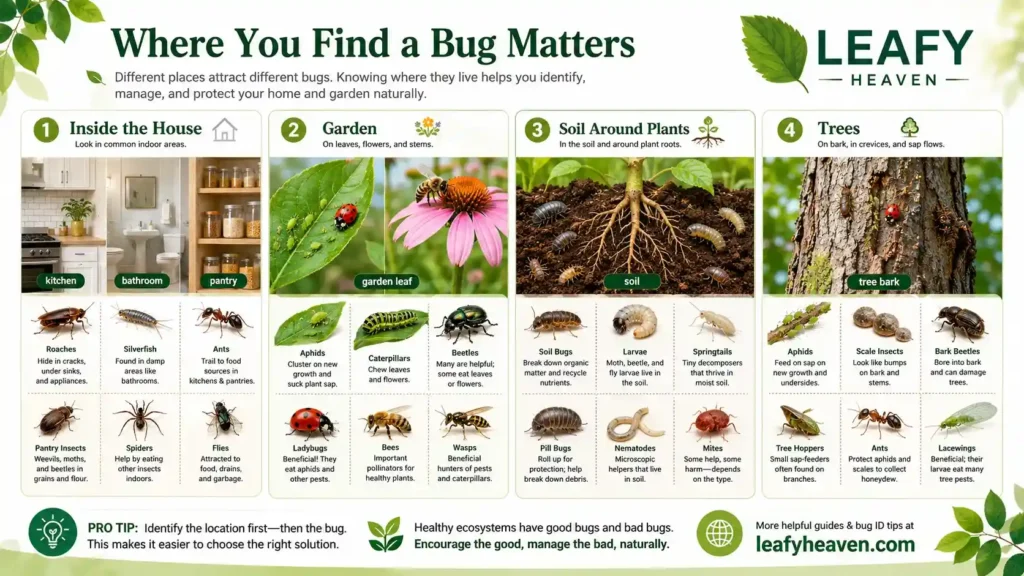
Where you find a bug often gives strong clues about what it is and why it is there. Location helps connect the bug with food, moisture, plants, soil, wood, light, stored products, or nesting areas.
A bug found in a kitchen may have a different reason for being there than one found in soil, on tree bark, near flowers, or around a bathroom drain. The same body color can appear in many insects, but habitat often narrows the identification.
Use location with visible features. Check the bug’s legs, body shape, wings, antennae, movement, and nearby signs before deciding whether it is a pantry insect, garden pest, ant, roach, spider, fly, beetle, or true bug.
Bugs Found Inside the House
Indoor bugs are often attracted to food, moisture, warmth, clutter, cracks, drains, or stored products. Common house bugs include pantry insects, roaches, silverfish, ants, spiders, flies, beetles, and occasional outdoor insects that enter by accident.
Pantry insects are usually found near flour, cereal, rice, grains, spices, dry pet food, nuts, and stored goods. Small beetles, moth larvae, and tiny crawling insects in cupboards often point toward stored product activity.
Roaches are usually linked with warmth, moisture, food scraps, grease, trash areas, wall cracks, appliances, and dark hiding spaces. A flat body, long antennae, fast movement, and night activity can help separate roaches from beetles.
Silverfish are tiny silver bugs with long antennae and a tapered body. They are often found in bathrooms, closets, basements, bookshelves, laundry rooms, and other damp or dark areas. Their movement is quick and fish like.
Ants inside the house usually appear in trails. They may enter through window gaps, door frames, wall cracks, plumbing openings, or baseboards. Their presence often connects to crumbs, sugar, grease, moisture, or nesting spaces.
Spiders inside the house are often found in corners, windows, basements, garages, closets, and quiet areas where prey insects appear. Eight legs, no antennae, webbing, and two main body sections help separate spiders from insects.
Flies inside the house may point to food waste, drains, open doors, garbage, fruit, pet waste, or decaying organic matter. A fly infestation in house situations usually means there is a breeding source or repeated entry point nearby.
A black and orange bug in house may be an outdoor insect that entered through a window, door, vent, or crack. Check whether it has hard wing covers, a shield shaped body, clear wings, or a narrow waist before identifying it.
Indoor location clues:
- Pantry shelves may suggest flour beetles, pantry moths, or stored product insects.
- Bathrooms and laundry rooms may suggest silverfish, drain flies, or moisture loving bugs.
- Kitchens may attract ants, roaches, flies, and pantry insects.
- Windows and lights may attract beetles, flies, stink bugs, and outdoor insects.
- Corners and closets may attract spiders and silverfish.
- Repeated sightings in one area may suggest a hidden source or infestation.
Bugs Found in the Garden
Garden bugs can be plant pests, predators, pollinators, decomposers, or harmless visitors. Not every insect in a garden is damaging, so identification should include both the bug and the plant condition. “Gardeners who want to protect their plants while encouraging beneficial insects can explore practical guides and seasonal advice through this comprehensive resource on gardening and plant care.”
Garden pests may chew leaves, suck sap, tunnel through stems, feed on roots, or damage flowers and fruit. Caterpillars, beetles, aphids, scale insects, leafhoppers, stink bugs, and some larvae are common plant related suspects.
Beneficial insects can help the garden by pollinating flowers, feeding on pests, breaking down organic matter, or improving soil activity. “Gardeners growing flowering plants in warm climates will find it especially useful to distinguish between beneficial pollinators and damaging pest insects before taking action.” Lady beetles, lacewings, bees, hoverflies, ground beetles, and many spiders can be helpful in garden ecosystems.
Leaf damage gives strong clues. Holes, ragged edges, skeletonized leaves, sticky residue, yellow speckling, curled leaves, webbing, and tunnels can point toward different insects in my garden.
Soil bugs may appear around mulch, compost, pots, garden beds, or damp soil. Some are decomposers, while others may be larvae, root feeders, ants, springtails, pill bugs, or fungus gnats.
Tree bugs may appear on bark, leaves, branches, flowers, fruit, or sap areas. Borers, beetles, aphids, scale insects, caterpillars, ants, and true bugs can all be connected with trees and shrubs.
Pictures of garden pests and pictures of garden bugs are most useful when the photo shows the insect, the damaged plant part, and the location. Garden pests identification pictures should include both the bug and the leaf, stem, soil, or fruit damage.
Garden location clues:
- Chewed leaves may suggest caterpillars, beetles, or grasshoppers.
- Sticky residue may suggest aphids, scale insects, or other sap feeders.
- Webbing may suggest spider mites, caterpillars, or spiders.
- Soil activity may suggest larvae, ants, springtails, pill bugs, or fungus gnats.
- Flower visits may suggest pollinators, beetles, flies, or wasps.
- Tree bark activity may suggest borers, ants, beetles, or scale insects.
Bugs Found in Soil or Around Plants
Soil bugs may include springtails, beetle larvae, ants, pill bugs, fungus gnats, termites, or decomposers. Soil bugs identification depends on size, movement, moisture level, body shape, and whether plant roots show damage.
Springtails are tiny moisture loving arthropods often found in damp soil, mulch, compost, and overwatered plant pots. They may jump when disturbed and are usually linked with high moisture and decaying organic material.
Beetle larvae often look like grubs with soft bodies, visible heads, and curved or worm like forms. Some larvae feed on roots, while others live in compost, soil, decaying wood, or organic matter.
Ants around plants may be nesting in soil or visiting because of honeydew from aphids and scale insects. Their presence alone does not always mean plant damage, but ant activity can point toward other sap feeding pests.
Pill bugs are small gray segmented decomposers that often live in damp soil, mulch, leaf litter, and under pots. They usually feed on decaying material, but they may nibble tender seedlings in very moist conditions.
Fungus gnats are small fly like insects often seen around damp potting soil. Their larvae live in moist growing media and may feed on fungi, organic matter, and sometimes tender roots.
Termites in soil or around wood should be identified carefully because they are linked with cellulose, wood, moisture, and hidden structural activity. Pale bodies, mud tubes, wood contact, and group activity can be important clues.
Soil insects pictures and names are most useful when they show the bug close up and the exact place it was found. Root feeding pests, moisture loving insects, and beneficial decomposers can look similar without location details.
Soil and plant area clues:
- Jumping tiny bugs in damp soil may suggest springtails.
- Small flies around pots may suggest fungus gnats.
- White grubs may suggest beetle larvae.
- Gray segmented bugs may suggest pill bugs.
- Ant trails may suggest nesting or honeydew feeding insects.
- Pale insects near wood and soil may need termite comparison.
- Root damage, wilting, or poor growth may suggest root feeding pests.
Bugs Found on Trees
Tree bugs may be borers, beetles, ants, aphids, scale insects, caterpillars, or true bugs feeding on bark, sap, or leaves. Tree insects identification should begin with where the bug appears on the tree.
Bugs on leaves may be chewing insects, sap feeders, caterpillars, beetles, aphids, leafhoppers, or true bugs. Leaf damage patterns help narrow the group. Holes, tunnels, yellow speckles, curled leaves, webbing, and sticky residue all point to different causes.
Bugs on bark may include ants, beetles, borers, scale insects, spiders, and true bugs. Some are only walking across the trunk, while others may be feeding, nesting, hiding, or using bark cracks as shelter.
Holes in wood can suggest borers, beetles, carpenter ants, or other insects connected with damaged wood. Small round holes, oval holes, exit holes, or galleries should be compared with sawdust signs and tree health.
Sawdust signs may point toward carpenter ants, wood boring beetles, or other insects working inside wood. Fine sawdust, coarse frass, or debris near bark, branches, or the base of the tree can help identify the type of activity.
Aphids and scale insects often feed on sap and may cause sticky honeydew, sooty mold, yellowing leaves, curled growth, or ant activity. “Choosing the right species for your garden can help minimize pest pressure — this guide to outdoor low maintenance plants includes varieties that tend to attract fewer problematic insects.” Ants on trees often visit honeydew producing insects rather than directly damaging the tree.
Tree bug identification becomes clearer when you connect the insect with the exact tree part. Leaves, bark, branches, roots, sap flow, holes, frass, and overall tree stress all provide useful evidence.
Tree location clues:
- Leaf holes may suggest caterpillars, beetles, or chewing insects.
- Sticky leaves may suggest aphids, scale insects, or other sap feeders.
- Bark holes may suggest borers or beetle activity.
- Sawdust near wood may suggest carpenter ants or wood boring insects.
- Ants on trunks may point toward aphids or scale insects.
- Webbing on branches may suggest mites, caterpillars, or spiders.
- Declining branches may need closer inspection for borers, disease, or stress.
Bug Identification by Eggs, Larvae, and Damage Signs
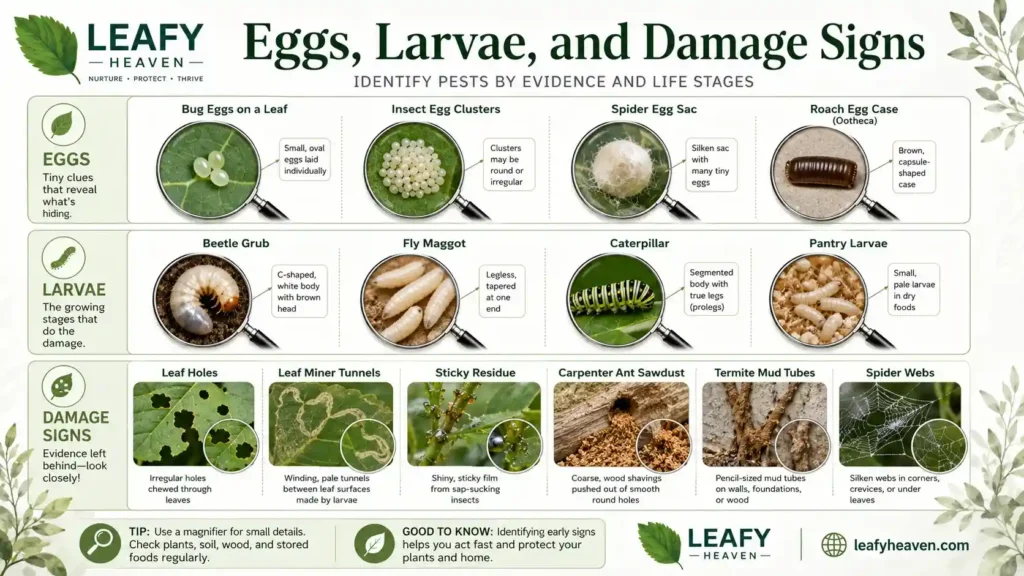
Eggs, larvae, shed skins, droppings, webs, nests, and plant damage can identify bugs even when the adult insect is not visible. These signs are useful because many insects hide during the day, move at night, or leave evidence before you see the actual bug.
Look at the shape, location, texture, and pattern of the evidence. Eggs may appear in clusters, larvae may live in food or soil, droppings may collect near hiding areas, and plant damage may show how the insect feeds.
This method is especially helpful for household pests, garden pests, pantry insects, tree insects, spiders, ants, roaches, termites, flies, and beetles. When the adult bug is missing, the surrounding signs become the strongest identification clues.
How to Identify Bug Eggs
Bug eggs may appear as clusters, sacs, capsules, tiny pearls, or hidden deposits on leaves, walls, soil, or fabric. To identify bug eggs, study their shape, color, placement, grouping pattern, and the surface where they were found.
Insect eggs can be round, oval, barrel shaped, flat, pointed, or capsule like. Some are laid in neat rows on leaves, while others are hidden in cracks, soil, fabric, wood, stored food, or protected corners.
Insect egg identification depends heavily on location. Eggs on the underside of leaves may belong to plant feeding insects, while eggs near stored food may point toward pantry pests. Eggs in soil may belong to beetles, flies, ants, termites, or other soil dwelling insects.
Insect egg case identification is also important. Roaches produce egg cases called oothecae, which look like small brown capsules. Some mantids also produce foamy egg cases, while certain moths and beetles place eggs directly near food sources.
Spider egg sacs are different from many insect eggs. A spider egg sac usually looks like a silk covered ball, pouch, or soft capsule. It may be attached to a web, hidden under furniture, placed in a corner, or carried by the spider.
Useful egg identification clues:
- Tiny round eggs on leaves may suggest garden insects.
- Barrel shaped egg clusters may suggest stink bugs or related true bugs.
- Brown capsule like cases may suggest roaches.
- Silk sacs may suggest spiders.
- Eggs near flour, grain, or dry food may suggest pantry insects.
- Eggs in soil may suggest beetles, flies, ants, termites, or decomposers.
- Hidden eggs in cracks or fabric need close inspection and context.
How to Identify Larvae
Larvae are immature stages that may look like worms, grubs, caterpillars, maggots, or tiny crawling forms. To identify larvae, check body shape, head visibility, legs, movement, food source, and where they were found.
Larvae do not always look like the adult insect. A beetle larva may look like a grub, a fly larva may look like a maggot, and a moth or butterfly larva may look like a caterpillar. This is why larvae identification should focus on form and habitat.
Household larvae identification often starts with location. Larvae found in pantry shelves may belong to pantry moths or stored product beetles. Larvae found near drains, trash, or decaying material may be linked with flies.
Garden larvae identification depends on plant damage and soil clues. Caterpillars may chew leaves, beetle grubs may feed near roots, and fly larvae may live in moist organic material. Larvae around roots may be more concerning when plants wilt or decline.
Pantry larvae are usually found in flour, cereal, rice, grains, nuts, dry pet food, or packaging seams. They may leave silk webbing, fine powder, shed skins, or clumped food particles. Their presence usually points to stored product insect activity.
Larvae vs nymphs is an important difference. Larvae often look very different from adults and go through a major transformation. Nymphs look more like smaller versions of adults and gradually develop wings or mature body features.
Quick larvae comparison:
| Larval form | Possible source | Common clue |
| Soft white grub | Beetle larva | Often in soil, compost, roots, or decaying material |
| Worm like maggot | Fly larva | Often near drains, trash, decay, or moist organic matter |
| Caterpillar form | Moth or butterfly larva | Often on leaves, stems, flowers, or vegetables |
| Tiny pantry larva | Pantry moth or beetle | Often in dry foods, packaging, flour, or grains |
| Small nymph | True bug, roach, or other insect | Looks like a smaller adult without full wings |
How to Read Leaf Damage
Leaf holes, chewed edges, skeletonized leaves, tunnels, sticky residue, and discoloration can help identify garden pests. Plant damage often shows how the insect feeds, even when the pest is hiding.
For insect leaves leaf damage identification, start by looking at the pattern. Chewing insects usually leave missing leaf tissue, while sap sucking insects often cause yellowing, speckling, curling, sticky residue, or weak new growth.
Chewing insects include caterpillars, beetles, grasshoppers, sawfly larvae, and some earwigs. They may leave round holes, ragged edges, skeletonized leaves, or large missing sections. Fresh chewing damage usually has cleaner edges than older damage.
Sap sucking insects include aphids, scale insects, whiteflies, leafhoppers, and some true bugs. They pierce plant tissue and remove sap. Their damage may appear as yellow spots, curled leaves, sticky honeydew, black sooty mold, or distorted growth.
Leaf miners create tunnels or winding trails inside leaves. Their damage often looks like pale lines, blotches, or squiggly paths between the leaf surfaces. The insect itself may be hidden inside the leaf tissue.
Caterpillar and beetle damage can look similar because both may chew leaves. Caterpillars often leave droppings near feeding areas, while beetles may create holes, notches, or skeletonized patches depending on the species.
Leaf damage guide:
| Damage sign | Possible pest group | What it usually means |
| Round holes | Caterpillars or beetles | Chewing damage |
| Ragged edges | Grasshoppers, beetles, caterpillars | Leaf tissue is being eaten |
| Skeletonized leaves | Beetles or caterpillars | Soft leaf tissue removed between veins |
| Sticky residue | Aphids, scale, whiteflies | Sap feeding and honeydew |
| Pale tunnels | Leaf miners | Larvae feeding inside leaves |
| Yellow speckling | Mites, leafhoppers, sap feeders | Piercing and sap removal |
| Curled leaves | Aphids, thrips, plant bugs | Feeding on young growth |
How to Use Droppings and Nest Clues
Bug droppings, sawdust, mud tubes, silk webs, egg sacs, and shed skins can point to the pest group. These signs are often found near hiding places, feeding areas, entry points, nests, or damaged materials.
Carpenter ant sawdust usually appears as small piles of wood shavings, also called frass. It may collect near baseboards, window frames, wall voids, tree trunks, damp wood, or damaged structural wood. This sign suggests tunneling activity rather than direct wood eating.
Termite mud tubes are narrow soil like tunnels used by termites to move between soil and wood while staying protected. They may appear on foundations, walls, crawl spaces, beams, or other wood connected areas. Mud tubes are stronger evidence of termite activity than seeing one random flying insect.
Roach droppings may look like black pepper, coffee grounds, dark smears, or small pellets depending on the species and size. They are often found in cabinets, drawers, behind appliances, under sinks, near trash, or along wall edges.
Spider webs can help identify spider activity, but web shape matters. Cobwebs, sheet webs, funnel webs, orb webs, and irregular webs can point toward different spider groups. Egg sacs near webs are another useful clue.
Fly larvae sites usually involve moisture, decay, drains, trash, food residue, animal waste, or organic buildup. If many flies appear indoors, the source may be hidden nearby. A fly infestation in house conditions often starts where larvae have enough food and moisture.
Shed skins are also important. Roach nymphs, bed bug nymphs, beetle larvae, spiders, and other arthropods may leave molts as they grow. Shed skins near cracks, bedding, pantry shelves, or plant areas can support identification.
Evidence checklist:
- Fine wood shavings may suggest carpenter ants or wood boring insects.
- Mud tubes may suggest termite activity.
- Pepper like droppings may suggest roaches.
- Silk webs and egg sacs may suggest spiders.
- Larvae near drains, trash, or decay may suggest flies.
- Shed skins may suggest growing nymphs, larvae, spiders, or roaches.
- Repeated evidence in one area is more important than one isolated sign.
Quick Bug Identification Table
A comparison table helps readers quickly match a bug’s visible clues with the most likely group. This is useful when you have only a quick photo, a short sighting, or basic details such as color, legs, wings, body shape, and location.
Use the table as a first identification filter, not a final species diagnosis. The most accurate result comes from matching several clues together, including body structure, movement, habitat, and any damage signs nearby.
| Visible clue | Possible bug group | Key features | Where it is found | Safety note |
| Six legs and hard shell | Beetle | Hard wing covers, antennae, compact body, chewing mouthparts | Gardens, windowsills, pantry shelves, soil, flowers, stored products | Most are not dangerous, but avoid handling unknown beetles directly |
| Eight legs and no antennae | Spider | Two main body sections, eight legs, no antennae, may have webs | Corners, basements, gardens, garages, windows, plants | Do not touch unknown spiders, especially shiny black or brown lookalikes |
| Narrow waist and wings | Wasp | Slender body, clear wings, long antennae, narrow waist | Eaves, fences, sheds, gardens, porch ceilings, nests | Can sting when threatened or when the nest is disturbed |
| Shield-shaped body | Stink bug | Broad shield-like back, flat body, patterned wings, piercing mouthparts | Plants, windows, walls, gardens, trees, lights | Usually not dangerous, but may release an odor when disturbed |
| Tiny silver body | Silverfish or springtail | Silverfish are flat and fast; springtails are tiny and may jump | Bathrooms, basements, damp rooms, soil, mulch, plant pots | Usually moisture related; avoid assuming infestation from one sighting |
| Fuzzy red and black ant-like body | Velvet ant | Hairy body, bright red and black color, ant-like movement, wingless female | Lawns, sandy soil, dry ground, open outdoor areas | Do not handle because velvet ants are wingless wasps and can sting |
| Black and orange winged body | Beetle, true bug, wasp, or fly | May have hard wing covers, clear wings, narrow waist, or shield-shaped body | Gardens, flowers, walls, lights, trees, windows, outdoor structures | Identify from a distance because some wasp-like insects can sting |
| Small ants in kitchen | House ants, ghost ants, odorous ants | Tiny body, six legs, elbowed antennae, trails, food-seeking behavior | Kitchens, sinks, counters, baseboards, windows, wall cracks | Repeated trails may indicate a nest or entry point |
| Pantry beetle | Flour beetle or stored-product pest | Very small beetle, reddish brown or dark body, hard shell, found near dry foods | Flour, cereal, grains, rice, dry pet food, spices, pantry shelves | Check stored products and packaging for larvae, eggs, or more insects |
This table helps narrow bug identification quickly, but it should be used with close observation. A black and orange bug, red and black bug, tiny silver bug, pantry beetle, or small ant can look different depending on age, lighting, and movement.
For better accuracy, compare the visible clue with the bug’s exact location. A beetle in flour, a spider in a web, a wasp near a nest, and tiny ants in a kitchen all give different context clues that improve identification.
When a Bug May Be Dangerous
A bug may require caution if it can sting, bite, trigger allergies, damage property, contaminate food, or indicate infestation. Most bugs are not dangerous to people, but some should be observed carefully instead of touched, crushed, or handled.
Danger signs are usually linked with behavior, location, body structure, and repeated evidence. A single outdoor insect may be harmless, while many insects in food, wood, walls, drains, or bedding can point to a larger issue.
Use caution when a bug has a stinger, strong jaws, bright warning colors, hidden nest activity, repeated indoor sightings, droppings, larvae, egg cases, mud tubes, or wood dust. These clues help separate harmless visitors from insects that need closer attention.
Stinging Bugs
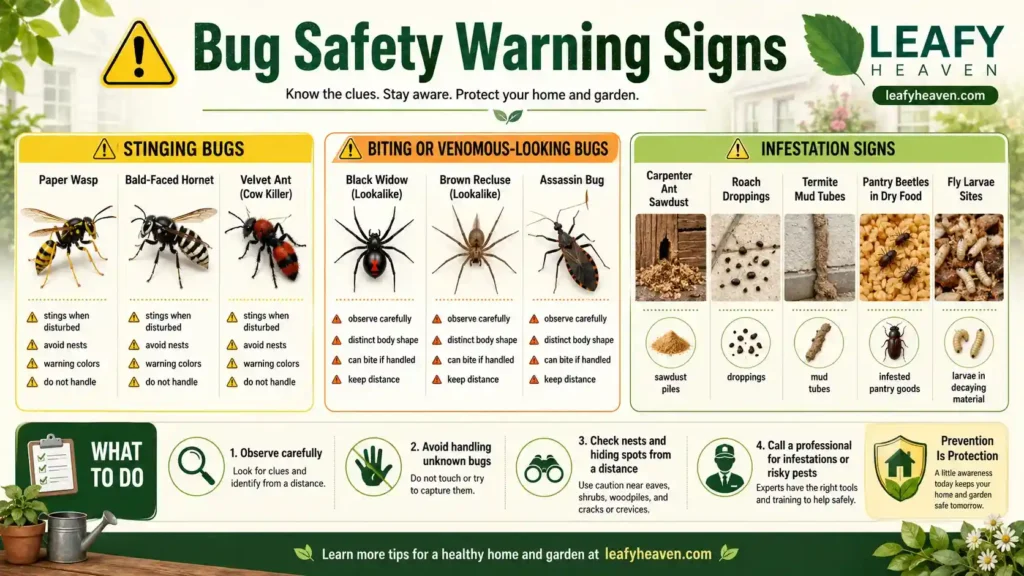
Wasps, hornets, bees, velvet ants, and some ant species can sting and should not be handled. These insects may sting when trapped, squeezed, stepped on, or when their nest is disturbed.
Paper wasps are common stinging insects with narrow waists, long legs, clear wings, and paper like nests. They are often seen around eaves, fences, porch ceilings, sheds, and garden structures. They usually avoid people when left alone, but they can defend their nest.
White faced hornets, also called bald faced hornets, are black and white wasp relatives that can be defensive near their nests. Their nests are often gray, papery, and enclosed. Any hornet like insect near a nest should be observed from a safe distance.
Velvet ants look like fuzzy red and black ants, but they are wingless wasps. A red and black velvet ant can deliver a painful sting, so it should not be picked up by hand. Its bright coloring is an important warning clue.
Africanized bees look very similar to other honey bees, so they cannot be reliably identified by casual appearance alone. The main safety concern is defensive behavior, especially when many bees respond around a hive or nesting site.
Stinging bug safety clues:
- Narrow waist and clear wings may suggest a wasp.
- Paper like nests may suggest paper wasps or hornet related insects.
- Fuzzy red and black ant like bodies may suggest velvet ants.
- Large numbers of defensive bees require caution.
- Do not touch, trap, or disturb unknown stinging insects.
- Take photos from a safe distance when identification is needed.
Biting or Venomous-Looking Bugs
Some spiders, ants, kissing bugs, assassin bugs, fleas, ticks, and biting flies may bite or cause skin reactions. A bug does not need to be highly dangerous to cause irritation, swelling, itching, or discomfort.
Brown recluse lookalikes are common because many brown spiders have similar coloring. Do not identify a brown spider by color alone. Body shape, eye pattern, leg texture, web type, location, and regional presence are more reliable clues.
Black widow traits include a shiny dark body, rounded abdomen, long legs, irregular web, and sometimes a red hourglass marking under the abdomen. Because markings can vary, any unknown shiny black spider should be left alone.
Assassin bugs have piercing mouthparts and some species can bite if handled. They may look narrow, long legged, or patterned, and some can resemble other true bugs. Avoid picking up unknown bugs with a long beak like mouthpart.
Jumping spiders have venom for catching prey, but most are not considered dangerous to healthy humans. They are usually compact, alert, and quick moving, with strong front vision and short jumping behavior.
Grass spiders also have venom for prey, but they are generally not considered dangerous to people. They often make sheet like webs in grass, shrubs, corners, or outdoor structures. Their fast movement can make them look more alarming than they are.
Bite caution checklist:
- Eight legs and no antennae usually suggest a spider.
- Shiny black spiders should not be handled.
- Brown spiders should not be identified by color alone.
- Bugs with piercing beak like mouthparts should be left untouched.
- Ticks and fleas may bite and should be identified carefully.
- Biting flies may appear near animals, water, waste, or outdoor activity.
- Skin reactions can vary by person, even from minor bites.
Infestation Signs
Repeated sightings, droppings, egg cases, larvae, wall void activity, wood dust, and food contamination may signal an infestation. One bug does not always mean a problem, but repeated evidence in the same area should be taken seriously.
What is a sign of possible insect infestation? Common signs include multiple insects in one location, new droppings, shed skins, egg cases, larvae, damaged food packaging, wood shavings, mud tubes, unusual odors, or insects appearing daily.
Carpenter ant infestation signs may include large ants indoors, fine wood dust, rustling sounds in walls, activity near damp wood, or ants entering through cracks. Carpenter ants tunnel in wood and are often linked with moisture damaged areas.
A fly infestation may involve many adult flies, larvae near drains or trash, recurring flies around food waste, or flies appearing soon after cleaning. The main clue is usually a hidden breeding source with moisture and organic material.
Pantry beetles and stored product pests often appear near flour, cereal, rice, grains, spices, nuts, dry pet food, or packaging seams. Signs may include tiny beetles, larvae, webbing, powder, clumped food, or small insects inside containers.
Roach nymphs are young roaches and usually suggest active reproduction nearby. They may appear as small versions of adults and are often found in kitchens, bathrooms, cabinets, appliances, cracks, and warm hidden spaces.
Termite signs may include mud tubes, damaged wood, hollow sounding areas, discarded wings, pale insects, or activity around soil and wood contact points. Termite evidence should be treated as a serious structural clue, not just a random bug sighting.
Infestation warning signs:
- Repeated sightings in the same room.
- Droppings near food, cabinets, appliances, or cracks.
- Egg cases, larvae, or shed skins.
- Wood dust, frass, or hollow sounding wood.
- Mud tubes near foundations or wood.
- Food contamination in pantry items.
- Insects appearing from drains, walls, vents, or hidden gaps.
How to Take a Clear Picture for Bug Identification
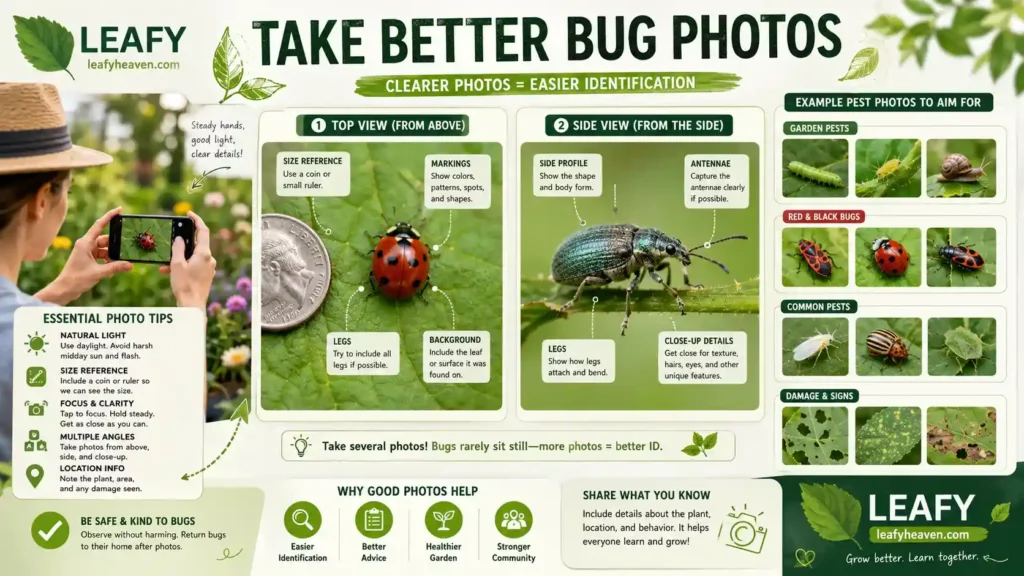
A clear photo should show the bug’s top view, side view, size reference, legs, antennae, wings, and markings. Good pictures make bug identification more accurate because many insects look similar in color but differ in body shape, wing type, and small markings.
Use natural light whenever possible. Bright daylight helps show the real color pattern, body texture, stripes, spots, wing markings, and antennae without strong shadows or artificial color changes.
Avoid crushing the bug before photographing it. A damaged insect may lose important identification features such as leg position, wing shape, body outline, antennae, and markings. If the bug is alive and safe to observe, photograph it from a careful distance.
Place a coin, ruler, pencil tip, or other small size reference near the bug. Size helps separate tiny ants, pantry beetles, roach nymphs, spiders, stink bugs, wasps, and other common household or garden insects.
Take multiple angles instead of one blurry image. A top view shows body shape and markings, while a side view can show height, legs, wings, waist shape, and antennae. A close photo of the head or wings can also improve identification.
Capture where the bug was found. A photo of the surrounding area helps explain whether the insect was on a leaf, in soil, near stored food, inside a bathroom, on tree bark, near a nest, around lights, or close to damaged wood.
For pictures of garden pests, include the plant damage in the same set of photos. Garden pest photos should show the bug, the leaf holes, sticky residue, webbing, tunnels, eggs, larvae, or damaged stems so the feeding pattern is easier to understand.
For pest pictures inside the house, show the bug and the nearby clue. This may include pantry packaging, droppings, shed skins, egg cases, drain areas, window sills, baseboards, or moisture spots.
For red and black bug identification pictures, make sure the red and black markings are visible and not blurred. Take one photo from above, one from the side, and one with a size reference so the bug can be compared with ants, beetles, stink bugs, velvet ants, or wasp-like insects.
Quick photo checklist:
- Use natural light for accurate color.
- Keep the bug intact before taking pictures.
- Add a coin or ruler for size.
- Take top, side, and close-up photos.
- Capture legs, antennae, wings, and markings.
- Photograph the place where the bug was found.
- Include plant damage when taking pictures of garden bugs.
- Avoid touching unknown stinging, biting, or venomous-looking insects.
Best Tools for Bug Identification
Bug identification works best with photos, field guides, extension resources, insect keys, and careful observation notes. These tools help you compare visible features instead of guessing from color, fear, or one quick sighting.
A clear photo gives the first evidence. A field guide or trusted insect resource helps compare body shape, wings, antennae, legs, markings, habitat, and behavior. Observation notes add context, such as where the bug was found and whether there were eggs, larvae, droppings, webs, or plant damage nearby.
The best approach is to use more than one tool. A photo may show color and shape, but notes about location, movement, size, and damage signs often make the identification more accurate.
Use a Simple Identification Checklist
A checklist prevents misidentification by making the user compare physical and behavioral clues in order. It is especially helpful for black and orange bugs, red and black bugs, tiny house insects, garden pests, pantry beetles, spiders, ants, wasps, and unknown flying insects.
Use this checklist before deciding what the bug is:
- Number of legs: Six legs usually suggest an insect, eight legs suggest a spider, tick, or mite, and many legs may suggest a centipede or millipede.
- Number and type of wings: Hard wing covers may suggest a beetle, clear wings may suggest a fly or wasp, and delicate upright wings may suggest a mayfly.
- Body shape: Oval bodies may suggest beetles or roaches, shield-shaped bodies may suggest stink bugs, and narrow waists may suggest ants or wasps.
- Color and markings: Look for black and orange markings, red and black patterns, white spots, stripes, bands, wing marks, or unusual patches.
- Antennae type: Elbowed antennae often suggest ants, long threadlike antennae may suggest roaches or beetles, and no antennae usually suggests a spider-like arthropod.
- Size: Use a coin, ruler, or fingertip comparison to separate tiny ants, flour beetles, roach nymphs, wasps, spiders, stink bugs, and larger beetles.
- Location: Note whether the bug was found in a kitchen, bathroom, garden, soil, tree bark, pantry, drain, window, wall crack, or near lights.
- Behavior: Watch whether it crawls slowly, jumps, flies directly, moves in trails, hides quickly, gathers in groups, or stays near a nest.
- Damage signs: Check for leaf holes, sticky residue, chewed edges, wood dust, mud tubes, droppings, food damage, or webbing.
- Egg, larva, or droppings evidence: Look for egg clusters, silk sacs, brown egg cases, larvae, shed skins, roach droppings, carpenter ant sawdust, or fly larvae sites.
This checklist works because bug identification is rarely based on one clue. The more features that match, the more reliable the identification becomes.
Use a Dichotomous Key for Common Insects
A dichotomous key identifies insects through paired yes-or-no feature choices. It guides the user through simple questions, such as whether the bug has six legs, wings, hard wing covers, a narrow waist, or piercing mouthparts.
A dichotomous key for common insects is useful for structured identification because it removes guesswork. Instead of starting with color, it starts with physical traits that separate major groups, such as beetles, flies, ants, wasps, true bugs, roaches, termites, and mayflies.
For beginners, the best way to use a dichotomous key is to answer only what is clearly visible. If the bug is too small or the photo is blurry, take another picture before choosing an answer. Wrong answers early in the key can lead to the wrong insect group.
A simple key may work like this:
- Does it have six legs? If yes, it may be an insect.
- Does it have eight legs? If yes, it may be a spider, tick, or mite.
- Does it have hard wing covers? If yes, it may be a beetle.
- Does it have a narrow waist and clear wings? If yes, it may be a wasp.
- Does it have a shield-shaped body? If yes, it may be a stink bug or true bug.
- Does it have one pair of wings and large eyes? If yes, it may be a fly.
A dichotomous key is best when the goal is careful, step-by-step identification. It is not always needed for a quick first match, but it is helpful when two bugs look similar, such as beetle vs roach, termite vs winged ant, stink bug vs assassin bug, or fly vs wasp mimic.
Common Mistakes in Bug Identification
Most bug identification mistakes happen when users rely only on color, fear-based assumptions, or one blurry photo. A bug’s color can be useful, but accurate identification needs body shape, legs, wings, antennae, location, behavior, and damage signs.
One common mistake is assuming every black and orange bug is the same species. Black and orange markings can appear on beetles, true bugs, wasps, boxelder bugs, assassin bugs, moths, and other garden insects. The same color pattern does not always mean the same insect group.
Another mistake is calling spiders insects. Spiders are arthropods, but they are not insects. Insects usually have six legs, three body parts, and antennae, while spiders have eight legs, two main body sections, and no antennae.
Beetles are also often confused with roaches. Beetles usually have harder wing covers and a more compact shell-like body. Roaches are usually flatter, faster, and have long antennae, especially when found in kitchens, bathrooms, or warm hidden spaces.
Termites and flying ants can look similar during swarming events. Flying ants usually have a narrow waist, elbowed antennae, and uneven wing pairs. Termites usually have a straighter body, straight antennae, and wings that are similar in length.
Harmless mayflies are sometimes confused with biting insects. Mayflies do not bite or sting humans. Their delicate wings, long tail-like filaments, and short adult lifespan separate them from mosquitoes, biting flies, and other nuisance insects.
Velvet ants are often mistaken for regular ants because females are wingless and ant-like. However, velvet ants are actually wingless wasps, not true ants. A fuzzy red and black ant-like insect should not be handled because it can sting.
Ignoring location and behavior is another major error. A beetle in flour, a fly near a drain, ants in a kitchen, a bug on tree bark, and insects gathering on garden leaves all provide important context.
Quick mistake checklist:
- Do not identify a bug by color alone.
- Do not assume every black and orange insect is the same species.
- Do not call spiders insects.
- Do not confuse hard-shelled beetles with fast-moving roaches.
- Do not identify termites and flying ants without checking waist, antennae, and wings.
- Do not assume mayflies bite.
- Do not pick up fuzzy red and black ant-like insects.
- Do not ignore where the bug was found or how it behaved.
Conclusion
The best way to identify a bug is to combine visual features, location, behavior, damage signs, and safety clues before deciding what it is. Start with the basics: count the legs, check the body shape, study the wings, compare antennae, observe movement, and note where the bug was found. Learning how to identify a bug starts with careful observation, not guessing from color alone.
A clear photo, size reference, and nearby evidence such as eggs, larvae, droppings, webs, leaf damage, wood dust, or food contamination can make identification more reliable. Unknown stinging, biting, or infestation related insects should always be handled carefully. Use the checklist and identification table before touching or removing any unknown bug.
References
- Purdue University Extension. Insect Anatomy.
- University of Minnesota Extension. What Insect Is This?
- University of Maryland Extension. Identifying Common Household Insect Pests.
- University of Maryland Extension. Social Wasps: Yellowjackets, Hornets, and Paper Wasps.
- Penn State Extension. Commonly Encountered Pennsylvania Spiders.
- Penn State Extension. Indicator Insects: Stoneflies and Mayflies.
- University of Minnesota Extension. Carpenter Ants.
- University of Minnesota Extension. Managing Insects on Indoor Plants.
- Purdue University Extension. A Pictorial Key to the Order of Adult Insects.
FAQs
How do I identify a bug I found in my house?
Start by checking the number of legs, body shape, wings, color, antennae, size, and where you found it. Indoor bug identification becomes easier when you connect the insect with its location, such as the kitchen, bathroom, pantry, windowsill, drain, closet, or basement. Six legs usually suggest an insect, while eight legs usually suggest a spider, tick, or mite. A bug near stored food may be a pantry pest, while one near moisture may be a silverfish, springtail, drain fly, or roach.
What is the difference between a bug and an insect?
An insect has six legs and three body parts, while “bug” is a broader common word people use for many small arthropods. Insects usually have a head, thorax, abdomen, antennae, and sometimes wings. Scientifically, a true bug belongs to the order Hemiptera and often has piercing and sucking mouthparts. In everyday language, people may call spiders, beetles, ants, roaches, silverfish, springtails, and centipedes bugs, even when they are not true bugs.
What are black and orange bugs?
Black and orange bugs can be beetles, true bugs, stink bugs, boxelder bugs, assassin bugs, wasps, or garden insects. Their color is useful, but it should not be the only identification clue. Check the body shape, wings, antennae, waist, movement, and location. A hard shell may suggest a beetle, a shield-shaped body may suggest a stink bug, and a narrow waist with clear wings may suggest a wasp-like insect.
How can I identify bug eggs?
Bug eggs are identified by shape, cluster pattern, location, color, and whether they are in sacs, capsules, rows, or hidden deposits. Eggs may appear on leaves, soil, fabric, walls, pantry items, cracks, or protected corners. Tiny round eggs may belong to garden insects, capsule-like cases may suggest roaches, and silk-covered sacs usually suggest spiders. For accurate insect egg identification, always compare the egg shape with the surface where it was found.
Do mayflies bite?
Mayflies do not bite or sting humans; they are usually short-lived flying insects found near water. Adult mayflies often appear around lights, windows, porches, rivers, ponds, and lakes. They are commonly mistaken for biting insects because they gather in large numbers. However, adult mayflies have delicate wings, long tail-like filaments, and no biting behavior toward people.
Are crab spiders poisonous?
Crab spiders have venom for prey, but most are not considered dangerous to humans. They use venom to subdue small insects, not to harm people in normal situations. A crab spider can usually be recognized by its sideways leg position and crab-like stance. Most are found on flowers, leaves, shrubs, or garden plants where they wait for prey.
How do I identify garden pests from leaf damage?
Leaf holes, tunnels, sticky residue, webbing, yellowing, and chewed edges can help identify the type of garden pest. Different feeding patterns point to different insect groups. Chewed edges may suggest caterpillars, beetles, or grasshoppers. Sticky residue may suggest aphids, scale insects, or whiteflies. Pale tunnels inside leaves often point to leaf miners, while fine webbing may suggest mites or caterpillar activity.
When should I worry about a bug infestation?
Repeated sightings, droppings, egg cases, larvae, damaged wood, food contamination, or many bugs in one area may suggest infestation. One random bug may not be serious, but repeated evidence in the same place should be checked carefully. Important warning signs include roach nymphs, pantry beetles in dry food, fly larvae near drains or trash, carpenter ant sawdust, termite mud tubes, shed skins, and insects appearing from cracks, walls, vents, or hidden gaps.

Written by the LeafyHeaven Editorial Team
LeafyHeaven shares practical gardening tips and simple plant care guides to help you grow, nurture, and enjoy your plants with ease. Our goal is to make gardening feel natural, approachable, and rewarding for everyone.