
Introduction
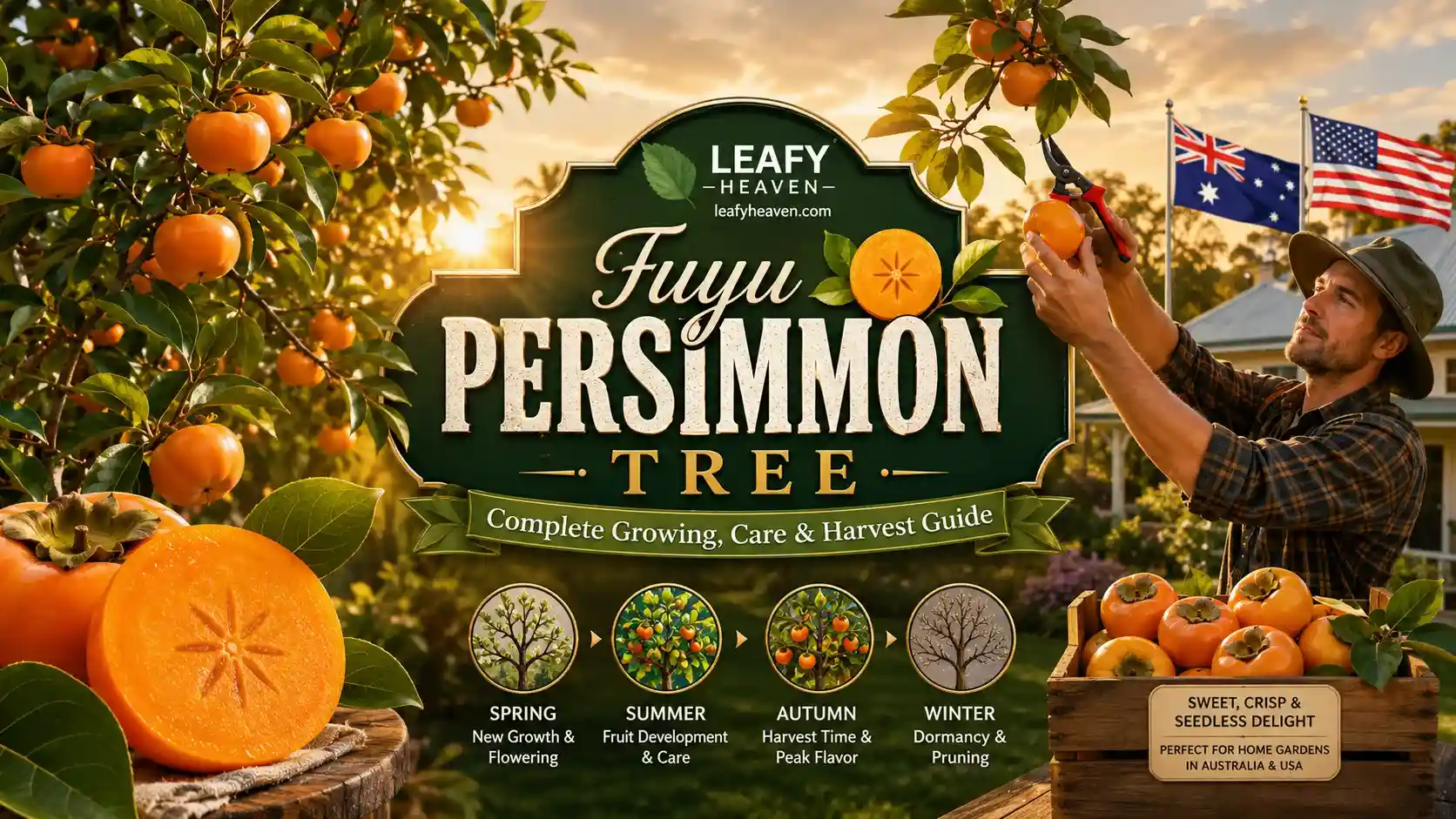
A fuyu persimmon tree is a popular non-astringent Japanese persimmon grown for its sweet, crisp, orange fruit that can be enjoyed while still firm or allowed to soften slightly before eating. Unlike many traditional persimmon varieties, Fuyu fruit does not develop the strong mouth-puckering taste associated with unripe astringent persimmons, making it one of the easiest types for home gardeners to enjoy.
The fuyu persimmon tree is especially well suited to Australian home gardens because it adapts to a wide range of temperate and subtropical climates, produces attractive autumn foliage, and requires relatively low maintenance once established. It is also widely grown across suitable regions of the USA, where gardeners value its reliable fruit production and ornamental appeal.
Whether you are interested in growing a productive persimmon fruit tree, learning more about persimmon Australia growing conditions, or comparing Fuyu with other Japanese persimmon varieties, this guide covers everything you need to know. Its sweet flavour, attractive appearance, and beginner-friendly nature make the Fuyu persimmon one of the most rewarding fruit trees for home landscapes.
Quick Facts About Fuyu Persimmon Tree
Fuyu is a compact, deciduous Asian persimmon tree valued for its sweet fruit, colourful autumn foliage, and relatively low-maintenance growing requirements. For gardeners wondering what is Fuyu persimmon or what is Fuyu fruit, it is one of the most popular non-astringent persimmon varieties grown for fresh eating.
| Feature | Details |
| Botanical Name | Diospyros kaki ‘Fuyu’ |
| Common Names | Fuyu persimmon, Japanese persimmon, Asian persimmon, kaki fruit tree |
| Plant Type | Deciduous fruit tree |
| Fruit Type | Non-astringent persimmon |
| Fruit Shape | Flat, tomato-like persimmon |
| Fruit Colour | Bright orange |
| Best Use | Fresh eating, salads, desserts |
| Main Season (Australia) | Autumn to early winter |
| Main Season (USA) | Fall to early winter |
| Sun Requirements | Full sun |
| Soil Requirements | Well-drained, fertile soil |
| Mature Size | Small to medium-sized fruit tree |
| Growing Habit | Upright, spreading canopy |
The Fuyu persimmon is a popular persimmon type of fruit known for its sweet flavour and ability to be eaten while still firm.
Gardeners building a diverse home orchard can explore other tropical fruit trees suited to similar warm-climate growing conditions across Australia and the USA.
As an Asian persimmon tree and Japanese persimmon tree, it is widely grown in home gardens and orchards because of its reliable harvests, attractive appearance, and excellent fruit quality.
What Is a Fuyu Persimmon Tree?
A Fuyu persimmon tree is a Japanese persimmon cultivar that produces sweet, firm, orange fruit without the strong astringency found in Hachiya persimmons. It belongs to the species Diospyros kaki and is one of the most widely grown persimmon varieties for home gardens and commercial orchards.
The persimmon Fuyu is classified as a non-astringent persimmon, which means the fruit can be eaten while still crisp and firm. Unlike astringent varieties that require full softening before they become pleasant to eat, Fuyu persimmons develop sweetness early and can be enjoyed much like an apple.
One of the main differences between Fuyu persimmon fruit and soft astringent persimmons is texture. Fuyu fruit remains firm when ripe, while varieties such as Hachiya must become very soft and jelly-like before their bitterness disappears. This makes Fuyu a more convenient option for fresh eating and beginner gardeners.
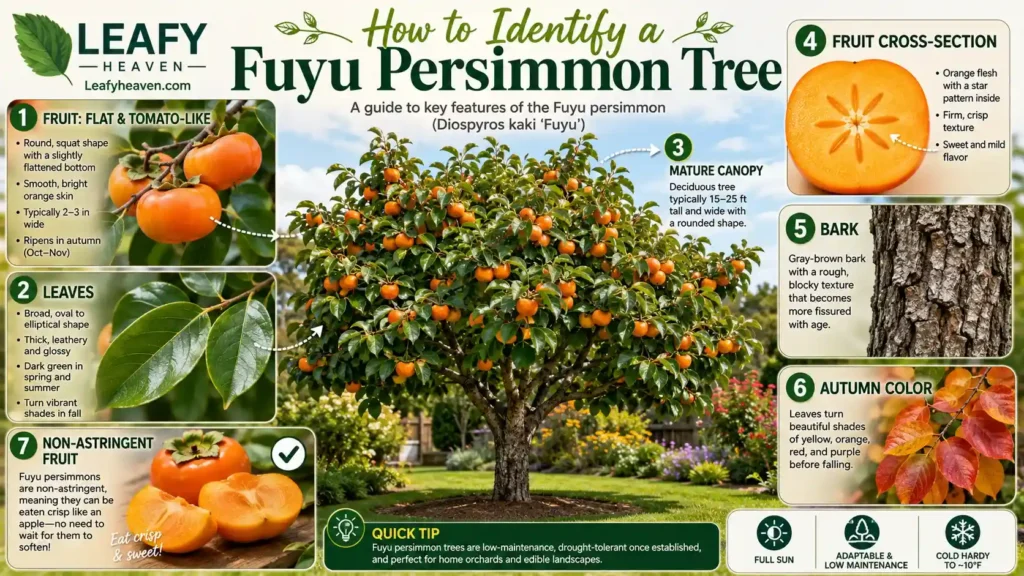
The fuyu persimmon fruit is easily recognized by its flattened, tomato-like shape and bright orange skin. The flesh is dense, crisp, and juicy when firm, becoming softer and sweeter as it matures further. Many gardeners appreciate the mild honey-like flavour and balanced sweetness that define the classic Fuyu persimmon taste.
Fuyu persimmons are also valued for their attractive appearance throughout the growing season. The fruit develops from green to deep orange as it ripens, while the tree produces colourful autumn foliage before leaf drop. This combination of ornamental beauty and productive harvests has helped make persimmon fruit Fuyu one of the most popular Asian persimmon varieties grown today.
Key characteristics of Fuyu persimmons include:
- Non-astringent fruit that can be eaten firm
- Sweet, mild flavour with low bitterness
- Flat, rounded fruit shape
- Bright orange persimmon colour at maturity
- Crisp texture similar to an apple when freshly harvested
- Suitable for fresh eating, salads, and desserts
Because of its easy-to-eat fruit, attractive appearance, and dependable production, the Fuyu persimmon remains one of the most recommended Japanese persimmon cultivars for both Australian and USA home gardens.
Fuyu Persimmon Tree in Australia
Fuyu persimmon trees grow well in many parts of Australia where winters are cool enough and summers are sunny, especially in suitable temperate and subtropical fruit-growing regions. Their adaptability, attractive appearance, and reliable fruit production have made them a popular choice for home gardeners looking to grow a productive persimmon tree.
The success of persimmon Australia cultivation largely depends on climate, sunlight, and soil drainage. As an Australian persimmon variety commonly planted in backyards and orchards, Fuyu performs best in locations that provide full sun and a period of winter dormancy.
Suitable Growing Regions in Australia
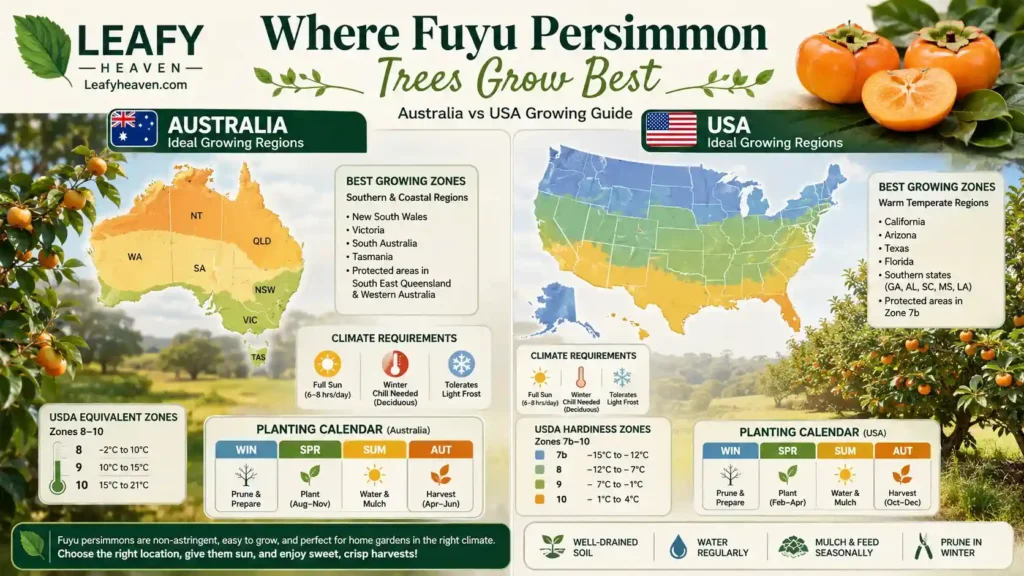
Many areas across Australia provide favourable conditions for Fuyu persimmon production, including:
- New South Wales (NSW)
- Victoria
- South East Queensland
- South Australia
- South West Western Australia
- Tasmania
Gardeners looking for a persimmon tree Australia can grow successfully will generally achieve the best results in regions with warm summers and cool winters. Trees may also perform well in selected subtropical areas when given adequate sunlight and proper care.
Best Time to Plant in Australia
The ideal time to plant Fuyu persimmon trees Australia-wide is during late autumn through winter while the tree is dormant.
Planting during dormancy offers several benefits:
- Reduces transplant stress
- Encourages strong root establishment
- Allows roots to develop before spring growth begins
- Improves early-season moisture uptake
This timing is especially important for bare-root trees and newly purchased nursery stock, including a dwarf persimmon tree intended for smaller gardens or containers.
Why Good Drainage Matters
One of the most important factors for growing healthy persimmon in Australia is soil drainage. Although Fuyu trees appreciate consistent moisture, they do not tolerate waterlogged conditions.
Poor drainage can lead to:
- Root rot
- Reduced growth
- Leaf yellowing
- Weak fruit production
- Increased disease risk
Before planting, improve heavy clay soils with organic matter and select a position where excess water can drain away naturally. Raised beds can also help in areas prone to winter wetness.
Australian Growing Considerations
Australian gardeners should focus on:
- Planting in full sun
- Protecting young trees from strong winds
- Applying mulch to conserve moisture
- Watering deeply during hot summer periods
- Maintaining good soil drainage year-round
The persimmon season Australia generally occurs from autumn to early winter, making Fuyu an excellent fruit tree for extending harvests after many summer fruits have finished producing.
Whether growing a standard tree or a dwarf persimmon tree, Fuyu adapts well to Australian home gardens. It is commonly available through nurseries, garden centres, and retailers that stock fruit trees, including locations where gardeners search for options such as a Fuyu persimmon tree Bunnings alternative or specialty fruit-tree suppliers. In cooler regions such as Victoria, a persimmon tree Melbourne gardeners plant can produce reliable crops when positioned in a sunny, well-drained location.
Fuyu Persimmon Tree in the USA
In the USA, Fuyu persimmon trees are commonly grown in mild to warm regions with enough winter chill and protection from severe late frost. Their sweet, non-astringent fruit and relatively easy care requirements have made them one of the most popular Asian persimmon varieties for home gardens and backyard orchards.
The Fuyu persimmon growing zone generally includes many temperate and warm-climate areas where winters are not excessively harsh and growing seasons are long enough for fruit to mature properly. While local conditions can vary, successful cultivation depends on adequate sunlight, suitable temperatures, and proper site selection.
Where Fuyu Persimmons Grow Best
Fuyu persimmons perform particularly well in:
- California
- Florida
- Texas
- Georgia
- North Carolina
- South Carolina
- Other southern states
- Mild temperate regions with moderate winters
A persimmon tree California gardeners grow often benefits from long sunny seasons and warm autumn weather that helps fruit ripen fully. In eastern states, including areas where a persimmon tree Maryland gardeners may plant, selecting a protected location can help reduce weather-related stress.
Full Sun Requirements
For strong growth and reliable fruit production, Fuyu persimmon trees need full sun.
Ideally, trees should receive:
- At least 6–8 hours of direct sunlight daily
- Good air circulation
- Protection from heavily shaded locations
- Space for canopy development
Insufficient sunlight can reduce flowering, slow fruit ripening, and limit overall tree vigor.
Late Frost Considerations
Although Fuyu persimmon trees are relatively adaptable, late spring frosts can damage flowers and developing fruit.
Gardeners in cooler areas should:
- Avoid low-lying frost pockets
- Plant near sheltered locations when possible
- Choose sites with good air drainage
- Protect young trees during unusual cold events
The greatest risk usually occurs around bloom time when tender flowers and new growth are most vulnerable.
Understanding Growing Zones
The exact persimmon tree growing zone can vary depending on local climate conditions, elevation, and winter temperatures. Rather than relying solely on hardiness ratings, gardeners should consider their area’s overall growing environment.
Factors influencing success include:
- Winter minimum temperatures
- Length of growing season
- Spring frost frequency
- Summer heat accumulation
- Soil drainage quality
The Fuyu persimmon hardiness zone is generally suited to many mild and warm temperate regions, but local microclimates often play a significant role in long-term performance. Gardeners should use regional recommendations alongside USDA guidance when evaluating the best persimmon growing zone for their location.
With full sun, well-drained soil, and protection from severe late frosts, Fuyu persimmons can become productive and attractive fruit trees across many suitable parts of the United States.
Fuyu Persimmon Tree Size, Height & Growth Rate
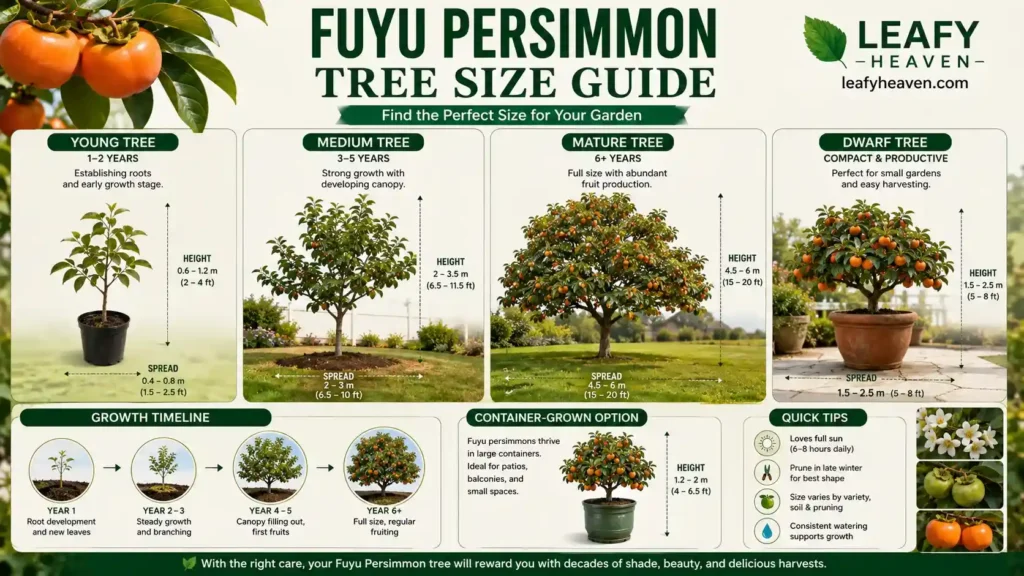
A full-grown Fuyu persimmon tree can become a medium-sized fruit tree, but pruning and dwarf rootstocks can keep it manageable for home gardens. Its moderate size, attractive canopy, and reliable fruit production make it suitable for both backyard orchards and smaller residential landscapes.
The exact Fuyu persimmon tree size depends on climate, soil quality, rootstock, and pruning practices. Trees grown in ideal conditions typically develop a rounded canopy and sturdy branch structure capable of supporting heavy fruit crops.
Standard Fuyu Persimmon Tree Size
A standard full grown Fuyu persimmon tree generally reaches:
| Growth Feature | Typical Size |
| Height | 4–7 metres (13–23 feet) |
| Canopy Spread | 4–6 metres (13–20 feet) |
| Growth Habit | Upright to rounded |
| Tree Type | Medium-sized deciduous fruit tree |
The mature persimmon tree develops a broad canopy that provides seasonal shade while remaining easier to manage than many larger fruit tree species.
Dwarf Fuyu Persimmon Tree Size
A dwarf Fuyu persimmon tree is a good option for smaller gardens, courtyards, and limited growing spaces.
Typical dwarf tree dimensions include:
- Height: 2–4 metres (6–13 feet)
- Spread: 2–3 metres (6–10 feet)
- Easier harvesting and pruning
- Suitable for container growing
A dwarf persimmon tree can still produce quality fruit while requiring less space than standard-sized trees.
Container Growing Size Expectations
When grown in large containers, Fuyu persimmons usually remain smaller than trees planted directly in the ground.
Container-grown trees often reach:
- 2–3 metres (6–10 feet) tall
- Compact canopy development
- Reduced root spread
- Easier maintenance and shaping
Regular pruning and root management help maintain a healthy size while encouraging continued fruit production.
Growth Rate
Fuyu persimmons are generally considered moderate-growing fruit trees.
Gardeners hoping for quicker harvests may want to compare this with some of the fastest growing fruit trees available for home orchards.
Growth is influenced by:
- Sunlight availability
- Soil fertility
- Watering practices
- Climate conditions
- Rootstock selection
A young persimmon tree often focuses on root establishment during its first few years before producing significant crops. Healthy trees typically add steady annual growth once established.
Fruiting Age
The time required to produce fruit varies depending on whether the tree is grafted or grown from seed.
Typical fruiting timelines include:
| Tree Type | Expected Fruiting Time |
| Grafted Fuyu Tree | 2–5 years |
| Seed-Grown Tree | 5–10 years or longer |
Most nursery-grown Fuyu trees are grafted because they produce fruit sooner and maintain the characteristics of the parent variety.
Mature Canopy Development
The persimmon Fuyu tree size at maturity includes a rounded canopy with strong scaffold branches that support heavy autumn harvests.
A mature canopy provides:
- Improved fruit production
- Better sunlight distribution
- Attractive landscape value
- Seasonal autumn colour
- Easier harvesting when properly pruned
With appropriate pruning and care, a Fuyu persimmon tree height can be controlled to suit home gardens while still producing dependable crops of sweet, high-quality fruit.
How to Plant a Fuyu Persimmon Tree
Plant a Fuyu persimmon tree in full sun, well-drained soil, and a sheltered position where roots can establish without waterlogging. Proper planting is one of the most important factors for long-term tree health, strong growth, and reliable fruit production. Selecting the right location from the beginning helps reduce future maintenance and encourages faster establishment.
Best Time to Plant
In Australia, plant in late autumn or winter; in the USA, plant during dormancy before active spring growth.
Understanding the best time to plant a persimmon tree can significantly improve establishment success. Planting during the dormant season allows the root system to develop before new spring growth begins.
For most regions:
- Australia: Late autumn through winter
- USA: Late fall through winter, before spring growth starts
- Bare-root trees should be planted during dormancy
- Container-grown trees can be planted at other times but often establish best during cooler months
If you are wondering when to plant Fuyu persimmon tree varieties, the dormant season is generally preferred because cooler temperatures reduce transplant stress and encourage root development.
When learning how to plant persimmon tree varieties successfully, timing should always be considered alongside site selection and soil preparation.
Soil Preparation
Fuyu persimmon trees prefer fertile, well-drained soil with compost added before planting.
Good soil preparation supports healthy root growth and forms the foundation of effective persimmon fruit tree care. Although Fuyu persimmons tolerate a range of soil types, they perform best in soils that drain freely while retaining adequate moisture.
Before planting:
- Remove weeds and grass from the planting area
- Loosen compacted soil
- Incorporate well-rotted compost or organic matter
- Improve heavy clay soils to increase drainage
- Avoid locations that remain wet after rainfall
Proper preparation reduces future problems and makes ongoing persimmon tree care much easier. Healthy soil also improves nutrient availability and supports stronger early growth.
For gardeners focused on long-term care for persimmon tree health, investing time in soil preparation is one of the most valuable steps.
Planting Steps
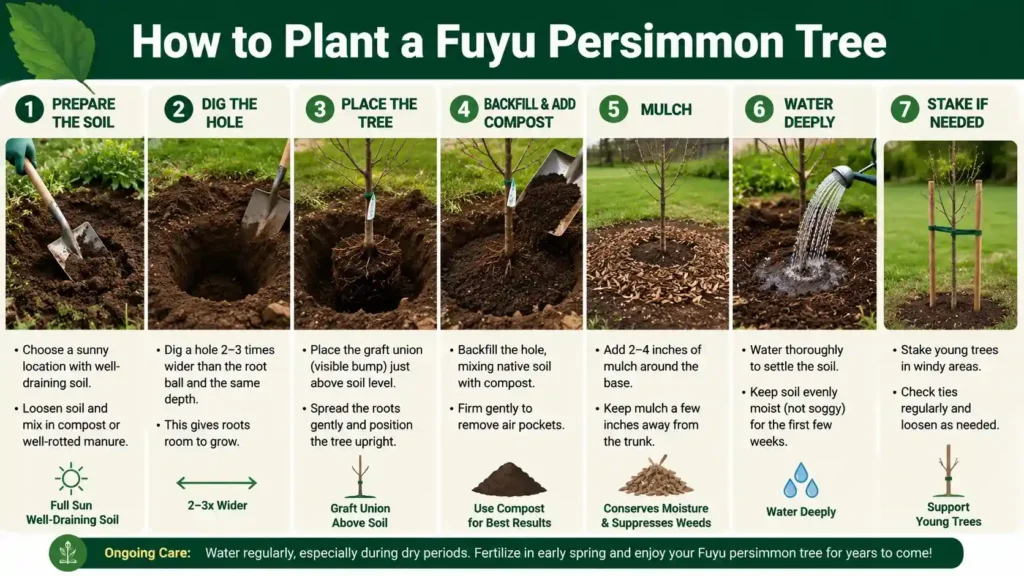
Dig wide, keep the graft above soil level, water deeply, mulch lightly, and stake young trees if windy.
Follow these steps when planting a Fuyu persimmon plant:
- Select a sunny location with good drainage.
- Dig a planting hole approximately twice as wide as the root ball.
- Position the persimmon plant so the graft union remains above soil level.
- Backfill gently using the original soil mixed with compost if needed.
- Water thoroughly to settle the soil around the roots.
- Apply mulch around the base while keeping it away from the trunk.
- Stake the tree if the site experiences strong winds.
- Continue regular watering while the tree establishes.
Special attention should be given to a persimmon seedling or newly planted persimmon young tree, as young roots are more sensitive to drought stress and competition from weeds.
With proper planting techniques, a Fuyu persimmon tree can establish quickly and develop into a productive, long-lived fruit tree capable of producing quality harvests for many years.
Fuyu Persimmon Tree Care
Fuyu persimmon tree care is simple when the tree gets full sun, steady moisture, light feeding, and basic pruning. Once established, Fuyu persimmons are relatively low-maintenance fruit trees that reward gardeners with attractive foliage and dependable harvests. Providing consistent care throughout the year helps maintain tree health, improve fruit quality, and support long-term productivity.
Watering
Proper watering is one of the most important aspects of persimmon tree care.
Young trees require regular watering while their root systems establish. Mature trees are more drought tolerant but still benefit from deep watering during extended dry periods.
General watering guidelines include:
- Water newly planted trees regularly during the first few years
- Water deeply rather than frequently
- Increase watering during hot, dry weather
- Reduce irrigation during prolonged wet periods
- Avoid waterlogged soil conditions
Consistent moisture supports healthy growth and helps prevent fruit drop during the growing season.
Mulching
Mulching helps conserve soil moisture, suppress weeds, and regulate soil temperatures around the root zone.
Apply a layer of organic mulch such as:
- Compost
- Aged bark
- Straw
- Leaf mulch
For effective persimmon fruit tree care:
- Maintain a mulch layer 5–10 cm (2–4 inches) deep
- Keep mulch several centimetres away from the trunk
- Replenish mulch as it breaks down
Mulching is especially beneficial during hot Australian summers and warm USA growing regions.
Feeding
Fuyu persimmons generally require moderate feeding compared to many other fruit trees.
A balanced fertilising program may include:
- Compost applied annually
- Well-rotted organic matter
- Balanced fruit tree fertiliser if needed
- Light feeding during active growth periods
Excessive nitrogen should be avoided because it can encourage excessive leafy growth at the expense of fruit production.
A healthy soil program forms an important part of ongoing care of persimmon tree health and productivity.
Weed Control
Keeping the area around the tree free from weeds reduces competition for water and nutrients.
Good weed management practices include:
- Maintaining a mulch layer
- Hand-pulling weeds when small
- Avoiding damage to surface roots
- Keeping grass away from the trunk area
Effective weed control improves growing conditions and simplifies overall persimmon tree maintenance.
Frost and Wind Protection
Young Fuyu persimmon trees benefit from protection against environmental stress, particularly during establishment.
Protect trees by:
- Planting in sheltered locations
- Avoiding frost-prone low areas
- Using windbreaks where necessary
- Protecting young growth during unexpected cold snaps
Strong winds can damage branches, reduce fruit retention, and stress newly planted trees. Frost can affect flowers and developing fruit if it occurs during sensitive growth stages.
Young Tree Care vs Mature Tree Care
Care requirements change as the tree matures.
| Care Factor | Young Tree | Mature Tree |
| Watering | Frequent and consistent | Deep watering during dry periods |
| Fertilising | Light feeding to support growth | Moderate seasonal feeding |
| Mulching | Important for root establishment | Helps maintain soil moisture |
| Protection | Requires frost and wind protection | Generally more resilient |
| Pruning | Focus on structure development | Focus on maintenance and airflow |
When learning how to care for Fuyu persimmon tree varieties, the primary goal during the early years is establishing a strong root system and healthy branch framework. As the tree matures, caring for persimmon trees becomes easier, with most maintenance focused on watering management, occasional feeding, and seasonal pruning.
With proper sunlight, moisture management, and routine care, a Fuyu persimmon tree can remain healthy and productive for many years while requiring relatively little ongoing maintenance.
How Often to Water Fuyu Persimmon Tree
Water young Fuyu persimmon trees deeply and regularly while establishing, then reduce watering once mature unless conditions are hot or dry. Consistent moisture supports healthy root development, strong growth, and quality fruit production, while excessive watering can lead to root problems and reduced tree vigor.
Understanding how often to water persimmon tree varieties depends on the tree’s age, climate, soil type, and seasonal conditions.
Watering Young Fuyu Persimmon Trees
Newly planted trees need more frequent watering than established trees because their root systems are still developing.
General guidelines include:
- Water deeply 1–2 times per week during dry weather
- Keep soil consistently moist but not saturated
- Increase watering during heatwaves
- Monitor soil moisture regularly during the first few years
Proper watering during establishment is an essential part of long-term care for persimmon tree health and productivity.
Australia Summer Watering
Australian summers can bring extended periods of heat and dry conditions, especially in inland and warmer regions.
During summer:
- Water deeply rather than lightly and frequently
- Check soil moisture before watering
- Increase irrigation during prolonged hot weather
- Use mulch to reduce moisture loss
- Avoid allowing the root zone to dry completely
Trees carrying a heavy crop of fruit may require additional moisture during periods of extreme heat.
USA Dry-Region Watering
In drier parts of the USA, including areas with low summer rainfall, Fuyu persimmons benefit from regular deep watering.
Best practices include:
- Water slowly to encourage deep root growth
- Adjust irrigation based on rainfall
- Monitor young trees more closely than mature trees
- Avoid frequent shallow watering
Deep watering helps maintain healthy growth and supports fruit development throughout the growing season.
Signs of Underwatering
A lack of moisture can stress the tree and affect both growth and fruit production.
Common signs include:
- Wilting leaves
- Leaf drop during hot weather
- Reduced shoot growth
- Smaller fruit size
- Premature fruit drop
- Dry soil around the root zone
In some cases, developing persimmon tree green fruit may drop before ripening if the tree experiences significant drought stress.
Avoiding Root Rot
While persimmons appreciate consistent moisture, they do not tolerate waterlogged soil.
To reduce the risk of root rot:
- Plant in well-drained soil
- Avoid standing water around the roots
- Allow excess water to drain freely
- Reduce irrigation during wet periods
- Improve drainage in heavy clay soils
Overwatering can be just as harmful as underwatering and may weaken the overall health of the tree.
Benefits of Mulching
Mulch plays an important role in moisture management and helps reduce watering requirements.
Benefits include:
- Conserves soil moisture
- Suppresses weeds
- Moderates soil temperatures
- Improves soil structure over time
- Reduces moisture fluctuations
Apply a layer of organic mulch around the tree while keeping it away from direct contact with the trunk.
For most established Fuyu persimmon trees, deep watering during prolonged dry periods is usually sufficient. By balancing moisture levels and maintaining good drainage, gardeners can support healthy growth, improve fruit quality, and simplify ongoing care for persimmon tree management.
Fertilizer Needs for Fuyu Persimmon Tree
Fuyu persimmon trees usually need light feeding because too much nitrogen can encourage excessive leafy growth and reduce fruit quality. A balanced nutrition program helps maintain healthy growth, supports fruit production, and contributes to long-term tree health without overstimulating vegetative growth.
Compared to many fruit trees, Fuyu persimmons are not heavy feeders. In fertile soils with regular organic matter additions, they often require only modest supplemental fertilization.
Compost in Spring
Applying compost in spring is one of the simplest and most effective ways to support healthy tree growth.
Benefits of compost include:
- Improves soil structure
- Increases organic matter
- Supports beneficial soil organisms
- Enhances moisture retention
- Provides slow-release nutrients
Spread a layer of well-rotted compost around the root zone, keeping it away from direct contact with the trunk. This practice supports overall persimmon fruit tree care while gradually improving soil quality over time.
Balanced Fruit Tree Fertilizer
Where additional nutrients are needed, a balanced fruit tree fertilizer can be applied during the active growing season.
A suitable fertilizer program should:
- Provide balanced nutrients
- Support flowering and fruit development
- Encourage healthy root growth
- Avoid excessive nitrogen levels
Many gardeners apply fertilizer in early spring as new growth begins, followed by light additional feeding only if required.
Avoid Overfeeding
Overfertilizing is one of the most common mistakes in persimmon tree maintenance.
Excess fertilizer can lead to:
- Vigorous leafy growth
- Reduced fruit production
- Delayed fruit ripening
- Increased susceptibility to stress
- Weak branch structure under heavy crops
If a tree is growing strongly, producing healthy leaves, and fruiting regularly, additional feeding may not be necessary.
Leaf and Soil Testing for Orchards
Commercial growers and serious home orchardists can benefit from periodic leaf and soil testing.
Testing helps determine:
- Nutrient deficiencies
- Nutrient imbalances
- Soil pH conditions
- Fertilizer requirements
- Long-term soil health trends
Rather than applying fertilizer on a fixed schedule, testing allows nutrient programs to be adjusted based on actual tree needs.
Quick Fertilizer Guidelines
| Tree Age | Feeding Recommendation |
| Newly Planted Trees | Light compost application and minimal fertiliser |
| Young Trees | Moderate feeding to support establishment |
| Mature Trees | Light annual feeding if needed |
| Productive Orchard Trees | Soil and leaf testing recommended |
A successful fertilization program focuses on maintaining steady growth rather than rapid growth. When combined with proper watering, mulching, and pruning, light feeding helps support healthy fruit production and simplifies long-term persimmon tree maintenance.
How to Prune Fuyu Persimmon Tree
Prune Fuyu persimmon trees lightly to shape the canopy, remove dead wood, improve airflow, and control height. Unlike some deciduous fruit trees that require heavy annual pruning, Fuyu persimmons generally perform best with moderate maintenance pruning that preserves the tree’s natural structure while encouraging healthy growth and fruit production.
Regular pruning helps maintain a balanced canopy, improves sunlight penetration, and reduces the risk of overcrowded branches.
Winter Pruning
Winter is the preferred time for major pruning because the tree is dormant and its branch structure is easier to see.
During winter pruning:
- Remove dead, damaged, or diseased branches
- Thin crowded growth to improve airflow
- Remove crossing or rubbing branches
- Maintain a balanced canopy shape
- Control excessive height if necessary
Pruning during dormancy reduces stress on the tree and encourages healthy spring growth.
Summer Correction if Needed
Most structural pruning should occur during winter, but light corrective pruning can be carried out during summer when necessary.
Summer pruning may be useful for:
- Removing damaged shoots
- Correcting unwanted growth
- Eliminating water sprouts
- Improving light penetration
Only minor adjustments should be made during the growing season to avoid excessive stress.
Remove Suckers
Suckers often emerge from the base of the trunk or below the graft union.
These shoots should be removed because they:
- Compete for nutrients and water
- Reduce tree vigor
- Interfere with the desired tree shape
- May originate from the rootstock rather than the Fuyu variety
Inspect the tree regularly and remove suckers as soon as they appear.
Train Young Tree Structure
Proper training during the early years creates a strong framework that supports future fruit production.
For a young tree:
- Select strong scaffold branches
- Encourage an open, balanced canopy
- Remove weak or poorly positioned shoots
- Develop a structure that allows good light distribution
Early training reduces the need for heavier corrective pruning later in the tree’s life.
Avoid Heavy Pruning Every Year
One of the most important principles when learning how to prune persimmon tree varieties is avoiding excessive annual pruning.
Heavy pruning can lead to:
- Excessive vegetative growth
- Reduced fruit production
- Delayed cropping
- Increased stress on the tree
Fuyu persimmons naturally develop an attractive structure and generally require less aggressive pruning than many other fruit trees.
Pruning Benefits
Proper pruning provides several advantages:
- Better air circulation
- Improved sunlight exposure
- Easier harvesting
- Reduced branch congestion
- Improved fruit quality
- Better canopy management
A healthy canopy also supports attractive seasonal displays, including the glossy green foliage of summer and the colourful autumn transformation of Fuyu persimmon tree leaves.
Monitoring Leaves and Canopy Health
While pruning, take the opportunity to inspect overall tree health.
Look for:
- Healthy green persimmon tree leaf growth
- Signs of disease or pest damage
- Dead or weak branches
- Abnormal leaf discoloration
Healthy Japanese persimmon leaves are an important indicator of tree vigor and can help gardeners identify potential problems before they become serious.
With light annual maintenance, proper structure training, and selective branch removal, Fuyu persimmon trees can remain productive, attractive, and easy to manage for many years.
Fuyu Persimmon Flowering & Fruit Stages
Fuyu persimmon trees flower in spring and develop green young fruit that slowly colours orange as harvest season approaches. Understanding the flowering and fruit development cycle helps gardeners monitor tree health, anticipate harvest timing, and identify potential issues during the growing season.
The complete process begins with bud formation in late winter or early spring and ends with fully ripe fruit ready for harvest in autumn.
Flower Bud Formation
The first stage of persimmon flowering begins with the development of flower buds on new season growth.
During this stage:
- Buds emerge as temperatures rise in spring
- Healthy trees produce numerous persimmon fruit buds
- Bud development depends on sunlight, nutrition, and overall tree health
- Young trees may produce fewer buds until fully established
Strong bud formation is often a sign that the tree is preparing for a productive growing season.
Persimmon Flower Stage
As spring progresses, the buds open into small flowers.
The persimmon flower is typically:
- Creamy white to pale yellow
- Bell-shaped in appearance
- Produced on new growth
- Attractive to pollinating insects
A flowering persimmon tree can be quite ornamental during this period, adding seasonal interest before fruit development begins.
Many gardeners ask, “When does persimmon tree bloom?” In most growing regions, flowering occurs during spring, although exact timing varies according to local climate and seasonal temperatures.
Fruit Set
After successful pollination and flowering, small fruit begins to form.
During fruit set:
- Flowers naturally drop after pollination
- Tiny developing fruit appears behind the flower
- Excess fruit may drop naturally as the tree balances its crop load
- Healthy growing conditions improve fruit retention
Good sunlight, consistent watering, and balanced nutrition support successful fruit set.
Young Green Persimmon Fruit
Following fruit set, the tree enters one of the longest persimmon tree fruit stages.
At this stage:
- Fruit remains small and green
- Rapid internal development occurs
- Fruit gradually increases in size throughout summer
- Persimmon young fruit may be shed naturally if the tree is under stress
A green persimmon fruit is completely normal during summer and does not indicate a problem. The fruit requires time to mature before colour development begins.
Colour Change Stage
As harvest season approaches, the fruit starts transitioning from green to orange.
During colour development:
- Green skin gradually fades
- Orange pigmentation becomes more visible
- Sugar levels increase
- Fruit reaches near-full size
- Flavour continues improving
The speed of colour change depends on variety, weather conditions, and overall tree health.
Ripe Fruit Stage
The final stage occurs when the fruit reaches full maturity.
Signs of ripe Fuyu persimmons include:
- Rich orange skin colour
- Full fruit size
- Sweet flavour
- Crisp or slightly softened texture
- Easy harvesting from the tree
Unlike astringent persimmon varieties, Fuyu fruit can be eaten while still firm, making it easier to determine harvest readiness.
Quick Summary of Fuyu Persimmon Fruit Stages
| Stage | What Happens |
| Flower Bud Formation | Persimmon fruit buds develop in spring |
| Flowering | Small cream-coloured flowers open |
| Fruit Set | Tiny fruit begins forming after flowering |
| Young Fruit Stage | Green fruit grows throughout summer |
| Colour Change | Fruit gradually turns orange |
| Ripe Fruit Stage | Sweet orange fruit becomes ready for harvest |
From the first Fuyu persimmon flower to the final harvest, the development process follows a predictable seasonal pattern. Monitoring each stage helps gardeners support healthy growth and enjoy high-quality fruit at the ideal time.
Is Fuyu Persimmon Self-Pollinating?
Fuyu persimmon is often self-fruitful, but another compatible persimmon variety can improve fruit set in some conditions. This means a single tree is usually capable of producing fruit on its own, making it a practical choice for home gardens where space is limited.
For gardeners asking, “Are Fuyu persimmons self pollinating?” the answer is generally yes. Most Fuyu persimmon trees can produce a crop without requiring a second tree nearby, although growing another compatible persimmon variety may sometimes increase pollination success and overall yields.
Understanding Self-Pollination
A self-fruitful tree can set fruit using its own flowers without relying on pollen from another variety.
Benefits of self-pollinating Fuyu persimmons include:
- Suitable for small gardens
- Only one tree may be needed for fruit production
- Easier planning for home landscapes
- Reliable cropping under suitable growing conditions
This characteristic has helped make the Fuyu persimmon one of the most popular persimmon varieties for backyard growers.
Seedless vs Seeded Fruit
Many Fuyu persimmons are harvested without seeds, which is why they are often referred to as a seedless persimmon in home gardens and commercial production.
Fruit may be:
- Completely seedless
- Contain a few seeds
- Produce variable seed numbers depending on pollination
The presence or absence of seeds does not usually affect the fruit’s overall quality or sweetness.
Why Seeds May Appear
Gardeners often ask, “Do Fuyu persimmons have seeds?”
The answer is that they can, but not always.
Seeds may develop when:
- Flowers receive pollen from another persimmon variety
- Pollinating insects transfer compatible pollen
- Nearby persimmon trees are flowering at the same time
When cross-pollination occurs, a Fuyu persimmon seed may develop inside the fruit. In isolated plantings, fruit is often seedless or contains very few seeds.
Polliniser Varieties
Although Fuyu persimmons commonly fruit without assistance, compatible persimmon varieties can sometimes improve fruit set.
Potential benefits of cross-pollination include:
- Increased fruit production
- Better fruit retention
- Improved pollination under certain conditions
- Greater seed development in some fruit
The need for a polliniser varies depending on local climate, tree health, flowering conditions, and nearby persimmon varieties.
Home Garden Advice
For most home gardeners, a single Fuyu persimmon tree is usually sufficient for fruit production.
To encourage reliable crops:
- Plant in full sun
- Maintain consistent watering
- Protect flowers from late frosts
- Promote pollinator activity in the garden
- Keep the tree healthy through proper pruning and nutrition
In most backyard situations, gardeners do not need to plant a second persimmon tree unless they want to experiment with increased pollination or grow multiple varieties.
Quick Summary
| Question | Answer |
| Is Fuyu persimmon self pollinating? | Yes, it is generally self-fruitful. |
| Are Fuyu persimmons self pollinating enough for one-tree gardens? | Yes, a single tree often produces fruit successfully. |
| Do Fuyu persimmons have seeds? | Sometimes, depending on pollination. |
| Is Fuyu a seedless persimmon? | Often yes, but seeded fruit can occur. |
| Why does a Fuyu persimmon seed develop? | Usually due to cross-pollination from another persimmon variety. |
Because of its self-fruitful nature and dependable fruit production, the Fuyu persimmon remains one of the easiest persimmon varieties for home gardeners to grow successfully.
Fuyu Persimmon Season: Australia vs USA
Fuyu persimmons usually ripen in autumn; in Australia this often means around April to June, while in the USA it usually means fall to early winter. The exact harvest period varies depending on local climate, growing conditions, and seasonal weather patterns, but Fuyu is generally considered a late-season fruit tree.
For gardeners wondering when is persimmon in season, Fuyu persimmons develop throughout spring and summer before reaching maturity during the cooler months of the year.
Fuyu Persimmon Season Comparison
| Region | Main Harvest Season |
| Australia | Autumn to early winter (typically April–June) |
| USA | Fall to early winter (typically October–December) |
| Harvest Sign | Rich orange colour, full size, sweet flavour |
| Best Eating Stage | Firm or slightly soft |
Fuyu Persimmon Season in Australia
The persimmon season Australia gardeners experience generally begins in autumn and can continue into early winter depending on location.
Factors affecting harvest timing include:
- Local climate
- Summer temperatures
- Tree age
- Growing conditions
- Seasonal weather patterns
In many Australian fruit-growing regions, the Fuyu persimmon season commonly occurs between April and June as fruit changes from green to deep orange and reaches full maturity.
Fuyu Persimmon Season in the USA
In the United States, persimmon season typically occurs during fall and early winter.
Many growing regions harvest fruit during:
- October
- November
- December
Warmer areas may begin harvesting slightly earlier, while cooler locations may experience later ripening.
When Is Fuyu Persimmon Ripe?
A common question among gardeners is when is Fuyu persimmon ripe.
Signs of ripeness include:
- Bright orange skin colour
- Full fruit size
- Sweet flavour development
- Firm but mature texture
- Easy separation from the tree when harvested carefully
Unlike astringent persimmons, Fuyu fruit does not need to become extremely soft before eating.
How Seasonal Conditions Affect Ripening
The timing of persimmon season can vary slightly from year to year based on environmental conditions.
Factors influencing ripening include:
- Spring flowering time
- Summer heat accumulation
- Rainfall patterns
- Tree health
- Crop load
Healthy trees growing in full sun generally produce more consistent harvests and better fruit quality.
Quick Harvest Indicators
If you are wondering when is the season for persimmons or when persimmons season typically begins, look for these harvest signs:
- Fruit reaches its mature size
- Skin turns a rich orange colour
- Flavour becomes noticeably sweeter
- Fruit feels firm or slightly softened
- Green colouring has mostly disappeared
Whether grown in Australia or the USA, the Fuyu persimmon season arrives during the cooler part of the year, rewarding gardeners with sweet, easy-to-eat fruit that can be enjoyed fresh while still firm.
When to Harvest Fuyu Persimmons
Harvest Fuyu persimmons when the fruit turns rich orange, reaches full size, and tastes sweet while still firm. Unlike astringent persimmon varieties that must soften completely before eating, Fuyu persimmons can be picked and enjoyed while they are crisp, making harvest timing much easier for home gardeners.
Knowing when to harvest persimmons at the right stage helps maximize flavour, texture, and storage life.
How to Tell if Fuyu Persimmons Are Ripe
The easiest way to determine ripeness is by observing colour, size, and flavour.
Signs of ripe Fuyu persimmons include:
- Deep orange skin colour
- Full fruit size
- Sweet taste with little or no bitterness
- Firm but mature texture
- Well-developed fruit shape
For gardeners wondering how to tell when a Fuyu persimmon is ripe, colour is usually the most reliable visual indicator. Most fruit should have changed from green to a rich orange before harvesting.
Picking with Secateurs
Fuyu persimmons should be harvested carefully using clean secateurs or pruning shears.
To harvest properly:
- Support the fruit with one hand.
- Cut the stem just above the fruit cap.
- Avoid pulling fruit directly from branches.
- Place harvested fruit gently into a basket or container.
This method reduces damage to both the fruit and the tree.
When deciding when to pick Fuyu persimmons from tree branches, focus on fruit maturity rather than waiting for extreme softness.
Firm-Ripe vs Soft-Ripe Fruit
One advantage of Fuyu persimmons is that they can be enjoyed at different stages of ripeness.
| Stage | Characteristics |
| Firm-Ripe | Crisp texture, sweet flavour, apple-like bite |
| Slightly Soft-Ripe | Softer texture, richer sweetness, juicier flesh |
Many gardeners prefer harvesting ripe Fuyu persimmons while they are still firm because they store better and are easier to handle.
Can Fruit Be Left on the Tree?
Yes, Fuyu persimmons can often remain on the tree after reaching maturity.
Benefits of leaving fruit on the tree slightly longer include:
- Continued flavour development
- Increased sweetness
- Flexible harvest timing
- Extended picking season
However, fruit should not be left indefinitely, especially if frost, birds, or severe weather become concerns.
Avoid Bruising During Harvest
Although Fuyu persimmons are firmer than many persimmon varieties, careful handling is still important.
To prevent bruising:
- Harvest gently
- Use padded harvest containers
- Avoid stacking fruit too deeply
- Handle fruit by the stem when possible
- Store harvested fruit carefully
Bruised fruit may soften more quickly and have a shorter storage life.
Quick Harvest Checklist
If you are asking when are Fuyu persimmons ripe or how to know when Fuyu persimmons are ripe, look for these indicators:
- Rich orange skin colour
- Full-sized fruit
- Sweet flavour
- Firm or slightly soft texture
- Easy harvesting with secateurs
For most gardeners, the best time to harvest Fuyu persimmons is when the fruit has fully coloured and developed sweetness while still retaining its characteristic firm texture. This stage provides excellent flavour, longer storage potential, and the classic eating quality that makes Fuyu persimmons so popular.
How to Eat, Cut & Store Fuyu Persimmons
Fuyu persimmons can be eaten fresh, sliced, peeled or unpeeled, stored at room temperature until ripe, and refrigerated once ready. Their sweet flavour, crisp texture, and non-astringent nature make them one of the easiest persimmon varieties to enjoy straight from the tree.
Unlike astringent persimmons that must become very soft before eating, Fuyu fruit can be enjoyed while still firm, making preparation and storage much simpler.
How to Cut a Fuyu Persimmon
If you are wondering how to cut a Fuyu persimmon, the process is quick and straightforward.
Follow these steps:
- Wash the fruit thoroughly.
- Remove the leafy calyx at the top if desired.
- Place the fruit on a cutting board.
- Slice from top to bottom or cut into wedges.
- Remove any seeds if present.
- Serve immediately or add to recipes.
The skin is edible, so peeling is optional. Many people prefer to eat the fruit with the skin intact because it contains additional fibre and texture.
Eating Firm Fruit
One of the biggest advantages of Fuyu fruit is its ability to be eaten while firm.
Firm-ripe fruit typically offers:
- Crisp, apple-like texture
- Sweet flavour
- Easy slicing
- Excellent snacking quality
- Better storage life
A ripe Fuyu persimmon does not need to become soft before consumption, which distinguishes it from many other persimmon varieties.
Storing Ripe Fruit
Knowing how to store Fuyu persimmons properly helps maintain freshness and flavour.
For best results:
- Keep unripe fruit at room temperature
- Store away from direct sunlight
- Allow fruit to develop colour and sweetness naturally
- Refrigerate once fully ripe
- Use refrigerated fruit within a reasonable period for best quality
Proper storage helps preserve texture while slowing further ripening.
Using Fuyu Persimmons in Salads and Desserts
Because Fuyu persimmons remain firm when ripe, they are highly versatile in the kitchen.
Popular uses include:
- Fresh fruit platters
- Green salads
- Fruit salads
- Cheese boards
- Smoothies
- Cakes and desserts
- Yogurt toppings
- Breakfast bowls
Their sweet flavour and attractive orange colour make them a useful ingredient in both sweet and savoury dishes.
Difference from Hachiya Persimmon Handling
Fuyu and Hachiya persimmons require different handling because of their contrasting ripening characteristics.
| Feature | Fuyu Persimmon | Hachiya Persimmon |
| Can Be Eaten Firm | Yes | No |
| Texture at Harvest | Crisp to slightly soft | Must become very soft |
| Preparation | Slice and eat fresh | Wait for full softening |
| Ease of Use | Very easy | Requires careful ripening |
| Astringency | Non-astringent | Astringent until fully ripe |
This difference is one reason many home gardeners prefer Fuyu persimmons ripe and ready for immediate use without the need for extended indoor ripening.
Quick Serving Tips
For the best eating experience:
- Choose fully coloured fruit
- Enjoy firm or slightly softened fruit
- Slice into wedges for snacking
- Add to fresh salads
- Refrigerate ripe fruit to extend freshness
- Handle carefully to avoid bruising
Whether eaten fresh from the tree, added to desserts, or included in seasonal salads, Fuyu persimmons provide a convenient and delicious way to enjoy sweet autumn fruit.
Fuyu vs Hachiya Persimmon
Fuyu is non-astringent and can be eaten firm, while Hachiya is astringent and must become very soft before eating. Although both belong to the same Japanese persimmon species (Diospyros kaki), they differ significantly in texture, flavour, shape, and how they are consumed.
For gardeners choosing between Hachiya or Fuyu persimmon varieties, Fuyu is generally considered the easier option because it requires less attention during the ripening process.
Fuyu vs Hachiya Comparison
| Feature | Fuyu Persimmon | Hachiya Persimmon |
| Fruit Shape | Flat and tomato-like | Elongated and pointy |
| Texture When Eaten | Firm to slightly soft | Very soft when ripe |
| Astringency | Non-astringent | Astringent until fully ripe |
| Flavour | Sweet and mild | Rich and sweet when fully ripe |
| Best Use | Fresh eating, salads, snacks | Baking, purees, puddings |
| Beginner Friendly | Yes | Requires more attention |
| Harvest Use | Can be eaten immediately when ripe | Must soften completely first |
Fruit Shape Differences
One of the easiest ways to distinguish these persimmon types is by appearance.
Fuyu persimmon:
- Flat, round shape
- Tomato-like appearance
- Shorter and wider fruit
- Easy to slice
Hachiya persimmon:
- Tall, elongated shape
- Acorn-like appearance
- Often called a pointy persimmon
- More delicate when fully ripe
Texture and Eating Experience
The biggest difference between Fuyu and Hachiya persimmons is texture.
Fuyu can be eaten:
- Firm
- Crisp
- Slightly softened
- Fresh from the tree once ripe
Hachiya is considered a soft persimmon because it must become extremely soft before it is pleasant to eat.
Eating an unripe Hachiya persimmon can produce a strong mouth-drying sensation due to its high astringency.
Best Culinary Uses
Both varieties have different kitchen applications.
Fuyu is best for:
- Fresh snacking
- Fruit salads
- Cheese boards
- Lunchboxes
- Slicing into desserts
Hachiya is best for:
- Baking
- Persimmon bread
- Cakes
- Purees
- Smoothies
The soft texture of ripe Hachiya fruit makes it especially useful for recipes that require a creamy consistency.
Which Variety Is Better for Beginners?
For most home gardeners, Fuyu is the simpler choice.
Reasons include:
- Easier to harvest
- Can be eaten while firm
- Less risk of harvesting too early
- Lower maintenance during ripening
- More versatile for everyday use
While both varieties are excellent, beginners often find Fuyu more convenient.
Understanding Persimmon Types
Fuyu and Hachiya are two of the most popular persimmon types, but they represent different categories.
Broadly speaking:
- Fuyu = non-astringent persimmon
- Hachiya = astringent persimmon
These two categories form the basis for many modern persimmon varieties grown worldwide.
Quick Summary
If you are choosing between Hachiya or Fuyu persimmon varieties:
- Choose Fuyu for fresh eating and easy harvesting.
- Choose Hachiya for baking and rich, soft fruit.
- Fuyu is ideal for beginners.
- Hachiya requires patience during ripening.
Both Fuyu and Hachiya persimmons are excellent fruit trees, but understanding their differences helps gardeners choose the variety that best suits their growing goals and eating preferences.
Fuyu Persimmon Varieties & Similar Types
Fuyu is one of the best-known non-astringent persimmons, but related types include Giant Fuyu, Hana Fuyu, Imoto Fuyu, Jiro, Chocolate, and Hachiya. These varieties belong to the wider group of Japanese and Asian persimmons and offer differences in fruit size, flavour, ripening time, and growth habits.
Understanding the different Fuyu persimmon varieties helps gardeners choose a tree that best suits their climate, garden space, and harvest preferences.
Standard Fuyu
Standard Fuyu is the most widely grown variety and the benchmark for many non-astringent persimmons.
Characteristics include:
- Flat, tomato-like fruit shape
- Sweet flavour
- Crisp texture when ripe
- Bright orange skin
- Reliable production
Many gardeners simply refer to it as Fuyu kaki or kaki Fuyu because it belongs to the species Diospyros kaki.
Giant Fuyu
Giant Fuyu is a larger-fruited selection that shares many of the characteristics of standard Fuyu.
Features include:
- Larger fruit size
- Sweet flavour
- Non-astringent flesh
- Similar harvest season
- Good fresh-eating quality
A Giant Fuyu persimmon tree may require slightly more branch support due to the heavier fruit load.
Hana Fuyu
Hana Fuyu persimmon is a popular early-ripening variety.
Its advantages include:
- Earlier harvest than standard Fuyu
- Sweet flavour
- Firm texture
- Attractive orange fruit
- Suitable for home gardens
A Hana Fuyu persimmon tree is often chosen by gardeners who want to extend their persimmon harvest season.
Imoto Fuyu
Imoto Fuyu persimmon is another non-astringent selection that resembles traditional Fuyu but may differ slightly in growth habit and fruit characteristics.
It is valued for:
- Sweet flavour
- Reliable fruit production
- Attractive appearance
- Fresh eating quality
Availability varies by region and nursery supplier.
Chocolate Fuyu and Chocolate Persimmon
Chocolate Fuyu persimmon refers to persimmons associated with darker flesh colouring that can develop when pollination occurs.
Characteristics may include:
- Brown or darker flesh tones
- Richer flavour profiles
- Sweet fruit
- Unique appearance
Chocolate persimmons are distinct from standard Fuyu, although they are often grouped among specialty Japanese persimmon varieties.
Fuyugaki and Fuyu-Gaki Naming
Gardeners may encounter alternative names such as:
- Fuyugaki
- Fuyu-gaki
- Persimmon Fuyugaki
- Fuyugaki persimmon tree
The word “gaki” is the Japanese term associated with persimmons, so these names generally refer to Fuyu selections within Japanese naming systems.
Other Japanese and Asian Persimmon Varieties
Besides Fuyu, several other Asian persimmon varieties are commonly grown.
Popular examples include:
- Fuyu
- Jiro
- Giant Fuyu
- Hana Fuyu
- Imoto Fuyu
- Chocolate persimmon
- Hachiya
These Japanese persimmon types can be grouped into two main categories:
Non-astringent varieties:
- Fuyu
- Giant Fuyu
- Hana Fuyu
- Imoto Fuyu
- Jiro
Astringent varieties:
- Hachiya
Quick Comparison Table
| Variety | Fruit Type | Main Feature | Eating Style |
| Standard Fuyu | Non-astringent | Sweet and reliable | Eat firm or slightly soft |
| Giant Fuyu | Non-astringent | Larger fruit | Fresh eating |
| Hana Fuyu | Non-astringent | Earlier harvest | Fresh eating |
| Imoto Fuyu | Non-astringent | Productive and sweet | Fresh eating |
| Chocolate Persimmon | Variable | Darker flesh colour | Fresh eating |
| Jiro | Non-astringent | Compact growth | Fresh eating |
| Hachiya | Astringent | Must soften completely | Baking and purees |
The wide range of Fuyu persimmon types gives gardeners plenty of options, but standard Fuyu remains one of the easiest and most beginner-friendly choices among all Asian persimmon varieties.
Can You Grow Fuyu Persimmon in a Container?
A dwarf Fuyu persimmon tree can grow in a large container if it receives full sun, good drainage, regular watering, and proper root-space management. Container growing is an excellent option for gardeners with limited space, patios, balconies, or small backyards.
Although standard trees eventually become too large for long-term container culture, a dwarf Fuyu persimmon tree can remain productive for many years when properly maintained.
Best Pot Size
Choosing the right container is essential for healthy growth.
Recommended container sizes include:
- Start with a pot at least 45–60 cm (18–24 inches) wide
- Upgrade to a final container of 75–90 cm (30–36 inches) wide
- Use a sturdy, heavy pot for stability
- Choose containers that provide enough depth for root development
A larger pot helps maintain moisture levels and gives the root system enough space to expand.
Drainage Holes Are Essential
Good drainage is one of the most important factors when growing a persimmon tree in container conditions.
Always choose a container with multiple drainage holes to prevent excess water from accumulating around the roots.
Poor drainage can lead to:
- Root rot
- Yellow leaves
- Weak growth
- Reduced fruit production
- Tree decline
Never allow water to sit in trays for long periods.
Use a Well-Draining Potting Mix
A Fuyu persimmon plant grows best in fertile, airy soil that drains freely.
An ideal potting mix should contain:
- High-quality potting soil
- Compost or well-rotted organic matter
- Perlite or coarse sand for drainage
- Organic materials that improve moisture retention
Avoid using heavy garden soil because it can become compacted inside containers.
Pruning for Size Control
Container-grown trees require regular pruning to maintain a manageable size.
Pruning goals include:
- Controlling height
- Maintaining a balanced canopy
- Improving airflow
- Removing dead or crowded branches
- Encouraging fruit production
A dwarf persimmon tree naturally stays smaller, but occasional pruning keeps it productive and easy to manage.
Container Watering
Container-grown trees dry out faster than trees planted in the ground.
Watering guidelines include:
- Check soil moisture regularly
- Water deeply when the top layer begins to dry
- Increase watering during hot weather
- Reduce watering during cool or rainy periods
- Avoid both drought stress and waterlogging
Consistent moisture is especially important while the tree is flowering and developing fruit.
Repotting
Over time, roots can outgrow the container and become crowded.
Repotting is usually needed every 3–5 years.
Signs that repotting may be necessary include:
- Slower growth
- Water draining too quickly
- Roots circling the container
- Reduced fruit production
- Soil becoming compacted
When repotting:
- Move the tree to a slightly larger container if needed.
- Refresh the potting mix.
- Lightly trim overcrowded roots.
- Water thoroughly after repotting.
Quick Container Growing Checklist
| Requirement | Recommendation |
| Tree Type | Dwarf Fuyu persimmon tree |
| Sunlight | 6–8+ hours of full sun daily |
| Pot Size | 75–90 cm (30–36 inches) wide when mature |
| Soil | Well-draining fertile potting mix |
| Watering | Deep and consistent |
| Pruning | Light annual size control |
| Repotting | Every 3–5 years |
A Fuyu tree adapts surprisingly well to container growing when its basic needs are met. For gardeners with limited space, growing a dwarf Fuyu persimmon tree in a container provides an excellent way to enjoy fresh fruit without needing a large backyard.
Growing Fuyu Persimmon From Seed
Fuyu persimmon can grow from seed, but seedlings may not produce true Fuyu fruit, so grafted trees are better for reliable fruit. Growing from seed can be an enjoyable gardening project, but it is not the preferred method if your goal is to produce the same fruit quality as a named Fuyu variety.
Because seedlings inherit mixed genetic characteristics, the resulting tree may differ in fruit size, flavour, productivity, and growth habit.
Seed Planting Basics
To grow a tree from a persimmon seed, start with fresh seeds taken from mature fruit.
Basic preparation includes:
- Remove seeds from ripe fruit.
- Wash away any fruit pulp.
- Allow seeds to dry for a short period.
- Discard damaged or unhealthy seeds.
- Prepare for cold treatment before planting.
Healthy seeds have a higher chance of successful germination.
Cold Stratification
Persimmon seeds usually require a period of cold stratification before they will sprout.
This process mimics natural winter conditions.
Steps include:
- Wrap seeds in a slightly damp paper towel.
- Place them inside a sealed plastic bag.
- Store them in the refrigerator.
- Keep them chilled for 8–12 weeks.
- Check periodically for mold or drying.
Cold stratification helps break dormancy and improves germination rates.
Germination
After stratification, the seeds can be planted.
Planting guidelines:
- Use small pots with drainage holes.
- Fill with a well-draining seed-starting mix.
- Plant seeds 2–3 cm (¾–1 inch) deep.
- Keep soil lightly moist.
- Place containers in a warm, bright location.
Germination may take several weeks, and patience is often required.
Seedling Care
A young persimmon seedling needs gentle care while establishing.
Provide:
- Bright sunlight or strong indirect light
- Consistent moisture
- Protection from extreme temperatures
- Good air circulation
- Gradual outdoor acclimation before transplanting
Once established, the persimmon young tree can be moved to a permanent location or larger container.
Why Grafted Trees Are Preferred
Most nurseries sell grafted Fuyu trees because they offer several advantages over seed-grown trees.
Benefits of grafted trees include:
- True-to-type Fuyu fruit
- Earlier fruit production
- More predictable growth
- Better overall reliability
- Known fruit quality
A grafted tree often produces fruit within 2–5 years, while seed-grown trees may take much longer.
Seed-Grown Fruit Variation
Growing from a Fuyu persimmon seed does not guarantee that the tree will produce identical Fuyu fruit.
Seed-grown trees may vary in:
- Fruit sweetness
- Fruit size
- Shape
- Harvest timing
- Productivity
- Tree size
Some seedlings may produce excellent fruit, while others may not meet expectations.
Quick Comparison: Seed vs Grafted Trees
| Feature | Seed-Grown Tree | Grafted Tree |
| Fruit Quality | Unpredictable | Consistent |
| Time to Fruit | 5–10+ years | 2–5 years |
| Tree Characteristics | Variable | True to variety |
| Reliability | Lower | Higher |
| Recommended for Beginners | No | Yes |
Growing a persimmon seed can be a rewarding experiment, but gardeners who want dependable harvests should choose a grafted Fuyu tree. It provides faster fruit production and ensures you receive the true characteristics that make Fuyu persimmons so popular.
Common Fuyu Persimmon Tree Problems
Most Fuyu persimmon tree problems come from poor drainage, irregular watering, wind damage, frost injury, pests, or weak fruit set. Fortunately, Fuyu persimmons are generally low-maintenance trees, and many problems can be prevented with proper planting, consistent care, and good growing conditions.
Early identification allows gardeners to correct issues before they affect tree health or fruit production.
Common Problems and Solutions
| Problem | Possible Cause | Solution |
| Yellow leaves | Overwatering, poor drainage, nutrient imbalance | Improve drainage and adjust watering |
| Fruit drop | Drought stress, excess nitrogen, environmental stress | Water consistently and avoid overfeeding |
| No fruit | Young tree, frost damage, poor pollination | Allow tree to mature and protect flowers |
| Cracked fruit | Inconsistent watering | Maintain even soil moisture |
| Weak growth | Poor soil, heavy shade, nutrient deficiency | Improve soil and provide full sun |
| Root rot | Waterlogged soil | Improve drainage immediately |
Yellow Leaves
Yellow foliage is one of the most common issues gardeners encounter.
Possible causes include:
- Excessive watering
- Poor drainage
- Compacted soil
- Nutrient deficiencies
- Prolonged wet conditions
Healthy Fuyu trees should have deep green foliage during the growing season. If leaves become a yellow persimmon appearance prematurely, inspect the soil before adding fertilizer.
Fruit Drop
Some fruit drop is normal, especially during early fruit development. Excessive fruit loss, however, usually indicates stress.
Common causes include:
- Irregular watering
- Heat stress
- Excess nitrogen fertilizer
- Sudden weather changes
- Young tree establishment
Consistent watering and balanced nutrition can reduce unnecessary fruit loss.
No Fruit Production
Many gardeners worry when their tree does not produce fruit.
Possible reasons include:
- The tree is still too young
- Late spring frost damaged flowers
- Poor flowering conditions
- Environmental stress
- Pollination limitations in some situations
Most grafted trees need several years before producing significant crops.
Cracked Fruit
Fruit splitting or cracking is usually caused by inconsistent moisture levels.
This often happens when:
- Dry soil is followed by heavy watering
- Rain arrives after prolonged drought
- Watering schedules fluctuate significantly
Maintaining even soil moisture helps prevent damage.
Weak Growth
Poor growth can occur when the tree is planted in unsuitable conditions.
Look for factors such as:
- Too much shade
- Poor soil fertility
- Root competition
- Compacted soil
- Inadequate watering
Fuyu persimmons perform best in full sun with fertile, well-drained soil.
Root Rot
Root rot is one of the most serious problems affecting persimmons.
Symptoms include:
- Yellowing leaves
- Wilting
- Slow growth
- Leaf drop
- Branch dieback
Prevention is far easier than treatment.
To avoid root rot:
- Plant in well-drained soil
- Avoid overwatering
- Improve heavy clay soils
- Never allow standing water around roots
Environmental Stress Factors
Young trees are more sensitive to environmental conditions.
Protect them from:
- Strong winds
- Late frosts
- Extended drought
- Extreme heat
A healthy tree with proper care is far more resilient against seasonal stress.
Quick Prevention Tips
To reduce long-term persimmon tree maintenance issues:
- Plant in full sun.
- Ensure excellent drainage.
- Water deeply and consistently.
- Apply mulch to conserve moisture.
- Avoid excessive fertilizer.
- Prune lightly for airflow.
- Protect young trees from frost and wind.
Healthy foliage, steady growth, and properly developing persimmon tree green fruit are good indicators that the tree is thriving. Although some gardeners may refer to a young tree as a persimmon bush during its early years, proper care will eventually allow it to develop into a productive, long-lived fruit tree.
Benefits of Growing a Fuyu Persimmon Tree
Fuyu persimmon trees provide edible fruit, ornamental autumn colour, shade, wildlife value, and a productive feature tree for home gardens. Their combination of beauty, low-maintenance care, and dependable harvests makes them one of the most rewarding fruit trees for both beginner and experienced gardeners.
Whether planted in Australia or the USA, a Fuyu persimmon tree offers benefits throughout every season.
Fresh Fruit for the Kitchen
One of the biggest advantages of growing a persimmon fruit tree is the yearly harvest of sweet, nutritious fruit.
Fuyu persimmons are valued because they:
- Can be eaten while firm
- Have a naturally sweet flavour
- Require minimal preparation
- Are versatile in recipes
- Store well after harvest
Homegrown fruit often tastes better because it can be picked at peak ripeness.
Adds Beauty to the Garden
A Fuyu tree is not just a fruit producer; it is also an attractive ornamental tree.
Throughout the year, it provides:
- Glossy green summer foliage
- Attractive branching structure
- Bright orange fruit displays
- Seasonal garden interest
Even after leaves fall, persimmons on tree branches create a striking winter appearance.
Stunning Autumn Foliage
One of the most admired features of the Japanese fruit persimmon is its autumn colour.
As temperatures cool, leaves may turn shades of:
- Yellow
- Golden orange
- Deep orange
- Red
This seasonal transformation makes the tree an excellent landscape feature even when fruit production is not the primary goal.
Provides Light Shade
As the tree matures, it develops a broad, rounded canopy that offers gentle shade.
Benefits include:
- Cooler garden spaces
- Improved landscape comfort
- Seasonal protection for understory plants
- Enhanced backyard aesthetics
The shade is generally lighter than that of large ornamental trees, allowing sunlight to still reach nearby plants.
Supports Wildlife
Fuyu persimmons can contribute to backyard biodiversity.
They may attract:
- Pollinating insects during flowering
- Beneficial garden insects
- Birds that feed on leftover fruit
Maintaining healthy ecosystems can improve overall garden health.
Compact Fruit Tree Option
Compared to many fruit trees, Fuyu is relatively manageable in size.
Advantages include:
- Suitable for small gardens
- Available in dwarf forms
- Easy to prune
- Easier harvesting
- Adaptable to containers
This makes it an excellent choice for modern home landscapes.
Gardeners seeking another compact, ornamental fruiting option for small spaces may also enjoy growing a Red Dragon Fruit plant, which thrives in similarly warm climates.
Australia Backyard Suitability
Fuyu persimmons are well suited to many Australian gardens.
Australian growers benefit from:
- Adaptability to temperate climates
- Autumn harvest seasons
- Low maintenance requirements
- Drought tolerance once established
- Attractive landscape value
They fit well into suburban backyards where space may be limited.
USA Edible Landscape Use
In the USA, Fuyu persimmons are often used in edible landscaping.
Gardeners appreciate them because they combine:
- Food production
- Seasonal beauty
- Moderate tree size
- Ornamental value
- Long-term productivity
A fruit persimmon tree can function as both a decorative landscape feature and a productive food source.
Quick Summary of Benefits
| Benefit | Why It Matters |
| Fresh Fruit | Sweet, easy-to-eat harvests |
| Garden Beauty | Attractive shape and seasonal interest |
| Autumn Colour | Brilliant foliage displays |
| Shade | Comfortable backyard spaces |
| Wildlife Value | Supports beneficial garden activity |
| Compact Size | Suitable for smaller gardens |
| Australia Friendly | Performs well in many climates |
| USA Edible Landscaping | Combines beauty with food production |
A Fuyu persimmon tree is more than just a fruit producer. It is a long-lived, attractive, and productive addition to the garden that delivers value through every season while providing delicious Asian persimmon fruit year after year.
Fuyu Persimmon Tree Maintenance Calendar
Fuyu persimmon maintenance changes by season, with planting and pruning in dormancy, flowering in spring, fruit care in summer, and harvest in autumn. Following a seasonal routine helps maintain tree health, improve fruit quality, and simplify long-term care.
The timing below follows an Australia-first approach. Gardeners in the USA can follow the same tasks but adjust them according to the opposite seasons in the Northern Hemisphere.
Australia-First Fuyu Persimmon Maintenance Calendar
| Season | Main Tasks |
| Winter (June–August) | Plant bare-root trees, prune lightly, inspect branches, prepare soil |
| Spring (September–November) | Flowering begins, fertilise lightly, water young trees, monitor fruit set |
| Summer (December–February) | Mulch, water deeply, protect from heat stress, monitor developing fruit |
| Autumn (March–May) | Harvest Fuyu persimmons, reduce watering as temperatures cool |
| Early Winter (May–June) | Clean fallen fruit and leaves, inspect tree health, prepare for dormancy |
Winter: Plant and Prune During Dormancy
Winter is one of the most important periods for persimmon tree maintenance because the tree is dormant.
Tasks include:
- Plant bare-root trees
- Carry out light pruning
- Remove dead or damaged branches
- Improve soil with compost if needed
- Inspect for structural issues
Dormant planting allows roots to establish before active spring growth begins.
Spring: Flowering and Early Fruit Development
Spring is when the tree becomes active again.
Key tasks include:
- Monitor flowering
- Apply light fertiliser if necessary
- Water young trees consistently
- Watch for successful fruit set
- Protect flowers from late frosts if needed
Healthy spring growth supports the upcoming harvest season.
Summer: Focus on Watering and Fruit Care
Summer is the main fruit development period.
Priorities include:
- Water deeply during hot weather
- Refresh mulch layers
- Protect trees from heat stress
- Monitor developing fruit
- Remove weeds around the base
Healthy watering practices help prevent fruit drop and cracking.
Autumn: Harvest Fuyu Persimmons
Autumn is the main Fuyu persimmon season in Australia.
Tasks include:
- Harvest fruit as it turns orange
- Pick fruit carefully using secateurs
- Continue light watering if conditions are dry
- Remove damaged fruit
- Enjoy fresh harvests
This is also the period many gardeners associate with persimmon season Australia.
Early Winter: Clean Up and Prepare for Dormancy
After harvest, focus on preparing the tree for its resting period.
Tasks include:
- Remove fallen fruit
- Collect fallen leaves
- Check for pests or disease
- Refresh mulch if necessary
- Prepare for winter pruning
Good sanitation reduces future pest and disease risks.
USA Seasonal Timing Note
The same maintenance schedule applies in the USA, but the months are reversed because seasons occur at different times.
| USA Season | Approximate Months | Main Tasks |
| Winter | December–February | Plant, prune, prepare soil |
| Spring | March–May | Flowering, fertilising, watering |
| Summer | June–August | Mulching, deep watering, fruit care |
| Fall | September–November | Harvest Fuyu persimmons |
| Early Winter | November–December | Garden cleanup and dormancy preparation |
If you are wondering when persimmons season begins, remember that harvest timing depends on your hemisphere. The Fuyu persimmon season usually occurs during autumn in Australia and during fall to early winter in the USA.
Following a simple seasonal schedule makes persimmon tree maintenance easy and helps ensure healthy trees, reliable harvests, and long-term productivity year after year.
Conclusion
A Fuyu persimmon tree is one of the best persimmon choices for Australian and USA home gardeners because it is productive, ornamental, sweet, and easier to eat than astringent types. Its non-astringent fruit can be enjoyed while firm, making harvesting, storage, and everyday use much simpler than varieties such as Hachiya.
Beyond its delicious fruit, the tree adds year-round value to the garden with glossy green foliage, vibrant autumn colour, and an attractive branching structure. It also adapts well to home landscapes thanks to its manageable size, low-maintenance nature, and suitability for both in-ground planting and large containers.
Whether you are gardening in Australia or the USA, a Fuyu persimmon tree is a dependable long-term investment. With full sun, well-drained soil, seasonal care, and consistent watering during establishment, the tree can remain healthy and productive for decades.
For beginners, it is one of the easiest persimmon varieties to grow. For experienced gardeners, it offers reliable harvests and excellent ornamental value. From spring flowers to autumn fruit, a Fuyu persimmon tree delivers beauty and productivity throughout the year.
If you want a fruit tree that is attractive, beginner-friendly, and rewarding to grow, Fuyu is one of the best choices among all Japanese persimmon varieties.
Fuyu Persimmon Tree FAQs
What is a Fuyu persimmon?
A Fuyu persimmon is a sweet, non-astringent Japanese persimmon that can be eaten while firm. It belongs to the species Diospyros kaki and produces flat, orange fruit with a mild, honey-like flavour. Unlike astringent varieties, it does not need to become soft before eating, which makes it one of the most popular persimmons for home gardens.
How big do Fuyu persimmon trees get?
Fuyu persimmon trees can become medium-sized trees, but dwarf forms and pruning keep them smaller. Standard trees typically reach about 4–7 metres (13–23 feet) tall with a similar canopy spread, while dwarf varieties remain much more compact and are suitable for small gardens and containers.
When are Fuyu persimmons ripe in Australia?
In Australia, Fuyu persimmons usually ripen in autumn to early winter, often around April to June. Exact timing depends on the local climate, but fruit is ready when it develops a rich orange colour, reaches full size, and tastes sweet while still firm.
Are Fuyu persimmons self-pollinating?
Fuyu is commonly self-fruitful, but cross-pollination can sometimes improve fruit set. A single tree is usually enough to produce fruit in home gardens, although nearby compatible persimmon varieties may increase production in some conditions.
How do you know when a Fuyu persimmon is ripe?
A ripe Fuyu persimmon is fully coloured orange, full-sized, sweet, and can still feel firm. Unlike Hachiya persimmons, it does not need to soften completely before eating. Harvesting is usually done when the fruit has developed its characteristic bright orange colour.
Can you grow a Fuyu persimmon tree in a pot?
Yes, dwarf Fuyu persimmon trees can grow in large pots with full sun and excellent drainage. Container-grown trees require regular watering, annual pruning, quality potting mix, and occasional repotting to maintain healthy root growth and fruit production.
Is Fuyu better than Hachiya?
Fuyu is easier for fresh eating because it is non-astringent, while Hachiya must be very soft before eating. Fuyu is generally more beginner-friendly because it can be harvested and eaten while firm, whereas Hachiya requires careful ripening before it becomes enjoyable to eat.

Written by the LeafyHeaven Editorial Team
LeafyHeaven shares practical gardening tips and simple plant care guides to help you grow, nurture, and enjoy your plants with ease. Our goal is to make gardening feel natural, approachable, and rewarding for everyone.