
Introduction
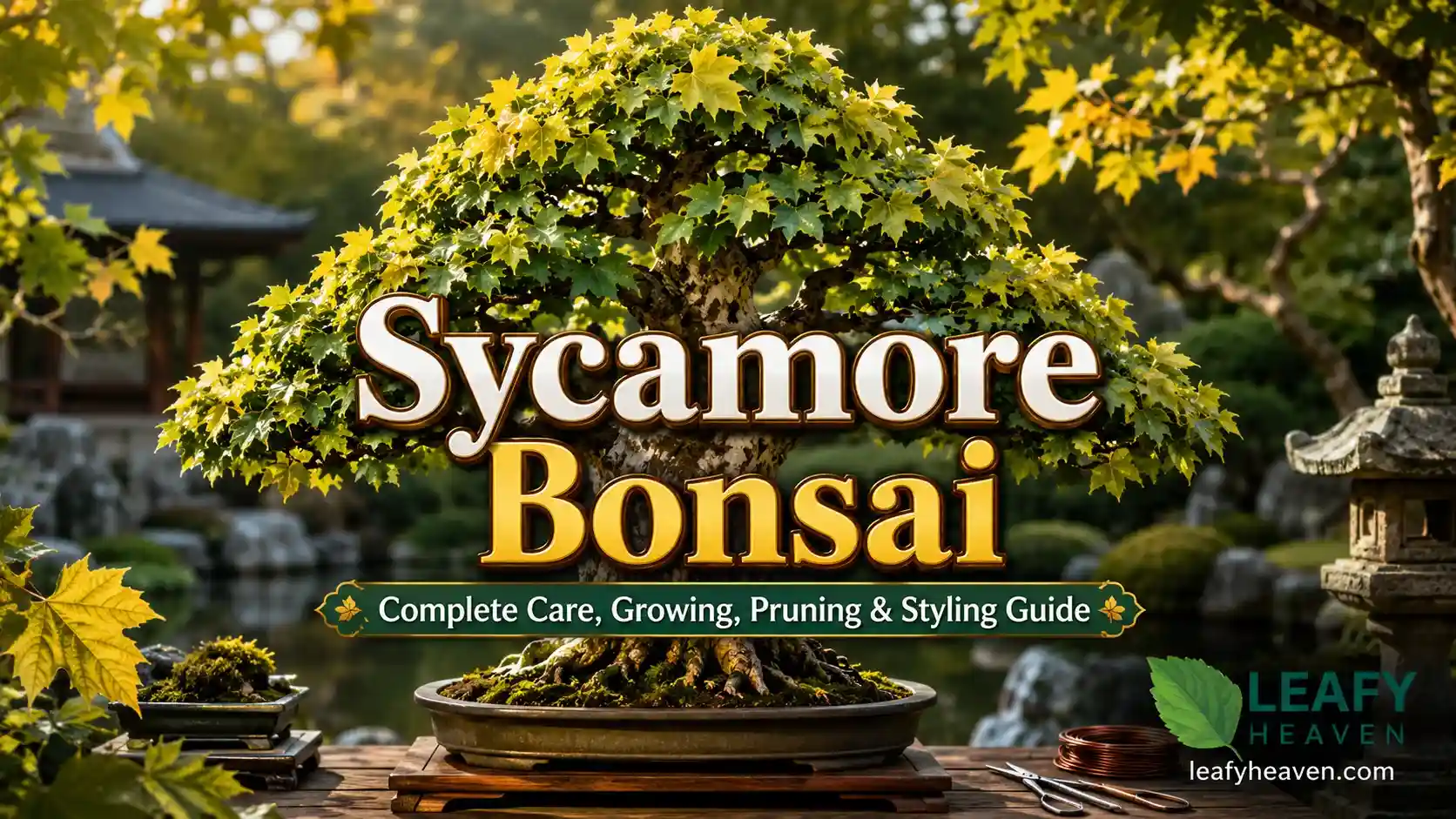
A sycamore bonsai is a miniature version of a sycamore tree, most commonly grown from Acer pseudoplatanus (Sycamore Maple) or Platanus occidentalis (American Sycamore). It is valued for its vigorous growth, attractive foliage, and excellent suitability as an outdoor bonsai tree.
Sycamore species are well suited for bonsai because they develop strong trunks, respond well to pruning, and produce dense branching over time. Their natural vigor allows growers to shape and refine the tree using traditional bonsai techniques such as root pruning, ramification development, and structural training. These characteristics make both the sycamore maple bonsai and American sycamore bonsai attractive options for long-term bonsai cultivation.
Many bonsai enthusiasts grow sycamore bonsai trees because they offer rapid development compared to slower-growing species. The combination of seasonal foliage changes, impressive trunk thickening, and adaptable growth habits creates strong visual appeal throughout the year. Mature specimens can develop the appearance of an old landscape tree while remaining compact enough for bonsai display.
Successful sycamore bonsai care depends on several key factors, including proper watering, well-draining bonsai soil, regular fertilization, seasonal pruning, and adequate sunlight exposure. As deciduous trees, sycamores also require outdoor growing conditions and winter dormancy to maintain long-term health and vigor.
Both beginners and advanced growers can enjoy growing a sycamore bonsai. Beginners often appreciate its resilience and fast growth, while experienced bonsai practitioners value its potential for advanced styling, branch refinement, and long-term development. With consistent care and proper training, a sycamore bonsai can become a highly impressive bonsai specimen that improves with age.
What Is a Sycamore Bonsai?
A sycamore bonsai is a trained miniature tree developed from sycamore species through pruning, root management, and bonsai techniques. The goal is to create a compact tree that reflects the appearance, structure, and maturity of a full-sized sycamore while maintaining a much smaller size.
Unlike naturally dwarf trees, a sycamore bonsai is shaped through continuous cultivation practices. Regular pruning, branch training, root reduction, and careful maintenance allow the tree to develop proportion, trunk taper, and refined branching over time.
The term sycamore bonsai most commonly refers to bonsai created from either Acer pseudoplatanus (Sycamore Maple) or Platanus occidentalis (American Sycamore). Both species are deciduous trees known for vigorous growth and strong development potential.
Scientific Classification of Sycamore Bonsai
Several sycamore-related species can be trained as bonsai, but two species are most commonly associated with sycamore bonsai cultivation.
Acer pseudoplatanus (Sycamore Maple)
Acer pseudoplatanus, commonly called Sycamore Maple, is a large deciduous maple native to Europe and Western Asia. It belongs to the maple family and is widely used in European bonsai collections because of its adaptability and strong response to pruning.
Key characteristics include:
- Broad lobed leaves
- Vigorous growth
- Good cold tolerance
- Strong branch development
- Reliable response to bonsai training
Platanus occidentalis (American Sycamore)
Platanus occidentalis, commonly known as American Sycamore, is native to North America. It is recognized for its impressive trunk growth and distinctive exfoliating bark.
Important features include:
- Large broad leaves
- Fast growth rate
- Strong root system
- Attractive mature bark
- Excellent trunk thickening potential
Family and Botanical Classification
| Classification | Acer pseudoplatanus | Platanus occidentalis |
| Kingdom | Plantae | Plantae |
| Division | Magnoliophyta | Magnoliophyta |
| Class | Magnoliopsida | Magnoliopsida |
| Family | Sapindaceae | Platanaceae |
| Genus | Acer | Platanus |
| Common Name | Sycamore Maple | American Sycamore |
| Growth Type | Deciduous Tree | Deciduous Tree |
Common Names
Depending on the species, region, and bonsai community, sycamore bonsai may be known by several common names.
Common names include:
- Sycamore Bonsai
- Bonsai Sycamore Tree
- Sycamore Tree Bonsai
- Sycamore Maple Bonsai
These names generally refer to bonsai specimens created from sycamore-related species and trained using traditional bonsai methods.
Sycamore Maple vs American Sycamore
Both Acer pseudoplatanus and Platanus occidentalis can be developed into bonsai, but they differ in several important characteristics that influence training and maintenance.
Comparison Table
| Feature | Acer pseudoplatanus | Platanus occidentalis |
| Common Name | Sycamore Maple | American Sycamore |
| Family | Sapindaceae | Platanaceae |
| Native Region | Europe and Western Asia | North America |
| Growth Rate | Fast | Very Fast |
| Leaf Size | Moderate | Large |
| Leaf Reduction Potential | Better | More Challenging |
| Bark Characteristics | Gray and textured with age | Distinctive peeling bark |
| Bonsai Popularity | High | Moderate |
| Training Ease | Easier | Slightly More Challenging |
| Best Use | Traditional bonsai styling | Powerful trunk-focused bonsai |
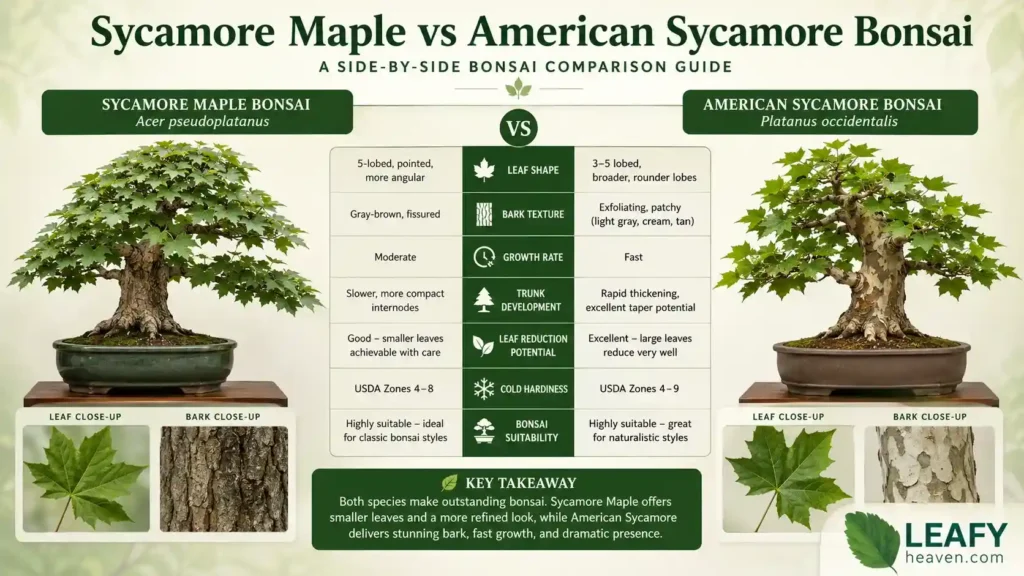
Quick Summary Block
- Sycamore Maple is generally the more popular bonsai choice.
- American Sycamore is valued for its dramatic bark and rapid growth.
- Both species are vigorous deciduous trees suitable for outdoor bonsai cultivation.
- Proper pruning and root management are essential for both species.
Which Species Is Easier for Bonsai?
Acer pseudoplatanus is generally considered easier for bonsai development. It responds predictably to pruning, produces finer branching, and typically develops more balanced proportions during training.
American Sycamore can also produce impressive bonsai, but its larger leaves and stronger growth often require more intensive maintenance and refinement.
Leaf Size Differences
Leaf size is one of the most noticeable differences between the two species.
Sycamore Maple naturally develops smaller leaves that are easier to manage and reduce through bonsai techniques. American Sycamore typically produces larger foliage, making leaf reduction more challenging during the refinement stage.
Growth Habit Differences
Sycamore Maple tends to produce a balanced branching structure with good ramification potential. This growth habit aligns well with many traditional bonsai styles.
American Sycamore often exhibits more vigorous and upright growth. It develops thick trunks quickly and can create powerful bonsai designs, but usually requires more frequent pruning to maintain structure and proportion.
How to Identify a Sycamore Bonsai
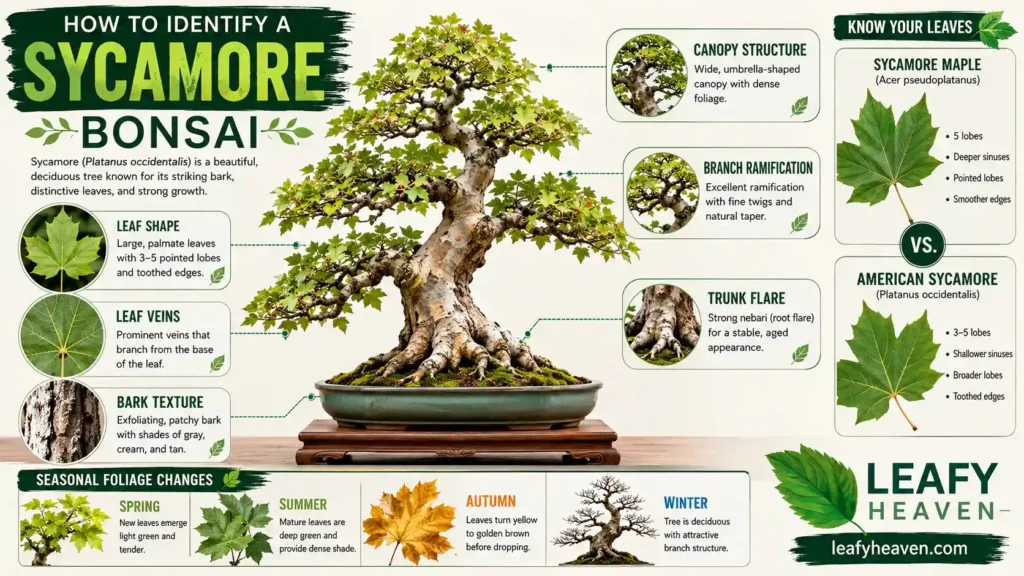
Sycamore bonsai can be identified by its broad leaves, strong branching, vigorous growth, and distinctive bark characteristics. While appearance varies slightly between species, most sycamore bonsai display a robust structure, rapid seasonal growth, and deciduous foliage that changes color throughout the year.
Correct identification is important because leaf characteristics, bark development, and growth habits influence pruning, styling, and long-term bonsai care.
Sycamore Leaf Characteristics
The leaves are often the easiest feature to use when identifying a sycamore bonsai. Both Sycamore Maple and American Sycamore produce broad leaves, but their shapes and sizes differ.
Healthy foliage is typically dense during the growing season and contributes significantly to the tree’s visual appeal.
Sycamore Leaf Shape
Sycamore leaf shape depends on the species being grown.
Sycamore Maple leaves are typically five-lobed and resemble the leaves of many other maple species. The lobes are broad, with smooth to slightly toothed margins and a balanced symmetrical appearance.
American Sycamore leaves are generally larger and have a broader outline. They often display three to five shallow lobes with a more irregular shape compared to maple foliage.
Sycamore Tree Leaf Structure
The leaf structure of a sycamore tree is designed to support vigorous growth and efficient light collection.
Common characteristics include:
- Broad leaf blades
- Prominent vein patterns
- Strong leaf stems
- Deciduous growth habit
- Dense seasonal foliage production
Leaves emerge rapidly during spring and remain active throughout the growing season before entering dormancy in autumn.
Seasonal Color Changes
Sycamore bonsai undergoes noticeable seasonal changes that help with identification.
Typical seasonal appearance includes:
| Season | Foliage Appearance |
| Spring | Fresh light green growth |
| Summer | Rich medium to dark green foliage |
| Autumn | Yellow, golden, or bronze coloration |
| Winter | Leafless dormant structure |
The exact autumn color varies according to species, climate, and growing conditions.
American Sycamore Leaves vs Sycamore Maple Leaves
Although both species produce broad leaves, several differences make identification easier.
| Feature | American Sycamore | Sycamore Maple |
| Leaf Size | Larger | Smaller |
| Leaf Shape | Broad and irregular | More symmetrical |
| Lobes | Shallow lobes | Distinct maple-like lobes |
| Leaf Reduction Potential | Lower | Higher |
| Bonsai Refinement | More challenging | Easier |
Sycamore Maple foliage generally becomes more refined under bonsai cultivation. American Sycamore leaves often remain larger even after years of training.
Bark, Trunk, and Branch Features
Bark, trunk development, and branch structure provide additional clues when identifying a sycamore bonsai.
Young trees usually have relatively smooth bark, while mature specimens develop more texture and visual character over time.
Common identifying features include:
- Strong trunk thickening
- Vigorous branch growth
- Good taper development
- Dense branching potential
- Attractive mature bark texture
American Sycamore is especially recognizable for its exfoliating bark. As the bark peels away, patches of cream, gray, brown, and green may become visible, creating a camouflage-like appearance.
Sycamore Maple typically develops gray to dark gray bark that becomes rougher and more textured with age.
Growth Habit and Tree Structure
Sycamore bonsai is known for its vigorous and upright growth habit. The tree naturally produces strong extension growth during the growing season and responds quickly to pruning.
Typical structural characteristics include:
- Rapid trunk development
- Strong apical growth
- Dense branch formation
- Broad canopy potential
- Excellent ramification with training
These growth habits allow growers to create a wide range of bonsai designs while maintaining the appearance of a mature deciduous tree.
Definition Box
Sycamore Maple (Acer pseudoplatanus):
A large deciduous maple species commonly used in European bonsai cultivation.
Sycamore Bonsai Tree Characteristics
Sycamore bonsai trees are vigorous deciduous bonsai known for rapid growth and strong trunk development. Their natural energy, adaptability, and ability to respond well to training make them popular among growers seeking a tree with long-term development potential.
Whether grown from Acer pseudoplatanus or Platanus occidentalis, sycamore bonsai typically develops a powerful structure, dense branching, and attractive seasonal foliage when properly maintained.
Mature Size and Height
The mature size of a sycamore bonsai depends on its age, species, bonsai style, and training goals.
Most cultivated specimens are maintained between 12 and 36 inches (30–90 cm) in height. Larger exhibition trees may exceed this range, especially when designed in broom, informal upright, or multi-trunk styles.
Regular pruning and root management help maintain proportion while encouraging trunk thickening and branch refinement.
Growth Rate
Sycamore bonsai is considered a fast-growing deciduous bonsai species.
During the active growing season, healthy trees can produce significant extension growth. This vigorous growth allows growers to build trunk size and primary branch structure more quickly than many slower-growing bonsai species.
Factors influencing growth rate include:
- Sunlight availability
- Watering consistency
- Soil quality
- Fertilization schedule
- Climate conditions
Because of its strong growth habit, sycamore bonsai usually requires regular pruning throughout the growing season.
Leaf Development
Leaf development begins in spring when buds open and fresh foliage emerges.
New leaves are typically bright green and gradually mature into deeper shades during summer. As autumn approaches, foliage often changes to yellow, gold, or bronze before dropping during winter dormancy.
Leaf size can be gradually reduced through:
- Ramification development
- Controlled fertilization
- Proper pruning techniques
- Balanced watering practices
Sycamore Maple generally produces smaller and more manageable leaves than American Sycamore.
Root System Characteristics
Sycamore bonsai develops a vigorous and extensive root system.
Healthy trees produce abundant feeder roots that support rapid growth and efficient nutrient uptake. This strong root development contributes to the species’ resilience and ability to recover from repotting and root pruning.
Important root characteristics include:
- Dense fibrous roots
- Strong feeder root production
- Fast root regeneration
- Good tolerance to root pruning
- Strong anchoring ability
Regular repotting is important because vigorous roots can quickly fill a bonsai container.
Lifespan and Longevity
With proper care, a sycamore bonsai can remain healthy and attractive for several decades.
Long-term success depends on consistent maintenance, including proper watering, seasonal pruning, fertilization, pest management, and periodic repotting. As the tree matures, trunk character, bark texture, and branch ramification continue to improve.
Many mature sycamore bonsai become more visually impressive with age as they develop the appearance of a full-sized ancient tree in miniature form.
Quick Facts Table
| Characteristic | Details |
| Tree Type | Deciduous Bonsai |
| Common Species | Acer pseudoplatanus, Platanus occidentalis |
| Growth Rate | Fast |
| Mature Bonsai Height | 12–36 inches (30–90 cm) |
| Leaf Size | Moderate to Large |
| Leaf Reduction Potential | Moderate |
| Root Growth | Vigorous |
| Trunk Development | Fast |
| Sun Requirement | Full Sun to Partial Sun |
| Indoor Suitability | Poor |
| Outdoor Suitability | Excellent |
| Repotting Frequency | Every 2–4 Years |
| Cold Hardiness | Good |
| Lifespan | Several Decades |
| Skill Level | Beginner to Intermediate |
Is Sycamore a Good Tree for Bonsai?
Yes, sycamore can become an attractive bonsai because it responds well to pruning and develops impressive trunks. Its vigorous growth, strong root system, and ability to recover from training make it a practical choice for both bonsai development and long-term refinement.
While sycamore bonsai requires regular maintenance to control its growth, it rewards growers with rapid structural development and a mature appearance that can be achieved faster than many slower-growing species.
Advantages of Growing Sycamore Bonsai
Sycamore offers several qualities that make it suitable for bonsai cultivation.
Key advantages include:
- Fast trunk thickening
- Vigorous growth and recovery
- Strong response to pruning
- Good tolerance to root work
- Attractive deciduous foliage
- Excellent branch development potential
- Long lifespan with proper care
- Adaptability to multiple bonsai styles
Many growers appreciate sycamore bonsai because it allows visible progress within a relatively short period. This makes it especially appealing for those who enjoy developing trees from young material.
The species also develops strong structural characteristics that help create the appearance of an aged tree in miniature form.
Challenges of Sycamore Bonsai
Although sycamore bonsai offers many benefits, it also presents some challenges that growers should understand.
Common challenges include:
- Rapid growth requiring frequent pruning
- Larger leaves compared to some bonsai species
- Strong apical dominance
- Regular repotting needs
- Potential leaf scorch during extreme heat
- Branch thickening that can occur quickly if not managed
American Sycamore can be particularly challenging because its naturally large leaves often require more effort to balance with the overall bonsai design.
Without consistent maintenance, vigorous growth may quickly reduce the refined appearance of the tree.
Beginner vs Advanced Suitability
Sycamore bonsai can be suitable for both beginners and experienced bonsai enthusiasts, although the reasons differ.
For beginners, sycamore offers:
- Strong growth and resilience
- Good recovery from mistakes
- Easy establishment
- Reliable response to pruning
- Faster development than many species
For advanced growers, sycamore provides opportunities for:
- Advanced ramification techniques
- Leaf reduction training
- Detailed branch refinement
- Complex styling projects
- Long-term trunk and bark development
Because the tree grows vigorously, beginners can learn important bonsai techniques while observing results relatively quickly.
More experienced practitioners often appreciate the challenge of refining foliage and developing highly detailed branch structures.
Why Sycamore Is Different From Other Bonsai Trees
Sycamore bonsai differs from many traditional bonsai species because of its combination of vigor, trunk-building ability, and deciduous character.
Unlike slower-growing species that may require many years to develop significant trunk size, sycamore can create substantial structural growth within a shorter timeframe. This makes it particularly useful for growers focused on trunk development and primary branch formation.
Compared to species such as Japanese Maple, sycamore generally grows more aggressively and requires more frequent maintenance. Compared to conifer bonsai such as pine or juniper, sycamore develops faster but relies heavily on seasonal pruning and deciduous tree techniques.
Distinctive characteristics that set sycamore bonsai apart include:
- Rapid trunk development
- Strong seasonal growth cycles
- Vigorous root production
- Broad deciduous foliage
- Excellent recovery after pruning
- Ability to develop powerful bonsai designs
These qualities make sycamore bonsai a rewarding species for growers seeking a strong, fast-developing deciduous bonsai with long-term styling potential.
Growers who want to explore the full range of deciduous options will find this comprehensive guide to bonsai trees helpful for building foundational knowledge before beginning sycamore training.
Growing Requirements for Sycamore Bonsai
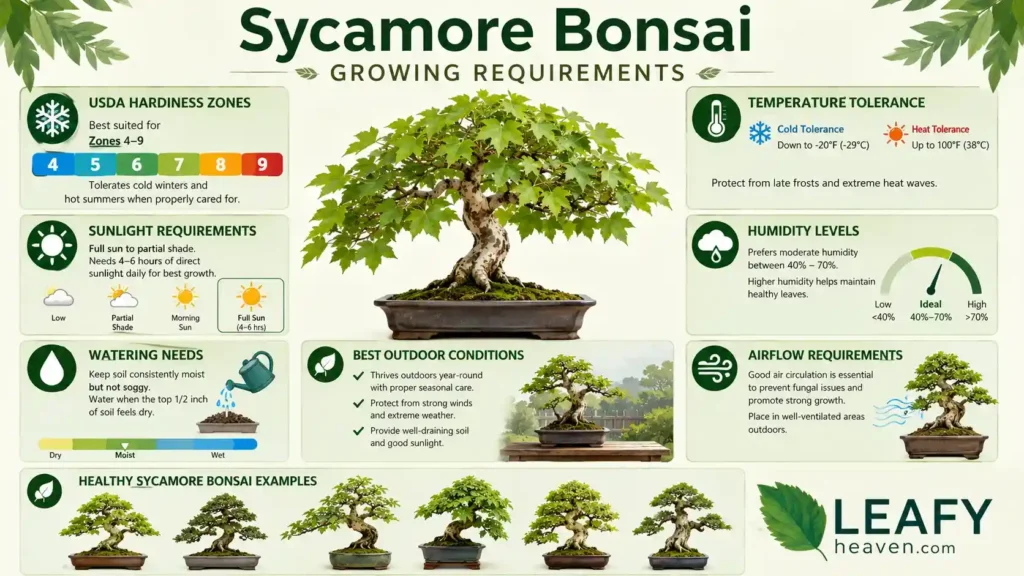
Sycamore bonsai grows best outdoors with full sun, well-draining soil, and consistent watering. As a deciduous tree, it relies on natural seasonal changes to maintain healthy growth, develop strong roots, and enter winter dormancy.
Providing the correct growing environment is one of the most important factors in long-term sycamore bonsai health. Proper light, temperature, humidity, and airflow help reduce stress while supporting vigorous growth and foliage development.
USDA Hardiness Zones
Sycamore bonsai is generally well suited to temperate climates and can tolerate a wide range of weather conditions.
Most sycamore species perform best in:
- USDA Zone 4–8 for Acer pseudoplatanus
- USDA Zone 4–9 for Platanus occidentalis
Growers can verify their exact zone using the official USDA Plant Hardiness Zone Map before selecting a species.
Trees grown within their recommended hardiness range usually experience healthy seasonal growth and reliable winter dormancy.
In colder regions, additional root protection may be necessary during severe freezes, especially when the tree is growing in a shallow bonsai container.
Sunlight Requirements
Sycamore bonsai thrives in bright outdoor conditions and benefits from several hours of direct sunlight each day.
Ideal sunlight exposure includes:
- Full morning sun
- 6–8 hours of daily light
- Partial afternoon protection in extremely hot climates
- Open outdoor placement during the growing season
Adequate sunlight promotes:
- Strong branch development
- Healthy foliage production
- Better internode control
- Improved trunk thickening
Trees grown in excessive shade often develop weak growth, larger leaves, and elongated branches.
Temperature Tolerance
Sycamore bonsai is known for its ability to tolerate a broad temperature range.
Healthy trees can generally withstand:
- Summer temperatures above 85°F (29°C)
- Moderate winter freezes
- Seasonal temperature fluctuations
- Cool spring and autumn conditions
However, prolonged extreme heat may cause leaf scorch, especially when combined with drought stress.
During severe winter conditions, protecting the root system from prolonged freezing helps prevent root damage.
Humidity Needs
Sycamore bonsai adapts well to average outdoor humidity levels and does not require unusually high humidity to thrive.
Moderate humidity supports:
- Healthy foliage
- Reduced moisture stress
- Consistent growth
- Better leaf quality
In very dry climates, regular watering becomes especially important because moisture loss from leaves and soil can increase significantly during hot weather.
Maintaining healthy soil moisture is generally more important than attempting to artificially increase humidity.
Air Circulation Requirements
Good airflow is essential for maintaining a healthy sycamore bonsai.
Proper air circulation helps:
- Reduce fungal disease risk
- Dry excess moisture from foliage
- Improve overall tree vigor
- Discourage pest infestations
- Support healthy leaf development
Avoid placing the tree in enclosed areas with stagnant air. Outdoor locations with steady natural airflow typically provide the best growing conditions.
When growing multiple bonsai together, sufficient spacing between trees helps maintain good ventilation around the canopy.
Quick Summary Block
Ideal Growing Conditions at a Glance
| Growing Factor | Recommended Conditions |
| Location | Outdoors |
| USDA Hardiness Zones | 4–8 (Acer pseudoplatanus), 4–9 (Platanus occidentalis) |
| Sunlight | Full Sun to Partial Sun |
| Daily Light | 6–8 Hours |
| Soil Type | Fast-Draining Bonsai Soil |
| Watering | Consistent, Never Waterlogged |
| Humidity | Moderate Outdoor Humidity |
| Airflow | Good Natural Air Circulation |
| Winter Requirement | Seasonal Dormancy |
| Heat Tolerance | Moderate to High |
| Cold Tolerance | Good with Root Protection |
A combination of full sun, proper watering, well-draining soil, and seasonal outdoor conditions provides the foundation for successful sycamore bonsai cultivation.
Best Soil for Sycamore Bonsai
A fast-draining bonsai soil mix helps prevent root rot while supporting healthy growth. Sycamore bonsai develops a vigorous root system that requires a balance of moisture retention, aeration, and drainage to remain healthy throughout the year.
The ideal soil allows water to move freely through the container while still retaining enough moisture to support active growth. Poorly draining soil can quickly lead to root problems, weak growth, and reduced tree vigor.
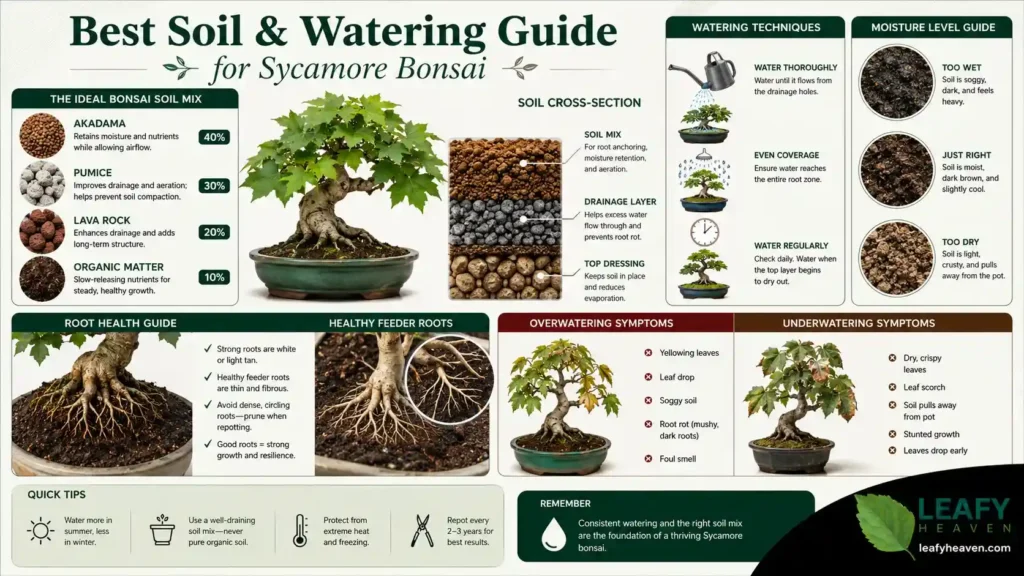
Recommended Soil Components
A quality sycamore bonsai soil mix is typically built from several components that work together to provide drainage, oxygen, and moisture management.
Akadama
Akadama is a traditional Japanese bonsai soil component valued for its water retention and root development benefits.
Benefits of akadama include:
- Retains moisture without becoming waterlogged
- Encourages fine feeder root growth
- Improves nutrient retention
- Supports healthy root structure
As akadama gradually breaks down over time, it also helps indicate when repotting may be necessary.
Pumice
Pumice is a lightweight volcanic material commonly used in bonsai soil mixes.
Advantages of pumice include:
- Excellent aeration
- Good moisture retention
- Improved root oxygenation
- Enhanced drainage performance
Pumice helps maintain a healthy balance between moisture and airflow around the root system.
Lava Rock
Lava rock provides long-term structure and drainage within the soil mix.
Key benefits include:
- Prevents soil compaction
- Improves airflow
- Supports drainage
- Maintains soil stability over time
Because lava rock decomposes very slowly, it contributes to a durable bonsai soil structure.
Organic Matter
A small amount of organic matter can help increase moisture retention and nutrient availability.
Common organic components include:
- Pine bark fines
- Composted bark
- High-quality organic bonsai compost
Organic matter should be used in moderation because excessive amounts may reduce drainage and increase the risk of root problems.
Soil Drainage Requirements
Proper drainage is one of the most important requirements for a healthy sycamore bonsai.
The soil should allow excess water to leave the container quickly while maintaining adequate moisture for root growth. Roots that remain constantly saturated are more vulnerable to fungal diseases and root rot.
Signs of good drainage include:
- Water flowing freely from drainage holes
- Soil that remains moist but not soggy
- Healthy white feeder roots
- Consistent growth and foliage development
Signs of poor drainage include:
- Persistently wet soil
- Foul soil odor
- Yellowing leaves
- Slow growth
- Root decline
Using a bonsai pot with adequate drainage holes is just as important as selecting the correct soil mix.
Repotting Soil Mix Recommendations
The best soil mix may vary depending on climate, rainfall, and watering frequency.
Growers in hot and dry regions often need slightly more moisture retention, while those in humid or rainy areas benefit from additional drainage materials.
When repotting, the goal is to create a soil environment that supports vigorous root growth while preventing excessive moisture accumulation.
A balanced mix of akadama, pumice, and lava rock is suitable for most sycamore bonsai trees and can be adjusted according to local conditions.
Table: Soil Mix Ratios for Different Climates
| Climate Type | Akadama | Pumice | Lava Rock | Organic Matter |
| Hot and Dry Climate | 50% | 25% | 15% | 10% |
| Moderate Temperate Climate | 40% | 30% | 20% | 10% |
| Humid Climate | 35% | 35% | 25% | 5% |
| High Rainfall Areas | 30% | 35% | 30% | 5% |
| Beginner General Mix | 40% | 30% | 20% | 10% |
These ratios can be adjusted based on individual growing conditions, watering habits, and tree health. The primary objective is always to provide excellent drainage while maintaining sufficient moisture and aeration for healthy root development.
How to Water a Sycamore Bonsai
Water thoroughly when the upper soil layer begins to dry, but never allow prolonged waterlogging. Sycamore bonsai prefers consistently moist soil, yet excessive moisture around the roots can lead to serious health problems, including root rot and reduced vigor.
The correct watering routine depends on temperature, sunlight exposure, soil composition, tree size, and seasonal growth activity. Rather than watering on a fixed schedule, it is best to monitor soil moisture and water according to the tree’s needs.
Watering During Spring and Summer
Spring and summer are the most active growth periods for sycamore bonsai. During these seasons, the tree produces new shoots, leaves, and roots, which increases water consumption.
Watering requirements are usually highest during warm weather.
Best practices include:
- Check soil moisture daily
- Water thoroughly until water exits the drainage holes
- Water more frequently during heatwaves
- Avoid allowing the root ball to completely dry out
- Water early in the morning when possible
Trees growing in full sun and shallow bonsai containers may require watering once or even twice daily during extremely hot periods.
The goal is to keep the soil evenly moist without creating constantly saturated conditions.
Watering During Autumn and Winter
Water requirements decrease significantly during autumn and winter as growth slows and the tree enters dormancy.
Although less water is needed, the roots should never be allowed to dry completely.
Autumn and winter watering guidelines include:
- Check soil moisture before watering
- Reduce watering frequency as temperatures decline
- Water only when the upper soil layer begins to dry
- Avoid leaving soil excessively wet during cold weather
- Monitor moisture carefully during dry winter winds
Dormant trees consume less water, but healthy roots still require consistent moisture throughout the winter season.
Signs of Overwatering
Overwatering is one of the most common causes of sycamore bonsai decline.
Excess moisture reduces oxygen availability around the roots and can encourage fungal diseases.
Common signs of overwatering include:
- Yellowing leaves
- Soft or weak new growth
- Premature leaf drop
- Persistently wet soil
- Foul odor from the pot
- Slow growth despite adequate light
- Blackened or damaged roots
If overwatering is suspected, improve drainage, reduce watering frequency, and inspect the root system during the next repotting cycle.
Signs of Underwatering
Underwatering occurs when the root system does not receive enough moisture to support healthy growth.
Because sycamore bonsai has broad foliage, water loss can increase rapidly during warm weather.
Common signs of underwatering include:
- Wilting leaves
- Crispy leaf edges
- Dry soil pulling away from the pot
- Premature leaf drop
- Reduced growth
- Leaf scorch during hot conditions
- Weak or stressed appearance
Severe drought stress can damage fine feeder roots and slow recovery even after watering resumes.
Troubleshooting Table
| Problem | Likely Cause | Solution |
| Yellow Leaves | Overwatering or poor drainage | Allow soil to dry slightly and improve drainage |
| Wilting Leaves with Wet Soil | Root stress from excess moisture | Reduce watering and inspect root health |
| Crispy Leaf Edges | Underwatering or heat stress | Increase watering frequency and monitor moisture |
| Soil Always Wet | Poor soil drainage | Repot into a fast-draining bonsai mix |
| Premature Leaf Drop | Watering imbalance | Adjust watering routine based on soil moisture |
| Slow Growth | Root problems caused by excess water | Improve aeration and drainage |
| Dry Root Ball | Infrequent watering | Soak thoroughly and establish a consistent watering routine |
| Leaf Scorch | Heat combined with insufficient moisture | Increase monitoring during hot weather |
A healthy sycamore bonsai should have evenly moist soil, vigorous growth, and healthy foliage throughout the growing season. Consistent observation of soil moisture is far more effective than following a rigid watering schedule.
Fertilizing Sycamore Bonsai for Healthy Growth
Balanced fertilization supports trunk thickening, foliage development, and root health. Because sycamore bonsai is a vigorous deciduous tree, it requires a steady supply of nutrients throughout the growing season to maintain strong growth and healthy foliage.
A consistent fertilizing program helps the tree produce new shoots, develop ramification, strengthen roots, and recover from pruning. Proper nutrition also improves overall vigor and supports long-term bonsai development.
Best Fertilizers
Sycamore bonsai responds well to balanced fertilizers that provide the primary nutrients needed for growth.
The most important nutrients include:
- Nitrogen (N) for leaf and shoot growth
- Phosphorus (P) for root development
- Potassium (K) for overall health and stress resistance
Common fertilizer options include:
- Balanced 10-10-10 fertilizer
- Balanced 12-12-12 fertilizer
- Balanced 15-15-15 fertilizer
- Organic bonsai fertilizer pellets
- Liquid bonsai fertilizers
- Slow-release granular fertilizers
During active development and trunk thickening, slightly higher nitrogen levels can encourage stronger growth. For mature and refined bonsai, balanced formulas are generally preferred to maintain compact growth and healthy foliage.
A healthy fertilization program should support growth without creating excessively long shoots or oversized leaves.
Seasonal Fertilizing Schedule
Fertilizer requirements change throughout the year as the tree moves through different growth stages.
Spring
Spring is the most important fertilizing period because new growth emerges rapidly.
Recommended practices include:
- Begin fertilizing after new buds open
- Apply fertilizer regularly during active growth
- Support shoot and root development
- Encourage branch formation
Summer
Continue fertilization during summer while monitoring growth strength.
Summer fertilizing goals include:
- Maintaining healthy foliage
- Supporting trunk development
- Sustaining root activity
- Replacing nutrients lost through watering
During periods of extreme heat, some growers reduce fertilizer strength to avoid stressing the tree.
Autumn
Autumn fertilization helps prepare the tree for winter dormancy.
Benefits include:
- Strengthening roots
- Building energy reserves
- Supporting overall tree health
- Improving spring vigor
Nitrogen-heavy fertilizers are generally reduced as growth slows.
Winter
Sycamore bonsai typically does not require fertilization during winter dormancy.
Because growth is inactive, nutrient uptake decreases significantly. Fertilizing during this period is usually unnecessary and may encourage unwanted growth if temperatures become temporarily warm.
Seasonal Fertilizing Schedule Table
| Season | Fertilizing Recommendation |
| Early Spring | Begin regular feeding after bud break |
| Late Spring | Apply balanced fertilizer consistently |
| Summer | Continue feeding during active growth |
| Early Autumn | Maintain moderate fertilization |
| Late Autumn | Gradually reduce feeding |
| Winter | Do not fertilize during dormancy |
Organic vs Synthetic Fertilizers
Both organic and synthetic fertilizers can successfully support sycamore bonsai growth when used correctly.
Organic Fertilizers
Organic fertilizers release nutrients gradually as they break down.
Advantages include:
- Slow, steady nutrient release
- Lower risk of fertilizer burn
- Improved soil biology
- Consistent feeding over time
Common organic options include:
- Rapeseed cakes
- Cottonseed meal
- Fish-based fertilizers
- Organic bonsai pellets
Organic fertilizers are often preferred by bonsai growers seeking stable growth and long-term soil health.
Synthetic Fertilizers
Synthetic fertilizers provide nutrients in a readily available form.
Advantages include:
- Fast nutrient availability
- Precise nutrient control
- Easy dosage adjustment
- Rapid correction of deficiencies
Common synthetic options include:
- Water-soluble fertilizers
- Granular balanced fertilizers
- Slow-release synthetic products
Because nutrients become available quickly, careful application is important to prevent overfertilization.
Organic vs Synthetic Comparison
| Feature | Organic Fertilizer | Synthetic Fertilizer |
| Nutrient Release | Slow | Fast |
| Risk of Burn | Low | Moderate |
| Soil Improvement | Yes | Minimal |
| Nutrient Precision | Moderate | High |
| Feeding Frequency | Less Frequent | Often More Frequent |
| Beginner Friendly | High | Moderate |
Both fertilizer types can produce excellent results. The best choice often depends on growing goals, maintenance preferences, and the specific needs of the sycamore bonsai. Consistent feeding, combined with proper watering and sunlight, helps maintain vigorous growth and long-term tree health.
How to Prune and Shape a Sycamore Bonsai
Regular pruning controls leaf size, improves ramification, and maintains bonsai structure. Sycamore bonsai grows vigorously, so pruning is essential for keeping the tree compact, balanced, and visually refined.
Pruning should support the tree’s natural deciduous structure while improving trunk taper, branch placement, canopy density, and overall proportion.
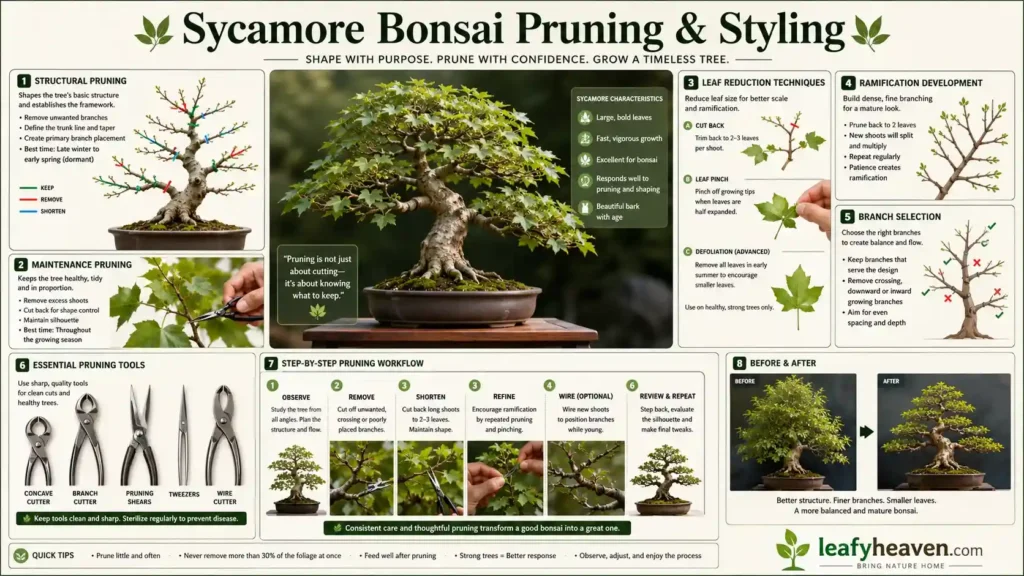
Structural Pruning
Structural pruning builds the main framework of the sycamore bonsai.
This type of pruning is used to select the trunk line, primary branches, and major design direction. It is usually done during dormancy or early spring before strong new growth begins.
Structural pruning helps:
- Remove unwanted large branches
- Improve trunk movement
- Create branch spacing
- Establish taper
- Build the main silhouette
- Correct poor branch angles
Large cuts should be made cleanly with sharp bonsai tools. Cut paste may be used on major wounds to reduce drying and support proper callus formation.
Maintenance Pruning
Maintenance pruning controls active growth during the growing season.
Sycamore bonsai produces strong shoots quickly, so regular trimming helps maintain shape and prevents the canopy from becoming coarse or overcrowded.
Maintenance pruning usually includes:
- Shortening long shoots
- Removing crossing branches
- Cutting back overly strong growth
- Thinning dense foliage
- Keeping the canopy balanced
- Encouraging compact branching
A common method is to allow new shoots to extend several leaves, then cut back to one or two pairs of leaves. This helps maintain energy while encouraging finer growth.
Leaf Reduction Techniques
Leaf reduction helps improve proportion, especially because sycamore species naturally produce broad leaves.
Leaf size can be reduced gradually through consistent bonsai training rather than one aggressive technique.
Effective leaf reduction methods include:
- Increasing ramification
- Providing strong sunlight
- Avoiding excessive nitrogen
- Using controlled watering
- Pruning long shoots regularly
- Maintaining a healthy root system
Partial leaf trimming may be used on strong, healthy trees, but complete defoliation should be approached carefully. Young or weak sycamore bonsai should not be heavily defoliated.
Sycamore Maple usually responds better to leaf reduction than American Sycamore because its natural leaf size is more manageable.
Ramification Development
Ramification is the development of fine secondary and tertiary branches.
Good ramification gives a sycamore bonsai a mature, tree-like appearance and improves winter structure after leaf drop.
To develop ramification:
- Prune strong shoots consistently
- Encourage back budding
- Remove overly thick branches early
- Keep branch tips balanced
- Avoid allowing one area to dominate growth
- Rotate the tree for even sunlight exposure
Ramification improves gradually over several growing seasons. The process requires patience, consistent pruning, and balanced tree health.
Common Pruning Mistakes
Pruning mistakes can weaken the tree or create poor structure.
Common mistakes include:
- Pruning too heavily on a weak tree
- Leaving long internodes unchecked
- Removing too much foliage during hot weather
- Allowing thick branches to grow in the wrong position
- Cutting all new growth too early
- Ignoring branch balance
- Using dull or dirty tools
Another common mistake is focusing only on the canopy outline instead of improving internal branch structure. A good sycamore bonsai should have both an attractive silhouette and a strong internal branch framework.
Numbered Step-by-Step Pruning Process
- Inspect the tree structure
Check the trunk line, main branches, branch angles, and overall canopy shape before making cuts. - Remove dead or damaged growth
Cut away dead twigs, weak shoots, diseased branches, and damaged foliage first. - Select important primary branches
Keep branches that support the bonsai design and remove branches that compete with the main structure. - Shorten strong shoots
Allow new shoots to extend, then cut them back to one or two leaf pairs to control growth. - Thin crowded areas
Remove crossing, inward-growing, or overly dense branches to improve light and airflow. - Balance the canopy
Prune stronger areas slightly more while preserving weaker areas to maintain even energy distribution. - Refine branch tips
Trim outer growth to maintain the silhouette and encourage compact ramification. - Check leaf size and internodes
Monitor whether growth is becoming too coarse and adjust pruning, sunlight, and fertilization accordingly. - Clean major cuts properly
Use sharp tools and apply cut paste on larger wounds when needed. - Allow recovery after pruning
Place the sycamore bonsai in suitable outdoor conditions and maintain consistent watering after pruning.
Regular pruning keeps sycamore bonsai healthy, compact, and structurally balanced while improving its long-term bonsai character.
Wiring and Styling Techniques for Sycamore Bonsai
Wiring helps create movement and balanced branch structure in developing bonsai. While pruning establishes the basic framework of a sycamore bonsai, wiring allows growers to position branches, improve spacing, and develop a more natural and aesthetically pleasing design.
Because sycamore bonsai grows vigorously, wiring should be monitored carefully to prevent wire marks from forming on developing branches.
When to Wire Sycamore Bonsai
The best time to wire a sycamore bonsai is when branches are flexible enough to bend safely but strong enough to hold a new position.
Common wiring periods include:
- Late autumn after leaf drop
- Winter dormancy
- Early spring before vigorous growth begins
These periods provide better visibility of the branch structure and reduce interference from dense foliage.
Young branches are generally easier to wire because they remain flexible and respond quickly to shaping. Older branches become stiffer and may require gradual adjustments over time.
Regular inspections are important because rapidly growing branches can thicken quickly and become marked by wire.
Safe Wiring Techniques
Proper wiring techniques help shape the tree while minimizing the risk of damage.
Recommended wiring practices include:
- Use appropriately sized aluminum or copper bonsai wire
- Wrap wire at approximately a 45-degree angle
- Anchor the wire securely before bending
- Bend branches gradually rather than forcing movement
- Avoid excessive pressure on bark
- Remove wire before it cuts into the branch
When shaping branches, create gentle curves and natural movement that complement the overall bonsai design.
For sycamore bonsai, gradual adjustments are usually safer than aggressive bends because deciduous branches can be more prone to cracking than some conifer species.
Signs that wire should be removed include:
- Visible swelling around the wire
- Bark compression
- Rapid branch thickening
- Wire beginning to bite into the bark
Removing and rewiring is generally preferable to leaving wire on for too long.
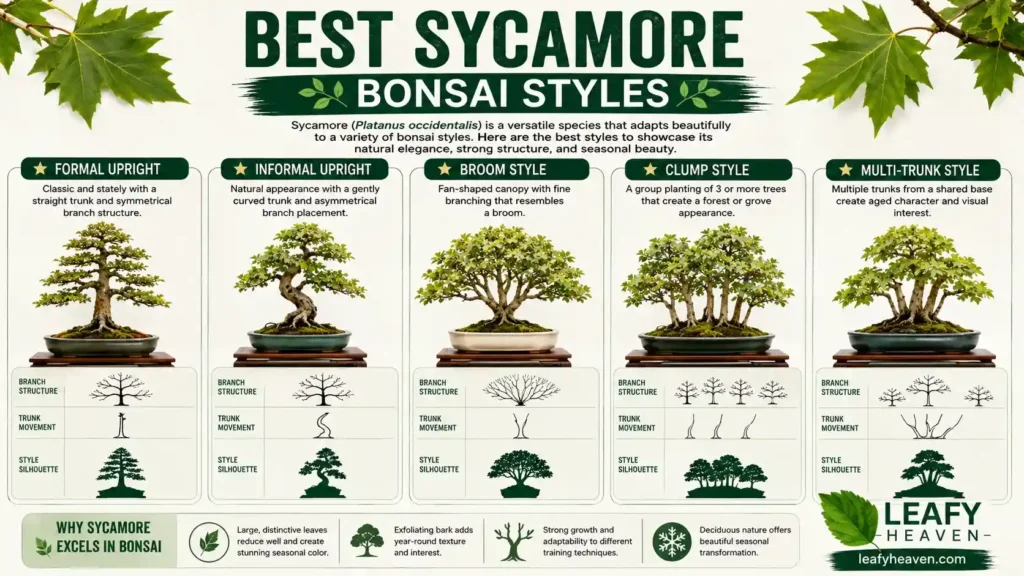
Popular Bonsai Styles
Sycamore bonsai adapts well to several traditional bonsai styles because of its strong growth, branching potential, and deciduous character.
Formal Upright
The Formal Upright style features a straight vertical trunk with evenly spaced branches that gradually decrease in size toward the apex.
Characteristics include:
- Strong central trunk
- Symmetrical structure
- Balanced branch placement
- Classic bonsai appearance
This style works best with trees that naturally develop a straight and powerful trunk.
Informal Upright
The Informal Upright style is one of the most popular choices for sycamore bonsai.
Features include:
- Gently curved trunk
- Natural movement
- Asymmetrical branch placement
- Realistic mature tree appearance
The vigorous growth habit of sycamore makes it well suited to this highly naturalistic style.
Broom Style
Broom Style is particularly effective for deciduous bonsai species such as sycamore.
Key characteristics include:
- Straight trunk
- Rounded crown
- Fine branch ramification
- Balanced canopy structure
This style highlights winter branch structure and creates the appearance of a mature landscape tree.
Clump Style
Clump Style uses several trunks emerging from a shared root system.
Benefits include:
- Natural woodland appearance
- Strong visual interest
- Excellent use of vigorous growth
- Enhanced seasonal display
Sycamore’s rapid growth allows multiple trunks to develop quickly in this design.
Multi-Trunk Style
Multi-Trunk Style consists of several trunks of varying sizes growing together as a single composition.
Common features include:
- Multiple trunk lines
- Natural forest-like character
- Visual depth
- Dynamic composition
This style works particularly well when developing sycamore bonsai from seedlings or grouped saplings.
Comparison Block
Best Styles for Sycamore Bonsai
| Bonsai Style | Suitability | Main Strength |
| Informal Upright | Excellent | Natural movement and mature appearance |
| Broom Style | Excellent | Showcases deciduous branching and ramification |
| Formal Upright | Very Good | Highlights strong trunk development |
| Clump Style | Very Good | Creates a natural multi-stem composition |
| Multi-Trunk Style | Very Good | Adds depth and woodland character |
Quick Style Summary
- Informal Upright is often considered the most versatile style for sycamore bonsai.
- Broom Style highlights fine branching and winter structure.
- Formal Upright works best with straight, powerful trunks.
- Clump Style emphasizes natural growth habits.
- Multi-Trunk Style creates a mature grove-like appearance.
The best style ultimately depends on the tree’s natural structure, trunk characteristics, branch placement, and the long-term vision of the grower.
Repotting Sycamore Bonsai
Repotting every few years keeps roots healthy and prevents the tree from becoming root-bound. Because sycamore bonsai develops a vigorous root system, regular repotting is essential for maintaining root health, improving nutrient uptake, and supporting long-term growth.
Without periodic repotting, roots can become densely packed inside the container, reducing drainage, limiting oxygen availability, and weakening overall tree vigor.
Best Time to Repot
The best time to repot a sycamore bonsai is in late winter or early spring, just before new growth begins.
At this stage, the tree is emerging from dormancy and can recover quickly from root work. Repotting before vigorous spring growth allows new roots to establish efficiently throughout the growing season.
General repotting intervals include:
- Young sycamore bonsai: Every 1–2 years
- Developing bonsai: Every 2–3 years
- Mature bonsai: Every 3–4 years
Repotting frequency should be based on root growth rather than a fixed schedule.
Signs that repotting may be needed include:
- Roots circling the pot
- Reduced drainage
- Slower growth
- Soil breaking down
- Water running off the surface instead of penetrating the root ball
Root Pruning Techniques
Root pruning helps maintain a compact root system and encourages the growth of fine feeder roots.
During repotting, carefully remove the tree from its container and inspect the root mass. Remove old soil gradually while preserving healthy roots.
Recommended root pruning practices include:
- Remove dead or damaged roots
- Shorten long circling roots
- Preserve healthy feeder roots
- Maintain balanced root distribution
- Avoid excessive root removal
For most healthy sycamore bonsai, removing approximately one-third of the root mass is generally sufficient during routine repotting.
Heavy root pruning should be avoided on weak or stressed trees because it may slow recovery and reduce vigor.
Choosing the Right Bonsai Pot
The bonsai pot plays an important role in both aesthetics and root health.
A suitable pot should provide adequate drainage, enough root space, and visual balance with the tree.
Important considerations include:
- Large drainage holes
- Stable construction
- Appropriate depth for root development
- Proportional size relative to the tree
- Good airflow through the soil
For developing sycamore bonsai, slightly larger training pots can encourage stronger growth and faster trunk development.
More refined bonsai specimens are often moved into shallower display containers that complement the tree’s mature appearance.
Because sycamore bonsai grows vigorously, choosing a pot with sufficient room for healthy root expansion is important between repotting cycles.
Post-Repotting Care
Proper aftercare helps the tree recover from root pruning and establish new roots successfully.
Immediately after repotting:
- Water thoroughly until water drains from the pot
- Keep the soil evenly moist
- Protect the tree from extreme heat
- Avoid heavy pruning at the same time
- Delay fertilization for several weeks
- Monitor for signs of stress
During the recovery period, the tree should be placed in a location with good airflow and moderate sunlight exposure.
Most healthy sycamore bonsai resumes active growth within a few weeks as new feeder roots begin developing in the fresh bonsai soil.
Consistent watering and careful observation during this period help ensure a smooth transition and strong growth throughout the remainder of the growing season.
How to Grow Sycamore Bonsai From Seed
Sycamore bonsai can be grown from seed through stratification, germination, and gradual training. Although growing from seed requires patience, it gives growers complete control over trunk development, root structure, and future bonsai design from the earliest stages of growth.
Both Acer pseudoplatanus (Sycamore Maple) and Platanus occidentalis (American Sycamore) can be successfully grown from seed when proper preparation and germination techniques are followed.
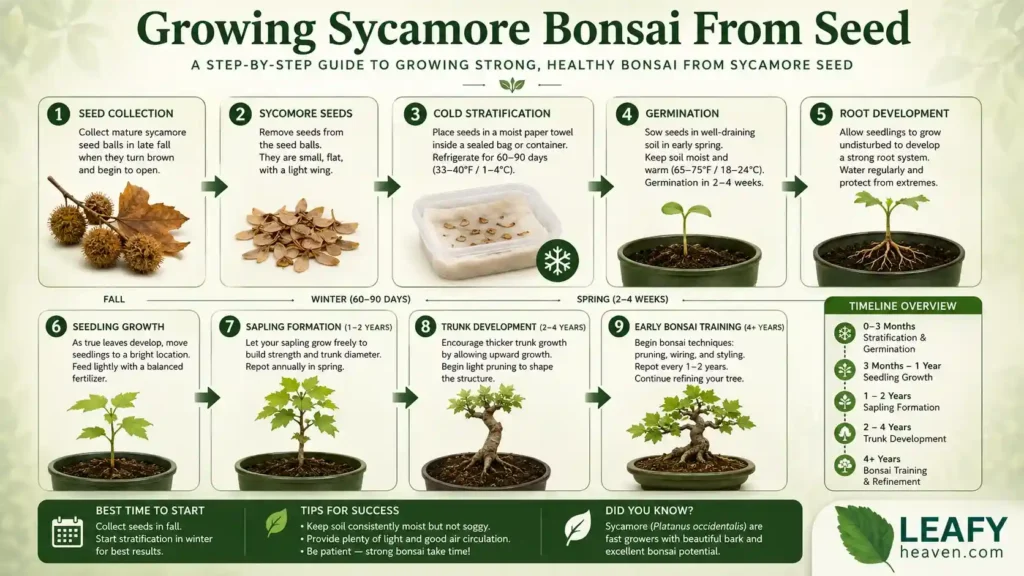
Seed Collection
Seed collection is the first step in growing a sycamore bonsai from seed.
Seeds should be collected from healthy, mature trees during autumn when they have fully developed and reached maturity. Harvesting seeds from vigorous parent trees increases the likelihood of producing strong seedlings.
Seed collection guidelines include:
- Collect seeds during autumn
- Choose healthy parent trees
- Select fully mature seed clusters
- Remove damaged or undeveloped seeds
- Store seeds in a cool, dry location until stratification
Sycamore Maple produces winged samaras, while American Sycamore produces seed balls that contain numerous small seeds.
Cold Stratification
Cold stratification is necessary because sycamore seeds naturally experience winter conditions before germinating in spring.
This process helps break seed dormancy and improves germination rates.
Typical cold stratification steps include:
- Place seeds in a slightly moist medium such as peat moss or vermiculite.
- Seal the mixture in a plastic bag or container.
- Store the seeds in a refrigerator.
- Maintain temperatures between 34°F and 41°F (1°C–5°C).
- Keep the medium lightly moist throughout the process.
Most sycamore seeds require approximately 60–90 days of cold stratification before they are ready to germinate.
Germination Process
After stratification is complete, the seeds can be sown into a well-draining seed-starting mix.
The germination process is most successful when seeds receive consistent moisture, warmth, and adequate light.
Best practices include:
- Sow seeds shallowly in the soil
- Maintain even moisture
- Avoid waterlogged conditions
- Provide bright indirect light
- Keep temperatures moderately warm
- Ensure good air circulation
Germination time varies depending on species and environmental conditions, but seedlings commonly emerge within several weeks after sowing.
Once seedlings develop multiple sets of true leaves, they can gradually be exposed to stronger sunlight and outdoor growing conditions.
Seedling Development Timeline
Seedling development occurs gradually over several years as the tree establishes roots, develops a trunk, and forms branches suitable for bonsai training.
Early growth should focus on building strength rather than immediate styling.
Typical development stages include:
- Germination and root establishment
- Seedling growth
- Trunk thickening
- Primary branch development
- Initial bonsai training
- Structural refinement
Allowing unrestricted growth during the early years often helps accelerate trunk development.
Training a Young Sycamore Sapling
Training begins once the seedling has established a healthy root system and strong growth pattern.
The primary goal during the first few years is to develop the trunk, root base, and primary branch structure.
Important training techniques include:
- Selecting a future trunk line
- Encouraging trunk taper
- Removing unwanted shoots
- Developing radial root spread
- Performing light pruning
- Avoiding excessive early styling
Young sycamore saplings grow vigorously and usually respond well to training. However, heavy pruning and aggressive root work should be avoided until the tree becomes well established.
Patience during the early development phase creates a stronger foundation for future bonsai refinement.
Growth Timeline Table
| Age | Development Stage | Primary Goal |
| 0–3 Months | Germination | Establish roots and first leaves |
| 3–12 Months | Seedling Growth | Build strength and healthy root system |
| 1–2 Years | Young Sapling | Encourage vigorous trunk growth |
| 2–4 Years | Early Training | Develop trunk line and primary branches |
| 4–7 Years | Structural Development | Improve branch structure and taper |
| 7–10 Years | Refinement Stage | Increase ramification and leaf control |
| 10+ Years | Mature Bonsai Development | Long-term refinement and styling |
Growing a sycamore bonsai from seed is a long-term project, but it provides the opportunity to shape every stage of the tree’s development and create a unique bonsai with strong character and structure.
Seasonal Care Calendar for Sycamore Bonsai
Seasonal care adjustments help maintain healthy growth throughout the year. Because sycamore bonsai is a deciduous tree, its care requirements change significantly between active growth periods and winter dormancy.
Understanding these seasonal changes allows growers to provide the correct watering, fertilizing, pruning, and protection at the right time. Consistent seasonal care supports healthy foliage, strong roots, balanced growth, and long-term bonsai development.
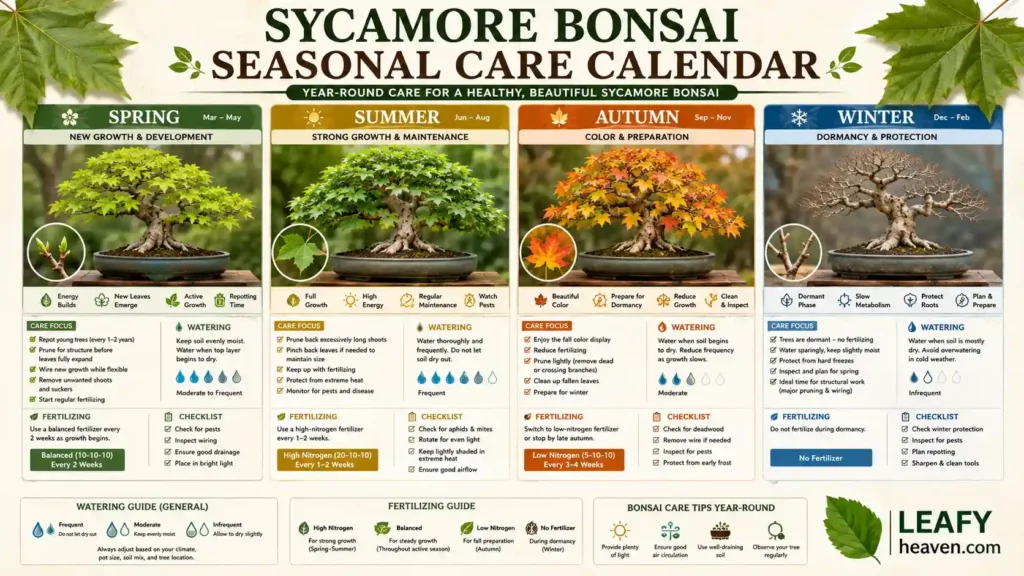
Spring Care
Spring is the most active growth period for sycamore bonsai. Buds begin to swell, new shoots emerge, and the tree rapidly increases energy production.
Spring care priorities include:
- Resume regular watering as growth increases
- Begin fertilization after bud break
- Monitor new shoot development
- Perform repotting if needed
- Inspect for pests and diseases
- Carry out structural pruning before vigorous growth begins
Spring is also an excellent time to evaluate branch structure and plan seasonal training objectives.
Summer Care
Summer focuses on maintaining healthy growth while protecting the tree from heat stress.
During warm weather, water consumption increases significantly and foliage development reaches its peak.
Summer care tasks include:
- Monitor soil moisture daily
- Water thoroughly when needed
- Protect from extreme afternoon heat if necessary
- Continue maintenance pruning
- Maintain a regular fertilizing schedule
- Check for aphids, spider mites, and other pests
- Ensure good air circulation
Trees growing in shallow bonsai containers may require more frequent watering during heatwaves.
Autumn Care
Autumn is the transition period between active growth and winter dormancy.
As temperatures cool, growth slows and foliage begins changing color before leaf drop.
Autumn care priorities include:
- Gradually reduce fertilization
- Continue moderate watering
- Remove fallen leaves from the soil surface
- Monitor overall tree health
- Inspect branch structure after leaf drop
- Prepare for winter protection if required
Autumn is also a valuable time to evaluate the tree’s branch structure because deciduous bonsai becomes easier to inspect once foliage has fallen.
Winter Dormancy Care
Winter dormancy is essential for the long-term health of sycamore bonsai.
During dormancy, growth stops and the tree conserves energy for the following growing season.
Winter care recommendations include:
- Reduce watering frequency
- Prevent complete soil drying
- Protect roots from prolonged freezing
- Avoid fertilization
- Avoid major styling work on stressed trees
- Monitor for winter damage
Although the tree is dormant, roots remain alive and require adequate moisture throughout the winter period.
In extremely cold climates, additional root protection may be necessary because bonsai containers provide less insulation than natural ground soil.
Annual Maintenance Checklist
Spring
- Inspect buds and new growth
- Repot if necessary
- Begin fertilization
- Resume active watering
- Check for pests
Summer
- Monitor soil moisture daily
- Continue fertilization
- Perform maintenance pruning
- Watch for heat stress
- Maintain airflow around the canopy
Autumn
- Reduce fertilization gradually
- Clean fallen leaves
- Assess branch structure
- Monitor autumn foliage health
- Prepare winter protection materials
Winter
- Maintain moderate soil moisture
- Protect roots from severe freezing
- Avoid active fertilization
- Inspect dormant branches
- Plan next season’s pruning and styling work
Following a seasonal care calendar helps sycamore bonsai remain healthy, balanced, and vigorous while supporting continuous development throughout every stage of its life cycle.
Common Problems and Solutions
Most sycamore bonsai problems are caused by watering issues, pests, or environmental stress. Early identification of symptoms allows growers to correct problems before they affect the long-term health and development of the tree.
Regular inspection of leaves, branches, roots, and growing conditions is one of the most effective ways to prevent serious damage.
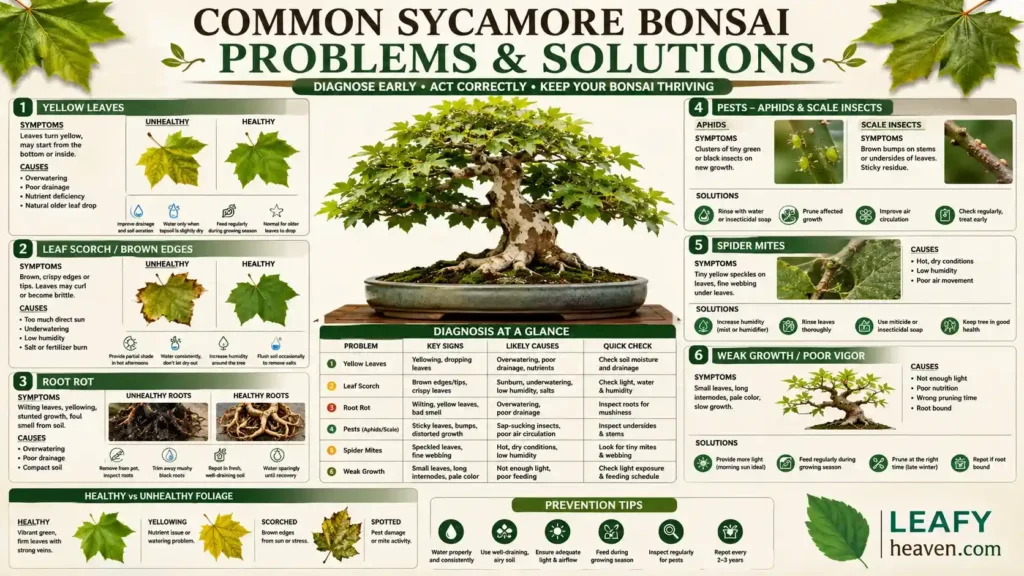
Yellow Leaves
Yellow leaves are one of the most common issues seen in sycamore bonsai.
While some yellowing is normal during autumn, yellow leaves during the active growing season often indicate a cultural or environmental problem.
Possible causes include:
- Overwatering
- Poor soil drainage
- Underwatering
- Nutrient deficiencies
- Root stress
- Insufficient sunlight
Correcting the underlying cause usually restores healthy foliage production and normal growth.
Leaf Scorch
Leaf scorch appears as brown, dry, or crispy edges on the foliage.
This condition is most common during periods of intense heat, strong sunlight, or inadequate moisture.
Factors contributing to leaf scorch include:
- Hot summer temperatures
- Dry soil conditions
- Low moisture availability
- Hot drying winds
- Root stress
Providing consistent watering and protecting the tree during extreme heat can significantly reduce leaf scorch damage.
Root Rot
Root rot is a serious condition caused by prolonged excess moisture around the roots.
Poor drainage and overwatering reduce oxygen levels in the root zone and encourage fungal activity.
Common symptoms include:
- Yellowing foliage
- Weak growth
- Wilting despite wet soil
- Foul soil odor
- Black or mushy roots
Improving drainage, adjusting watering practices, and repotting into a well-draining bonsai soil mix are often necessary to address root rot issues.
Slow Growth
Slow growth may indicate that the tree is not receiving the conditions required for healthy development.
Several factors can contribute to reduced vigor.
Common causes include:
- Poor sunlight exposure
- Nutrient deficiency
- Root congestion
- Inadequate watering
- Poor soil quality
- Environmental stress
Evaluating the tree’s overall growing conditions usually helps identify the source of the problem.
Pest Problems
Sycamore bonsai can occasionally experience pest infestations, especially during the active growing season.
Regular monitoring helps prevent minor pest activity from becoming a serious issue.
Aphids
Aphids are small sap-feeding insects that commonly attack new growth.
Signs of aphid infestation include:
- Distorted leaves
- Sticky honeydew residue
- Clusters of insects on shoots
- Reduced vigor
Light infestations can often be removed with a strong spray of water, while larger infestations may require insecticidal soap.
Scale Insects
Scale insects attach themselves to stems and branches where they feed on plant sap.
Common symptoms include:
- Small raised bumps on bark
- Weak growth
- Yellowing leaves
- Sticky residue
Manual removal and horticultural oils are commonly used to control scale populations.
Spider Mites
Spider mites are tiny pests that become more common during hot, dry conditions.
Typical symptoms include:
- Fine webbing
- Speckled leaves
- Fading foliage color
- Premature leaf drop
Increasing humidity around the tree and using appropriate mite-control treatments can help manage infestations.
Troubleshooting Table
| Problem | Cause | Solution |
| Yellow Leaves | Overwatering, nutrient deficiency, root stress | Improve drainage, adjust watering, fertilize appropriately |
| Leaf Scorch | Heat stress, drought, strong sun exposure | Increase watering and provide protection during extreme heat |
| Root Rot | Waterlogged soil and poor drainage | Repot into fast-draining soil and reduce excess watering |
| Slow Growth | Poor light, nutrient deficiency, root congestion | Improve growing conditions and fertilization program |
| Aphids | Sap-feeding insect infestation | Remove manually or apply insecticidal soap |
| Scale Insects | Persistent sap-feeding pests | Use horticultural oil and remove visible insects |
| Spider Mites | Hot, dry conditions | Increase moisture and apply suitable mite treatments |
| Premature Leaf Drop | Water stress or environmental shock | Stabilize watering and improve growing conditions |
| Weak New Growth | Poor nutrition or root problems | Review fertilization and root health |
| Wilting with Wet Soil | Root damage or root rot | Inspect roots and improve drainage immediately |
Most sycamore bonsai problems can be prevented through proper watering, well-draining soil, adequate sunlight, and regular monitoring. Healthy growing conditions remain the most effective defense against pests, diseases, and environmental stress.
Sycamore Bonsai Indoor vs Outdoor Growing
Sycamore bonsai performs best as an outdoor bonsai because it requires seasonal dormancy. As a deciduous tree, it depends on natural temperature changes, sunlight exposure, and winter rest periods to maintain healthy growth and long-term vigor.
While sycamore bonsai can occasionally be displayed indoors for short periods, it should not be treated as a permanent indoor bonsai. Outdoor growing conditions provide the environmental cues necessary for healthy seasonal development.
Can Sycamore Bonsai Live Indoors?
Sycamore bonsai can live indoors temporarily, but it is not considered a true indoor bonsai species.
Most homes cannot provide the conditions required for sustained healthy growth. Indoor environments typically lack sufficient sunlight, natural seasonal temperature changes, and winter dormancy periods.
Long-term indoor cultivation may lead to:
- Weak growth
- Large leaves
- Reduced vigor
- Poor branch development
- Increased pest problems
- Gradual decline in health
Short-term indoor display for a few days is generally safe, provided the tree is returned to its normal outdoor environment afterward.
Why Outdoor Bonsai Conditions Are Better
Outdoor conditions closely match the natural habitat of both Acer pseudoplatanus and Platanus occidentalis.
Natural exposure to sunlight, rainfall, airflow, and seasonal changes supports healthy development throughout the year.
Benefits of outdoor growing include:
- Full-spectrum natural sunlight
- Proper seasonal dormancy
- Stronger branch development
- Better leaf quality
- Improved trunk thickening
- Healthier root growth
- Enhanced pest resistance
- Natural seasonal color changes
Outdoor cultivation also promotes better ramification and overall bonsai refinement over time.
Because sycamore bonsai is a vigorous deciduous species, consistent outdoor exposure is one of the most important factors in achieving long-term success.
Winter Protection Requirements
Although sycamore bonsai is cold-hardy, the roots are more vulnerable in a bonsai pot than they would be in the ground.
Winter protection is often necessary when temperatures remain below freezing for extended periods.
Recommended winter protection methods include:
- Placing the tree in a sheltered location
- Protecting the pot from severe freezing
- Using mulch around the container
- Moving the tree into an unheated cold frame
- Shielding roots from drying winter winds
The goal is to protect the root system while still allowing the tree to experience natural winter dormancy.
Avoid bringing the tree into a heated indoor environment during winter because this can disrupt its dormancy cycle and weaken future growth.
Comparison Table
Indoor vs Outdoor Sycamore Bonsai
| Feature | Indoor Growing | Outdoor Growing |
| Long-Term Suitability | Poor | Excellent |
| Sunlight Availability | Limited | High |
| Seasonal Dormancy | Usually Absent | Natural |
| Growth Quality | Weaker | Stronger |
| Leaf Size Control | More Difficult | Easier |
| Branch Development | Limited | Better |
| Trunk Thickening | Slower | Faster |
| Pest Risk | Higher | Lower |
| Seasonal Color Changes | Reduced | Full Expression |
| Overall Tree Health | Often Declines Over Time | Supports Long-Term Vigor |
| Recommended For | Short-Term Display Only | Permanent Cultivation |
Quick Summary
- Sycamore bonsai is primarily an outdoor bonsai species.
- Seasonal dormancy is essential for long-term health.
- Indoor growing should only be temporary.
- Natural sunlight and outdoor airflow support stronger growth.
- Winter protection should focus on protecting roots rather than eliminating dormancy.
For most growers, maintaining sycamore bonsai outdoors throughout the year provides the healthiest environment and the best long-term bonsai development results.
Sycamore Bonsai vs Other Maple Bonsai Species
Sycamore bonsai differs from Japanese maple bonsai in growth rate, leaf size, and training requirements. While both belong to the Acer genus when discussing Sycamore Maple (Acer pseudoplatanus), they offer distinct characteristics that influence styling, maintenance, and long-term bonsai development.
Understanding these differences helps growers select the maple species that best matches their climate, experience level, and bonsai goals.
Sycamore Bonsai vs Japanese Maple Bonsai
Sycamore bonsai and Japanese maple bonsai are both attractive deciduous bonsai trees, but they develop differently over time.
Sycamore bonsai is generally more vigorous and develops trunk thickness faster. Japanese maple bonsai is often prized for its refined foliage, elegant branching, and spectacular autumn color.
Key differences include:
- Sycamore grows faster
- Japanese maple typically has smaller leaves
- Sycamore develops trunk size more quickly
- Japanese maple often achieves finer ramification
- Sycamore is generally more tolerant of heavy pruning
- Japanese maple may require more protection from intense sun
For growers focused on rapid structural development, sycamore bonsai is often the stronger choice. For those seeking delicate foliage and refined aesthetics, Japanese maple remains a favorite.
Acer pseudoplatanus vs Acer palmatum
Acer pseudoplatanus (Sycamore Maple) and Acer palmatum (Japanese Maple) are two popular maple species used in bonsai cultivation.
Although they belong to the same genus, their growth habits and maintenance requirements differ significantly.
Acer pseudoplatanus (Sycamore Maple)
Characteristics include:
- Fast growth rate
- Strong trunk development
- Vigorous root system
- Good tolerance to pruning
- Larger leaves
- Excellent cold hardiness
Acer palmatum (Japanese Maple)
Characteristics include:
- Moderate growth rate
- Finer branching potential
- Smaller, more delicate leaves
- Exceptional autumn color
- Greater sensitivity to heat stress
- Highly refined appearance
Sycamore Maple is often easier for structural development, while Japanese Maple is commonly preferred for advanced refinement and exhibition-quality bonsai.
Sycamore Bonsai vs Other Maple Bonsai Trees
Sycamore bonsai shares many characteristics with other maple bonsai species but stands out because of its vigorous growth and durability.
Compared with other maple bonsai trees:
- It develops trunks faster than many maple species.
- It tolerates stronger pruning and root work.
- It generally requires more leaf management due to larger foliage.
- It is often easier to establish and maintain during early development.
- It performs well in a wide range of temperate climates.
Other popular maple bonsai species, such as Trident Maple, Amur Maple, and Field Maple, may offer smaller leaves or finer ramification, but sycamore bonsai often excels in strength, vigor, and rapid development.
Other popular maple bonsai species, such as Trident Maple, Amur Maple, and Field Maple, may offer smaller leaves or finer ramification, but sycamore bonsai often excels in strength, vigor, and rapid development.
Comparison Table
| Feature | Sycamore Maple (Acer pseudoplatanus) | Japanese Maple (Acer palmatum) | Trident Maple (Acer buergerianum) |
| Growth Rate | Fast | Moderate | Fast |
| Leaf Size | Medium to Large | Small to Medium | Small |
| Leaf Reduction Potential | Moderate | Good | Excellent |
| Trunk Development | Fast | Moderate | Fast |
| Ramification Potential | Good | Excellent | Excellent |
| Cold Hardiness | High | Moderate to High | High |
| Pruning Tolerance | High | Moderate | High |
| Beginner Suitability | Good | Moderate | Excellent |
| Maintenance Level | Moderate | Moderate to High | Moderate |
| Bonsai Development Speed | Fast | Moderate | Fast |
Quick Comparison Summary
- Sycamore Maple is ideal for rapid development and strong trunk formation.
- Japanese Maple is valued for refined foliage and elegant aesthetics.
- Trident Maple offers excellent ramification and leaf reduction.
- Sycamore bonsai is often easier to grow than many refined maple species during the early stages of development.
- Growers seeking a balance of vigor, durability, and long-term styling potential often find sycamore bonsai to be a rewarding choice.
Each maple species has unique strengths, but sycamore bonsai remains a strong option for growers who want a vigorous deciduous bonsai capable of developing impressive structure and character over time.
Benefits of Growing a Sycamore Bonsai
Sycamore bonsai offers aesthetic appeal, training opportunities, and long-term bonsai development potential. Its vigorous growth, strong structure, and adaptability make it a rewarding species for growers who want both practical learning experiences and visually impressive bonsai trees.
Whether developed from Acer pseudoplatanus or Platanus occidentalis, sycamore bonsai provides benefits that extend far beyond simple ornamental value.
Educational Benefits
Sycamore bonsai is an excellent learning species because it responds clearly to bonsai techniques and grows quickly enough for growers to observe results within a reasonable timeframe.
Educational advantages include:
- Learning pruning techniques
- Understanding root management
- Practicing branch selection
- Developing wiring skills
- Observing seasonal growth cycles
- Understanding deciduous bonsai care
- Improving long-term bonsai planning
Because sycamore grows vigorously, beginners can gain practical experience with pruning, repotting, fertilization, and structural development without waiting many years to see progress.
Experienced growers also use sycamore bonsai to refine advanced techniques such as ramification development, leaf size control, and branch refinement.
Landscape and Display Value
Sycamore bonsai creates a strong visual impact due to its mature appearance, broad canopy, and powerful trunk structure.
As the tree ages, it develops characteristics that closely resemble large landscape sycamores found in parks, woodlands, and urban environments.
Display benefits include:
- Attractive seasonal foliage
- Strong deciduous silhouette
- Impressive trunk development
- Natural branch structure
- Excellent winter branch display
- Long-term visual improvement with age
American Sycamore bonsai can become especially striking because of its distinctive exfoliating bark, while Sycamore Maple bonsai is often admired for its balanced canopy and maple-like foliage.
The tree remains visually interesting throughout the year, offering changing seasonal features from spring growth to winter branch structure.
Long-Term Development Potential
One of the greatest advantages of sycamore bonsai is its ability to improve significantly over time.
The species responds well to years of careful training, allowing growers to gradually develop:
- Trunk taper
- Branch ramification
- Root flare
- Canopy refinement
- Bark character
- Overall bonsai maturity
Because sycamore grows relatively quickly, structural development often progresses faster than with many slower-growing bonsai species.
Long-term development benefits include:
- Faster trunk thickening
- Strong recovery after pruning
- Continued refinement over decades
- Adaptability to multiple bonsai styles
- Potential for highly mature bonsai designs
With proper care, a sycamore bonsai can remain healthy for several decades and continue becoming more refined and visually impressive as it ages.
For many bonsai enthusiasts, this combination of growth vigor, training flexibility, and long-term improvement makes sycamore bonsai a highly rewarding species to cultivate.
Is Sycamore Bonsai Safe for Pets and Children?
Most sycamore species are not highly toxic, but consuming plant material should still be avoided. Sycamore bonsai is generally considered a low-risk bonsai tree for households with pets and children, especially when compared with known toxic ornamental plants.
However, no bonsai tree should be treated as edible. Leaves, seeds, bark, and other plant parts may cause digestive discomfort if consumed, and bonsai tools, wires, fertilizers, and soil additives can present additional safety concerns.
Pet Safety
Sycamore bonsai is generally regarded as relatively safe around common household pets when the tree is used as an ornamental plant and not consumed.
Most pets show little interest in mature bonsai trees, but curious animals may occasionally chew leaves, twigs, or surface roots.
Potential concerns include:
- Mild digestive upset if plant material is eaten
- Vomiting or stomach irritation in sensitive animals
- Injury from bonsai wire or sharp branches
- Exposure to fertilizers or pesticides
- Disturbance of roots and soil
Dogs and cats should be discouraged from chewing any part of the bonsai, even when the species is considered low risk.
If a pet consumes a significant amount of plant material or shows unusual symptoms, contacting a veterinarian is recommended.
Child Safety
Sycamore bonsai can generally be displayed safely in homes with children when reasonable precautions are followed.
The tree itself is not considered highly toxic, but young children should not be encouraged to handle or consume any plant material.
Important safety considerations include:
- Avoid allowing children to chew leaves or seeds
- Keep bonsai tools out of reach
- Prevent access to fertilizers and pesticides
- Place heavy bonsai containers securely
- Supervise young children around display trees
Older children interested in gardening and bonsai can often participate safely when proper guidance and supervision are provided.
General Precautions
Basic bonsai safety practices help protect both people and animals while maintaining the health of the tree.
Recommended precautions include:
- Treat all bonsai plants as non-edible
- Wash hands after pruning or repotting
- Store fertilizers safely
- Use pesticides according to label instructions
- Remove fallen leaves and debris regularly
- Keep wiring materials and tools secured
- Place bonsai displays in stable locations
Although sycamore bonsai is not generally classified as a highly toxic bonsai species, responsible handling remains important. Proper placement, supervision, and routine bonsai safety practices help create a safe environment for pets, children, and the tree itself.
Conclusion
Sycamore bonsai is a vigorous outdoor bonsai species that rewards growers with strong trunks, attractive foliage, and long-term styling potential. Whether developed from Acer pseudoplatanus (Sycamore Maple) or Platanus occidentalis (American Sycamore), this deciduous bonsai offers a combination of rapid growth, structural strength, and seasonal beauty that appeals to both beginners and experienced bonsai enthusiasts.
With proper watering, well-draining soil, regular fertilization, seasonal pruning, and appropriate outdoor growing conditions, a sycamore bonsai can develop into an impressive miniature tree that continues to improve for decades. Its adaptability to multiple bonsai styles and strong response to training make it a rewarding long-term bonsai project.
Key Takeaways
Identification Summary
- Sycamore bonsai is recognized by its broad leaves, vigorous growth, and strong branching structure.
- The two most common species are Acer pseudoplatanus and Platanus occidentalis.
- Mature trees may develop attractive bark characteristics and dense deciduous canopies.
Care Essentials
- Use a fast-draining bonsai soil mix.
- Water thoroughly when the upper soil layer begins to dry.
- Fertilize regularly during the growing season.
- Monitor for pests, root issues, and environmental stress.
Growing Requirements
- Grow sycamore bonsai outdoors year-round.
- Provide full sun to partial sun exposure.
- Ensure good air circulation around the tree.
- Allow natural winter dormancy for long-term health.
Pruning and Styling Highlights
- Perform regular maintenance pruning to control growth.
- Develop ramification through consistent branch refinement.
- Use wiring carefully to improve branch positioning and structure.
- Popular styles include Informal Upright, Broom Style, Formal Upright, Clump Style, and Multi-Trunk Style.
Long-Term Maintenance Tips
- Repot every few years to maintain root health.
- Adjust care according to seasonal growth cycles.
- Protect roots during severe winter conditions.
- Continue refining branch structure and leaf size over time.
- Focus on gradual development rather than rapid styling changes.
With patience, consistent care, and proper bonsai techniques, sycamore bonsai can become a highly refined specimen that displays the character and beauty of a mature sycamore tree in miniature form.
Frequently Asked Questions (FAQs)
Can you make a bonsai from a sycamore tree?
Yes, you can make a bonsai from a sycamore tree. Both Acer pseudoplatanus (Sycamore Maple) and Platanus occidentalis (American Sycamore) can be trained into bonsai through pruning, root management, wiring, and long-term shaping techniques. Young seedlings, saplings, and collected nursery stock are commonly used as starting material. With consistent training, a sycamore tree can develop the appearance of a mature miniature tree while retaining the characteristics of the full-sized species.
Is American sycamore good for bonsai?
Yes, American Sycamore can be a good bonsai species, especially for growers interested in rapid trunk development and distinctive bark characteristics. Its vigorous growth allows trunks to thicken relatively quickly, making it useful for developing powerful bonsai designs. However, its naturally large leaves require more refinement work than some other deciduous bonsai species. For growers willing to manage leaf size and strong growth, American Sycamore offers excellent long-term bonsai potential.
How fast does a sycamore bonsai grow?
Sycamore bonsai is generally considered a fast-growing deciduous bonsai species. Under favorable conditions, it produces strong annual growth and develops trunk size faster than many traditional bonsai trees. Growth rate depends on factors such as sunlight, watering, soil quality, fertilization, and climate. Young trees in development often grow especially quickly, while mature bonsai are managed through regular pruning to maintain their size and structure.
Can sycamore bonsai be kept indoors?
Sycamore bonsai should not be kept indoors permanently. As a deciduous outdoor tree, it requires natural seasonal changes and winter dormancy to remain healthy. Indoor environments typically do not provide sufficient sunlight, airflow, or seasonal temperature variation. While the tree can be displayed indoors temporarily for short periods, long-term cultivation should take place outdoors.
How often should a sycamore bonsai be watered?
A sycamore bonsai should be watered whenever the upper layer of soil begins to dry. The exact frequency varies depending on weather, season, pot size, soil composition, and tree health. During spring and summer, watering may be needed daily or even more frequently during hot conditions. Instead of following a fixed schedule, monitor soil moisture regularly and water thoroughly when necessary.
What is the best soil for sycamore bonsai?
The best soil for sycamore bonsai is a fast-draining bonsai mix that provides good aeration while retaining adequate moisture. A common blend includes: Akadama Pumice Lava rock Small amounts of organic matter This combination supports healthy root growth, improves drainage, and helps reduce the risk of root rot.
How do you reduce leaf size on a sycamore bonsai?
Leaf size reduction is achieved gradually through proper bonsai cultivation rather than a single technique. Methods that help reduce leaf size include: Developing dense ramification Regular maintenance pruning Balanced fertilization Strong sunlight exposure Healthy root management Controlled shoot growth Sycamore Maple generally responds better to leaf reduction than American Sycamore because it naturally produces smaller foliage.
When should a sycamore bonsai be repotted?
Sycamore bonsai is typically repotted in late winter or early spring before active growth begins. This timing allows the tree to recover quickly and establish new roots during the growing season. Young trees may require repotting every 1–2 years, while mature bonsai are often repotted every 3–4 years. Signs that repotting is needed include root congestion, reduced drainage, compacted soil, and declining growth performance.

Written by the LeafyHeaven Editorial Team
LeafyHeaven shares practical gardening tips and simple plant care guides to help you grow, nurture, and enjoy your plants with ease. Our goal is to make gardening feel natural, approachable, and rewarding for everyone.