
Introduction
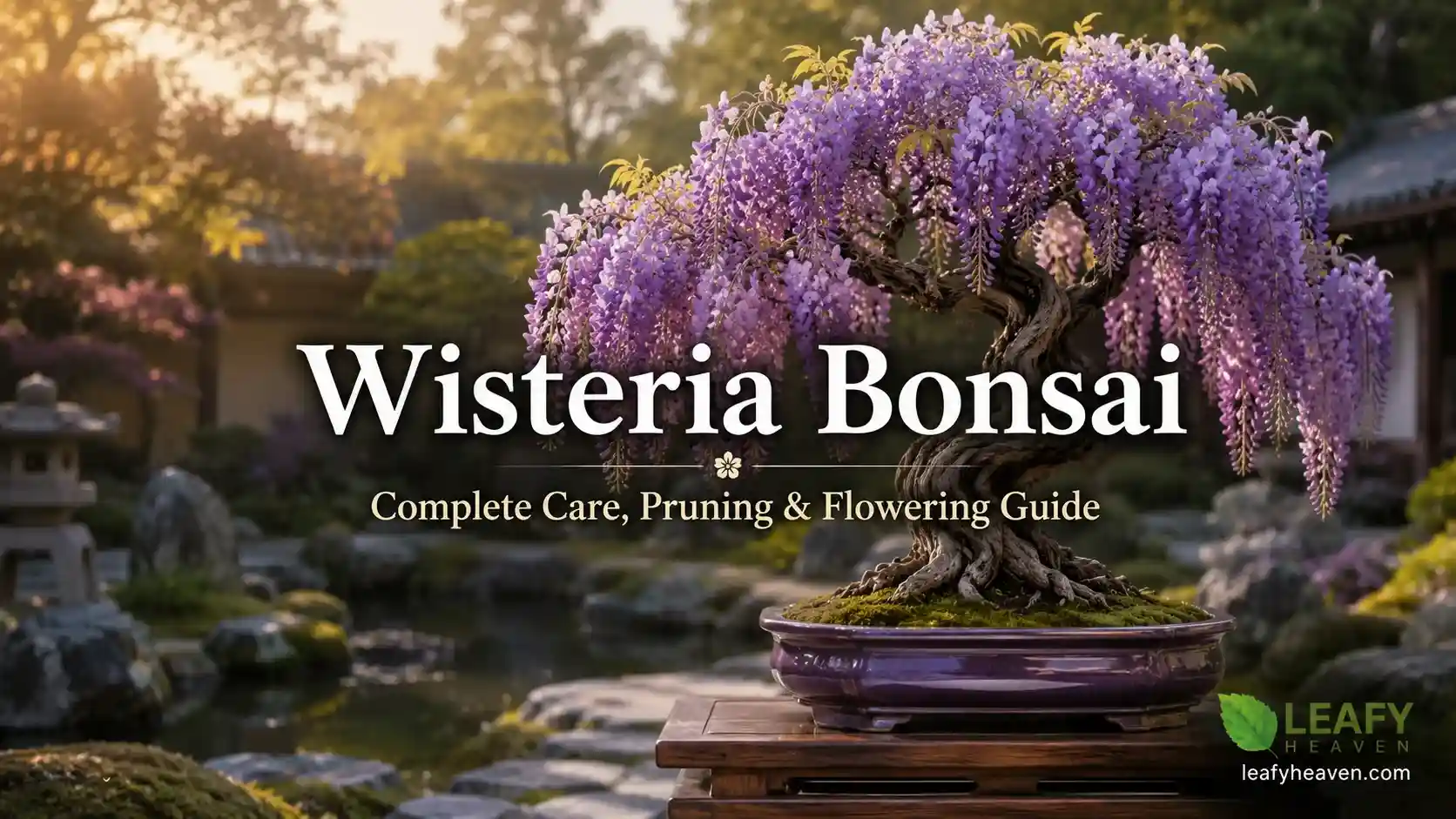
Wisteria Bonsai is one of the most spectacular flowering bonsai trees, admired for its cascading clusters of purple, blue, pink, or white blooms and its impressive aged trunk structure. Unlike many bonsai species that are valued primarily for foliage or branch ramification, Wisteria Bonsai creates a dramatic floral display that can transform a bonsai collection during the blooming season.
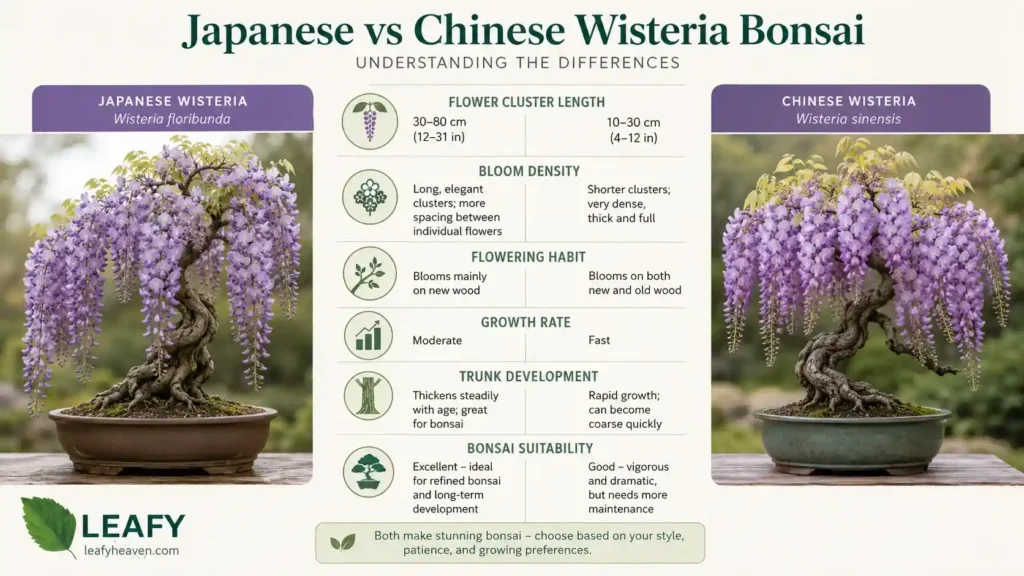
The two most popular species used for bonsai cultivation are Japanese Wisteria Bonsai (Wisteria floribunda) and Chinese Wisteria Bonsai (Wisteria sinensis). Japanese Wisteria is known for its exceptionally long flower racemes and elegant appearance, while Chinese Wisteria is valued for its vigorous growth and earlier flowering habits. Both species can develop into stunning flowering bonsai specimens when properly trained and maintained.
Wisteria is widely regarded as one of the best flowering bonsai species because it combines breathtaking seasonal blooms, strong trunk development, long lifespan, and remarkable artistic potential. Mature specimens often become showpiece trees that attract attention during spring flowering displays.
In this guide, you will learn everything about Wisteria Bonsai, including identification, types, growth rate, growing conditions, watering, fertilizing, pruning, wiring, flowering, troubleshooting common problems, and long-term care techniques for developing a healthy and beautiful bonsai tree.
What Is a Wisteria Bonsai?
A Wisteria Bonsai is a miniature trained version of a Wisteria vine grown in a bonsai container while retaining the plant’s natural flowering characteristics. Through careful pruning, root management, and styling, growers create a compact tree-like form that produces the same spectacular hanging flower clusters seen on full-sized Wisteria plants. Despite its smaller size, a mature Wisteria Bonsai can display abundant blooms, thick trunks, and impressive branching structure.
Wisteria Bonsai Overview
Wisteria Bonsai belongs to the pea family (Fabaceae) and is one of the most admired flowering bonsai species in the world. It is typically developed from Japanese Wisteria (Wisteria floribunda) or Chinese Wisteria (Wisteria sinensis), both known for their vigorous growth and stunning floral displays.
Key characteristics include:
- Botanical Names: Wisteria floribunda, Wisteria sinensis
- Common Names: Wisteria Bonsai, Japanese Wisteria Bonsai, Chinese Wisteria Bonsai
- Plant Family: Fabaceae
- Plant Type: Deciduous flowering bonsai
- Native Origins: China, Japan, and parts of East Asia
Unlike evergreen bonsai species, Wisteria loses its leaves during winter dormancy and produces fresh foliage and flower buds each growing season.
Wisteria Bonsai vs Regular Wisteria Vine
A Wisteria Bonsai and a regular Wisteria vine come from the same plant species, but their growth and maintenance differ significantly.
| Feature | Wisteria Bonsai | Regular Wisteria Vine |
| Growth Habit | Miniature tree form | Climbing vine |
| Mature Size | Kept compact through pruning | Can reach several meters long |
| Flower Production | Controlled but abundant | Large-scale flowering |
| Root System | Restricted in bonsai pot | Extensive root spread |
| Maintenance | Regular pruning and training | Seasonal pruning only |
While a regular Wisteria vine naturally climbs fences, pergolas, and structures, a Wisteria Bonsai is carefully shaped to create a balanced miniature tree with artistic proportions.
Why Wisteria Is Popular as a Flowering Bonsai
Wisteria is considered one of the finest flowering bonsai species because it combines dramatic blooms with classic bonsai aesthetics.
Its popularity comes from several unique qualities:
- Spectacular cascading flower clusters that create a waterfall-like effect
- Thick, aged trunks that develop impressive character over time
- Exceptional longevity when properly maintained
- Attractive seasonal changes throughout the year
- Strong visual impact during flowering season
- Ability to become a prized exhibition bonsai specimen
Many bonsai enthusiasts consider a mature flowering Wisteria Bonsai to be one of the most rewarding trees to grow due to its combination of beauty, age, and seasonal interest.
Growers who want to build a strong plant care foundation before starting bonsai training will find this complete gardening and plant care guide an essential resource for learning essential seasonal maintenance principles.
Quick Facts About Wisteria Bonsai
| Feature | Details |
| Botanical Name | Wisteria floribunda / Wisteria sinensis |
| Type | Flowering Bonsai |
| Lifespan | Long-lived |
| Bloom Color | Purple, Blue, White, Pink |
| Sun Needs | Full Sun |
| Difficulty | Intermediate |
What Does a Wisteria Bonsai Look Like?
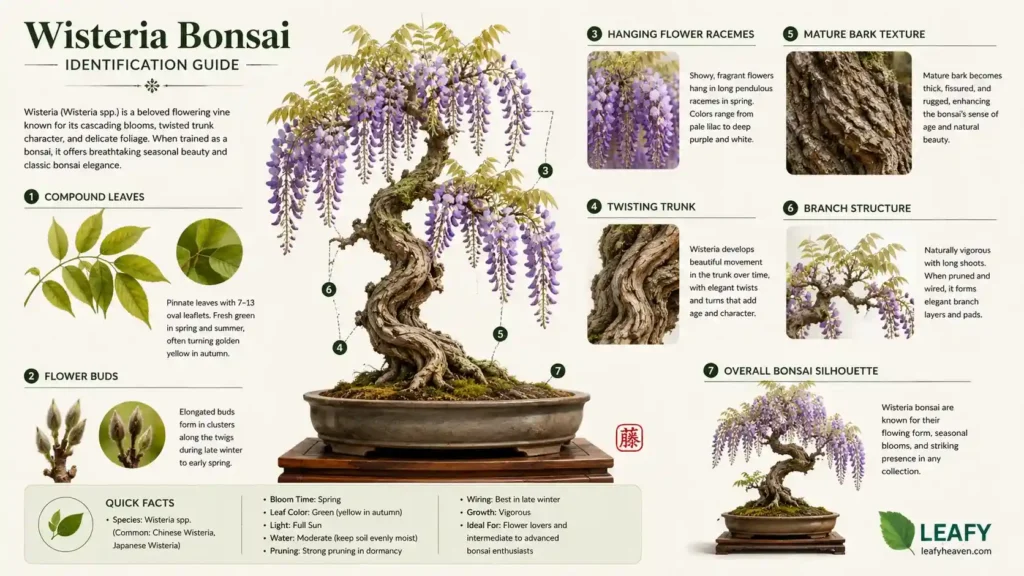
A Wisteria Bonsai is recognized by its twisting trunk, graceful branch structure, compound green leaves, and spectacular hanging flower clusters. As the tree matures, it develops a rugged, aged appearance that contrasts beautifully with its soft, cascading blooms. During spring, flowering specimens become one of the most visually striking bonsai trees, while the changing foliage provides interest throughout the year.
Wisteria Leaves Identification
Wisteria leaves are compound leaves made up of multiple leaflets arranged along a central stem. Their soft texture and elegant shape help create a refined appearance that complements the tree’s flowering display.
What Do Wisteria Leaves Look Like?
Wisteria leaves are typically:
- Pinnate and compound
- Medium to bright green in color
- Smooth-edged with pointed tips
- Arranged alternately along branches
- Made up of several individual leaflets
Each leaf can contain multiple leaflets that create a feathery, layered appearance.
Types of Wisteria Leaves
Leaf size and leaflet count can vary depending on the species.
- Japanese Wisteria (Wisteria floribunda) often produces slightly larger compound leaves.
- Chinese Wisteria (Wisteria sinensis) typically develops dense foliage with attractive leaflet arrangements.
Although both species have similar foliage characteristics, subtle differences in leaflet size and growth habits may be observed.
Wisteria Vine Leaves
Like full-sized Wisteria vines, bonsai specimens produce compound foliage designed to support vigorous growth. The leaves emerge after dormancy and help the tree build energy reserves for future flowering.
Young foliage often appears lighter green before maturing into a deeper shade during the growing season.
Seasonal Foliage Changes
Wisteria foliage changes noticeably throughout the year.
- Spring: Fresh light-green leaves emerge.
- Summer: Dense green foliage develops.
- Autumn: Leaves turn yellow before dropping.
- Winter: The tree becomes completely leafless during dormancy.
These seasonal transitions contribute to the tree’s year-round ornamental value.
Wisteria Buds and Flowers
Wisteria flowers are the main attraction of this bonsai species. Large hanging flower clusters create a dramatic display that few other bonsai trees can match.
What Do Wisteria Buds Look Like?
Wisteria flower buds are:
- Rounded and slightly elongated
- Covered by protective scales
- Formed during the previous growing season
- Usually visible before spring flowering begins
Healthy flower buds are often larger and fuller than vegetative leaf buds.
Flower Cluster Structure
Wisteria flowers grow in pendulous clusters known as racemes.
Each raceme contains numerous pea-shaped blossoms arranged along a central stem. Depending on the species and cultivar, flower clusters may range from relatively short to exceptionally long cascading displays.
Japanese Wisteria is especially known for producing long, elegant racemes that create a waterfall-like effect.
Bloom Colors
Wisteria Bonsai can produce flowers in several colors, including:
- Purple
- Blue
- White
- Pink
- Violet-lavender shades
Purple and blue flowering varieties remain the most popular among bonsai enthusiasts due to their striking visual impact.
Wisteria Branches and Trunk Characteristics
The trunk and branch structure of a mature Wisteria Bonsai often become as valuable as the flowers themselves.
Mature Bark
As the tree ages, the bark develops:
- Rough texture
- Deep furrows
- Weathered appearance
- Increased visual character
Older specimens can display remarkable age and maturity even in relatively compact bonsai sizes.
Twisting Trunk
One of the most distinctive features of Wisteria Bonsai is its naturally twisting trunk.
Over time, vigorous growth and training create:
- Curving trunk lines
- Dramatic movement
- Powerful visual interest
- Strong bonsai character
These twisting forms help distinguish Wisteria from many other flowering bonsai species.
Weeping Branch Forms
Many Wisteria Bonsai trees develop elegant arching branches that complement their hanging flowers.
This naturally graceful structure creates:
- Soft silhouettes
- Cascading branch lines
- Improved flowering displays
- Refined bonsai aesthetics
The combination of weeping branches and pendulous blooms is one reason Wisteria is highly valued in bonsai exhibitions.
Seasonal Appearance Throughout the Year
Wisteria Bonsai changes dramatically with each season, providing continuous visual interest.
Spring Blooms
Spring is the highlight of the year.
During this period:
- Flower buds open into colorful racemes
- Branches become covered with blooms
- New foliage begins emerging
- The tree reaches peak ornamental value
Summer Growth
After flowering, vigorous growth begins.
Summer characteristics include:
- Dense green foliage
- Rapid branch extension
- Active root development
- Strong energy production
This is the primary growth period for training and development.
Autumn Foliage
As temperatures cool, foliage begins to change.
Typical autumn features include:
- Yellow leaf coloration
- Gradual leaf drop
- Slowing growth
- Preparation for dormancy
Winter Silhouette
During winter, Wisteria Bonsai becomes dormant and sheds all leaves.
The leafless structure reveals:
- Twisting trunk movement
- Fine branch ramification
- Mature bark texture
- Overall bonsai design
Many enthusiasts appreciate the winter silhouette because it highlights the tree’s structural beauty without foliage or flowers.
Types of Wisteria Bonsai
Several Wisteria species and cultivars can be trained into bonsai, but some varieties are better suited than others due to their flowering habits, growth patterns, and adaptability to container cultivation. Japanese Wisteria remains the most widely used species for bonsai because of its spectacular flower displays, while other cultivars offer unique colors, growth rates, and maintenance requirements.
Japanese Wisteria Bonsai (Wisteria floribunda)
Japanese Wisteria Bonsai is considered the gold standard among flowering Wisteria bonsai varieties. It is highly valued for producing exceptionally long, pendulous flower clusters that create a dramatic cascading effect during spring.
Long Flower Racemes
The most distinctive feature of Japanese Wisteria is its long racemes, which can extend significantly farther than those of many other species. These hanging flower clusters create a waterfall-like appearance that makes mature specimens highly desirable for exhibitions and displays.
Bonsai Suitability
Japanese Wisteria is well suited for bonsai cultivation because it:
- Develops attractive trunk movement
- Produces abundant flowers
- Responds well to pruning and training
- Creates impressive aged specimens over time
For growers seeking maximum flowering impact, Wisteria floribunda is often the preferred choice.
Chinese Wisteria Bonsai (Wisteria sinensis)
Chinese Wisteria Bonsai is another popular species known for vigorous growth and reliable flowering.
Faster Flowering
Compared to many Wisteria varieties, Chinese Wisteria often reaches flowering maturity sooner. This makes it appealing to growers who want to enjoy blooms earlier in the bonsai development process.
Compact Bloom Clusters
Although the flower racemes are generally shorter than those of Japanese Wisteria, the clusters are dense and highly attractive. The concentrated blooms create a colorful display that complements compact bonsai designs.
Chinese Wisteria is often chosen for:
- Faster development
- Strong growth vigor
- Reliable flowering
- Easier availability in many regions
Purple Wisteria Bonsai
Purple Wisteria Bonsai remains the most recognized and widely grown flowering color among bonsai enthusiasts.
Popular Flowering Color
Rich purple blooms are closely associated with traditional Wisteria displays. The vibrant color creates a dramatic contrast against green foliage and aged bark.
Display Value
Purple-flowering varieties are highly valued because they:
- Create eye-catching spring displays
- Stand out in bonsai exhibitions
- Pair beautifully with traditional bonsai containers
- Offer classic Wisteria aesthetics
Many award-winning flowering bonsai collections feature purple Wisteria varieties.
Weeping Wisteria Bonsai
Weeping Wisteria Bonsai is prized for its graceful and elegant appearance.
Elegant Cascading Form
This style emphasizes naturally arching branches and hanging flower clusters that flow downward from the canopy.
Key characteristics include:
- Soft branch movement
- Dramatic flowering displays
- Refined silhouette
- Strong visual balance
Weeping forms are especially effective when combined with mature trunks and abundant spring blooms.
Dwarf Wisteria Varieties
Dwarf Wisteria varieties provide an alternative for growers seeking more manageable growth.
Smaller Growth Habit
These selections typically produce shorter internodes and more compact development than vigorous standard varieties.
Benefits include:
- Reduced pruning requirements
- Easier size control
- Better suitability for smaller bonsai containers
- Improved maintenance for limited growing spaces
Easier Maintenance
Because growth is generally more restrained, dwarf varieties often require less frequent trimming while still providing attractive flowering displays.
They are commonly recommended for growers who want a flowering bonsai with a more manageable growth rate.
Popular Bonsai Cultivars
Several Wisteria cultivars have become favorites among bonsai growers due to their flowering performance and adaptability.
Black Dragon Wisteria
Black Dragon is known for:
- Deep purple blooms
- Double-flowered appearance
- Strong ornamental value
- Exceptional spring displays
Blue Moon Wisteria
Blue Moon is valued for:
- Lavender-blue flowers
- Good cold tolerance
- Reliable flowering performance
- Vigorous growth
Amethyst Falls Wisteria
Amethyst Falls offers:
- Compact growth habit
- Earlier flowering potential
- Shorter racemes
- Excellent container performance
Japanese Wisteria Floribunda
Traditional Wisteria floribunda cultivars remain among the most desirable bonsai choices because of their:
- Long flower clusters
- Elegant cascading blooms
- Strong exhibition value
- Classic Wisteria appearance
Wisteria Bonsai Variety Comparison
| Variety | Flower Color | Growth Rate | Bonsai Suitability |
| Japanese Wisteria (Wisteria floribunda) | Purple, Blue, White | Moderate to Fast | Excellent |
| Chinese Wisteria (Wisteria sinensis) | Purple, Blue-Violet | Fast | Excellent |
| Black Dragon | Deep Purple | Moderate | Excellent |
| Blue Moon | Lavender-Blue | Fast | Very Good |
| Amethyst Falls | Lavender-Purple | Moderate | Very Good |
| Dwarf Wisteria Varieties | Varies by Cultivar | Moderate | Good to Very Good |
How Fast Does Wisteria Bonsai Grow?
Wisteria Bonsai is a vigorous and fast-growing bonsai species capable of producing substantial branch extension and trunk thickening in a relatively short period. Under full sun, regular watering, and proper fertilization, it can develop much faster than many traditional bonsai trees. While rapid growth helps create impressive trunks and branch structures, it also requires consistent pruning and training to maintain bonsai proportions.
Wisteria Growth Rate
Wisteria is naturally a vigorous vine, and this growth energy remains evident even when cultivated as a bonsai.
How Quickly Does Wisteria Grow?
Under favorable growing conditions, Wisteria Bonsai can produce:
- Several feet of shoot growth during a single growing season
- Rapid root development
- Strong branch extension
- Noticeable trunk thickening each year
Growth is usually most vigorous during spring and early summer when temperatures are warm and sunlight is abundant.
How Fast Does a Wisteria Tree Grow?
A full-sized Wisteria tree or vine can grow several feet annually. Bonsai cultivation slows overall size increase through root restriction and pruning, but the species still maintains its naturally energetic growth habit.
Factors affecting growth rate include:
- Sunlight exposure
- Soil quality
- Water availability
- Fertilization program
- Tree age
- Growing season length
Healthy trees grown in full sun generally develop much faster than those grown in shaded locations.
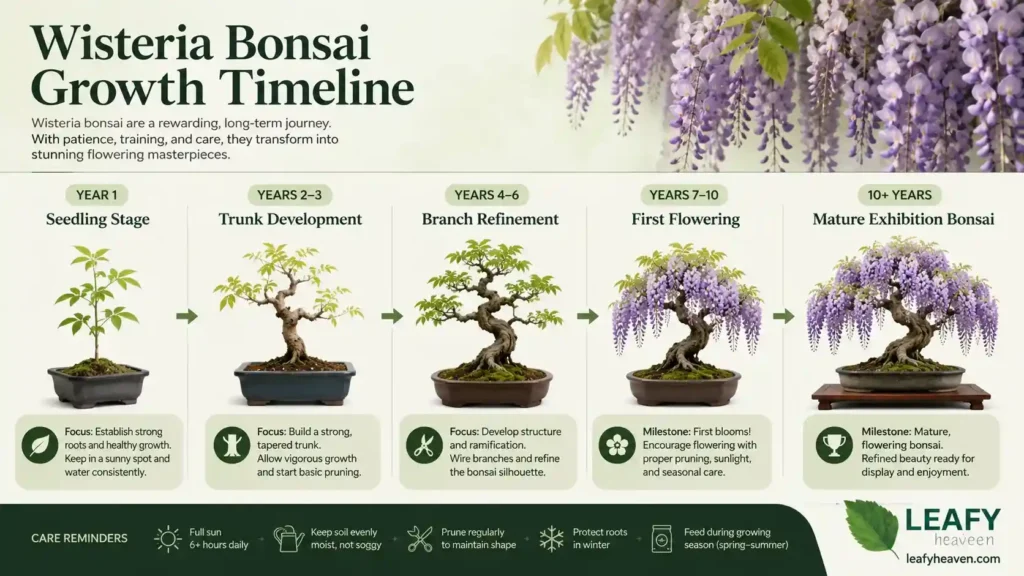
Growth Stages of Wisteria Bonsai
Wisteria Bonsai progresses through several development stages before becoming a mature flowering specimen.
Young Wisteria
The young stage focuses primarily on establishing roots and initial trunk growth.
Characteristics include:
- Thin stems
- Rapid shoot extension
- Limited branching
- Little or no flowering
This stage requires patience because structural development is more important than blooms.
Development Stage
During the development phase, growers concentrate on creating the trunk and primary branch framework.
Key goals include:
- Increasing trunk thickness
- Building branch structure
- Improving root spread
- Establishing overall design
Growth remains vigorous and pruning is often directed toward shaping rather than refinement.
Refinement Stage
Once the main structure is established, attention shifts toward improving details.
At this stage growers focus on:
- Ramification development
- Branch balance
- Flower production
- Fine pruning techniques
The tree begins to resemble a finished bonsai while continuing to gain maturity.
Mature Flowering Bonsai
A mature Wisteria Bonsai combines strong trunk character with reliable seasonal flowering.
Features often include:
- Thick aged trunk
- Refined branching
- Consistent bloom production
- Well-developed root system
- Exhibition-quality appearance
Many mature specimens continue improving for decades with proper care.
How Long Does It Take Wisteria Bonsai to Flower?
The time required for flowering depends largely on how the tree was propagated.
Seed-Grown Trees
Wisteria grown from seed usually takes the longest to bloom.
Typical flowering time:
- Approximately 7–15 years
- Sometimes longer under less favorable conditions
Although slower to flower, seed-grown specimens can develop excellent trunks over time.
Cutting-Grown Trees
Trees propagated from cuttings generally flower sooner because they originate from mature plant material.
Typical flowering time:
- Around 3–7 years
- Often faster than seed-grown specimens
Cuttings are a popular method for bonsai development because they combine reasonable flowering speed with strong growth.
Grafted Specimens
Grafted Wisteria Bonsai usually produce flowers the fastest.
Typical flowering time:
- 1–3 years after establishment
- Sometimes immediately if already mature
For growers seeking blooms as quickly as possible, grafted trees are often the best option.
Wisteria Bonsai Growth Timeline
The following timeline provides general expectations for Wisteria Bonsai development.
| Age | Growth Expectations |
| Year 1 | Root establishment and vigorous shoot growth |
| Year 2 | Strong trunk thickening and branch development |
| Year 3 | Initial structural design begins taking shape |
| Year 4–5 | Improved trunk character and secondary branching |
| Year 5–7 | Many cutting-grown trees begin flowering |
| Year 7–10 | Mature structure develops and flowering becomes more reliable |
| Year 10–15 | Seed-grown trees may begin flowering regularly |
| 15+ Years | Mature flowering bonsai with refined branching and aged appearance |
Growth speed varies between individual trees, but Wisteria remains one of the faster-growing flowering bonsai species. With proper cultivation, growers can develop impressive trunks and beautiful flowering displays much sooner than with many slower-growing bonsai varieties.
Ideal Growing Conditions for Wisteria Bonsai
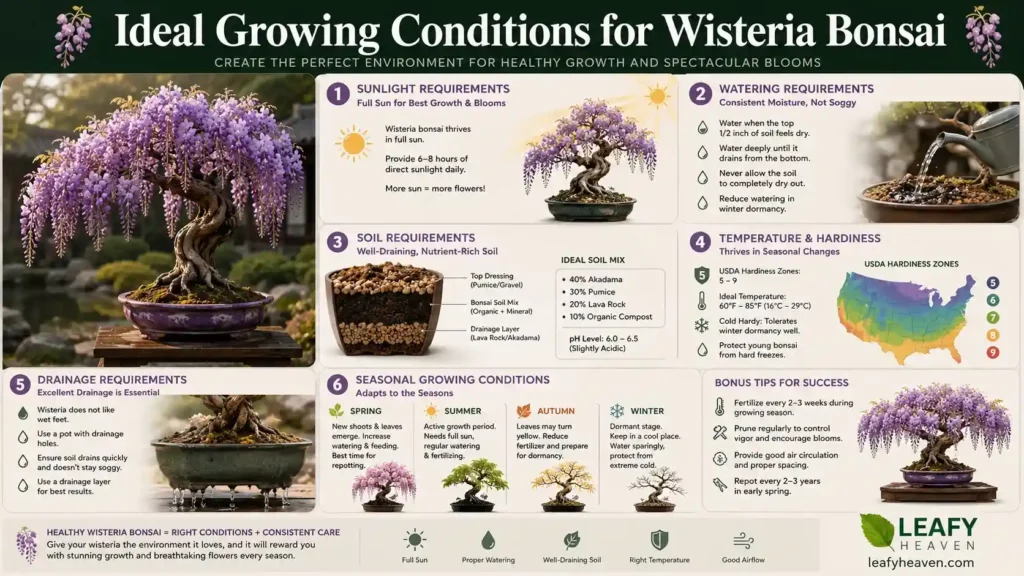
Wisteria Bonsai performs best when grown in full sun, nutrient-rich soil, and consistently moist conditions. As a vigorous flowering species, it requires abundant light, reliable watering, and a well-balanced growing medium to support healthy growth and abundant blooms. Providing the right environment is one of the most important factors in achieving strong flowering and long-term bonsai health.
Sunlight Requirements
Wisteria is a sun-loving bonsai species that requires direct sunlight for healthy growth and flower production.
Wisteria Light Requirements
For optimal performance, Wisteria Bonsai should receive:
- At least 6–8 hours of direct sunlight daily
- Morning and afternoon sun exposure
- Open-air growing conditions
- Good airflow around the canopy
Outdoor placement is strongly recommended because natural sunlight is difficult to replicate indoors.
Flowering Impact
Sunlight directly affects blooming performance.
Trees grown in insufficient light often experience:
- Reduced flower production
- Weak growth
- Longer internodes
- Smaller flower displays
Full sun encourages stronger flower bud formation and helps produce the spectacular spring blooms for which Wisteria is known.
Best Soil Mix for Wisteria Bonsai
A well-draining yet moisture-retentive soil mix is essential for healthy root growth and vigorous flowering.
Drainage Requirements
Although Wisteria enjoys consistent moisture, it does not tolerate waterlogged roots.
A suitable bonsai soil should:
- Drain excess water efficiently
- Prevent root rot
- Maintain adequate oxygen around roots
- Support healthy root development
Good drainage becomes especially important during periods of heavy watering.
Organic Matter Balance
Wisteria benefits from a soil mix that contains both drainage materials and organic components.
An effective mix typically provides:
- Moisture retention
- Nutrient availability
- Stable root environment
- Long-term soil structure
The goal is to maintain evenly moist soil without allowing roots to remain saturated for extended periods.
Temperature & USDA Zones
Wisteria Bonsai adapts well to a wide range of climates and can tolerate significant seasonal temperature changes.
Wisteria Zone Guide
According to the USDA Plant Hardiness Zone Map, most Wisteria species perform well in Zones 5–9 with distinct seasonal changes.
- USDA Zones 5–9
- Temperate climates
- Regions with distinct seasonal changes
- Areas that provide winter dormancy
Both Japanese Wisteria (Wisteria floribunda) and Chinese Wisteria (Wisteria sinensis) benefit from a natural dormant period during winter.
Cold Tolerance
Established Wisteria Bonsai demonstrates good cold tolerance.
Benefits of winter dormancy include:
- Proper bud development
- Improved flowering performance
- Seasonal growth regulation
- Long-term tree health
However, bonsai containers expose roots to colder temperatures than garden-grown plants, so additional protection may be necessary during severe freezes.
Watering Requirements
Consistent moisture is critical for healthy Wisteria Bonsai growth and flowering.
Seasonal Watering Schedule
Water needs vary throughout the year.
Spring
- Increase watering as growth and flowering begin.
- Monitor soil moisture closely during bloom development.
Summer
- Water frequently during hot weather.
- Mature trees may require daily watering during extreme heat.
Autumn
- Gradually reduce watering as growth slows.
- Continue preventing complete soil drying.
Winter
- Water less often during dormancy.
- Keep soil slightly moist, not wet.
The exact schedule depends on climate, pot size, soil composition, and tree maturity.
Avoiding Drought Stress
Wisteria is less tolerant of drought than many bonsai species.
Prolonged dryness can cause:
- Flower bud loss
- Leaf scorch
- Reduced growth
- Premature leaf drop
- Poor flowering performance
Regular monitoring helps maintain consistent soil moisture and prevents unnecessary stress on the tree.
Quick Summary Box
| Factor | Recommended Conditions |
| Sun | Full sun, 6–8+ hours daily |
| Water | Consistently moist soil, never completely dry |
| Soil | Well-draining, fertile, moisture-retentive bonsai mix |
| Temperature | Best in USDA Zones 5–9 with winter dormancy |
Can Wisteria Bonsai Grow in a Pot?
Wisteria Bonsai adapts exceptionally well to container growing when its roots are properly managed and its growing requirements are met. In fact, bonsai cultivation depends entirely on container growth, allowing growers to control root development, maintain compact size, and create the miniature tree form that defines bonsai art. With the right pot, soil, watering routine, and repotting schedule, Wisteria can thrive in a container for decades.
Can a Wisteria Grow in a Pot?
Yes, Wisteria grows successfully in pots and containers when provided with adequate space, sunlight, water, and nutrients.
Container growing offers several advantages:
- Better control of root growth
- Easier shaping and training
- Improved bonsai size management
- Greater flexibility for display and maintenance
- Suitable for patios, balconies, and bonsai benches
Because Wisteria is naturally vigorous, container cultivation helps regulate excessive growth while still allowing the tree to flower and develop a mature appearance.
Will Wisteria Grow in a Pot Long-Term?
Wisteria can live and grow in a pot long-term when proper bonsai care practices are followed.
Long-term success depends on:
- Regular root pruning
- Periodic repotting
- Consistent watering
- Adequate fertilization
- Sufficient sunlight exposure
Many exhibition-quality Wisteria Bonsai have been maintained in containers for decades. As the tree matures, the restricted root environment helps maintain bonsai proportions while encouraging trunk development and flowering.
Without routine maintenance, however, roots may become overcrowded and reduce overall tree health.
Pot Size Recommendations
Choosing the correct pot size is important for balancing growth, flowering, and root health.
General guidelines include:
| Tree Stage | Recommended Pot Size |
| Young Wisteria | Larger training container |
| Developing Bonsai | Medium-sized bonsai pot |
| Mature Bonsai | Display pot suited to tree size |
| Flowering Specimen | Pot with adequate depth and drainage |
When selecting a container, consider:
- Strong drainage holes
- Adequate root space
- Stability for heavy flowering displays
- Compatibility with the bonsai design
Training containers are often used during early development to accelerate trunk thickening before transitioning to a finished bonsai pot.
Repotting Schedule
Regular repotting keeps the root system healthy and prevents excessive root congestion.
General repotting guidelines:
- Young trees: Every 1–2 years
- Developing trees: Every 2–3 years
- Mature bonsai: Every 3–5 years
The best time to repot is usually late winter or early spring before vigorous new growth begins.
During repotting:
- Remove overly long roots
- Improve root structure
- Refresh soil
- Inspect for root health issues
- Maintain proper drainage
Avoid excessive root removal, as severe pruning can temporarily reduce vigor and flowering performance.
Common Container Growing Mistakes
Most container-related problems result from improper watering, poor drainage, or neglecting root maintenance.
Common mistakes include:
- Using pots without adequate drainage
- Allowing soil to dry out completely
- Choosing containers that are too small
- Overwatering and creating waterlogged conditions
- Skipping scheduled repotting
- Allowing roots to become severely pot-bound
- Growing the tree in insufficient sunlight
- Using heavy garden soil instead of bonsai soil
Avoiding these mistakes helps maintain healthy roots, vigorous growth, and reliable flowering over the long term.
Can Wisteria Bonsai Be Grown Indoors?
Wisteria Bonsai is primarily an outdoor bonsai and generally does not perform well as a permanent indoor plant. This species depends on full sun, seasonal temperature changes, and winter dormancy to maintain healthy growth and reliable flowering. While it may be displayed indoors briefly during its blooming period, long-term indoor cultivation often leads to weak growth, reduced flowering, and declining health.
Indoor Wisteria Challenges
Growing Wisteria Bonsai indoors presents several challenges that can affect both growth and flowering performance.
Common indoor problems include:
- Insufficient sunlight exposure
- Poor air circulation
- Lack of seasonal temperature changes
- Reduced flower bud formation
- Weak or elongated growth
- Difficulty maintaining proper dormancy
Most indoor environments cannot provide the strong light intensity that Wisteria requires to produce healthy foliage and abundant blooms.
Over time, trees grown indoors may become less vigorous and flower less frequently.
Why Outdoor Growing Is Preferred
Outdoor cultivation provides the natural conditions Wisteria Bonsai needs to thrive.
Benefits of outdoor growing include:
- Full sun exposure throughout the growing season
- Natural rainfall and humidity fluctuations
- Better air movement
- Stronger branch and root development
- Proper winter dormancy
- Improved flowering performance
Wisteria evolved as an outdoor vine and performs best when exposed to natural environmental cycles. Seasonal changes help regulate growth, encourage flower bud development, and support long-term health.
For most climates, an outdoor location with plenty of direct sunlight is the ideal growing environment.
Temporary Indoor Display During Blooming
Although Wisteria Bonsai should not be grown indoors permanently, it can be displayed indoors temporarily when in bloom.
Many growers bring flowering specimens inside for:
- Special occasions
- Bonsai exhibitions
- Decorative displays
- Short-term enjoyment of the flowers
When displaying indoors:
- Limit the display period to a few days
- Place the tree near the brightest available window
- Avoid heat vents and air conditioners
- Return the tree outdoors promptly after display
Extended indoor stays may stress the tree and reduce overall vigor.
Indoor vs Outdoor Wisteria Bonsai Comparison
| Factor | Indoor | Outdoor |
| Sunlight Availability | Limited | Full Sun |
| Flower Production | Poor to Limited | Excellent |
| Growth Strength | Weak to Moderate | Strong |
| Air Circulation | Limited | Natural Airflow |
| Winter Dormancy | Difficult to Provide | Naturally Occurs |
| Long-Term Health | Often Declines | Thrives with Proper Care |
| Maintenance Difficulty | High | Moderate |
| Overall Suitability | Temporary Display Only | Recommended |
For long-term success, Wisteria Bonsai should be treated as an outdoor bonsai species. Outdoor cultivation provides the sunlight, seasonal cycles, and growing conditions necessary for healthy growth, strong flowering, and long-term development.
How to Grow a Wisteria Bonsai Tree
Wisteria Bonsai can be developed from seeds, cuttings, air layering, or nursery stock. Each propagation method offers different advantages depending on whether the goal is faster flowering, quicker trunk development, or long-term bonsai training. While seed-grown trees require the most patience, methods such as cuttings and air layering often produce flowering bonsai much sooner.
Growing Wisteria Bonsai from Seed
Growing Wisteria Bonsai from seed is a rewarding but long-term process that allows complete control over the tree’s development from an early stage.
Wisteria Bonsai from Seed
Seed-grown Wisteria typically develops:
- Strong root systems
- Natural trunk movement
- Long-term structural potential
- Unique bonsai characteristics
However, flowering usually takes considerably longer than with other propagation methods.
Germinating Wisteria Seeds
To germinate Wisteria seeds successfully:
- Collect mature seeds from healthy seed pods.
- Soak the seeds in warm water for 24 hours.
- Plant them in a well-draining seed-starting mix.
- Keep the soil evenly moist but not waterlogged.
- Place the container in a warm, bright location.
- Maintain consistent moisture until germination occurs.
Once seedlings establish several sets of leaves, they can be gradually trained for future bonsai development.
How to Root a Wisteria Cutting
Propagation from cuttings is one of the most popular methods for creating a Wisteria Bonsai because it produces flowering trees faster than seed propagation.
Basic rooting process:
- Select a healthy stem during the active growing season.
- Cut a section containing several nodes.
- Remove lower leaves.
- Apply rooting hormone if desired.
- Plant the cutting in a moist, well-draining propagation medium.
- Maintain humidity and consistent moisture.
- Place in bright indirect light until roots develop.
Benefits of growing from cuttings include:
- Faster flowering potential
- Genetic consistency with the parent plant
- Reliable propagation results
- Reduced waiting time compared to seeds
Air Layering Techniques
Air layering is an excellent method for creating a bonsai from an existing mature Wisteria branch.
The process involves:
- Selecting a healthy branch.
- Removing a ring of bark.
- Applying rooting medium around the exposed area.
- Wrapping the section to retain moisture.
- Waiting for roots to form.
- Separating the rooted branch from the parent plant.
Advantages of air layering include:
- Faster bonsai development
- Mature trunk characteristics
- Earlier flowering
- Improved initial structure
Many growers use air layering to create advanced bonsai material in a relatively short period.
Developing Trunk Thickness Faster
One of the main goals during early bonsai development is creating a thick, aged-looking trunk.
Methods that encourage faster trunk development include:
- Growing the tree in a larger training container
- Allowing sacrifice branches to grow temporarily
- Providing full sun exposure
- Using a consistent fertilization program
- Maintaining vigorous seasonal growth
- Avoiding excessive pruning during early development
Wisteria naturally thickens more quickly than many bonsai species when given adequate space and growing conditions.
Patience remains important because trunk character improves gradually over multiple growing seasons.
How to Create a Tree Form Wisteria
Wisteria naturally grows as a climbing vine, but it can be trained into an attractive tree form suitable for bonsai cultivation.
The process generally involves:
- Selecting a strong central stem.
- Training the stem vertically to create a trunk.
- Removing unwanted shoots and competing leaders.
- Developing primary branches at appropriate heights.
- Gradually building branch structure through pruning.
- Refining the canopy while preserving flowering potential.
A tree-form Wisteria Bonsai combines the spectacular blooms of a flowering vine with the structure and elegance of a traditional bonsai tree.
With proper training, the result is a compact specimen featuring an aged trunk, balanced branch architecture, and dramatic cascading flower clusters each spring.
Wisteria Bonsai Care Guide
Consistent watering, strong sunlight, balanced fertilization, and seasonal pruning are the foundations of successful Wisteria Bonsai care. Although Wisteria is a vigorous and relatively resilient species, maintaining its health and flowering performance requires attention throughout the year. Proper care encourages strong growth, abundant blooms, healthy roots, and long-term bonsai development.
Daily Care Routine
A simple daily routine helps keep Wisteria Bonsai healthy and productive.
Daily care tasks include:
- Check soil moisture levels before watering.
- Water thoroughly when the soil begins to dry near the surface.
- Ensure the tree receives adequate direct sunlight.
- Inspect leaves, buds, and branches for pests or disease.
- Monitor overall growth and vigor.
- Remove fallen leaves, flowers, or debris from the soil surface.
During active growth periods, frequent observation allows problems to be identified before they become serious.
Seasonal Maintenance Checklist
Wisteria Bonsai care changes throughout the year as the tree moves through growth, flowering, and dormancy cycles.
Spring
- Monitor developing flower buds.
- Increase watering as growth accelerates.
- Begin seasonal fertilization after flowering.
- Inspect for pest activity.
- Enjoy peak flowering displays.
Summer
- Water frequently during hot weather.
- Perform maintenance pruning as needed.
- Continue balanced fertilization.
- Monitor for drought stress.
- Encourage healthy branch development.
Autumn
- Reduce fertilization as growth slows.
- Continue moderate watering.
- Remove dead or damaged growth.
- Prepare the tree for dormancy.
- Observe seasonal foliage color changes.
Winter
- Protect roots during severe freezing conditions.
- Water sparingly while dormant.
- Inspect branch structure.
- Plan future pruning and styling work.
- Prepare for spring growth and flowering.
Following seasonal maintenance helps maintain vigor and supports reliable flowering year after year.
Caring for Japanese Wisteria Bonsai
Japanese Wisteria Bonsai (Wisteria floribunda) is famous for its long cascading flower racemes and exceptional display value.
Care priorities include:
- Providing full sun exposure
- Maintaining consistent soil moisture
- Supporting heavy flowering displays
- Performing regular pruning to control vigorous growth
- Ensuring proper winter dormancy
Because Japanese Wisteria often produces larger flower clusters, adequate nutrition and watering are especially important during the blooming season.
Growers commonly choose this species when dramatic flowering displays are a primary goal.
Caring for Chinese Wisteria Bonsai
Chinese Wisteria Bonsai (Wisteria sinensis) is valued for its vigorous growth and relatively early flowering potential.
Important care considerations include:
- Regular pruning to manage strong growth
- Consistent watering during active growth
- Adequate sunlight for flower production
- Seasonal fertilization to support vigor
- Monitoring branch extension throughout the growing season
Chinese Wisteria often develops rapidly, making it an excellent choice for growers seeking faster bonsai development and earlier flowering performance.
Wisteria Bonsai Care Table
| Care Factor | Recommended Practice |
| Sunlight | Full sun, 6–8+ hours daily |
| Watering | Keep soil consistently moist |
| Fertilizer | Balanced feeding during active growth |
| Pruning | Regular seasonal pruning |
| Soil | Well-draining, fertile bonsai mix |
| Repotting | Every 1–5 years depending on age |
| Winter Care | Allow dormancy and protect roots during extreme freezes |
| Difficulty Level | Intermediate |
| Flowering Support | Strong sunlight, proper feeding, and seasonal pruning |
| Best Growing Location | Outdoor bonsai environment |
Best Fertilizer for Wisteria Bonsai
Wisteria Bonsai responds well to a balanced fertilization program that supports vigorous growth while encouraging abundant flowering. Proper feeding helps develop healthy roots, strong branches, dense foliage, and reliable bloom production. Because excessive nitrogen can reduce flowering, fertilizer selection should change throughout the growing season to match the tree’s needs.
Wisteria Plant Food Requirements
Wisteria is a heavy feeder compared to many bonsai species and benefits from regular nutrient replenishment during active growth.
Essential nutrients include:
- Nitrogen (N): Supports foliage and shoot growth
- Phosphorus (P): Encourages root development and flower production
- Potassium (K): Improves overall vigor and plant health
A balanced fertilizer is generally suitable during the main growing season because it promotes healthy development without excessively favoring either foliage or flowers.
Proper feeding helps:
- Strengthen roots
- Improve branch growth
- Support trunk development
- Increase flower bud formation
- Maintain overall bonsai health
Fertilization should always be combined with adequate sunlight and watering for best results.
Fertilizing Before Bloom Season
The period before flowering is one of the most important feeding stages for Wisteria Bonsai.
As flower buds develop, many growers reduce nitrogen levels and focus on fertilizers that support blooming.
Benefits of lower-nitrogen feeding before bloom include:
- Improved flower production
- Better bud development
- Reduced excessive leafy growth
- More energy directed toward blooms
During this period:
- Avoid heavy nitrogen applications.
- Use bloom-supporting fertilizer formulas when appropriate.
- Maintain consistent watering.
- Continue providing full sun exposure.
Proper nutrient management before flowering can significantly improve the quality and quantity of blooms.
Fertilizing After Flowering
Once flowering has finished, Wisteria enters a vigorous growth phase and requires additional nutrients to rebuild energy reserves.
Post-bloom fertilization helps:
- Restore plant vigor
- Encourage healthy foliage growth
- Support root development
- Promote branch thickening
- Prepare the tree for future flowering seasons
During active growth:
- Resume balanced fertilization.
- Feed regularly throughout the growing season.
- Monitor growth response.
- Adjust feeding based on tree vigor and climate conditions.
Healthy post-flowering growth contributes directly to next year’s flowering potential.
Common Fertilizer Mistakes
Improper fertilization can reduce flowering and negatively affect overall tree health.
Common mistakes include:
- Applying excessive nitrogen throughout the year
- Overfertilizing weak or stressed trees
- Fertilizing dry soil
- Feeding heavily during winter dormancy
- Using fertilizer as a substitute for proper sunlight
- Ignoring watering requirements while fertilizing
- Applying strong fertilizer immediately after major root pruning
Potential symptoms of poor fertilization practices include:
- Excessive leafy growth
- Reduced flowering
- Weak branches
- Root stress
- Salt buildup in the soil
A balanced feeding schedule combined with proper sunlight, watering, and pruning will usually produce the healthiest and most floriferous Wisteria Bonsai specimens.
How to Prune a Wisteria Bonsai
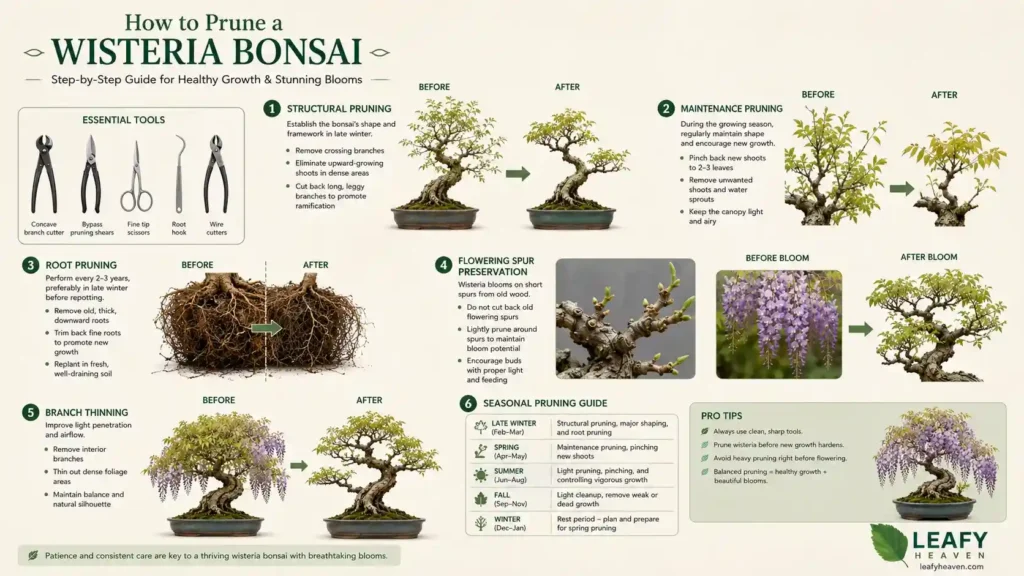
Proper pruning controls Wisteria Bonsai’s vigorous growth, improves branch structure, encourages ramification, and supports abundant flowering. Because Wisteria grows quickly, pruning must balance two goals: keeping the bonsai compact while preserving the short flowering spurs that produce blooms. When pruning is done at the right time, the tree becomes healthier, more refined, and more reliable during the blooming season.
Best Time to Prune Wisteria
The best time to prune Wisteria Bonsai is after flowering and again during the active growing season to control long shoots.
Post-flowering pruning helps shape the tree without removing too many flower buds. Summer pruning controls vigorous extension growth and directs energy back into the main structure.
General timing:
- After flowering: Remove spent flowers and reduce long shoots.
- Summer: Trim excessive vine-like growth.
- Late winter: Inspect structure and remove dead or unwanted branches.
- During repotting: Perform root pruning if needed.
Avoid heavy pruning immediately before the bloom season because this may remove flower buds and reduce flowering.
Structural Pruning
Structural pruning builds the main trunk line, primary branches, and overall bonsai shape.
This type of pruning is most important during the development stage, when the tree is being trained into a balanced bonsai form.
Structural pruning focuses on:
- Selecting the main trunk line
- Removing competing leaders
- Keeping useful primary branches
- Eliminating crossing or awkward branches
- Creating open space for future flower clusters
- Improving trunk and branch movement
Strong cuts should be made carefully because Wisteria can bleed sap and respond with vigorous new growth. Major pruning is usually best done when the tree is dormant or after flowering, depending on the tree’s health and development stage.
Maintenance Pruning
Maintenance pruning keeps Wisteria Bonsai compact and prevents uncontrolled vine-like growth.
During the growing season, Wisteria may produce long shoots that quickly disturb the bonsai shape. These shoots should be shortened regularly to maintain balance and encourage finer branching.
Maintenance pruning includes:
- Shortening long shoots
- Removing unwanted suckers
- Cutting back overly strong growth
- Thinning crowded areas
- Keeping the canopy open
- Preserving flowering spurs
The goal is not to remove all new growth but to manage it. Some extension growth is useful for strengthening the tree, while excessive growth should be controlled before it weakens the design.
Root Pruning
Root pruning keeps the bonsai healthy in a container and prevents the root system from becoming overcrowded.
Wisteria has a strong root system, so repotting and root pruning are important for long-term container success.
Root pruning should focus on:
- Removing circling roots
- Shortening overly long roots
- Preserving fine feeder roots
- Refreshing old soil
- Improving drainage
- Maintaining root balance
Avoid removing too many roots at once, especially from weak or recently stressed trees. Severe root pruning can reduce vigor and may affect flowering in the following season.
How to Trim Wisteria Bonsai for Flowers
To encourage flowers, trim Wisteria Bonsai in a way that preserves mature flowering spurs and prevents excessive leafy growth.
Flower buds often form on short spurs rather than long, vigorous shoots. If these spurs are removed too aggressively, the tree may grow well but flower poorly.
Flower-focused trimming tips:
- Keep short flowering spurs whenever possible.
- Cut back long shoots after flowering.
- Avoid overfeeding with nitrogen before bloom season.
- Allow enough sunlight to reach developing buds.
- Remove weak, shaded, or unproductive shoots.
- Do not prune heavily right before spring bloom.
Good flowering depends on pruning, sunlight, maturity, and seasonal care working together.
Step-by-Step Pruning Guide
- Inspect the tree first.
Check the trunk, branches, flower spurs, long shoots, and overall bonsai shape before making cuts. - Remove dead or damaged growth.
Cut away dry, broken, diseased, or weak branches to improve tree health. - Shorten long shoots.
Reduce vigorous vine-like shoots to keep the tree compact and balanced. - Preserve flowering spurs.
Keep short, mature spurs that are likely to produce blooms in future seasons. - Thin crowded branches.
Remove crossing, inward-growing, or overly dense growth to improve airflow and light penetration. - Refine the branch outline.
Trim the canopy to maintain the desired bonsai shape without making it look too stiff or unnatural. - Check root condition during repotting.
If repotting is needed, prune roots moderately and refresh the soil. - Water after pruning.
Keep the tree evenly moist after pruning to support recovery and continued growth.
Regular pruning keeps Wisteria Bonsai controlled, healthy, and capable of producing the dramatic cascading flowers that make this species so valuable.
Wiring and Styling a Wisteria Bonsai
Wisteria Bonsai can be styled into several elegant bonsai forms, with designs that emphasize its twisting trunk, graceful branches, and spectacular hanging flower clusters. Because Wisteria naturally grows as a vigorous climbing vine, styling focuses on creating a balanced tree structure while showcasing its flowering potential. Proper wiring and branch training help transform vigorous growth into an artistic bonsai display.
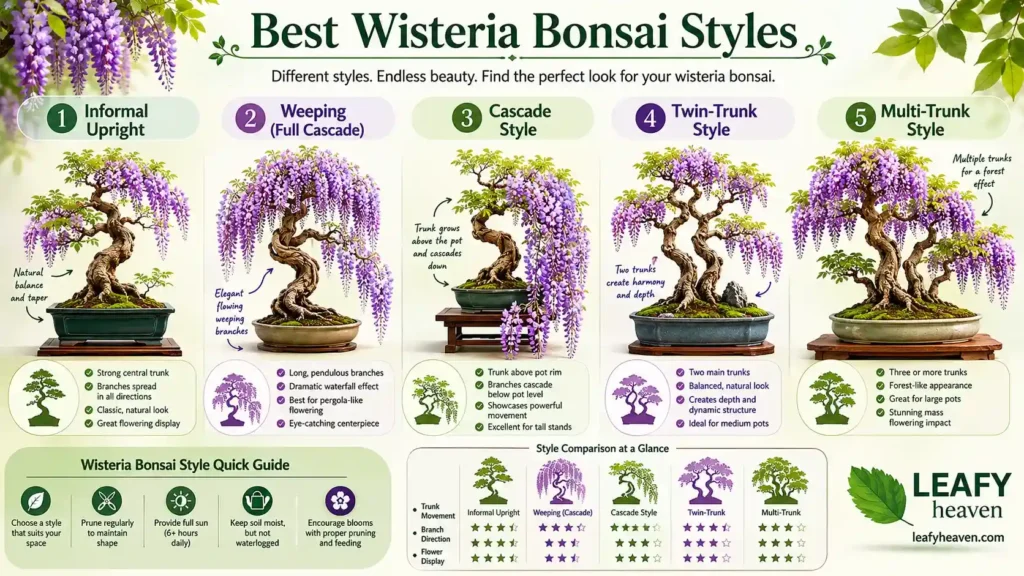
Best Bonsai Styles
Wisteria adapts well to a variety of bonsai styles, although some designs complement its flowering habit more effectively than others.
Popular Wisteria Bonsai styles include:
- Informal Upright Style
- Weeping Style
- Cascade Style
- Semi-Cascade Style
- Twin-Trunk Style
- Multi-Trunk Style
- Flowering Display Style
The best style often depends on the trunk structure, branch placement, and overall character of the tree.
Many growers favor styles that highlight the hanging flower racemes and natural movement of the branches.
Weeping Style Design
The weeping style is one of the most attractive designs for Wisteria Bonsai.
This style emphasizes:
- Arching branches
- Graceful downward movement
- Hanging flower clusters
- Soft, elegant silhouettes
The combination of drooping branches and pendulous blooms creates a waterfall-like effect during the flowering season.
Benefits of the weeping style include:
- Enhanced floral display
- Natural appearance
- Strong visual elegance
- Excellent exhibition potential
Mature specimens in this style often become focal points in flowering bonsai collections.
Cascade Style
Cascade and semi-cascade styles work exceptionally well with Wisteria’s naturally flowing growth habit.
In this design:
- The trunk descends below the rim of the container.
- Branches flow downward naturally.
- Flower clusters hang dramatically beneath the pot.
- The overall composition emphasizes movement and balance.
Cascade Wisteria Bonsai can create a striking visual impact when displayed on bonsai stands, particularly during peak bloom.
Because flowering clusters already hang downward, cascade forms often appear especially harmonious and natural.
Multi-Trunk Style
Multi-trunk Wisteria Bonsai uses two or more trunks to create a mature grove-like appearance.
This style highlights:
- Multiple trunk relationships
- Natural-looking growth patterns
- Increased visual depth
- Seasonal flowering displays across several trunks
Common variations include:
- Twin-trunk style
- Triple-trunk compositions
- Clump-style arrangements
When properly developed, multi-trunk designs create the impression of an older, naturally established Wisteria specimen.
The flowering display can become particularly impressive when several trunks bloom simultaneously.
Wiring Precautions
Wiring Wisteria Bonsai requires extra care because branches can grow rapidly and may scar easily if wires are left on too long.
Important wiring precautions include:
- Use appropriately sized bonsai wire.
- Monitor wired branches frequently.
- Remove wire before it cuts into the bark.
- Avoid excessive bending of older branches.
- Wire young shoots whenever possible.
- Support heavy branches during shaping.
Because Wisteria grows vigorously, wire marks can develop quickly during active growth periods.
Many growers rely on a combination of pruning, directional growth management, and limited wiring rather than aggressive bending. This approach helps maintain branch health while preserving the tree’s natural flowing character.
The most successful Wisteria Bonsai designs balance trunk movement, branch structure, and flowering potential to create a graceful tree that remains attractive throughout every season.
When Does Wisteria Bonsai Bloom?
Most Wisteria Bonsai bloom during spring, producing spectacular hanging flower clusters before or alongside new leaf growth. The exact flowering period varies depending on the species, climate, age of the tree, and growing conditions. When healthy and mature, Wisteria Bonsai can create one of the most impressive floral displays in the bonsai world, with colorful racemes cascading from the branches.
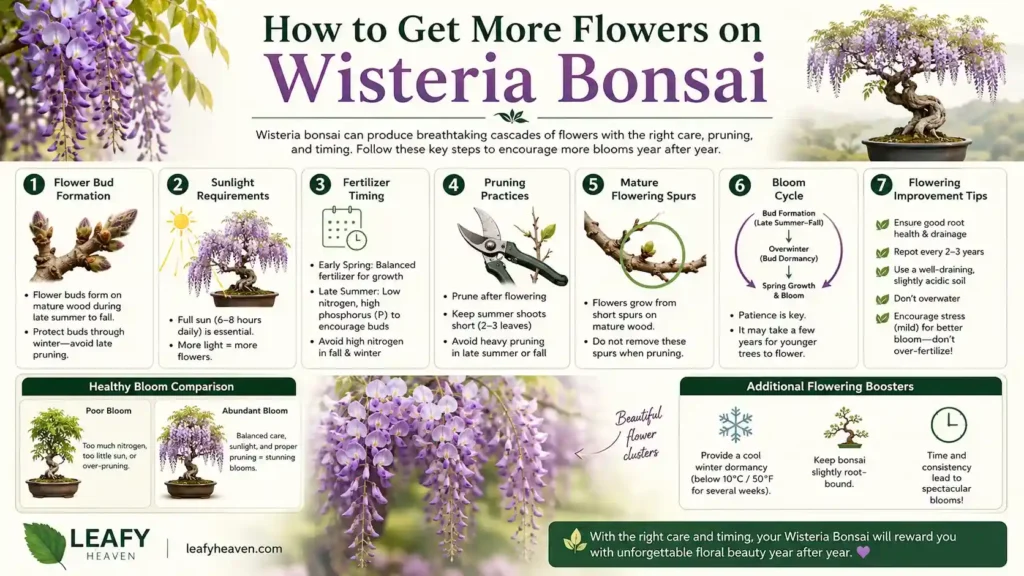
Blooming Season
Wisteria Bonsai typically flowers once each year during spring.
General flowering periods include:
- Early Spring: Flower buds begin swelling.
- Mid to Late Spring: Peak blooming period.
- Early Summer: Flowers gradually fade and new vegetative growth dominates.
In many climates, blooms appear before the foliage fully develops, creating a dramatic display of hanging flowers against bare or lightly leafed branches.
Japanese Wisteria (Wisteria floribunda) and Chinese Wisteria (Wisteria sinensis) may flower at slightly different times depending on local growing conditions and seasonal temperatures.
Factors influencing bloom timing include:
- Climate
- Winter dormancy quality
- Sunlight exposure
- Tree maturity
- Species and cultivar selection
Why Wisteria Fails to Flower
A healthy Wisteria Bonsai may still fail to bloom if important flowering requirements are not met.
Common causes of poor flowering include:
Insufficient Sunlight
Wisteria requires full sun for reliable flower production.
Too little sunlight can result in:
- Reduced flower buds
- Weak growth
- Excessive foliage production
- Delayed blooming
Excessive Nitrogen
Overfeeding with high-nitrogen fertilizers often encourages leafy growth instead of flowers.
Symptoms include:
- Vigorous shoot extension
- Dense foliage
- Few or no blooms
Immature Trees
Young Wisteria Bonsai frequently focus on vegetative growth before reaching flowering maturity.
This is especially common with:
- Seed-grown trees
- Recently propagated cuttings
- Trees still in development stages
Improper Pruning
Removing flowering spurs or pruning at the wrong time can reduce bloom production.
Flower buds often develop on mature short shoots, which should be preserved whenever possible.
Inadequate Winter Dormancy
Wisteria depends on seasonal dormancy to support future flowering.
Warm winters or improper indoor cultivation may interfere with flower bud development.
How to Increase Flower Production
Consistent care and proper seasonal management can significantly improve flowering performance.
Methods that encourage more blooms include:
- Provide at least 6–8 hours of direct sunlight daily.
- Allow proper winter dormancy.
- Use balanced fertilizers during active growth.
- Reduce excessive nitrogen before bloom season.
- Preserve mature flowering spurs when pruning.
- Maintain consistent soil moisture.
- Repot only when necessary.
- Keep the tree healthy and stress-free.
Additional flowering tips:
- Choose grafted or mature specimens for faster flowering.
- Avoid excessive root disturbance before bloom season.
- Ensure good air circulation around the canopy.
- Remove weak or unproductive growth to direct energy toward flower production.
Flowering usually improves as the tree becomes older and more established.
Flowering Expectations by Age
The age and propagation method of a Wisteria Bonsai strongly influence when flowering begins.
| Tree Age / Type | Flowering Expectation |
| 1–3 Years | Primarily vegetative growth |
| 3–7 Years (Cutting-Grown) | Flowering may begin |
| 7–15 Years (Seed-Grown) | Flowering becomes more likely |
| Grafted Specimens | Often flower within 1–3 years |
| Mature Bonsai | Consistent annual flowering under proper care |
Young trees often require patience before producing significant blooms. As trunk maturity, branch structure, and root development improve, flowering typically becomes more reliable and more abundant.
A mature Wisteria Bonsai grown in full sun and properly maintained can reward growers each spring with spectacular cascading clusters of purple, blue, white, or pink flowers that make it one of the most celebrated flowering bonsai species.
Common Wisteria Bonsai Problems and Solutions
Most Wisteria Bonsai problems are caused by watering mistakes, insufficient sunlight, root-related issues, environmental stress, or improper pruning practices. Fortunately, many common issues can be corrected when identified early. Regular monitoring and proper seasonal care help prevent serious damage and keep the tree healthy, vigorous, and capable of producing abundant flowers.
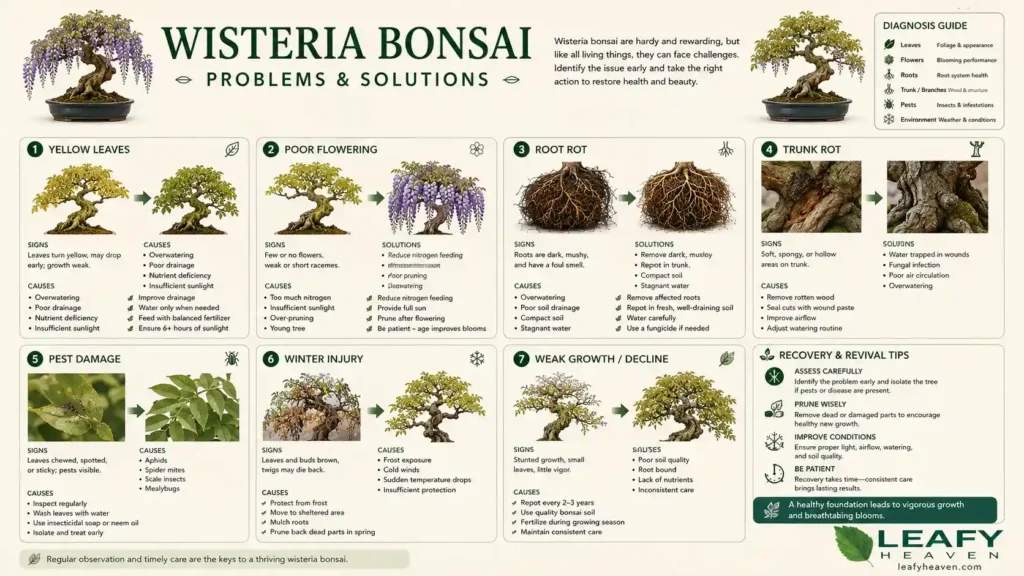
Yellow Leaves
Yellow leaves are one of the most common issues seen in Wisteria Bonsai and can result from several different causes.
Common causes include:
- Overwatering
- Underwatering
- Poor drainage
- Nutrient deficiencies
- Root stress
- Seasonal leaf aging
Symptoms may include:
- Pale green or yellow foliage
- Premature leaf drop
- Weak growth
- Reduced vigor
Solutions:
- Check soil moisture before watering.
- Improve drainage if soil remains constantly wet.
- Follow a balanced fertilization schedule.
- Inspect roots during repotting.
- Ensure the tree receives adequate sunlight.
Seasonal yellowing during autumn is natural and should not be confused with health problems.
Poor Flowering
Poor flowering is one of the most frustrating problems for Wisteria Bonsai growers.
Common causes include:
- Insufficient sunlight
- Excessive nitrogen fertilization
- Improper pruning
- Immature trees
- Lack of winter dormancy
- Stress from root problems
Signs include:
- Healthy foliage but few blooms
- Reduced flower clusters
- Flower buds failing to develop
Solutions:
- Provide full sun exposure.
- Reduce high-nitrogen feeding before bloom season.
- Preserve flowering spurs during pruning.
- Allow proper winter dormancy.
- Maintain consistent watering.
Flower production generally improves as the tree matures and receives proper seasonal care.
Root Rot
Root rot is a serious condition caused by prolonged waterlogged soil and poor root aeration.
Common causes:
- Overwatering
- Compacted soil
- Poor drainage
- Pots without adequate drainage holes
Symptoms include:
- Yellowing leaves
- Wilting despite wet soil
- Weak growth
- Root discoloration
- Foul-smelling soil
Solutions:
- Improve drainage immediately.
- Reduce excessive watering.
- Repot into fresh bonsai soil if necessary.
- Remove severely damaged roots during repotting.
- Allow better airflow around the root zone.
Preventing waterlogged conditions is the most effective defense against root rot.
Wisteria Trunk Rot
Trunk rot is less common than root rot but can become serious if left untreated.
Potential causes include:
- Physical damage to the trunk
- Fungal infections
- Constant moisture against the bark
- Poor sanitation during pruning
Symptoms may include:
- Soft or discolored bark
- Cracking tissue
- Darkened trunk sections
- Progressive dieback
Solutions:
- Remove damaged tissue where appropriate.
- Improve air circulation.
- Avoid keeping water trapped against the trunk.
- Sterilize pruning tools before use.
- Monitor affected areas regularly.
Early intervention improves the chances of recovery.
Pest Problems
Although Wisteria Bonsai is relatively resilient, several common pests may occasionally appear.
Potential pests include:
- Aphids
- Scale insects
- Spider mites
- Caterpillars
- Mealybugs
Common symptoms:
- Distorted leaves
- Sticky residue
- Yellow foliage
- Reduced growth
- Visible insect activity
Solutions:
- Inspect foliage regularly.
- Remove pests manually when possible.
- Improve airflow around the canopy.
- Keep the growing area clean.
- Use appropriate bonsai-safe pest treatments when necessary.
Routine inspections help prevent minor infestations from becoming major problems.
Winter Damage
Wisteria is generally cold-hardy, but bonsai containers expose roots to lower temperatures than garden-grown plants.
Potential causes of winter damage include:
- Severe freezing temperatures
- Repeated freeze-thaw cycles
- Dry winter winds
- Unprotected root systems
Symptoms include:
- Branch dieback
- Delayed spring growth
- Damaged buds
- Reduced flowering
Solutions:
- Protect bonsai pots during extreme cold.
- Shelter trees from harsh winter winds.
- Maintain slight soil moisture during dormancy.
- Avoid warm indoor conditions that interrupt dormancy.
Proper winter protection helps preserve flower buds and supports healthy spring growth.
Wisteria Bonsai Troubleshooting Table
| Problem | Common Cause | Solution |
| Yellow Leaves | Watering issues, nutrient deficiency, root stress | Adjust watering, improve drainage, fertilize properly |
| Poor Flowering | Low sunlight, excess nitrogen, improper pruning | Increase sunlight, preserve flowering spurs, adjust fertilizer |
| Root Rot | Overwatering and poor drainage | Repot, improve soil drainage, reduce watering |
| Trunk Rot | Moisture damage or fungal infection | Improve airflow, remove damaged tissue, monitor trunk health |
| Pest Problems | Aphids, scale, mites, mealybugs | Inspect regularly and apply appropriate treatments |
| Winter Damage | Extreme cold and exposed roots | Protect pots, maintain dormancy, shelter from severe weather |
Most Wisteria Bonsai problems can be prevented through proper watering, strong sunlight, good drainage, seasonal maintenance, and regular observation. Early detection remains the key to maintaining a healthy, long-lived flowering bonsai.
Wisteria Bonsai Lifespan and Long-Term Care
With proper care, Wisteria Bonsai can live for decades and continue improving in beauty, character, and flowering performance over time. Unlike many ornamental plants that decline with age, a healthy Wisteria Bonsai often becomes more valuable as its trunk thickens, bark matures, and branch structure becomes increasingly refined. Long-term success depends on consistent maintenance, seasonal care, and patience throughout the tree’s development.
How Long Do Wisteria Live?
Wisteria is a naturally long-lived plant capable of surviving for many decades under favorable conditions.
In bonsai cultivation, lifespan is influenced by:
- Quality of care
- Growing conditions
- Root health
- Pruning practices
- Pest and disease management
- Environmental stability
Well-maintained Wisteria Bonsai commonly live for:
- Several decades in containers
- Multiple generations with proper care
- Far longer than many flowering ornamental plants
Many mature specimens continue to flower and develop character well into old age, making them prized additions to bonsai collections.
Long-Term Maintenance
Long-term health requires a consistent maintenance routine that supports both growth and flowering.
Important long-term care practices include:
- Maintaining regular watering schedules
- Providing full sun exposure
- Following a balanced fertilization program
- Performing seasonal pruning
- Repotting when necessary
- Monitoring root health
- Protecting the tree during extreme weather
As the bonsai ages, routine maintenance becomes more focused on preserving health and refinement rather than rapid development.
Long-term maintenance goals include:
- Sustaining flowering performance
- Preserving branch structure
- Maintaining root vigor
- Preventing decline from overcrowded roots
- Enhancing overall bonsai aesthetics
Small adjustments made consistently over many years often produce the best results.
Aging and Trunk Development
One of the most attractive features of an older Wisteria Bonsai is its increasingly mature trunk.
As the tree ages, it gradually develops:
- Greater trunk thickness
- Improved taper
- Rougher bark texture
- Enhanced trunk movement
- Stronger visual character
These features create the appearance of an ancient flowering tree in miniature form.
Aging also improves:
- Branch ramification
- Flowering consistency
- Overall balance
- Seasonal beauty
Unlike young specimens that rely primarily on flowers for visual appeal, mature Wisteria Bonsai often possess impressive structural beauty even when not in bloom.
The combination of an aged trunk and cascading flower clusters is one of the defining characteristics of exceptional Wisteria Bonsai.
Creating a Legacy Bonsai
Wisteria Bonsai has the potential to become a true legacy bonsai that can be enjoyed for generations.
Creating a long-lasting specimen involves:
- Prioritizing tree health over rapid development
- Making thoughtful design decisions
- Preserving structural quality
- Avoiding unnecessary stress
- Maintaining detailed care records
- Continuing refinement over time
Characteristics of a legacy bonsai often include:
- Mature trunk development
- Refined branch structure
- Reliable flowering
- Strong root health
- Timeless artistic design
Because Wisteria is naturally long-lived and responds well to careful cultivation, it is well suited for growers who wish to create a bonsai that continues to improve for decades.
With patience, proper maintenance, and consistent care, a Wisteria Bonsai can become a treasured living artwork that grows more beautiful with every passing year.
Benefits and Uses of Wisteria Bonsai
Wisteria Bonsai combines spectacular flowering displays, artistic design potential, and year-round seasonal interest in a compact form. Its cascading blooms, aged trunk development, and elegant branch structure make it one of the most admired flowering bonsai species. Whether displayed as a centerpiece, exhibited in bonsai shows, or used as inspiration for landscape design, Wisteria Bonsai offers exceptional ornamental value.
Display and Exhibition Use
Wisteria Bonsai is highly valued in bonsai exhibitions because of its dramatic floral displays and mature appearance.
Features that make it an outstanding exhibition tree include:
- Cascading flower clusters
- Twisting, aged trunks
- Elegant branch structure
- Strong seasonal visual impact
- Impressive flowering presentations
During the blooming season, Wisteria often becomes the focal point of a bonsai display due to the sheer abundance of flowers and the striking contrast between blooms and bark.
Exhibition-quality specimens are typically developed over many years and carefully maintained to maximize flowering and structural refinement.
Flowering Bonsai Collections
Wisteria Bonsai is considered a cornerstone species in many flowering bonsai collections.
Collectors often include Wisteria because it offers:
- Reliable seasonal blooms
- Distinctive floral displays
- Variety in flower colors
- Strong visual contrast to foliage-focused bonsai
It pairs well with other flowering bonsai species such as:
- Cherry Blossom Bonsai
- Azalea Bonsai
- Crabapple Bonsai
- Magnolia Bonsai
Summer-blooming varieties like crepe myrtle also complement Wisteria beautifully in flowering bonsai collections, extending seasonal color well beyond the spring flowering period.
Adding a Wisteria Bonsai to a collection introduces a dramatic spring flowering element that complements both deciduous and evergreen bonsai trees.
Landscape Inspiration
Although grown in miniature form, Wisteria Bonsai often reflects the beauty of mature Wisteria trees found in gardens and landscapes.
Design elements inspired by natural Wisteria include:
- Flowing branch movement
- Arching canopy forms
- Cascading floral displays
- Natural trunk curves
- Multi-trunk compositions
Many bonsai artists use landscape-grown Wisteria as inspiration when designing branch structure and overall tree silhouette.
The miniature representation of a mature flowering tree is one of the core artistic principles that makes Wisteria Bonsai so appealing.
Decorative Value
Wisteria Bonsai provides exceptional decorative value throughout the year.
Its ornamental appeal changes with the seasons:
- Spring: Spectacular flower clusters create the main visual display.
- Summer: Dense green foliage adds freshness and vitality.
- Autumn: Yellow foliage provides seasonal color interest.
- Winter: Twisting trunks and refined branch structure become the focal point.
Decorative benefits include:
- Elegant focal-point displays
- Seasonal visual variety
- Artistic indoor display during short bloom periods
- Attractive patio and garden presentation
- Increased aesthetic value for bonsai collections
Few bonsai species combine flowering beauty, structural elegance, and seasonal transformation as effectively as Wisteria Bonsai, making it one of the most decorative and visually rewarding trees to grow.
Wisteria Bonsai vs Other Flowering Bonsai Trees
Wisteria Bonsai stands out among flowering bonsai species because of its long cascading flower clusters, vigorous growth, and impressive trunk development. While many flowering bonsai produce beautiful blooms, few combine dramatic floral displays with the aged appearance and longevity that Wisteria offers. Choosing the right flowering bonsai depends on factors such as maintenance requirements, flowering characteristics, climate suitability, and experience level.
Wisteria vs Cherry Blossom Bonsai
Both Wisteria Bonsai and Cherry Blossom Bonsai are prized for their spectacular spring blooms, but they offer different visual effects and growing characteristics.
| Feature | Wisteria Bonsai | Cherry Blossom Bonsai |
| Flower Type | Hanging flower clusters | Individual blossoms |
| Bloom Duration | Moderate | Relatively short |
| Growth Rate | Fast | Moderate |
| Trunk Development | Strong and vigorous | Slower |
| Seasonal Impact | Dramatic cascading display | Elegant spring blossoms |
Wisteria creates a waterfall-like floral effect with long racemes, while Cherry Blossom Bonsai is admired for its delicate blossoms that symbolize spring.
Growers seeking bold floral displays often prefer Wisteria, whereas those who appreciate subtle seasonal beauty may favor Cherry Blossom Bonsai.
Growers seeking bold floral displays often prefer Wisteria, whereas those who appreciate subtle seasonal beauty may favor cherry blossom bonsai.
Wisteria vs Azalea Bonsai
Azalea Bonsai is another popular flowering species known for producing large numbers of colorful flowers.
Key differences include:
| Feature | Wisteria Bonsai | Azalea Bonsai |
| Flower Structure | Hanging racemes | Dense flower clusters |
| Growth Habit | Vigorous vine-based growth | Compact shrub growth |
| Trunk Development | Strong and dramatic | Generally slower |
| Flower Colors | Purple, Blue, White, Pink | Wide range of colors |
| Maintenance | Moderate to High | Moderate |
Wisteria often develops more impressive trunk character, while Azalea Bonsai is famous for producing dense masses of flowers that can completely cover the canopy.
Both species are highly valued exhibition trees.
Wisteria vs Chinese Elm Bonsai
Chinese Elm Bonsai differs significantly because it is primarily grown for trunk movement, bark texture, and branch ramification rather than flowers.
| Feature | Wisteria Bonsai | Chinese Elm Bonsai |
| Primary Attraction | Flowers | Structure and foliage |
| Blooming Value | Excellent | Minimal |
| Growth Rate | Fast | Moderate to Fast |
| Trunk Character | Excellent | Excellent |
| Beginner Friendly | Moderate | High |
Chinese Elm Bonsai is often recommended for beginners because it is highly adaptable and forgiving.
Wisteria, on the other hand, rewards growers with spectacular blooms but generally requires more attention to watering, pruning, and flowering management.
Best Flowering Bonsai for Beginners
For beginners interested in flowering bonsai, some species are easier to manage than others.
Common beginner-friendly flowering bonsai choices include:
- Azalea Bonsai
- Chinese Sweet Plum Bonsai
- Crabapple Bonsai
- Bougainvillea Bonsai
- Wisteria Bonsai (for growers willing to learn regular pruning and watering)
Wisteria is not the easiest flowering bonsai, but it is one of the most rewarding. Beginners who can provide full sun, consistent watering, and seasonal pruning often achieve excellent results.
Its rapid growth can actually help new growers learn bonsai techniques more quickly than slower-growing species.
Flowering Bonsai Comparison Table
| Bonsai Species | Flower Display | Growth Rate | Difficulty | Beginner Friendly |
| Wisteria Bonsai | Excellent | Fast | Intermediate | Moderate |
| Cherry Blossom Bonsai | Excellent | Moderate | Intermediate | Moderate |
| Azalea Bonsai | Excellent | Moderate | Moderate | Good |
| Chinese Elm Bonsai | Limited Flowers | Moderate to Fast | Easy | Excellent |
| Crabapple Bonsai | Very Good | Moderate | Moderate | Good |
| Bougainvillea Bonsai | Very Good | Fast | Moderate | Good |
Wisteria Bonsai remains one of the most impressive flowering bonsai trees available. Its combination of vigorous growth, aged trunk development, and dramatic cascading blooms makes it a standout choice for growers seeking a visually striking and highly rewarding flowering bonsai species.
Conclusion
Wisteria Bonsai is one of the most spectacular flowering bonsai species, admired for its cascading blooms, powerful trunk development, and exceptional seasonal beauty. Whether grown from seed, cuttings, air layering, or nursery stock, it rewards patient growers with breathtaking displays that few other bonsai trees can match.
Key Takeaways
- Wisteria Bonsai is a deciduous flowering bonsai known for its hanging flower clusters.
- Japanese Wisteria (Wisteria floribunda) and Chinese Wisteria (Wisteria sinensis) are the most popular bonsai species.
- Full sun exposure is essential for healthy growth and reliable flowering.
- Consistent watering and well-draining soil are critical for long-term success.
- Regular pruning helps control vigorous growth and improve flowering.
- Most Wisteria Bonsai perform best outdoors and require winter dormancy.
- Mature specimens can live for decades and become increasingly valuable over time.
Most Important Care Tips
For the best results, focus on these core care practices:
- Provide at least 6–8 hours of direct sunlight daily.
- Keep the soil consistently moist but never waterlogged.
- Use balanced fertilizer during active growth and reduce nitrogen before flowering.
- Prune regularly to maintain shape and preserve flowering spurs.
- Repot periodically to maintain healthy roots.
- Allow natural winter dormancy each year.
- Monitor for pests, root issues, and watering problems.
Consistent care throughout the seasons has a greater impact on success than any single technique.
Flowering Success Checklist
Use this checklist to maximize bloom production:
✔ Grow the tree in full sun.
✔ Allow proper winter dormancy.
✔ Use appropriate fertilizer throughout the year.
✔ Avoid excessive nitrogen before bloom season.
✔ Preserve flowering spurs during pruning.
✔ Keep soil evenly moist.
✔ Maintain healthy roots through repotting and root care.
✔ Choose mature, cutting-grown, or grafted specimens for earlier flowering.
✔ Avoid unnecessary stress before the blooming season.
✔ Be patient as the tree matures.
Encouragement for Beginners
Although Wisteria Bonsai is often considered an intermediate-level bonsai, beginners can achieve excellent results with proper care and patience. Its vigorous growth makes it responsive to training, while its spectacular flowers provide a rewarding goal for growers learning bonsai techniques.
Every mature Wisteria Bonsai begins as a young tree that requires years of careful development. By focusing on sunlight, watering, pruning, and seasonal maintenance, even new bonsai enthusiasts can gradually create a beautiful flowering specimen that improves year after year.
With time, dedication, and consistent care, a Wisteria Bonsai can become a stunning living artwork that delivers unforgettable spring blooms for decades to come.
Frequently Asked Questions
How often should I water a Wisteria Bonsai?
Wisteria Bonsai prefers consistently moist soil and generally requires more water than many other bonsai species. During spring and summer, watering may be needed daily, especially during hot weather. Always check soil moisture before watering and avoid allowing the soil to dry out completely. At the same time, avoid waterlogged conditions that can lead to root rot.
Can Wisteria Bonsai grow indoors permanently?
No, Wisteria Bonsai is not suitable for permanent indoor cultivation. It requires full sun, natural seasonal changes, and winter dormancy to remain healthy and flower reliably. While it can be displayed indoors temporarily during the blooming season, long-term growing should take place outdoors.
How long does it take for Wisteria Bonsai to flower?
The flowering timeline depends on how the tree was propagated. Grafted specimens may flower within 1–3 years, cutting-grown trees often bloom within 3–7 years, while seed-grown Wisteria may take 7–15 years or longer before producing flowers. Mature trees generally flower more consistently than young specimens.
What is the best fertilizer for Wisteria Bonsai?
A balanced fertilizer is usually best during active growth. Before the flowering season, many growers reduce nitrogen levels and use fertilizers that support flower production. After blooming, balanced feeding helps restore energy and promote healthy growth. Proper fertilization should always be combined with adequate sunlight and watering.
How do I make my Wisteria Bonsai bloom more?
To increase flowering, provide full sun exposure, allow proper winter dormancy, maintain consistent watering, and avoid excessive nitrogen fertilization before bloom season. Preserving flowering spurs during pruning is also important. Healthy, mature trees grown under optimal conditions generally produce the best flowering displays.
Is Japanese Wisteria better than Chinese Wisteria for bonsai?
Neither species is universally better, but each offers different advantages. Japanese Wisteria (Wisteria floribunda) is famous for its exceptionally long flower racemes and dramatic displays, while Chinese Wisteria (Wisteria sinensis) often flowers earlier and grows vigorously. The best choice depends on your growing goals, available space, and preferred flowering style.
Can I grow a Wisteria Bonsai from seed?
Yes, Wisteria Bonsai can be grown from seed, and many enthusiasts enjoy developing trees from the earliest stages. However, seed-grown specimens require patience because flowering may take many years. Cuttings, air layering, and grafted plants are often chosen when faster flowering is desired.
How long can a Wisteria Bonsai live?
With proper care, Wisteria Bonsai can live for several decades and may even be passed down through generations. Regular watering, proper pruning, healthy root management, adequate sunlight, and seasonal maintenance all contribute to long-term health and longevity. Mature specimens often become more beautiful and valuable as they age.

Written by the LeafyHeaven Editorial Team
LeafyHeaven shares practical gardening tips and simple plant care guides to help you grow, nurture, and enjoy your plants with ease. Our goal is to make gardening feel natural, approachable, and rewarding for everyone.