
Introduction
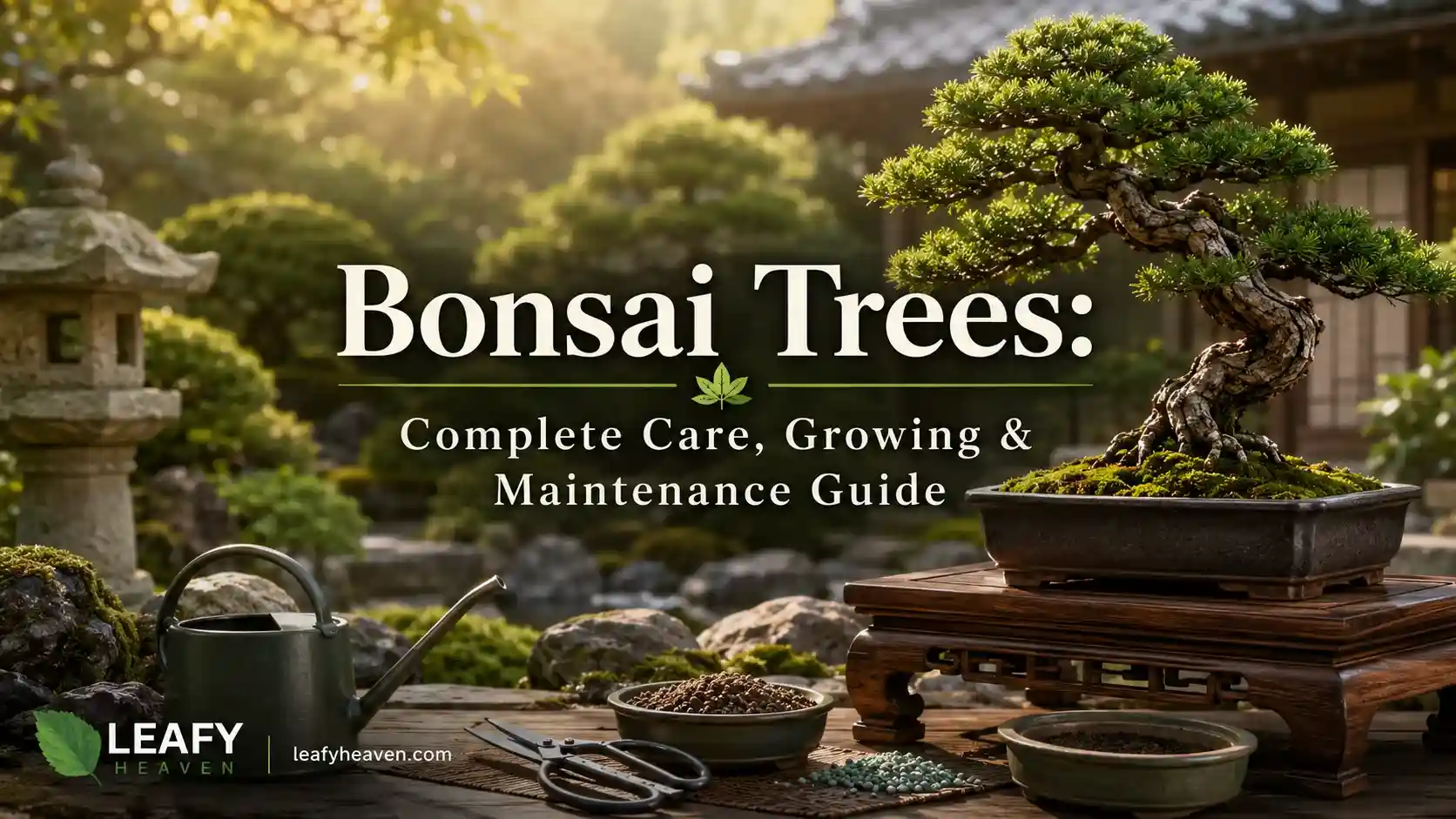
Bonsai trees are living miniature trees cultivated in containers through specialized techniques such as pruning, wiring, and root management. Although small in size, they require the same biological needs as full-sized trees, making bonsai tree care a balance between horticultural knowledge and artistic design. Proper care allows bonsai to develop natural proportions, healthy growth, and long-term vitality for decades or even centuries.
Successful caring for bonsai involves understanding how trees respond to water, sunlight, soil structure, nutrients, seasonal changes, and pruning practices. Every decision, from selecting the right species to managing root growth, directly affects the tree’s health and appearance. This combination of science and craftsmanship is what makes bonsai one of the most respected forms of living plant cultivation.
This comprehensive bonsai care guide explains the essential principles of bonsai plant care for both beginners and experienced growers. You will learn how to water bonsai correctly, choose the best soil mix, apply fertilizer effectively, repot trees safely, select suitable species, protect bonsai during winter, and diagnose common problems before they become serious. By understanding these core fundamentals, you can build a strong foundation for growing healthy, attractive, and long-lasting bonsai trees.
What Is a Bonsai Tree? Basic Overview and Classification
Bonsai is not a plant species. It is a horticultural technique that involves growing woody trees or shrubs in shallow containers and carefully training them to resemble mature trees found in nature. The goal is to create a realistic miniature representation of a full-sized tree while maintaining its natural growth habits, proportions, and seasonal characteristics.
Definition and Meaning of Bonsai
A bonsai tree is a living miniature tree developed through pruning, wiring, root management, and container cultivation. Understanding what is bonsai tree begins with understanding its name and historical background.
The word bonsai comes from two Japanese terms:
- Bon = tray or shallow container
- Sai = planting or growing
Together, bonsai meaning translates to “tray planting” or “planting in a container.”
The art originated from the ancient Chinese practice of Penjing, which involved creating miniature landscapes and trees. This technique was later introduced to Japan during the Heian period, where it evolved into the refined art form recognized today.
Beyond horticulture, bonsai reflects the Japanese philosophy of wabi-sabi, which appreciates simplicity, imperfection, patience, and harmony with nature. For this reason, bonsai is often viewed as both a gardening practice and a form of living art.
For people wondering what is a bonsai plant, it is not a genetically dwarf tree. Instead, it is a carefully trained tree whose growth is managed to maintain a miniature size while preserving the appearance of a mature specimen.
Is Bonsai a Specific Plant Species?
No, bonsai is not a specific plant species.
One of the most common misconceptions in bonsai basics is believing that a bonsai tree belongs to a special type of plant. In reality, almost any woody tree or shrub can become a bonsai if it can tolerate pruning, root reduction, and container cultivation.
This means that species from many climates and regions can be trained as bonsai, including:
- Juniper
- Japanese Maple
- Chinese Elm
- Ficus
- Pine
- Jade
- Azalea
- Wisteria
- Ginkgo
- Oak
Today, hundreds of species are used worldwide, each offering unique foliage, bark texture, flowering habits, growth rates, and seasonal interest.
Among the most interesting bonsai tree facts is that the same species growing naturally in a forest can also be transformed into a bonsai while remaining genetically identical. The difference lies entirely in cultivation techniques rather than the plant itself.
Bonsai Tree Size Classifications
Bonsai trees range from extremely small specimens measuring only a few centimeters to large exhibition trees that require multiple people to move. As a result, bonsai tree sizes are traditionally classified using Japanese size categories.
The answer to questions such as how big do bonsai trees get, how big can a bonsai tree get, and how tall do bonsai trees get depends on the chosen style, species, and classification.
| Size Classification | Japanese Term | Height Range |
| Miniature | Keshitsubo | Under 3 cm |
| Tiny Bonsai | Shito | 3–10 cm |
| Small Bonsai | Shohin | 10–20 cm |
| Medium Bonsai | Komono | 15–25 cm |
| Medium Bonsai | Katade-Mochi | 25–46 cm |
| Large Bonsai | Chumono | 41–91 cm |
| Very Large Bonsai | Omono | 76–122 cm |
| Imperial Bonsai | Imperial | 76–122 cm and larger |
A tiny bonsai tree may fit comfortably in the palm of a hand, while an Imperial bonsai can exceed one meter in height and require decades of development.
How Long Do Bonsai Trees Live?
Bonsai trees can live for exceptionally long periods when provided with proper care. In many cases, their lifespan equals or exceeds that of the same species growing naturally in the ground.
The average bonsai lifespan ranges from approximately 25 to more than 800 years, depending on the species, environment, and maintenance practices.
Several famous bonsai specimens in Japan are estimated to be between 800 and 1,000 years old, making them among the oldest living cultivated trees in the world.
The answer to how long do bonsai trees live, how long can a bonsai tree live, or how long does a bonsai tree live depends on several key factors:
- Species longevity
- Proper watering practices
- Quality soil and drainage
- Regular pruning and repotting
- Pest and disease management
- Suitable climate conditions
- Long-term consistency of care
While some beginner trees may survive only a few years due to improper maintenance, a healthy bonsai tree lifespan can extend across multiple generations when cared for correctly. This remarkable longevity is one reason bonsai remains one of the most respected and rewarding forms of plant cultivation.
Types of Bonsai Trees: Best Species for Beginners and Experts
The most popular bonsai tree species include Juniper, Ficus, Japanese Maple, Chinese Elm, and Jade. Each species has unique growth habits, care requirements, environmental preferences, and styling potential. Choosing the right species is one of the most important decisions because it directly affects maintenance difficulty, growth rate, and long-term success.
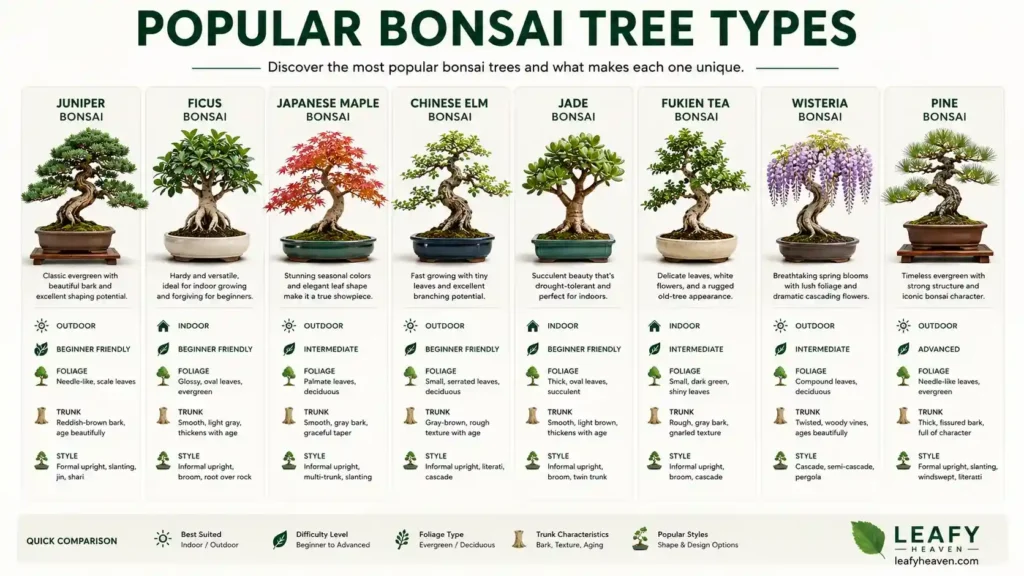
Best Bonsai Trees for Beginners
The best bonsai tree for beginners is one that tolerates occasional mistakes, adapts well to training, and responds positively to basic care techniques. If you are new to bonsai, selecting an easy care bonsai species significantly increases the chances of success.
Juniper Bonsai (Juniperus chinensis, Juniperus procumbens)
Juniper Bonsai is widely considered the most reliable outdoor bonsai tree for beginners.
Key advantages:
- Extremely resilient and adaptable
- Responds well to pruning and wiring
- Tolerates a wide range of climates
- Develops attractive deadwood features
- Available in many bonsai nurseries worldwide
For those asking whether bonsai trees are easy to care for, Juniper is often the species most commonly recommended because of its forgiving nature.
Ficus Bonsai (Ficus retusa / Ficus microcarpa)
Ficus is considered one of the best indoor bonsai species.
Benefits include:
- Tolerates indoor conditions well
- Handles pruning aggressively
- Fast growth and recovery
- Attractive aerial roots in humid environments
- Suitable for beginners and experienced growers
Ficus is frequently recommended in bonsai care for beginners because it can survive conditions that would stress many other species.
Ficus Bonsai is frequently recommended in bonsai care for beginners because it can survive conditions that would stress many other species.
Chinese Elm Bonsai (Ulmus parvifolia)
Chinese Elm is one of the most adaptable bonsai species available.
Notable characteristics:
- Semi-deciduous growth habit
- Fine branching structure
- Excellent response to pruning
- Suitable for indoor or outdoor cultivation depending on climate
- Attractive bark development with age
Many enthusiasts consider Chinese Elm the ideal bonsai for beginners because it combines beauty with durability.
Many enthusiasts consider Chinese Elm Bonsai the ideal bonsai for beginners because it combines beauty with durability.
Jade Bonsai (Crassula ovata)
Jade Bonsai is a succulent species valued for its simplicity and drought tolerance.
Advantages include:
- Stores water in leaves and stems
- Requires less frequent watering
- Suitable for bright indoor locations
- Thick trunk development over time
- Minimal maintenance requirements
For growers wondering if bonsais are hard to take care of, Jade demonstrates that some species are remarkably easy to maintain.
Dwarf Jade (Portulacaria afra)
Often confused with true Jade, Dwarf Jade is considered by many growers to be an even better bonsai candidate.
Benefits:
- Faster growth than Jade
- Excellent response to pruning
- High drought tolerance
- Easy propagation from cuttings
- Strong suitability for bonsai training
Popular Flowering and Fruiting Bonsai Species
Flowering bonsai and fruit-producing species add seasonal color, fragrance, and visual interest that standard foliage trees cannot provide.
Azalea / Satsuki Bonsai
Azalea is often called the king of flowering bonsai.
Tropical flowering enthusiasts may also appreciate Jacaranda Bonsai, which produces stunning blue-purple flower clusters and elegant fern-like foliage.
Key features:
- Spectacular spring blooms
- Hundreds of flower varieties
- Compact growth habit
- Strong bonsai styling potential
Its dramatic flowering display makes it one of the most desirable blooming bonsai species.
Summer-blooming varieties like Lagerstroemia Bonsai also deserve recognition for their vibrant flower clusters and distinctive peeling bark.
Wisteria Bonsai (Wisteria sinensis)
Wisteria Bonsai is famous for its cascading clusters of flowers.
Highlights:
- Long hanging flower racemes
- Fragrant spring blooms
- Powerful trunk development
- Exceptional exhibition-quality appearance
A mature Wisteria Bonsai is often considered one of the most visually impressive bonsai specimens.
Growers seeking blue-purple tropical blooms may also appreciate Jacaranda Bonsai for its elegant fern-like foliage and stunning seasonal flowers.
Cherry Blossom Bonsai (Prunus)
Cherry Blossom Bonsai holds special cultural significance in Japan.
Benefits:
- Beautiful seasonal blossoms
- Strong symbolic value
- Elegant branch structure
- Attractive spring display
Successful cherry blossom bonsai care requires adequate winter dormancy and seasonal maintenance.
Successful Cherry Blossom Bonsai care requires adequate winter dormancy and seasonal maintenance.
Fukien Tea Bonsai (Carmona retusa / Carmona microphylla)
Fukien Tea Bonsai is one of the most popular indoor flowering bonsai trees.
Characteristics:
- Small white flowers throughout the year
- Glossy green foliage
- Compact growth habit
- Suitable for indoor environments
Both Fukien Tea Bonsai and Carmona microphylla bonsai are highly valued by indoor growers.
Pomegranate Bonsai
Pomegranate creates one of the most attractive bonsai fruit tree displays.
Features include:
- Bright orange-red flowers
- Small edible fruits
- Attractive bark texture
- Excellent seasonal interest
Crabapple Bonsai (Malus)
Crabapple combines flowers and fruit in a single bonsai specimen.
Benefits:
- Abundant spring blossoms
- Decorative autumn fruit
- Strong seasonal appeal
- Excellent exhibition potential
Barbados Cherry Bonsai (Malpighia)
This tropical species is prized for its colorful fruit production.
Advantages:
- Small edible fruits
- Tropical appearance
- Compact growth
- Suitable for warm climates and indoor cultivation
Conifer and Evergreen Bonsai Species
Conifer bonsai tree species are among the most traditional and respected bonsai subjects. They provide year-round foliage and often develop impressive aged characteristics.
Japanese Black Pine (Pinus thunbergii)
Japanese Black Pine is considered one of the classic bonsai species.
Key traits:
- Strong trunk development
- Long lifespan
- Traditional Japanese styling
- Excellent needle reduction potential
Many bonsai masters consider it the ultimate bonsai pine species.
Juniper Bonsai Varieties
Several Juniper species are commonly cultivated as bonsai.
Popular varieties include:
- Shimpaku Juniper
- Juniperus procumbens nana
- Chinese Juniper
- Itoigawa Juniper
The Juniper bonsai tree remains one of the most widely grown bonsai worldwide.
Hinoki Cypress (Chamaecyparis obtusa)
Hinoki Cypress Bonsai is known for its elegant foliage pads and refined appearance.
Benefits:
- Soft scale-like foliage
- Attractive bark texture
- Strong Japanese aesthetic
- Excellent for formal designs
Spruce Bonsai (Picea abies)
Spruce Bonsai offers excellent styling opportunities.
Characteristics:
- Dense branching
- Strong apical dominance
- Traditional conifer appearance
- Long-term development potential
The species most commonly used is bonsai Picea abies.
Dawn Redwood Bonsai (Metasequoia)
Metasequoia Bonsai combines conifer structure with deciduous characteristics.
Growers who enjoy fast-growing deciduous conifers may also explore Bald Cypress Bonsai for its impressive trunk flare and wetland-inspired bonsai designs.
Features:
- Fast growth
- Attractive trunk formation
- Fine feathery foliage
- Seasonal color changes
Deciduous Bonsai Species
Deciduous bonsai trees provide seasonal beauty through spring growth, summer foliage, autumn color, and winter branch structure.
Japanese Maple Bonsai (Acer palmatum)
Japanese Maple Bonsai is famous for its exceptional seasonal color.
Benefits:
- Brilliant autumn foliage
- Delicate leaf structure
- Elegant branching patterns
- Strong ornamental value
Both bonsai Japanese Maple and Japanese Maple bonsai tree varieties remain among the most sought-after bonsai specimens.
Trident Maple Bonsai
Trident Maple is highly regarded for advanced bonsai development.
Advantages:
- Excellent ramification
- Strong root spread
- Vigorous growth
- Easy response to pruning
Chinese Elm Bonsai
Chinese Elm is often considered the best all-around beginner deciduous bonsai.
Those seeking a more open-canopy deciduous option may also enjoy Honey Locust Bonsai for its fine compound foliage and elegant airy branching.
Benefits:
- Adaptability
- Attractive bark
- Fine branching
- Reliable growth
Beech, Hornbeam, and Oak Bonsai
These classic deciduous species are valued for their natural appearance and seasonal beauty.
Key characteristics:
- Beech Bonsai – smooth bark and elegant structure
- Hornbeam Bonsai – dense branching and refined foliage
- Oak Bonsai – rugged appearance and longevity
Growers who enjoy rugged deciduous character may also find Black Locust Bonsai rewarding for its deeply textured bark and fast trunk development.
Ginkgo Biloba Bonsai
Ginkgo Bonsai is cultivated from one of the world’s oldest tree species.
Notable features:
- Distinctive fan-shaped leaves
- Spectacular golden autumn color
- Exceptional longevity
- Unique historical significance
The Ginkgo Biloba bonsai tree is often described as a living fossil because its ancestors existed millions of years ago.
Tropical and Indoor Bonsai Species
Tropical bonsai species are best suited for indoor cultivation because they do not require winter dormancy.
Ficus Microcarpa / Ficus Retusa Ginseng
Ficus Microcarpa Bonsai is the most common indoor bonsai tree worldwide.
For outdoor tropical growers, the flame tree bonsai offers dramatic red-orange flowers and fast canopy development in warm climates.
Advantages:
- Excellent indoor adaptability
- Strong growth rate
- Attractive root formations
- High tolerance to pruning
Schefflera Arboricola Bonsai (Hawaiian Umbrella)
Hawaiian Umbrella Bonsai is a durable indoor species.
Benefits:
- Tolerates lower light levels
- Flexible branches
- Fast recovery after pruning
- Beginner-friendly maintenance
Serissa Foetida / Serissa Japonica
Serissa Bonsai is admired for its delicate flowers and refined appearance.
Characteristics:
- Small white blooms
- Compact foliage
- Fine branching structure
- Attractive display quality
Serissa foetida bonsai requires more attention than many beginner species but rewards growers with excellent aesthetics.
Dwarf Jade, Fukien Tea, and Brazilian Rain Tree
These tropical bonsai species are popular among indoor growers.
Tropical outdoor growers may also find the flame tree bonsai highly rewarding for its dramatic red-orange flowers and fast-developing umbrella canopy.
Species highlights:
- Dwarf Jade – drought-tolerant and easy maintenance
- Fukien Tea – flowers throughout the year
- Brazilian Rain Tree Bonsai – responsive foliage and unique movement
These species are excellent options for growers seeking attractive indoor bonsai trees that thrive in warm environments.
Another tropical species worth exploring is Tamarind Tree Bonsai, which combines fine compound foliage with fast trunk development and edible fruit potential in warm climates.
Bonsai Tree Styles: Classical and Modern Training Styles
Bonsai trees are shaped into recognized artistic forms known as bonsai styles. These styles are inspired by trees growing naturally in forests, mountains, coastal regions, and harsh environments. Understanding bonsai styles helps growers create realistic miniature trees while maintaining visual balance, proportion, and natural movement. The five foundational styles form the basis of most bonsai training techniques and remain the starting point for both beginners and advanced enthusiasts.
The Five Classical Bonsai Styles
The five classical bonsai styles are Formal Upright (Chokkan), Informal Upright (Moyogi), Slanting (Shakan), Cascade (Kengai), and Semi-Cascade (Han-Kengai). Each style follows specific design principles and creates a unique visual effect.
| Style | Japanese Name | Best Species | Difficulty | Visual Effect |
| Formal Upright | Chokkan | Pine, Juniper, Spruce | Intermediate | Strong, balanced, symmetrical tree |
| Informal Upright | Moyogi | Chinese Elm, Ficus, Maple | Beginner | Natural movement with gentle curves |
| Slanting | Shakan | Juniper, Pine, Maple | Intermediate | Wind-influenced appearance |
| Cascade | Kengai | Juniper, Pine, Wisteria | Advanced | Tree growing over a cliff edge |
| Semi-Cascade | Han-Kengai | Juniper, Cotoneaster, Pine | Intermediate | Partial cascading growth with balanced structure |
Chokkan (Formal Upright)
Formal upright bonsai represents one of the oldest and most respected bonsai styles.
Key characteristics:
- Perfectly straight trunk
- Strong central apex
- Symmetrical branch arrangement
- Thick trunk base tapering toward the top
- Highly structured appearance
This style is commonly used for pines, spruces, and other conifer species that naturally develop strong vertical growth.
Moyogi (Informal Upright)
Moyogi is the most commonly practiced style in modern bonsai training.
Characteristics include:
- Trunk with natural S-shaped curves
- Balanced branch placement
- Natural-looking movement
- Flexible design possibilities
Because it mimics many trees found in nature, it is often recommended for beginners following a bonsai styling guide.
Shakan (Slanting)
The Slanting style recreates trees that have been influenced by wind, uneven sunlight, or environmental pressure.
Features include:
- Trunk growing at an angle
- Strong root development opposite the lean
- Dynamic visual movement
- Natural asymmetry
This style creates the impression of a tree constantly adapting to its environment.
Kengai (Cascade)
Cascade bonsai imitates trees growing from cliffs, rocky slopes, or mountainsides.
Key features:
- Trunk extends below the pot rim
- Specialized tall bonsai containers required
- Strong downward movement
- Dramatic and highly artistic appearance
Cascade remains one of the most visually striking bonsai styles.
Han-Kengai (Semi-Cascade)
Semi-Cascade serves as a balance between upright and fully cascading designs.
Characteristics:
- Trunk initially grows upward
- Branches extend horizontally and downward
- Tree remains partially above the container
- Suitable for many evergreen species
This style offers elegance while maintaining stability and visual harmony.
Additional Bonsai Styles
Beyond the classical forms, several advanced and artistic styles expand creative possibilities in bonsai tree training. These styles often replicate unique natural environments and demonstrate the versatility of bonsai design.
Literati (Bunjin-gi)
Literati bonsai trees are inspired by trees that survive in harsh conditions where competition and limited resources create unusual growth patterns.
Characteristics:
- Tall, slender trunk
- Minimal branches
- Sparse foliage
- Strong artistic expression
- Emphasis on trunk movement
The style focuses on simplicity and elegance rather than dense foliage.
Forest Style (Yose-ue)
A bonsai forest consists of multiple trees planted together in a single container to recreate a natural woodland scene.
Features include:
- Multiple trees of the same species
- Varying trunk sizes and heights
- Natural spacing and arrangement
- Strong landscape effect
A well-designed bonsai forest creates the illusion of a mature natural forest in miniature form.
Root-over-Rock (Seki-joju)
Root-over-rock bonsai showcases the relationship between roots and stone.
Key characteristics:
- Exposed roots wrapped around rock surfaces
- Strong visual contrast between tree and stone
- Natural mountain-like appearance
- Long-term development process
This style highlights both the strength and adaptability of the tree.
Windswept (Fukinagashi)
Windswept bonsai simulates trees growing in areas exposed to strong, constant winds.
Features:
- Trunk leaning in one direction
- Branches swept toward the same side
- Dynamic movement
- Strong environmental storytelling
The design creates a realistic image of survival against natural forces.
Broom Style (Hokidachi)
Bonsai broom style is commonly used for deciduous species with fine branching.
Characteristics:
- Straight upright trunk
- Branches radiating evenly from one point
- Rounded canopy shape
- Excellent winter silhouette
Chinese Elm and Zelkova species are frequently trained in this style due to their natural branching habits.
Understanding how to train a bonsai tree begins with selecting a style that complements the species, trunk structure, and growth habits of the tree. Whether following traditional bonsai techniques or exploring modern artistic approaches, proper bonsai training helps transform ordinary nursery stock into a realistic and visually balanced miniature tree.
Indoor Bonsai Trees vs. Outdoor Bonsai Trees
Most bonsai trees are outdoor species that require natural seasonal changes to remain healthy over the long term. Only tropical and subtropical species such as Ficus, Jade, Fukien Tea, and Schefflera can thrive as permanent indoor bonsai trees. Understanding whether a species is suited for indoor or outdoor cultivation is one of the most important factors in successful bonsai care.
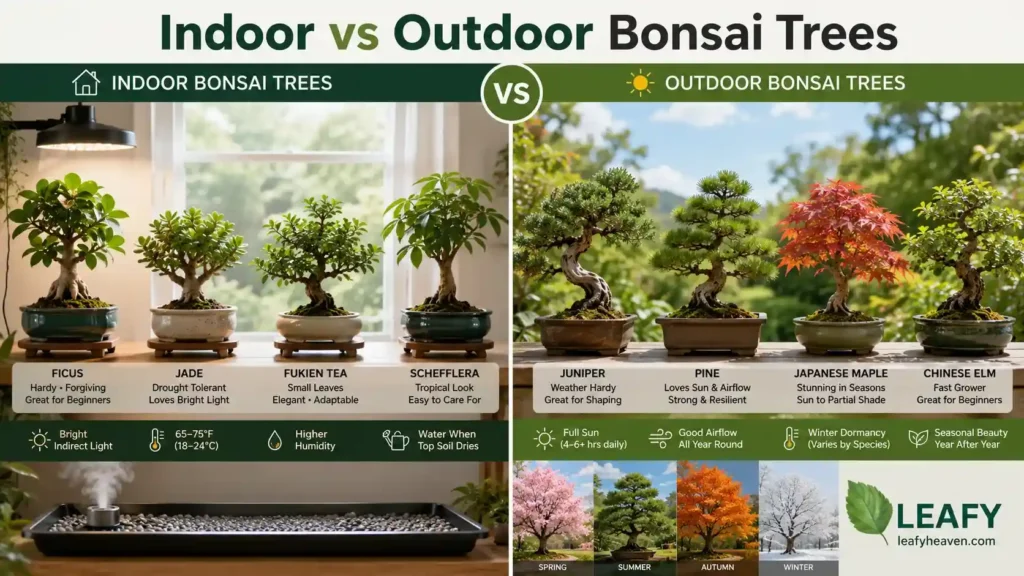
Best Indoor Bonsai Trees
The best indoor bonsai species are tropical or subtropical plants that naturally grow in warm climates and do not require winter dormancy. These trees adapt well to indoor temperatures and can tolerate lower humidity and reduced light levels compared to outdoor species.
Ficus Bonsai
Ficus is widely considered the best indoor bonsai for beginners and experienced growers alike.
Advantages:
- Tolerates indoor heating and air conditioning
- Adapts well to lower light conditions
- Fast-growing and resilient
- Responds well to pruning and shaping
- Suitable for year-round indoor cultivation
For many enthusiasts, Ficus remains the best bonsai tree for indoors because of its durability and ease of care.
Fukien Tea Bonsai
Fukien Tea is a popular flowering indoor bonsai species.
Key benefits:
- Produces small white flowers indoors
- Attractive glossy foliage
- Compact growth habit
- Good humidity tolerance
- Suitable for bright indoor environments
Jade Bonsai
Jade Bonsai is one of the easiest indoor bonsai tree types to maintain.
Characteristics:
- Drought-tolerant succulent species
- Stores water in leaves and stems
- Requires less frequent watering
- Performs well in bright indoor locations
- Low-maintenance care requirements
Hawaiian Umbrella Bonsai (Schefflera Arboricola)
Schefflera is valued for its adaptability and attractive tropical appearance.
Benefits include:
- Tolerates lower indoor light levels
- Flexible branches for styling
- Fast recovery after pruning
- Suitable for homes and offices
Serissa (Snow Rose Bonsai)
Serissa is admired for its delicate flowers and refined structure.
Important characteristics:
- Produces small white blooms
- Attractive fine branching
- Compact growth habit
- Requires consistent care and attention
Although beautiful, Serissa is more sensitive than many other bonsai for indoor cultivation and is often recommended for growers with some experience.
Best Outdoor Bonsai Trees
Outdoor bonsai trees require natural sunlight, seasonal temperature changes, and winter dormancy. These species should not be kept permanently indoors because doing so eventually weakens the tree and shortens its lifespan.
Juniper Bonsai
Juniper is one of the most popular outdoor bonsai species.
Benefits:
- Requires full outdoor conditions
- Excellent cold tolerance
- Strong response to styling techniques
- Long lifespan with proper care
Juniper is often considered the benchmark species for outdoor bonsai tree care.
Pine Bonsai
Pine species are traditional bonsai subjects that thrive outdoors.
Characteristics:
- Require seasonal dormancy
- Prefer full sunlight
- Develop impressive aged appearance
- Long-term development potential
Japanese Maple Bonsai
Japanese Maple combines seasonal beauty with refined branch structure.
Advantages:
- Spectacular autumn color
- Excellent ramification
- Strong seasonal interest
- Requires winter dormancy
Chinese Elm Bonsai
Chinese Elm is highly adaptable and can tolerate a wider range of conditions than many deciduous species.
Benefits:
- Semi-deciduous growth habit
- Excellent branching structure
- Suitable for many climates
- Beginner-friendly outdoor bonsai
Trident Maple, Hornbeam, Oak, and Beech
These deciduous species are highly valued for bonsai cultivation.
Common characteristics:
- Require natural seasonal cycles
- Benefit from winter dormancy
- Produce attractive branch structures
- Display strong autumn interest
Why Outdoor Species Must Not Be Kept Indoors Permanently
Many beginners wonder whether a bonsai tree should be grown indoors or outdoors. The answer depends entirely on the species.
Outdoor species require:
- Natural sunlight intensity
- Seasonal temperature changes
- Winter dormancy periods
- Outdoor airflow and humidity cycles
Without these conditions, trees often develop:
- Weak growth
- Yellowing foliage
- Increased pest problems
- Reduced lifespan
- Eventual decline
This is why most bonsai indoor or outdoor decisions should be based on the natural requirements of the species rather than personal preference.
Indoor vs. Outdoor Bonsai Comparison Table
| Factor | Indoor Bonsai Trees | Outdoor Bonsai Trees |
| Light Needs | Bright indirect light or supplemental grow lights | Direct natural sunlight |
| Humidity | Moderate to high humidity preferred | Naturally regulated outdoors |
| Winter Dormancy | Not required | Required for most species |
| Difficulty | Moderate | Usually easier when species are matched to climate |
| Best Species Examples | Ficus, Jade, Fukien Tea, Schefflera, Serissa | Juniper, Pine, Japanese Maple, Chinese Elm, Oak |
Can You Grow a Bonsai Tree Indoors?
Yes, you can grow a bonsai tree indoors, but only species naturally adapted to warm tropical or subtropical environments can live indoors full-time. Many people ask whether bonsai trees can live indoors, and the answer depends entirely on species selection.
Species that can successfully grow indoors include:
- Ficus Microcarpa
- Ficus Retusa
- Jade Bonsai
- Dwarf Jade
- Fukien Tea
- Schefflera
- Brazilian Rain Tree
- Serissa
If you are wondering whether you can grow a bonsai tree indoors or whether bonsai can be grown indoors successfully, selecting one of these species is essential.
Using Grow Lights for Indoor Bonsai
Natural sunlight is always preferred, but artificial lighting can supplement indoor conditions.
A quality bonsai tree grow light should provide:
- Full-spectrum LED output
- 10–14 hours of daily light
- Consistent intensity throughout the year
- Adequate coverage across the canopy
Grow lights for bonsai trees are particularly useful during winter months or in homes with limited sunlight.
Humidity Management for Indoor Bonsai
Indoor environments are often drier than the natural habitats of tropical bonsai species.
Methods for maintaining humidity include:
- Humidity trays
- Room humidifiers
- Grouping plants together
- Regular monitoring of indoor conditions
Successful indoor bonsai care depends on balancing light, humidity, watering, and airflow. Understanding bonsai tree light requirements is especially important because insufficient light is one of the most common causes of poor growth.
Most indoor species need bright indirect light for several hours daily. While many bonsai trees need sun, tropical species generally perform best with filtered sunlight rather than prolonged exposure to intense direct afternoon sun. Providing adequate bonsai sunlight and maintaining proper bonsai light requirements will significantly improve long-term health and development.
Bonsai Tree Care: Complete Guide to Watering, Light, and Feeding
Proper bonsai tree care depends on three essential factors: watering, light, and fertilization. When these fundamentals are managed correctly, bonsai trees remain healthy, develop strong root systems, produce vigorous growth, and respond better to pruning and styling. Most bonsai problems can be traced back to mistakes in one of these three areas, making them the foundation of successful long-term bonsai cultivation.
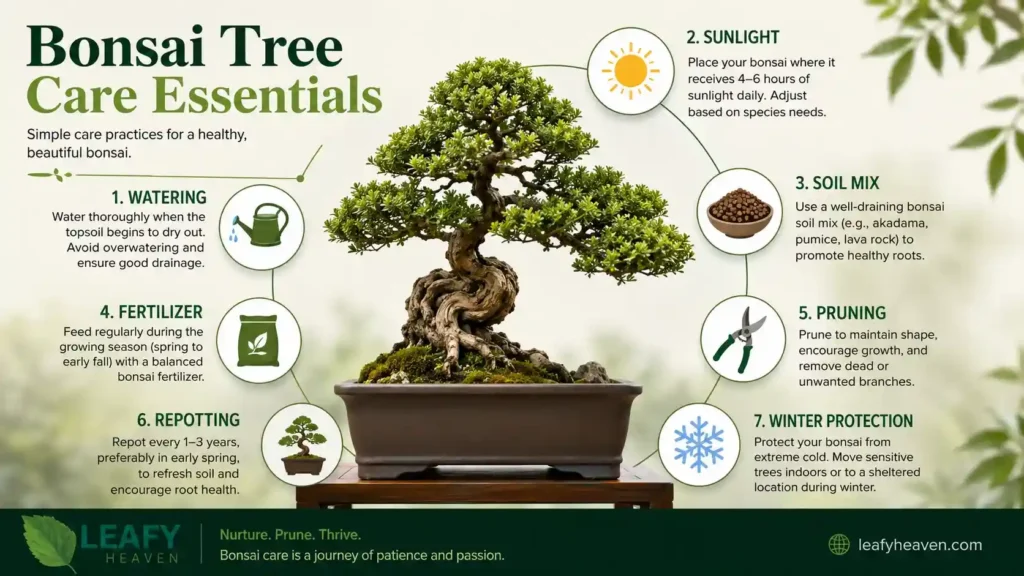
How to Water a Bonsai Tree
The correct way to water a bonsai tree is to water thoroughly whenever the top layer of soil begins to dry. Bonsai should never be watered on a fixed timetable because moisture levels change depending on weather, season, species, and pot size.
The Finger or Chopstick Moisture Test
Before watering a bonsai tree, check soil moisture first.
Two reliable methods include:
- Insert a finger about 1–2 cm into the soil.
- Insert a wooden chopstick into the soil for several minutes.
If the soil feels slightly dry beneath the surface, it is time to water. If it remains moist, wait and check again later.
This simple practice prevents both overwatering and underwatering.
Correct Watering Technique
When watering bonsai, the goal is to completely saturate the root system.
Follow these steps:
- Water slowly across the entire soil surface.
- Continue watering until water drains from the drainage holes.
- Wait one to two minutes.
- Water again to ensure the root ball is fully saturated.
This method ensures all roots receive moisture and prevents dry pockets from developing inside the pot.
Anyone learning how to water bonsai trees should focus on deep watering rather than frequent shallow watering.
Water Quality for Bonsai
Water quality can affect long-term tree health.
| Water Type | Suitability | Notes |
| Rainwater | Excellent | Naturally soft and free of chemicals |
| Filtered Water | Very Good | Reduces chlorine and mineral buildup |
| Tap Water | Good in most areas | Allow chlorine to dissipate if heavily treated |
| Distilled Water | Not Recommended Long-Term | Lacks beneficial minerals |
Rainwater is generally considered the best source for bonsai watering because it closely resembles natural conditions.
Indoor vs. Outdoor Bonsai Watering
Indoor bonsai and outdoor bonsai often have different watering needs.
Indoor Bonsai
- Dry more slowly
- Require humidity monitoring
- Less affected by wind and direct sun
- Usually watered less frequently
Outdoor Bonsai
- Exposed to sunlight and airflow
- Dry more rapidly
- May require more frequent watering during summer
- Require closer monitoring during heat waves
A proper bonsai watering schedule should always be based on soil moisture rather than a calendar.
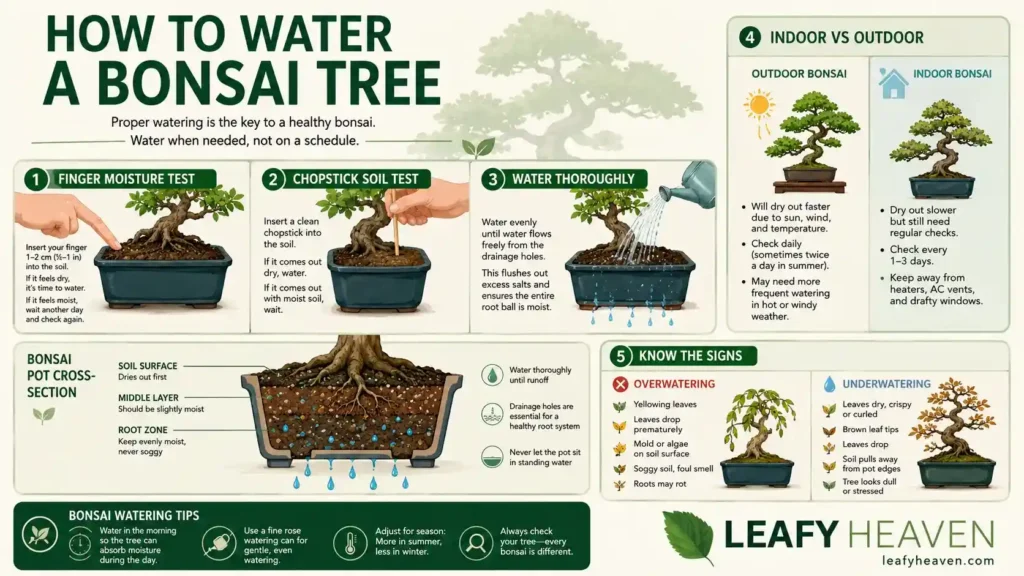
How Often to Water a Bonsai Tree
There is no universal answer to how often to water a bonsai tree. Watering frequency depends on species, climate, pot size, soil composition, and season.
Factors That Influence Watering Frequency
The following factors affect how much water a bonsai tree needs:
- Tree species
- Temperature
- Humidity levels
- Wind exposure
- Pot size
- Soil type
- Growth stage
Because these variables constantly change, bonsai tree watering should always be adjusted accordingly.
Summer Watering Requirements
During active growth periods, water demand increases significantly.
Many bonsai trees may require:
- Once-daily watering during warm weather
- Twice-daily watering during extreme heat
- Additional monitoring during windy conditions
This is why experienced growers check moisture daily rather than following a fixed schedule.
Winter Watering Requirements
Water consumption decreases during dormancy.
Winter watering generally involves:
- Less frequent irrigation
- Regular moisture monitoring
- Avoiding waterlogged soil
- Preventing roots from drying completely
Dormant trees still require water, but far less than during active growth.
Signs of Overwatered vs. Underwatered Bonsai
| Condition | Common Symptoms |
| Overwatered Bonsai | Yellow leaves, weak growth, root rot, constantly wet soil |
| Underwatered Bonsai | Dry soil, brittle leaves, leaf drop, branch dieback |
For growers asking how much water does a bonsai tree need, the correct answer is simple: enough to fully saturate the root system whenever the soil begins to dry.
Bonsai Tree Light Requirements
Most bonsai trees require abundant light to remain healthy. The amount of light needed depends largely on whether the species is tropical or temperate.
Indoor Bonsai Light Requirements
Indoor bonsai generally perform best in bright locations.
Recommended placement:
- South-facing windows
- East-facing windows
- Bright rooms with natural sunlight
- Areas receiving several hours of indirect light
Most indoor species benefit from strong morning sunlight and bright conditions throughout the day.
Outdoor Bonsai Light Requirements
Outdoor species require significantly more light.
Most species need:
- A minimum of 4–6 hours of sunlight daily
- Good air circulation
- Seasonal exposure to natural conditions
Many Junipers, Pines, and Maples qualify as full sun bonsai species and perform best when grown outdoors year-round.
Grow Lights for Indoor Bonsai
When natural light is insufficient, supplemental lighting becomes necessary.
A quality bonsai tree grow light should provide:
- Full-spectrum LED output
- Consistent daily illumination
- Coverage across the entire canopy
- Energy-efficient operation
Grow lights for bonsai trees are particularly valuable during winter or in apartments with limited sunlight.
Seasonal Light Adjustments
Light requirements can change throughout the year.
Seasonal adjustments may include:
- Relocating indoor trees closer to windows during winter
- Providing afternoon shade for sensitive species in summer
- Increasing artificial lighting during shorter days
- Rotating trees periodically for balanced growth
For anyone asking do bonsai need sunlight or does bonsai need sun, the answer is yes. Adequate light is essential for photosynthesis, healthy growth, and long-term survival.
Fertilizing Bonsai Trees
Bonsai trees rely on regular fertilization because nutrients are gradually depleted from the limited soil volume within the container. Proper fertilization supports root development, foliage growth, flowering, and overall vigor.
Understanding NPK Ratios
Most bonsai fertilizers contain three primary nutrients:
- Nitrogen (N) — promotes foliage growth
- Phosphorus (P) — supports roots and flowering
- Potassium (K) — improves overall plant health
A balanced bonsai tree fertilizer such as 10-10-10 works well during active growing seasons.
During autumn, many growers switch to lower-nitrogen formulas to prepare trees for dormancy.
Organic Bonsai Fertilizers
Organic bonsai fertilizer provides nutrients gradually over time.
Benefits include:
- Reduced risk of fertilizer burn
- Improved microbial activity
- Consistent nutrient release
- Long-lasting effectiveness
One of the most respected products is Biogold bonsai fertiliser, which uses slow-release organic pellets.
Advantages of Biogold bonsai fertilizer:
- Easy application
- Balanced nutrition
- Suitable for many species
- Consistent feeding schedule
Liquid Fertilizers
Bonsai fertilizer liquid products provide nutrients quickly and are especially useful during active growth.
Benefits include:
- Fast nutrient absorption
- Easy dosage adjustment
- Effective during spring and summer
- Convenient for indoor bonsai
Many growers combine slow-release fertilizer with occasional liquid feeding for optimal results.
Bonsai Fertilizing Schedule
| Season | Recommended Fertilizer | Frequency |
| Early Spring | Balanced 10-10-10 | Every 2–4 weeks |
| Late Spring | Balanced fertilizer | Every 2 weeks |
| Summer | Balanced fertilizer or liquid feed | Every 2 weeks |
| Autumn | Low-nitrogen fertilizer | Every 3–4 weeks |
| Winter Dormancy | Usually no fertilizer | Pause feeding |
Juniper Bonsai Fertilizer Requirements
Juniper bonsai fertilizer programs should focus on steady, moderate feeding.
Best practices:
- Use balanced fertilizer during growth season
- Avoid excessive nitrogen
- Reduce feeding before winter dormancy
- Apply slow-release fertilizer where possible
A quality fertilizer for juniper bonsai tree development supports healthy foliage and root growth without excessive vigor.
Ficus Bonsai Fertilizer Requirements
Ficus grows actively for much of the year and generally benefits from more frequent feeding.
Recommended approach:
- Regular balanced fertilizer applications
- Increased feeding during active growth
- Liquid fertilizer supplementation if needed
- Consistent nutrient availability indoors
Because Ficus remains active longer than many temperate species, ficus bonsai fertilizer schedules are often more frequent than those used for outdoor bonsai.
When watering and fertilization are combined correctly, bonsai trees develop stronger roots, healthier foliage, and improved resistance to stress. These practices form the foundation of successful bonsai plant food management and long-term bonsai health.
Bonsai Soil: Best Mix, Recipes, and Potting Requirements
Bonsai trees require fast-draining, oxygen-rich soil that allows roots to receive moisture without becoming waterlogged. The standard bonsai soil mix consists of akadama, pumice, and lava rock. Unlike regular potting soil, bonsai soil is designed to balance water retention, drainage, and aeration within the limited space of a bonsai container. Using the wrong soil is one of the most common causes of root rot, weak growth, and poor bonsai health.
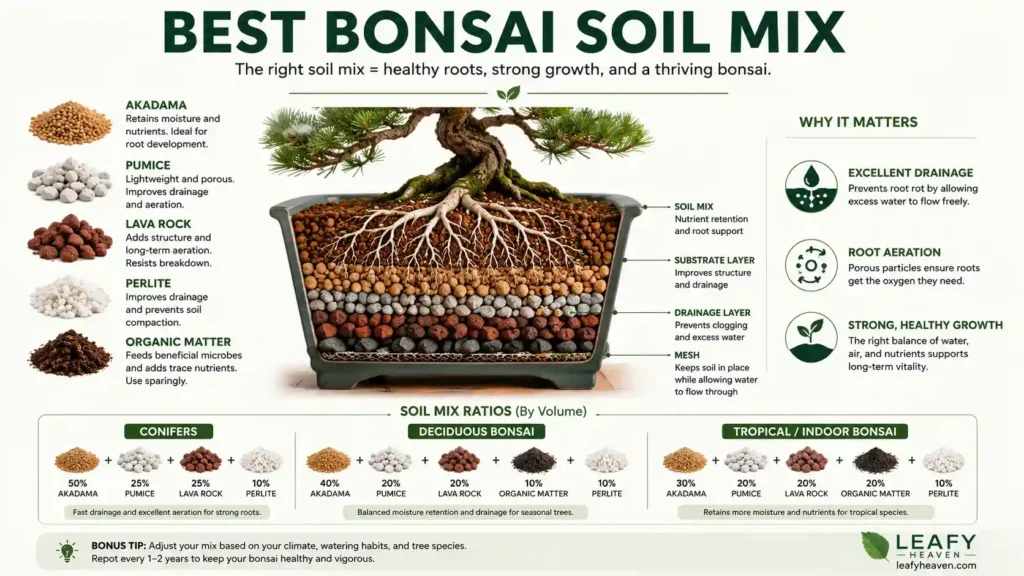
Why Bonsai Soil Is Different from Regular Soil
Bonsai soil is different because bonsai roots grow in shallow containers where drainage and airflow are critical. Traditional garden soil and standard potting mixes often hold excessive moisture, reducing oxygen around the roots and increasing the risk of disease.
A good bonsai soil provides:
- Rapid drainage
- Strong root aeration
- Controlled moisture retention
- Stable root development
- Reduced risk of root rot
Many beginners ask what is bonsai soil and whether bonsai need special soil. The answer is yes. Bonsai require specialized growing media that support healthy root systems within restricted containers.
Problems with Regular Potting Soil
Regular potting soil can create several issues:
- Compacts over time
- Reduces airflow to roots
- Retains excessive moisture
- Encourages fungal diseases
- Increases root rot risk
Similarly, garden soil is generally unsuitable because it becomes dense and poorly drained when used in bonsai containers.
For growers searching for the best soil for bonsai or the best soil for bonsai trees, a coarse inorganic mix is almost always the preferred solution.
Akadama: The Core Bonsai Substrate
Akadama is one of the most important components of traditional bonsai soil. It is widely used throughout Japan and remains the foundation of many professional bonsai soil formulations.
What Is Akadama?
Akadama is a fired Japanese clay granule specifically used for bonsai cultivation.
Its primary functions include:
- Water retention
- Root aeration
- Drainage support
- Nutrient holding capacity
Because of its balanced properties, akadama for bonsai is often considered the ideal substrate for long-term root health.
Many growers searching for what is akadama may also encounter alternate spellings such as acadama or akedama. Regardless of spelling, they refer to the same bonsai substrate.
Akadama Grades and Uses
Akadama is available in several particle sizes.
| Grade | Typical Use |
| Fine Grade | Seedlings and small bonsai |
| Medium Grade | Most bonsai species |
| Large Grade | Large bonsai and heavy root systems |
Selecting the correct particle size helps maintain proper drainage and root development.
Where to Buy Akadama
Akadama soil can usually be purchased from:
- Bonsai nurseries
- Specialized garden centers
- Bonsai supply retailers
- Online bonsai stores
Because imported Japanese akadama can be expensive in some regions, growers often mix it with locally available alternatives.
Best Bonsai Soil Mix Ratios (by Species Type)
There is no single bonsai soil mix that works for every species. Different trees require different moisture-retention and drainage characteristics.
Conifer Bonsai Soil Mix
Species such as Juniper and Pine prefer excellent drainage.
Recommended ratio:
- 1 part akadama
- 1 part pumice
- 1 part lava rock
This balanced juniper bonsai soil mix prevents excessive moisture while maintaining adequate hydration.
Deciduous Bonsai Soil Mix
Maples and Elms benefit from slightly increased moisture retention.
Recommended ratio:
- 2 parts akadama
- 1 part pumice
- 1 part lava rock
The higher akadama content helps support vigorous root growth and consistent moisture levels.
Tropical and Indoor Bonsai Soil Mix
Species such as Ficus and Jade can tolerate a slightly higher organic content.
Recommended characteristics:
- Good drainage
- Moderate moisture retention
- Small percentage of organic material
- Strong root aeration
Both ficus bonsai soil and jade bonsai soil mixtures often contain a small amount of bark or organic compost.
Using Perlite as an Alternative
In regions where pumice is unavailable, perlite can be used as a substitute.
Benefits of perlite for bonsai include:
- Improved aeration
- Better drainage
- Lightweight structure
- Easy availability
Many bonsai soil DIY recipes successfully incorporate perlite bonsai mixtures as a practical alternative.
Bonsai Soil Mix Ratio Table
| Species Type | Akadama % | Pumice % | Lava Rock % | Organic % |
| Conifers (Juniper, Pine) | 33% | 33% | 34% | 0% |
| Deciduous (Maple, Elm) | 50% | 25% | 25% | 0% |
| Tropical (Ficus, Jade) | 40% | 25% | 20% | 15% |
| Flowering Species | 45% | 25% | 20% | 10% |
These ratios provide a reliable starting point for creating a bonsai tree soil mix suitable for most species.
How to Make Bonsai Soil at Home (DIY Recipe)
Making bonsai soil at home is often more affordable than purchasing pre-mixed blends. A DIY bonsai soil approach also allows growers to customize mixtures for specific species and growing conditions.
Basic DIY Bonsai Soil Recipe
A simple bonsai soil recipe consists of:
- 2 parts akadama
- 1 part pumice
- 1 part lava rock
This formula works well for many deciduous and general-purpose bonsai species.
Ingredient Alternatives
If specialized bonsai materials are difficult to obtain, consider these substitutes:
| Standard Ingredient | Possible Alternative |
| Akadama | Calcined clay |
| Pumice | Perlite |
| Lava Rock | Crushed granite or scoria |
| Organic Component | Pine bark fines |
These alternatives can help create a functional bonsai potting medium while maintaining proper drainage.
Sifting and Rinsing Process
Before mixing soil components:
- Sift each ingredient to remove dust and fine particles.
- Separate materials into consistent particle sizes.
- Rinse substrates thoroughly.
- Allow excess water to drain.
- Combine ingredients according to the desired ratio.
Removing dust improves airflow and prevents compaction over time.
Step-by-Step Soil Preparation
To prepare bonsai soil at home:
- Gather all ingredients.
- Sift each component separately.
- Wash materials to remove dust.
- Measure ingredients according to species requirements.
- Mix thoroughly.
- Store unused soil in a dry container.
For growers asking how to make bonsai soil, how to make bonsai soil at home, or how to prepare bonsai soil, this process provides a reliable foundation for healthy root development.
A high-quality bonsai substrate is one of the most important investments in long-term bonsai success. Choosing a good bonsai soil mix promotes healthier roots, stronger growth, improved drainage, and greater resistance to disease, making soil selection a critical part of overall bonsai care.
Bonsai Pots and Containers: Choosing the Right Pot
Choosing the right bonsai pot is essential for both tree health and visual balance. A bonsai container does more than hold soil—it influences drainage, root development, moisture retention, stability, and overall design. In general, bonsai pots should be approximately two-thirds the height of the tree and must include adequate drainage holes. Unglazed containers are typically preferred for conifers, while glazed pots are often used for tropical and flowering bonsai species.
Bonsai Pot Size Guide
The correct bonsai pot size should complement the tree’s proportions while providing sufficient space for healthy root growth. Oversized pots can make a bonsai appear immature, while undersized pots may restrict root development excessively.
General Bonsai Pot Proportions
For most upright bonsai styles:
- Pot length should be approximately two-thirds of the tree’s height.
- Pot width should visually balance the canopy spread.
- Pot size should match the visual weight of the trunk.
These guidelines help create harmony between the tree and container.
Depth Rule for Bonsai Pots
A widely accepted bonsai design principle is:
Pot depth ≈ trunk diameter at the tree’s base
This proportion helps maintain both visual balance and sufficient root space.
Shallow Pots for Cascade Styles
Certain styles require specialized bonsai containers.
Examples include:
- Cascade bonsai (Kengai) often use tall bonsai pots.
- Semi-cascade bonsai use deeper containers than upright styles.
- Formal and informal upright trees frequently use shallow bonsai pot designs.
Selecting the proper bonsai pot dimensions helps reinforce the visual character of each style.
Quick Bonsai Pot Size Reference
| Tree Style | Recommended Pot Type |
| Formal Upright | Standard shallow bonsai pot |
| Informal Upright | Oval or rectangular bonsai tray |
| Slanting | Slightly deeper container |
| Cascade | Tall bonsai pot |
| Semi-Cascade | Medium-depth container |
| Forest Style | Wide bonsai tray |
Whether choosing a bonsai tree pot for a mature specimen or a developing tree, proper proportions improve both aesthetics and health.
Glazed vs. Unglazed Bonsai Pots
The choice between glazed and unglazed bonsai pots depends largely on species type, design goals, and moisture management requirements.
Unglazed Bonsai Pots
Unglazed containers are traditionally used for conifer species.
Benefits include:
- Natural appearance
- Better moisture regulation
- Classic bonsai aesthetic
- Excellent compatibility with Junipers and Pines
Species commonly paired with unglazed pots:
- Juniper Bonsai
- Pine Bonsai
- Spruce Bonsai
- Hinoki Cypress Bonsai
These containers emphasize the rugged and natural appearance often associated with evergreen bonsai.
Glazed Bonsai Pots
Glazed containers are commonly used for flowering, fruiting, and tropical species.
Advantages:
- Decorative appearance
- Wide color selection
- Enhanced visual contrast
- Suitable for display-focused specimens
Common examples include:
- Blue bonsai pot designs for flowering trees
- Yellow bonsai pot options for tropical species
- Decorative round bonsai pot styles
Species often grown in glazed pots include:
- Azalea Bonsai
- Fukien Tea Bonsai
- Crabapple Bonsai
- Ficus Bonsai
Terracotta Pots for Bonsai
Terracotta remains a popular option for both training and display.
Pros
- Affordable
- Readily available
- Good airflow through pot walls
- Natural appearance
Cons
- Less refined than traditional bonsai containers
- Can dry out more quickly
- Limited styling options
Many growers use terracotta pots low and wide for bonsai during development stages before transferring trees into display containers.
Other Bonsai Container Options
Additional choices include:
- Large bonsai pot designs for mature trees
- Bonsai pot small containers for shohin bonsai
- Wooden bonsai planters for training stock
- Custom DIY bonsai pots for unique projects
The container should always support the tree’s health before aesthetics become the primary consideration.
How to Pot a Bonsai Tree
Proper bonsai potting ensures healthy root establishment and long-term stability. Whether planting a bonsai tree for the first time or repotting an established specimen, following the correct procedure is essential.
Step 1: Install Drainage Mesh
Before adding soil:
- Cover drainage holes with mesh screens.
- Secure mesh using wire.
- Prevent soil loss while maintaining drainage.
Good drainage is one of the most important aspects of successful bonsai potting.
Step 2: Install Anchor Wire
Anchor wires help stabilize the tree during root establishment.
Benefits include:
- Prevents tree movement
- Protects developing roots
- Improves post-repotting recovery
- Increases overall stability
Anchor wire is especially important when planting a bonsai tree into a new container.
Step 3: Add Soil and Position the Tree
After preparing the container:
- Add a base layer of bonsai soil.
- Position the tree carefully.
- Spread roots evenly.
- Secure the tree with anchor wire.
- Add remaining soil.
- Work soil into root spaces using a chopstick.
This process eliminates air pockets and improves root contact with the growing medium.
Step 4: Water Thoroughly
Immediately after potting bonsai:
- Water until runoff exits drainage holes.
- Ensure complete saturation of the root ball.
- Allow excess water to drain naturally.
Proper initial watering supports root recovery and establishment.
Step 5: Provide Aftercare
Recently potted bonsai require temporary protection while roots recover.
Recommended aftercare:
- Place in partial shade for 2–4 weeks.
- Protect from strong wind.
- Avoid heavy fertilization immediately after potting.
- Monitor moisture carefully.
This recovery period helps reduce stress and encourages healthy root growth.
For growers learning how to pot a bonsai tree, how to plant bonsai, or how to plant a bonsai tree, following these steps creates a stable foundation for long-term health and successful development. The combination of the correct bonsai container, proper soil, and careful aftercare significantly improves the tree’s ability to thrive.
Pruning and Shaping Bonsai Trees
Bonsai pruning is the primary technique used to control size, maintain proportions, and develop the desired tree structure. Bonsai pruning generally falls into two categories: maintenance pruning and structural pruning. Maintenance pruning focuses on preserving an existing design by trimming new growth throughout the year, while structural pruning involves removing larger branches to improve or redesign the tree’s framework. Together with wiring, these techniques form the foundation of bonsai tree training and long-term development.
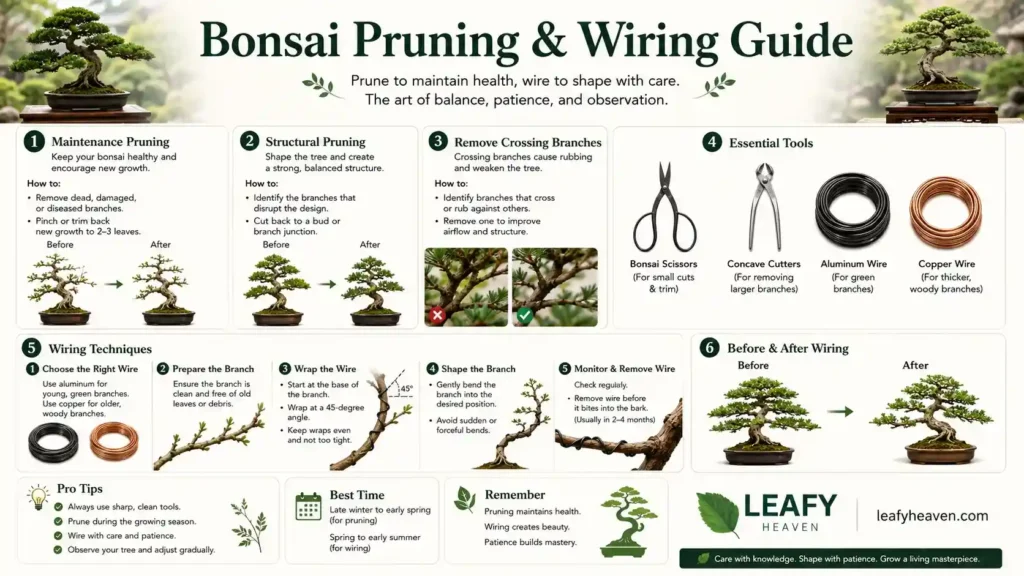
Maintenance Pruning: Keeping Your Bonsai in Shape
Maintenance pruning keeps a bonsai compact, balanced, and visually appealing. It is performed regularly during the growing season to control excessive growth and encourage finer branching.
Shoots and Branches to Remove
When performing bonsai tree pruning, focus on removing growth that disrupts the overall design.
Common targets include:
- Crossing branches
- Inward-growing branches
- Downward-growing shoots
- Excessive vertical growth
- Weak or damaged branches
- Crowded branch areas
- Unwanted back-budding in certain locations
Removing these growth points improves light penetration and airflow throughout the canopy.
Pruning Frequency by Season
The timing of bonsai pruning depends on species and growth activity.
| Season | Pruning Activity |
| Spring | Active maintenance pruning and structural work |
| Summer | Frequent trimming of vigorous growth |
| Autumn | Light pruning and shape refinement |
| Winter | Minimal pruning for dormant outdoor species |
For growers asking when to trim bonsai, the most active pruning period is usually spring through early autumn.
Essential Bonsai Pruning Tools
Proper tools improve precision and reduce damage to the tree.
Common tools include:
- Bonsai scissors
- Twig shears
- Concave cutters
- Branch cutters
- Knob cutters
- Root pruning scissors
Using specialized tools results in cleaner cuts and faster healing.
Applying Cut Paste
Large pruning wounds should be protected after branch removal.
Benefits of cut paste:
- Reduces moisture loss
- Helps prevent infection
- Promotes callus formation
- Improves wound healing
This practice is especially important after major structural pruning.
Whether learning how to prune a bonsai tree or how to prune a bonsai plant, making clean cuts and pruning at the correct time significantly improves long-term tree health.
Bonsai Wiring Techniques
Wiring is used to guide branches and trunks into desired positions. While pruning removes unwanted growth, wiring allows the grower to shape and direct future development.
Aluminum Wire vs. Copper Wire
Both materials are commonly used as bonsai shaping wire, but each serves different purposes.
Aluminum Wire
Advantages:
- Easier to bend
- Beginner-friendly
- Less risk of branch damage
- Suitable for deciduous and tropical species
Copper Wire
Advantages:
- Stronger holding power
- Preferred for many conifers
- Requires less wire thickness
- Favored by experienced practitioners
For beginners learning how to wire bonsai, aluminum wire is generally recommended.
Single Wire vs. Double Wire Technique
Two primary wiring methods are used in bonsai tree training.
Single Wiring
- One wire applied to one branch
- Easier for beginners
- Suitable for isolated branches
Double Wiring
- One wire controls two branches
- Greater efficiency
- Improved stability
- Commonly used in advanced bonsai work
Both methods are widely used depending on branch structure and design goals.
Correct Wiring Angle
The standard wiring angle is approximately 45 degrees around the branch.
Benefits include:
- Secure branch support
- Even pressure distribution
- Reduced bark damage
- Better shaping control
Wrapping wire too tightly can injure the branch, while loose wiring provides insufficient support.
How Long Should Wire Stay on a Bonsai?
Wire should remain only until the branch holds its new position.
Typical timeframes:
- Fast-growing species: 2–4 months
- Moderate growers: 4–6 months
- Slow-growing conifers: 6–12 months
Inspect wired branches regularly.
Remove wire immediately if:
- Bark swelling occurs
- Wire begins cutting into tissue
- Visible wire marks develop
Learning how to wire a bonsai tree properly helps create movement, structure, and artistic balance without causing permanent damage.
How to Keep a Bonsai Tree Small
Bonsai trees remain small through a combination of root restriction, pruning, and controlled growth management. Contrary to popular belief, bonsai are not genetically miniature trees.
Why Bonsai Stay Small
The answer to how do bonsai stay small lies in several cultivation techniques working together.
These include:
- Root pruning
- Restricted container size
- Branch pruning
- Shoot trimming
- Controlled fertilization
- Leaf reduction techniques
Each method helps regulate growth while maintaining tree health.
Regular Shoot and Leaf Pruning
One of the most effective ways to keep a bonsai tree small is consistent maintenance pruning.
Benefits include:
- Reduced growth vigor
- Increased ramification
- Smaller internodes
- Improved canopy density
Frequent trimming redirects energy into finer branch development rather than excessive extension growth.
Relationship Between Pot Size and Tree Size
Pot size plays a major role in controlling growth.
Smaller containers:
- Restrict root expansion
- Limit available nutrients
- Slow overall growth
- Help maintain compact proportions
However, pots should never be so small that they compromise root health.
Defoliation for Leaf Reduction
Defoliation is an advanced technique used primarily on deciduous species.
The process involves:
- Removing most or all leaves during active growth
- Encouraging a second flush of smaller leaves
- Improving ramification
- Increasing light penetration
Because defoliation places stress on the tree, it should only be performed on healthy, vigorous specimens.
Maintaining Long-Term Bonsai Size
To successfully keep a bonsai small while keeping it healthy:
- Prune regularly
- Repot on schedule
- Monitor root growth
- Use appropriate fertilizer levels
- Maintain proper watering practices
- Match the pot size to the tree’s development stage
For growers wondering how to keep bonsai trees small or how to keep a bonsai tree alive while maintaining miniature proportions, the key is balancing growth control with overall tree health. Consistent pruning, thoughtful wiring, and careful root management allow bonsai to remain compact while continuing to mature naturally for decades.
Repotting Bonsai Trees: When, How, and How Often
Repotting is an essential part of long-term bonsai care. Bonsai should be repotted when roots begin circling the pot, emerge from drainage holes, or completely fill the container. In general, young bonsai require repotting every 1–2 years, while mature specimens are typically repotted every 3–5 years. For most species, early spring—just before buds begin to open—is the safest and most effective time for repotting.
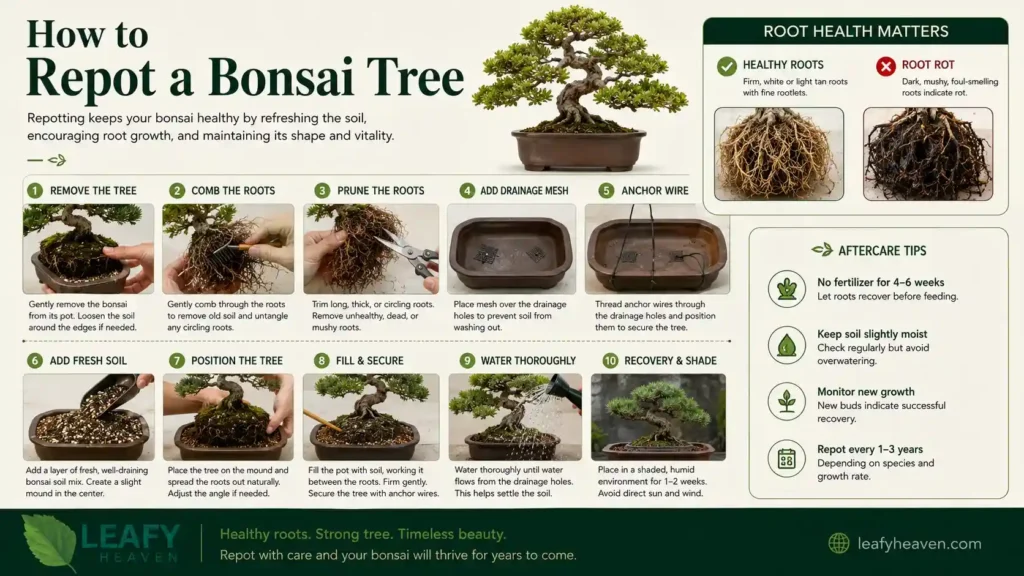
Signs Your Bonsai Needs Repotting
The best time to repot bonsai is determined by root development rather than a strict schedule. Monitoring root growth and soil performance helps identify when repotting is necessary.
Roots Emerging from Drainage Holes
One of the clearest signs that it is time to repot a bonsai tree is when roots begin growing through drainage holes.
This indicates:
- The root system has filled the container
- Available growing space is limited
- Water and nutrient uptake may be affected
Water Drains Too Quickly
Healthy bonsai soil should retain moisture while allowing excess water to drain.
If water immediately passes through the pot:
- Roots may have replaced most of the soil
- The root ball may be severely compacted
- Moisture retention becomes difficult
This is a common indicator that repotting bonsai should not be delayed.
Slow Growth Despite Proper Care
A bonsai receiving proper watering, sunlight, and fertilizer should continue growing steadily.
When growth slows unexpectedly, possible causes include:
- Root congestion
- Compacted soil
- Reduced oxygen availability
- Limited nutrient absorption
Tree Dries Out Faster Than Normal
If a tree suddenly requires much more frequent watering, the root system may have outgrown the pot.
Common symptoms include:
- Soil drying rapidly
- Increased watering frequency
- Reduced moisture retention
- Faster summer stress
For growers wondering when to repot bonsai or when to repot a bonsai tree, these signs often provide the most reliable answer.
How to Repot a Bonsai Tree: Step-by-Step
Successful bonsai repotting requires preparation, careful root work, and proper aftercare. The process refreshes the soil, improves root health, and creates space for continued development.
Step 1: Remove the Tree from the Pot
Carefully lift the bonsai from its container.
Tips:
- Loosen soil around the edges first
- Remove anchor wires if present
- Avoid pulling directly on the trunk
Gentle handling reduces root damage during repotting.
Step 2: Comb Out and Untangle the Roots
Using a root rake or chopstick:
- Remove old soil gradually
- Untangle circling roots
- Spread roots outward evenly
This process improves root structure and promotes healthier future growth.
Step 3: Prune the Root System
Root pruning is a critical part of repotting a bonsai tree.
General guideline:
- Remove no more than one-third of the root mass during a single repotting
Focus on removing:
- Long circling roots
- Damaged roots
- Dead roots
- Overcrowded sections
Healthy roots should always be preserved whenever possible.
Step 4: Prepare the New Pot
Before positioning the tree:
- Install drainage mesh
- Thread anchor wires through drainage holes
- Add a thin layer of fresh bonsai soil
Proper preparation improves drainage and stability.
Step 5: Position the Tree and Add Soil
Place the tree in the desired position.
Then:
- Spread roots evenly.
- Secure the tree with anchor wire.
- Add fresh bonsai soil.
- Work soil between roots using a chopstick.
- Eliminate air pockets.
This ensures complete root-to-soil contact.
Step 6: Water and Provide Recovery Care
Immediately after repotting:
- Water thoroughly until runoff appears
- Place the tree in partial shade
- Protect from strong wind
- Delay heavy fertilization for several weeks
This recovery period allows roots to heal and re-establish.
For beginners learning how to repot a bonsai tree, following these steps greatly improves transplant success.
Root Pruning Techniques
Root pruning helps maintain the miniature size of bonsai while encouraging a dense, healthy root system. It is typically performed during repotting.
How Much Root Can Be Removed Safely?
The amount of root removal depends on species, health, and age.
General recommendations:
| Tree Type | Maximum Root Reduction |
| Young Vigorous Bonsai | Up to 33% |
| Mature Bonsai | 20–30% |
| Weak or Recovering Trees | Minimal pruning |
| Tropical Species | Often tolerate slightly more pruning |
Removing too many roots can weaken or even kill a bonsai.
Healthy Roots vs. Diseased Roots
During repotting, inspect all bonsai roots carefully.
Healthy roots typically appear:
- Firm
- White or light tan
- Well-branched
- Odor-free
Signs of bonsai root rot include:
- Black coloration
- Mushy texture
- Sour smell
- Root decay
- Reduced feeder roots
Identifying root rot bonsai problems early allows corrective action before serious damage occurs.
Bonsai Root Pruning Tools
Common root pruning tools include:
- Root scissors
- Root shears
- Root hooks
- Root rakes
- Concave cutters for large roots
Clean, sharp tools create healthier cuts and reduce recovery time.
Because repotting, bonsai transplant procedures, and root pruning often occur together, proper tool selection is important for successful bonsai tree transplanting.
Species-Specific Repotting Notes
Different species respond differently to repotting and root pruning. Understanding species-specific timing improves survival and recovery.
Juniper Bonsai Repotting
Juniper bonsai repotting should be performed during early spring before vigorous growth begins.
Best practices:
- Avoid excessive root reduction
- Preserve fine feeder roots
- Repot only when necessary
- Use well-draining soil
For growers wondering when to repot Juniper bonsai, early spring remains the preferred window.
Ficus Bonsai Repotting
Ficus bonsai repotting is generally more forgiving than many temperate species.
Advantages:
- Strong recovery ability
- Tolerates moderate root pruning
- Can often be repotted during active growth in warm conditions
- Produces new roots rapidly
These qualities make Ficus one of the easiest species for beginners to repot.
Japanese Maple Repotting
Japanese Maple requires more precise timing.
Important considerations:
- Repot during dormancy or just before bud break
- Avoid repotting during active leaf growth
- Minimize stress during warm weather
- Use moisture-retentive but well-draining soil
Because maples can be sensitive to root disturbance, careful timing is especially important.
Whether performing bonsai replanting, transplanting a bonsai tree, or routine repotting maintenance, the goal remains the same: maintain a healthy root system while providing fresh soil and adequate growing space. Consistent repotting at the appropriate interval is one of the most important practices for sustaining healthy bonsai over the long term.
Winter Bonsai Care: Protecting Your Trees in Cold Weather
Outdoor bonsai trees require winter dormancy to remain healthy and complete their natural growth cycle. Unlike tropical bonsai, temperate species should not be moved into heated indoor environments during winter. Instead, they should be protected in an unheated greenhouse, cold frame, garage, or sheltered outdoor location where temperatures remain cold but do not expose roots to severe freezing. Proper bonsai winter care helps preserve tree health, promotes vigorous spring growth, and prevents unnecessary stress.
Why Outdoor Bonsai Need Winter Dormancy
Winter dormancy is a natural resting period that allows temperate bonsai species to conserve energy and prepare for the next growing season. Without dormancy, many outdoor bonsai gradually weaken and lose vigor.
How Cold Temperatures Trigger Dormancy
As temperatures decrease and daylight hours shorten, outdoor trees enter a resting phase.
During dormancy:
- Growth slows or stops completely
- Energy is stored in roots and woody tissue
- Water consumption decreases
- Buds prepare for spring development
This natural process is essential for many deciduous and conifer species.
What Happens if Dormancy Is Skipped?
Keeping outdoor bonsai in warm indoor environments throughout winter can cause serious problems.
Potential consequences include:
- Weak spring growth
- Reduced energy reserves
- Increased susceptibility to disease
- Poor bud development
- Gradual decline over multiple years
This is why proper bonsai tree care in winter focuses on protection rather than bringing trees indoors.
Outdoor Species vs. Tropical Species
Understanding the difference between outdoor and tropical bonsai is critical.
Outdoor Species That Need Dormancy
Examples include:
- Juniper Bonsai
- Japanese Maple Bonsai
- Pine Bonsai
- Chinese Elm Bonsai
- Hornbeam Bonsai
- Oak Bonsai
- Beech Bonsai
These species require cold periods each year.
Tropical Species That Cannot Tolerate Freezing
Examples include:
- Ficus Bonsai
- Jade Bonsai
- Fukien Tea Bonsai
- Schefflera Bonsai
- Brazilian Rain Tree
These species should be protected from frost and grown indoors during cold weather.
Successful winter care for bonsai begins with identifying which category your tree belongs to.
How to Protect Bonsai Trees in Winter
The goal of winter protection is not to keep outdoor bonsai warm. Instead, it is to prevent root damage caused by extreme freezing while still allowing the tree to remain dormant.
Cold Frames for Bonsai
A bonsai cold frame is one of the most effective winter protection methods.
A cold frame is:
- An insulated enclosure
- Positioned outdoors
- Protected from wind
- Designed to moderate temperature fluctuations
Benefits include:
- Reduced root freezing
- Protection from harsh winds
- Stable winter environment
- Continued dormancy support
Many enthusiasts consider a cold frame essential for reliable winter bonsai care in colder climates.
Unheated Greenhouse Method
An unheated greenhouse offers another excellent winter solution.
Advantages:
- Shields trees from snow and wind
- Maintains slightly higher temperatures
- Reduces rapid temperature fluctuations
- Provides additional protection for containers
Many growers successfully maintain bonsai in greenhouse environments throughout winter without supplemental heating.
Mulching Roots for Ground-Stored Bonsai
In regions with severe winters, additional root protection may be necessary.
Common techniques include:
- Surrounding pots with mulch
- Burying containers partially in soil
- Using bark chips or straw insulation
- Grouping pots together
These methods help protect the root system from temperature extremes.
Minimum Temperature Guidelines
Different species tolerate different levels of cold.
| Species Type | Approximate Minimum Tolerance |
| Juniper Bonsai | -20°C to -30°C |
| Pine Bonsai | -20°C to -30°C |
| Chinese Elm Bonsai | -10°C to -20°C |
| Japanese Maple Bonsai | -10°C to -20°C |
| Ficus Bonsai | Above 10°C |
| Jade Bonsai | Above 5°C |
Actual tolerance varies based on species, health, and local climate conditions.
For growers wondering whether bonsai trees can live outside in the winter, the answer is yes for outdoor species, provided roots receive adequate protection.
Juniper Bonsai Winter Care
Juniper bonsai winter care often requires minimal intervention because Junipers are highly cold-hardy.
Recommended practices:
- Keep outdoors during dormancy
- Protect roots from extreme freezing
- Avoid heated indoor environments
- Monitor soil moisture periodically
Proper Juniper bonsai tree winter care preserves vigor and supports healthy spring growth.
Winter Watering and Fertilizing Schedule
Bonsai care requirements change significantly during dormancy. Growth slows dramatically, reducing both water and nutrient demand.
Winter Watering Requirements
Watering frequency should be reduced during winter.
General guidelines:
- Water only when soil begins to dry
- Avoid keeping soil constantly wet
- Check moisture regularly
- Water during milder daytime temperatures when possible
Even dormant bonsai require moisture, but excessive watering can create serious problems.
Checking Soil Moisture During Dormancy
The safest approach is to monitor soil rather than follow a schedule.
Methods include:
- Finger moisture test
- Wooden chopstick test
- Visual inspection of soil surface
This helps prevent both drought stress and overwatering.
Winter Fertilizing Schedule
Most outdoor bonsai should not be fertilized during dormancy.
Typical recommendation:
- Stop fertilizing in late autumn
- Resume feeding in early spring
- Allow the tree to complete its natural rest period
During winter, the root system is largely inactive and cannot efficiently utilize fertilizer.
Bonsai in Greenhouse Conditions
When maintaining bonsai in greenhouse environments:
- Monitor temperatures regularly
- Avoid excessive humidity buildup
- Maintain ventilation when possible
- Continue checking soil moisture
A properly managed bonsai in greenhouse conditions can remain dormant while being protected from severe weather.
Successful bonsai tree care in winter focuses on balancing protection and dormancy. Outdoor species need cold conditions to complete their annual growth cycle, while tropical species require frost-free environments. By providing appropriate shelter, monitoring moisture levels, and suspending fertilization during dormancy, growers can ensure their bonsai emerge healthy and vigorous when spring arrives.
Common Bonsai Tree Problems, Diseases, and Pests
The most common bonsai problems are overwatering, insufficient light, poor soil drainage, and pest infestations. Many issues begin with improper watering practices that weaken roots and reduce the tree’s ability to resist diseases and insects. Fortunately, most bonsai health problems can be prevented or corrected when identified early and addressed with proper care routines.
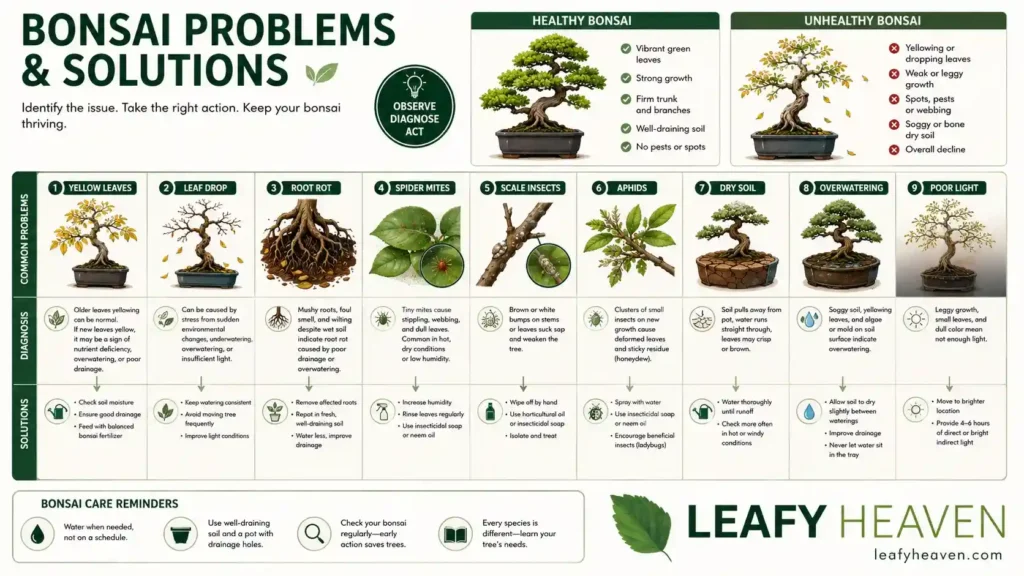
Why Is My Bonsai Tree Losing Leaves?
Leaf loss is one of the most common concerns among bonsai growers. While some leaf drop is natural, excessive leaf loss often indicates environmental stress or care-related problems.
Seasonal Leaf Drop
For deciduous species, leaf loss during autumn is completely normal.
Species that naturally shed leaves include:
- Japanese Maple
- Chinese Elm
- Beech
- Hornbeam
- Oak
During dormancy, these trees enter a resting phase and temporarily lose foliage before producing new growth in spring.
Stress-Induced Leaf Drop
If a bonsai is losing leaves outside its normal seasonal cycle, stress is often the cause.
Common triggers include:
- Overwatering
- Underwatering
- Repotting shock
- Sudden temperature changes
- Insufficient light
- Fertilizer imbalance
Many cases of bonsai leaves falling off can be traced back to root-related stress caused by watering problems.
Indoor Placement Issues
Indoor bonsai are particularly sensitive to environmental changes.
Problem locations include:
- Near heating vents
- Beside air conditioners
- Close to drafty windows
- Areas with inconsistent temperatures
These conditions frequently cause bonsai tree leaves falling unexpectedly.
Common Causes of Leaf Loss
| Symptom | Possible Cause |
| Gradual leaf drop in autumn | Normal dormancy |
| Sudden leaf drop after repotting | Repotting shock |
| Yellow leaves before falling | Overwatering |
| Dry, brittle leaves falling | Underwatering |
| Weak growth with leaf loss | Insufficient light |
If you are wondering why your bonsai tree is losing its leaves, examining watering, light, and environmental conditions is the best place to start.
Yellow Leaves on Bonsai Trees — Causes and Fixes
Yellowing foliage is often an early warning sign that something is affecting root function or nutrient uptake.
Overwatering
Overwatering is the most common reason for yellow leaves on bonsai.
Excess moisture can:
- Reduce oxygen around roots
- Encourage fungal growth
- Cause root damage
- Trigger leaf discoloration
If soil remains constantly wet, overwatering should be suspected immediately.
Nutrient Deficiency
Nitrogen deficiency frequently causes bonsai leaves turning yellow.
Typical symptoms include:
- Pale foliage
- Slow growth
- Weak shoots
- General loss of vigor
Regular fertilization helps prevent nutrient-related problems.
Early Root Rot
One of the first signs of root rot is yellow foliage combined with persistently wet soil.
Warning signs include:
- Yellow leaves
- Poor growth
- Soft roots
- Damp soil that never dries properly
Early detection significantly improves recovery chances.
Natural Seasonal Yellowing
Many deciduous species naturally develop yellow leaves before shedding them during autumn.
This process is normal and should not be confused with disease or nutrient problems.
Quick Diagnosis Guide
| Symptom | Likely Cause |
| Yellow leaves with wet soil | Overwatering or root rot |
| Yellow leaves with dry soil | Underwatering |
| Pale yellow foliage overall | Nutrient deficiency |
| Yellow leaves during autumn | Seasonal dormancy |
Understanding why a bonsai tree is turning yellow requires evaluating both environmental conditions and root health.
Bonsai Root Rot: Identification and Recovery
Bonsai root rot is one of the most serious and potentially fatal bonsai problems. It develops when roots remain in saturated soil for extended periods and begin to decay.
Signs of Bonsai Root Rot
Common symptoms include:
- Yellowing leaves
- Leaf drop
- Slow growth
- Black or brown roots
- Mushy root tissue
- Sour or rotten smell from soil
These signs often indicate advanced root damage.
How to Diagnose Root Rot
The most reliable diagnosis method is direct inspection.
Steps:
- Remove the tree from the pot.
- Gently remove soil around the roots.
- Inspect root color and texture.
- Identify healthy and damaged roots.
Healthy roots should be:
- Firm
- White or light tan
- Well-branched
Diseased roots are typically:
- Black
- Soft
- Slimy
- Foul-smelling
Step-by-Step Root Rot Recovery
If bonsai root rot is detected:
- Remove the tree from the pot.
- Cut away all rotten roots.
- Sterilize pruning tools.
- Replace old soil completely.
- Repot into fresh, well-draining bonsai soil.
- Reduce watering temporarily.
- Place the tree in a protected location.
Early intervention offers the highest chance of success.
Preventing Root Rot
The best bonsai root rot treatment is prevention.
Preventive measures include:
- Proper drainage
- Correct watering practices
- Quality bonsai soil
- Adequate airflow
- Appropriate pot size
Many cases of root rot bonsai damage originate from chronic bonsai overwatering rather than disease alone.
For growers asking how to save a bonsai tree or how to revive a bonsai after root problems, correcting watering practices is often the most important step.
Bonsai Pests: Spider Mites, Scale, and Aphids
Pests can weaken bonsai by feeding on leaves, stems, roots, and new growth. Regular inspection helps identify infestations before significant damage occurs.
Spider Mites
Spider mites on bonsai are extremely common, especially indoors.
Symptoms include:
- Tiny webbing
- Speckled leaves
- Bronzing foliage
- Weak growth
Treatment:
- Increase humidity
- Spray foliage with water
- Apply neem oil
- Use miticides if necessary
Many bonsai spider mites infestations occur during hot, dry conditions.
Scale Insects
Scale insects attach themselves to branches and stems.
Signs include:
- Waxy bumps
- Cotton-like deposits
- Sticky residue
- Reduced vigor
Treatment options:
- Remove manually
- Apply rubbing alcohol
- Use systemic insecticides when necessary
Aphids
Aphids commonly attack new growth.
Symptoms include:
- Clusters of green or black insects
- Distorted leaves
- Sticky honeydew deposits
- Reduced shoot development
Treatment:
- Insecticidal soap
- Neem oil
- Strong water spray
Fungus Gnats
Fungus gnats often indicate excessive moisture.
Management includes:
- Allowing soil to dry slightly
- Sticky traps
- Improved drainage
- Reduced watering frequency
Little White Bugs on Bonsai Trees
Many growers notice little white bugs on bonsai trees and assume disease.
Common causes include:
- Mealybugs
- Scale insects
- Juvenile pest stages
Proper identification helps determine the most effective treatment approach.
Bonsai Diseases: Fungal and Bacterial Problems
Fungal diseases are generally more common than bacterial diseases in bonsai cultivation. Most develop when moisture, humidity, and airflow become unbalanced.
Powdery Mildew
Powdery mildew appears as a white powder-like coating on leaves.
Symptoms:
- White surface growth
- Distorted foliage
- Reduced photosynthesis
Treatment:
- Improve air circulation
- Remove affected leaves
- Apply appropriate fungicides
Root Rot (Phytophthora)
Root rot caused by Phytophthora is one of the most destructive bonsai diseases.
Typical signs include:
- Soggy soil
- Black roots
- Yellow leaves
- Declining growth
Treatment requires:
- Immediate repotting
- Removal of infected roots
- Fresh soil
- Improved drainage
Rust Fungus
Rust diseases create orange, yellow, or reddish spots on leaves.
Management involves:
- Removing infected foliage
- Improving airflow
- Applying fungicides
- Avoiding overhead watering
Chinese Elm Bonsai Disease Issues
Chinese Elm Bonsai is generally resilient but can occasionally develop fungal problems.
Common issues include:
- Powdery mildew
- Leaf spot diseases
- Rust infections
Most Chinese Elm bonsai disease problems can be prevented through proper watering, airflow, and sanitation practices.
Maintaining strong bonsai tree health is the most effective defense against pests and diseases. Correct watering, proper light exposure, quality soil, and routine inspections allow growers to identify problems early and apply appropriate bonsai care instructions before minor issues become serious threats.
Propagating Bonsai Trees: Seeds, Cuttings, and Collected Trees
Bonsai trees can be propagated from seed, cuttings, or collected plant material. Each method has advantages and challenges depending on the species, desired timeline, and level of experience. Growing bonsai from seed provides maximum control over development but requires patience, while cuttings and nursery stock offer faster results. Collecting suitable trees from nature, known as yamadori, can produce exceptional bonsai but requires careful planning and legal consideration.
Growing Bonsai from Seed
Growing bonsai from seed is one of the most rewarding ways to develop a tree because it allows complete control over trunk formation, root structure, and styling from the earliest stages. However, it is also the slowest propagation method.
Seed Stratification for Temperate Species
Many temperate trees require a cold period before seeds can germinate.
This process, known as stratification, mimics natural winter conditions.
Species commonly requiring stratification include:
- Japanese Maple
- Trident Maple
- Juniper
- Pine
- Oak
- Beech
Typical stratification steps:
- Soak seeds in water.
- Place seeds in moist growing medium.
- Refrigerate for the required period.
- Sow after the chilling requirement is completed.
Without stratification, many temperate species will not germinate successfully.
Direct Sowing for Tropical Species
Most tropical bonsai species do not require cold treatment.
Examples include:
- Ficus
- Jade
- Schefflera
- Brazilian Rain Tree
These species can generally be sown directly into a suitable growing medium under warm conditions.
Bonsai Seed Germination Timeline
Bonsai seed germination varies by species, but development into a trainable tree takes considerable time.
Typical progression:
| Stage | Approximate Time |
| Germination | Days to months |
| Seedling Development | 6–12 months |
| Young Tree Formation | 1–3 years |
| Initial Bonsai Training | 3–5 years |
| Mature Bonsai Development | 10+ years |
For anyone wondering how to grow bonsai from seed, patience is one of the most important requirements.
Best Species to Grow from Seed
Some species respond particularly well to seed propagation.
Popular choices include:
- Japanese Maple
- Juniper
- Pine
- Ginkgo
- Oak
- Chinese Elm
These species develop strong root systems and allow growers to shape the tree from an early age.
Beginners interested in fast tropical development may also find Pigeon Pea Bonsai rewarding for its rapid growth and beginner-friendly training response.
Growing bonsai from seed is often recommended for enthusiasts who want to fully understand how to start bonsai development from the beginning.
Bonsai from Cuttings
Bonsai from cuttings is significantly faster than seed propagation because the new plant begins as a clone of a mature tree. This method is widely used to produce bonsai material with predictable characteristics.
Softwood vs. Hardwood Cuttings
Different species root more successfully at different times of the year.
Softwood Cuttings
Collected during:
- Spring
- Early summer
Advantages:
- Faster rooting
- High success rates
- Vigorous growth
Hardwood Cuttings
Collected during:
- Late autumn
- Winter dormancy
Advantages:
- Easier storage
- Suitable for some deciduous species
- Less moisture loss
The best method depends on the species being propagated.
Using Rooting Hormone
Rooting hormone significantly improves success rates.
Benefits include:
- Faster root initiation
- Higher rooting percentages
- Stronger root development
- Improved cutting survival
The cut end is typically dipped into rooting hormone before planting.
Creating a Humidity Tent
Maintaining high humidity is critical while roots develop.
A humidity tent can be created using:
- Clear plastic bags
- Propagation domes
- Mini greenhouses
Benefits include:
- Reduced moisture loss
- Improved rooting success
- Stable growing conditions
Ventilation should still be provided to prevent fungal problems.
Best Species for Cuttings
Several bonsai species root reliably from cuttings.
Popular examples include:
- Juniper
- Ficus
- Chinese Elm
- Dwarf Jade
- Serissa
- Bougainvillea
Because cuttings produce genetically identical plants, they are often preferred when specific characteristics are desired.
For growers learning bonsai basics, propagation from cuttings provides one of the fastest ways to establish bonsai material.
Yamadori — Collecting Bonsai from Nature
Yamadori refers to the collection of naturally growing trees from the wild for bonsai cultivation. Many of the world’s most impressive bonsai began as yamadori because years of natural environmental stress often create unique trunk movement and character.
What Is Yamadori?
The Japanese term yamadori translates roughly to “collected from the mountains.”
A yamadori bonsai tree typically possesses:
- Naturally aged bark
- Dramatic trunk movement
- Environmental character
- Unique root structures
- Features difficult to replicate through cultivation
These qualities make yamadori highly prized among advanced bonsai enthusiasts.
Ethical and Legal Considerations
Collecting trees from nature should always be done responsibly.
Important considerations include:
- Obtain landowner permission
- Follow local regulations
- Respect protected habitats
- Avoid collecting endangered species
- Minimize environmental impact
Many regions have strict laws governing wild plant collection.
Before collecting yamadori, growers should verify all applicable legal requirements.
Best Collection Seasons
Timing greatly influences survival rates.
The ideal collection period is usually:
- Early spring before active growth begins
- Late winter in suitable climates
During these periods:
- Trees experience less stress
- Root recovery is improved
- Water demand remains lower
Recovery After Collection
Newly collected yamadori require careful aftercare.
Recommended practices include:
- Minimal pruning immediately after collection
- High-quality free-draining soil
- Wind protection
- Careful watering
- Delayed styling work
Recovery often takes one or more growing seasons before significant training should begin.
Species Suitable for Yamadori
Many species adapt well to collection.
Common examples include:
- Juniper
- Pine
- Spruce
- Cedar
- Oak
- Hornbeam
- Collected native species appropriate to the region
Species selection depends largely on local climate and collection regulations.
Whether starting from seed, propagating cuttings, or developing yamadori material, each method offers a unique path into bonsai cultivation. Seeds provide complete developmental control, cuttings offer speed and consistency, and collected trees deliver immediate character that may take decades to create through conventional growing techniques.
Bonsai Tree Benefits and Uses
Bonsai trees offer benefits that extend far beyond their appearance. They provide opportunities for relaxation, mindfulness, and creative expression while serving as attractive decorative features for homes and gardens. In addition to their horticultural value, bonsai trees carry deep cultural significance rooted in Japanese and East Asian traditions. The combination of artistry, nature, and long-term cultivation makes bonsai one of the most rewarding plant-related hobbies.
Mental Health and Therapeutic Benefits of Bonsai
One of the most recognized bonsai tree benefits is its positive impact on mental well-being. Caring for living plants encourages focus, routine, and a stronger connection with nature, all of which contribute to improved emotional health.
Bonsai and Stress Reduction
Research in horticultural therapy has consistently shown that plant care activities can help reduce stress and promote relaxation.
Potential benefits include:
- Lower perceived stress levels
- Improved mood
- Reduced mental fatigue
- Greater emotional balance
- Increased connection with nature
Because bonsai care requires attention and observation, many growers find the activity calming and restorative.
Bonsai as a Mindfulness Practice
Bonsai cultivation naturally encourages mindfulness.
Activities such as:
- Watering
- Pruning
- Wiring
- Repotting
- Seasonal observation
require concentration and patience. These tasks encourage individuals to focus on the present moment rather than daily distractions.
For this reason, many enthusiasts describe bonsai cultivation as a form of living meditation.
Patience, Focus, and Creative Expression
Unlike many hobbies that produce immediate results, bonsai development occurs gradually over years or even decades.
This long-term process helps cultivate:
- Patience
- Discipline
- Observation skills
- Problem-solving abilities
- Creative decision-making
Each tree becomes a unique artistic project shaped by the grower’s vision and care techniques.
Cultural and Symbolic Meaning
Many people ask what does a bonsai tree symbolize.
Although interpretations vary, bonsai commonly represents:
- Harmony with nature
- Patience
- Longevity
- Balance
- Wisdom
- Perseverance
In traditional Asian culture, bonsai is often associated with respect for nature and the passage of time.
Bonsai and Feng Shui
Bonsai tree feng shui interpretations often view healthy bonsai as symbols of balance, stability, and positive energy.
According to many feng shui practices, well-maintained plants can contribute to:
- Visual harmony
- Calm environments
- Improved focus
- Positive atmosphere
Regardless of personal beliefs, healthy bonsai can enhance the overall feeling of a living space.
Summary of Psychological Benefits
The benefits of bonsai plants commonly include:
- Stress reduction
- Improved concentration
- Enhanced mindfulness
- Creative fulfillment
- Greater appreciation for nature
These advantages make bonsai cultivation valuable for both beginners and experienced plant enthusiasts.
Bonsai as Home and Garden Décor
Beyond their therapeutic value, bonsai trees serve as highly distinctive decorative elements. Their sculptural forms, seasonal changes, and artistic presentation make them focal points in both indoor and outdoor environments.
Bonsai Tree at Home
A bonsai tree at home can function as a living piece of art.
Popular indoor locations include:
- Desks
- Windowsills
- Coffee tables
- Entryways
- Shelving displays
- Home offices
A carefully maintained bonsai statement plant often becomes one of the most visually interesting features in a room.
Bonsai in Interior Design
Indoor bonsai complement many design styles.
Examples include:
- Minimalist interiors
- Japanese-inspired spaces
- Modern homes
- Traditional décor
- Contemporary office environments
Because bonsai combine natural elements with artistic design, they integrate well into a wide range of settings.
Bonsai Tree in Garden Settings
Outdoor bonsai create equally impressive displays.
Common placements include:
- Japanese gardens
- Courtyards
- Patios
- Dedicated bonsai benches
- Display stands
- Garden focal points
A bonsai tree in garden environments can add structure, seasonal interest, and artistic character.
Displaying Bonsai Effectively
Proper presentation enhances the visual impact of bonsai.
Display considerations include:
- Appropriate stand height
- Balanced background scenery
- Good lighting conditions
- Seasonal viewing angles
- Complementary accent plants
The display itself is often considered an important part of the bonsai experience.
Bonsai as a Gift Tradition
Bonsai has long been associated with meaningful gift-giving.
A bonsai tree may symbolize:
- Friendship
- Respect
- Longevity
- Prosperity
- Personal growth
Because bonsai continue developing over time, they are often viewed as living gifts that strengthen sentimental value as the years pass.
A Lifelong Hobby and Decorative Art Form
For many enthusiasts, bonsai becomes more than a plant collection.
It combines:
- Gardening
- Design
- Artistic expression
- Botanical knowledge
- Long-term cultivation
This unique combination explains why the bonsai tree hobby continues to attract growers around the world.
Whether appreciated for their therapeutic value, cultural significance, artistic beauty, or decorative impact, bonsai trees offer benefits that few other plants can provide. Their ability to combine nature, creativity, and mindfulness makes them one of the most distinctive and rewarding forms of plant cultivation.
Are Bonsai Trees Toxic? Safety for Pets and Children
Some bonsai species can be toxic to pets and, in some cases, humans if ingested. The level of risk depends entirely on the species being grown. While many bonsai are relatively safe, others contain compounds that can cause digestive upset, skin irritation, or serious poisoning. Before placing a bonsai in a home with pets or young children, it is important to identify the species and understand any associated risks.
Bonsai Species Toxicity Table
The question “are bonsai trees toxic to cats” or “are bonsai trees toxic to dogs” cannot be answered with a simple yes or no because bonsai is a growing technique rather than a specific plant species. Toxicity varies significantly between species.
| Species | Toxic to Cats | Toxic to Dogs | Human Risk | Severity |
| Sago Palm | Yes | Yes | Moderate | Very High |
| Azalea / Rhododendron | Yes | Yes | Low to Moderate | High |
| Jade Plant | Yes | Yes | Low | Mild to Moderate |
| Ficus | Mild Risk | Mild Risk | Skin/Eye Irritant | Low |
| Fukien Tea | Mild Risk | Mild Risk | Low | Low |
| Wisteria | Yes | Yes | Mild | Moderate |
| Juniper | Low Risk | Low Risk | Low | Low |
| Chinese Elm | Low Risk | Low Risk | Low | Low |
| Trident Maple | Low Risk | Low Risk | Low | Low |
Sago Palm: Highly Toxic
Sago Palm is one of the most dangerous bonsai species for pets.
Toxic compound:
- Cycasin
Potential effects:
- Vomiting
- Diarrhea
- Liver damage
- Neurological symptoms
- Potentially fatal poisoning
Even small amounts can cause severe illness in dogs and cats.
Azalea and Rhododendron
Azalea Bonsai contains compounds known as grayanotoxins.
Possible symptoms include:
- Excessive drooling
- Vomiting
- Weakness
- Heart rhythm abnormalities
- Severe poisoning in large amounts
Because of its toxicity, Azalea should be kept away from pets.
Jade Plant
Although often considered a beginner-friendly bonsai, Jade Plant can be mildly toxic.
Potential effects:
- Gastrointestinal upset
- Vomiting
- Lethargy
- Reduced appetite
Most cases are mild but still require caution around pets.
Ficus Bonsai
Ficus Bonsai is generally not highly toxic, but its sap can cause irritation.
Potential risks:
- Skin irritation
- Eye irritation
- Mild digestive upset if ingested
The latex-like sap is the primary concern.
Fukien Tea and Wisteria
These species may cause mild to moderate symptoms if consumed.
Possible effects include:
- Digestive discomfort
- Vomiting
- Mild toxicity reactions
Although less dangerous than Sago Palm, they should still be kept out of reach of pets and children.
Safe Bonsai Trees for Pet and Child-Friendly Homes
Several bonsai species are considered relatively safe or low risk compared to highly toxic alternatives. While no plant should be intentionally consumed, some species present significantly fewer concerns in households with pets and children.
Recommended Low-Risk Bonsai Species
Common safe bonsai for pets include:
- Juniper Bonsai
- Chinese Elm Bonsai
- Trident Maple Bonsai
These species are generally considered lower-risk options than Sago Palm, Azalea, or Jade.
Best Placement Practices
Even when growing relatively safe species, proper placement remains important.
Recommended locations include:
- Elevated bonsai stands
- High shelves
- Display benches
- Dedicated bonsai areas
- Rooms with limited pet access
Keeping bonsai out of reach reduces the likelihood of chewing, digging, or accidental damage.
Safety Tips for Homes with Pets and Children
Follow these precautions:
- Correctly identify every bonsai species.
- Research species-specific toxicity.
- Remove fallen leaves promptly.
- Avoid allowing pets to chew foliage.
- Monitor children around plant displays.
- Contact a veterinarian immediately if ingestion occurs.
Balancing Safety and Enjoyment
The bonsai tree benefits of stress reduction, mindfulness, and decorative beauty can still be enjoyed in pet-friendly households. By selecting appropriate species and using safe placement strategies, growers can maintain attractive bonsai collections while minimizing potential risks.
When choosing a pet safe bonsai tree, species selection is the most important factor. Juniper, Chinese Elm, and Trident Maple are often safer choices, while Sago Palm and Azalea should be approached with greater caution in homes with curious pets or young children.
Conclusion: Starting Your Bonsai Journey
Successful bonsai cultivation is built on a few essential principles: patience, proper watering, suitable soil, adequate light, and consistent care. While bonsai techniques such as pruning, wiring, repotting, and styling become more advanced over time, long-term success always begins with mastering these fundamentals. Healthy roots, balanced growth, and proper environmental conditions are far more important than complex styling techniques during the early stages of bonsai development.
For beginners, choosing the right species can significantly improve the learning experience. If you plan to grow bonsai outdoors, Juniper Bonsai remains one of the most reliable and forgiving options due to its hardiness and adaptability. For indoor growers, Ficus Bonsai is often considered the best starting point because it tolerates indoor conditions and recovers well from beginner mistakes.
As your knowledge grows, species-specific care becomes increasingly important. Each tree has unique requirements for watering, fertilizing, pruning, repotting, winter protection, and styling. Exploring detailed care guides for individual species such as Juniper, Ficus, Japanese Maple, Chinese Elm, Jade, Azalea, or Wisteria can help you develop more advanced skills and achieve better results.
Bonsai is not a short-term project. It is a long-term practice that combines horticulture, creativity, observation, and patience. Every season brings new opportunities to learn, refine techniques, and watch your tree mature into a living work of art. The time invested in proper care is often rewarded with decades of growth, beauty, and personal satisfaction.
Choose your first bonsai species and begin with the right soil, pot, and care routine — your bonsai tree can outlive you.
Frequently Asked Questions (FAQs)
How often should I water my bonsai tree?
There is no fixed watering schedule for bonsai trees because water requirements vary by species, climate, season, soil type, and pot size. The best approach is to check soil moisture daily and water when the top layer of soil begins to dry. During hot summer weather, some bonsai may need watering once or even twice per day, while winter-dormant trees require significantly less frequent watering.
What is the best soil for a bonsai tree?
The best soil for a bonsai tree is a fast-draining mixture that provides both moisture retention and root aeration. A commonly recommended bonsai soil mix consists of akadama, pumice, and lava rock. This combination supports healthy root growth while preventing waterlogging. Regular potting soil should not be used because it retains excessive moisture, compacts over time, and increases the risk of root rot.
Can bonsai trees live indoors permanently?
Only tropical and subtropical bonsai species can live indoors year-round. Popular indoor species include Ficus, Jade, Fukien Tea, Schefflera, and Brazilian Rain Tree. Most traditional bonsai species, such as Juniper, Pine, Japanese Maple, and Chinese Elm, require seasonal temperature changes and winter dormancy. Keeping outdoor bonsai indoors permanently often leads to declining health and reduced longevity.
What is the easiest bonsai tree for beginners?
The easiest bonsai tree depends on whether it will be grown indoors or outdoors. For outdoor cultivation, Juniper Bonsai is widely regarded as the most beginner-friendly option because it is hardy, adaptable, and forgiving. For indoor cultivation, Ficus Bonsai is generally considered the best choice due to its resilience, fast recovery, and ability to tolerate indoor conditions better than most species.
Why is my bonsai tree losing leaves?
Leaf loss is commonly caused by overwatering, underwatering, insufficient light, repotting stress, or sudden environmental changes. Deciduous species may also lose leaves naturally during autumn as part of their normal dormancy cycle. To diagnose the problem, check soil moisture, light exposure, recent care changes, and the seasonal growth habits of the species.
How long do bonsai trees live?
With proper care, bonsai trees can live for several decades and often much longer. Many bonsai specimens commonly live 25 to 100+ years, while some famous bonsai in Japan are estimated to be over 800 years old. Longevity depends on species selection, proper watering, healthy soil, regular repotting, and consistent long-term maintenance.
How do I repot a bonsai tree?
Repotting should generally be performed in early spring before new buds fully open. Remove the tree from its pot, gently untangle the roots, and prune no more than one-third of the root system. Prepare a clean pot with drainage mesh and fresh bonsai soil, position the tree securely, fill with soil, and water thoroughly. After repotting, place the bonsai in partial shade for several weeks while it recovers.
Are bonsai trees toxic to cats and dogs?
Toxicity depends on the species used as bonsai. Sago Palm and Azalea Bonsai can be highly toxic to cats and dogs and should be avoided in pet-friendly homes. Species such as Juniper, Chinese Elm, and Trident Maple are generally considered lower-risk options. Ficus may cause mild irritation but is typically less dangerous than highly toxic species. Always verify the toxicity of a specific bonsai species before bringing it into a household with pets.

Written by the LeafyHeaven Editorial Team
LeafyHeaven shares practical gardening tips and simple plant care guides to help you grow, nurture, and enjoy your plants with ease. Our goal is to make gardening feel natural, approachable, and rewarding for everyone.