
Introduction
The Trident Maple Bonsai Tree (Acer buergerianum) is one of the most popular deciduous bonsai species because it combines vigorous growth, excellent branch development, attractive bark, and beautiful seasonal color. Its adaptability makes it suitable for both beginners learning bonsai techniques and experienced growers focused on advanced refinement.
A well-developed trident maple bonsai is valued for its naturally small leaves, strong root system, and outstanding ramification. Over time, the tree develops a mature appearance with textured bark, refined branching, and vibrant yellow, orange, or red autumn foliage. These qualities have made the bonsai trident maple a favorite in bonsai collections around the world.
The acer buergerianum trident maple bonsai responds well to pruning, root work, wiring, and repotting, allowing growers to create a wide range of traditional bonsai styles. Whether grown from seedlings, pre-bonsai material, or a mature specimen, a trident maple tree bonsai offers long-term development potential and impressive seasonal interest.
Because of its resilience and predictable growth habits, the trident maple bonsai tree is often recommended as one of the best choices for anyone interested in developing a high-quality maple bonsai tree. With proper care, this deciduous species can remain healthy and visually impressive for decades.
What Is a Trident Maple Bonsai Tree?
A Trident Maple Bonsai is a miniature form of Acer buergerianum, a deciduous maple species known for its strong growth, small leaves, and exceptional ability to develop fine branching. It is one of the most widely cultivated deciduous bonsai trees because it responds well to pruning, root work, and long-term training techniques.
Growers new to the hobby will benefit from this comprehensive guide to bonsai trees before beginning their maple bonsai journey.
Unlike many ornamental maples, the trident maple bonsai combines vigor with refinement. Its compact foliage, attractive bark, and seasonal color changes make it suitable for both traditional and modern bonsai designs.
Scientific Classification of Acer buergerianum
Acer buergerianum belongs to the maple family and is recognized as one of the most important deciduous species used in bonsai cultivation. The species is valued for its adaptability, durability, and ability to create impressive ramification over time.
The scientific name, Acer buergerianum, identifies the species commonly known as the Trident Maple. In bonsai circles, a mature bonsai acer buergerianum is often appreciated for its balanced proportions, strong root flare, and refined branch structure.
An acer buergerianum bonsai develops characteristics that closely resemble mature landscape trees but in miniature form. As the tree ages, the acer buergerianum trident maple develops textured bark and increasingly detailed branching, adding visual maturity.
The acer buergerianum trident maple tree is especially valued because it tolerates repeated pruning and root reduction while continuing to grow vigorously under proper care.
Origin and Native Habitat
The Trident Maple originates from East Asia, where it naturally grows in regions of China, Taiwan, Japan, and neighboring temperate areas. In its native environment, the trident maple tree is commonly found in forests, hillsides, valleys, and areas with well-draining soil.
Many enthusiasts associate the species with traditional bonsai culture because the japanese trident maple has been cultivated and refined by bonsai artists for generations. Its predictable growth habits and elegant appearance made it a natural choice for container training.
Today, the japanese trident maple bonsai remains highly respected among bonsai practitioners due to its ability to develop powerful trunks, fine twigging, and outstanding seasonal color while maintaining excellent health in a bonsai container.
Why Trident Maple Is Popular for Bonsai
The Trident Maple is popular for bonsai because it combines fast development with refined aesthetics. Few deciduous species offer the same balance of strength, adaptability, and long-term artistic potential.
Key reasons growers choose a trident bonsai include:
- Small leaves that suit miniature tree proportions
- Strong root growth and excellent root flare development
- Rapid healing after pruning
- Outstanding ramification potential
- Attractive bark that improves with age
- Vibrant yellow, orange, and red autumn color
- Compatibility with multiple bonsai styles
A mature bonsai maple can develop impressive branch density while maintaining a natural deciduous appearance. This allows artists to create realistic tree silhouettes that improve year after year.
Because of its forgiving nature and predictable response to training, the maple trident bonsai is often recommended for beginners while still offering enough refinement potential for advanced bonsai enthusiasts.
Quick Facts Table
| Feature | Details |
| Botanical Name | Acer buergerianum |
| Common Name | Trident Maple |
| Type | Deciduous Bonsai Tree |
| USDA Zones | 5–9 |
| Growth Rate | Moderate to Fast |
| Fall Color | Yellow, Orange, Red |
How to Identify a Trident Maple Bonsai
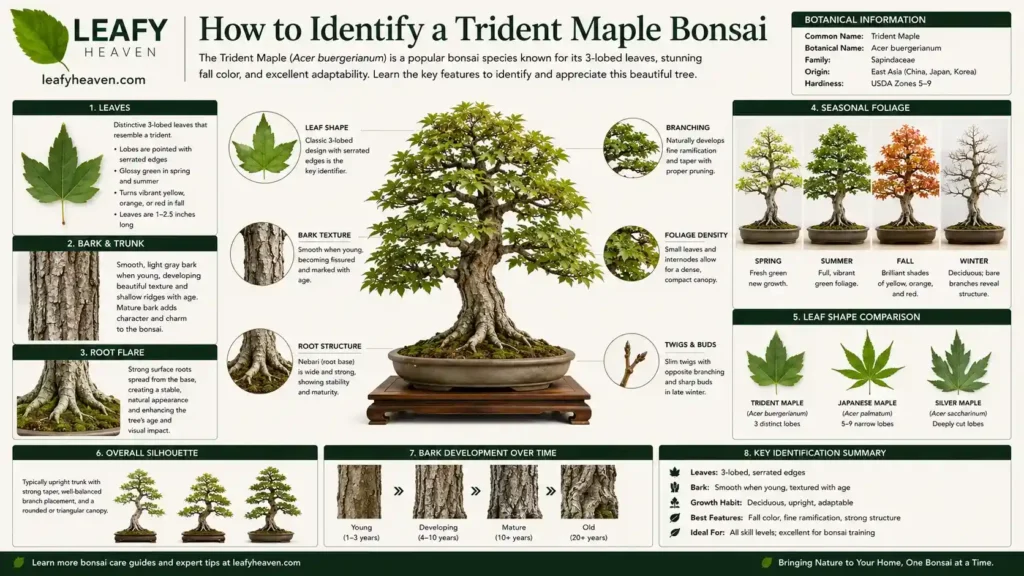
A Trident Maple Bonsai can be identified by its distinctive three-lobed leaves, developing bark texture, vigorous growth habit, and striking seasonal color changes. These characteristics help distinguish it from other deciduous bonsai species, especially Japanese Maple.
The combination of compact foliage, strong branch development, and attractive bark makes identification relatively straightforward throughout most of the year.
Trident Maple Leaves and Leaf Shape
The most recognizable feature of a Trident Maple Bonsai is its leaf shape. Mature trident maple leaves typically have three distinct lobes, giving the species its common name.
A typical trident maple leaf is smaller and thicker than the leaves found on many other maple species. The central lobe is usually longer, while the two side lobes create a balanced triangular appearance.
The shape of a trident maple tree leaf is often described as a three pointed maple leaf, although the exact lobe shape can vary slightly depending on age, growing conditions, and cultivar.
Key leaf identification features include:
- Three clearly defined lobes
- Smooth leaf margins or lightly serrated edges
- Glossy green color during the growing season
- Compact leaf size suitable for bonsai cultivation
- Bright autumn color before leaf drop
A healthy trident leaf appears firm, well-formed, and evenly colored during active growth.
Trident Maple Bark Characteristics
Young Trident Maples typically have smooth gray or light brown bark. As the tree matures, the bark gradually develops texture, character, and visual depth.
One reason bonsai growers value trident maple bark is its ability to create the appearance of age relatively quickly compared to many other deciduous species. Older specimens often develop attractive fissures, plates, and rugged trunk features.
The trunk of a mature acer trident maple tree frequently displays:
- Smooth bark in early years
- Gradual texture development with age
- Strong trunk flare at the base
- Natural-looking bark patterns
- Improved visual maturity over time
These bark characteristics contribute significantly to the tree’s overall bonsai appeal and help create the impression of a much older landscape tree in miniature form.
Seasonal Appearance Throughout the Year
Trident Maple Bonsai undergoes noticeable seasonal changes that make identification easier throughout the year.
Spring
New leaves emerge in fresh shades of green. During this period, small and often inconspicuous trident maple flowers may appear before or alongside developing foliage.
Summer
The canopy becomes dense and vibrant green. Branch structure begins to fill out, and the tree displays strong growth and healthy foliage.
Autumn
The most dramatic transformation occurs during fall. Depending on climate and growing conditions, trident maple fall color may range from yellow and orange to deep red, creating one of the species’ most attractive seasonal displays.
Winter
After leaf drop, the tree reveals its branch structure, trunk movement, bark texture, and ramification. This dormant season often highlights the bonsai’s design and craftsmanship.
Identification Comparison Table
| Feature | Trident Maple | Japanese Maple |
| Leaf Lobes | 3 | 5–7 |
| Growth Rate | Faster | Slower |
| Root Strength | Strong | Moderate |
| Bark Development | Excellent | Moderate |
Trident Maple Bonsai Tree Pros and Cons
Trident Maple Bonsai offers excellent ramification, vigorous growth, attractive bark development, and outstanding seasonal color. At the same time, it requires regular maintenance, seasonal pruning, and proper winter care to maintain long-term health and appearance.
Understanding the trident maple tree pros and cons helps growers decide whether this species matches their climate, experience level, and bonsai goals.
Main Advantages
Trident Maple is widely considered one of the most rewarding deciduous bonsai species because it combines beauty, resilience, and trainability.
Major advantages include:
- Excellent ramification and fine branch development
- Small leaves that suit bonsai proportions
- Strong root system and reliable growth
- Fast recovery after pruning and repotting
- Attractive bark that improves with age
- Vibrant yellow, orange, and red autumn foliage
- Adaptability to multiple bonsai styles
- Long lifespan with proper maintenance
- Suitable for both beginners and advanced enthusiasts
Another significant advantage is its response to training techniques. With proper bonsai maple tree care, growers can develop trunk thickness, branch structure, and root flare more quickly than many other deciduous species.
The tree also tolerates root pruning well, making long-term container cultivation easier compared to more delicate maple varieties.
Potential Drawbacks
Although the species offers many benefits, growers should also understand its limitations.
Common drawbacks include:
- Requires regular pruning to control vigorous growth
- Needs winter dormancy for long-term health
- Can suffer from root rot in poorly draining soil
- Leaves may scorch during extreme summer heat
- Frequent watering may be necessary during active growth
- Defoliation and refinement techniques require proper timing
- Branches can thicken quickly if maintenance is delayed
Many of these challenges are manageable with experience and proper cultivation practices. Most issues arise from incorrect watering, inadequate seasonal care, or neglected pruning schedules rather than weaknesses in the species itself.
When evaluating overall trident maple pros and cons, the advantages generally outweigh the disadvantages for most bonsai growers.
Is It Good for Beginners?
Yes, Trident Maple is considered one of the best deciduous bonsai trees for beginners.
Its strong growth, adaptability, and tolerance for common mistakes make it easier to maintain than many other maple species. The tree responds predictably to pruning, root work, fertilization, and seasonal training techniques.
Beginners benefit from:
- Fast visual progress during development
- Strong recovery after maintenance work
- Clear seasonal growth patterns
- High tolerance for pruning
- Reliable response to bonsai techniques
- Easier branch development compared to delicate species
At the same time, experienced growers continue to value Trident Maple because it can achieve exceptional refinement, detailed ramification, and mature bark characteristics over time.
This combination of beginner friendliness and advanced potential is one reason the species remains a favorite in bonsai collections worldwide.
Pros vs Cons Table
| Pros | Cons |
| Excellent ramification | Requires regular pruning |
| Strong root system | Needs winter dormancy |
| Fast development | Can experience leaf scorch in extreme heat |
| Attractive bark with age | Requires consistent watering during active growth |
| Beautiful fall color | Seasonal maintenance is necessary |
| Tolerates pruning and repotting well | Overwatering can lead to root problems |
| Suitable for beginners and experts | Refinement requires ongoing attention |
| Long lifespan | Growth can become coarse if neglected |
Trident Maple Bonsai Size, Growth Rate and Lifespan
Trident Maple Bonsai grows relatively quickly compared to many deciduous bonsai species and can live for several decades when maintained properly. Its vigorous growth, strong root system, and excellent response to training make it ideal for both development and long-term refinement.
One reason growers favor this species is that it can develop trunk thickness, branch structure, and mature characteristics faster than many other maples while still maintaining fine bonsai proportions.
Trident Maple Height and Mature Size
The mature size of a Trident Maple Bonsai depends on its style, age, container size, and training goals. Unlike landscape trees, bonsai specimens are intentionally maintained at compact dimensions through pruning and root management.
Typical trident maple size ranges include:
| Bonsai Category | Approximate Height |
| Shohin | 6–8 inches (15–20 cm) |
| Small Bonsai | 8–12 inches (20–30 cm) |
| Medium Bonsai | 12–24 inches (30–60 cm) |
| Large Bonsai | 24–36+ inches (60–90+ cm) |
The natural trident maple height in the landscape can reach 20–35 feet (6–10 meters) or more under favorable conditions. However, bonsai cultivation keeps the tree compact while preserving the appearance of a mature full-sized tree.
A mature trident maple tree height in bonsai form is determined more by artistic design than by the species’ natural growth potential.
Growth Rate Explained
Trident Maple is generally considered a moderate-to-fast growing bonsai species. During active growing seasons, healthy trees can produce significant branch extension and trunk development.
Growth rate is influenced by several factors:
- Sunlight exposure
- Soil quality and drainage
- Water availability
- Fertilization program
- Pot size
- Climate conditions
- Age of the tree
Young development-stage trees often grow rapidly because the goal is trunk thickening and branch formation. Mature exhibition-quality bonsai usually grow more slowly because pruning is used to maintain refinement and structure.
This balance between vigorous growth and controllability is one of the species’ greatest strengths in bonsai cultivation.
Lifespan and Long-Term Development
Trident Maple Bonsai is a long-lived tree capable of surviving for many decades. With proper maintenance, some specimens remain healthy for generations.
Long-term development typically occurs in stages:
- Early growth and trunk formation
- Primary branch development
- Secondary branch refinement
- Fine ramification development
- Mature bark formation
- Advanced exhibition refinement
As the tree ages, the trunk thickens, bark texture improves, and branch structure becomes increasingly detailed. These characteristics add visual maturity and increase the overall quality of the bonsai.
Consistent care, proper repotting schedules, and seasonal maintenance are key factors that support longevity.
From Seedling to Mature Bonsai Timeline
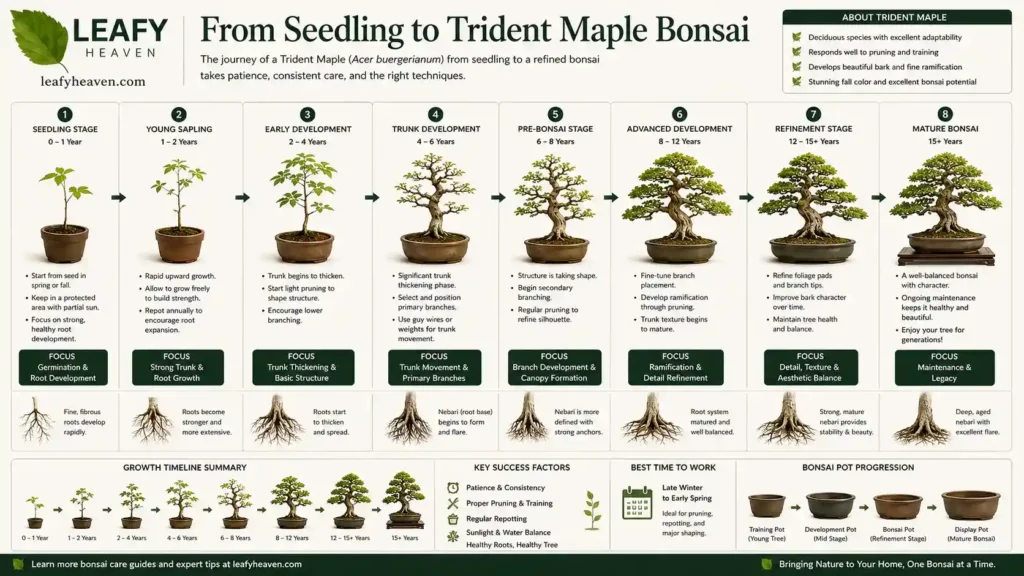
Developing a Trident Maple Bonsai requires patience, but the species is known for progressing faster than many deciduous bonsai trees.
Young trident maple seedlings are commonly used for long-term bonsai development because they adapt well to root training and trunk-building techniques.
A developing trident maple sapling can gain significant thickness within a few growing seasons when planted in larger containers or training beds before final bonsai refinement begins.
Growth Timeline Table
| Development Stage | Approximate Time |
| Seed Germination | 1–3 months |
| Young Seedling Development | 1–2 years |
| Sapling Growth and Trunk Building | 2–5 years |
| Pre-Bonsai Development | 5–10 years |
| Early Bonsai Refinement | 8–15 years |
| Mature Bonsai Appearance | 15–25+ years |
| Advanced Exhibition Quality | 20+ years |
While timelines vary by growing conditions and techniques, Trident Maple remains one of the faster deciduous species for achieving a mature bonsai appearance.
Trident Maple Bonsai Care Requirements
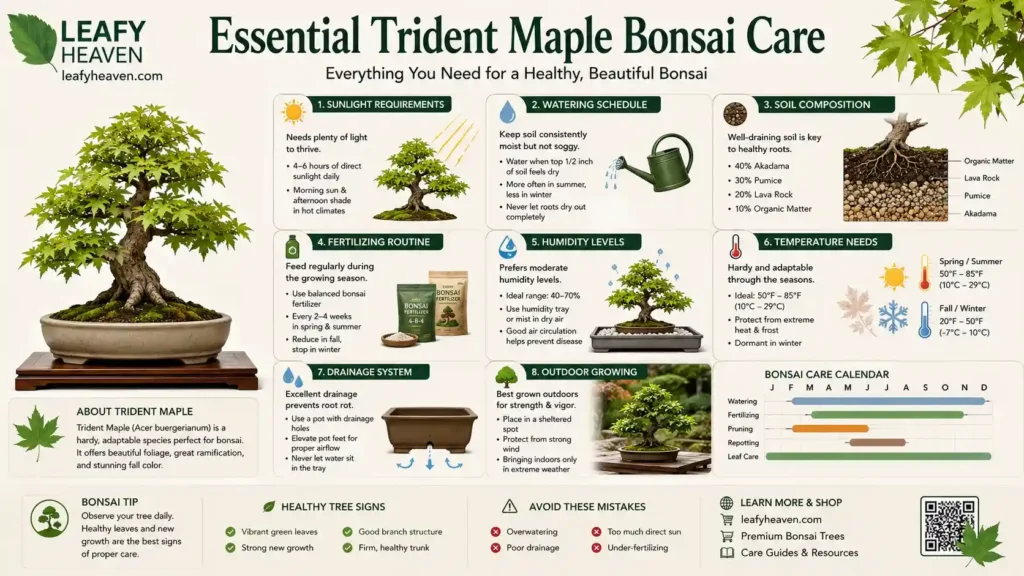
Proper sunlight, watering, soil composition, and fertilization are essential for maintaining a healthy Trident Maple Bonsai. When these basic requirements are met consistently, the tree develops strong roots, vigorous growth, fine ramification, and attractive seasonal color.
Successful trident maple bonsai care focuses on balancing moisture, nutrition, sunlight exposure, and seasonal maintenance. Although this species is relatively forgiving, long-term health depends on providing suitable growing conditions throughout the year.
Sunlight Requirements
Trident Maple Bonsai grows best in full sun to partial sun. Adequate light promotes compact growth, healthy foliage, stronger branching, and vibrant autumn color.
General sunlight guidelines include:
- 4–8 hours of direct sunlight daily
- Morning sun is highly beneficial
- Light afternoon shade is helpful in extremely hot climates
- Insufficient light can cause weak growth and larger leaves
Proper sunlight exposure is one of the most important aspects of bonsai trident maple care because it directly affects vigor, leaf size, and branch development.
Best Soil Mix
A well-draining soil mix is essential for healthy root development. Trident Maple roots prefer consistent moisture but should never remain waterlogged.
A quality bonsai soil mix typically contains:
- Akadama for moisture retention
- Pumice for aeration
- Lava rock for drainage and root health
Many growers use a mixture such as:
| Component | Approximate Ratio |
| Akadama | 50% |
| Pumice | 25% |
| Lava Rock | 25% |
Good soil structure supports strong roots and reduces the risk of root diseases, making it a critical part of overall trident maple care.
Watering Schedule
Trident Maple Bonsai prefers evenly moist soil throughout the growing season. Watering frequency depends on temperature, humidity, soil composition, and pot size.
General watering guidelines include:
- Water thoroughly when the upper soil surface begins to dry
- Increase watering during hot summer weather
- Reduce watering during winter dormancy
- Avoid allowing the soil to become completely dry
Overwatering and underwatering are among the most common mistakes in trident maple tree care. The goal is to maintain consistent moisture without creating saturated conditions around the roots.
Temperature and Climate Needs
Trident Maple Bonsai performs best in temperate climates with distinct seasonal changes. The species benefits from warm growing seasons and cool winter dormancy.
Ideal temperature conditions include:
- Active growth during spring and summer
- Moderate temperatures during autumn
- Cool winter dormancy period
- Protection from extreme environmental stress
Proper climate management is a key component of long-term maple bonsai care because seasonal cycles support healthy growth and development.
Humidity Requirements
Trident Maple Bonsai adapts well to a wide range of humidity levels. Unlike many tropical bonsai species, it does not require exceptionally high humidity to remain healthy.
Helpful humidity practices include:
- Good air circulation around the tree
- Avoiding overly dry environments during active growth
- Maintaining proper watering habits
- Preventing stagnant, humid conditions that encourage disease
Balanced humidity supports healthy foliage while reducing stress during warm weather.
Fertilizing Schedule
Regular fertilization provides the nutrients needed for healthy growth, branch development, and root strength.
A typical fertilization program includes:
| Season | Fertilization Approach |
| Spring | Balanced fertilizer during active growth |
| Summer | Continued feeding with moderate strength |
| Early Autumn | Reduced but consistent fertilization |
| Winter | Usually no fertilization during dormancy |
Consistent feeding helps maintain vigorous growth and supports advanced ramification development. Proper fertilization is an important part of effective maple tree bonsai care and long-term refinement.
Pot Selection and Drainage
The bonsai container should provide sufficient drainage while supporting root development and overall tree stability.
Important pot considerations include:
- Large drainage holes
- Proper depth for the development stage
- Durable construction
- Adequate space for root growth
- Stability against wind and weather
Good drainage prevents excess moisture accumulation and protects root health. Container selection plays a significant role in successful bonsai maple tree care over the life of the tree.
Indoor vs Outdoor Growing
Trident Maple Bonsai is primarily an outdoor bonsai species. It requires seasonal changes and winter dormancy to maintain long-term health.
Outdoor Growing Advantages
- Natural seasonal cycles
- Better light exposure
- Stronger growth
- Proper dormancy development
- Improved fall color
Indoor Growing Challenges
- Insufficient sunlight
- Lack of dormancy
- Reduced vigor
- Increased risk of pest problems
- Difficulty maintaining seasonal growth patterns
For most growers, outdoor cultivation provides the best results and aligns with proper acer bonsai tree care practices.
Care Requirements Summary Table
| Care Factor | Recommended Requirement |
| Sunlight | Full sun to partial sun |
| Soil Type | Fast-draining bonsai soil |
| Watering | Keep evenly moist, not waterlogged |
| Temperature | Temperate climate with dormancy |
| Humidity | Moderate with good airflow |
| Fertilizer | Regular feeding during growing season |
| Pot Type | Bonsai pot with excellent drainage |
| Growing Location | Primarily outdoors |
USDA Zones and Climate Requirements
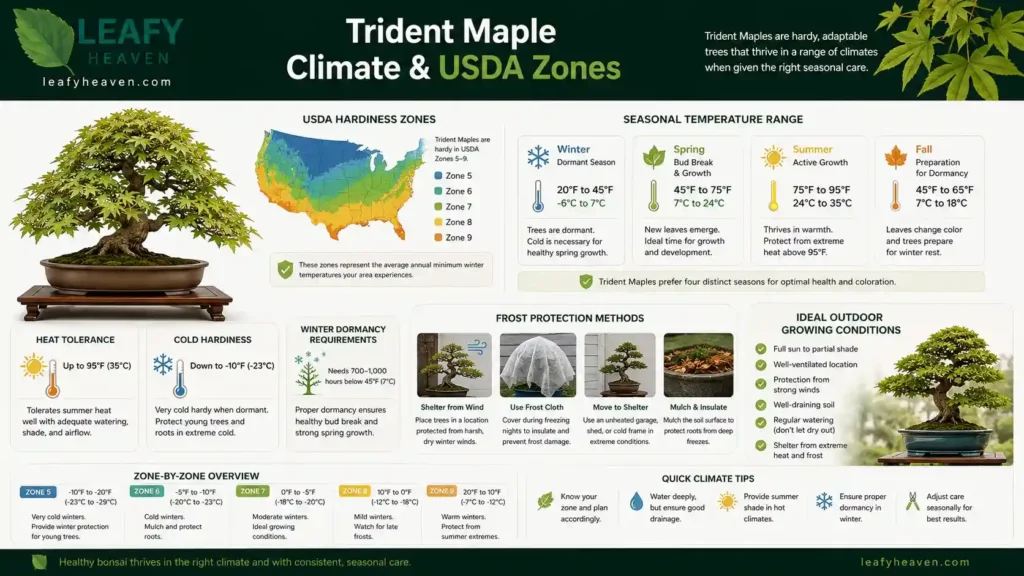
Trident Maple Bonsai performs best in temperate climates where it can experience all four seasons, including a necessary winter dormancy period. Proper climate conditions support healthy root development, vigorous growth, seasonal color changes, and long-term tree health.
Although adaptable to various environments, Trident Maple grows most successfully when temperature extremes are managed appropriately throughout the year.
Best USDA Zones
According to the USDA Plant Hardiness Zone Map, Trident Maple Bonsai is generally suited to Zones 5–9, where it can experience the seasonal temperature changes needed for healthy annual growth cycles.
The ideal trident maple zone range provides:
- Warm growing seasons
- Cool autumn temperatures
- Reliable winter dormancy
- Moderate spring conditions
- Protection from prolonged temperature extremes
Growers located within Zones 5–9 can typically cultivate Trident Maple Bonsai outdoors year-round with appropriate seasonal protection when necessary.
Heat Tolerance
Trident Maple Bonsai has good heat tolerance compared to many deciduous bonsai species. Healthy trees can withstand warm summer conditions when provided with adequate water and proper care.
During periods of high temperatures:
- Increase watering frequency as needed
- Monitor soil moisture closely
- Provide afternoon shade in extremely hot climates
- Maintain good air circulation
- Avoid severe pruning during heat waves
Extended exposure to extreme heat can cause leaf scorch, dehydration, and reduced vigor if the tree is not properly protected.
Cold Hardiness
Trident Maple Bonsai is relatively cold hardy and benefits from winter dormancy. Dormancy allows the tree to rest and prepare for vigorous growth during the following spring.
Cold tolerance improves as trees mature and develop stronger root systems. However, bonsai roots are more exposed than roots growing in the ground, making container protection important during severe winter conditions.
Benefits of proper winter chilling include:
- Healthier spring growth
- Stronger bud development
- Improved seasonal cycles
- Better long-term vigor
- Enhanced overall tree health
While the tree tolerates cold weather well, prolonged freezing conditions can damage exposed roots if adequate protection is not provided.
Protecting Trees in Extreme Weather
Extreme weather conditions require additional care to prevent stress and damage. Seasonal protection helps maintain tree health during unusually hot summers or severe winter events.
During Extreme Heat
- Move trees to locations with afternoon shade
- Water more frequently when necessary
- Avoid allowing soil to dry completely
- Increase humidity through proper watering practices
- Protect foliage from intense reflected heat
During Severe Cold
- Place trees in a protected cold frame or unheated shelter
- Mulch around pots to insulate roots
- Shield trees from freezing winds
- Avoid waterlogged soil during winter
- Monitor moisture levels throughout dormancy
Providing protection during temperature extremes helps preserve root health, maintain vigor, and support the long-term development of a healthy Trident Maple Bonsai.
Trident Maple Bonsai Winter Care
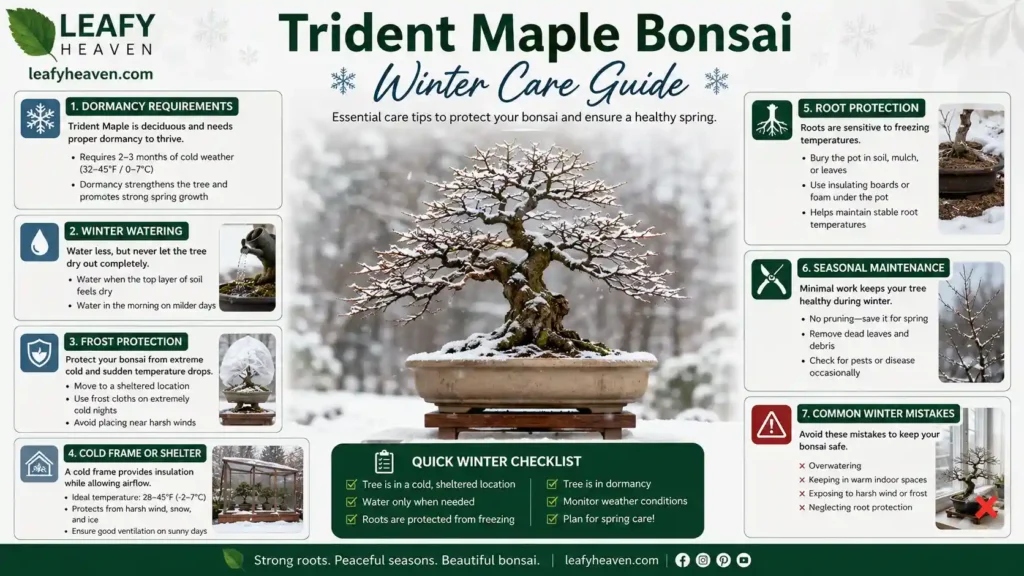
Proper winter care protects the root system from severe damage while allowing the tree to complete its natural dormancy cycle. Successful trident maple bonsai winter care balances cold protection with the chilling period required for healthy spring growth.
Because Trident Maple is a deciduous species, winter dormancy is not optional. It is a natural biological process that supports long-term vigor, bud development, and seasonal growth patterns.
Dormancy Requirements
Trident Maple Bonsai requires a winter dormancy period each year. As temperatures cool and daylight hours decrease, the tree gradually slows growth and sheds its leaves.
During dormancy:
- Growth stops temporarily
- Energy is stored within roots and branches
- Water requirements decrease
- Leaf production ceases
- Buds prepare for spring growth
A proper dormancy period helps maintain the health and longevity of the bonsai. Trees that do not experience sufficient winter rest may develop weaker growth and reduced vigor over time.
Winter Watering
Trident Maple Bonsai still requires water during dormancy, but significantly less than during the active growing season.
Winter watering guidelines include:
- Check soil moisture regularly
- Water when the soil begins to dry
- Avoid keeping soil constantly wet
- Reduce watering frequency compared to summer
- Ensure excess water drains freely
The goal is to keep roots slightly moist without creating saturated conditions. Excess moisture during cold weather can increase the risk of root problems and fungal issues.
Frost Protection
While Trident Maple tolerates cold temperatures well, bonsai roots are more vulnerable than roots growing in the ground because they are confined within a shallow container.
Protecting roots during severe winter conditions may include:
- Moving the tree into a cold frame
- Placing the bonsai in an unheated garage or shed
- Mulching around the pot
- Shielding the tree from strong winter winds
- Grouping bonsai together for additional insulation
Protection should focus on the root system rather than keeping the tree warm. The objective is to prevent extreme root freezing while still allowing dormancy to occur naturally.
Common Winter Mistakes
Many winter problems result from overprotection or improper watering rather than cold temperatures themselves.
Common mistakes include:
- Bringing the tree into a heated indoor environment
- Overwatering during dormancy
- Allowing soil to remain waterlogged
- Preventing the tree from experiencing dormancy
- Exposing roots to repeated freeze-thaw cycles
- Ignoring winter moisture levels completely
- Fertilizing during dormancy
Avoiding these mistakes helps maintain healthy roots and ensures the tree enters spring with strong stored energy reserves.
Seasonal Care Table
| Season | Primary Care Focus |
| Spring | Bud break, fertilization, repotting, active growth |
| Summer | Regular watering, pruning, heat management |
| Autumn | Reduced fertilization, color development, preparation for dormancy |
| Winter | Dormancy, frost protection, reduced watering, root protection |
Pruning Trident Maple Bonsai for Better Ramification
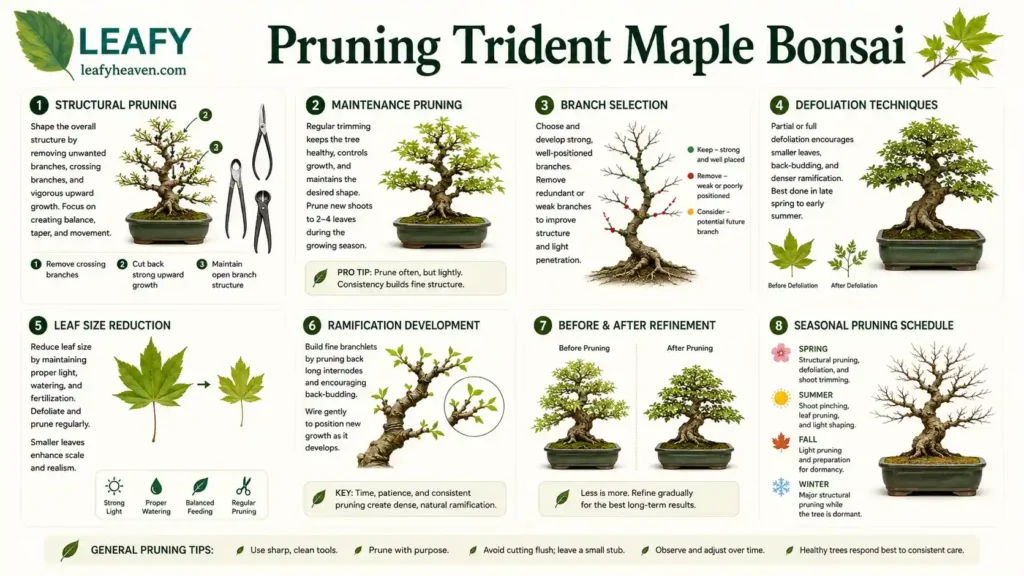
Regular pruning creates finer branching, smaller leaves, improved structure, and a more refined bonsai silhouette. Proper pruning is one of the most important techniques for developing high-quality ramification and maintaining the long-term appearance of a Trident Maple Bonsai.
Because of its vigorous growth and strong response to cutting, pruning trident maple trees is generally easier than pruning many other deciduous bonsai species. Consistent pruning encourages dense branching while preserving balanced growth throughout the canopy.
Structural Pruning
Structural pruning focuses on establishing the primary framework of the bonsai. This type of pruning is used to create trunk movement, select major branches, and improve the overall design.
Structural pruning is typically performed to:
- Remove unwanted branches
- Improve branch placement
- Correct design flaws
- Enhance trunk visibility
- Develop primary branch structure
Major cuts should be planned carefully because they influence the future shape of the tree for many years. Trident Maple generally heals pruning wounds well when healthy and actively growing.
Maintenance Pruning
Maintenance pruning controls ongoing growth and preserves the established design of the bonsai.
As new shoots extend, they are trimmed back to maintain shape and encourage additional branching. Repeated maintenance pruning gradually increases ramification and creates a denser canopy.
Benefits of maintenance pruning include:
- Improved branch density
- Better light penetration
- Enhanced ramification
- Balanced growth distribution
- Preservation of bonsai proportions
A refined trident bonsai typically requires regular maintenance throughout the growing season to prevent coarse growth and maintain a compact appearance.
Defoliation Techniques
Defoliation is an advanced technique used to encourage smaller leaves, increase ramification, and improve light penetration into the canopy.
Depending on tree health and development goals, growers may use:
- Partial defoliation
- Selective leaf removal
- Full defoliation on mature, vigorous trees
Defoliation should only be performed on healthy trees with strong growth. Weak or recently repotted specimens should not be defoliated because the process temporarily reduces the tree’s energy-producing foliage.
When applied correctly, defoliation can significantly improve the refinement of a mature bonsai trident maple.
Leaf Size Reduction
Leaf size reduction is an important objective in deciduous bonsai development because smaller leaves create better visual scale.
Several factors contribute to smaller foliage:
- Regular pruning
- Controlled fertilization
- Proper sunlight exposure
- Balanced watering practices
- Defoliation techniques
- Strong ramification development
As branch density increases, leaf size often decreases naturally. Mature Trident Maple Bonsai usually develop noticeably smaller leaves than young development-stage trees.
Leaf reduction should occur gradually through proper cultivation rather than through excessive stress or severe pruning.
Best Time to Prune
The timing of pruning affects both tree health and development results.
General pruning guidelines include:
| Pruning Type | Best Time |
| Structural Pruning | Late winter to early spring before active growth |
| Maintenance Pruning | Throughout the growing season |
| Defoliation | Early to mid-summer on healthy trees |
| Fine Ramification Pruning | Spring through early autumn |
| Heavy Design Corrections | Dormant season or early spring |
Avoid major pruning immediately before severe winter weather or during periods of extreme heat stress.
By combining structural pruning, maintenance pruning, and seasonal refinement techniques, growers can develop the dense branching, compact foliage, and mature appearance that make Trident Maple one of the most admired deciduous bonsai species.
Wiring and Styling a Trident Maple Bonsai
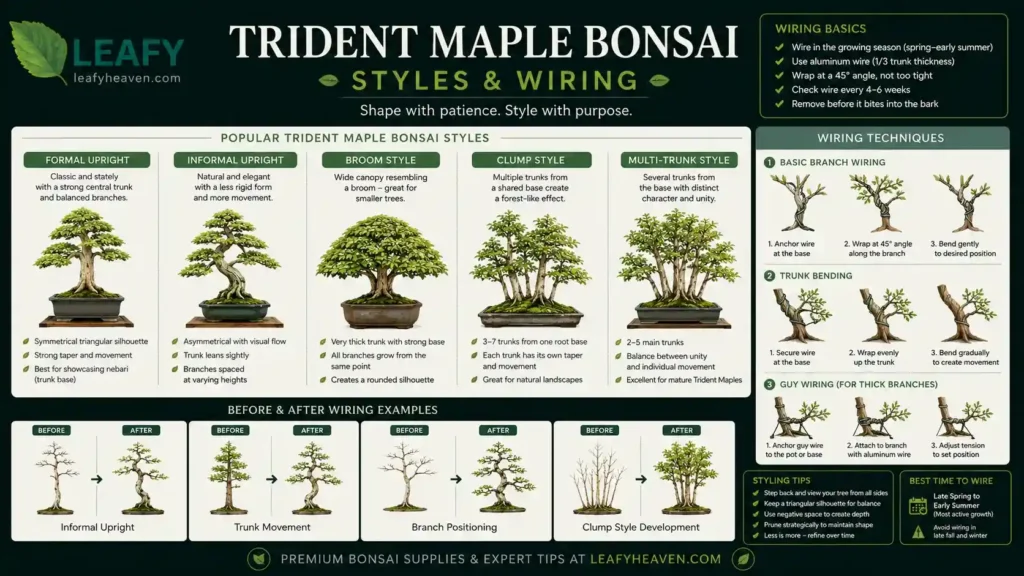
Wiring helps shape branches, improve structure, and guide future growth while maintaining the natural appearance expected of a deciduous bonsai. When combined with proper pruning, wiring allows growers to create balanced branch placement, attractive movement, and refined silhouettes.
Trident Maple responds well to wiring, but its branches can thicken quickly during active growth. Regular monitoring is important to prevent wire marks and preserve bark quality.
When to Wire
The best time to wire Trident Maple Bonsai depends on branch age, growth stage, and styling objectives.
Wiring is commonly performed:
- During late autumn after leaf drop
- Throughout winter dormancy
- In early spring before vigorous growth begins
- On young flexible shoots during the growing season
Many growers prefer wiring after leaf fall because the branch structure is fully visible and easier to work with.
Young branches are generally more flexible and easier to position, while older branches may require gradual adjustments over time.
Safe Wiring Techniques
Proper wiring should guide branch movement without damaging the bark or restricting growth.
Safe wiring practices include:
- Selecting appropriately sized aluminum or copper wire
- Applying wire at approximately a 45-degree angle
- Anchoring wire securely before bending branches
- Creating smooth, gradual curves
- Avoiding excessive force when positioning branches
- Checking wire regularly during active growth
The objective is to guide branch development while maintaining the health and appearance of the tree.
Because Trident Maple grows vigorously, wire should be inspected frequently to ensure it does not cut into expanding branches.
Common Wiring Mistakes
Improper wiring can damage bark, scar branches, and negatively affect future development.
Common mistakes include:
- Using wire that is too thick
- Wrapping wire too tightly
- Leaving wire on for too long
- Creating unnatural branch angles
- Bending branches too aggressively
- Wiring weak or unhealthy branches
- Ignoring wire marks during rapid growth
Preventing these mistakes helps maintain the smooth branch structure and attractive bark that contribute to a high-quality bonsai.
Best Trident Maple Bonsai Styles
Trident Maple adapts well to many traditional bonsai forms because of its strong growth, excellent ramification, and natural deciduous character.
Its flexibility allows growers to create designs ranging from formal and symmetrical to natural woodland compositions.
Many of the same design principles used in classic japanese maple bonsai styles can also be applied successfully to Trident Maple. However, the stronger growth habit of the species often makes development faster and more forgiving.
A mature maple trident bonsai can be trained into multiple styles while maintaining a realistic tree-like appearance.
Formal Upright Style
The Formal Upright style features a straight trunk that gradually tapers from base to apex.
Characteristics include:
- Strong vertical trunk line
- Symmetrical branch placement
- Balanced proportions
- Clear apex development
- Formal and structured appearance
This style highlights trunk taper and branch organization while creating a powerful, mature image.
Informal Upright Style
The Informal Upright style is one of the most popular designs for Trident Maple Bonsai.
Key features include:
- Gentle trunk curves
- Natural branch placement
- Balanced canopy structure
- Realistic deciduous tree appearance
- Strong visual movement
This style closely resembles mature trees found in nature and works exceptionally well with Trident Maple’s growth habits.
Broom Style
The Broom Style is especially suitable for deciduous species with dense ramification.
Characteristics include:
- Straight trunk
- Branches radiating outward from a central point
- Rounded canopy shape
- Fine twig development
- Elegant winter silhouette
Because Trident Maple develops excellent branch density, it is often considered one of the best species for broom-style bonsai.
Clump Style
The Clump Style creates the appearance of multiple trunks emerging from a shared root system.
Important design elements include:
- Several trunks of varying thickness
- Unified root base
- Natural spacing between trunks
- Balanced canopy development
- Woodland-like appearance
This style showcases the species’ strong root growth and creates a mature, natural landscape effect.
Multi-Trunk Style
The Multi-Trunk style uses several trunks to represent a group of related trees growing together.
Features typically include:
- Multiple trunks with varying heights
- Visual depth and perspective
- Natural forest-like composition
- Coordinated branch structure
- Unified design flow
When developed properly, a multi-trunk Trident Maple Bonsai creates a powerful image of a mature grove while preserving the elegant characteristics of a deciduous bonsai tree.
Repotting and Root Management
Root pruning and repotting maintain tree health, improve nutrient uptake, and encourage the development of fine feeder roots. These practices are essential for sustaining long-term vigor and preventing root congestion within the bonsai container.
Because Trident Maple is a vigorous species, regular root management helps maintain a balanced relationship between the root system and the canopy. Proper repotting also improves drainage, aeration, and overall tree health.

When to Repot
The best time to repot Trident Maple Bonsai is typically in late winter or early spring, just before buds begin active growth.
Common signs that repotting is needed include:
- Roots circling around the pot
- Reduced water absorption
- Slower growth than normal
- Soil breakdown and compaction
- Poor drainage performance
Repotting intervals vary depending on the age and development stage of the tree.
General guidelines include:
| Tree Stage | Typical Repotting Interval |
| Young Development Trees | Every 1–2 years |
| Intermediate Bonsai | Every 2–3 years |
| Mature Bonsai | Every 3–5 years |
Regular repotting prevents severe root binding and promotes healthy growth.
Root Pruning Process
Root pruning is performed during repotting to maintain a compact and efficient root system.
The process generally involves:
- Removing the tree from the container.
- Carefully loosening old soil from the roots.
- Inspecting roots for damage or disease.
- Removing excessively long or circling roots.
- Preserving healthy feeder roots whenever possible.
- Repositioning the tree in fresh bonsai soil.
- Watering thoroughly after repotting.
The objective is to create a dense network of fine roots that efficiently absorb water and nutrients while fitting comfortably within the bonsai container.
Heavy root reduction should be avoided unless the tree is healthy and vigorous.
Trident Maple Roots Explained
The root system of Trident Maple is one of the species’ greatest strengths in bonsai cultivation.
Healthy trident maple roots are vigorous, adaptable, and capable of producing large numbers of fine feeder roots after pruning. This characteristic makes the species highly responsive to bonsai techniques.
Important root characteristics include:
- Strong root growth
- Excellent response to pruning
- Ability to develop attractive surface roots
- Rapid feeder root production
- Good recovery after repotting
Many growers work to develop a broad root flare, often called nebari, because it creates the appearance of age, stability, and visual balance.
A well-developed root system contributes significantly to the overall quality of a mature Trident Maple Bonsai.
Best Soil After Repotting
Fresh bonsai soil should provide excellent drainage while retaining enough moisture to support healthy root growth.
An effective post-repotting soil mix commonly includes:
| Component | Purpose |
| Akadama | Moisture retention and root development |
| Pumice | Aeration and drainage |
| Lava Rock | Structure and long-term drainage |
Desired soil characteristics include:
- Fast drainage
- Good aeration
- Stable particle structure
- Moderate moisture retention
- Healthy microbial activity
Using fresh, well-structured soil encourages rapid root recovery and supports vigorous growth following repotting.
Step-by-Step Repotting Checklist
- Repot during late winter or early spring.
- Prepare fresh bonsai soil before removing the tree.
- Carefully remove the tree from the pot.
- Loosen and inspect the root system.
- Remove damaged, dead, or excessively long roots.
- Preserve healthy feeder roots whenever possible.
- Clean and prepare the bonsai container.
- Add fresh soil and position the tree correctly.
- Secure the tree if necessary.
- Fill remaining spaces with soil and eliminate air pockets.
- Water thoroughly after repotting.
- Protect the tree from extreme weather during recovery.
- Resume fertilization only after new growth begins.
Proper repotting and root management support strong growth, healthy ramification, and long-term development while maintaining the compact root structure required for high-quality bonsai cultivation.
Growing a Trident Maple Bonsai From Seedlings and Pre-Bonsai Material
Seedlings and pre-bonsai stock provide affordable and effective ways to develop high-quality Trident Maple Bonsai. These starting materials allow growers to build trunk thickness, root flare, branch structure, and overall design from an early stage.
Many experienced bonsai artists prefer developing trees from young material because it provides greater control over the tree’s future shape and long-term refinement.
Starting From Trident Maple Seedlings
Growing bonsai from trident maple seedlings is one of the most economical methods of developing a mature bonsai tree. Seedlings offer complete control over root development, trunk movement, and branch placement from the beginning.
Benefits of starting with seedlings include:
- Low initial cost
- Full design flexibility
- Early root system development
- Improved nebari formation
- Long-term customization potential
During the first few years, the primary goal is vigorous growth rather than refinement. Young seedlings are usually allowed to grow freely to strengthen roots and increase trunk diameter.
Key early development priorities include:
- Establishing a healthy root system
- Creating trunk movement
- Encouraging strong growth
- Preventing root defects
- Building future branch structure
Patience is essential because seed-grown bonsai require several years before refinement begins.
Working With a Trident Maple Sapling
A trident maple sapling provides a faster starting point than a newly germinated seedling because it already has some trunk development and root maturity.
Saplings are often selected when growers want to shorten the early development phase while still retaining significant design flexibility.
Advantages of working with saplings include:
- Faster trunk development
- Stronger root systems
- Earlier branch selection
- Reduced development time
- Greater structural options
At this stage, growers typically begin identifying the front of the tree, selecting primary branches, and planning future styling objectives.
Regular pruning and directional growth management help transform a young sapling into quality bonsai material.
Developing Trunk Thickness
Trunk thickness is one of the most important elements of bonsai development because it creates the visual impression of age and stability.
Young Trident Maples develop thicker trunks more quickly when they are allowed to grow vigorously before refinement begins.
Common trunk development techniques include:
- Growing the tree in larger containers
- Planting in training beds
- Allowing sacrifice branches to grow
- Providing strong fertilization programs
- Extending unrestricted growth periods
Sacrifice branches are often used because they increase trunk diameter without becoming part of the final design. Once sufficient thickness has been achieved, these branches can be removed.
The trunk-building phase may last several years depending on the desired bonsai size and style.
Trident Maple Pre-Bonsai Development
Many growers begin with trident maple pre bonsai material because it offers a balance between affordability and development progress.
A trident maple pre-bonsai has already undergone some early training but still requires significant refinement before becoming a finished bonsai.
Typical pre-bonsai development goals include:
- Improving trunk taper
- Enhancing root flare
- Selecting primary branches
- Building secondary branch structure
- Increasing ramification
- Refining overall proportions
The development process generally progresses through several stages:
- Trunk and root development
- Primary branch selection
- Secondary branch formation
- Ramification development
- Fine refinement
- Long-term maintenance
Pre-bonsai material often shortens the timeline to a finished tree while still allowing growers substantial creative control over the final design.
Whether starting with seedlings, saplings, or pre-bonsai stock, Trident Maple remains one of the most rewarding species for long-term bonsai development because of its vigorous growth, adaptability, and exceptional refinement potential.
Common Problems and Troubleshooting
Most Trident Maple Bonsai problems are caused by watering mistakes, poor soil conditions, pests, environmental stress, or improper seasonal care. Early diagnosis helps prevent minor issues from becoming serious health problems.
Regular inspection of leaves, branches, roots, and soil conditions allows growers to identify problems quickly and take corrective action before long-term damage occurs.
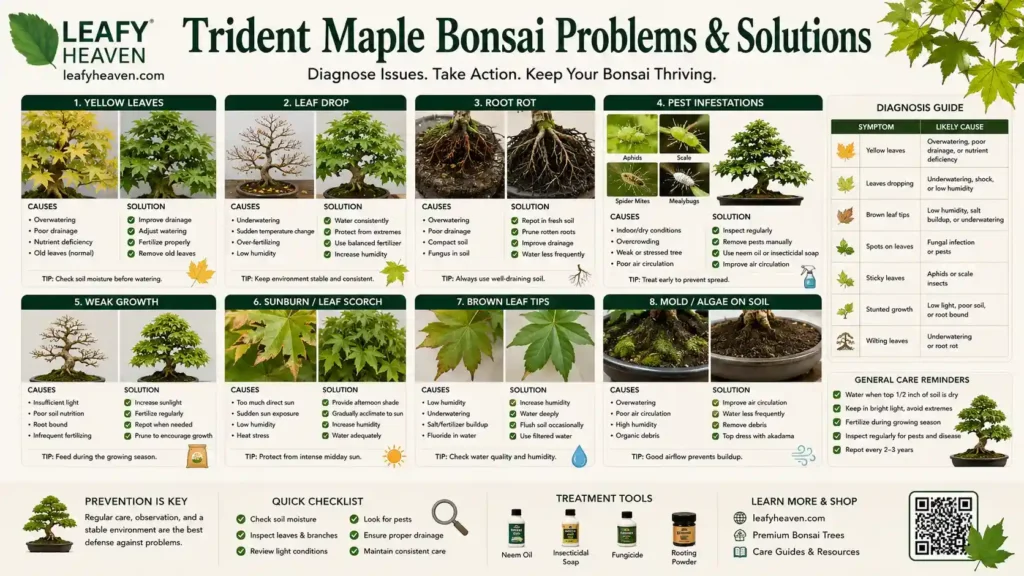
Yellow Leaves
Yellow leaves are one of the most common issues observed in Trident Maple Bonsai. While seasonal color change in autumn is normal, yellowing during the growing season often indicates stress.
Common causes include:
- Overwatering
- Poor soil drainage
- Nutrient deficiencies
- Root problems
- Excessive heat stress
- Insufficient sunlight
Correcting watering practices and ensuring proper drainage usually resolves many yellow leaf issues.
Leaf Drop
Leaf drop can occur naturally during autumn dormancy, but premature leaf loss often signals environmental or cultural problems.
Potential causes include:
- Water stress
- Sudden temperature changes
- Root disturbance
- Severe pest infestations
- Excessive heat
- Extended drought conditions
Temporary leaf loss may occur after repotting or major pruning, but healthy trees typically recover when proper care is restored.
Weak Growth
Weak growth usually indicates that the tree is not receiving optimal growing conditions.
Signs of weak growth include:
- Small annual extension growth
- Sparse foliage
- Reduced vigor
- Poor branch development
- Slow recovery after pruning
Common causes include:
- Inadequate sunlight
- Poor fertilization
- Root congestion
- Old compacted soil
- Chronic underwatering
- Improper dormancy conditions
Improving basic care practices often restores normal vigor over time.
Root Rot
Root rot is one of the most serious health problems affecting Trident Maple Bonsai. It typically develops when roots remain in constantly wet, poorly aerated soil.
Common warning signs include:
- Yellowing leaves
- Weak growth
- Wilting despite moist soil
- Foul soil odor
- Progressive branch dieback
Preventive measures include:
- Using well-draining bonsai soil
- Avoiding overwatering
- Maintaining proper drainage holes
- Repotting when soil structure deteriorates
- Monitoring moisture levels regularly
Healthy roots are essential for long-term tree survival and development.
Pest Problems
Trident Maple Bonsai can occasionally be affected by common bonsai pests.
Potential pests include:
- Aphids
- Scale insects
- Spider mites
- Caterpillars
- Mealybugs
Signs of infestation may include:
- Distorted leaves
- Sticky residue on foliage
- Visible insects
- Reduced growth
- Premature leaf drop
Regular inspection and early treatment help prevent serious infestations from becoming established.
Sunburn Damage
Sunburn occurs when foliage is exposed to excessive heat or intense sunlight beyond the tree’s tolerance level.
Symptoms may include:
- Brown leaf edges
- Crispy leaf margins
- Scorched leaf surfaces
- Premature leaf drop
- Reduced vigor during hot weather
Risk increases when:
- Temperatures become extreme
- Watering is inconsistent
- Trees experience reflected heat from walls or pavement
- Recently repotted trees are exposed to harsh conditions
Providing afternoon shade during extreme heat can significantly reduce sunburn damage.
Troubleshooting Table
| Problem | Likely Cause | Recommended Solution |
| Yellow Leaves | Overwatering, poor drainage, nutrient deficiency | Improve drainage, adjust watering, fertilize appropriately |
| Leaf Drop | Water stress, temperature fluctuations, environmental shock | Stabilize growing conditions and monitor moisture |
| Weak Growth | Low light, poor nutrition, root congestion | Increase sunlight, fertilize, inspect roots |
| Root Rot | Waterlogged soil and poor aeration | Repot into well-draining soil and remove damaged roots |
| Pest Problems | Aphids, mites, scale, or other insects | Inspect regularly and apply appropriate treatment |
| Sunburn Damage | Excessive heat and intense sunlight | Provide afternoon shade and maintain consistent watering |
Most Trident Maple Bonsai problems can be prevented through proper watering, quality soil, regular inspections, and consistent seasonal care. Healthy trees are generally resilient and recover well when issues are identified early.
Trident Maple Bonsai Forest and Group Plantings
Forest-style plantings create the appearance of a mature woodland landscape in miniature by combining multiple trees into a single composition. This approach emphasizes natural scenery, depth, perspective, and the visual relationship between individual trees.
Because of its vigorous growth, fine ramification, and attractive seasonal color, Trident Maple is considered one of the best species for creating realistic forest-style bonsai displays.
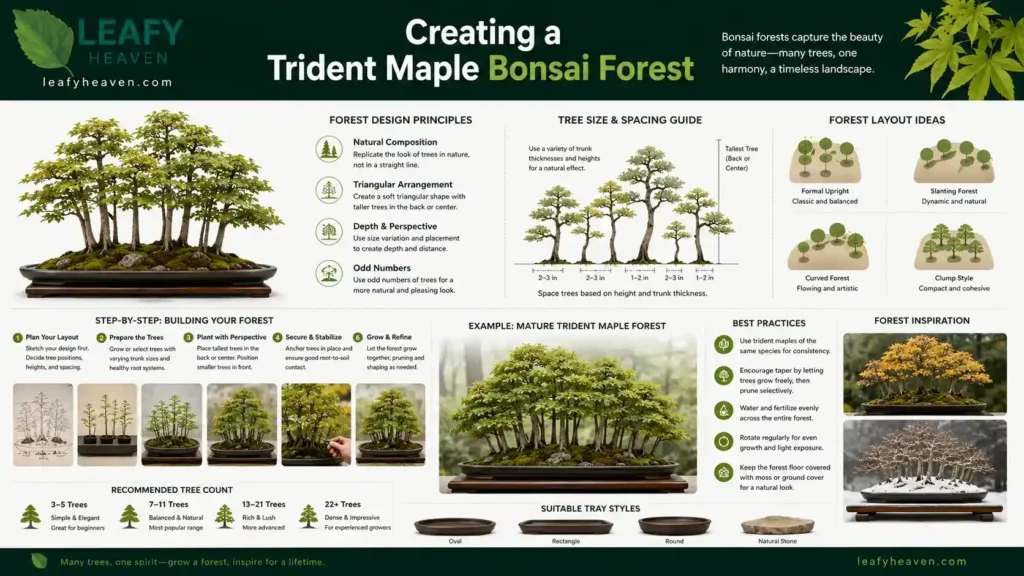
What Is a Trident Maple Bonsai Forest?
A trident maple bonsai forest is a bonsai composition that uses multiple Trident Maple trees planted together in a shallow container to represent a natural woodland scene.
Unlike a single-tree bonsai, a forest planting focuses on the interaction between trees rather than one dominant trunk. The objective is to recreate the appearance of a mature grove or small forest in miniature form.
Key characteristics include:
- Multiple trees of varying sizes
- Shared landscape design
- Natural spacing and positioning
- Unified root environment
- Realistic woodland appearance
A mature trident maple forest bonsai often creates a stronger landscape effect than a single specimen because it adds visual depth, movement, and scale.
How to Create a Forest Composition
Successful forest plantings rely on careful planning and natural-looking tree placement.
The process generally includes:
- Selecting trees with varying trunk diameters.
- Choosing one dominant tree as the visual focal point.
- Arranging secondary trees around the main trunk.
- Creating depth through size variation.
- Planting all trees in a shallow bonsai container.
- Refining branch structure over time.
Important design considerations include:
- Using odd numbers of trees whenever possible
- Avoiding perfectly symmetrical arrangements
- Creating visual movement across the composition
- Maintaining realistic proportions between trees
- Leaving open spaces to represent natural pathways and clearings
Over time, pruning and branch development help unify the planting and create the appearance of a mature woodland ecosystem.
Tree Spacing and Design Principles
Proper spacing is one of the most important factors in forest bonsai design. Trees should appear naturally grouped without looking crowded or artificially arranged.
Effective spacing principles include:
- Positioning larger trees near the visual center
- Placing smaller trees toward the edges and background
- Avoiding equal distances between trunks
- Creating natural clusters and open areas
- Maintaining clear visual pathways through the composition
Strong forest compositions also use perspective techniques to increase the illusion of depth. Smaller trees positioned farther back can make the planting appear larger and more realistic.
Many of the same design principles used in a red maple bonsai forest can also be applied to Trident Maple forests. However, Trident Maple is often preferred because of its stronger growth, excellent ramification, and reliable response to pruning.
As the planting matures, trunk development, branch refinement, and seasonal color changes combine to create a highly realistic miniature woodland scene. With proper maintenance, a Trident Maple forest bonsai can become one of the most impressive landscape-style displays in a bonsai collection.
Trident Maple Bonsai vs Japanese Maple Bonsai
Trident Maple grows faster, develops stronger roots, and generally tolerates bonsai techniques more easily, while Japanese Maple Bonsai is prized for its delicate foliage, refined appearance, and ornamental beauty. Both species are excellent deciduous bonsai trees, but they offer different advantages depending on a grower’s goals and experience level.
Understanding the differences between these two popular maple species helps growers select the tree that best matches their climate, maintenance preferences, and bonsai experience.
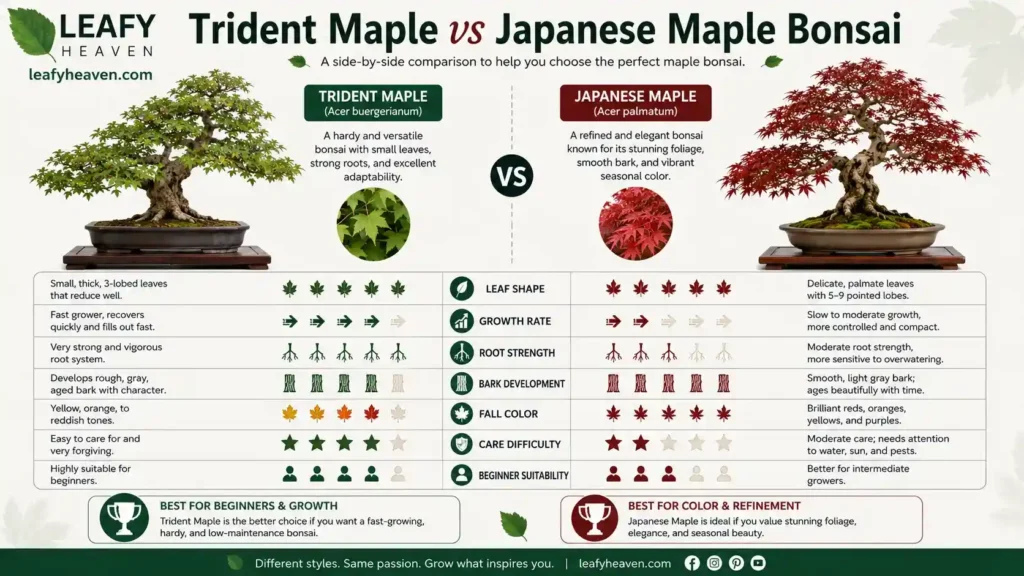
Leaf Comparison
Leaf shape is one of the most noticeable differences between the two species.
Trident Maple leaves typically have three distinct lobes and a slightly thicker structure. The foliage is durable and responds well to pruning and leaf-reduction techniques.
In contrast, the japanese trident maple is often confused with Japanese Maple, but true Japanese Maple varieties generally produce leaves with five to seven lobes and a more delicate appearance.
Key leaf differences include:
- Trident Maple: Three-lobed leaves
- Japanese Maple: Five to seven lobes
- Trident Maple: Thicker foliage
- Japanese Maple: Finer and more delicate foliage
- Trident Maple: Greater tolerance to environmental stress
- Japanese Maple: More sensitive to heat and drying conditions
Both species produce attractive autumn color, although Japanese Maple is often admired for its exceptionally vibrant foliage displays.
Growth Rate Comparison
Trident Maple generally grows faster than Japanese Maple and responds more vigorously to pruning and root work.
Growth advantages of Trident Maple include:
- Faster trunk thickening
- Stronger root development
- Quicker branch formation
- Faster recovery after pruning
- More rapid ramification development
Japanese Maple usually develops more slowly and may require additional time to achieve comparable trunk size and structural maturity.
For growers focused on development speed, Trident Maple often provides faster visible progress.
Care Difficulty Comparison
Both species require quality bonsai care, but Trident Maple is generally considered easier to maintain.
Trident Maple advantages include:
- Greater tolerance of pruning
- Stronger root systems
- Better recovery after repotting
- Improved heat tolerance
- More forgiving growth habits
Japanese Maple may require closer attention because of:
- Increased sensitivity to heat
- Greater risk of leaf scorch
- Slower recovery after stress
- More delicate foliage
While neither species is excessively difficult, Trident Maple tends to tolerate beginner mistakes more effectively.
Best Choice for Beginners
For most new growers, Trident Maple is usually the better beginner option.
Reasons include:
- Faster development
- Strong root growth
- Easier pruning response
- Better adaptability
- More forgiving maintenance requirements
- Reliable recovery after training work
A beginner seeking a dependable maple bonsai with strong growth and predictable results will often achieve success more quickly with Trident Maple.
However, experienced growers who prioritize delicate foliage and ornamental refinement may prefer a japanese trident maple bonsai or traditional Japanese Maple cultivar for advanced artistic development.
Growers seeking a similarly hardy but European deciduous option may also enjoy Field Maple Bonsai, which combines excellent ramification, rugged bark texture, and beginner-friendly care.
Comparison Table
| Feature | Trident Maple Bonsai | Japanese Maple Bonsai |
| Leaf Lobes | 3 | 5–7 |
| Growth Rate | Faster | Slower |
| Root Strength | Strong | Moderate |
| Heat Tolerance | Better | More Sensitive |
| Pruning Response | Excellent | Good |
| Repotting Recovery | Faster | Slower |
| Ramification Potential | Excellent | Excellent |
| Fall Color | Yellow, Orange, Red | Red, Orange, Purple Tones |
| Beginner Friendly | Highly Suitable | Moderate |
| Maintenance Difficulty | Easier | More Demanding |
Both species can produce outstanding bonsai specimens, but Trident Maple is generally favored for faster development, stronger growth, and beginner-friendly cultivation, while Japanese Maple is often chosen for its refined foliage and ornamental beauty.
Buying a Trident Maple Bonsai Tree
When purchasing a Trident Maple Bonsai, the most important factors to evaluate are trunk quality, root flare, branch structure, overall health, and future development potential. A well-selected tree can provide decades of enjoyment and refinement, while poor material may require years of corrective work.
Whether searching for a beginner tree, pre-bonsai stock, or an advanced specimen, understanding what to inspect before purchase helps ensure a better long-term investment in bonsai development.
What to Look for Before Buying
A healthy Trident Maple Bonsai should show strong growth, good structure, and no obvious signs of disease or stress.
Important features to evaluate include:
- Strong trunk taper
- Visible surface root flare (nebari)
- Healthy branch structure
- Balanced canopy development
- Vigorous buds and foliage
- No major pest infestations
- No signs of root problems
- Well-draining soil
The trunk is often considered the most important feature because it takes many years to develop. Branches can usually be improved through training, but major trunk defects are more difficult to correct.
When evaluating a trident maple bonsai tree for sale, prioritize long-term structural quality over temporary foliage appearance.
Beginner vs Advanced Trees
Trident Maple Bonsai is available in various stages of development, ranging from simple starter material to highly refined exhibition-quality specimens.
Beginner Trees
Typically offer:
- Lower purchase cost
- Basic trunk development
- Simple branch structure
- Greater learning opportunities
- Significant future development potential
Advanced Trees
Usually feature:
- Mature trunk taper
- Developed ramification
- Refined branch placement
- Improved bark character
- Higher artistic value
Many beginners choose a trident maple bonsai for sale that already has basic structure while still allowing room for future development and learning.
Pre-Bonsai vs Finished Bonsai
Understanding the difference between pre-bonsai material and finished bonsai helps buyers select the tree that matches their goals.
Pre-Bonsai
Pre-bonsai trees typically have:
- Developing trunks
- Early branch structure
- Basic styling work
- Lower prices
- Greater design flexibility
These trees are ideal for growers who enjoy shaping and developing their own bonsai.
Finished Bonsai
Finished trees generally feature:
- Refined branch structure
- Established ramification
- Mature appearance
- Display-ready quality
- Higher purchase prices
Many collectors seeking a bonsai trident maple for sale choose finished trees because they can immediately enjoy the refined appearance without waiting through years of development.
The choice depends largely on whether the buyer enjoys the development process or prefers an already refined bonsai.
Typical Price Ranges
Prices vary significantly depending on age, trunk quality, refinement level, and overall bonsai quality.
General price expectations include:
| Tree Type | Typical Price Range |
| Young Seedling | Low |
| Pre-Bonsai Material | Low to Moderate |
| Beginner Bonsai | Moderate |
| Intermediate Bonsai | Moderate to High |
| Advanced Bonsai | High |
| Exhibition-Quality Bonsai | Very High |
When comparing a trident maple bonsai sale, it is important to evaluate quality rather than price alone. A tree with superior trunk development and root flare may offer significantly greater long-term value.
Buyers searching for trident maple for sale, trident maple tree for sale, trident maple trees for sale, or trident maples for sale should focus on structural characteristics, health, and development potential instead of choosing solely based on size or foliage density.
A carefully selected Trident Maple Bonsai can continue improving for decades, making the initial choice one of the most important decisions in bonsai cultivation.
Conclusion
The Trident Maple Bonsai Tree is widely regarded as one of the finest deciduous bonsai species because it combines vigorous growth, exceptional ramification, attractive bark development, and outstanding seasonal color. Its adaptability allows both beginners and experienced bonsai enthusiasts to achieve excellent results through proper cultivation and training.
Unlike many deciduous species, Trident Maple responds well to pruning, wiring, root work, and repotting, making long-term development more predictable and rewarding. The species also develops strong surface roots, impressive trunk character, and dense branch structure that improve with age.
Whether grown from seedlings, pre-bonsai material, or a mature specimen, Trident Maple offers outstanding potential for creating high-quality bonsai in a wide range of traditional styles. Its durability, beauty, and refinement capabilities continue to make it one of the most respected trees in bonsai cultivation worldwide.
Final Key Takeaways
- Easy to train and style for both beginners and advanced growers
- Strong root system that responds well to bonsai techniques
- Excellent fall color ranging from yellow and orange to deep red
- Suitable for forest plantings, group compositions, and single-tree designs
- Long lifespan when maintained with proper seasonal care
- Great choice for beginners and experts seeking a versatile deciduous bonsai species
Frequently Asked Questions About Trident Maple Bonsai Tree
How often should I water a Trident Maple Bonsai?
A Trident Maple Bonsai should be watered whenever the upper layer of soil begins to dry. Watering frequency varies depending on temperature, humidity, pot size, soil composition, and season. During warm summer weather, daily watering may be necessary, while winter dormancy usually requires much less frequent watering. The goal is to keep the soil evenly moist without allowing it to become waterlogged.
Can Trident Maple Bonsai grow indoors?
Trident Maple Bonsai is primarily an outdoor bonsai species and is not well suited to permanent indoor cultivation. It requires natural seasonal changes and winter dormancy to remain healthy over the long term. While the tree may spend short periods indoors for display purposes, year-round indoor growing often leads to weak growth, reduced vigor, and long-term health problems.
How fast does a Trident Maple Bonsai grow?
Trident Maple Bonsai is considered a moderate-to-fast growing species. Young trees can develop trunk thickness and branch structure relatively quickly when provided with proper sunlight, water, fertilizer, and growing conditions. Compared to many deciduous bonsai species, Trident Maple often shows faster development, making it a popular choice for growers seeking visible progress within a reasonable timeframe.
When should I repot a Trident Maple Bonsai?
The best time to repot a Trident Maple Bonsai is usually in late winter or early spring before active growth begins. Young trees often require repotting every one to two years, while mature bonsai may only need repotting every three to five years. Repotting schedules should be based on root growth, soil condition, and overall tree health rather than a fixed calendar.
Why are my Trident Maple leaves turning brown?
Brown leaves are commonly caused by environmental stress, especially excessive heat, underwatering, inconsistent watering, or leaf scorch from intense sunlight. Other possible causes include root problems, poor soil drainage, nutrient deficiencies, and prolonged drought conditions. Evaluating watering practices and overall growing conditions usually helps identify the underlying issue.
Does Trident Maple Bonsai need winter dormancy?
Yes, Trident Maple Bonsai requires winter dormancy to maintain long-term health and vigor. Dormancy allows the tree to rest, store energy, and prepare for healthy spring growth. Without a proper dormancy period, the tree may become weakened over time and develop reduced growth, poor health, and diminished overall performance.
How do I reduce leaf size on a Trident Maple Bonsai?
Leaf size can be reduced through a combination of proper pruning, ramification development, balanced fertilization, adequate sunlight, and selective defoliation techniques. As branch density increases, leaves naturally become smaller and more proportionate to the bonsai design. Healthy trees with refined ramification typically produce the best leaf reduction results.
Is Trident Maple better than Japanese Maple for beginners?
For most beginners, Trident Maple is generally considered the better choice. It grows faster, develops stronger roots, recovers more quickly from pruning and repotting, and tolerates beginner mistakes more effectively. Japanese Maple offers beautiful foliage and refinement potential but is usually more sensitive to environmental stress and requires more careful management. As a result, Trident Maple is often recommended as one of the best beginner-friendly deciduous bonsai species.

Written by the LeafyHeaven Editorial Team
LeafyHeaven shares practical gardening tips and simple plant care guides to help you grow, nurture, and enjoy your plants with ease. Our goal is to make gardening feel natural, approachable, and rewarding for everyone.