
Introduction
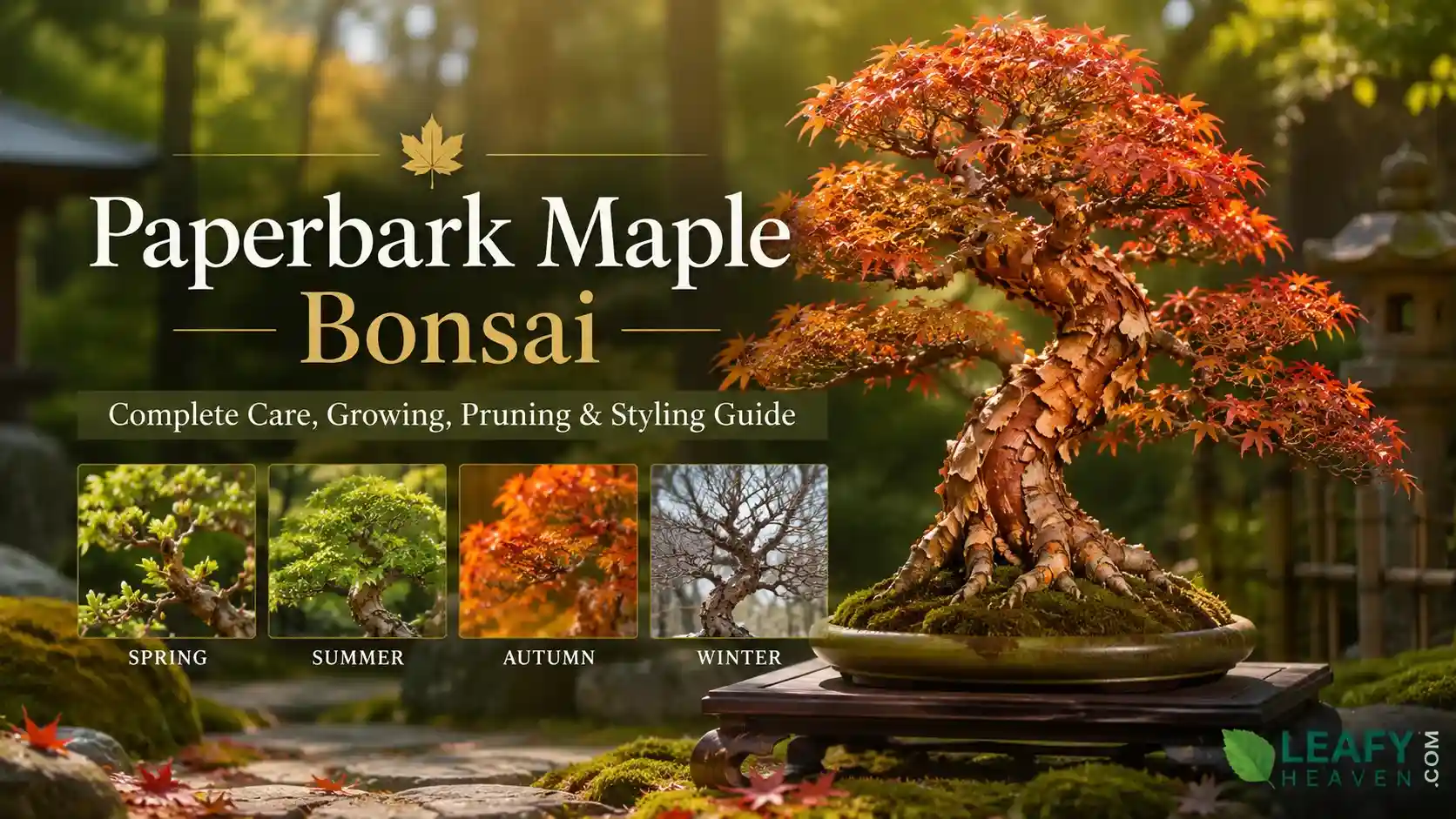
Paperbark Maple Bonsai is a miniature form of Paperbark Maple (Acer griseum), valued for its distinctive cinnamon-colored peeling bark, elegant branching structure, and vibrant seasonal display. Unlike many bonsai species grown primarily for foliage, this Maple Bonsai Tree offers year-round ornamental appeal through its bark texture, refined silhouette, and changing colors.
As a Deciduous Bonsai, Paperbark Maple develops attractive trifoliate leaves that emerge fresh green in spring, provide dense summer foliage, and transform into brilliant shades of orange and red during autumn. The species is widely recognized as one of the most beautiful examples of a peeling bark maple, making it especially desirable for collectors seeking visual interest beyond leaves alone.
Its naturally slow growth rate supports detailed bonsai training, gradual branch development, and fine ramification over time. Combined with careful root pruning and seasonal maintenance, Acer griseum can develop into an elegant bonsai that showcases mature bark character, balanced structure, and exceptional autumn foliage for decades.
What Is Paperbark Maple Bonsai?
Paperbark Maple Bonsai is a miniature version of Acer griseum trained using bonsai techniques while preserving the species’ famous peeling bark, elegant branching, and seasonal foliage display. Its combination of ornamental bark, refined structure, and year-round interest makes it one of the most distinctive maple species used in bonsai cultivation.
Growers exploring deciduous options for the first time will find this comprehensive guide to bonsai trees helpful for understanding core cultivation techniques before beginning a maple bonsai project.
Paperbark Maple (Acer griseum) Overview
Acer griseum is a deciduous maple species best known for its cinnamon-brown exfoliating bark and attractive trifoliate leaves. In bonsai form, it retains the same visual characteristics that make the full-sized tree highly valued in landscapes and botanical collections.
| Feature | Details |
| Scientific Name | Acer griseum |
| Common Names | Paperbark Maple, Paper Bark Maple, Bark Maple |
| Plant Family | Sapindaceae |
| Plant Type | Deciduous Tree |
| Native Range | Central China |
| Bonsai Category | Deciduous Bonsai |
One of the most unique features of Acer griseum is its naturally peeling bark. As the tree matures, thin layers of bark curl away from the trunk and branches, exposing rich coppery tones underneath. This characteristic creates visual interest even during winter dormancy when leaves are absent.
Unlike many ornamental maples that rely mainly on foliage color, Paperbark Maple delivers ornamental value through bark texture, branch architecture, seasonal color changes, and overall tree character.
Why Is Paperbark Maple Popular for Bonsai?
Paperbark Maple has become increasingly popular among bonsai enthusiasts because it offers multiple ornamental features within a single species.
Ornamental Bark
The species is famous for its cinnamon-colored exfoliating bark. Few bonsai trees develop such dramatic bark characteristics at a relatively young age, making the trunk a major focal point throughout the year.
Compact Growth Habit
Paperbark Maple grows relatively slowly compared to many landscape trees. This moderate growth habit allows bonsai artists to maintain shape more easily while gradually improving branch structure and ramification.
Seasonal Interest
Every season provides a different display.
- Spring brings fresh green foliage.
- Summer develops dense trifoliate leaves.
- Autumn produces vibrant orange and red colors.
- Winter highlights the peeling bark and branch silhouette.
This four-season appeal makes the species attractive for exhibition and long-term cultivation.
Attractive Branch Structure
As the tree matures, it develops graceful branching patterns that suit many traditional bonsai styles. Fine ramification and balanced branch placement enhance its natural appearance without requiring excessive intervention.
Paperbark Maple Bonsai vs Other Maple Bonsai Trees
Paperbark Maple is often compared with other popular maple species used in bonsai. While all maples offer seasonal beauty, each species has distinct strengths and limitations.
Paperbark Maple vs Japanese Maple
Japanese Maple is primarily grown for its delicate leaves and spectacular autumn colors. Paperbark Maple, on the other hand, combines attractive foliage with highly ornamental bark, providing visual interest even during winter.
Paperbark Maple vs Trident Maple
Trident Maple is known for vigorous growth, rapid trunk development, and strong adaptability. Paperbark Maple grows more slowly but compensates with unique exfoliating bark and a more refined appearance.
Paperbark Maple vs Coral Bark Maple
Coral Bark Maple is valued for its bright red winter stems. Paperbark Maple offers a different type of winter appeal through its peeling cinnamon-colored bark and textured trunk surface.
Advantages and Limitations
Advantages
- Unique peeling bark rarely found in other bonsai species
- Excellent year-round ornamental value
- Attractive autumn foliage
- Elegant branch structure
- Long lifespan with proper care
Limitations
- Slow growth rate
- Requires patience during development
- Less common and sometimes harder to source
- Slower trunk thickening than Trident Maple
Quick Comparison Table
| Feature | Paperbark Maple | Japanese Maple | Trident Maple | Coral Bark Maple |
| Scientific Name | Acer griseum | Acer palmatum | Acer buergerianum | Acer palmatum ‘Sango-kaku’ |
| Main Attraction | Peeling Bark | Delicate Foliage | Strong Trunk Development | Red Winter Bark |
| Growth Rate | Slow | Moderate | Fast | Moderate |
| Autumn Color | Excellent | Excellent | Very Good | Good |
| Winter Interest | Outstanding | Moderate | Moderate | Excellent |
| Ramification Potential | Good | Excellent | Excellent | Good |
| Beginner Friendly | Moderate | Moderate | High | Moderate |
| Unique Bark Feature | Exceptional | Limited | Limited | Colored Bark |
How to Identify a Paperbark Maple Bonsai
Paperbark Maple Bonsai is identified by its coppery exfoliating bark, trifoliate leaves, elegant branching structure, and brilliant autumn colors. While many maple bonsai are recognized primarily by their foliage, Acer griseum is most famous for its distinctive bark, which provides year-round visual interest.
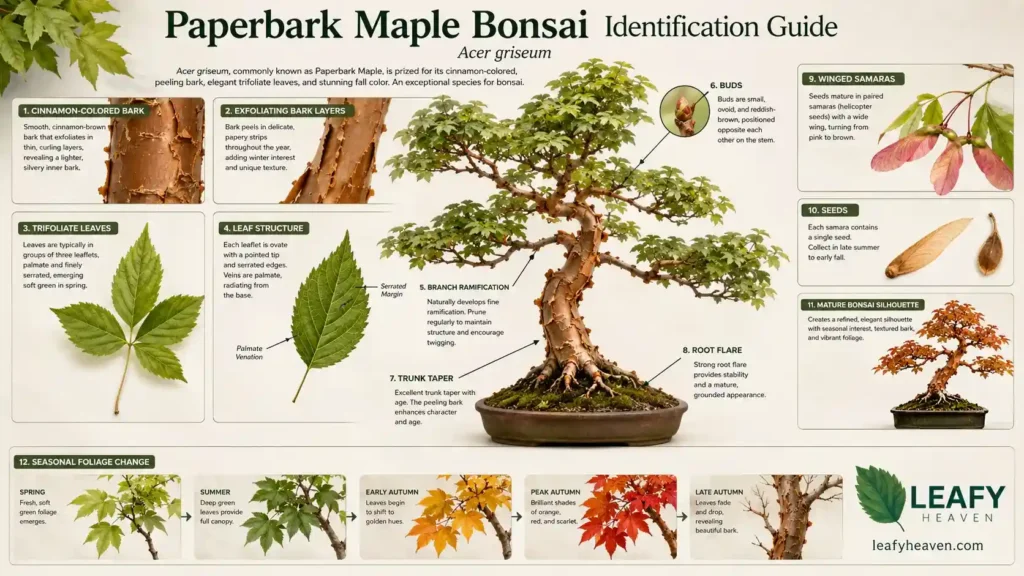
Paperbark Maple Bark Identification
The easiest way to identify a Paperbark Maple Bonsai is by examining its bark. The unique bark characteristics of Acer griseum are unlike those of most other maple species.
Cinnamon-Colored Bark
Young and mature trees develop warm reddish-brown to cinnamon-colored bark. This rich coloration gives the trunk and branches a striking appearance throughout the year.
The color often becomes more pronounced as the tree ages, creating strong visual contrast against green summer foliage and autumn leaves.
Exfoliating Bark Layers
The defining feature of paperbark maple bark is its tendency to peel naturally in thin, papery layers. This exfoliation reveals fresh coppery bark underneath and creates the textured appearance associated with a true peeling bark maple.
Unlike bark that flakes due to disease or damage, healthy exfoliation is a normal and desirable characteristic of the species.
Mature Bark Characteristics
As the tree matures, acer griseum bark becomes increasingly decorative. Multiple layers of curled bark develop along the trunk and primary branches, adding age, texture, and visual depth.
This mature bark character is one of the main reasons bonsai growers value the species.
Winter Bark Appearance
Winter is often the most impressive season for a maple bark tree such as Paperbark Maple. After leaf drop, the peeling bark becomes fully visible, highlighting the tree’s structure and creating a dramatic seasonal display.
What Does Maple Bark Look Like?
Many growers ask, what does maple bark look like or what does a maple tree bark look like when trying to identify different maple species. The answer depends on the species and age of the tree.
Young vs Mature Bark
Young maple bark is typically smoother and less textured than mature bark. In young Paperbark Maples, the bark may appear relatively smooth with only slight peeling.
As the tree ages, exfoliation becomes more pronounced and develops the characteristic papery appearance that distinguishes Acer griseum from other maples.
Seasonal Bark Changes
Bark appearance changes throughout the year.
- Spring highlights fresh bark coloration.
- Summer provides contrast between bark and foliage.
- Autumn enhances bark visibility as leaves change color.
- Winter reveals the full bark structure after leaf drop.
These seasonal transitions help make Paperbark Maple an attractive bonsai species year-round.
Bark Texture Comparison
Compared with Japanese Maple and Trident Maple, Paperbark Maple develops a much more textured and ornamental trunk surface.
While many maples have relatively smooth bark, maple tree bark in winter on Acer griseum displays curled layers, warm copper tones, and noticeable exfoliation that remain attractive even during dormancy.
Paperbark Maple Leaves
The foliage of Paperbark Maple Bonsai provides another reliable identification feature. The leaf structure differs noticeably from many other maple species.
Trifoliate Leaf Structure
A typical paperbark maple leaf consists of three leaflets attached to a single stem. This trifoliate arrangement is one of the easiest ways to distinguish Acer griseum from maples with traditional single-lobed leaves.
Each leaflet is oval-shaped with smooth margins and a clean, refined appearance.
Summer Foliage
During the growing season, paperbark maple leaves display a rich medium-green color. Healthy foliage creates a balanced canopy that complements the tree’s ornamental bark.
The underside of the leaf often has a slightly bluish or gray-green tone, adding further visual interest.
Autumn Color Changes
Autumn is one of the most attractive seasons for Acer griseum. Acer griseum leaves transform into shades of orange, scarlet, and red before dropping.
The combination of colorful foliage and peeling bark creates one of the most dramatic autumn displays among deciduous bonsai species.
Flowers, Seeds & Samaras
Flowers and seeds provide additional identification clues, especially on mature specimens.
Flower Appearance
Acer griseum flowers are small, yellowish-green blooms that appear in spring. Although they are not highly ornamental, they signal the beginning of the growing season and contribute to the tree’s natural lifecycle.
Seed Production
Mature trees may produce paperbark maple seeds after flowering. Seed production varies depending on age, climate, and pollination conditions.
These seeds are commonly used for propagation, although germination can be slow and often requires stratification.
Samara Identification
Like other maples, Acer griseum produces winged seeds known as samaras.
These paired samaras contain the developing acer griseum seeds and help disperse them naturally through wind movement. Their distinctive winged shape makes them easy to recognize during late summer and autumn.
Seasonal Appearance Throughout the Year
Paperbark Maple Bonsai offers visual interest in every season, making it one of the most attractive deciduous bonsai species.
Spring Growth
Spring brings fresh buds, new shoots, and emerging trifoliate leaves. New growth appears vibrant and healthy, creating a soft, delicate appearance.
Summer Foliage
During summer, the canopy becomes fuller and denser. Rich green foliage contrasts beautifully with the cinnamon-colored bark and developing branch structure.
Fall Paperbark Maple Color
The famous fall paperbark maple color display includes shades of orange, crimson, and scarlet. This seasonal transformation is one of the tree’s most celebrated ornamental features.
Autumn color often coincides with increased bark visibility as leaves begin to thin.
Winter Bark Display
Winter reveals the tree’s architectural beauty. Without foliage, the elegant branching pattern and exfoliating bark become the primary focal points.
The coppery bark, layered texture, and refined silhouette allow Paperbark Maple Bonsai to remain visually impressive even during dormancy.
Paperbark Maple Bonsai Size, Growth Rate & Lifespan
Paperbark Maple Bonsai grows slowly, develops refined branching over time, and can live for decades with proper care. While it is not a fast-developing bonsai species, its gradual growth contributes to finer ramification, improved bark character, and long-term ornamental value.
Paperbark Maple Growth Rate
The paperbark maple growth rate is generally considered slow compared to many other maple species used for bonsai. This slower development allows growers to create detailed branch structure without frequent corrective pruning.
In landscape conditions, Acer griseum may add modest annual growth, but bonsai cultivation naturally restricts size through pruning and root management. As a result, trunk thickening and branch development occur gradually over many years.
Several factors influence growth rate:
- Sunlight exposure
- Soil quality and drainage
- Water availability
- Fertilization practices
- Climate conditions
- Root development
Although slow growth requires patience, it often results in more refined branching and a balanced bonsai appearance.
Mature Paperbark Maple Size in Bonsai Form
A mature paperbark maple remains significantly smaller than a landscape-grown tree due to regular pruning and bonsai training techniques.
Most specimens are maintained within traditional bonsai size categories, though the final dimensions depend on the grower’s design goals and the age of the tree.
Typical paperbark maple size ranges include:
| Bonsai Category | Approximate Height |
| Small Bonsai | 8–12 inches (20–30 cm) |
| Medium Bonsai | 12–24 inches (30–60 cm) |
| Large Bonsai | 24–36 inches (60–90 cm) |
| Exhibition Specimens | Up to 40 inches (100 cm) |
The average paperbark maple height in bonsai collections typically falls between 12 and 24 inches, providing a balance between trunk visibility, branch development, and overall proportion.
As the tree matures, the focus shifts from increasing size to improving bark quality, branch ramification, and visual refinement.
Paperbark Maple Lifespan
Paperbark Maple Bonsai is a long-lived tree when maintained correctly. Healthy specimens can survive for several decades and often become more attractive with age.
Longevity depends on consistent care, including:
- Proper watering
- Seasonal fertilization
- Regular root pruning
- Timely repotting
- Pest and disease management
- Winter dormancy protection
Unlike short-lived ornamental plants, bonsai trees are cultivated as long-term living artworks. As Acer griseum ages, its bark becomes increasingly decorative and its branch structure gains greater character.
Many well-maintained bonsai specimens remain healthy for 40–60 years or longer, making them valuable additions to long-term collections.
Development Timeline From Seedling to Bonsai
Paperbark Maple develops gradually. The species rewards patience by producing increasingly attractive bark, refined branching, and improved seasonal displays as it matures.
During the early years, growers focus on root establishment and trunk development. Later stages emphasize branch structure, ramification, and overall refinement.
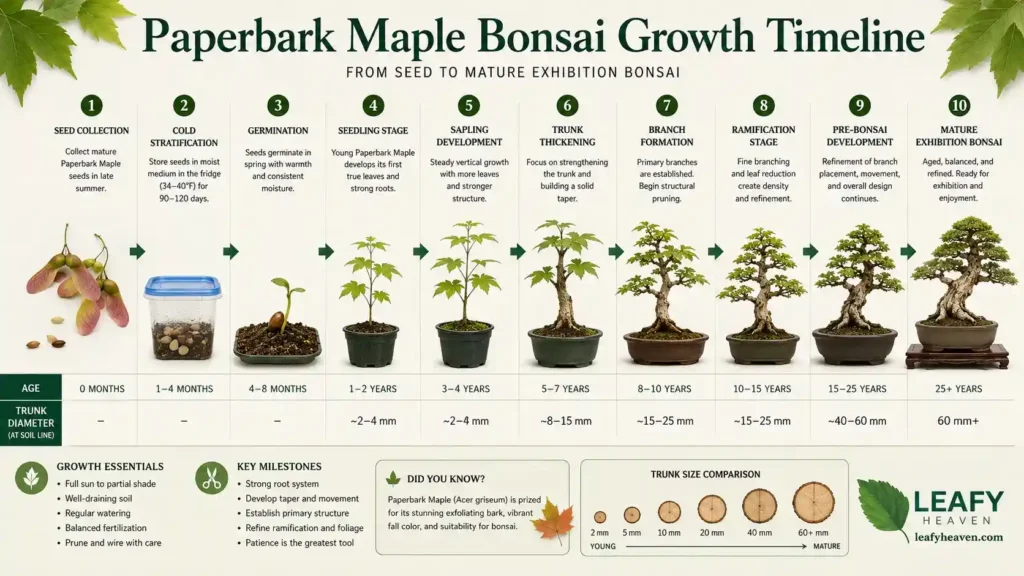
Growth Timeline Table
| Age | Development Stage | Key Characteristics |
| 0–1 Year | Germination Stage | Seed sprouts and develops initial root system |
| 1–3 Years | Seedling Stage | Young growth, basic trunk formation, early branching |
| 3–5 Years | Sapling Stage | Increased trunk thickness, stronger root development |
| 5–8 Years | Pre-Bonsai Stage | Initial styling, structural pruning, branch selection |
| 8–12 Years | Developing Bonsai | Improved ramification, bark character becoming visible |
| 12–20 Years | Mature Bonsai | Refined branch structure, strong seasonal display, attractive bark |
| 20+ Years | Advanced Bonsai | Exceptional bark texture, mature silhouette, exhibition-quality potential |
Because Acer griseum develops slowly, most growers view bonsai cultivation as a long-term process. The gradual appearance of peeling bark, refined ramification, and seasonal beauty is what makes Paperbark Maple Bonsai particularly rewarding over time.
How to Grow Paperbark Maple Bonsai
Paperbark Maple Bonsai grows best in well-draining soil, bright sunlight, moderate moisture, and seasonal outdoor conditions. Like other deciduous bonsai species, Acer griseum relies on natural seasonal changes to maintain healthy growth, develop strong roots, and produce vibrant autumn color.
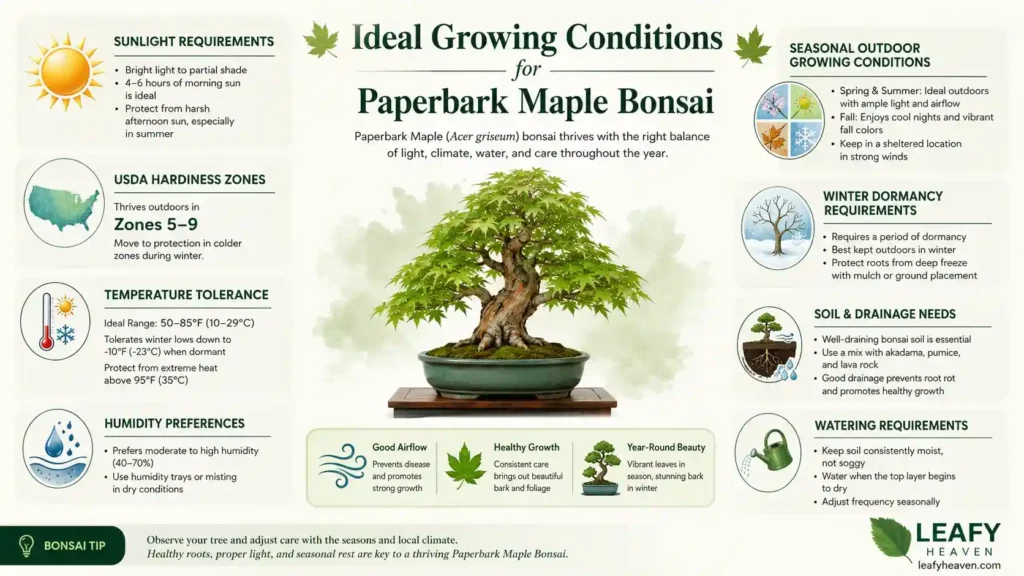
Ideal USDA Hardiness Zones
According to the USDA Plant Hardiness Zone Map, Paperbark Maple is generally suitable for Zones 4–8, where it can experience the seasonal temperature fluctuations required for healthy growth and winter dormancy.
Trees grown within these zones typically develop stronger seasonal characteristics, including spring budding, summer growth, autumn foliage color, and winter rest periods.
In warmer climates, protection from excessive summer heat may be necessary. In colder regions, bonsai containers may require winter protection to prevent root damage.
Light Requirements
Proper light exposure plays a major role in foliage health, branch development, and overall vigor.
Full Sun
Paperbark Maple Bonsai performs best with several hours of direct sunlight each day.
Benefits of full sun include:
- Stronger branch development
- Improved autumn color
- Better internode control
- Enhanced bark coloration
- Increased overall vigor
Morning sun is particularly beneficial because it provides strong light without excessive afternoon heat.
Partial Shade
In regions with intense summer temperatures, partial afternoon shade can help reduce heat stress and prevent leaf scorch.
Filtered sunlight is often ideal during periods of extreme heat, especially for trees growing in shallow bonsai containers.
Seasonal Adjustments
Light requirements can vary throughout the year.
- Spring: Full sun encourages healthy growth.
- Summer: Partial afternoon shade may be beneficial in hot climates.
- Autumn: Increased sunlight enhances fall color development.
- Winter: Full exposure helps maintain seasonal rhythm while dormant.
Adjusting placement according to seasonal conditions helps maintain healthy foliage and balanced growth.
Soil Requirements
A healthy root system depends on a well-structured bonsai soil that balances moisture retention with excellent drainage.
Bonsai Soil Mix
Paperbark Maple Bonsai performs best in a coarse, free-draining bonsai substrate.
A typical mix may include:
- Akadama
- Pumice
- Lava rock
- Small amounts of organic material
This combination supports root health while providing adequate moisture retention.
Drainage Needs
Good drainage is essential because Acer griseum roots dislike remaining waterlogged for extended periods.
Poor drainage can lead to:
- Root rot
- Weak growth
- Reduced vigor
- Increased disease risk
Bonsai containers should always contain adequate drainage holes to allow excess water to escape freely.
Root Aeration
Healthy roots require oxygen as well as moisture.
Coarse soil particles create air spaces that improve root aeration and encourage the development of fine feeder roots. These feeder roots are responsible for efficient water and nutrient uptake.
Proper root aeration also supports long-term bonsai health and helps maintain strong growth after repotting and root pruning.
Watering Requirements
Paperbark Maple Bonsai prefers consistently moist soil but should never remain saturated.
The goal is to water thoroughly when the upper soil layer begins to dry while avoiding prolonged dryness or excessive moisture.
General watering guidelines include:
- Check soil moisture daily during active growth.
- Water deeply until excess water drains from the container.
- Increase watering frequency during hot summer weather.
- Reduce watering during winter dormancy.
- Avoid allowing the root ball to dry completely.
Water requirements vary depending on climate, container size, soil composition, and seasonal growth activity.
Temperature & Humidity Preferences
Paperbark Maple is adapted to temperate climates and benefits from natural seasonal temperature changes.
Ideal growing conditions include:
- Cool to moderate temperatures
- Seasonal variation throughout the year
- Winter dormancy period
- Good air circulation
The species generally tolerates average outdoor humidity levels and does not require specialized humidity management in most climates.
During extreme summer heat, temporary shade and careful watering help prevent stress. During severe winter conditions, protecting the root system from freezing temperatures can reduce the risk of damage.
Fertilizing Schedule
Regular fertilization supports healthy foliage, root development, and branch growth.
During the growing season, balanced fertilizers can be applied at regular intervals to provide essential nutrients.
A typical schedule includes:
| Season | Fertilizing Recommendation |
| Early Spring | Begin balanced fertilizer as new growth emerges |
| Late Spring | Continue regular feeding |
| Summer | Maintain moderate fertilization |
| Early Autumn | Reduce nitrogen-heavy feeding |
| Late Autumn | Stop fertilizing as dormancy approaches |
| Winter | No fertilization during dormancy |
Over-fertilization should be avoided because excessive growth can reduce branch refinement and create larger leaves that are less desirable for bonsai development.
Quick Growing Conditions Table
| Growing Factor | Recommended Conditions |
| USDA Zones | 4–8 |
| Light | Full sun to partial shade |
| Soil Type | Well-draining bonsai mix |
| Drainage | Excellent |
| Root Aeration | High |
| Watering | Consistently moist, not waterlogged |
| Humidity | Average outdoor humidity |
| Temperature | Cool to moderate seasonal climates |
| Fertilizer | Balanced fertilizer during growing season |
| Winter Dormancy | Required |
| Outdoor Growing | Recommended year-round where climate allows |
How to Grow Paperbark Maple Bonsai From Seeds
Paperbark Maple can be propagated from seed, though germination requires patience and cold stratification. Growing Acer griseum from seed is a long-term process, but it allows bonsai enthusiasts to shape the tree from an early age and develop a strong foundation for future bonsai training.
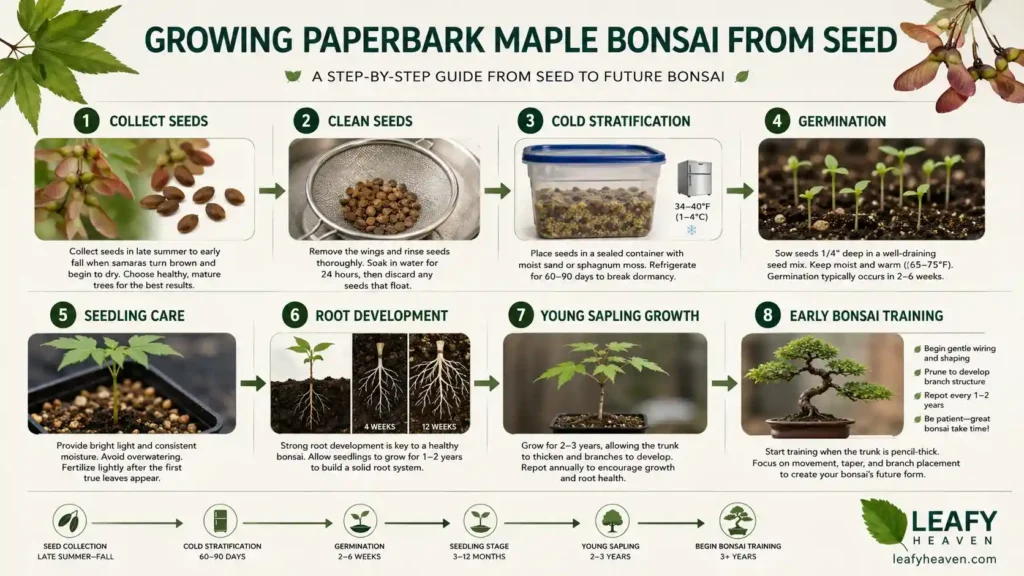
Paperbark Maple Seeds Collection
Successful propagation begins with collecting healthy, mature seeds.
Paperbark Maple produces winged seeds known as samaras after flowering. These seeds typically mature during late summer and autumn when they develop a dry, papery texture and turn brown.
For the best results:
- Collect seeds from healthy, mature trees.
- Select fully developed samaras.
- Avoid damaged or diseased seeds.
- Store seeds in a cool, dry location until stratification begins.
Fresh seed generally provides better germination results than seed that has been stored for extended periods.
Seed Stratification Process
Cold stratification is essential because Paperbark Maple seeds naturally require a winter-like period before germination.
Without stratification, many seeds remain dormant and fail to sprout.
A typical stratification process includes:
- Soak seeds in clean water for 24 hours.
- Prepare a moist medium such as peat moss, vermiculite, or sphagnum moss.
- Place seeds inside a sealed plastic bag with the moist medium.
- Store the bag in a refrigerator at approximately 34–41°F (1–5°C).
- Maintain cold stratification for 60–120 days.
The medium should remain slightly moist throughout the process but never excessively wet.
Regular inspection helps prevent mold development and allows early detection of germinating seeds.
Germination Requirements
After stratification, seeds can be planted in a well-draining propagation mix.
Paperbark Maple seeds germinate best under stable conditions that support root and shoot development.
Recommended germination conditions include:
- Temperatures between 65–75°F (18–24°C)
- Bright indirect light
- Consistent moisture
- Good air circulation
- Well-draining soil
Seeds should be planted shallowly and lightly covered with soil.
Germination may occur within several weeks, although some seeds may sprout more slowly. Patience is important because Acer griseum often germinates less uniformly than many other maple species.
Caring for Acer griseum Seedlings
Young acer griseum seedlings require careful attention during their first few years of growth.
At this stage, the primary goal is establishing a healthy root system and encouraging steady development rather than immediate bonsai styling.
Important care practices include:
- Keeping soil evenly moist
- Providing bright filtered sunlight
- Protecting seedlings from extreme temperatures
- Avoiding excessive fertilization
- Ensuring good drainage
A healthy paperbark maple seedling will gradually develop stronger stems, improved root growth, and larger leaves as it matures.
As development continues, the young tree enters the paperbark maple sapling stage. During this period, trunk thickening, branch formation, and overall vigor become more noticeable.
Most growers delay significant pruning or styling until the sapling has established sufficient strength and structure.
Seedling Development Stages
Paperbark Maple develops gradually from seed to pre-bonsai material. Each stage contributes to future trunk development, branching, and overall bonsai quality.
Stage 1: Germination
The seed absorbs moisture and produces its first root, followed by the emergence of the initial shoot.
Key characteristics:
- Root emergence
- First stem growth
- Initial leaf development
Stage 2: Early Seedling
The young seedling develops additional leaves and begins establishing a stronger root system.
Key characteristics:
- Increased leaf production
- Root expansion
- Improved vigor
Stage 3: Juvenile Seedling
Growth becomes more vigorous as the tree develops a thicker stem and stronger branching potential.
Key characteristics:
- Faster vegetative growth
- Stem thickening
- Stronger root development
Stage 4: Sapling Stage
The tree begins taking on a more recognizable structure and can eventually become suitable for future training.
Key characteristics:
- Early branch formation
- Improved trunk development
- Greater environmental tolerance
Stage 5: Pre-Bonsai Development
Once sufficient strength has been achieved, growers can begin introducing basic bonsai techniques.
Key characteristics:
- Initial structural pruning
- Early branch selection
- Root development planning
- Future styling preparation
Growing Paperbark Maple Bonsai from seed requires patience, but it offers the opportunity to develop an Acer griseum specimen from its earliest stage through every phase of bonsai creation. Over time, careful cultivation results in stronger roots, refined branching, and the distinctive peeling bark that makes this species so desirable.
Paperbark Maple Bonsai Care Guide
Proper watering, feeding, pruning, and seasonal maintenance are essential for maintaining a healthy Paperbark Maple Bonsai. Consistent care supports strong root development, healthy foliage, refined branching, and the long-term health of Acer griseum as a deciduous bonsai.
Daily Care Requirements
Daily observation is one of the most important aspects of successful bonsai care. Regular monitoring helps identify potential problems before they become serious.
Key daily care tasks include:
- Check soil moisture levels.
- Water when the upper soil surface begins to dry.
- Inspect leaves for discoloration or damage.
- Monitor for pests and fungal issues.
- Ensure adequate sunlight and airflow.
- Remove fallen leaves or debris from the soil surface.
Paperbark Maple Bonsai generally performs best when moisture remains consistent but never excessive. Healthy daily routines help maintain vigorous growth and reduce environmental stress.
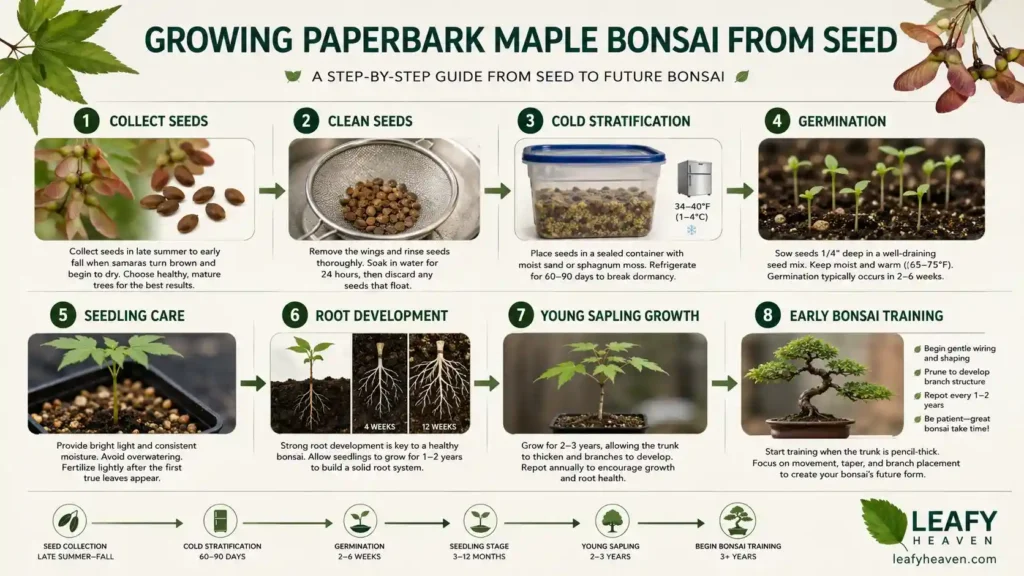
Seasonal Care Calendar
Paperbark Maple experiences distinct seasonal growth cycles. Adjusting care throughout the year helps support healthy development and proper dormancy.
Spring Care
Spring is the most active growth period for Acer griseum.
Recommended spring tasks:
- Resume regular fertilization.
- Increase watering as growth accelerates.
- Monitor new buds and shoots.
- Perform structural pruning when appropriate.
- Repot if necessary before vigorous growth begins.
This season establishes the foundation for the year’s growth and branch development.
Summer Care
Summer focuses on maintaining vigor while protecting the tree from excessive heat.
Recommended summer tasks:
- Monitor soil moisture closely.
- Water more frequently during hot weather.
- Provide afternoon shade in extremely warm climates.
- Continue balanced fertilization.
- Inspect regularly for insects and diseases.
Strong summer growth contributes to future ramification and branch refinement.
Autumn Care
Autumn is known for the spectacular foliage display produced by Paperbark Maple.
Recommended autumn tasks:
- Enjoy seasonal color development.
- Gradually reduce fertilization.
- Adjust watering as temperatures cool.
- Remove weak or damaged growth if necessary.
- Prepare the tree for winter dormancy.
This period allows the tree to store energy before entering its resting phase.
Winter Care
Winter dormancy is essential for long-term health.
Recommended winter tasks:
- Protect roots from extreme freezing conditions.
- Reduce watering frequency.
- Avoid fertilization.
- Monitor for winter damage.
- Preserve natural dormancy conditions.
During this season, the tree’s peeling bark and branch structure become the primary visual features.
Indoor vs Outdoor Care
Paperbark Maple Bonsai is primarily an outdoor tree and generally performs best when exposed to natural seasonal conditions.
Outdoor Care
Outdoor cultivation provides:
- Natural temperature fluctuations
- Seasonal dormancy
- Better airflow
- Stronger growth
- Improved autumn color
Most growers consider outdoor placement essential for long-term health.
Indoor Care
Indoor cultivation is usually suitable only for short periods.
Potential indoor challenges include:
- Insufficient light
- Lack of winter dormancy
- Reduced airflow
- Dry indoor air
- Weak seasonal growth patterns
If temporary indoor display is desired, the tree should be returned outdoors after a short period whenever conditions permit.
Repotting Requirements
Repotting maintains root health, improves soil structure, and prevents root congestion.
Paperbark Maple Bonsai typically benefits from repotting every 2–4 years depending on age, growth rate, and root development.
Signs that repotting may be needed include:
- Water draining slowly
- Roots circling the container
- Reduced vigor
- Compact or degraded soil
During repotting:
- Carefully remove the tree from the container.
- Inspect the root system.
- Perform moderate root pruning.
- Replace old soil with fresh bonsai mix.
- Water thoroughly after repotting.
Repotting is usually performed during late winter or early spring before vigorous growth begins.
Seasonal Care Table
| Season | Watering | Fertilizing | Pruning | Special Care |
| Spring | Moderate to High | Begin regular feeding | Structural pruning if needed | Monitor new growth and repot when necessary |
| Summer | High | Continue balanced feeding | Light maintenance pruning | Protect from extreme heat and monitor moisture |
| Autumn | Moderate | Gradually reduce feeding | Minor cleanup pruning | Prepare for dormancy and enjoy autumn foliage |
| Winter | Low | None | Avoid major pruning | Protect roots and maintain dormancy |
| Year-Round | Monitor soil moisture | Fertilize only during active growth | Remove damaged growth as needed | Check regularly for pests and diseases |
Consistent seasonal care allows Paperbark Maple Bonsai to develop stronger roots, healthier foliage, improved ramification, and the distinctive bark character that makes Acer griseum one of the most admired deciduous bonsai species.
How to Prune and Style Paperbark Maple Bonsai
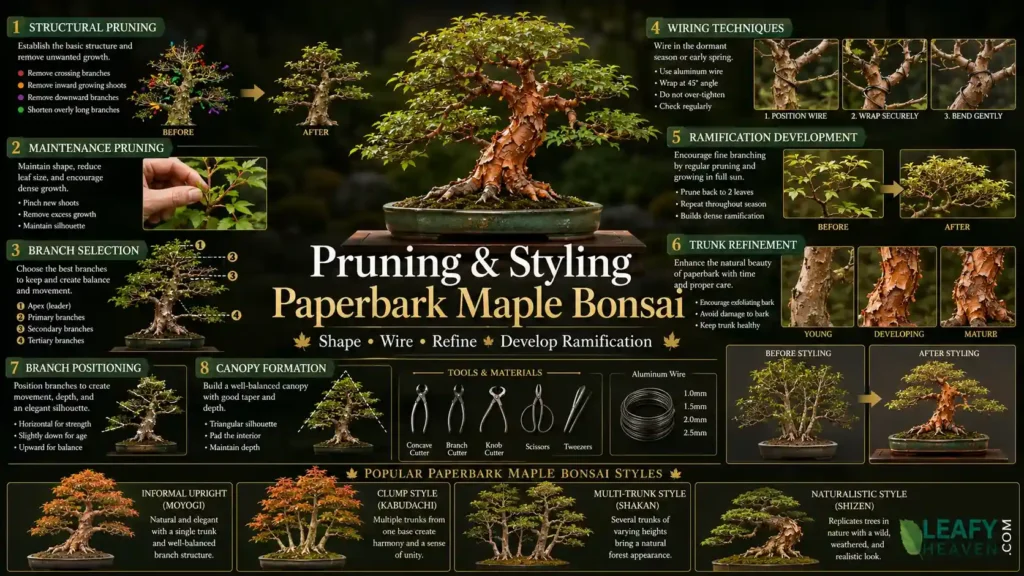
Structural pruning and careful branch training help create balanced form while preserving the tree’s natural elegance. Proper styling enhances the distinctive characteristics of Paperbark Maple Bonsai, including its exfoliating bark, graceful branching, and refined seasonal appearance.
Structural Pruning
Structural pruning establishes the overall framework of the bonsai and guides future development.
This type of pruning is typically performed during the dormant season when the branch structure is clearly visible.
The primary objectives include:
- Creating trunk taper
- Improving branch placement
- Removing crossing branches
- Eliminating unwanted growth
- Establishing overall tree design
Major cuts should be made thoughtfully because Paperbark Maple develops relatively slowly compared to many other bonsai species.
Well-executed structural pruning provides the foundation for long-term refinement.
Maintenance Pruning
Maintenance pruning focuses on preserving shape and encouraging balanced growth throughout the growing season.
Regular maintenance helps:
- Control excessive shoot extension
- Improve canopy density
- Encourage finer branching
- Maintain overall proportions
- Improve light penetration
New shoots can be shortened after sufficient growth has occurred, allowing the tree to direct energy into developing additional branch divisions.
Consistent maintenance pruning supports gradual refinement without dramatically altering the tree’s structure.
Branch Selection Techniques
Successful bonsai design depends heavily on selecting the right branches.
The goal is to create a balanced structure that appears natural and visually appealing from all viewing angles.
When evaluating branches, growers typically retain those that:
- Contribute to the overall design
- Improve visual balance
- Support trunk movement
- Create depth and perspective
- Enhance branch taper
Branches are often removed if they:
- Cross each other
- Grow directly upward
- Grow directly downward
- Create visual congestion
- Distract from the primary trunk line
Thoughtful branch selection improves both aesthetics and future ramification.
Wiring Methods
Wiring is used to position branches and refine the overall silhouette of the bonsai.
Because Paperbark Maple develops decorative bark, wiring should be performed carefully to avoid damage.
Common wiring principles include:
- Apply wire at an appropriate angle.
- Support branches during bending.
- Make gradual adjustments.
- Monitor regularly for wire marks.
- Remove wire before it begins cutting into the bark.
Young branches are generally easier to shape than mature branches because they remain more flexible.
Patience is essential, as gradual shaping often produces the most natural results.
Developing Ramification
Ramification refers to the development of increasingly fine branch divisions that create a mature bonsai appearance.
Paperbark Maple naturally benefits from gradual ramification development through consistent pruning and proper care.
Techniques used to encourage ramification include:
- Regular shoot pruning
- Balanced fertilization
- Adequate sunlight exposure
- Strategic branch selection
- Seasonal maintenance
Over time, repeated branching creates a dense network of fine twigs that improves the tree’s silhouette and winter display.
Well-developed ramification is one of the key indicators of a mature bonsai.
Best Bonsai Styles for Paperbark Maple
Paperbark Maple adapts well to several traditional bonsai styles due to its elegant branching habit and attractive bark.
Informal Upright
The Informal Upright style is one of the most popular options for Acer griseum.
Characteristics include:
- Gently curved trunk
- Natural movement
- Balanced branch placement
- Realistic tree appearance
This style highlights both the trunk and the peeling bark while maintaining a natural look.
Multi-Trunk
Multi-Trunk compositions use two or more trunks growing from a common root system.
Benefits include:
- Greater visual complexity
- Enhanced seasonal display
- Strong natural appearance
- Increased design flexibility
This style can effectively showcase the bark characteristics of multiple trunks within a single composition.
Clump Style
Clump Style features multiple trunks emerging from one root base and forming a cohesive group.
The arrangement creates the appearance of a naturally occurring grove while preserving the visual unity of the composition.
Because Paperbark Maple develops attractive bark across all trunks, this style can be especially striking during winter.
Naturalistic Style
Naturalistic Style emphasizes realism rather than strict design rules.
Characteristics include:
- Irregular branch placement
- Organic trunk movement
- Natural proportions
- Minimal artificial appearance
This style complements the species’ graceful growth habit and allows the bark to remain a dominant visual feature.
Paperbark Maple Clump Style Bonsai
A clump paperbark maple design is among the most attractive ways to display the species’ distinctive bark and seasonal beauty.
In this arrangement, multiple trunks grow from a shared root system, creating the appearance of a mature woodland cluster in miniature form.
The appeal of a paperbark maple clump includes:
- Increased bark visibility
- Strong winter interest
- Natural forest-like appearance
- Enhanced trunk movement
- Greater visual depth
As the trunks mature, each develops its own peeling bark characteristics, creating a layered display of texture and color throughout the year.
When properly maintained, a Paperbark Maple Clump Style Bonsai can become an exceptional showcase of bark structure, ramification, and seasonal beauty while retaining the species’ naturally elegant character.
Paperbark Maple Bonsai Problems and Solutions
Most problems result from watering issues, poor drainage, pests, or environmental stress. Early diagnosis and corrective action help maintain healthy growth, protect the root system, and preserve the ornamental beauty of Paperbark Maple Bonsai.
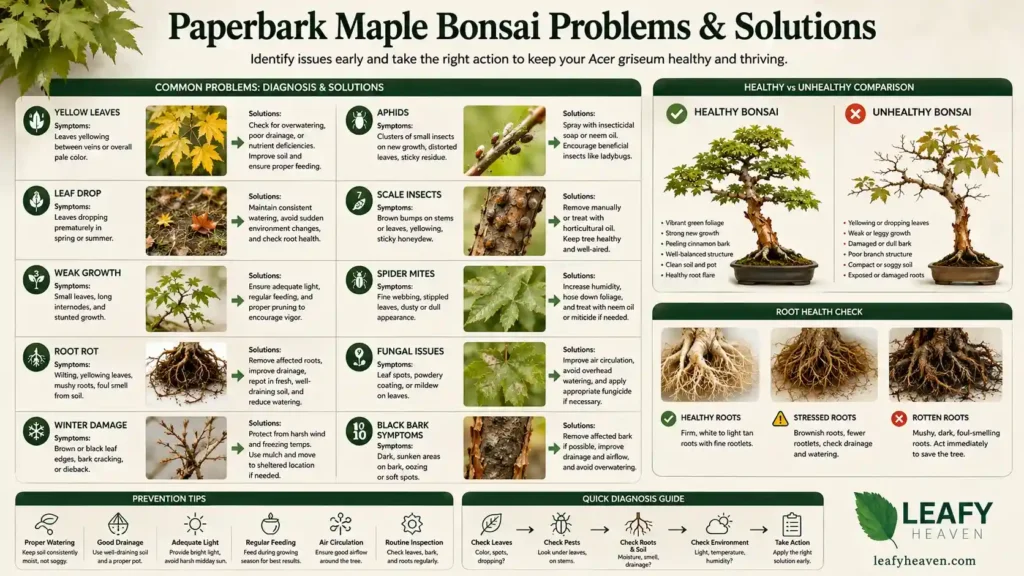
Yellowing Leaves
Yellowing leaves are among the most common issues encountered when growing Acer griseum.
This symptom often indicates that the tree is experiencing stress related to moisture, nutrition, or environmental conditions.
Common causes include:
- Overwatering
- Underwatering
- Poor soil drainage
- Nutrient deficiencies
- Excessive heat exposure
- Root health problems
The first step is to inspect soil moisture and drainage. Consistently waterlogged soil often causes roots to function poorly, resulting in yellow foliage.
Correcting watering practices and maintaining a balanced fertilization schedule usually resolves the issue.
Leaf Drop
Leaf drop can occur naturally during autumn dormancy, but premature leaf loss usually indicates stress.
Potential causes include:
- Sudden temperature changes
- Drought stress
- Excessive watering
- Root disturbance
- Severe pest infestations
- Environmental shock
When leaf drop occurs outside the normal autumn season, evaluate recent changes in watering, location, temperature, or root health.
Stable growing conditions generally reduce the likelihood of premature defoliation.
Weak Growth
Weak growth often develops when the tree cannot produce sufficient energy for healthy development.
Symptoms may include:
- Small leaves
- Short shoots
- Poor branch extension
- Sparse foliage
- Reduced vigor
Possible causes include:
- Insufficient sunlight
- Nutrient deficiencies
- Root congestion
- Poor soil quality
- Lack of seasonal dormancy
Improving light exposure, refreshing the soil during repotting, and following a proper fertilization program usually encourage stronger growth.
Root Rot
Root rot is one of the most serious problems affecting Paperbark Maple Bonsai.
This condition develops when roots remain in excessively wet soil for extended periods.
Common warning signs include:
- Yellowing foliage
- Wilting despite moist soil
- Leaf drop
- Slow growth
- Foul-smelling roots
- Dark or soft root tissue
Prevention is far easier than treatment.
Key preventive measures include:
- Using well-draining bonsai soil
- Avoiding waterlogged conditions
- Maintaining proper drainage holes
- Monitoring watering frequency
- Repotting when soil becomes compacted
Healthy root systems are essential for long-term bonsai success.
Winter Damage
Although Paperbark Maple is a hardy species, bonsai roots are more vulnerable to winter conditions because they are confined to shallow containers.
Winter damage may appear as:
- Dead buds
- Dieback on branch tips
- Cracked twigs
- Delayed spring growth
Risk increases during:
- Severe freezes
- Rapid temperature fluctuations
- Extended cold winds
- Root freezing events
Protective measures include:
- Sheltering the bonsai during extreme cold
- Insulating containers
- Reducing exposure to drying winter winds
- Maintaining proper dormancy conditions
Winter protection should safeguard roots while still allowing the tree to experience its natural dormant period.
Pests and Diseases
Paperbark Maple Bonsai is generally resilient, but several pests and diseases can occasionally affect tree health.
Aphids
Aphids are small sap-feeding insects that often gather on new growth.
Symptoms include:
- Distorted leaves
- Sticky honeydew deposits
- Reduced vigor
Early treatment and regular inspection help prevent larger infestations.
Scale Insects
Scale insects attach themselves to branches and stems while feeding on plant sap.
Signs of infestation include:
- Small shell-like bumps
- Weak growth
- Yellowing foliage
Prompt removal and appropriate treatment help prevent population increases.
Spider Mites
Spider mites are more common during hot, dry conditions.
Symptoms include:
- Fine webbing
- Speckled leaves
- Premature leaf drop
- Reduced foliage quality
Improved air circulation and routine inspections help minimize outbreaks.
Fungal Issues
Fungal problems typically occur when moisture levels remain excessively high and airflow is poor.
Potential symptoms include:
- Leaf spotting
- Discolored foliage
- Branch dieback
- Surface fungal growth
Proper watering practices and good air movement significantly reduce fungal risk.
Black Bark on Maple Tree
Many growers become concerned when they notice black bark on maple tree surfaces.
Not all dark bark discoloration indicates a serious problem.
Possible causes include:
- Algae growth
- Sooty mold
- Environmental staining
- Fungal infections
- Natural bark aging in some areas
Inspection is important to determine whether the bark remains healthy beneath the discoloration.
Warning signs that may indicate a more serious issue include:
- Soft bark tissue
- Cracking beyond normal exfoliation
- Branch dieback
- Persistent moisture damage
Healthy Paperbark Maple bark should remain firm and continue its natural peeling process. If bark damage is accompanied by declining tree health, further investigation may be necessary.
Troubleshooting Table
| Problem | Common Causes | Symptoms | Recommended Solution |
| Yellowing Leaves | Overwatering, nutrient deficiency, poor drainage | Yellow foliage, reduced vigor | Adjust watering, improve drainage, fertilize appropriately |
| Leaf Drop | Environmental stress, watering issues, temperature changes | Premature leaf loss | Stabilize growing conditions and monitor moisture |
| Weak Growth | Low light, poor nutrition, root congestion | Small leaves, slow growth | Improve sunlight, fertilization, and root health |
| Root Rot | Waterlogged soil, poor drainage | Wilting, yellow leaves, soft roots | Repot into well-draining soil and correct watering practices |
| Winter Damage | Extreme cold, root freezing | Dead buds, twig dieback | Protect roots and provide winter shelter when necessary |
| Aphids | Sap-feeding insects | Distorted new growth | Monitor regularly and treat early |
| Scale Insects | Insect infestation | Weak growth, yellow leaves | Remove infestations and improve monitoring |
| Spider Mites | Hot, dry conditions | Webbing, speckled foliage | Increase inspections and improve growing conditions |
| Fungal Issues | Excess moisture, poor airflow | Spots, discoloration, dieback | Improve airflow and avoid prolonged wet conditions |
| Black Bark on Maple Tree | Algae, mold, fungal issues, staining | Dark bark discoloration | Inspect bark health and correct underlying causes if necessary |
Proper monitoring, consistent care, and early intervention prevent most Paperbark Maple Bonsai problems from becoming serious and help maintain the tree’s health, bark quality, and seasonal beauty for many years.
Paperbark Maple Bonsai Pros and Cons
Paperbark Maple offers exceptional ornamental value but requires patience due to its slow growth. Understanding the paperbark maple pros and cons helps growers determine whether this unique bonsai species matches their experience level, climate, and long-term bonsai goals.
Benefits of Growing Paperbark Maple Bonsai
Paperbark Maple is widely admired because it combines decorative bark, elegant structure, and seasonal beauty in a single species.
Some of the most significant advantages include:
Exceptional Peeling Bark
The most distinctive feature of Acer griseum is its cinnamon-colored exfoliating bark.
Unlike many bonsai species that rely mainly on foliage for visual appeal, Paperbark Maple remains attractive throughout the year because of its unique bark texture and color.
Outstanding Four-Season Interest
Paperbark Maple offers year-round beauty.
Seasonal highlights include:
- Fresh spring growth
- Rich green summer foliage
- Brilliant autumn colors
- Decorative winter bark display
This continuous visual appeal makes it highly desirable for bonsai collections.
Elegant Branch Structure
The species naturally develops graceful branching patterns that suit a variety of bonsai styles.
As ramification improves over time, the tree gains greater refinement and visual balance.
Long Lifespan
With proper care, Paperbark Maple Bonsai can remain healthy for several decades.
Its longevity allows growers to enjoy continuous development while gradually improving trunk character and branch structure.
Unique Appearance Among Maple Bonsai
Many maple bonsai species are selected primarily for their foliage. Paperbark Maple stands apart because it combines attractive leaves with one of the most ornamental bark displays found in any maple species.
This unique combination increases its appeal among collectors and enthusiasts.
Potential Drawbacks
Although Paperbark Maple has many strengths, there are several limitations that growers should consider.
Slow Growth Rate
One of the biggest challenges is its slow development.
Compared to Trident Maple and some other bonsai species, Acer griseum requires more time to achieve:
- Trunk thickening
- Branch development
- Advanced ramification
- Mature bonsai refinement
Growers seeking rapid results may find the process demanding.
Requires Patience
The tree rewards long-term cultivation rather than quick styling projects.
Many of its most desirable features, including advanced bark character and refined branching, become more impressive with age.
Less Common Availability
Paperbark Maple is generally less common in bonsai nurseries than Japanese Maple or Trident Maple.
This can make quality starter material more difficult to locate in some regions.
Moderate Experience Requirement
While not considered extremely difficult, Paperbark Maple benefits from consistent care and an understanding of deciduous bonsai management.
Beginners can grow the species successfully, but patience and proper maintenance are essential.
Slower Recovery After Major Work
Because growth is relatively slow, recovery from significant pruning, root work, or styling may take longer than with more vigorous species.
Careful planning is important when performing major bonsai operations.
Who Should Grow This Bonsai?
Paperbark Maple Bonsai is best suited for growers who appreciate long-term development and year-round ornamental value.
It is particularly suitable for:
- Intermediate bonsai enthusiasts
- Collectors seeking unusual bark characteristics
- Growers who enjoy deciduous bonsai species
- Hobbyists interested in seasonal displays
- Bonsai artists focused on refinement and ramification
It may be less suitable for:
- Growers seeking fast development
- Those wanting rapid trunk thickening
- Individuals unable to provide winter dormancy
- Beginners looking for highly forgiving species
For enthusiasts who value bark texture, elegant structure, and seasonal beauty, Paperbark Maple remains one of the most rewarding maple species available for bonsai cultivation.
Pros vs Cons Table
| Pros | Cons |
| Unique cinnamon-colored peeling bark | Slow growth rate |
| Exceptional four-season interest | Requires long-term patience |
| Beautiful autumn foliage | Less common than other maple species |
| Attractive winter display | Slower trunk development |
| Elegant branching structure | Moderate learning curve for beginners |
| Long lifespan with proper care | Recovery after major work can be slower |
| Excellent ramification potential over time | Quality material may be harder to source |
| Distinctive appearance among maple bonsai | Requires outdoor seasonal conditions |
| Suitable for multiple bonsai styles | Not ideal for growers seeking quick results |
| Highly ornamental throughout the year | Development takes years rather than seasons |
Overall, the strongest advantage of Paperbark Maple Bonsai is its unmatched combination of exfoliating bark, refined branching, and seasonal beauty. Its primary limitation is the patience required to fully develop these qualities over time.
Paperbark Maple Bonsai Compared to Similar Trees
Paperbark Maple stands out because of its peeling bark, while other maples are often grown primarily for foliage. Although many maple species make excellent bonsai trees, Acer griseum offers a unique combination of exfoliating bark, seasonal color, and refined branching that is rarely matched by other varieties.
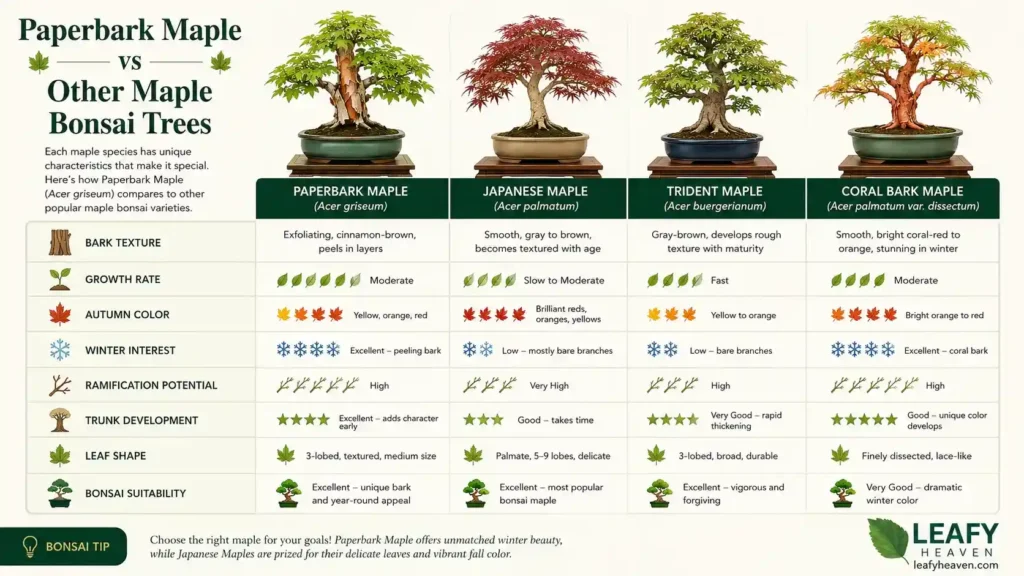
Paperbark Maple vs Japanese Maple
Both Paperbark Maple and Japanese Maple are highly valued in bonsai cultivation, but they are appreciated for different reasons.
Paperbark Maple is primarily grown for its decorative bark and year-round visual appeal. The peeling cinnamon-colored bark remains attractive even after the leaves have fallen.
Japanese Maple is typically grown for its delicate leaf structure, colorful cultivars, and dramatic autumn foliage.
Key Differences
| Feature | Paperbark Maple | Japanese Maple |
| Main Attraction | Peeling bark | Foliage and leaf color |
| Bark Interest | Exceptional | Limited |
| Leaf Type | Trifoliate leaves | Lobed leaves |
| Growth Rate | Slow | Moderate |
| Autumn Color | Excellent | Outstanding |
| Winter Interest | Very High | Moderate |
Paperbark Maple generally provides stronger winter interest, while Japanese Maple offers greater foliage diversity and cultivar selection.
Paperbark Maple vs Trident Maple
Trident Maple is one of the most popular deciduous bonsai species due to its vigorous growth and adaptability.
Paperbark Maple grows more slowly but compensates with unique bark characteristics that Trident Maple cannot provide.
Key Differences
| Feature | Paperbark Maple | Trident Maple |
| Growth Rate | Slow | Fast |
| Trunk Development | Slow | Rapid |
| Bark Texture | Peeling and decorative | Smooth to lightly textured |
| Ramification Development | Moderate | Excellent |
| Beginner Friendly | Moderate | High |
| Winter Display | Outstanding | Good |
Growers seeking faster bonsai development often prefer Trident Maple, while those focused on bark aesthetics frequently choose Paperbark Maple.
Paperbark Maple vs Coral Bark Maple
Coral Bark Maple is best known for its colorful red stems during winter.
While both species provide strong winter appeal, they achieve it in different ways.
Paperbark Maple creates interest through exfoliating bark texture, whereas Coral Bark Maple relies on vivid stem coloration.
Key Differences
| Feature | Paperbark Maple | Coral Bark Maple |
| Winter Feature | Peeling cinnamon bark | Bright red stems |
| Bark Texture | Highly textured | Relatively smooth |
| Foliage Interest | High | High |
| Seasonal Color | Strong autumn display | Strong winter display |
| Growth Rate | Slow | Moderate |
| Bonsai Availability | Less common | More readily available |
Paperbark Maple often develops greater trunk character over time, while Coral Bark Maple provides stronger color contrast during winter.
Best Alternatives to Paperbark Maple Bonsai
For growers who cannot obtain Acer griseum or want similar characteristics, several alternative species offer attractive bonsai potential.
Japanese Maple (Acer palmatum)
Best for:
- Exceptional autumn color
- Fine foliage
- Traditional deciduous bonsai styles
Trident Maple (Acer buergerianum)
Best for:
- Rapid development
- Strong root systems
- Excellent ramification
Coral Bark Maple (Acer palmatum ‘Sango-kaku’)
Best for:
- Bright winter stem color
- Seasonal visual contrast
- Decorative bark coloration
Amur Maple (Acer ginnala)
Best for:
- Cold climates
- Strong autumn colors
- Compact growth habit
Growers in cold climates may find Amur Maple Bonsai an ideal starting point before progressing to slower-growing species like Paperbark Maple.
Field Maple (Acer campestre)
Best for:
- Fine ramification
- Naturalistic styling
- Durable outdoor cultivation
Each alternative offers unique strengths, but none fully replicate the distinctive peeling bark that makes Paperbark Maple Bonsai so recognizable.
Comparison Matrix Table
| Feature | Paperbark Maple | Japanese Maple | Trident Maple | Coral Bark Maple | Amur Maple | Field Maple |
| Scientific Name | Acer griseum | Acer palmatum | Acer buergerianum | Acer palmatum ‘Sango-kaku’ | Acer ginnala | Acer campestre |
| Main Attraction | Peeling bark | Delicate foliage | Fast development | Red winter stems | Autumn color | Ramification |
| Growth Rate | Slow | Moderate | Fast | Moderate | Moderate | Moderate |
| Autumn Color | Excellent | Outstanding | Very Good | Good | Excellent | Good |
| Winter Interest | Outstanding | Moderate | Moderate | Excellent | Moderate | Moderate |
| Bark Character | Exceptional | Limited | Limited | Colored bark | Limited | Moderate |
| Ramification Potential | Good | Excellent | Excellent | Good | Good | Excellent |
| Trunk Development Speed | Slow | Moderate | Fast | Moderate | Moderate | Moderate |
| Beginner Friendly | Moderate | Moderate | High | Moderate | High | High |
| Long-Term Refinement | Excellent | Excellent | Excellent | Good | Good | Excellent |
| Availability | Moderate | High | High | High | Moderate | Moderate |
| Unique Feature | Exfoliating bark | Leaf diversity | Vigorous growth | Winter stem color | Cold tolerance | Fine branching |
For growers seeking the most distinctive bark among maple bonsai species, Paperbark Maple remains difficult to surpass. Its combination of peeling bark, elegant branching, and seasonal beauty gives it a character that sets it apart from other maple bonsai trees.
Landscaping and Display Value of Paperbark Maple
Even in bonsai form, Paperbark Maple provides year-round visual appeal thanks to its bark, structure, and autumn color. The combination of exfoliating bark, refined branching, and seasonal foliage makes Acer griseum one of the most decorative deciduous bonsai species for display, exhibitions, gardens, patios, and outdoor bonsai collections.
Winter Display Value
Winter is often considered the most impressive season for Paperbark Maple Bonsai.
Once the leaves have fallen, the tree’s architectural structure becomes fully visible. The exposed branches reveal years of ramification, while the cinnamon-colored peeling bark becomes the dominant visual feature.
Key winter display features include:
- Coppery exfoliating bark
- Elegant branch structure
- Fine twig ramification
- Strong trunk character
- Attractive dormant silhouette
Unlike many bonsai species that lose visual impact after leaf drop, Paperbark Maple remains highly ornamental throughout the dormant season.
The textured bark reflects sunlight beautifully, creating depth and visual contrast even in simple display settings.
Autumn Foliage Display
Autumn is another standout season for Paperbark Maple Bonsai.
As temperatures cool, the foliage transforms from green into vibrant shades of orange, scarlet, and red. These warm autumn colors complement the cinnamon bark, creating one of the most attractive seasonal displays among maple bonsai species.
Autumn display highlights include:
- Brilliant foliage coloration
- Strong contrast between leaves and bark
- Enhanced branch visibility
- Seasonal landscape appeal
- Exhibition-quality appearance
Because bark and foliage are both ornamental features, Paperbark Maple often remains visually impressive throughout the entire autumn transition period.
Decorative Uses
Paperbark Maple Bonsai serves as both a living tree and a decorative design element.
Its refined appearance makes it suitable for a variety of display environments.
Common decorative uses include:
- Bonsai exhibitions
- Japanese-inspired gardens
- Courtyard displays
- Patio focal points
- Outdoor bonsai benches
- Seasonal garden showcases
- Entryway accent displays
The species pairs particularly well with:
- Natural stone accents
- Moss-covered display surfaces
- Wooden bonsai benches
- Gravel gardens
- Traditional bonsai display arrangements
Because the tree provides four-season interest, it remains attractive even when surrounding plants change throughout the year.
Display Stand Recommendations
The right display stand enhances the visual presentation of Paperbark Maple Bonsai and helps highlight its most attractive features.
When selecting a stand, the goal is to complement the tree without distracting from it.
Recommended display stand characteristics include:
- Natural wood construction
- Stable support structure
- Simple, elegant design
- Proportional size relative to the bonsai
- Neutral colors that emphasize bark and foliage
Suitable stand styles include:
Traditional Wooden Bonsai Stands
Traditional hardwood stands are among the most popular choices.
They provide:
- Classic bonsai aesthetics
- Strong visual balance
- Enhanced exhibition presentation
- Timeless appearance
Natural Slab Displays
Wooden slabs create a more naturalistic presentation.
Benefits include:
- Organic appearance
- Enhanced landscape feeling
- Strong compatibility with deciduous bonsai
Seasonal Exhibition Stands
Formal exhibitions often use elevated stands specifically selected to match the season.
For Paperbark Maple:
- Autumn displays emphasize foliage color.
- Winter displays highlight peeling bark and branch structure.
- Spring displays showcase fresh growth.
- Summer displays focus on canopy refinement.
A well-chosen stand elevates the overall presentation and allows viewers to appreciate the unique characteristics that make Paperbark Maple Bonsai one of the most visually distinctive deciduous bonsai species.
Its exceptional bark, elegant silhouette, and seasonal color ensure that Acer griseum remains a compelling display tree throughout every season of the year.
Conclusion
Paperbark Maple Bonsai combines beautiful exfoliating bark, elegant branching, and stunning seasonal color, making Acer griseum one of the most distinctive maple species for bonsai cultivation. Its famous cinnamon-colored bark, attractive trifoliate leaves, and refined structure provide visual interest throughout every season, from fresh spring growth to vibrant autumn foliage and dramatic winter bark displays.
Although Paperbark Maple develops more slowly than many other bonsai species, its gradual growth contributes to exceptional bark character, fine ramification, and long-term refinement. With proper watering, pruning, root management, seasonal care, and winter dormancy, this deciduous bonsai can remain healthy and attractive for decades.
For growers who appreciate patience, natural elegance, and year-round ornamental value, Paperbark Maple Bonsai remains one of the most rewarding maple bonsai trees to cultivate and display.
Key Takeaways
- Unique cinnamon-colored peeling bark sets Paperbark Maple apart from other maple bonsai species.
- Slow growth encourages refined branching and long-term bonsai development.
- Excellent four-season interest provides beauty in spring, summer, autumn, and winter.
- Best suited for growers willing to invest time in gradual refinement and maintenance.
- Attractive trifoliate foliage delivers vibrant autumn color displays.
- Elegant branch structure supports a variety of bonsai styles.
- Strong winter display value comes from decorative exfoliating bark and ramification.
- Long lifespan allows the tree to improve in character and appearance with age.
- Outdoor cultivation and seasonal dormancy are important for long-term health.
- Proper care can transform Acer griseum into a highly collectible and exhibition-worthy bonsai.
Frequently Asked Questions About Paperbark Maple Bonsai
Is Paperbark Maple good for bonsai?
Yes, Paperbark Maple is an excellent bonsai species, especially for growers who appreciate year-round ornamental value. Its cinnamon-colored peeling bark, attractive trifoliate leaves, elegant branching structure, and vibrant autumn foliage make Acer griseum one of the most distinctive deciduous bonsai trees available. While it grows more slowly than some maple species, its unique bark characteristics provide exceptional visual appeal throughout every season.
How fast does Paperbark Maple Bonsai grow?
Paperbark Maple Bonsai is considered a slow-growing bonsai species. Growth is generally more gradual than that of Trident Maple and some other popular maple bonsai varieties. This slower development requires patience but often results in finer ramification, improved branch structure, and more refined long-term bonsai characteristics. With proper care, the tree steadily develops into an increasingly attractive specimen over many years.
Can Paperbark Maple Bonsai be grown indoors?
Paperbark Maple Bonsai is best grown outdoors. As a deciduous tree, it depends on natural seasonal changes and winter dormancy for long-term health. Indoor environments often lack sufficient sunlight, airflow, and seasonal temperature variation. While the tree can be displayed indoors temporarily, it should generally remain outdoors throughout the year in suitable climates to maintain vigor and proper growth cycles.
Why is the bark peeling on my Paperbark Maple?
Peeling bark is one of the most desirable and natural characteristics of Paperbark Maple. The species is famous for its cinnamon-colored exfoliating bark, which peels away in thin papery layers as the tree matures. This process is normal and helps create the decorative appearance that makes Acer griseum highly valued among bonsai enthusiasts and landscape gardeners.
How often should I water Paperbark Maple Bonsai?
Watering frequency depends on climate, season, soil composition, container size, and overall tree health. In general, Paperbark Maple Bonsai should be watered whenever the upper layer of soil begins to dry. The soil should remain consistently moist but never waterlogged. During hot summer weather, more frequent watering may be necessary, while watering requirements decrease during winter dormancy.
Can Paperbark Maple Bonsai be grown from seed?
Yes, Paperbark Maple Bonsai can be grown from seed. However, successful germination usually requires cold stratification to break seed dormancy. After stratification, seeds can be planted in a well-draining propagation mix and grown into seedlings before beginning bonsai training. Although growing from seed requires patience, it allows complete control over the tree's development from an early stage.
What is the lifespan of a Paperbark Maple Bonsai?
With proper care, Paperbark Maple Bonsai can live for several decades and may continue improving with age. Consistent watering, seasonal maintenance, root pruning, repotting, pest management, and winter protection all contribute to longevity. Mature specimens often become increasingly valuable because bark texture, trunk character, and branch refinement improve over time.
Does Paperbark Maple require winter dormancy?
Yes, winter dormancy is essential for the long-term health of Paperbark Maple Bonsai. Like most temperate deciduous trees, Acer griseum requires a dormant period during winter to complete its natural growth cycle. Dormancy helps regulate energy reserves, supports healthy spring growth, and contributes to overall vigor. Preventing dormancy for extended periods can weaken the tree and reduce long-term health.

Written by the LeafyHeaven Editorial Team
LeafyHeaven shares practical gardening tips and simple plant care guides to help you grow, nurture, and enjoy your plants with ease. Our goal is to make gardening feel natural, approachable, and rewarding for everyone.